’The Celestial Suite’: a body of work rooted in the unconscious, displaying a deep connection between Pale Jay and his musical guides such as Donny Hathaway, J Dilla and Khruangbin. Pale Jay’s self-produced debut EP ‘The Celestial Suite’ showcases his fragile falsetto floating over dusty beats and serene strings glued together by ageless arrangements.
quête:10 sui
Odd Nosdam really doesn’t need an introduction, unless you’ve been living under a rock for the last 20 years then undoubtedly you’ll know what’s up, and what an absolute humbling pleasure it is to now introduce Nosdam to the Where To Now? catalogue with two new cuts that flow from ethereal, meditative contemplation through to downtown abstracted machine damage..
The record opens with ‘End is Important’, A looping, spiritual lament which forces observation, or resolution around the concept of ‘Endings.’ Passages from Tsunetomo Yamamoto’s ‘Hagakure’ seep in and out of the mix throughout, where spiraling and glistening arpeggios dance across a glorious choral mantra, intended to elevate minds towards some kind of plume of awakening. This is a heady and deep cut which finds Odd Nosdam in full introspection mode.
‘Here to Know’ recalls the work of Patrick Cowley in his best downtown ultra slow swinging funk suit, or the more obvious nods to John Carpenter’s Assault on Precinct 13 OST. However, this is far from a straight up ode to creeping machine funk - Nosdam’s injection of energetic, pulsing synth stabs move the piece into a more surreal territory, creating a masterful and experimental injection of life and colour into an otherwise smoked out landscape.
“Where I found myself when Where To Now? reached out - asking if I'd consider a vinyl release with the label - was over in Barcelona spending time with loved ones at my family's apartment in the district of Sant Gervasi.
After my initial contact with WTN?, I ventured north to Cadaqués to visit Salvador Dalí's house in Port Lligat, where Gala & Dalí spent some 50 summers. While inspired asf touring the glorious property, I captured recordings from a looping video screening in an open air theater. These recordings became the foundation of Here To Know.
Sometimes there’s a break in the road. End Is Important was realized after re-watching the Jim Jarmusch film, Ghost Dog. Stealthy and evanescent, a familiar voice carries this slow-diver with a message to the world warped cruiser in all of us.” - Odd Nosdam
BREFORTH – Für den Metal geboren
Jürgen Breforth ist seit mehr als 40 Jahren ein fester Bestandteil der Metal Szene. Begeistert und inspiriert von der „New Wave Of British Heavy Metal“ mit Bands wie IRON MAIDEN, SAXON und JUDAS PRIEST gründete er 1982 seine Band MAD MAX, die bis auf eine kurze Pause auch heute noch erfolgreich Platten veröffentlicht und die ganze Welt betourt. Da MAD MAX im Laufe der Jahre mehr den melodischen Weg eingeschlagen haben, Jürgens Herz aber aus purem Stahl ist, wurde es Zeit für ein zweites Standbein. 2023 präsentiert er auf „Metal In My Heart“ seinen authentischen Mix aus NWOBHM-Einflüssen und Teutonic Metal! Zusammen mit seinem kongenialen Songwriter-Partner und Sänger Peter Lenzschau hat er zehn zeitlose Heavy Metal Hymnen mit autobiografischen Texten geschrieben, welche alle Metalheads begeistern sollten.
Die drei bereits vorab veröffentlichten Singles „Reset My Sanity“, „Wheel Of Fortune“ und der hymnische Titelsong zeigen, dass hier keine Kompromisse gemacht werden. Auch heute ist bei Jürgen das Feuer noch da und gemeinsam mit BREFORTH-Leadsänger Peter Lenzschau, Arne Fleischhut am Schlagzeug, Erik Blumenthal an den Leadgitarren und Jens Lükermann am Bass brennt er darauf, das mit der ganzen Welt zu teilen. Einfach „Play“ drücken und Jürgen auf seiner persönlichen „40 Years In Metal“ Reise begleiten!
Earlier this year, Subwax Bcn made an important contribution to the electronic music community by having the timeless dub techno compilation Vibrant Forms II by Fluxion remastered and reissued. First released in the year 2000 on Chain Reaction, Earlier this year, Subwax Bcn made an important contribution to the electronic music community by having the timeless dub techno compilation Vibrant Forms II by Fluxion remastered and reissued. First released in the year 2000 on Chain Reaction, Vibrant Forms II is widely considered to be one of the greatest achievements in the genre. As it turned out, Vibrant Forms II became one of the last records to be released on Mark Ernestus and Moritz von Oswald's classic label - a suitable swan song if there ever was one. And that's it, right
Well not quite.
If one would search for Fluxion - Vibrant Forms III, Discogs would come up empty and Google would treat it as a misspelling. Until now.
Konstantinos Soublis, aka Fluxion, and Subwax Bcn have decided to pick up the banner and release Vibrant Forms III as a CD as well as four individual 12" records under 2016. It contains everything you could hope for and more: The massive, booming basses, the clicks and hisses, the atmospheric thunderstorms, the opium smoke-scented streaks of reverb and dub echoes. The warmth. Yes, above all else the warmth: Sometimes moist and dripping as in Safe Harbour, sometimes blisteringly dry as in Variant. It's no easy task, giving cold, dead machines warm breaths. And no-one quite does it like Fluxion.
The Reissue of Vibrant Forms II was an act of cultural preservation. It reminded us about the legacy of the Basic Channel label family, in which Chain Reaction played an important part. Without this legacy, the contemporary body of electronic music would look different and make very different sounds. With the Release of Vibrant Forms III, Subwax Bcn takes it one step further. Fluxion's Vibrant Forms III album remind us of the timelessness of truly great music, never mind the genre.
Released in early 2023 in several different DIY packaging and colour
versions, this is a limited run for retail outlets: black vinyl, hand stickered
labels, and a red newsprint broadsheet wrap-around poster inside a red
tinted PVC outer sleeve
"A Sunshine Pop travelogue for the introvert." - Louder Than War 2023
"The record brims with buoyancy, hopefulness and, it goes without saying,
melodies..." - Shindig 2023.
"Pop music - just when you think it's burnt itself out and can no longer inspire or
move you, a record comes along to reaffirm your faith in its powers. It may well be
the finest Papernut Cambridge album yet." - Harmonic Distortion 2023
- 1: We Can Look Up
- 1: 2 Morning
- 1: 3 Feel The Light
- 1: 4 Breathe
- 1: 5 The Lake
- 1: 6 Dusty Road, So Kind
- 1: 7 As Long As I Can Go
- 1: 8 Right Down There In Your Tributary
- 1: 9 The Orient
- 2: 1 Lift
- 2: Silent Signs
- 2: 3 Heroin(E)
- 2: 4 Love Long Gone
- 2: 5 First Impression
- 2: 6 Bones
- 2: 7 Heart For Hire
- 2: 8 Dead Anchor
- 2: 9 Ragstock
- 2: 10 We
- 2: 11 Dash
- 2: 1 Time To Know
- 3: 1 What Are They Doing In Heaven Today?
- 3: 2 Step It Up And Go
- 3: Phil's Instrumental
- 3: 4 Louis Collins
- 3: 5 Old Dollar Mamie
- 3: 6 Two Scenes
- 3: 7 Sea Legs
- 3: 8 Abel + Cain
- 3: 9 Half Life
- 3: 10 Afro Blue
- 4: 1 Four Keyboard Phase In A
- 4: 2 Cybernetic Meadow
- 4: 3 Paul's Park
- 4: Justin's Phase Piece
- 4: 5 Exercise In Abandonment
- 4: 6 Bones
- 4: 7 I Live The Life I Love (I Love The Life I Live)
- 4: 8 My Beautiful Reward
- 4: 9 A Satisfied Mind
- 4: 10 Come And Go With Me (To That Land)
- 5: 1 Intro
- 5: 2 I Been Drinking
- 5: 3 Down On The Banks Of The Ohio
- 5: 4 Silent Signs
- 5: Please Find Me Here
- 5: 6 Abel + Cain
- 5: 7 We
- 5: 8 Will The Circle Be Unbroken?
- 5: 9 Afro Blue
- 6: 1 Intro
- 6: 2 The Longest Train
- 6: 3 No Depression In Heaven
- 6: 4 Red Shoes
- 6: 5 Song For A Lover (Of Long Ago)
- 6: Ain't No More Cane
- 6: 7 Easy
- 6: 8 All Tomorrow's Parties
- 6: 9 A Satisfied Mind
- 6: 10 Come And Go With Me (To That Land)
- 7: 1 Song For A Love (Of Long Ago)
- 7: 2 Epoch
- 7: 3 Baby Done Got Your Number
- 7: 4 Brief Scene
- 7: 5 Where We Belong
- 7: 6 Red Shoes
- 7: Heroin(E)
- 8: 1 Hazelton
- 8: 2 Frail Sail
- 8: 3 Game Night
- 8: 4 Easy
- 8: 5 Liner
- 8: 6 Song For A Lover (Of Long Ago)
- 8: 7 Hannah, My Ophelia
- 9: 1 Look Down That Long, Lonesome Road
- 9: 2 Handwriting On The Wall
- 9: 3 Hands Up
- 9: 4 Funeral Lights
- 9: 5 Lazy Suicide (Edit)
- 9: 6 Carolina Days
- 9: 7 Trials, Troubles, Tribulations
- 9: 8 Worried Mind
- 9: Set Me Free
DeYarmond Edison war der Vorläufer von Bon Iver und Megafaun. Im Sommer 2005 verließen vier Freunde Wisconsin in Richtung North Carolina mit einem einzigen Ziel: der Folk-Rock-Flaute zu entkommen. Während eines Jahres intensiver Konzentration, des Studiums und der Verletzlichkeit taten sie genau das, indem sie an den ekstatischen Rand des New Weird America vordrangen und von allem ein bisschen ausprobierten - Grindcore und Gospel, Free Jazz und Phasenstücke, Bluegrass und Blues - und es in DeYarmond Edison packten. Der Rest ist Geschichte_ Ein Mitglied ging nach Hause, um das zu gründen, was später Bon Iver werden sollte, während drei vor Ort blieben, um Megafaun zu gründen. Epoch ist die Geschichte von DeYarmond Edison: Brad Cook, Phil Cook, Justin Vernon und Joe Westerlund, erzählt wie nie zuvor. Die Sammlung umfasst fünf LPs, vier CDs, Dutzende von ungehörten Aufnahmen und ungesehene Fotos. Begleitet wird sie von einer ausführlichen Biografie des Schriftstellers Grayson Haver Currin, der auch als ausführender Produzent der Sammlung fungiert. Alles in allem fängt Epoch die Zeit ein, bevor aus diesen vier Freunden zwei andere, aufsehenerregende Bands wurden. Es ist eine Geschichte über Gemeinschaft, Visionen, Familie und ein Quartett, das zu gut sein wollte, um zu bestehen. Es gibt Momente des Experimentierens, subtile Wendungen im Fuzz von "Epoch" und eine stampfende Herangehensweise beim Covern von "All Tomorrow's Parties", die den Grundstein dafür legten, wie Bon Iver und Megafaun die akustische Musik ein wenig umkrempeln würden. Aber ein Großteil von Epoch unterstreicht die einzigartige Sichtweise der Gruppe auf amerikanisches Songwriting, auf das Nehmen von Patchworks, das Finden der Akkorde und das Singen aus vollem Herzen. "Trials, Troubles and Tribulations" ist ein Beispiel dafür. Am bekanntesten ist es als Duett von Justin Vernon und Sharon Van Etten, das hier in ausufernder Last-Waltz-Manier wieder zum Leben erweckt wird, mit Vocals von Megafaun, Justin Vernon, Frazy Ford und Fight the Big Bull. Jede Platte ist gleichermaßen ein Crash-Kurs in allem, was dieses spezielle Stück Musikgeschichte ausmacht: Fotos aus Hinterhöfen und Kellern; Essays, die bestimmte Aufnahmen beschreiben; Farbpaletten, die Zeit und Ort widerspiegeln. Mit über sieben Stunden und 55.000 Wörtern ist Epoch eine maximalistische Sammlung. Aber man muss kein Komplettist sein, um zu verstehen, was es bedeutet, sich mit seinen besten Freunden zusammenzukauern und Dinge zu erschaffen, für diese Dinge zu träumen, zu lernen, zu kämpfen und zu wachsen.
- 1: We Can Look Up
- 1: 2Morning
- 1: 3Feel The Light
- 1: 4Breathe
- 1: 5The Lake
- 1: 6Dusty Road, So Kind
- 1: 7As Long As I Can Go
- 1: 8Right Down There In Your Tributary
- 1: 9The Orient
- 2: 1Lift
- 2: Silent Signs
- 2: 3Heroin(E)
- 2: 4Love Long Gone
- 2: 5First Impression
- 2: 6Bones
- 2: 7Heart For Hire
- 2: 8Dead Anchor
- 2: 9Ragstock
- 2: 10We
- 2: 11Dash
- 2: 1Time To Know
- 3: 1What Are They Doing In Heaven Today?
- 3: 2Step It Up And Go
- 3: Phil's Instrumental
- 3: 6Two Scenes
- 3: 7Sea Legs
- 3: 8Abel + Cain
- 3: 9Half Life
- 3: 10Afro Blue
- 4: 1Four Keyboard Phase In A
- 4: 2Cybernetic Meadow
- 4: 3Paul's Park
- 4: Justin's Phase Piece
- 4: 5Exercise In Abandonment
- 4: 6Bones
- 4: 7I Live The Life I Love (I Love The Life I Live)
- 4: 8My Beautiful Reward
- 4: 9A Satisfied Mind
- 4: 10Come And Go With Me (To That Land)
- 5: 1Intro
- 5: 2I Been Drinking
- 5: 3Down On The Banks Of The Ohio
- 5: 4Silent Signs
- 5: Please Find Me Here
- 5: 6Abel + Cain
- 5: 7We
- 5: 8Will The Circle Be Unbroken?
- 5: 9Afro Blue
- 6: 1Intro
- 6: 2The Longest Train
- 3: 4Louis Collins
- 6: 3No Depression In Heaven
- 6: 4Red Shoes
- 6: 5Song For A Lover (Of Long Ago)
- 6: Ain't No More Cane
- 6: 7Easy
- 6: 8All Tomorrow's Parties
- 6: 9A Satisfied Mind
- 6: 10Come And Go With Me (To That Land)
- 7: 1Song For A Love (Of Long Ago)
- 7: 2Epoch
- 7: 3Baby Done Got Your Number
- 7: 4Brief Scene
- 7: 5Where We Belong
- 7: 6Red Shoes
- 7: Heroin(E)
- 8: 1Hazelton
- 8: 2Frail Sail
- 8: 3Game Night
- 8: 4Easy
- 8: 5Liner
- 8: 6Song For A Lover (Of Long Ago)
- 8: 7Hannah, My Ophelia
- 9: 1Look Down That Long, Lonesome Road
- 9: 2Handwriting On The Wall
- 9: 3Hands Up
- 9: 4Funeral Lights
- 3: 5Old Dollar Mamie
- 9: 5Lazy Suicide (Edit)
- 9: 6Carolina Days
- 9: 7Trials, Troubles, Tribulations
- 9: 8Worried Mind
- 9: Set Me Free
DeYarmond Edison war der Vorläufer von Bon Iver und Megafaun. Im Sommer 2005 verließen vier Freunde Wisconsin in Richtung North Carolina mit einem einzigen Ziel: der Folk-Rock-Flaute zu entkommen. Während eines Jahres intensiver Konzentration, des Studiums und der Verletzlichkeit taten sie genau das, indem sie an den ekstatischen Rand des New Weird America vordrangen und von allem ein bisschen ausprobierten - Grindcore und Gospel, Free Jazz und Phasenstücke, Bluegrass und Blues - und es in DeYarmond Edison packten. Der Rest ist Geschichte_ Ein Mitglied ging nach Hause, um das zu gründen, was später Bon Iver werden sollte, während drei vor Ort blieben, um Megafaun zu gründen. Epoch ist die Geschichte von DeYarmond Edison: Brad Cook, Phil Cook, Justin Vernon und Joe Westerlund, erzählt wie nie zuvor. Die Sammlung umfasst fünf LPs, vier CDs, Dutzende von ungehörten Aufnahmen und ungesehene Fotos. Begleitet wird sie von einer ausführlichen Biografie des Schriftstellers Grayson Haver Currin, der auch als ausführender Produzent der Sammlung fungiert. Alles in allem fängt Epoch die Zeit ein, bevor aus diesen vier Freunden zwei andere, aufsehenerregende Bands wurden. Es ist eine Geschichte über Gemeinschaft, Visionen, Familie und ein Quartett, das zu gut sein wollte, um zu bestehen. Es gibt Momente des Experimentierens, subtile Wendungen im Fuzz von "Epoch" und eine stampfende Herangehensweise beim Covern von "All Tomorrow's Parties", die den Grundstein dafür legten, wie Bon Iver und Megafaun die akustische Musik ein wenig umkrempeln würden. Aber ein Großteil von Epoch unterstreicht die einzigartige Sichtweise der Gruppe auf amerikanisches Songwriting, auf das Nehmen von Patchworks, das Finden der Akkorde und das Singen aus vollem Herzen. "Trials, Troubles and Tribulations" ist ein Beispiel dafür. Am bekanntesten ist es als Duett von Justin Vernon und Sharon Van Etten, das hier in ausufernder Last-Waltz-Manier wieder zum Leben erweckt wird, mit Vocals von Megafaun, Justin Vernon, Frazy Ford und Fight the Big Bull. Jede Platte ist gleichermaßen ein Crash-Kurs in allem, was dieses spezielle Stück Musikgeschichte ausmacht: Fotos aus Hinterhöfen und Kellern; Essays, die bestimmte Aufnahmen beschreiben; Farbpaletten, die Zeit und Ort widerspiegeln. Mit über sieben Stunden und 55.000 Wörtern ist Epoch eine maximalistische Sammlung. Aber man muss kein Komplettist sein, um zu verstehen, was es bedeutet, sich mit seinen besten Freunden zusammenzukauern und Dinge zu erschaffen, für diese Dinge zu träumen, zu lernen, zu kämpfen und zu wachsen.
- A1: Joe 90 Main Titles
- A2: A Dream Come True
- A3: A Wolf In The Fox's Den
- A4: Air/Sea Rescue Colonel Mcclaine
- A5: Wagon Train Of Fear
- A6: Running The Gauntlet
- B1: Tragedy Aboard The U85/Porto Guava
- B2: A Song And Dance Of Death
- B3: The Tangled Web
- B4: Race Of Intelligence
- B5: Taking The Win
- C1: Fleming In The Fortress
- C2: Breakout And Pursuit
- C3: Nuclear Winter
- C4: Boy With A Suitcase
- C5: Church Rats
- C6: Divine Intervention
- D1: Agent Sladek
- D2: Sladek's Recital
- D3: Trapped In The Sky
- D4: The Alpine Clinic Waltz
- D5: Balloon Ride
- D6: The Mine Rescue
- D7: Joe 90 End Titles
First appearing on TV screens in September 1968, Joe 90 was a unique nine year old boy with the ability to absorb the brain patterns of top experts
enabling him to become the most special agent of W.I.N. (World Intelligence Network).
Whilst there are arguably better-known scores amongst Barry Gray's sublime catalogue of work with the Andersons, the composer's work for Joe 90 is in many ways
the most consistent and inventive selection he ever wrote. Developing a theme for the new series was always the musician's starting point, and for Joe 90, the pop charts breezed into Gray's studio,
with an opening tune featuring a genuine groove. Mixing Gray's inventive electronics with 60s "surf rock" guitars was an inspired decision.
It is no wonder that this piece has gone on to enjoy a second life as a Northern Soul disco floor-filler.
For episodic incidentals, Gray was freed from the detached unearthly premise of Captain Scarlet and able to bring back a playful sensibility
and a more mature musical palette which are amply illustrated in this 24 track collection.
Cumgirl8 met in a sex chat 8000 years ago in another metaverse. Made up of Lida Fox (bass), Veronika Vilim (guitar), Chase Lombardo (drums) and Avishag Rodrigues (guitar), the band render the immersive and chaotic energy from cyberspace into our world, coming together to make a boundary-less sound that brilliantly stretches across the likes of ESG, Cocteau Twins, Suicide, CSS, B-52s, The Shangri-Las, Chris & Cosey, Madonna, and many more.
Angel Attack delivers his debut album Divine Practicalities on his label, House of Reptile. The Boston and London-based artist blends several sound palettes, sharing his most poignant body of work to date. The album includes two remixes by Univac and Blind Delon, respectively.
The title track acts as a prelude to the album. A broken-beat,
experimental number, it dips into cinematic soundscapes and warbling percussion, which Angel Attack describes as an “introduction to summarise the emotions we are about to experience on the album.” Tightening Tension follows suit. It’s a mutation of broken techno with electro flavours over a malicious Moog bassline, featuring the vocals of French producer IV Horsemen, whose lyrics conjure a smokey, bonechilling atmosphere between skittery drums. Angel Attack dives into a metal-edged mood on Ankles, stitching distorted riffs between broken beats.
The energy is visceral. Come To Me is straight-up Japanese Horror-inspired electro, combining eerie textures with thudding kickdrums and a gnarly scream — a freaky trip at just over five minutes. Franco-Spanish author, singer, DJ and musician Pedro Peñas Robles, aka HIV+, features on Oblivion War. A sludgy, slow-burning soundscape ensues with a deluge of downtempo, hip-hop and EBM textures, complemented by HIV+’s gravelly voice. Whipping up the pace, Wrists blurs the lines between sci-fi, electro and goth. A stinging melody snakes between staccato claps and ghostly pads — lethal energy of the highest order.
Forgotten is the postlude-type track of the album, and this is where Angel Attack’s interdisciplinary approach comes to life. It’s the most piercing tune of the release, complete with a guitar melody, stripped-back drums and pagan throat chants provided by Angel Attack. An introspective offering, staying with the listener long after the record stops spinning.
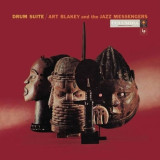
One of the inventors of the modern bebop style of drumming, Blakey is known as a powerful musician and a vital groover; his brand of bluesy, funky hard bop was and continues to be profoundly influential on mainstream jazz.
For more than 30 years his band, Art Blakey & The Jazz Messengers included many young musicians who went on to become prominent names in jazz. Recorded in 1956, Art Blakey's Drum Suite is a wonderful hybrid of African, Latin, and hard bop rhythms that prefigures the concept of Afro-beat by at least a decade. The sheer energy, not to mention its very special and fresh-sounding intimacy, make it especially astounding.
Even more amazing is that the three parts of the suite -- Blakey's "The Sacrifice," Ray Bryant's "Cubano Chant," and Oscar Pettiford's "Oscalypso" -- were recorded straight through live, and were only intended to be a pre-take run-through. As is obvious here, Blakey and company nailed the whole thing right out of the box.
Groundbreaking for its time, and still sounding vital, powerful, and visionary, the Drum Suite album is somewhat of a lost masterpiece that deserves a fresh audience.
"Art Blakey's first release for Columbia Records is essentially two records. Side one is a percussion ensemble playing what would, ten years later, be called Afro-Cuban drumming. Side two is the mid-fifties version of the Jazz Messengers featuring Jackie McLean on saxophone. Side one features Blakey, Jo Jones and Charles Wright on drums, Candido and Sabu on bongos, and Oscar Pettiford and bass and cello. The group plays three compositions, one by Blakey, one by Pettiford and one by Ray Bryant, fusing African, Cuban, and calypso percussion into a well-integrated suite.
"The group recorded a run through and it was so perfectly executed that they used the practice run for the release, unedited except to add some Swahili chants by the percussionists during a few passages. One cannot help but think of Olantunji's Drums of Passion, another Afro drumming landmark, here. Blakey's drum suite was recorded at Columbia's 30th Street studios in New York in 1957 and is in mono. The almost stereoscopic image is truly remarkable. Mastered by Kevin Gray and pressed at RTI, Drum Suite is a valuable record of one of the most important figures in jazz history. Recording: 9/10. Music 9/10." - Dennis Davis, Hifi+
"...The three-part suite was laid down in one take with no arrangements, and begins with a few tympani thwacks followed by an African chant. Soon the ensemble kicks in and the group takes off an a sweaty Afro-Cuban-bop journey that will leave you breathless, as the thing crackles with terrific energy. Side Two is more conventional hard bop, but given this group's mastery of if not invention of the style, these tracks are extremely satisfying. Kevin Gray's remastering is detailed and immediate, with plenty of bit and air, if not the widest dynamic range. For anyone interested in percussion of this genre, this is not to be missed." - Wayne Garcia, The Absolute Sound
TEMPLE OF DREAD bleiben dem Old School Death Metal grundsätzlich auch auf ihrem vierten Albumhammer "Beyond Acheron" treu. Dazu haben die Ostfriesen den Fokus auf eine dunkle und schwere Atmosphäre gelegt und mit einigen schönen Prisen Melancholie sowie schwarzen Momenten abgerundet. Das stählerne Sahnehäubchen liefern Gastbeiträge des ehemaligen MORGOTH und INSIDIOUS DISEASE Sängers Marc Grewe sowie GOD DETHRONED Frontmann Henri Sattler ab. Die Texte stammen aus der blutigen Feder von Bandfreund und Wortschmied Frank Albers. Die Zeilen des Psychologen drehen sich um antike Mythen und Historie mit Protagonisten wie Ikarus, Vulkan, Hades, Kleopatra und Marcus Antonius. Auch das Cover Artwork von "Beyond Acheron", das vom gefeierten italienischen Künstler Paolo Girardi gestaltet wurde, bleibt beim antiken Thema und zeigt Charon, den Fährmann der griechischen Unterwelt Hades. Die massive Produktion von "Beyond Acheron" stammt von TEMPLE OF DREADs Schlagzeuger Jörg Uken, der in seinem weit bekannten Soundlodge Tonstudio unter anderem bereits Alben von DEW-SCENTED, GOD DETHRONED, OBSCENITY, SUICIDAL ANGELS und WARPATH aufgenommen hat. TEMPLE OF DREAD wurden auf Spiekeroog im Jahr 2017 von Gitarrist Markus Bünnemeyer als Ventil für seine Old School Death Metal Ambitionen gegründet. Im Jahr 2018 stießen Sänger Jens Finger und Schlagzeuger Jörg Uken dazu, mit denen Bünnemeyer auch bei Slaughterday aktiv war. Schon im nächsten Jahr erschien das Debütalbum "Blood Craving Mantras" (2019). Das Trio erwies sich als äußerst kreativ und zwei weitere Alben folgten binnen kurzer Zeit: "World Sacrifice" (2020) und das von der Kritik hochgelobte "Hades Unleashed" im Jahr 2021. Mit "Beyond Acheron" setzen TEMPLE OF DREAD neue Maßstäbe für intelligente Death Metal Brutalität!
- A1: African Suite – Vibes
- A2: Babatunde Olatunji - Gin-Go-Lo-Ba (Drums Of Passion)
- A3: Dissidenten - Fata Morgana
- B1: Dave Grusin, Lee Ritenour - The Bird
- B2: Alphonse Mouzon – Sunflower
- B3: David Byrne & Brian Eno – Regiment
- C1: Gilberto Gil - Maracatu Atômico (Segunda Versão)
- C2: Dave Grusin, Lee Ritenour - Before It´s Too Laten (Antes Que Seja Tarde)
- C3: David Van Tieghem - The Women
- D1: Can - Vitamin C
- D2: Meo - Coma Goes On
- D3: Meo - Monday’s Coma (Remix)
Second vinyl-compilation dedicated to the Melody Mecca disco in Rimini on Use Vinyl Records, a double vinyl compiled by another of the club's historic resident DJs, Dj Meo who has selected some of the most iconic tracks that have characterized his sets inside of the venue.
Fünftes Album von Holy Wave aus Austin, Texas. Im Tarot steht die Karte der Fünf Kelche für Verlust und Trauer. Die Karte zeigt eine verhüllte Gestalt mit gesenktem Kopf, die über drei verschüttete Kelche blickt, während sie die beiden verbleibenden Gefäße ignoriert. Die Fünf Kelche wird im Allgemeinen so interpretiert, dass sie ein verzweifeltes Verharren in der Vergangenheit und die Unfähigkeit darstellt, die positiven Dinge der Gegenwart zu schätzen. Die Tarotkarte wurde zur Muse für das sechste Album von Holy Wave, "Five of Cups". Zu Beginn ihrer Karriere lehnten sich Holy Wave in ein ruhiges Reich der Psychedelik zurück und verzichteten auf lange Jams und Gitarren-Heldentaten zugunsten eines verträumten Pop-Ansatzes. Als sich die Band weiterentwickelte, wich der frühe Sgt. Peppers-meets-the-Velvets-Sound ausgefeilteren Melodien und einer ausgefallenen Instrumentierung und lenkte ihre Musik weg von sonnengebleichter Nostalgie hin zu einer farbenfrohen Dimension, in der sich Klänge der Vergangenheit, Gegenwart und Zukunft vermischten. Wie Pink Floyd in den frühen 70er Jahren haben Holy Wave es verstanden, auf ihrem neuen Album aus dem Pathos ein Gefühl tiefer Erheiterung zu zaubern, indem sie dunkle Elemente durch eine Linse filtern und sie in ein Kaleidoskop des Lichts verwandeln. Five of Cups eröffnet mit dem Titeltrack, der von Anfang an den auditiven und thematischen Modus Operandi des Albums festlegt. Die lysergische Texturpalette von Holy Wave wird sofort in den wabernden Synthie-Leads und dem Gitarren-Jangle des Songs deutlich, aber die untypischen Akkordfolgen und die Gesangsmelodie lenken die Musik weg vom anodynen Eskapismus hin zu einer nachdenklichen Auseinandersetzung zwischen Selbstbestimmung und Defätismus. Holy Wave reiten weiter auf dem wehmütigen und phantasmatischen Zug von "Bog Song" und schwanken zwischen Anschwellungen von strengen Moll-Akkorden und überlagerter elektrischer Orchestrierung. Die zuvor veröffentlichte Single "Chaparral" spielt mit der Nostalgie der Band und verwebt Verweise auf ihre Vergangenheit in El Paso zu einem Teppich des transzendentalen Triumphs. Wie so oft bei klassischer, albumorientierter Rockmusik entfaltet sich die wahre Magie erst in der zweiten Hälfte von Five of Cups. Auf "The Darkest Timeline" rekrutieren Holy Wave ihre Freunde Lorena Quintanilla und Alberto Gonzalez von dem Psych-Duo Lorelle Meets The Obsolete aus Baja California, Mexiko, um ihren berauschenden After-Mid-Night-Grooves zusätzliche ätherische Schichten hinzuzufügen. "Nothing in the Dark" funktioniert nach einem ähnlichen Prinzip, wobei ein gleichmäßiges, treibendes Schlagzeugmuster als Fundament für bandverwaschene Synthesizer, arpeggierte Gitarrenakkorde, Fuzz-Sounds und ruhige Vocals dient. Die Überlegungen von Five of Cups zur Bekämpfung von Niederlagen und Enttäuschungen werden im letzten Stück des Albums, "Happier", direkt aufgegriffen. Wieder einmal auf der melodischen Linie zwischen Melancholie und luftiger Raffinesse, untersuchen Holy Wave das synthetische Konstrukt des Glücks in unserem modernen Zeitalter und wie oft die Erlangung von Komfort jegliches wahre Gefühl von Freude vermissen lässt. Dennoch ist dies kein nihilistisches Klagelied. Vielmehr ist es eine beschwingte Erinnerung daran, dass die Bandbreite menschlicher Erfahrung von Natur aus Höhen und Tiefen erfordert und dass Euphorie oft in der Suche außerhalb des Vertrauten zu finden ist.
Incredible jazz / prog / folk score to groundbreaking tattoo film by maverick filmmaker. Unreleased until now, so don’t go saying it’s a reissue because it isn’t, but I’m sure some people will because they always do.
John Samson (1946 - 2004) was a truly great documentary maker. He must be as I’ve been obsessed with his work for many years. Educated first at Glasgow School Of Art (circa 1963) and then finally in the art of film making at The National Film And Television School in Beaconsfield - he headed there in its opening year of 1971 having made a short film that got him a scholarship.
It was at the NFTS that Samson met Mike Wallington, who was to become his right hand man and eventual producer; together as a quite brilliant team they made a handful of inspiring, entertaining and hugely prescient films about important, overlooked, unseen and marginal fringes in society. Tattoo (1975) Exploring the rather clandestine world of tattooing in the UK. Dressing For Pleasure (1977) Exploring the rather clandestine world of festish in the UK. Brittania (1979) A film about railway enthusiasts and a steam train restoration.
Arrows (1979) The life of dart player Eric Bristow. Drag Ball (1981) An unreleased film about the annual Porchester Hall Drag Ball. The Skin Horse (1983) BAFTA winning film about The Outsiders Club, a dating agency for disabled people. The subject matter in all films was always unusual for the time, and Samson managed to navigate his way with compassion, interest and subtlety, immersing himself in the chosen scene and producing moving, fascinating and sometimes darkly amusing situations. His documentaries also do not rely on traditional voiceovers, with stories, facts and narrative threads being dictated by the subjects.
I’ve tried for a long time to find the music for a couple of his early films (there was actually an original 7” for Arrows) - so far this is the only unreleased soundtrack I have found. This one was written by Steve Jolliffe, who met Samson at the NFTS. Joliffe was the resident composer and had a room at the college complex where he could work on scores for the fledgling film makers. Jolliffe was and still is a multi-instrumentalist and prolific composer who had met Edgar Froese at the Berlin Konservatorium in the late 1960s and played in an early incarnation of Tangerine Dream. He toured with blues rock outfit Steamhammer, before hanging out at the NFTS, making this recording (and many others) and eventually rejoining Tangerine Dream in the late 1970s. Jolliffe still writes, records and releases today and once i had made contact with him we traced the original Tattoo master tape to a box at his brother’s house. Musically it’s charming, slightly folky, a touch baroque, there’s a whiff of prog too, and it perfectly suited this early documentary about the art and desire of tattoos. I only wish it was longer. But the film is only 16 minutes long. Seek it out if you can. Try and find all the Samson films, they really are a joy.
As well as featuring intimate footage of tattooed people, the film also includes a rare and very early interview with Alan Oversby (better known as Mr Sebastian), a seminal character in the development of tattoos and body modifications worldwide - it was he who eventually was to tattoo and pierce Genesis P-Orridge.
The images for this vinyl release were all found in Mike Wallington’s Tattoo documentary research folder from 1974, and were photos sent in to Mike and John by people who wanted to feature in the film. Most answered an advert in Time Out, and others included people from my home town of Aldershot where tattooist Bill Skuse and his wife, Rusty (the most tattooed woman in Britain at the time, and featured in the film) were based. His parlour was situated at the back of the arcade where we all used to lose all our pocket money in the slot machines.
The Musicians:
Steve Jolliffe - keyboards, flute, sax Geoff Jolliffe - bass guitar Julian Furniss - guitar Mick Kirby - drums
Rare 1986 Funk/Soul From Alabama.
Originally released as a private pressed cassette tape only.
First Time On Vinyl.
Released in collaboration with the Numero Group.
180g BLACK vinyl limited to 500 copies w/obi strip. Non-Returnable.
Armed with little more than his Peavey T-60 guitar and a Jumbo Fuzz pedal, Errol Stubbs and his bar-band cohorts cranked out a self-released tape of funked-up disco soul in 1986. With no label or distribution to speak of, Errol would simply put on his best suit and sell the cassettes by hand. The tape languished into obscurity…until now!
The story of Errol Stubbs begins in Birmingham, Alabama in 1959. The youngest of five, he was surrounded by music as a child–his aunt taught piano at Daniel Payne College while his older brother, Avery Beavers, was an accomplished jazz trumpeter. Under the guidance of Avery, Errol started playing trumpet at the age of nine, though he gravitated toward songwriting and quickly picked up the guitar. Inspired by blues greats the likes of Albert King, Buddy Guy, and Little Milton, 12-year-old Errol began mimicking the sounds that filled southern airwaves. As a teenager, he played at barbecues, fish fries, and dive bars across the Magic City. After a brief stint at Jefferson State studying music, Errol’s passion for songwriting beckoned him away from the classroom.
Stubbs bounced around bar bands before settling on a live lineup and saving enough dough to take his vision to the recording studio. Over the course of two days, his well-rehearsed band recorded Turning it Out mostly live to tape at the Sound Of Birmingham Studio. Located on Birmingham’s east side, the state-of-the-art studio kept the lights on by recording commercial jingles but was more than happy to open their doors to local talent.
Taking notes from guitar god Ernie Isley and funk legend Rick James, the resulting recordings are drenched in cosmic phaser-fuzz guitar work, slapping bass lines, and sexual disco innuendos. Big brother Avery lends a hand on Clavinet for “Sweat,” while studio owner/engineer Don Mosley adds a tasteful dose of Moog synthesizer across a handful of cuts.
Soon after the Sound Of Birmingham sessions, Errol released the private pressed EP “Dancin’ Fancy,” b/w “Spaced Out On Your Love,” the latter of which was featured on Numero Group’s 2019 compilation Visible and Invisible Persons Distributed In Space.
The seven-song cassette Turning It Out was sold in local record stores and from night club stages, but only a few copies made their way out of Birmingham.
Lndon Odense Ensemble is a powerhouse quintet that combines forces from the Causa Sui/El Paraiso family tree (Jakob Skott, Jonas Munk, Martin Rude) with the vibrant, experimental London jazz scene (Tamar Osborn, Al MacSween). On two studio full-lengths, released in 2022 and 2023, they have explored the confluence of psychedelia, improvisation and cosmic jazz. On this set, recorded at the 2021 edition of Denmark's Jaiyede Jazz Festival, the energy is cranked up another notch or two. Comprised almost entirely of exclusive material not found on the two studio records these three sonic excursions dive head-on into the fiery side of the group's sound. Taking up the entire A-side "Energy Ascending" starts out as a gently flowing piece of dreamy jazz that wouldn't have sounded out of place on a late 1960s Pharoah Sanders record. As the piece evolves the guitar takes it into rock territory, where it dissolves in a mesmerising breakdown before commencing a build of epic proportions, lead by Tamar Osborn's baritone sax, channelling The Stooges as much as John Coltrane. Heavy. On the B-side things get more electronic and spacy. Here the ensemble uses album track "Sojourner" as a starting point for a new improvisation guided by Al MacSween's virtuoso keyboard work. The rhythm section creates a hypnotic foundation for layers of synths and electric keys to fully blossom and travel into cosmic territory. Limited to 300 copies on transparent ochre vinyl.
A fascinating blend of jazz and contemporary classical influences, How Time Passes is the debut album from the envelope pushing trumpeter and composer Don Ellis Known for his extensive musical experimentation, particularly in the area of time
signatures, Ellis began his long career in the New York City's post bop and avantgarde jazz scenes of late 1950s. Most notably he appeared on Charles Mingus'
Mingus Dynasty, and albums by George Russell and Maynard Feguson. But he
also worked with, among others, the Glenn Miller Orchestra, Lionel Hampton, and
Woody Herman. On subsequent albums, Ellis would take an even wilder direction.
Here, on his first recoding date as a band leader, the experimentation begins. Ellis
stretches the boundaries of bop-based jazz playing with time, tempo and meter. It
is the start of his exploration of Third Stream - a fusion of jazz and contemporary
classical music. The album title itself - How Time Passes - was taken from an
article written by the controversial German composer Karlheinz Stockhausen on
the "function of time." The exceptional section features Ron Carter on bass, the
underrated Jaki Byard on piano and saxophone, and Charlie Persip on drums. The
LP includes extraordinary liner notes by Candid A&R man and producer Nat
Hentoff, and noted musician, historian and writer Gunther Schuller - the originator
of the term "Third Stream" - giving a context and insight that adds to the
experience of hearing these extraordinary performances.
When he first came on the scene, Phil Woods was often referred to as
"The New Bird," in a nod to the legendary Charlie Parker - A testament to
his genius on the saxophone to be sure
But while obviously indebted to Parker - as all modern jazz saxophonists of a
certain era were - there is no question that Phil Woods was an original. After
earning a degree in music from Juilliard in the early 1950's, Woods found himself
in the orbit of the great Quincy Jones. At Jones' invitation Woods joined Dizzy
Gillespie's infamous Jazz Ambassadors - a tour sponsored by the US State
Department as part of a global cultural diplomacy initiative - and subsequently
became a member of Jones' own touring band. This recording, his 9th album as a
band leader, consists entirely of Woods' five- part Rights of Swing Suite. An
ambitious large-scale composition based solidly on jazz traditions. A culmination
of the influences the then 30 year artist had absorbed. Arguably considered one
of Woods finest recordings, the record features a stellar section made up of
Wood's fellow Quincy Jones band members. (It should be noted that these same
musicians, for the most part, are also the section on Benny Bailey's Candid
Records recording, Big Brass, recorded a a few months prior in November of
1960). Recorded at the Nola Penthouse Studios in New Your City on two dates in
January and February of 1961, and conducted by Quincy Jones. The LP includes
extraordinary liner notes by Candid A&R man and producer Nat Hentoff, and indepth commentary from Woods himself, giving a context and insight that adds to
the experience of hearing these extraordinary performances