
Cerca:11 am

One side is a powerfull Downtempo Techno tune, featuring a long break intro, inna Dubstep mood. The other side is a Breakbeat Electro progressive tunes (an Ambient bonus track). Original and nice.


10
Electric Satie is a one-off conceptual project by Japanese composer Mitsuto Suzuki, who is mostly known for his work on Final Fantasy soundtracks. Released on CD-only in 1998, “Gymnopédie ’99” reimagines Erik Satie’s beloved piano compositions in electronic form ranging sonically from downtempo bossa-nova (featuring Brazilian percussionist Marco Bosco and vocalist Silvio Anastacio) to freestyle ambience and chillout room IDM, not far from the music featured on Music from Memory’s “Virtual Dreams II” or Warp Record’s “Artificial Intelligence.” A deeply imaginative composer and arranger, Suzuki harnesses a unique mix of drum machines, synthesizers, live percussion, soprano saxophone, piano, and spoken word to craft a lush and vividly futuristic sound world that video game soundtrack enthusiasts will easily fall into.


- Down
- Magic Mirror
CHILD OF PANOPTES channels the psychedelic spirit of the late '60s and early '70s, blending British freakbeat, popsike, and American garage-psych rock Following their stunning debut album "Child of Panoptes" and their first 7" single "Walk With Me", their brand-new release "Down" offers two dark psychedelic tracks wrapped in a brilliant and truly "eye-catching" cover design. The title track "Down" features the legendary Frank Durban (LES PLAYBOYS) on bass guitar and French drummer Daniel Aprosio. This rockin' tune is infused with cool vocals, a wild Hammond organ, and a trippy vibe. The B- side, "Magic Mirror" , pays homage to APHRODITE'S CHILD, with instrumental orchestration performed by LE CHIFFRE ORGAN- IZATION, including drummer Alexandre Besson's effortlessly cool vocals. CHILD OF PANOPTES delivers a perfect blend of late '60s psychedelia and jazzy, Hammond-driven '60s garage rock, all with a modern twist that is sure to blow your mind!

- Swimming In The Ocean
- Time On My Hands (Feat. Jim James)
- Hide Anymore
- Offering (Feat. Anna Graves)
- Love Last
- Where Do We Go From Here
- Devil In My Eyes
- Kind Of Magic
- Descendants
- Wild Fire (Feat. Maggie Rose)
Curioso, Bear Rinehart's third solo release as Wilder Woods, unapologetically explores all the curious corners of Rinehart's sound, powered by his genrebending approach to anthemic American music It's a wide mix of texture, razor-sharp songwriting, held together not by some lyrical thread or overarching story, but simply by the enthusiasm of a longtime musician who's still eager to stretch his legs and cover new ground.

- Weera
- Share Your Care
- Mekong
- Interlude 1 - Sam Law
- Fortune
- Horizon
- Morlam Plearn (Luk Khrueng Surprise)
- Interlude 2 - Look That Way!
- Barn Nork
- Hell Money
- Chaiyo!
- Interlude 3 - Conversations At The Catfish Lake
- Myna
In the summer of 2021, Brighton-based, Scottish-Thai songwriter Helen Ganya's grandmother passed away
The grief hit the artist hard, not only because it marked the loss of her last remaining grandparent, but also because it felt like her links to being half- Thai were disintegrating, roots quaking and shifting in uncharted territories. Ganya grew up in Singapore, but spent her summers in the northeast of Thailand where her mum's side of the family is from, visiting her grandmother. Where would all those memories go now that the person at the centre of them was gone? What was her relationship to this place without that glue? And so, in an attempt to process it all, Ganya began to write. "I got my diary and wrote every single memory of my time as a child in Thailand, spending time with her, my grandad, my aunts and cousins and everything," she explains, "I had these snapshots of memories that I just wrote down because I just suddenly panicked: it was like, who am I, then?" It was for this reason that, while Helen Ganya was waiting for her acclaimed 2022 album, polish the machine, to come out, she was already working on what would become her arresting new record, Share Your Care. Ganya has been releasing music since 2015 (formerly under the moniker Dog in the Snow). In the records she's put out over the years, she's shown a proclivity towards dark and artful rock and off- kilter sounds, garnering praise from the likes of the Sunday Times, Uncut, Clash, Loud & Quiet and more. But Share Your Caremarks a new era, building on Ganya's past sonic worlds and interspersing them with traditional Thai instrumentation, resulting in a plush, luminous, psych-tinged affair that is full of feeling. The result is a triumphant, abundant record, teeming with heart and cinematic warmth.

- Bike In L.a
- Driving Down Slow With My 505
- Barcelona (Learning To Love Myself)
- Strangers
- Heartbreak Big Mac
- Passenger
- Souvenir Shop
- Opposite Opinions
- Just Like Ice Cream
- Where Do You Go?
- Jude Bellingham
- It's A Beautiful World (When I'm On My Own)
The Germany-based band Rikas' new album, "Soundtrack For A Movie That Has Not Been Written Yet," promises to be their most cohesive and contemplative project to date
Comprising 11 brisk yet beautiful tracks, the album showcases the band's tight tempos and mellow delivery. "We started this record just to have fun. It's not been that easy, because so much change has happened," guitarist and keyboardist Sascha Scherer reflects. "We've had to learn to adapt... This record is more inward-looking. We were reflecting. " Scherer further explains, "I think a lot of bands have trouble staying still. When you stop touring and moving to a new city each day, you feel lost. I feel like our new album is capturing that feeling of go, go, go." This feeling of inertia contains layers: there's a sense of restlessness, but also brotherhood and camaraderie-- feelings Rikas aim to depict in each of the album's videos. "For our sophomore album, we wanted to create a very homogeneous one," Scherer continues. "Which was not easy to achieve because we have made the experience that throughout all of our records every song differs from each other. We have four songwriters who happen to be also multi-instrumentalists in our band, and that's why we don't have to put much effort into diverse record making. Instead, we had to put pressure on ourselves to make something consistent. But we also didn't want to make every song sound the same. So the concept of the album lays in its topics."The songs for "Soundtrack For A Movie That Has Not Been Written Yet" were written over the past year, adapting and shaping old snippets and ideas, as well as creating songs completely from scratch. "For some reason, when we started writing and listening back to the songs, they all shared a similar feeling of cruising, traveling, being in motion," Scherer says. "This wasn't intentional at first, but felt more and more suiting as we proceeded with the writing. We found we'd enjoy the songs most while driving in our van, looking out the window, seeing the landscapes passing by. This has something very meditating to itself already, amplified even more by a suiting soundtrack. This is the soundtrack we tried to write. The album in its entirety is supposed to feel warm, hugging, like 'being bedded in cotton.'" For the visual content of the album, the band decided to travel to San Remo, northern Italy, to capture some of the late November sun. "In a way, you could say we tried to film the first part of the movie whose soundtrack we had just written," Scherer concludes. "Soundtrack For A Movie That Has Not Been Written Yet" is a testament to Rikas' ability to adapt and reflect on their journey, offering listeners a meditative and immersive experience that captures the essence of being in motion.

- A1: (Part I)
- B1: Prelude (Part Ii)
- B2: Maiysha
- C1: Interlude
- C2: Theme From Jack Johnson
The capstone of Miles Davis’ electric period, Agharta reigns as a funk-rock fireball — a blazing comet streaked energy and elan, a fearless organism feasting on adventure and freedom, a seven-headed Godzilla stomping its way through Osaka, Japan. Recorded on February 1, 1975 at Osaka Festival Hall at the first of a two-show stand, the double album offers an endless abundance of surprises and shifts — as well as a road-proven ensemble whose chemistry and abilities equal that of any of Davis’ celebrated bands. If the true measure of jazz is the capacity to adapt to the moment and challenge perception, Agharta is consummate.
Sourced from the original master tapes, housed in a Stoughton gatefold jacket, and pressed at Fidelity Record Pressing in California, Mobile Fidelity’s numbered-edition 180g 33RPM 2LP set of this epic live release presents it in audiophile sound on a domestic pressing for the first time. Offering greater degrees of separation, detail, and richness than the compressed CD editions and more clarity, openness, and presence than older vinyl copies, this version of the 1975 release helps bring the concert stage to your home. Just make sure your turntable and speakers are up to the challenge of Davis and Co.’s explosive performances — and producing the decibels they demand.
Teeming with vibrant colors, tones, and pace, Mobile Fidelity’s reissue captures the hear-it-to-believe-it flow, sweep, and moodiness of the music. Though the group honors looseness and freedom with religious verve, the specificity and scale rendered by this remaster allows you to detect methods behind the alleged madness that are often otherwise harder to discern. This insight extends to the understated changes in volume, harmonics, and phrasings. In many ways, you can listen as Davis himself did that early February evening as he helped coordinate the overall direction and decided on whether to blow his wah-wah-wired trumpet or take a turn on the organ.
Tellingly, Agharta would likely never have been made if not for Davis’ ventures overseas and, specifically, to the Land of the Rising Sun. Having for years faced a backlash on his native soil for his choices to experiment and blow past all known borders, Davis was welcomed with open arms in Japan. The concert documented on Agharta — as well as the day’s later show, captured on the equally exciting Pangea — stemmed from a sold-out three-week tour that would ultimately mark Davis’ final public appearances for years, as he soon settled into semi-retirement and nursed the wounds connected to an unprecedented stretch of restless and relentless output.
For all the band-fueled merit of Agharta — and there’s plenty, given the cast of saxophonist Sonny Fortune, bassist Michael Henderson, drummer Al Foster, percussionist James Mtume, and guitarists Reggie Lucas and Pete Cosey seemingly blasts off to outer space and travels distant galaxies by the time this minimally edited record runs its course — Davis’ own playing often remains overlooked. As critics Richard Cook and Brian Morton observed, it is “often fantastically subtle, creating surges and ebbs in a harmonically static line, allowing him to build huge melismatic variations on a single note.” He attacks like a man on a mission, out to prove naysayers wrong and bent on trailblazing another new path forward. Convention and skeptics be damned.
Noisy and furious, dark and discordant, abstract and off-balance, radical and intense, abrasive and atmospheric, strangely beautiful and hypnotically eccentric: Agharta evades simple description, and refuses to be pinned down in any established category — rock, jazz, punk, ambient, prog, avante-garde, or otherwise. Shot through with trench-deep grooves, screaming riffs, scalding solos, and free-improv leads, its cosmic thrust comes on as the equivalent of an animated pointillist painting comprised of millions of textured dots, dashes, and dabs that hold your attention so raptly you want to revisit the ideas again and again.
Always steps ahead of everyone else, Davis knew what he was doing even when Agharta debuted in Japan before later hitting U.S. markets. Though “Maiysha” and “Theme from Jack Johnson” are identified in the track listing, the record contains a number of uncredited references to other Davis works, including a nod to “So What.” This decision to bypass labels only adds to the art of the reveal — the rare black magic in which Agharta expertly deals.

- A1: Killing Me Softly With His Song
- A2: Jesse
- B1: No Tears (In The End)
- B2: I'm The Girl
- C1: River
- C2: Conversation Love
- C3: When You Smile
- D1: Suzanne
Analogue Productions (Atlantic 75 Series) Celebrating the 75th Anniversary of Atlantic Records! Platinum-selling, Grammy-nominated album featuring the No. 1 smash title track! Tip-on old style gatefold double pocket jacket by Stoughton Printing Female R&B singers were expected to be forceful, big-voiced divas (like Aretha Franklin) or come-hither seductresses (like Diana Ross), but, as AllMusic says, Roberta Flack had her own unique approach. Flack's voice is vast, deep, and stately — where some singers confuse frenzy with passion, she is confident, majestic, and unhurried, intense in a profound yet reserved manner.
The title song of this 1973 masterful eight track album, "Killing Me Softly," was her second No. 1 hit, establishing her as a major modern R&B stylist. Killing Me Softly reached No. 3 on the Billboard Top LPs & Tape and No. 2 on the Soul LPs chart. The Recording Industry Association of America (RIAA) certified the album gold on August 27, 1973, and double platinum on January 30, 2006, denoting shipments of 2 million copies in the United States. It was nominated for a Grammy Award for Album of the Year, which it lost to Stevie Wonder's 1973 album Innervisions. The album's title track was released as a single and topped the Billboard Hot 100. The title track won the 1974 Grammy Award for Record of the Year. This deluxe 180-gram 45 RPM 2LP Analogue Productions (Atlantic Series) reissue of Killing Me Softly is a true audiophile gem and a worthy addition to your music collection.

- A1: Let The Good Times Roll
- A2: It Had To Be You
- A3: Alexander's Ragtime Band
- B1: Two Years Of Torture
- B2: When Your Lover Has Gone
- B3: Deed I Do
- C1: Just For A Thrill
- C2: You Won't Let Me Go
- C3: Tell Me You'll Wait For Me
- D1: Don't Let The Sun Catch You Cryin
- D2: Am I Blue
- D3: Come Rain Or Come Shine
Analogue Productions (Atlantic 75 Series) Celebrating the 75th Anniversary of Atlantic Records! Rolling Stone list of 500 Greatest Albums 265/500 for 2012 180-gram 45 RPM double LP Pressed at Quality Record Pressings Tip-on old style gatefold double pocket jacket by Stoughton Printing The Genius of Ray Charles, his sixth studio album, released in 1959 by Atlantic Records, eschewed the the soul sound of his 1950s recordings, which fused jazz, gospel, and blues, for swinging pop with big band arrangements.
Charles is joined bymany ringers from the Count Basie and Duke Ellington bands for the first half of this program, featuring Charles belting out six songs arranged by Quincy Jones. "Let the Good Times Roll" and "Deed I Do" are highlights, and there are solos by tenorman David "Fathead" Newman, trumpeter Marcus Belgrave, and (on "Two Years of Torture") tenor Paul Gonsalves. The remaining six numbers are ballads, with Charles backed by a string orchestra arranged by Ralph Burns (including "Come Rain or Come Shine" and "Don't Let the Sun Catch You Cryin'"). Charles' voice is heard throughout in peak form, giving soul to even the veteran standards. Pressed on 180-gram vinyl at Quality Record Pressings, and housed in a tip-on old style gatefold double pocket jacket by Stoughton Printing.

This album is both a musical and political document that tells the story of one of the most brutal massacres that took place in 1976 in a Palestinian refugee camp during the Lebanese Civil War. Pianist Gaetano Liguori, along with Giulio Stocchi and Demetrio Stratos (the legendary singer of the band Area), composed this album, a gut-wrenching blend of free jazz, poetry, and Mediterranean music. The first edition was released in 1978 and, after almost 50 years, unfortunately, nothing seems to have changed. If we call ourselves human, we cannot help but grieve for the suffering of the Palestinian people. This is the third edition of the album, and as with the previous releases, all proceeds will go to charity. This time, we have chosen to donate the funds to UNRWA.

- 1: The Barbarian
- 2: Take A Pebble
- 3: Knife-Edge
- 4: The Three Fates A. Clotho B. Lachesis C. Atropos
- 5: Tank
- 6: Lucky Man
Supergroups existed before Emerson, Lake & Palmer formed in 1970. And, as we all know well, many came after. But few, if any, matched the English trio’s chemistry and its elevated combination of virtuosity, vision, and verve. Having influenced a multitude of followers, ELP’s prowess was obvious from the start. The band’s self-titled debut stands as a towering statement of creative imagination, execution, and discipline more than five decades after its original release.
Mastered at MoFi’s California studio, housed in a Stoughton jacket, and pressed at Fidelity Record Pressing, Mobile Fidelity’s numbered-edition 180g 33RPM LP of Emerson, Lake & Palmer presents the benchmark album in audiophile sound. Clear, dynamic, and balanced, this collectible edition honors the perfectionist approaches that both informed the playing and recording of the record.
Distinguished with black backgrounds, this reissue brings to light the epic scope, tonal depth, and mind-bending degrees of musicianship on display. Aspects — textures, nuances, effects, melodies, tempo changes — that go hand-in-hand with the trio’s compositions and interplay are rendered amid broad soundstages and delivered with pinpoint detail. Whether you’ve owned multiple copies of this touchstone or seeking out your first version, you’ll relish the presence, separation, imaging, and crispness that help make every song come across as if the group has set up shop in your listening space.
Opening the door to the seemingly infinite possibilities of progressive rock while steering clear of excess, Emerson, Lake & Palmer achieved a rare feat in that its complex, cerebral music didn’t prevent it from attaining mainstream success. The gold-certified effort launched the career of a band that would sell tens of millions of records. It also landed a Top 50 single in the form of the ballad “Lucky Man,” whose vocal harmonies, folksy strumming, multi-tracked instrumentation, and breakthrough Moog solo almost feel quaint in the face of the other fare on the album.
Comprised of genre-defying originals and hybrid arrangements of two classical pieces, the album Rolling Stone originally and rightly said is “best heard as a whole” matches outrageous ambition with the otherworldly skills of three musicians who remain among the finest to ever pick up their respective instruments. While Emerson soon drew the lion’s share of headlines for his ability on keys — clavinet, Moog, piano, Hammond organ, and pipe organ included — Greg Lake’s aptitude on guitar and bass, along with well as Carl Palmer’s monster talents behind the kit, created a three-headed hydra that devoured everything in front of it.
That extends to the radical reinterpretation of Bela Bartok’s “The Barbarian” that begins the LP, a performance that in less than four-and-a-half minutes runs the gamut from distorted to churchy to angular and blustery. More classical flourishes, keyboard wizardry, hard-rock heaviness, and gothic signatures emerge throughout “Knife-Edge,” which reimagines music by Leos Janacek and J.S. Bach — and ultimately invites you to explore a cathedral of sound teeming with separate bursts of keys and percussion.
And did someone say “drumming”? Check out Palmer’s monster salvo on “Tank,” a rhythmic showcase that marches out with knee-bent notes and mirror-reflected passages. Or dive into the mythological suite “The Three Fates.” Replete with three parts and Emerson playing the pipe organ at Royal Festival Hall, it shoots off sonic fireworks via sophisticated arpeggios, jazz improvisations, dancing counter-meters, sizzling chords, and a few explosions. Please don’t hold anyone at MoFi responsible if your system cannot handle it; this is heady stuff.
Indeed, everything on Emerson, Lake & Palmer is there for a purpose. Whether you aim to attempt to dissect all of the notes, shifts, and polyrhythmic bluster or just want to absorb this album as one living, breathing organism, this version invites you to do both as many times as you desire.
- Mean Street
- Dirty Movies
- Sinners Swing!
- Hear About It Later
- Unchained
- Push Comes To Shove
- So This Is Love?
- Sunday Afternoon In The Park
- One Foot Out The Door
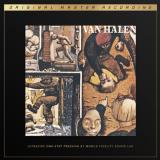
The song titles on Van Halen's aptly titled Fair Warning don't lie. The likes of "Unchained," "Mean Street," "Push Comes to Shove," "One Foot Out the Door," and more indicate the mood the band channels on its double-platinum 1981 record — the nastiest, darkest, and fiercest album of the group's storied career. For the fourth time in four years, Van Halen throws down the gauntlet to all challengers and emerges victorious.
Sourced from the original analog tapes, pressed on MoFi SuperVinyl at Fidelity Record Pressing, and strictly limited to 5,000 numbered copies, Mobile Fidelity's UltraDisc One-Step 180g 45RPM 2LP set plays with unfettered clarity, dynamics, and immediacy. Benefitting from superb groove definition, an ultra-low noise floor, and dead-quiet surfaces, this vinyl edition captures what went down in the studio with tremendous realism and involving presence.
Taking a more controlled approach in the studio and still completing everything in less than two weeks, Van Halen and producer Ted Templeman relied on studio amplifiers to direct the sound. Further diverging from the live-on-the-floor approach of its earlier albums, the ensemble also employed overdubs to great effect. The result: Dense, stacked architecture that underlines the hard-hitting tenor of the songs — and which comes alive like never before on this reference edition that looks as good as it sounds.
The premium packaging and gorgeous presentation befit the reissue's select status. Housed in a deluxe slipcase, it features special foil-stamped jackets and faithful-to-the-original graphics that illuminate the splendor of the recording. Aurally and visually, it is made for listeners who want to immerse themselves in everything involved with the album, including the iconic cover art adopted from William Kurelek's haunting painting, "The Maze."
Isolated frames from Kurelek's childhood-inspired work — including a man bashing his head into a brick wall, a guy pinning down an adversary as he delivers bare-fist blows to his face and others watch with apparent glee, a boy tied down on a conveyer belt and being sent through the equivalent of a meat saw — adorn the front and back covers. The sunnier visual disposition of Van Halen's prior efforts gives way to something sinister and tortured, traits reflective of the music within. The band members, too, are visually depicted not in glamorous shots but in a serious black-and-white portrait in which the quartet is clad in black leather jackets.
Tough, aggressive, stark: Fair Warning comes on like a series of bare-knuckled punches to the solar plexus and boasts lyrical narratives to match. Though not a concept record, the concise album revolves around themes of roughing it on the streets and struggling to survive amid dim prospects. Singer David Lee Roth reportedly penned many of the initial lyrics after traveling to Haiti and observing extreme poverty. The characters and situations populating Fair Warning reflect hardscrabble existence, last-chance desperation, and underlying danger.
Witness the crazies, poor folks, and hunters of “Mean Street”; the former prom queen turned pornographic actress on “Dirty Movies”; the menace and vice of “Sinners Swing!”; the streetwise hustle of “Unchained”; the isolation and alienation of “Push Comes to Shove”; the desire for escape on “One Foot Out the Door”: A carefree California beach party Fair Warning is not.
Having said he felt angry and frustrated during the sessions, guitarist Eddie Van Halen uses the forceful arrangements as a playground for his seemingly unlimited arsenal. Supported by a crack rhythm section and a hyped-up Roth, he performs with an almost impossible combination of punk-like intensity, technical finesse, lyrical fluidity, and unbridled emotion. The virtuoso was increasingly butting heads with Templeton and seeking a freedom in the studio he believed denied him.
No wonder he plays like a bat out of hell. Listen to the rapid-fire manner in which he slaps the high and low E strings on the 12th fret of his instrument on “Mean Street,” instilling the tune with funk flair and metal-spiked sharpness. For the pouty strut of “Dirty Movies,” Eddie Van Halen contributes slide guitar magic made possible after he sawed off the lower portion of a Gibson SG so he could reach further down the fretboard.
Related intensity, urgency, and daredevil momentum punctuate the surging “Sinner’s Swing!” A heavily flanged, delicately melodic introduction frames the attitudinal “Hear About It Later,” among the most creative arrangements of Van Halen’s career. And do riffs come any bigger or magnetic than those on the high-wire kick of “Unchained”? As for the out-of-left-field “Sunday in the Park,” an instrumental composed on an Electro-Harmonix micro-synthesizer: Who but Eddie Van Halen to supply creep factor in such an ingenious way?
Despite selling fewer quantities than Van Halen’s prior efforts, Fair Warning remains for many diehards the record that epitomizes all of the band’s immense strengths —Roth’s manic energy and tongue-wagging humor, Alex Van Halen’s rhythmic heartbeat-in-your-chest bombast, and Michael Anthony’s lucid bass lines included. Arriving when the New Wave of British Heavy Metal and new-wave movements were taking flight, it signaled a shot across the bow from a band determined to stay a step ahead and provide proof nobody could touch what it delivered.
More than four decades later, Fair Warning still sounds that alarm.

- Brown Is The Color
- Tame
- No Yawn
- All Odds No Chants Feat. Sara Persico & Elvin Brandhi
- Im Bann Der Wehenden Fahnen
- No Place Like
- Home
- Spellbound To Ancestral Curse
- Though The Trees Feat. Iceboy Violet
- Nowhere Everywhere Feat. Elvin Brandhi & Sara Persico
- Who, Me?
The notion of home isn’t precise, even a dictionary will offer multiple definitions. A home can be a place where you live, a place where you belong, where you originate from or a place where you’re given care; it can be a physical space, a land, a people or even a person. The concept isn’t completely universal, but everyone possesses a unique idea of what home means to them. On her fifth album, Ziúr considers not just what home symbolizes from her perspective, but the word’s resonance to the diverse community that surrounds her, and how their stories have impacted her over the years. Indeed, it’s the first time she’s felt it necessary to examine her own nationality. In the past, she’s deliberately avoided labelling herself as German, feeling disconnected from her country’s politics, culture and even the German language itself. In 2025, the idea of Germanness is in flux and progressives are under attack from all sides. The country’s politics aren’t only being turned inward by the growing throng of far-right voices, but by scared moderates, opportunists and those blinded by comfort, willing to ignore hatred to maintain their privilege. Stepping up to provide a different narrative, Ziúr scours her soul, writing and singing in German for the first time and proposing growth and evolution, not fear and regression. “I never considered being part of Germany,” she explains. “But I am.”
A solemn mood permeates the album’s opening track ‘Brown is the Color’, and Ziúr sings in measured, slow-motion breaths over noisy synth oscillations and doomed piano flourishes. Already, it’s a significant departure from her last run of releases, veering away from the frenetic, satirical chaos of 2023’s Hakuna Kulala-released ‘Eyeroll’ or its fantastical, dubby predecessor ‘Antifate’. Ziúr pulls on real world insights here, tracing her oldest, dearest musical inspirations to present her origins to anybody who might be listening. “Cold world is holding up,” she laments with a metallic crunch. “To let go of your heart, let me go.” And her voice emerges from the shadows completely on ‘Tame’; unprocessed, Ziúr sounds naked and vulnerable on ‘Tame’, curving her precise words around broken, lopsided rhythms and jangling new wave guitars. It’s pop music in its own way, inverted and reconstructed to fit snugly into her well-established sonic landscape. On ‘No Yawn’, brittle, downsampled hi-hats and industrial scrapes ping-pong around distorted riffs, provided by James Ó Ceallaigh aka WIFE; “You fail to sugarcoat your half-ass attempt,” she deadpans, “to build your promised wonderland on quicksand.” Even the beatless ‘All Odds No Chants’, a collaboration with Elvin Brandhi and Sara Persico, reveals another room in Ziúr’s autobiographical suite, mirroring György Ligeti’s enduringly influential choral works with its gnarled, dissonant vocal harmonies.


- Ceremonie Du Piment Piment
- Les Mains Dor Ek Bernard Lavilliers
- Demerd Azot With That Ek Maya Kamaty
- Gourmandises Amoureuses
- Melancolie Ek Rosemary Standley
- Les Promesses
- Fais Bouger Ton Boule Ek Rene Lacaille Mouss Hakim Amokrane
- Labsence Ek Rosemary Standley
- Epopee Meteque
- Afrodiziak
- Testosterone Ek Fixi Dje Baleti
- Apparu Ek Nellyla
12
Bonbon Vodou’s third album (Épopée métèque), created by Oriane Lacaille and JereM Boucris, follows the paths of exile with lush orchestration and lyrics in French, Creole, and Gascon.
The bonbon piment (a spicy Réunionese fritter) is deceptive. Beneath its harmless appearance lies a fiery kick that can jolt you into clarity. Bonbon Vodou operates the same way. While the duo's musical influences sway between the Indian Ocean and the Mediterranean Sea, a sharp edge cuts through the tenderness of their graceful songs, often carried by the rhythms of maloya. This contrast gives depth to their third album, Épopée métèque, which takes us on journeys of exile—both across land and sea.
Oriane Lacaille is the daughter of accordionist René Lacaille, a key figure in the revival of Réunionese music in the 1970s, who has lived in mainland France for five decades. JereM Boucris’s father, from a Tunisian Jewish family, was 14 when he arrived in France at the end of the colonial protectorate. Their lives are interwoven with these paternal exiles, which they continue to explore and unravel, alongside the broader, universal stories of migrants fleeing poverty, persecution, and war.
The duo is now joined by a vibrant trio—Piment Piment (Juliette Minvielle, Roland Seilhes, and Yann-Lou Bertrand)—bringing a rich orchestration featuring guitars, flutes, brass, roulèr, kayamb, jaw harp… all set to lyrics in French, Creole, and Gascon. Their voices are joined by numerous guests, including Mouss and Hakim, Rosemary Standley, and Bernard Lavilliers. This playful yet poignant album explores themes of life and death—radiant but aware—seemingly echoing Camus: “There is no sun without shadow, and one must know the night.”

- A1: Primetime
- A2: Turboframe
- A3: All You Did (Feat. Elvin Brandhi)
- B1: Top Suki Girl
- B2: Hunter Hunted
- B3: Cavalier
Assembled by Pedro Alves Sousa, Má Estrela is a conjuration of ideas and obsessions around dub, leftfield dance phenomena and the hypnotic potential of urban somnambulance.
In a levitating state, not exactly detached from the unease of these end times, Sousa surrounds himself by a number of accomplices from past and present endeavours to project a scrying mirror reflection of distinct languages of trance and liberation - dub's space and infinity, jungle and footwork's broken shards, DJ Screws legacy perpetually reanimated via numerous slowed down anonymous versions on Youtube and the lyricism and fire of jazz.
Temporarily a quartet, comprised of Sousa on saxophone and its electronic processing, Bruno Silva and Simão Simões on electronics and Gabriel Ferrandini on acoustic and electronic drums, after the departure of Miguel Abras, Má Estrela had in their 2022 debut album their first document of this ongoing process that’s now continued with ‘Tornada". Miguel Abras has since been replaced with Bruna de Moura and Má Estrela came back to being a five piece.
Coming out in November through Discrepant, with Miguel Abras' bass still present, 'Tornada' deepens the symbiotic connection between those rhythmic, melodic and textural particles in a mutating flux of continuities and disruptions throughout seven tracks. Featuring the invocations of Elvin Brandhi in 'All You Did', 'Tornada' makes its way amidst harmonic spectres, rhythmic debris that breathe for life and a certain, implicit idea of ritual that sustains itself liminally between the ethereal dissolution of time and the physical projection of space.
