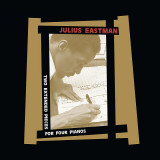
It is recognized today that these tutelary pieces for four pianos are among the most powerful in contemporary music,their impact is almost unparalleled. After the historical version recorded forty years ago, this one, featuring four of the greatest European performers, is now regaining its full power. High level recordings too.
There was some for John Cage, then came Christian Wolff, and finally Morton Feldman, from this school in New York. Only Julius Eastman remained outside the game, the last figure, the most solitary and enigmatic - undoubtedly also one of the most powerful, and it is this power that is revealed through these recordings. In the 1970s and 1980s, Eastman was one of the very few African-Americans to gain recognition in the New York avant-garde music scene. He was politically committed, a figure of queer culture and a solar and solitary poet whose melancholy influenced his genius as well as his tragic destiny : suffering from various addictions, declared missing, actually homeless. During Winter of 1981-82, he got deported from his apartment by the police, who destroyed most of what he owned - including scores and recordings. He was found dead in 1990, on the streets of Buffalo, after years of vagrancy.
The Performers Nicolas Horvath, pianist and electroacoustic composer Nicolas Horvath is known for his boundariesless musical explorations - he has collaborated with leading contemporary composers from around the world, including Alvin Lucier, Alvin Curran and Valentyn Silvestrov - the recordings of his complete works for piano by Phil Glass made a lasting impression. He has collaborated recently with Lustmord on the Deconstruction of November by Dennis Johnson (Sub Rosa SR502: The Fall).
Melaine Dalibert, a French composer and pianist, fascinated by natural phenomena which are both expected and unpredictable, Dalibert has developed his own algorithmic procedures of composition which contain the notion of stretched time evoking Morton Feldman, minimal and introspective, adopting a unique concept of fractal series.
Stephane Ginsburgh, a tireless surveyor of the repertoire but also explorer of new music, collaborated with composers such as Philippe Boesmans, Jean-Luc Fafchamps, Stefan Prins, Frederic Rzewski and Matthew Shlomowitz of whom he premiered works, as well as with choreographers such as Anne Teresa De Keersmaeker (Rosas) and recorded Feldman, Duchamp and Satie for Sub Rosa and the complete set of Prokofiev piano sonatas for Cypres. Wilhem Latchoumia, he embraces both new music and the classical repertoire with success and charisma. His two last recordings for La Dolce Volta (Prokofiev and de Falla) have been highly acclaimed by critics with a FFFF in Télérama. Winner of the Hewlett-Packard Foundation and the Montsalvatge International Piano Competition, he brilliantly won the First Prize in the 2006 Orléans International Piano Competition.
Search:1980
Pink Vinyl
er französischen New-Wave-/Pop-Künstlerin Desireless gelangen in den 1980er Jahren mit 'Voyage, Voyage' und 'John' zwei Welthits, darunter die Nr.1 in mehr als 50 Ländern. Diese Kollektion mit 10 neuen Remasters ist das ultimative Zeugnis ihrer schillernden Karriere. Beide Hits sind erstmals als Akustikversionen auf Vinyl erhältlich, dazu gibt es 'Voyage, Voyage' im Instrumental Club Remix von DJ Esteban. Ltd. Auflage auf pinkfarbenem Vinyl.
It almost seems churlish to regard Celtic Frost as one of the great extreme metal bands, because they were so much more than that. It’s better to hail them as among the finest extreme and experimental bands of the 1980s. Refusing ever to do what was expected or demanded, the band constantly changed musical direction, always brought in surprising influences, and kept people guessing as to where they might venture next. Their catalogue of albums is formidable and unmatched. Each is not only unique, but part of an entire tapestry that only now can be appreciated for being a remarkable part of music history. Despite, or maybe because of, constant turmoil on so many fronts, Celtic Frost achieved an artistic level few others would even have dared to dream of aspiring towards. They climbed high because they were never afraid to fall. Which is why the band are now rightly regarded as icons, and iconoclasts.
Released in 1987, only now can people understand just how far ahead of its time this album was. Not only did it have maniacal rhythms, but introduced electronica into extreme metal. On every level, it was a remarkable record, full of visionary ideas and ideals. This release includes alternate versions of tracks from the album and a cover of Dean Martin! The concept and art direction of the release was done by the man behind Celtic Frost, Tom G. Warrior.
Glasgow’s Seated Records return with more archival Scottish New Wave material; this time, in the form of Pop Wallpaper’s disco-not-disco interpretation of the Shuggie Otis classic, “Strawberry Letter 23”. And interpretation is the right word, guitarist Evan Henderson confesses that the lyrics sang by Audrey Redpath on the record were, “err inaccurate due to pre-internet home recording translation”.
The Edinburgh band first released “Strawberry Letter 23” in 1986 as a double A side 12” alongside original song, “Nothing Can Call Me Back". The 1986 record’s sleeve states that the original - “Strawberry Letter 23" has been “re-modelled for special pleasures, namely on the dance floor”. Here the re-model has been re-modelled once more. The track is recontextualised for 2022 playing on a four track 12” that includes an unreleased instrumental demo version of the track, as well as mixes from label founder Pigeon Steve and close friend of the label, Useful Tom.
Wallpaper’s first EP “Over Your Shoulder” was released in 1984. The release received a considerable amount of radio support, not least from Radio 1’s John Peel and Janice Long, which culminated with a live session for Long’s show at the BBC’s studios in London. Released a couple of years later, Strawberry Letter received similar levels of radio play. Despite (much to the band’s confusion) being tracked by Motown UK at one point, Pop Wallpaper did not go on to receive commercial success and eventually went their separate ways.
“Strawberry Letter 23” sits in the singular historical, cultural context of mid-80s Britain. Following the explosion of punk at the end of the 1970s, in the 1980s many British bands began experimenting with new styles and instruments - always keeping an eye firmly on their punk roots. The loose percussion and synthesiser melodies have an almost new-age, balearic mood, while the falsetto vocals of singer Audrey Redpath are an unmistakable embodiment the Post-punk style of the time. The prominent bass-line suggests a reggae or disco inspiration, and bass player Myles Raymond admits that he obsessed over a Sly & Robbie Taxi records compilation around the time the band put the tune together.
This reissue includes an unreleased, unheard instrumental demo-version of the cover, “SL23”. The band recorded the demo during an nighter at Wilf’s Planet studios in Edinburgh, just after Wet Wet Wet had just finished up their own demo for “Wishing I Was Lucky” (Pop Wallpaper all insist they thought it would never be a hit). In this version, we hear the band messing around with drum machines and synths which, in a similar style to Kevin Low and Fiona Carlin on Seated 001, creates a stripped back dance floor work-out that bares almost no resemblance to any version of “Strawberry Letter 23”. In an attempt to emulate the Trevor Horne production style of the time, the band’s drummer Les Cook recalls pushing for more and more reverb on the drums during the session to a reluctant producer Chic Medley, who “eventually obliged, but needed a lot of persuading”. Much to Cook’s disappointment “the reverb was toned down when we got to the final release”.
On the B side, label boss Pigeon Steve delivers a dubbed-out and acid drenched, cosmic rendition of the track with “SL24”, before Useful Tom (son of Pop Wallpaper bass player Myles Raymond) brings the EP to an end with spacey de-construction of fractured vocals and gliding synths on the B2 with “SL25”.
This is a licensed reissue of the track featured on the album “On The Beach”- Treasure Isle – 1967.
This gorgeous and haunting song boasts remarkable singing and musicianship allied to the finest song-writing.
A Rocksteady masterpiece that totally deserved being released as a single at last.
this is a special limited edition - strictly limited to 500 copies - one release only
The Paragons were originally called “The Binders”, a band that comprised Keith Anderson (better known as Bob Andy),
Garth Evans (aka Tyrone Evans), Junior Menz, and Leroy Stamp. In 1964 John Holt and Howard Barrett replaced Menz,and Stamp
and the name was changed to The Paragons. Anderson left in 1965, and The Paragons continued as a trio.
After John Holt left to pursue a solo career, Vic Taylor took Holt's place. The trio initially recorded two outstanding albums: the legendary
“On The Beach” 1967, and the equally good “Riding High“- later renamed “The Paragons with Roslyn Sweat” - in 1974.
Most of their many masterpieces come from these two albums... They carried on recording more albums, the latest being
“The Paragons Return” with John Holt. In 1980 Blondie covered their song "The Tide Is High" with great international success.
Today “On The Beach” is considered by many as the definitive Rocksteady L.P…
BBE Music announces the first-ever re-issue of this sun baked folk/jazz hybrid 45 by Louisiana brothers Will & James Ragar. First released in 1981, this private press 7" showcases Will & James' songwriting skills, refined performance and sophisticated compositions. Remastered by Frank Merritt the re-issue has an analogue warmth that the brothers say sounds even more pleasing than the original. Will & James Ragar began as the Will James Band performing on the popular 'Crawfish Circuit' of Southern Louisiana - this circuit included New Orleans, Thibodaux and Baton Rouge. They played blues, rock and jazz combos, covering everything from James Taylor to Jimi Hendrix. Eventually evolving into an acoustic folk-rock duo by the time they entered the studio in 1980. Both tracks on the 45 were recorded at River City studios in Baton Rouge in 1980. The engineer had the Allman Brothers on his list of recording credits, so they felt they were in excellent company. "Bayou Paradise" was an ode to the beauty of Southern Louisiana. The famous Sunshine bridge over wetlands as the sounds of migrating geese echo overhead on their journey down the Mississippi River flyway. The Atchafalaya river basin flows into the Gulf of Mexico near Lafayette creating a large wetland area and lush lakes connected by endless bayous. Miles and miles of lush swamps with many uninhabited areas just waiting to be explored. "Forever" captures the exhilaration of new love, focusing on its intoxication and ecstasy without looking ahead to the reality of a life on the road. The soulful chorus inspires motion and enthusiasm. The shadow of Woodstock had a defining role against tradition. Things were changing socially. Loving someone forever was always part of the dream but seemingly broken in an age of break-ups and divorce. The optimistic hope that "love will survive" was half dream and half pessimistic glance forward at the social trends of relationships that were to follow. The studio band included Will & James. John Smart on keyboards, he's solo on "Forever" was achieved with the Legendary Analog Prophet synth and saturated the studio with rich layers of its distinctive sound, driving the up-tempo chorus. Dave D'Aubin, a versatile bass player whose resonant tone is very present on both songs. Tommy Jefferson is on drums, an alumnus of the Southern University jazz program, the same place Randy Jackson and Billy Cobham studied. Tommy used a tight higher pitch snare drum on the recording, a sound that would soon become very popular, but at that time was a little ahead of the curve. The session was recorded on analogue tape using the 24-track MCI recorder and mixed down to analogue tape for the single. Will & James added vocal harmonies and soaked up the fidelity during mix-down. The release coincides with the long-awaited re-issue of the brothers' album 'Will & James Ragar One'. This much sort after private press long-player was originally released in 1980 and sold locally in a limited run has now been fully remastered by Frank Merritt. BBE Music presents the album in a glorious gatefold with extensive sleeve notes. This time the vinyl will be pressed over 2 discs to produce the best sound possible.
- 1: Feel You Around Me
- 2: Me And The Boys
- 3: Music Goes Round And Around
- 4: Beverly
- 5: That I Get Back Home
- 6: Roll Call
- 7: I Don’t Think Of
- 8: Want You To Feel Good Too
- 9: Never Take The Place Of You
- 10: You Can’t Hide
- 11: Definition Of Love
- 12: Hobbies
- 13: Big Goodbyes
- 14: Tiddlywinks Tv Spot
- 15: Tiddlywinks Radio Ad
Expanded reissue of their 1980 classic Featuring the hits “Me And The Boys,” “Never Take The Place Of You,” plus four bonus tracks Packaging contains new liner notes from original Engineer Tom Mark • Available on LP, CD, and Digital Over a decade into their career, NRBQ entered Bearsville Studios and recorded their eighth album. The line-up featured Terry Adams (keyboards), Joey Spampinato (bass), Tom Ardolino (drums) and Al Anderson (guitar), plus The Whole Wheat Horns (Donn Adams and Keith Spring). The end result was Tiddlywinks, which contained the singles “Me And The Boys” and “Never Take The Place Of You.” It immediately became another fan favorite NRBQ classic album, and provided an entry point for new a new audience to come on board as “Me And The Boys” garnered repeat airplay on radio stations across the country. Now, over four decades later, Tiddlywinks returns. This time, four bonus tracks are added to the mix; “I Don’t Think Of…” and “Big Goodbyes” – recorded during the Tiddlywinks sessions and released on 1983’s Tapdancin’ Bats collection, plus the Radio and TV Spots originally issued on the flip side of the “Never Take The Place Of You” 7” single. Featuring updated artwork and liner notes from original engineer Tom Mark (who had worked with the band on At Yankee Stadium), the Tiddlywinks experience is now complete. From Mark’s liner notes: “Working with those guys was such a pleasure. We always had fun. Four amazing musician/writers really listening to each other, what else do you want? Thank you NRBQ.” Available on LP, CD, and Digital, it’s time to stop playing games, and grab some Tiddlywinks!
[g] 7. I Don’t Think Of... [Bonus Track]
[m] 13. Big Goodbyes [Bonus Track]
[n] 14. Tiddlywinks TV Spot [Bonus Track]
[o] 15. Tiddlywinks Radio Ad [Bonus Track]
The new album Octagon Sphere by Duesseldorf duo Strafe F.R. comprises of four pieces recorded in 2020 and 2021 at the group's own studio. The work features heavily treated female vocals and includes rhythmic patterns and electronic sounds contributed by invited guest musician Detlef Klepsch (of the group keit). The overall atmosphere is tense and moody, both dark and uplifting at the same time. Octagon Sphere was mastered by Kai Blankenberg at Skyline Tonfabrik.
Octagon Sphere is the sister release to last year's CD Soundless Sphere – both albums are tied together by rhythmic alchemy and sound manipulation in highest detail.
STRAFE FÜR REBELLION was founded in 1979 in Düsseldorf by the two artists Siegfried Michael Syniuga and Bernd Kastner. Conceived as an experimental project rather than a band, the duo is active since the early 1980s, they continue to work together to this day.
They demonstrated their subtle abilities in numerous performances and concerts. The members of STRAFE FÜR REBELLION see themselves as researchers on different visual and acoustic levels; they always make use of their idiosyncratic and unusual humor. The duo emphasize that they not only explore the world of music, but also incorporate elements of knowledge, and thus all usable influences, into their experiments. Working plans, storyboards, and compositional schemas usually serve as the basis for new musical projects.
Their texts reflect their interest in science, history, philosophy, as well as everyday phenomena, mass media, and popular culture: in their experimental sound experiences, performances, and installations STRAFE FÜR REBELLION are absolutely avant-garde, working at the forefront of research-performatively, acoustically, visually, and in a variety of media. Their motto always remains aesthetically uncompromising with serious pleasure.
- 01: Music For Hen Meditation Movement 1
- 02: Music For Hen Meditation Movement 2
- 03: Music For Hen Meditation Movement 3
- 04: Music For Hen Meditation Movement 4
- 05: Music For Hen Meditation Movement 5
- 06: Music For Hen Meditation Movement 6
- 07: Music For Hen Meditation Movement 7
- 08: Music For Hen Meditation Movement 8
- 09: Music For Hen Meditation Movement 9
- 10: Music For Excited Sauces Movement 1
- 11: Music For Excited Sauces Movement 2
- 12: Music For Excited Sauces Movement 3
- 13: Music For Excited Sauces Movement 4
Though severely cut, Red Circle doesn't exactly sweep along. It has a deliberate pace as Kallabris sets up the score of thirteen chance acquaintances who plan and carry out the sacking of our acoustic consciousness... Understatement is the method of these compositions for a small modular synthesizer. If there ever was something like heist music, this here surely is. (Vincent Canby, with a few minor changes and adaptions).
Kallabris is a musical project that was begun in the mid 1980ies out of the scene around Coitra's Clan. Since ist inception Kallabris has persistently neglected any usage of advanced recording technology. Ever since not technical or compositonal innovation is at the core of the group’s work but, the active engagement with the limitations and the objects of every day life. This sound positivism can result in stylistically varied outputs ranging from chanson or country blues to musique concrète – while all musics live by their surfaces. Save the surface and you save all.
• Vaughan Mason is an influential disco-funk producer and musician who most notably released the
1980s roller skating anthem ‘Bounce, Rock, Skate, Roll’
• The spectacular single was released on Brunswick records and has been sampled by dozens of
artists ranging from Daft Punk, De La Soul to a Tribe Called Quest
• Originally released in 1980, this reissue has been pressed on 140g black vinyl with original artwork
and printed inner sleeve
Dies ist das erste Mal seit 40 Jahren, dass „Physical“ neu gemastert wurde. Produziert wurde das Album von Grammy Award®-Gewinner John Farrar, Olivias langjährigem Freund, Songwriter, Musiker und der
kreativen Kraft hinter „Physical“. „Physical“ wurde nicht nur Teil der Popkultur und trug dazu bei, den Aerobic- und Modewahn der 80er Jahre auszulösen (letzteres dank Newton-Johns langjähriger Kostümbildnerin Fleur Thiemeyer), sondern wurde auch zum größten Hit der 1980er Jahre und hielt sich länger in den Billboard-Charts als jeder andere Song des Jahrzehnts mit 10 rekordverdächtigen Wochen an der Spitze der Billboard Hot 100-Singles und mehr als 2 Millionen verkauften Einheiten. Die Deluxe-Edition zum 40-jährigen Jubiläum ist in vier Formaten erhältlich: als CD- und DVD-Set, als 180-Gramm-Vinyl-LP, als digitaler Download und per Streaming.
Mysticisms keeps the Dubplate series moving, welcoming one of the seminal Dub producers of all time in Scientist. His unique studio techniques and understanding of rhythm are exalted and present on Step It Up, an enlightening example of his genius and matched with a widescreen remix by label associate DJN4, aka DJ Normal 4, teaming up with fellow Dusseldorf producer AKI AKI, to offer a dreamland breaks-steppers anthem.
The fact that Hopeton Overton Brown aka Scientist is one of the true pioneers of Dub music is undisputed. His productions, first as an apprentice at Studio One, then breaking through whilst teamed at King Tubby's studio, led to Channel One and a series of seminal Dub masterpieces throughout the 1980s, mixing engineer Henry 'Junjo' Lawes' productions with the Roots Radics, alongside vocalists Barrington Levy, Jonny Osbourne and Jah Thomas.
Step It Up precedes, taken from the period of seminal Tubby's work with Bunny Lee and in this instance, with Barry Brown classic vocals and Lee's house band, The Aggravators, backing. As often with Reggae's history, much is disputed, however, this unmistakable Scientist production showcases Brown's high pass filters in effect, the trademark riding 4/4, utilising the 4 track mixing desk to create a joyous bounce.
Working on the license from the outset, Tim Schumacher aka DJN4, waited in the wings to dive in the desk for a modern-day remix. Partnering with up-and-coming producer Aki Vierboom (Phaserboys / Candomble), the Digi-Dance MixX is bass-quaking histrionics, a steppers meets rave culture overdose that will be heard from festivals to dancehalls, a righteous dub-breaks riddim y'all.
Step the Mystery
- A1: Favour
- A2: Heartburn
- A3: An Immaculate Conception
- A4: Judas
- B1: Testament
- B2: Patrol
- B3: The Old Men
- B4: Chance
- C1: Something Outside
- C2: Host
- D1: The Drill (Peel)
- D2: Uniform (Peel)
- D3: Here Comes Everybody (Peel)
- E1: Heartburn (Live)
- E2: Host (Live)
- E3: Recovery (Live)
- E4: Uniform (Live)
- F1: The Old Men (Live)
- F2: Something Outside (Live)
- F3: Country Of The Blind (Live)
- F4: The Drill (Live)
Factory Benelux presents a new 3 disc black vinyl edition of Harmony, the debut album by influential Scottish group The Wake. Originally released by Factory Records in December 1982, this new expanded edition marks the 40th anniversary of this landmark post-punk album.
The Wake formed in Glasgow in 1981 after singer/guitarist Caesar left Altered Images, and joined Factory the following year. Harmony was recorded at Strawberry Studios in Stockport with producer Chris Nagle (formerly Martin Hannett’s preferred engineer), by which time the group comprised Caesar (vocals, guitar), Carolyn Allen (keyboards), Steven Allen (drums) and Bobby Gillespie (bass). On release as Fact 60 the original 7 track mini album earned a 5 star review in Sounds magazine, hailed as the missing indiepop link between Factory and Postcard Records.
Bonus tracks on Disc 2 include The Wake’s dub-informed second single, Something Outside b/w Host, and also their John Peel session from July 1983 – the last recordings to feature Gillespie before his departure for The Jesus and Mary Chain and Primal Scream.
Disc 3 offers a desk recorded live set from Ayr Pavilion on 15 April 1983 during a tour with New Order. The concert includes several songs never recorded in the studio, including Recovery and Country of the Blind.
The enhanced trifold artwork for this new edition includes images of the band by noted photographer Paul Slattery, taken at the Mitchell Library in Glasgow, as well as new liner notes by Caesar. A 2xCD edition is also available (FBN 29 CD).
After releasing several further albums on Factory and Sarah Records during the 1980s and 1990s, The Wake returned to recording with A Light Far Out in 2012. A new studio album is expected in 2023.
Red Vinyl
Adrian Borland and Graham Bailey might be better known as members of legendary post-punk group The Sound, but the two were childhood friends and had been playing together even earlier in The Outsiders, and continued their deep musical rapport as a duo, creating these intense and engaging songs as Second Layer at the same time as their higher profile band output.
Combining their early recordings, including the 1979 Flesh As Property EP and 1980 State Of Emergency EP, Courts Or Wars takes its title from the first song that served as the pair’s introduction to listeners. Right from the beginning you are enveloped in what The Quietus described as, “a monochrome worldview morbidly obsessed with the dehumanizing effect of war, nuclear weapon annihilation, and the fracturing and negation of the self within an increasingly distorted and technologically mediated society.” Where The Sound fit snugly next to Echo And The Bunnymen, Second Layer had far more in common with the pulsing menace of Suicide.
Borland’s familiar vocals and sense of melody hold a connection to his other songwriting, but within these songs he takes far more risks in his guitar work to suit the subject matter. What really drives everything is Bailey’s propulsive bedrock, formed by his homemade pre-drum machine rhythm generators, creating an innovative mechanical approach that somehow inserts a jittery neurotic touch that merges perfectly with his electronic layers driven by the wasp synth, various unique effects boxes or tape loops. Adding in Bailey’s own distinctive bass playing, the results feel personal and experimental, pointed and harsh, while also bracingly accessible and covered in dark manic energy.
Over forty years later, these recordings feel shockingly appropriate. In painting a bleak reality and frightening future, there is real desperate beauty here.
Welcome to the realm of creator and mentor Michael Wadada, the man behind the exotic manoeuvres of Suns of Arqa, one of the most sought after world beat fusion project of the early eighties. His main goal was to increase the vibrations of classical Indian raga with the rhythms of Niyabinghi drumming, epitomized in England by contemporary dub producers. Released in 1980 on Manchester’s own Rock Steady Records, Revenge Of The Mozabites is an essential masterpiece paving the way for future over the border contamination. Deeply informed by cosmic mysticism the album still reverberates with the hidden sounds of earth & soul.
- 1: The Creation Recordings Why Does The Rain
- 2: Like
- 3: Winter
- 4: Up The Hill And Down The Slope
- 5: Your Door Shines Like Gold
- 6: Lonely Street
- 7: Time
- 1: Bbc Radio Janice Long Session - 9/2/84 On A Tuesday
- 2: Skeleton Staircase
- 3: The Canal And The Big Red Town
- 4: Lonely Street
- 1: Live At The Living Room - 8/6/84 On A Tuesday
- 2: Your Door Shines Like Gold
- 3: Time
- 4: Colours I See
- 5: Emily
- 6: The Nothing Box
- 7: The Canal And The Big Red Town
- 8: Why Does The Rain
- 9: Over The Hill And Down The Slope
- 10: Day’s End
- 1: Bark Studio Recordings - 5-7/2/05 Model Village Rickety Frame
- 2: Beware
- 3: Mad Old Woman Mad Old Man
- 4: Ride
- 1: Bbc Radio 6 Music Gideon Coe Session - 24/9/5 Why Does The Rain
- 2: I Can’t Keep My Mind Off You
- 3: Up The Hill
Triple coloured vinyl version (Each disc is a different colour) of the double CD that came out on Cherry Red in 2021 Presented in Tri-fold gatefold sleeve with 16 page 12x12 colour booklet, poster & photograph.
ONLY 350 COPIES WORLDWIDE
Among the first crop of Creation Records bands in the mid-1980s, THE LOFT seemed the most likely to break through. Following the success of The Smiths, guitar-based independent pop was in vogue, Alan McGee’s Creation label was turning heads – its bands blending 60s psychedelia, the melodic end of punk and a new sound which would soon be immortalised on NME’s C86 cassette. And in this London quartet, Creation had their answer to bands like Television, The Only Ones or early Modern Lovers, offering taut, off-kilter songs with an irresistibly deadpan cool.
Sadly, after just two singles, 1984’s downbeat debut ‘Why Does The Rain’ and the punchier sequel, ‘Up The Hill And Down The Slope’ – an indie hit which the band performed live on TV show The Oxford Road Show, The Loft dissolved, with various members founding new bands The Weather Prophets, The Caretaker Race and The Wishing Stones. They left behind seven studio tracks, a BBC Radio 1 session for Janice Long and one track from a Creation LP documenting the scene’s roots in small club The Living Room.
However, The Loft’s legend endured, eventually prompting a reunion in the early 2000s with all four original members – singer/songwriter/guitarist Pete Astor, guitarist Andy Strickland, bassist Bill Prince and drummer Dave Morgan. Alongside various well-received live shows, that led to a new single, ‘Model Village’ (2006) and more recently a session for Gideon Coe on BBC 6 Music (2015). The Loft’s reputation as founding fathers of a new breed of mid-80s indie pop continues to grow to this day, with the band often cited as an influence.
Compiled and coordinated by the band, Ghost Trains & Country Lanes expands on previous retrospectives of The Loft, adding those reunion recordings (including three previously unissued tracks), the Gideon Coe session and several live recordings from that historic performance at The Living Room back in 1984. (including many exclusive songs which were never recorded in the studio).
With new sleeve-notes by Danny Kelly, this is the definite tribute to The Loft
Following the April 2022 reissue of the album Shrimp Boats, We Are Busy
Bodies presents companion titles Plum and Cherry and Deeper in Black
to round out a Lionel Pillay and Basil Mannenberg Coetzee trilogy as part
of the label's As-Shams South African jazz archive series
The connection between these three albums is tight as the 1987 release Shrimp
Boats compiled unreleased recordings from both the 1979 session for Plum and
Cherry and the 1980 session for Deeper in Black. These two rare records have
been carefully remastered from their original tapes and are back in print for the
very first time in over 40 years.Shrimp Boats and Plum and Cherry capture the
extraordinary musical chemistry that existed between pianist Lionel Pillay and
tenor saxophonist Basil Coetzee in the late 1970s. The respective album
showpieces Shrimp Boats and Cherry each occupy an entire side of vinyl with
both exquisite musical journeys clocking in at an epic 25 minutes a piece. While
Shrimp Boats was an instrumental reimagining of the popular 1951 song by
American singer Jo Stafford, Cherry drew inspiration from Abdullah Ibrahim at the
behest of producer Rashid Vally, who wanted to emulate the success of the
famous track that had helped launch his independent As-Shams/The Sun record
label in 1974.
Ibrahim's hit Mannenberg had also featured Basil Coetzee and it was this zeitgeist
South African jazz recording that had given rise to his stage name. Capturing the
grace and vitality of working- class township life on the city fringe, Cherry
channels the type of laid-back Cape groove that Abdullah Ibrahim, recording as
Dollar Brand, introduced to South African jazz in the 1970s. On the flip side, Plum
appears to take its own simple chord change in the same direction before
breaking into a chugging 20-minute romp that verges on proto-electronica and on
which Pillay hangs all manner of savage keyboard riffing and experimentation.
The two distinct flavours of Plum and Cherry make for a well-rounded platter with
an iconic cover featuring the work of abstract expressionist painter and AsShams/The Sun collaborator Hargreaves Ntukwana.
The 1980s will forever be remembered for electropop sensations, yet few, if any, are quite as sensational as Yaz's Upstairs at Eric's. A standard-setting mélange of smoky blues singing, jazzy arrangements, disco-tinged beats, and dancefloor vibes, the smash debut fits equally as well at a late-night club as it does in a living room, where the record's complexity and exoticism takes listeners hostage. No wonder the 1982 landmark remains one of the decade's most essential albums.
This numbered edition Silver Label LP breathes with a decongested openness, textural richness, and expansive tonal palette. Alison Moyet's inimitable vocals, such a huge part of the record's appeal, are dramatically enhanced, her sensual timbre, bittersweet crooning, and knockout range now encompassing the full frequency spectrum and projecting outward in a way that traverses the flatness of the original pressings.
Indeed, her bluesy deliveries are at once elegant and exuberant, and give collaborative partner Vince Clarke free range to construct beat architectures that encompass freewheeling disco, house music, uptempo dance, and chilled-out pop. The former Depeche Mode member also layers on elegant keyboard melodies, establishing contagious hooks and electronic-laced landscapes that preceded the techno explosion and do so with a cooler elegance. Tape loops, random field-noise dialogues, and synth-stroked bass notes add to what's nothing less than a perfect collusion of moody paranoia and soulful warmth.
While a cousin to synth-pop LPs by the likes of the Eurythmics, Soft Cell, OMD, and Depeche Mode, Yaz's Upstairs at Eric's is singular for its chemistry between Moyet and Clarke – and an insouciant batch of songs high on emotion, style, and substance.
One of These Nights occupies an important, unique place in the Eagles' discography given it represents the final album the group made before releasing the bajillion-selling Their Greatest Hits (1971-1975) compilation. The timing is telling. A coming-out party for Glenn Frey and Don Henley's songwriting skills, the studio record – the band's fourth, and its first to hit #1 on the charts – signifies the group's ascent to superstar status. Home to three massive singles (the title track, "Lyin' Eyes," and "Take It to the Limit") and nominated for four Grammy Awards, the quadruple-platinum 1975 effort solidified the Eagles' Southern California-reared sound and made the band a household name.
Mastered from the original analog tapes, pressed on MoFi SuperVinyl, and limited to 10,000 copies, Mobile Fidelity's UltraDisc One-Step 180g 45RPM 2LP vinyl box set takes One of These Nights to the limit. And then some. Playing with reference sonics and a practically indiscernible noise floor thanks to MoFi SuperVinyl's special formula, it provides a rich, dynamic, transparent, and three-dimensional view into a release that moved country-rock ahead by leaps and bounds – and paved the way for the Eagles' ascendancy to global superstardom. The opportunity to zero in on the particulars of the Eagles' golden harmonies, distinct vocal timbres, and cohesive interplay has never been better.
Visually, the premium packaging and presentation of the UD1S One of These Nights pressing befit its esteemed status. Housed in a deluxe box, it features beautiful foil-stamped jackets and faithful-to-the-original graphics that illuminate the splendour of the recording. From every angle, this UD1S reissue exists as a curatorial artefact meant to be preserved, touched, and examined. It is made for discerning listeners that prize sound quality and production, and who desire to fully immerse themselves in the art – and everything involved with the album, from the renowned cover art to the meticulous finishes. As much as any Eagles LP, the connection between the imagery and the music and the band on One of These Nights runs deep. No wonder it led to a Grammy Nomination for Best Album Package.
Devised by West Texas artist Boyd Elder, the striking skull-and-feathers themed piece gracing the front of One of These Nights represents where the Eagles have been and where they were headed. Album art director Gary Burden explained: "The cow skull is pure cowboy, folk, the decorations are American Indian-inspired, and the future is represented by the more polished reflective glass beaded surfaces covering the skull." Moreover, Elder had met the group years earlier when Henley and company performed at one of his gallery openings in California. MoFi's UD1S box set allows Elder's vision (and Burden's debossed treatment of the image) to pop and appear as if it was a stand-alone object.
Of course, what's inside the sleeves, and in the grooves, proves equally compelling. Though One of These Nights marks the final appearance of band co-founder Bernie Leadon on an Eagles LP and contains three of his tunes, the record's tremendous success owes to Frey and Henley's timeless contributions. Taking the next step in their maturation and evolution, the pair crafted several songs while living together as roommates in a rented house in which they converted a music room into a recording studio.
The duo's bond and chemistry pulse throughout the record – particularly in the tight arrangements, tasteful instrumental flourishes, and seamless blending of the folk, country, and rock elements. The musical combinations and partnership not only produced the Eagles' first million-selling single (the slow-dancing "Take It to the Limit," co-written with bassist-vocalist Randy Meisner) and the Frey-led cheating classic "Lyin' Eyes," but the famed title track, which nods to the era's nascent disco scene as well as Kenneth Gamble and Leon Huff's Philly soul platters.
Frey named "One of These Nights" as his favorite Eagles composition of all-time; Meisner's high harmonies alone send the track into a galaxy of its own. Speaking of the latter, Leadon's instrumental "Journey of the Sorcerer" ventures into another universe and was soon used by Douglas Adams as the theme to his "The Hitch-hiker's Guide to the Galaxy" radio series. Inspiration and creative experimentation also dragged the Eagles into the blues. Another Frey-Henley gem, the self-probing "After the Thrill Is Gone" serves as a response song to B.B. King's signature track and more evidence the band was turning the lens inward for lyrical narratives. Like everything on One of These Nights, the song confirms the Eagles were breathing rare musical air.
More About Mobile Fidelity UltraDisc One-Step and Why It Is Superior
Instead of utilizing the industry-standard three-step lacquer process, Mobile Fidelity Sound Lab's new UltraDisc One-Step (UD1S) uses only one step, bypassing two processes of generational loss. While three-step processing is designed for optimum yield and efficiency, UD1S is created for the ultimate in sound quality. Just as Mobile Fidelity pioneered the UHQR (Ultra High-Quality Record) with JVC in the 1980s, UD1S again represents another state-of-the-art advance in the record-manufacturing process. MFSL engineers begin with the original master recordings, painstakingly transfer them to DSD 256, and meticulously cut a set of lacquers. These lacquers are used to create a very fragile, pristine UD1S stamper called a "convert." Delicate "converts" are then formed into the actual record stampers, producing a final product that literally and figuratively brings you closer to the music. By skipping the additional steps of pulling another positive and an additional negative, as done in the three-step process used in standard pressings, UD1S produces a final LP with the lowest noise floor possible today. The removal of the additional two steps of generational loss in the plating process reveals tremendous amounts of extra musical detail and dynamics, which are otherwise lost due to the standard copying process. Every conceivable aspect of vinyl production is optimized to produce the most perfect record album available today.
MoFi SuperVinyl
Developed by NEOTECH and RTI, MoFi SuperVinyl is the most exacting-to-specification vinyl compound ever devised. Analogue lovers have never seen (or heard) anything like it. Extraordinarily expensive and extremely painstaking to produce, the special proprietary compound addresses two specific areas of improvement: noise floor reduction and enhanced groove definition. The vinyl composition features a new carbonless dye (hold the disc up to the light and see) and produces the world's quietest surfaces. This high-definition formula also allows for the creation of cleaner grooves that are indistinguishable from the original lacquer. MoFi SuperVinyl provides the closest approximation of what the label's engineers hear in the mastering lab.
ONE SIDED BLACK VINYL.
First ever release of the scariest, most inappropriate and possibly most influential kids TV music of ALL TIME.
'A first-ever release to the series' alarmingly experimental soundtrack'
SHINDIG! Five Page Feature.
There is only 17 minutes of music throughout the series, so we have fitted it all onto a one sided LP. Artwork is by Julian House – legendary hauntologist (Belbury Poly etc) and the man behind some of the greatest spooky band artwork of all time- Stereolab, Broadcast, Primal Scream etc etc.
Sleevenotes by Stewart Lee and inner sleeve notes by Alan Gubby of Buried Treasure Records.
It all looks and sounds superb. Of course it does because it’s a Trunk Records release. AND REMEMBER THIS IS NOT A REISSUE!!! SO DON’T SAY IT IS WHEN YOU TRY AND SELL IT.
anyone who watched was scared shitless. The 7 part drama centred around disturbing happenings in a strange pagan village of very weird and unusually happy people, all set in the midst of the stone circle at Avebury – known as Milbury for the show.
The series shown across British TV (and USA TV in 1980) would scar, disturb and influence an entire generation. Without COTS it’s unlikely we’d have hauntology, spooky folk stuff, stone circle clubs, weird walks and a hunger for such pagan oddities everywhere. And COTS really is the key TV series in many of these modern movements, way before The Wicker Man. Even though The Wicker Man was released in 1973 it was an adult film only released to a few cinemas.
Very few people saw it and its influence really started in the late 1990s with the first release of the music. Whereas COTS on the other hand was shown at 5pm, on schooldays, to a whole nation of impressionable kids, who had never seen or heard anything quite like it. The power of COTS runs deep. So much so Stewart Lee made a whole documentary about it. The release of this long-awaited album will be a “Happy Day” for many.
THE MUSIC:
According to rumour the director of the show was listening to Penderecki as he first approached Avebury to scope out locations. Sidney Sager and The Ambrosian Singers produced an avant-garde and often quite oddly terrifying sequence of vocal drones and dramatic peaks based on ancient Icelandic singular word “Hadave”. And yes, it’s still scary.



