Modern progressive rock band DILEMMA presents its third full length album, ‘The Purpose Paradox’. This concept album, spanning over 60 minutes, is released on CD, double LP and via all streaming platforms, and distributed internationally by Butler Records, a division of V2 Records.
It features 9 brand new tracks ranging in length from 4 to nearly 16 minutes. The sound showcases a broader side of DILEMMA — louder, faster, more technical, more progressive. With new frontman Jermain van der Bogt (Wudstik), the vocals have become rawer and more varied. Almost six years after the previous record ‘Random Acts of Liberation’ the band sounds reborn.
Like its predecessor, ‘The Purpose Paradox’ was produced by drummer Collin Leijenaar, who, together with the famed music wizard Rich Mouser (The Mouse House, LA), was also responsible for the mix and mastering. Thanks to their unmatched ears, the result is an audio experience that DILEMMA has worked on with great pride over the past years.
As said, ‘The Purpose Paradox’ was written and produced like a concept album. Because let’s face it, you’re either a progressive rock band or you’re not. But seriously: the story of ‘The Purpose Paradox’ revolves around a man named Neon. Someone like us in the here and now. During his quest for connection and fulfilment, he finds support from an unconventional guide named Electra. She points out to him that sometimes the things we look for are the things that found us first. Will Neon’s heart glow again when he discovers the outer light? Or does the greed of the corporate machine known as The Hand succeed in extinguishing his inner fire? Can Neon’s secrets be deleted? And will he, in the end, arrive in the comfort zone of allies in the raw, rainy city he once left behind?
quête:4 minutes
Four years after their Discrepant debut - 'OOOO' -, Lisbon-based travellers Jibóia return to the fold with another offering of globetrotting psychedelia with 'Salar'. With the core trio of Óscar Silva, Ricardo Martins and Mestre André augmented by a stellar parade of collaborators on various roles, 'Salar' further expands on the transglobal visions by now pretty trademarked by the band. Intersped among shorter vignettes for drums, saxophone and bass, each of the more fully fleshed tracks casts a guest to elevate Jibóia's music to uncharted realms - both in a mystical and geographical sense.
Opener 'Selar' summons the cello of songstress Joana Guerra for a skewed dialogue with Silva's guitar, propelled by Martins' drums and percussion and André's electronic textures into 4 minutes and 20 seconds that feel epic - if there was any psychedelic numerological symbolism needed. On 'Solar', Silva's non-western plucking rides on for Yaw Tembe's trumpet to veer in a multitude in directions, while the mysterious 'Sitar' conjures the voice of moroccan musician Ayoub El Ayadi for a contemplative nighttime prayer. Elsewhere, guitarist Rui Carvalho aka Filho da Mãe injects dissonant guitar lines unto 'Sarar's pummelling dance and Pedro Augusto's electronics hover below the shapeshifting dynamics of 'Sonar', among mesmerising keyboard lines. 'Salir' featuring Daiyen Jone enchanted flute brings the album to a close at its most reflective, all crepuscular synth lines and reverbed handclaps.
Amputechture Beneath the technical flash, the fury, the fearless creative brinkmanship of the first two Mars Volta albums lay a potent seam of the blues, an existential vexation that powered every twist and turn of Omar and Cedric’s imaginations. That mournful vibe would come to the surface of the group’s third full-length Amputechture, a simmering/blistering set that was unquestionably the group’s darkest yet. There was no overarching theme here, no interlinking concept binding the songs together, though Cedric concedes that, lyrically, the album was influenced “by a lot of stuff I was going through, a really bad break-up and a lot of other crazy stuff, and trying to put that feeling into the record.” But Amputechture – its name another of the late Jeremy Michael Ward’s invented words – was no downbeat bummer. Opener Vicarious Atonement might’ve been a deliciously gloomy, slow-burning thing, capturing Cedric in delirious duet with Omar’s swooning guitar lines, accompanied by squalling saxophone by Adrian Terrazas-Gonzales and dream-frequency fuckery by the group’s new sonic manipulator, former At The Drive- In member Paul Hinojos. But second track Tetragrammaton swiftly set pulses racing, an epic-in-miniature and containing more ideas within its 16 minutes than most bands manage over an entire career, its proggy, complex guitar figures tessellating in infinite configurations and converging as if conforming to mathematical formulae from another reality. The raw material Amputechture was hewn from started life on the road. Omar now travelled with his own mobile recording studio – a little Neve ten-channel tape recorder and an array of microphones – and was able to work on new ideas on tourbuses, in hotel rooms and during soundcheck (and, occasionally, after the show was done). After touring for Frances The Mute was complete, Omar relocated to Amsterdam, staying with his photographer friend Danielle Van Ark and her partner, Nils Post. It’s here that he demoed Amputechture, flying in engineer Jon DeBaun, drummer Jon Theodore and his brother, Chino, to work on these raw sketches. He later returned to Los Angeles, where the album was finally recorded. Omar ceded guitar duties to his dear friend and kindred spirit John Frusciante, instead assuming the role of musical director. “I wanted to hear the sound of the band,” he says. “I thought, I’ll be able to sit at the console, feel the air of the speakers moving, the unified sound of everything, and not feel distant from it. It was fun, but it was also challenging.” Part of Omar’s new method was to teach the musicians their parts only moments before the tapes rolled. “To keep things fresh, and to keep everyone on edge,” he says, before chuckling. “No, not on edge – on their toes. Amputechture would prove The Mars Volta’s most diverse set yet, drawing into the group’s tornado of influences moments of fiery jazz spirituality and esoteric folk introspection, finding space for passages of devastating subtlety and also their most fierce and full-on moments to date. The aforementioned Vicarious Atonement found its meditative mood echoed by Asilos Magdalena, an intimate, acoustic piece that invoked traditional Latin folk music, as Cedric sang in Spanish a sorrowful tale of a lost soul’s quest for sanctuary within a Magdalen Asylum, a refuge set up by the Catholic church for “fallen women”. The shadowy, sinister closer El Ciervo Vulnerado, meanwhile, tapped into the darker side of spiritual jazz to further explore the album’s themes of redemption and religious myth and magick. Elsewhere, the interplay between guitar and clarinet on Viscera Eyes created complex, unsettling counter-melodies, while the coiling, ornate Meccamputechture – Cedric’s wild fusion of sacred texts, occultism and dystopian science fiction – proved a great showcase for Ikey Owens’ swarming, infernal organ runs, in concert with Frusciante’s arcane guitar-play. But it was Day Of The Baphomets that would prove Amputechture’s most ambitious and most defining epic. Cedric’s lyrics tore into the hypocrisy of religious cant and myths of sin and punishment. “I wanted to make a song that was like the movie The Believers, where this cabal stole kids and did some occult shit with them,” he explains. “But I wanted it to be like, ‘What if the people you hire to do jobs you don’t wanna do rise up one day and then pull some shit like that?’ Like it was the guerrilla warfare, them taking over – wouldn’t that be some fucked up shit? And the music just lent itself to that – the big intro, the bass solo, and all of the ruckus that occurs.” That ruckus was some of the most thrilling Mars Volta music yet, as Omar directed his musicians to rumble through fiery modes of wild tribal groove, ransack-the-palaces riot- rock and supreme progressive experimentalism. Amputechture, then, is the sound of The Mars Volta in imperial mode: fearless, insatiable, unstoppable.
“Loves Love” jettisoned STÜM into 2024 and now “Beautiful Dancers” is here to take him ever higher.
As the second single off his forthcoming Essence Of Time EP, “Beautiful Dancers” is a blissful yet haunting take on techno. This track is total club rapture made up of ghostly vocal calls, static-like percussion and howling wind effects. A record of mixed emotions, pleasure and pain all blended up into 6 plus minutes.
Speaking on the tune, STÜM says “The songwriting process involved juxtaposing the organic with the synthetic weaving together contrasting sounds to mirror the duality of human emotion.”
Third in line is “Limbo”, a heaving acid hit full of hypnotic foreign instruments and vocals. This one gives off a massive street party feeling. From there we head to “Escape” a more dreamy and introspective bell-tone tune. A deliberate breather from STÜM before storming into the title track of the EP.
“Essence Of Time” is a shimmering rave piece. Dulcet piano intertwines with airy effects and hammering synths – another excellent example of STÜM’s ability to blend light and shade all at once.
De School is thrilled to announce the release of HET ALTIJD: a 160-page journey back to and through its now-defunct club, art spaces, café, and restaurant, which closed their doors on January 15. HET ALTIJD archives De School’s essential facets, functions, spaces, and stories, from the pre-DS days to the moment the music stopped. In sync with De School’s eight-year- spanning program, the publication is a sensory and experience-based format that crisscrosses disciplines and allows those who enter to define their own route. The release of HET ALTIJD follows the launch of HET ARCHIEF, the extensive sound archives unlocked earlier this year.
More than a final form of documentation, HET ALTIJD was created to be an experience in itself, expanding on the time-erasing sense of exploration that a deep dive into De School embodied. Preserved records such as architectural sketches and art documentation are interwoven with original imagery by various creative contributors, including semi-anonymous portraits of club regulars, and post-closing snapshots taken just minutes after the very last dance. Recurring throughout the publication, and featured on the cover, is the abstracted thermal imagery of artist Loes de Boer, who chronicled the 66-hour closing (Het Einde) while upholding De School’s distinct sense of anonymity and wonder. In HET ALTIJD, the no-photo policy is simultaneously upheld and lifted—leaving space to roam and relive De School one last time.
HET ALTIJD refrains from a singular storyline and exclusively features text found in, on, and around Doctor Jan van Breemenstraat 1. Left-behind wall markings, toilet scribbles and sticky notes from the basement were photographed and excerpted to form fragmentary, touching, and tongue-in-cheek poetry that revive individual and collective memories. In addition, the non-linear graphic design and—lack of—binding allows anyone to (re)arrange their very own De School encounters. Holding HET ALTIJD together is a translucent red cover featuring the instantly recognisable grid: a final nod to De School, the warm hue of its seemingly endless hallways, and its enduring, all-encompassing foundation.
Two seminal 12" mixes of a pair of Michael Wycoff heavy hitters from 1982. One a two-step favourite and one a Loft classic, these sought-after versions have never been paired on the same record.
Side A features the smooth-gliding anthem "Looking Up To You". The unmistakable snap of that sighing intro is unlike anything else. As such, it's no surprise that Leon Ware, celebrated master of the unexpected chord, has his fingerprints all over the track. Co-written with Zane Grey, "Looking Up To You" stands among the very best of Leon's staggering bank of compositions, both solo and with Michael Jackson, Minnie Riperton and Marvin Gaye. It's such an influential track, serving as the sample foundation of a massive top five R&B hit for Zhane in 1993, but it has never been bettered upon. Original 12" copies - if you can find them - go for over £50 today, making this side worth the price of admission alone.
If that wasn't enough, it's arguable that the B-Side wins again. A staple of David Mancuso's New York Loft parties, the Tee Scott mix of uplifting boogie gem "Diamond Real" is on another level entirely. A DJ legend of infamous clubs Better Days and Zanzibar and a trailblazing innovator, Tee Scott mastered the art of the reconstructive club mix.
For maximum destruction of discerning dancers, we've opted for here for his heavenly dub. 7 minutes of devastatingly slick dance floor dynamite, at once polished and dilapidated, its ecstatic charm is universal.
Devout lovers of modern soul have long worshipped the rapturous, sophisticated funk of Michael Wycoff. In combining that richly elegant voice, redolent of Donny Hathaway, with the production of keyboardist and arranger Webster Lewis, it's no surprise that both of these tracks became vital club classics of the early 80s R&B scene. Clear, full-bodied and bright - the 12" versions of these tracks are notoriously punchier than those featured on Wycoff's LP, and feature boomin' low end and neck-snapping drums. Buy on sight.
To commemorate the 30th anniversary of Therapy?'s Troublegum album , this 2LP set contains the original album pressed on 180g silver vinyl plus a further 14 tracks rounding up B-sides and bonus tracks of the era pressed on 180g lavender vinyl. By the time Therapy? released Troublegum in 1994 they were already well established, but it was the first time many had encountered the group's intensely melodic blend of hard rock and indie, an arresting combination of old and new, striking in its immediacy. Formed by schoolfriends in Larne, Northern Ireland, Therapy? consistently pushed the rock trio to its limits, often saying that their use of feedback was their fourth instrument. Singer, guitarist and writer Andy Cairns, bassist Michael McKeegan and drummer Fyfe Ewing had been playing together since 1989, and were signed to indie label Wiiija the following year on the strength of their live reputation. After two albums with Wiiija, they were signed to A&M Records, and their 1992 album, Nurse, reached the UK Top 40. The group paired with Mission producer Chris Sheldon and went to Chipping Norton Studios to record a follow-up. The results were stunning. Lead single "Screamager" (on the Shortsharpshock EP) reached the UK Top 10 in March 1993; follow-up "Turn" made the Top 20. By the time Troublegum was released in February 1994, it contained both singles, plus "Nowhere" and "Trigger Inside", further hits from the album. Troublegum is warm and powerful, showing that grunge was not just the preserve of bands from the western seaboard of the US. Mixed without any discernible gaps between tracks, the album offers 45 minutes of attack. Amid the originals, the band's post punk roots are shown by their storming cover of Isolation by Joy Division. Widely acclaimed, Troublegum reached No 5 in the UK charts, went Gold and was nominated for the Mercury Music Prize. It sounds as fresh today as it did in 1994.
- Knives
- Screamager
- Hellbelly
- Stop It You're Killing Me
- Nowhere
- Die Laughing
- Unbeliever
- Trigger Inside
- Lunacy Booth
- Isolation
- Turn
- Femtex
- Unrequited
- Brainsaw
- Pantopon Rose
- Breaking The Law
- C C Rider
- Evil Elvis (The Lost Demo)
- Nice 'N' Sleazy
- Reuters
- Tatty Seaside Town
- Auto Surgery
- Totally Random Man
- Accelerator
- Speedball
- Bloody Blue
- Neck Freak (New Version)
- Opal Mantra
Limited Caramel Beige180g Vinyl[35,71 €]
To commemorate the 30th anniversary of Therapy?'s Troublegum album , this 2LP set contains the original album pressed on 180g silver vinyl plus a further 14 tracks rounding up B-sides and bonus tracks of the era pressed on 180g lavender vinyl. By the time Therapy? released Troublegum in 1994 they were already well established, but it was the first time many had encountered the group's intensely melodic blend of hard rock and indie, an arresting combination of old and new, striking in its immediacy. Formed by schoolfriends in Larne, Northern Ireland, Therapy? consistently pushed the rock trio to its limits, often saying that their use of feedback was their fourth instrument. Singer, guitarist and writer Andy Cairns, bassist Michael McKeegan and drummer Fyfe Ewing had been playing together since 1989, and were signed to indie label Wiiija the following year on the strength of their live reputation. After two albums with Wiiija, they were signed to A&M Records, and their 1992 album, Nurse, reached the UK Top 40. The group paired with Mission producer Chris Sheldon and went to Chipping Norton Studios to record a follow-up. The results were stunning. Lead single "Screamager" (on the Shortsharpshock EP) reached the UK Top 10 in March 1993; follow-up "Turn" made the Top 20. By the time Troublegum was released in February 1994, it contained both singles, plus "Nowhere" and "Trigger Inside", further hits from the album. Troublegum is warm and powerful, showing that grunge was not just the preserve of bands from the western seaboard of the US. Mixed without any discernible gaps between tracks, the album offers 45 minutes of attack. Amid the originals, the band's post punk roots are shown by their storming cover of Isolation by Joy Division. Widely acclaimed, Troublegum reached No 5 in the UK charts, went Gold and was nominated for the Mercury Music Prize. It sounds as fresh today as it did in 1994.
- A1: Holiday
- A2: Action & Action
- A3: Valentine
- A4: Red Letter Day
- A5: Out Of Reach
- A6: Ten Minutes
- B1: The Company Dime
- B2: My Apology
- B2: I'm A Loner Dottie, A Rebel
- B3: Long Goodnight
- B4: Close To Home
- B5: I'll Catch You
- C1: One Year Later (Demo)
- C2: Close To Home (Demo)
- C3: Out Of Reach (Demo)
- C4: Holiday (Demo)
- C5: Valentine (Demo)
- D1: My Apology (Demo)
- D2: Red Letter Day (Demo)
- D3: Ten Minutes (Demo)
- D4: Central Standard Time (Four Track Demo)
- D5: Long Goodnight (Four Track Demo)
- D6: The Company Dime (Four Track Demo)
- D7: I'll Catch You (Four Track Demo)
Zur Feier des 25-jährigen Jubiläums erscheint der 1999er Klassiker von The Get Up Kids in einer Deluxe-Neuauflage auf silberfarbigem Doppelvinyl im Gatefold samt Download-Code, sorgfältig von den Originalbändern remastert und mit einer Menge Bonusmaterial versehen, darunter seltenen Demoversionen und unveröffentlichten Raritäten. "Something To Write Home About" lieferte mit seiner elektrisierend-kämpferischen Konvergenz von Power Pop, Alternative Rock und Punk die Parameter für die im Mittleren Westen angesiedelte zweite Emo-Welle und wurde zum wichtigen Rock'n'Roll-Dokument des späten Millenniums.
The single features a collaboration between Studio Kosmische from UK and Cloud Canyons from Italy. Side A is a rework by Studio Kosmische of “Under Neon Stars”, a track from Cloud Canyon’s 2023 debut album “Dreaming Of Horses Running In Circles”: by adding a few parts and alchemically blending the original elements of the song - the relentless motorik pulse, the ethereal female vocals, the multilayers of monophonic analogue synths - Studio Kosmische’s version moulds a shrouding and lilting veil on the 9-minutes long original track. Side B features a brand new track, “Black Fruit”, also sprung from the creative dialogue between the two bands and clocking at about 9 minutes side-long. Born as an instrumental piece by Studio Kosmische, “Black Fruit” developed in a full song thanks to the vocal additions by Michelle Cristofori, Laura Storchi and Stella Baraldi (Cloud Canyons’ singers) and a rich yet minimalistic array of instrumental parts by Studio Kosmische’s Dom Keen, who ingeniously shaped the keys harmonies and rhythmic textures around the vocal lines. Accomplished by some subtle electronics treatment by Cloud Canyons’ Nicola Caleffi, “Black Fruit” ideally complements “Under Neon Stars” as a two-sided creature, hanging somewhere between krautrock and electronica.
What an unbelievable record. From the wild cover to the iconic breakbeats, Roots from Ian Carr’s Nucleus is one of the dopest albums we know. This is seriously thick, funky-prog jazz-rock heaven. Originally released on Vertigo in 1973, other than a couple of versions at the time for other territories, Roots was never re-pressed since so it’s gone on to become another one of those impossible to find records.
Maybe it was a little too out there for the time, but it’s aged very, very well indeed and this Be With re-issue, re-mastered from the original analogue tapes, shows off just why this deserves to be back in press.
Genius trumpeter and visionary composer Ian Carr was one of the most respected British musicians of his era. He was a true pioneer and saw the potential in fusing the worlds of jazz with rock, just as Miles Davis and The Tony Williams Lifetime did in the US. In late 1969, following the demise of the Rendell-Carr quintet, and tiring of British jazz, Carr assembled the legendary Nucleus. Regarding music as a continuous process, Nucleus refused to “recognise rigid boundaries” and worked on delivering what they saw as a “total musical experience”. We can get behind that.
Under bandleader Carr, Nucleus existed as a fluid line-up of inventive, skilled musicians. This constant evolution and revolution was all part of the continuous musical exploration and discovery that took jazz to new levels.
Working together with producer Fritz Fryer and engineer Roger Wake, the seven compositions by Carr, Brian Smith and Dave MacRae that make up Roots flirt with perfection, and Nucleus at that time made up of the cream of 1970s UK jazz with Brian Smith on tenor saxophones and flutes, Dave MacRae on piano and electric piano, Jocelyn Pitchen on guitar, Roger Sutton on bass, both Clive Thacker and Aureo De Souza on drums and percussion, Joy Yates delivering the vocals and of course Carr on trumpet.
The spellbinding title track immediately renders the album indispensable. Riding the illest of loping breakbeats, “Roots” is low-slung, doped-out heist-funk. An absolute monster. If it sounds familiar then that’s likely down to it being sampled by Madlib for Lootpack and Quasimoto’s “Loop Digga”, as well as by a whole host of beat manipulators. “Roots” conjures prime instrumental hip-hop / beat music, only 20 years ahead of its time. Truly, these are the roots. Through sinuous bass, twinkling keys and a hypnotic guitar riff, a smoky brass motif weaves its way into a gloriously deep haze around Carr’s solos. “Roots” is over 9 minutes long, but there’s not a single wasted second, not surprising given that this is a condensed version of an originally 40 minute long commissioned composition.
The soothing vocal fusion delight of “Images” follows. Meticulously constructed, with gorgeous flute work from Brian Smith, with Joy Yates’ silky vocals and Dave MacRae’s Rhodes never sounding better. The cool, driving “Caliban” closes out the first side. Originally the third movement in a four part commission to celebrate Shakespeare’s birthday it stands up on its own, all robust rhythms and blended brass. Keyboard colour and Carr’s trumpet are splashed across the funk drums and basslines (and there’s even some bamboo flute). This really is fusion: the elements of jazz and rock coming together in beautifully synthesis.
Side two opens in riotous fashion with the short, thrilling samba of “Wapatiti”. Next up, “Capricorn” forms a smoothed-out, jazzy constellation. Mellow and dreamy, its twinkling percussion and languid horns slowly build the vibe before head-nod drums and a killer bassline enter the fray. With a distinct heaviness that Black Sabbath would’ve envied, “Odokamona” is a venomous slice of riff-soaked jazz metal (yes, you read that right), elevated by Carr’s wah-wah horns.
The album closes with MacRae’s exceptionally cosmic “Southern Roots and Celebration”. Very much in conversation with Weather Report, it opens as a languorous, spiritual jazz of chiming keys and serene guitar that turns slowly, gorgeously into a mid-paced, brass-laced banger. It’s another sure-fire party starter and the sound of the band having a righteous blast, building an ecstatic chaos that ends with Yates screaming.
And of course we need to talk about Keith Davis’ cover for Roots. Perhaps the coolest record cover of all time? Certainly one of the most bonkers. Just your run-of-the-mill high-gloss, acid-tinged airbrush dystopian/utopian living-room party scene. Consider this your chemical flashback trigger warning.
Front-and-centre the hip-to-death green robot holds court with their giant ball of yellow barbwire wool, hooked up to… something(?) being teased out from under the stairs (probably best not to ask). A thoroughly zoned-out, long-legged Pop Art party-goer lounges half-plugged in to the painting behind her as a pair of legs flail into shot from the the top of the stairs opposite. We won’t even begin to guess what the chap’s up to in the middle, but the view out of the windows is rather nice, and someone’s already got the hoover out ready to tidy up. All of the Nucleus sleeves are something special, but this particular one? Crikey.
This Be With edition of Roots has been re-mastered from the original Vertigo master tapes, Simon Francis’ mastering working together with Pete Norman’s cut to weave their usual magic with these wonderful recordings. The crazy cover has been restored at Be With HQ as the finishing touch to this long overdue re-issue.
Aesthetically, Ed Schrader’s Music Beat hates to tread water. At the same time, the Baltimore-based two-piece of vocalist Ed Schrader and bassist Devlin Rice won’t force their songs to fit a preconceived style. “The next album’s always gotta be different from the last one. We’re different people from record to record. So, writing authentically to ourselves will always bring our work to a place that we haven’t been to yet,” Rice said. Schrader added, “We’re terrified of turning into AC/DC. We never want to be married to one scene or time or sound. We want to be the Boba Fett of bands! Constantly altering the way in which we make records has been pretty key in that process.”
For Orchestra Hits, the band’s latest, that alteration was welcoming longtime musical comrade Dylan Going into the fold as a co-writer and co-producer. A songwriter in his own right, a guitar sideman for ESMB on their last two tours, and a collaborator with Rice in the noise riffage band Mandate, Going had both a unique vision and an intimate familiarity with the ESMB vibe.
“Dylan came to every show we’ve ever played in New York—no matter how weird it was,” Schrader said. “He’d be standing there ready to move an amp or feed us barbecued cactus after the gig and toss on some Golden Girls so we could decompress. It felt like family as soon as we began working, but I honestly had no idea how damn good he was at tossing out these hooks.”
According to Schrader, the songs “just poured out of us” over the course of a highly caffeinated three-day weekend in a tiny room in Devlin’s house while his cat, Sandy Goose, screamed continually. “It was like three kids hiding from the world to get into some lovely mischief,” they said. The lack of external pressure in the process gives Orchestra Hits an almost paradoxical vibe. For all of the album’s layers, that mix live and sequenced instruments, it never loses the raw energy of a small handful of friends in the same room plugging in, cranking up, and playing until they pass out.
Lyrically, the album finds Schrader, now 45, meditating on experiences in their youth to make sense of the present moment. “We are not into the garden,” Schrader wails on the relentless “Roman Candle,” a song about the sad debacle of Woodstock ’99, and a direct response to Joni Mitchell’s “Woodstock,” a utopian ode to hippie idealism. A 19-year-old Schrader, having snuck into Woodstock ’99 through a hole in the fence, was there the night members of the crowd used candles intended for a vigil for victims of the Columbine High School massacre to set fires all over the grounds. Even before the fires, Schrader remembered feeling disconnected from the music, the nostalgic cash grab, and the meatheads in the crowd. After watching a press tower collapse, they boarded a random shuttle bus and were dropped off near a Denny’s. “It was a far cry from the Garden of Eden,” Schrader said. “That experience defined what I didn’t want to be a part of, and yet America is more like Woodstock ’99 than ever.”
With percolating synthesizer arpeggios, and climbing bass grooves, “IDKS” is the album’s dance-floor slapper. “’IDKS’ is a funny one,” Schrader said. “We already had a pretty satisfying suite of songs when Dylan was packing up to head back to New York, but he missed the train because of a freak snowstorm. Realizing he’d be stuck in town another day, he says to me, ‘Here’s this other weird thing I have.’ It was ‘IDKS.’ The hooks were so good I felt like Homer Simpson at a free donut convention. I just dove right in, and we cranked that baby out in like 20 minutes.”
Lyrically, “IDKS” is a letter from the true self to public-facing self. “It’s an angry song,” Schrader said. “Because the public-facing self is always looking for an easy escape, but it forces the true self into a cage. I honestly thought my lyrics were corny and was about to change them, but Dylan was digging it just the way it was. So that’s what you hear.”
With the soaring “Daylight Commander,” the band went against all of their musty-basement-bred instincts. “I went full High School Musical with the vocals,” Schrader said. “At first it felt almost embarrassing, but I remember reading somewhere that Bowie recommended always floating a little bit above your comfort zone, and that’s what we did here.” The song is part exercise in absurdity and part pop Trojan horse. “If ever we had a ‘Shiny Happy People’ moment, I guess this is it,” Schrader said.
Permanent Parts is the second album released by visual artist Katharina Grosse (synthesizer) and musician Stefan Schneider (synthesizer; So Sner, To Rococo Rot). Grosse and Schneider were joined at Galerie Max Hetzler on 29 April 2023, performing as part of the Spectrum without Traces exhibition, by three artists who all generally work within improvised music – Carina Khorkhordina (trumpet), Tintin Patrone (trombone and electronics), and Billy Roisz (noise generator, piezo and mini cymbal). Permanent Parts is an extraordinary set of recordings that inhabits multiple zones at once: within its thirty-five minutes, we can hear the interactions of non-idiomatic collective music making, and the electronic glimmers of electro-acoustics, while, at the same time, the music remains untethered to genre.
This capacity to work within liminal zones makes perfect sense when thinking about both Grosse’s and Schneider’s prior work, whether the energetic diffusions and spatial explorations of Grosse’s artistic practice, or the slippery texturology of Schneider’s recent work with electronics. Khorkhordina, Patrone and Roisz all find their own ways into this dynamic, too, and Permanent Parts feels like an equal exchange of presence and contribution; there are no hierarchies here. This might explain the music’s curious sense of development, where several elements are allowed to exist alongside each other, not in direct contact but in a mode that’s somewhere between carefree layering and unconscious juxtaposition. The musicians are listening, but not just with their ears – their skin, their bodies are hearing, too.
When talking about Permanent Parts, Schneider is careful to place it within contexts that are specific, to some degree, but which allow for difference to blossom. “Although it was recorded live, it somehow was not meant to be a documentation of a live event in the first place. The five piece line up that appears on the record had met for the first time only a few hours before the concert took place.” While it might take a leap of faith for all parties to walk together, and so willingly, into a place of such freedom, of such risk, there is clear sympathy here between the musicians, and a shared appreciation of the immediacies of the situation.
It also throws some of our preconceptions about this music out of the window. “The record does not feel like a document of a performance as the music was not pre-composed and there was no reference,” Schneider continues. “Perhaps it was not even an improvisation?” For Grosse, her musical relationship with Schneider similarly shakes free from expectation: “My sound does not exist without Stefan’s. It is neither written down nor is it improvised. It is instantaneous.” When thinking about the five-piece exploration on Permanent Parts and asked to expand on what each musician brings to the table, she continues, “We all love the thrill of an unknown encounter and we seem to have a need for building connections through the thicket of our voices.”
There’s a curious phrase on the back cover of the album, before the artists are listed: “Wir sind eine Batterie / We are a battery.” This sums up the spirit of Permanent Parts. Schneider recalls that Grosse said this phrase to the musicians at the start of the performance. Grosse explains further, “The figure of the battery referred to our placement in the space building out a small circle facing one another from where the sound could spill into the impressive volume of the gallery.” The battery as an arrangement of similar devices; but I also think of charge, and the conversion of chemical energy, and of fortification. It’s a poetic metaphor that sums up much of the febrile pleasure of the music contained on these Permanent Parts.
– Jon Dale, Melbourne
Permanent Parts is the second album released by visual artist Katharina Grosse (synthesizer) and musician Stefan Schneider (synthesizer; So Sner, To Rococo Rot, Mapstation). Grosse and Schneider were joined at Galerie Max Hetzler on 29 April 2023, performing as part of the Spectrum without Traces exhibition, by three artists who all generally work within improvised music - Carina Khorkhordina (trumpet), Tintin Patrone (trombone and electronics), and Billy Roisz (noise generator, piezo and mini cymbal). Permanent Parts is an extraordinary set of recordings that inhabits multiple zones at once: within its thirty-five minutes, we can hear the interactions of non-idiomatic collective music making, and the electronic glimmers of electro-acoustics, while, at the same time, the music remains untethered to genre.
The Heads’ Simon Price returns to his kandodo project with 'theendisinpsych'; "primitive pieces of psychedelic tuneage+years of wasted time=43 minutes of headphone bliss." It's the follow up to the 2019 collaboration with Wayne Maskell and Hugo Morgan, Kandodo 3 – K3, but this time back in solo-mode. He is now relocated in Northumbria, and has recorded the album himself in his home studio, drawing on his wide collection of music/instruments and the rural environment for inspiration. The new album fizzes and crackles with a verve that will activate the “turn on, tune in, drop out” sense in all listeners… Simon explained the album in a focused/out of focus track by track way… is this Price’s paean to his obsession with Bowie? chamba7 - octave mandolin through fuzz, tambo beat, in praise of Bowie compilations. chamba is malawian weed theendisinpsych - bought a reel to reel tape off ebay in 2005, ('Bowie radio interview tape, USA, 1970, 3 minutes?') then bought a machine to play it on in 2015. Heard the words and laid them onto a fuzzy break bed. Thought it all too relevant to today, prophetic David from his 'hippy' days (not a prophet or a stone age man) fuzzy oceans - played on 1 string spamjo, bouncing echo over 70's drum machine, 'we've fucked the oceans' freefalling - rolling cello and hissing cymbals with vocoder dreams comes with african/stationtostation artwork stylings for the sleeve..pre-apocalypse blues (and pinks), the world isn't going a good way a sumptuous 4 course sonic supper, tuck in.
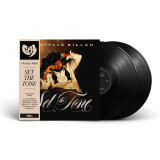
- A1: 6 Minutes (Ft. Jim Jones, Sheek Louch, & Harl3Y)
- A2: Pair Of Hammers (Ft. Method Man)
- A3: Skate Odyssey (Ft. Raekwon & October London)
- A4: Scar Tissue (Ft. Nas)
- B1: Kilo In The Safe (Ft. Iceman)
- B2: Skit 1
- B3: No Face (Ft. Ye)
- B4: Champion Sound (Ft. Beniton)
- B5: Cape Fear (Ft. Fat Joe & Harl3Y)
- C1: Skit 2
- C2: Plan B (Ft. Harl3Y)
- C3: Bad Bitch (Ft. Ja Rule & Trevor Jackson)
- C4: Locked In (Ft. Az & Bee-B)
- C5: Skit 3
- D1: Touch You (Ft. Shaun Wiah)
- D2: Shots (Ft. Busta Rhymes, Serani, & Harl3Y)
- D3: Trap Phone (Ft. Chucky Hollywood)
- D4: Outro Skit
- D5: Yupp! (Ft. Remy Ma)
Black Marble Color Version[39,71 €]
Hip-Hop-Legende Ghostface Killah liefert mit seinem neuen Album "Set The Tone" eine Mischung aus Tracks, die sowohl das männliche als auch das
weibliche Publikum ansprechen: Eine Mischung aus knallhartem New Yorker Rap und melodischen, entspannten Tracks.
Ghostface hat außerdem mit Hip-Hop-Schwergewichten wie Nas, Kanye West, Ja Rule und vielen anderen zusammengearbeitet.
Civilistjävel! returns with »Brödföda«, the successor to 2022’s »Järnnätter« and his fourth release for FELT. The record features collaborations with Laila Sakini, Mayssa Jallad, Thommy Wahlström, ELDON, and Withdrawn.
Tomas Bodén is a revered figure of the aural murk, known primarily for his work as Civilistjävel. It’s an alias that has spawned a catalogue of self-released peculiarities, featuring music that scorns traditional form, instead opting for unfussed symphonies of ice-hued minimalism; soft murmurs that emanate from his studio in the High Coast of Sweden.
On »Brödföda«, his latest album for Fergus Jones’s FELT imprint, subtle new developments in mood prevail. Across its 75 minutes, Civilistjävel! unveils a breadth of emotions that on previous releases seemed distant. He also invites collaborators on record for the first time: Beirut-based singer Mayssa Jallad mournfully croons on »IV«, »VIII« hosts Coldlight’s ELDON & Withdrawn for an abstracted session of dub-hop murk, Laila Sakini offers a hallucinogenic monologue amidst melodica, sticks & bells playing on »IX« and Thommy Wahlström floats scant acid dub stylings on »VI«. These additions and developments bring a forlorn intimacy to the music, and suggest an ambition that few artists of his ilk strive for.
FELT’s (un)reliable cast of audio ghouls routinely summon the odd, with Civilistjävel! often its primary culprit; »Brödföda« gently modifies this path to pursue some of his and the label’s most quaintly beautiful music yet.