- 1: Yellow Theme
- 2: Cocainium
- 3: Take My Bones Away
- 4: Back Where I Belong
- 5: Sea Lungs
- 6: March To The Sea
- 7: Little Things
- 8: Eula
- 9: Twinkler
- 1: Psalms Alive
- 2: Green Theme
- 3: Stretchmarker
- 4: Board Up The House
- 5: The Line Between
- 6: Mtns. (The Crown & Anchor)
- 7: If I Forget Thee, Lowcountry
- 8: Foolsong
- 9: Collapse
Cerca:4 to the bar
THE 1968 ALBUM ON WHICH JOHNNY CASH BECAME A LEGEND: AT FOLSOM PRISON AMONG THE MOST IMPORTANT AND POTENT STATEMENTS OF THE 20TH CENTURY
Johnny Cash already knew his way around Folsom Prison when he and his band stepped inside the institution’s forbidding walls on the morning of January 13, 1968 to record At Folsom Prison. He’d played there two years prior. But this time was different.
Cash took the stage that day for two shows amid a darkening sociopolitical atmosphere and a raging war in Vietnam, as well as the knowledge his career and health hung on by a thread. The Arkansas native shared many of the long odds and abject failures of the inmates for which he performed. The songs he chose, and the conviction with which he delivered them, say as much. The point at which Cash transformed from a country star into a legendary artist, and a bold statement about the American prison state and its commitment to rehabilitation, the triple-platinum At Folsom Prison remains one the most important, potent, and fabled records of the 20th century.
You can hear it echo off the walls of the room; pulse through the itchiness of the Tennessee Three’s acoustic-based boom-chick rhythms; crackle in the announcements conveyed over the intercom; ring in the comedy of the off-cuff remarks and pair of novelty tunes; sense it in palpable energy that wells up within Cash and his audience. And you can experience it like never before via Cash’s knockout singing. The bedrock foundation of all his music, the singer’s baritone resonates with profound degrees of depth, pliability, and passion that underscore how much this appearance meant to him — and the extent he was living the narratives.
Indeed, every song on At Folsom Prison serves a purpose and speaks to the conditions — mental, emotional, physical, geographical, legal, social — the inmates confronted on a daily basis. Beginning with the explicit messages of the opening “Folsom Prison Blues,” Cash makes it clear he understands and shares many of their plights. Not for nothing did the myth of Cash having done hard time persist for decades once this record hit the streets. That’s how real it is, and how dedicated Cash remains to conveying every note with the same truth he invests in the impromptu comments he makes between and amid songs.
Listen to the sorrow, regret, pity, and loneliness of Merle Travis’ “Dark as the Dungeon,” Cash pulling syllables til they threaten to break and inhabiting the mood of bleak phrases such as “pleasures are few” and “the sun never shines.” Witness the isolation, dejection, and sadness punctuating the walking-blues “I Still Miss Someone,” matched in gravity by a solemn reading of “The Long Black Veil” — a traditional dirge that involves murder, cheating, and deception. Cash cuts even deeper on a heartbreaking solo rendition of “Send a Picture of Mother” and plainspoken version of Harlan Howard’s “The Wall,” detailing a suicide disguised as jailbreak through cliched-jaw deliveries that softly curse the impossible situation.
In chronicling temptations, mistakes, mortality, punishment, and life “inside” — for better or worse, the stories of the disenfranchised, forgotten, written-off, and unrepentant — At Folsom Prison also has a blast playing the outlaw role. Cash captures wild-eyed craziness and out-of-control mayhem on a revved-up take of “Cocaine Blues,” taking extra satisfaction in its dastardly tales by way of voice that shifts into character for the sheriff and judge. The gallows humor and racing drama of “25 Minutes to Go”; quicksilver accents and resigned acceptance of “I Got Stripes”; train-whistle blare and twangy locomotion of “Folsom Prison Blues” — all fight the law only to see the law win.
Cash remains deeply committed at every moment, and inseparably connected with the tortured souls removed from the goings-on of the outside world. No wonder all but two songs here stem from the day’s first performance that saw Cash, Luther Perkins, Marshall Grant, and company give everything. As does the Man in Black’s soon-to-be-wife, June Carter. The couple’s fiery duet on “Jackson” scorches; their combination of surrender and fortitude “Give My Love to Rose” puts us in the dying protagonist’s shoes.
And with the closing “Greystone Chapel,” famously penned by convict Glen Sherley, who watched it all happen under the watchful eye of guards, Cash separates the corporeal from the spiritual, relaying lessons about salvation and survival. Heady themes to which he’d return for the remainder of his illustrious career.
Upchuck are experiencing a moment. The Atlanta punk collective just came off multiple tour runs with their good friend Faye Webster. Their Ty Segall-produced second album Bite The Hand That Feeds, with all its buzzsaw guitars and high-speed rippers and headbanging sludge, arrived in October. Later this year, they’ll make appearances at multiple festivals including Coachella. In the midst of relentlessly barreling ahead, the band and their label Famous Class are taking a beat to revisit how they got here. After working with Segall on Bite the Hand That Feeds, the band floated the notion that they wished they could hear what their collaborator could do with the songs on their 2022 debut album Sense Yourself. Holed up in his studio over Christmas with COVID and nothing else to do, Ty Segall began toying with Sense Yourself, sifting through folders of unlabeled stems to find the best guitar parts, emboldening the drum sound, and bringing greater clarity to KT’s vocals, all while bolstering the urgency of the band’s overall attack. With Segall’s new mix, Upchuck’s intense and righteous debut now impossibly overflows with even more fuzz and fury. In Segall, they found a kindred spirit whose studio approach made sense for just how hard they wanted this music to hit. “When we first went to record with Ty for Bite the Hand That Feeds, Mikey and I walked into the guitar room and Ty said, ‘Don’t touch the EQs.’ We looked at the amp and everything was on 10 except the master volume,” Hoff said. Previously, the band had been encouraged to capture the unvarnished sound of the studio. They’d toured with Segall’s band Fuzz, so everybody had the same goal while recording together: Capture the electricity of their intense live set. The band’s shows have a reputation for coming unglued, and there’s no greater document of that than Sense Yourself’s iconic album artwork. With no text, it’s a candid photo of a moment from a show shot on film without editing: blood streaked across KT’s face as they shout into the mic. In the middle of their EP release show, KT was in the pit as a fan started crowd surfing inside a shopping cart. A loose piece of metal near a wheel caught the singer right near the eyebrow and blood was everywhere, an instant piece of iconography snapped by probably every camera phone in the room. When Hoff revisits the message of this first album and Upchuck’s first songs, he thinks back to the year before the band even started when he and KT were hanging out. “We were sitting around talking for eight hours like ‘fuck, that's fucked up, that's fucked up.’” Upchuck became a vehicle for these five people to process how fucked up everything it is—to digest these formative hours-long conversations and put them to bludgeoning, intense rock music. The music is also fun as hell, and that’s part of the point. “There's a lot we need to do as people and a lot of things we need to fix in society but also like come on man like have your fun, wild out, have your drink,” KT says. “But be on your shit at the same time. Check your folk.”
True audiophile joy — now cut at 45 RPM 2LP for better tracking, exceptional bass!
Remastered by Kevin Gray at Cohearent Audio from the original master tapes
Plated and pressed on 180-gram vinyl at Quality Record Pressings!
Stoughton Printing gatefold tip-on heavyweight cardboard jacket
Praise for the 33 1/3 version of The Smoker You Drink, The Player You Get:
"(Side one) ends with the appropriately titled 'Happy Ways,' a Latin-tinged guitar-fest with lovely chunky bass lines that sounds absolutely glorious on this Analogue Productions pressing. The zing of steel string guitar almost sounds dead on the CD and tired on my ancient vinyl pressing, so this is clearly not one of those remasters that's based on an umpteenth generation copy of the tapes. ... You owe it to yourself to hear this album — and it will not sound any better than this spectacular pressing." — Recording = 8/10; Music 10/10 — Jason Kenedy, Hi-Fi+, Issue 148
"An outstanding new 180gm LP reissue from Analogue Productions, with improved sound thanks to a sparkling new remaster by Kevin Gray at Cohearent Audio, makes it clear that this 1973 release remains — with the possible exception of 1978's But Seriously, Folks . . . — the undisputed highlight of Walsh's solo career. ... Another week, another beautiful-sounding, wonderfully packaged reissue from Analogue Productions." Read the whole review here. — Robert Baird, May 2017
In between his stints with the James Gang and the Eagles, Joe Walsh tackled his second solo studio album The Smoker You Drink The Player You Get which became his most successful solo outing. The 1973 LP continued the heavy and light rock mix of tracks found on his previous release, Barnstorm.
Analogue Productions has done reissue justice to the album that AllMusic decries "features some of the most remembered Joe Walsh tracks, but it's not just these that make the album a success. Each of the nine tracks is a song to be proud of. This is a superb album by anyone's standards."
To obtain the best sound possible we turned to Kevin Gray at Cohearent Audio to remaster this superb album from the original analogue tapes. Next we plated the lacquers and pressed LPs on 180-gram audiophile vinyl at the world's best LP maker, Quality Record Pressings. Top it all off with a deluxe Stoughton Printing gatefold tip-on jacket and you've got the makings for audiophile joy.
But would we stop there? Hardly. Now with our 45 RPM release, the best-sounding version of this rock music gem gives listeners an even richer sonic experience. The dead-quiet double-LP, with the music spread over four sides of vinyl, reduces distortion and high frequency loss as the wider-spaced grooves let your stereo cartridge track more accurately.
This amazingly eclectic rock album has Joe's smash "Rocky Mountain Way," his hit "Meadows," plus "Bookends," "Wolf; Dreams" and more! Walsh's ability to swing wildly from one end of the rock scale to the other is unparalleled and makes for an album to suit many tastes.
"Tools of Oppression / Rule by Deception" is the new full length album by The Hope Conspiracy. The album was engineered by Kurt Ballou and Zach Weeks at God City Studios. Artwork for the release was created by acclaimed artist Alexander Heir (Death/Traitors). This is true sonic violence aimed at political division, economic manipulation, war profiteering, media propaganda and other vile forms of global oppression. Air raid sirens wail as the foreboding "Those Who Gave Us Yesterday" and "The Prophets and Doom" explode forth like burning shrapnel. The hell ride continues with "A Struggle For Power" and "Live In Fear", two vicious blasts supercharged with malice and contempt. "Shock By Shock" and "Of A Dying Nation" introduce doom and gloom heaviness, grinding down the tempo to a mid-paced barrage. "Confusion/Chaos/Misery" picks up the pace, going scorched-earth policy on the sociopolitical nightmares that ensnare us all while "Broken Vessels" plows into overdrive about the opioid crisis and addiction as a whole. This leads to "The West Is Dead" a dystopian hook laden hardcore anthem, and epic closer "The Specter Looms"; An ominous soundtrack to the steady decline of our modern age. There is no question, The Hope Conspiracy is back to make a cold hard statement about existence in the end times.
- A1: Space Odyssey
- A2: Against The Odds
- A3: Lush Feat. Tkay Maidza
- A4: Be Easy Feat. Magi Merlin
- B1: Mars Feat. Kurtis Wells
- B2: Gaspard’s Dream
- B3: Blurry
- B4: Quest (Real Love) Feat. Poté
- C1: Interface
- C2: Too Much Of The Same Things Feat. Kurtis Wells
- C3: Closer To The Source (Signals)
- C4: No Escape Feat. Barney Bones
- D1: Sunseeker Feat. The Code
- D2: Left In The Air
- D3: Music For The End
Color Vinyl[26,85 €]
‘EVERYTHING IS HERE’ is a journey through space and time, inspired by the more rarefied aspects of prog rock and the wistful side of psychedelia.
Fusing these influences with the accessibility of French electronic and the groove of R&B and disco, this album depicts the sweet dizziness of contemplation. Nostalgic, yet determined and modern in it’s genre blending, the first album of Kartell truly reveals what’s been underlining in his previous EP.
Taking influences in the space and dream pop aesthetic, the musical approach of the album embraces the 60’s and 70’s fascination for outer space, exotic locations, technologies and science fiction which was on the edge of becoming reality.
Nebulous textures and otherworldly sounds characteristic of space rock are infused throughout the record, while keeping a focus on making catchy songs, leaning on a minor-key groove and a pop yearning. It’s also a challenge and an artistic proposition to gather a wide range of genres to tell a story. Densely produced and cinematic, the album draws a truly living landscape where live bass, drums and guitars hold the line, evolving around hazy effects and synthesizer layers.
- A1: Flameout
- A2: Re-Entry To Mog (That's How It Is)
- A3: Space Odyssey (Sure Listic)
- A4: Astral Freakout (A Love Built On Sand)
- A5: Orbit Fantasy (Inside Looking Out)
- A6: Blues For The Guru
- A7: Strings For Ravi
- B1: Barrier X-69 (Slippin' & Trippin')
- B2: A Dissappointed Love With A Desensitized Robot
- B3: Where Were You In 1982?
- B4: Trippin' On Lunar 07
- B5: A Bad Trip Back In '69
- B6: Karma Sitar
- B7: Whiplash
- B8: Instant Nirvana
When first released Astro-Sounds From Beyond The Year 2000 promised an uncharted trip beyond the now generation! And it certainly delivered, as soon as the needle drops onto the opening track ‘Flameout’
we are in astral freak-out territory with cosmic strings phased beats & displaced fuzz guitars... Despite being released as a budget label’s take on the burgeoning psychedelic scene Astro Sounds, delivers the real deal.
This is thanks in no small part to the central role played by Wrecking Crew guitarist Jerry Cole. Cole had previously been the involved some L.A. session colleagues and cut his own psychedelic
album: The Inner Sounds of the Id by 'The Id' and was the perfect choice to front Astro Sounds which can be considered a development from the seminal sounds of the Id.
Astro Sounds has suffered from some unofficial releases that offer poor audio quality. This Vinyl Exotica re-issue is remastered from the original tapes and is presented on coloured vinyl
COBRA THE IMPALER is now a well-oiled killing machine, ready to take on anything that comes on its path. Taking strong cues from the New Wave of American Heavy Metal, COBRA THE IMPALER forges together larger-than-life grooves and spirited guitar leads with enchanting clean vocal harmonies and razor-sharp screams. Effortlessly flowing from breakneck riffs to tasteful melodic breaks, the band makes strong use of stylistic elements from groove, thrash, and classic heavy metal. Like many legendary metal acts from the 90s, COBRA THE IMPALER marries brute force with meticulous attention to detail, amounting to an unstoppable advance and an enticing experience diverse in punishment. 'Karma Collision' is an exercise in empowerment as well as a show of subtle restraint. Defiant to the end, COBRA THE IMPALER deliver a blatantly guitar-powered album full of huge riffs and equally huge choruses that instantly nestle themselves in your mind. Proving themselves as masters of melody as well as destruction, COBRA THE IMPALER hits hard while forcing an inescapable headlock, delivering salvation to those who worship, but certain punishment for those who dare to stray. For fans of Mastodon, Gojira, Baroness, Megadeth
An’archives presents the latest album by Japanese free saxophonist and vocalist Harutaka Mochizuki, Doppelgänger ga boku wo. Since the early 2000s, Harutaka has quietly, yet steadily, released a string of solo and collaborative releases that have allowed multiple perspectives on one of the most singular voices in modern music. In collaboration, he seems to prefer the duo format, and digging through his discography, you’ll find releases where he pairs with Tomoyuki Aoki (of Up-Tight), Michel Henritzi, and Hideaki Kondo. But Harutaka’s solo performances, with their lyricism and physicality, are where the magic truly happens.
If earlier albums, like Solo Document 2004 (Bishop, 2005) and Pas (no label, 2014), were raw documentations of solo alto saxophone performances, in recent years, Harutaka’s solo albums have become more complex, more mystifying. Most significantly, they’ve become more personal; there are few musicians extant whose albums feel quite so much like diaristic interventions, and Harutaka’s music now is deeply moving in its intimacy. Developing that thread of revelation, Doppelgänger ga boku wo offers a still richer exploration of many facets of Harutaka’s artistry.
The two double-tracked alto saxophone performances here feel consummate, with Harutaka shadowing himself, exploring the possibilities of the multiple self: Doppelgänger is me, indeed. The playing here is rich with affect, but still exploratory, voiced with rigour and intent. Two short pieces for keyboard and voice (about Giacometti and Genêt, respectively) are fragile miniatures, with clusters of chords, and passing phrases, wrapping around Harutaka’s untutored but lovely singing.
The ‘karaoke’ performance that closes the album, of “Woman ‘W no higeki’ yori”, speaks to the iterative aspects of Harutaka’s music. A cover of the Hiroki Yakushimaru song, the theme to Shinichirō Sawai’s 1984 film W’s Tragedy, he’s returned to this song several times, and here, his delivery perfectly captures the spirit of what Michel Henritzi, in his typically beautiful liner notes, evocatively details as “one of those sad love songs that accompany lonely sake drinkers in smoky night bars, sharing their spleen.”
Gorgeous, human, heartrending - Doppelgänger ga boku wo is Harutaka Mochizuki in element and in spirit.
Freedom is deeply rooted in the working-class rock of the 70's and 80's, giving us a sound like no other. With meaningful lyrics, power chords and mighty choruses, they're inevitably creating a soundtrack to the journey of life itself. Nicke Andersson once described Freedom as a "bargain basement Springsteen" - a band making music meant to follow you through thick and thin, far into those never-ending summer nights.
Since Freedom first started in 2019, they've established themselves as an amazing live act, filling clubs throughout Sweden with both energy and audience. In 2022 they were honorably chosen to play at the official release party of The Helicopters at the notorious Hamburger Börs in Stockholm.
The band recently added two new members to the crew: Ola Göransson (Heavy Feather, Stacie Collins) and Matte Gustafsson (In Solitude, Siena Root, Heavy Feather). Their combined experience of heavy roots-rock and sense of stage presence, makes Freedom one of Swedens strongest live bands - guaranteed.
Their self-titled debut album from 2021 became a great topic of conversation, leaving a permanent mark in the rock-world of Sweden. Finally, it's time for the awaited second album to be released - once again produced by Martin "Konie" Ehrencrona (Viagra Boys, Håkan Hellström and Les Big Byrd).
ush's eighth studio album, Moving Pictures, was released in 1981 and features the Top 10 hits "Limelight" and "Tom Sawyer." 40th Anniversary Edition LP cut at half-speed on 180-gram vinyl and wrapped in a premium tip-on gatefold jacket with one of six hand-drawn lyric sheets by Neil Peart.
Released in 1981 at the dawn of the age of sequencing and synthesizers, Moving Pictures has one musical foot firmly in the 70's and the other stepping into the future of recording technology. This global smash includes the ultimate prog-instrumental, YYZ; the band's ode to live performance, Limelight; Witch Hunt, which explores socio-politics; and Tom Sawyer, which captures the feelings behind teenage alienation more succinctly than any song that has since followed, save Nirvana's Smells Like Teen Spirit. This recording is considered by many to be the absolute best Rush. - Jodi Lutz
There's something spellbinding about Rhythm Rhyme Revolution’s seductive intensity and it’s all cleverly wrapped up in this rather sterling EP.
Summertime (nuacidfunk) slowly builds and changes tempo into a disco crescendo, in the style of Love Hangover, with Dan Lipman’s glorious jazz flute/sax weaving in and out of Gareth Tasker’s fantastic coral sitar riff that wouldn’t sound out of place on a Stylistics record.
The flipside - Sunshine Girl’s slinky Afro percussive groove builds pace as DJ Tabu merrily coos about making love in the sunshine and Barrie Sharpe’s vocal hooks chime in agreement:
bolstered by crisp guitar and Kenny Wellington’s jazzy mute trumpet darting around the sonic pool like a magnificent dragonfly. The arrangement has first class interplay and ensemble work too and the funky clavinet and bluesy electric piano really add to this slick
vibe.
Also on the flipside is the already established original version of Summertime from RRR LP #1 - which I can only compare to the Motown classics.
Sharpe is the master tease who builds a grand mood and positively revels in it. You will too,suffice to say, find this record is a real touch of class.
Emrys Baird (Blues & Soul)
After five long years, Balance and Composure return with Too Quick To Forgive--newly signed to Grammy-nominated producer Will Yip's label, Memory Music, the alt-rock darlings sound more assured and adventurous than ever across two vulnerable tracks. Too Quick To Forgive is a reflection on personal perseverance in the wake of confrontation, told through two distinctly different scenarios. "Savior Mode" finds frontman Jon Simmons baring his soul in a way that is unparalleled in their discography, while "Last To Know" is an emotionally-resonant highlight that leaves a lasting impact well after its final notes play out. Simmons' vulnerability and emotional delivery across both tracks cut through with unflinching precision courtesy of Andy Slaymaker (guitar), Matt Warner (bass), Erik Petersen (guitar), Dennis Wilson (drums), and who the band considers their 6th member--producer Will Yip. In the fall of 2022, the group got together at his Conshohocken, PA studio, Studio 4, with a few ideas that Yip helped turn into these otherworldly tracks. "It was all magic," Jon says. With a renewed sense of purpose, Balance and Composure will return to the stage for a series of Too Quick To Forgive release shows in some of the biggest rooms they've ever played.
- Complexo De EPico
- A Noite Do Meu Bem
- Cademar
- Todos Os Olhos
- Dodo E Zeze
- Quando Eu Era Sem NingueM
- Brigitte Bardot
- Augusta, AngeLica E ConsolacA~O
- Botaram Tanta FumacA
- O Riso E A Faca
- Um "Oh" E Um "Ah
- Complexo De EPico
Todos os Olhos is one of the most emblematic and essential records of the confrontational music of Brazil. By denouncing, criticizing, and mocking the trend of "heroes" who made "protest music" at the time, Tom Ze? signed his eremitic letter of exclusion but not without "contest the contestation". Excommunicated from the MPB and even from Tropica?lia, in Todos os Olhos Tom Ze? presented, with a lot of courage, an unusual way of fight Brazil's military dictatorship. All that would be later triggered in Tom Ze?'s career is here, always ready for a new rediscovery.
Introducing ‘‘Sad Lovers and Giants’’, a captivation debut album that delves into the personal journey of self-discovery and emotional exploration. Each song is a heartfelt expression of Crystal’s experiences, painted with raw honesty and authenticity. With a blend of genres and a focus on evoking emotions, this album showcases the duality, embracing both beauty and darkness.It’s a musical striptease, where she bares her soul, using her raw voice to convey the depth of her emotions. ‘‘Sad Lovers and Giants’’ transcends genres, aiming to touch hearts and connect with listeners on a universal level. It’s an intimate portrayal of the artist’s inner world, inviting you to join on a captivating journey of self-expression and personal growth.
Brooklyn Sounds legendary 1971 debut album, full of heavy Nuyorican underground salsa dura propelled by raw trombones and in-your-face percussion, born of the barrio streets and the band’s Caribbean heritage.
Fully authorized by producer Bobby Marin, with liner notes detailing the Brooklyn Sounds story, featuring never-before seen photos and pressed on 180g vinyl.
Absis returns to Hivern Discs with his Fenix EP. Six cuts that dive deep into Salva's more abstract and slow side keeping his signature reverberating drums and droning landscapes. Comes with poster that will be printed, together with the sleeve, at L'Anacronica in Barcelona, with letterpress on a shiny silver cardboard.
Some songs are so ingrained in our consciousness that they are immediately identifiable upon hearing one or two notes. Featuring one of the most indelible riffs ever played, Foghat's air-guitar anthem "Slow Ride" is such a tune. The hit single turned the British band into stars and catapulted 1975's Fool for the City up the charts. And what a ride it is.
We hear a lot of yearning today about the good-old, glory days of rock and roll, the simple kind that just locked into a good beat, turned out a raunchy groove, and simply kicked you in the butt. The no-pretense type meant for kicking back, letting loose, and surrendering to the melody. Bare-bones music that doesn't need image or looks as a crutch.
Well, this is it, friends, classic meat-and-potatoes 70s rock that comes with killer slide-guitar solos, crunchy leads, driving rhythms, and soaring vocals. No need for any further instructions or explanations. The pact between artist and audience is understood. Here, the band trusts that you know what to do and is ready to rock out with anyone in earshot.
Pressed at Fidelity Record Pressing, Mobile Fidelity's remaster of this Foghat gem bring to the surface the band's marble-solid sturdiness and bluesy structures like never before. Bass notes are thicker and richer, the dual guitars bite and snap, and Lonesome Dave Peverett's singing comes across with realistic grit. This LP invites you to hear and feel the energy Foghat brings to the boogie-infused title track, great cover of the Righteous Brothers' "My Babe," and, of course, the everlasting "Slow Ride."
- A1: Barry Woolnough - Great Father Spirit In The Sky
- A2: David Holmes & Steve Jones - The Reiki Healer From County Down
- A3: The Children Of Sunshine - It's A Long Way To Heaven
- A4: Spark Sparkle - Slythtovery
- A5: Alain Maclean - Talking Judgement Day Blues
- A6: David Crosby - Orleans
- A7: Buddy Holly - Love Is Strange
- B1: After Dinner - Paradise Of Replica
- B2: Lullaby Movement - Ru-Ru (Sleep Little Baby)
- B3: Jeff Bridges & Keefus Ciancia - It's In Every One Of Us
- B4: Song Sung - I'm Not In Love
- C1: Neo Maya - I Wont Hurt You
- C2: Bp Fallon & David Holmes - Henry Mccullough
- C3: Documenta - Love As A Ghost (Produced By David Holmes)
- C4: Keith Fullerton Whitman - Stereo Music For Acoustic Guitar, Buchla Music Box 100 Hewlett Packard Model 236 Oscillator, Electric Guitar And Computer Part I
- D1: Eat Lights Become Lights - Into Forever
- D2: Geese - Andrew Parsnip
- D3: Die Hexen - Gloomy Sunday
- D4: Jon Hopkins & David Holmes Feat Stephen Rea - Elsewhere Anchises
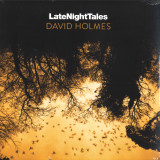
DJ and producer David Holmes is welcomed to the Late Night Tales fraternity with an evocative collection of personal songs and music, peppered with exclusive new material and rare gems. By now, I think we all know David Holmes, right There's acid house Holmes, with bone-rattling Chicago jams and Detroit destroyers, break-digger Holmes responsible for the grittily shaking 'Let's Get Killed' and seminal Essential Mix compilation (which brought Sixto Rodriguez to people's attention, and then there's soundtrack Holmes. His most enduring and vital source of musical inspiration - cinema - plugged into David's rst solo record 'This Film's Crap, Let's Slash the Seats' and inspired 2000's 'Bow Down to the Exit Sign', created as the soundtrack to a not-yet-made movie. Ofcial soundtracks have been bountiful, including scores for Soderbergh's Out Of Sight and Ocean's trilogy, '71, Hunger and Good Vibrations. In a series of personal songs sung by himself, David's last solo album 'The Holy Pictures' explored inuences of La Düsseldorf, The Jesus and Mary Chain and early Brian Eno. His Unloved collaboration with Keefus Ciancia and Jade Vincent then took us on a musical journey full of raw 60s pop-noir, psychedelia and French Ye Ye with a contemporary twist. Somehow he's also found time to produce records by Primal Scream and Jon Spencer Blues Explosion. Unsurprisingly, for someone au fait with matters cinematic, this Late Night Tales conjures up its own mindmovies. It's not only packed with the judiciously selected nuggets for which his mixes are noted but also stuffed with original material, including collaborations with BP Fallon and Jon Hopkins and an amazing new reading of 10cc's 'I'm Not In Love' by Holmes-produced Song Sung. In fact, there's a Celtic thread running through the whole journey with Stephen Rea's reading of an extract from Seamus Heaney's AENEID BOOK VI - Elsewhere Anchises. Among the other gems included here are David Crosby's lush 'Orleans', Buddy Holly's celestial 'Love Is Strange' and the Children Of Sunshine's 'It's A Long Way To Heaven'. David Holmes loves music. It's a way of expressing the sometimes inexpressible or the inconsolable, a questing desire to nd out just what is over the next hill. It's no surprise to learn he's a keen walker. Always on the move, headphones on, lost in some reverie or piece of music, the soundtrack to his life, the stuff that feeds his imagination. I walk a lot. It's amazing for listening to music: your phone or your emails aren't going and you're just in the forest listening to music. It's so intimate. Anyway, I was listening to the KLF's Chill Out album, which still sounds amazing, but it triggered an idea with concrete sounds through travelling and movement. And one of the things I was trying to do was to use this idea not just break up the moods but also as a metaphor for moving through life and arriving in different destinations or arriving at different stages in different parts of your life. Memory, Love, Living, Family, Friendship, Healing, Death and The Afterworld are some of the themes I wanted to explore within this record. Although these strong themes and tracks are personal to me, I also wanted it to be a great listen that was unpredictable yet had a seamless ow - a journey that was personal to me yet to the listener a great compilation of music that they may or may not have heard before. I hope I've succeeded in the later.' David Holmes 2016
- A1: Chakachas - Stories
- A2: Mad Unity - Funky Tramway
- A3: René Costy - Ostinato Bass
- A4: Alex Scorier - Topless
- B1: Open Sky Unit - Sunshine Star
- B2: Plus - Gimme Some More Of That
- B3: André Brasseur - Funky
- B4: Chicken Curry & His Pop Percussion Orchestra - Librium
- C1: Placebo - Balek
- C2: Les Hélions - Music & C°
- C3: Black Blood - Avenue Louise
- C4: S.s.o. Feat. Douglas Lucas & The Sugar Sisters - Tonight's The Night
- D1: Nico Gomez & His Afro Percussion Inc. - Ritual
- D2: André Brasseur - Saturnus
- D3: Chocolat's - El Caravanero
2024 Repress
Funky Chicken brings together some of the best Belgian dance tracks from the early seventies. Emerged in a country where virtually every musical wave passes through, most of these tunes were created and recorded by hired guns, in this case a few clusters of gifted session musicians and composers. The music on Funky Chicken is their take on (afro-)funk, soul and Latin. Some of their releases were hit parade cannon fodder, but occasionaly, some spare studio time or the urgent need for a B-side allowed for memorable musical experiments.
Funky Chicken is a post-fact documentation, the result of a quest into a period on which information is few and far between, the 'black hole' in Belgium's history of popular music. The barren wasteland between the variety orchestras of the sixties and the electronic revolution of the late seventies and early eighties. This series explores the ground the dance pioneers built upon.