Rachel Baiman’s ‘Thanksgiving’ EP is a collection of music to inspire an introspective holiday spirit. The songs center around themes of Indigenous Rights, home and homelessness, and love in hard times.
Baiman called upon her superb live touring band (Cy Winstanley, Shelby Means) in addition to special collaborators including flatpicking guitar master Molly Tuttle, who features prominently on a spirited John Hartford cover, “Madison Tennessee” to bring these
thoughtful songs to life. ‘Thanksgiving’ allows Baiman space to stretch out stylistically and marks an intriguing followup to her celebrated full-length debut ‘Shame’.
Baiman moves with ease from bluegrass, to folk, to old-time and country sensibilities over the course of these four tracks. Her adept lyricism is again on full display, as she sheds new light on the complex, bittersweet feelings of both hardship and hope that often intertwine around the holiday season.
Buscar:7 record cover
NEW REPRESS IN HARD CARDBOARD SLEEVE + OBI + INSERT WITH LINER NOTES
+ RESEALABLE OUTER SLEEVE.
Christopher were an underground acid rock trio featuring future Josefus drummer Doug Tull. They evolved from United Gas, a psychedelic band from Houston who rubbed shoulders with legends like The 13th Floor Elevators and Moving Sidewalks . After relocating to Los Angeles - where they changed his name to Christopher - they played at numerous biker parties and recorded their sole album in 1970 for the Metromedia label. It’s an amazing example of West Coast psychedelia / acid-rock featuring strong fuzz-wah guitar, great compositions and superb musicianship. It was housed in a terrific cover depicting the band at the same hippie crash-pad where some scenes from the “The Trip” movie were filmed.
One of the holy grails of American psychedelic-rock and the rarest album originally released by the collectable Metromedia label.
Remastered sound, original artwork, insert with liner notes.
Note: This is the only legitimate, fully-authorized vinyl reissue of Christopher in the current market. Beware of inferior, low-quality bootlegs.
- A1: Samba Negra - Eberebijara
- A2: King Somalie - Monkey 'S Dance
- A3: El Grupo Folclórico - Tamba
- A4: Los Viajeros Siderales - El Campanero
- A5: Rio Latino - Ayu
- B1: Aníbal Velásquez - La Mazamorra Del Diablo
- B2: La Francachela - Mosquita Muerta
- B3: El Grupo Folclórico - Juipiti
- B4: King Somalie - Le Mongui
- C1: El Grupo Folclórico - El Tornillito
- C2: Samba Negra - Long Life Africa
- C3: La Banda Africana - Te Clavo La... Mano
- C4: Myrian Makenwa - El Platano
- D1: El Grupo Folclórico - Tucutru
- D2: Grupo Bola Roja - Caracol
- D3: El Grupo D'abelard - Otro Perro Con Ese Hueso
- D4: Conjunto Barbacoa - Wabali
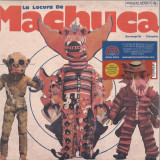
La Locura de Machuca is the story of one man’s bizarre odyssey into Colombia’s coastal music underground, and the wild, hypnotic sounds he helped bring up to the surface.
One night in 1975, a successful tax lawyer named Rafael Machuca had his mind blown in Barranquilla’s ‘Plaza de los Musicos’. Overnight he went from a high ranking position in the Columbian revenue authority to visionary production guru of the newly formed record label that bore his name, Discos Machuca, and for the next six years he devoted his life to releasing some of the strangest, most experimental Afro Psychedelia Cumbias ever produced. La Locura de Machuca is the story of one man’s bizarre odyssey into Colombia’s coastal music underground, and the wild, hypnotic sounds he helped bring up to the surface.
The Colombian music industry was thriving in the mid-seventies, but while homegrown bolero and vallenato tunes were doing well on the charts, it was imported African records that were setting crowds on fire at the picos – the sound-systems that fuelled neighbourhood parties – and wherever those records were played there were always a handful of groups who were inspired to plug traditional Cumbia directly into the electric currents coming from across the Atlantic.
It was these obscure bands, who fused Colombian and African rhythms with the swirling organs and psychedelic guitars of underground rock, that fired Machuca’s imagination. While the label made its money releasing popular hits by legends such as Alejandro Durán and Aníbal Velásquez, that money was poured back into a unique run of experimental releases by fringe artists such as La Banda Africana, King Somalie, Conjunto Barbacoa, and Abelardo Carbono, one of the godfathers of Champeta Criolla.
When Machuca couldn’t find groups to realise his particular vision, he simply created them himself. Drawing on a fearsome roster of musicians associated with the label, he assembled bands that lasted only as long as it took to record an album ,and unleashed the results – complete with arrestingly unusual album covers – under a series of different names such as Samba Negra or El Grupo Folclórico. This unorthodox approach led his longtime recording engineer, Eduardo Dávila, to describes Machuca’s productions as the “B-Movies of Colombian music.”
The story of Doctor Machuca and his eccentric exploits tells of one of Colombia’s most atypical and peculiar record companies; a defining pillar of Afro-Caribbean psychedelia. His productions have come to represent the roots of Champeta and set the pedigree standards for Afro and Costeño avant-garde. The seventeen tracks on La Locura de Machuca, harvested from the darkest, strangest corners of the Discos Machuca catalogue, sound like little else recorded before or since.
In 1978 Pharoah Sanders went into the studio with pianist, Ed Kelly, who was an important figure in the local San Francisco and Oakland jazz scene. The two of them recorded six tracks which ranged from covers of standards, through soul jazz through to two real gems. The album was originally released as Ed Kelly and Friend due to Pharoah being contracted to Arista Records at the time. Indeed, as you can see, the cover shows Kelly playing next to Pharoah’s hat, shoes and Selmer tenor saxophone.
Rainbow Song, a Kelly composition, opens matters in a manner far removed from Pharoah’s work on his Impulse albums (although there had been a dramatic change of course when he signed with Arista and recorded). This is firmly in Grover Washington Junior territory with a liberal sprinkling of oh so tasteful strings. The Master’s sound is full and mighty as ever.
With the radio track out of the way it is business as hoped for and Newborn is a Sanders composition that burns with intensity. The power of his solo is as good as anything he has produced and he runs over the full span of the tenor’s range and onwards into territory lesser known or explored by 99% of sax players.
Sam Cooke’s You Send Me is treated with reverence and respect, with Pharoah delivering a sensitive and heartfelt rendition and ending with some extraordinary phonics, which we will meet again on later albums. Kelly’s accompaniment complements Sander’s playing before he receives his own space for a shimmering yet restrained solo which discloses what this non-pianist assumes to be an agile right hand.
Answer Me My Love is an early 50’s ballad with a fascinating back story. On its initial release in post-war Britain, covers of this fine melody stirred sufficient controversy for the song to be banned by the BBC. What led to it being barred from broadcast on the Light Programme and treated like Anarchy For The UK, Wet Dream and Give Ireland Back To The Irish? I can reveal that the reason for this draconian action was that the original version was entitled ‘Answer Me, My Lord’. In the olden days, it seems that a direct appeal to God was considered to be blasphemous- especially if set in a secular or selfish. Further research indicates that Nat King Cole made the most celebrated recording and that Bob Dylan used to sing it live in the 1990’s, presumably during his overtly Christian phase. Anyway, it is a grand tune.
Pharoah went on to record at least three studio versions of his great anthem You’ve Got To Have Freedom but the one here is the earliest incarnation that I am aware of. It is also the most restrained treatment of the theme, although Pharoah’s solo shows his ability to play with fire and power over the entire range of the horn. There’s plenty of space for Kelly’s piano too and he provides an elegant setting for Sanders’ exploratory work.
arbitrary presents the 2020 remaster & vinyl reissue of PM016 by Danish musician Mads Emil Nielsen, re-mastered and cut by Kassian Troyer, with cover artwork by visual artist Dane Patterson.
Originally released as limited edition C30 tape on Plant Migration Records in 2014, the four pieces on Nielsen’s first solo release are based on short orchestral and percussive samples manipulated by various synthesizer modules and effects processors. Variations are created by emphasizing different frequencies, harmonics, sections of short loops and the various surprises that result from the idiosyncrasies of each machine.
This vinyl reissue is part of the Black Box series of releases with music & audio originally made for theatre pieces, performances, installations, radio soundtracks, compilations and remix collaborations. The series showcases a more melodic side of Mads Emil Nielsen’s work, who, during recent years, has been focused on more abstract electronic/acoustic material – such as his collaboration with Andrea Neumann and Framework series (graphic scores & recordings).
Written & produced by Mads Emil Nielsen, Copenhagen, 2013. Originally released as limited edition C30 tape on Plant Migration Records (US), 2014.
In 1990 Neil Hannon started recording and releasing under the name The Divine Comedy. Thirty years and twelve great albums later, Hannon is rightly adjudged one of the finest singer songwriters of his generation. To celebrate, Divine Comedy Records are updating and reissuing the band’s catalogue.
‘Foreverland’ - a record about “meeting your soulmate and living happily ever after... and then what comes after happily ever after” - was first released in 2016. Mojo described it as “Funny, learned and
poignant by turns,” while Uncut said it was “sumptuous, orchestral pop laced with lyrical absurdity.”
The album includes singles ‘Catherine The Great’ ‘How Can You Leave Me On My Own’ and ‘To The Rescue’.
The updated LP edition consists of the original album, packaged with a digital download code for the album plus bonus tracks of demos and alternate versions lovingly curated by Neil Hannon, much of which have never been heard before.
The LP is pressed on heavyweight black vinyl in a gatefold sleeve accompanied with photos, credits and extensive liner notes written by Neil, covering the context and inspiration behind the album and
its songs.
Kurt Vile’s ‘Speed, Sound, Lonely KV (ep)’ was recorded and mixed in sporadic sessions that spanned four years at The Butcher Shoppe studio in Nashville, TN. It includes five songs - covers of John Prine and “Cowboy” Jack Clement as well as two originals - and was recorded alongside a cast of local heavies like Bobby Wood, Dave Roe and Kenny Malone, with Dan Auerbach (The Black Keys) and Matt Sweeney (Chavez, Superwolf) tossed into the mix as well.
Most importantly, it features what KV has called “Probably the single most special musical moment in my life” - a duet with the late John Prine on the songwriter’s well-loved tune, ‘How Lucky’. “The truth is John was my hero for a long time when he came into The Butcher Shoppe to recut one of his deepest classics with me. And, man, I was floating and flying and I couldn’t hear anything he told me while he was there till after he was gone for the night,” notes Vile in a personal statement that accompanies the record. “A couple nights later we were playing ‘How Lucky’ together again; this time onstage at the Grand Ole Opry on New Year's Eve at the turn of 2020. Nothing like seeing John and his band of musical brothers and family and friends playing into the new decade in front of an adoring audience on that stage in Nashville, TN... and, yup, that’s just how lucky we all got that night."
“If you have a vacancy for Favourite New Band, Pom Poko would like to apply for the role,” tweeted Tim Burgess in April, as Norway’s finest punkpop anti-conformists revisited their joyous debut album, ‘Birthday’, for one of Tim’s mood-lifting Twitter listening parties. Pom Poko pimp their CV on all fronts with their glorious second album, ‘Cheater’. Between the quartet’s sweet melodies, galvanic punky ructions and wild-at-art-rock eruptions, ‘Cheater’ is the sound of a band celebrating the binding extremes that make them so uniquely qualified to thrill: and, like Tim’s listening party, to fulfil any need you might have for a pick-you-up.
As singer Ragnhild Fangel explains of the leap from ‘Birthday’ to ‘Cheater’, “I think it’s very accurate to say that we wanted to embrace our extremes a bit more. In the production process I think we aimed more for some sort of contrast between the meticulously written and arranged songs and a more chaotic execution and recording, but also let ourselves explore the less frantic parts of the Pom Poko universe. I think both in the more extreme and painful way, and in the sweet and lovely way, this album is kind of amplified.”
The sound of four distinct personalities driving in divergent directions towards one destination, the result is an evolved snapshot of the bracingly contrary chemistry forged when Fangel, Tonne, Jonas Krøvel (bass) and Ola Djupvik (drums) united to play punk during a jazz gig at a literature festival in Trondheim (the band-members studied jazz there).
Along the way, the band drew praise from NME, Interview Magazine, DIY, PopMatters, The Line Of Best Fit, The Independent and BBC Radio 6, where Miranda Sawyer was moved to note that “‘Birthday’s ‘Crazy Energy Night’ seems to contain about 20 songs in one.” Meanwhile, a huge touring schedule included countless sold-out headline shows and a rapturously received UK jaunt with Ezra Furman.
‘Cheater’ does its predecessor proud on every front. Bursting with colour and wonky life from its cover art (by close collaborator Erlend Peder Kvam) outwards, it differs from ‘Birthday’ primarily in that its songs did not have a chance to be road-tested before going into the studio. But you wouldn’t know it. As Ragnhild explains, “That meant we had to practice the songs in a more serious way, but it also meant the songs had more potential to change when we recorded them since we didn’t have such a clear image of what each song should/could be as the last time.”
140g clear vinyl LP with PVC printed outer sleeve and digital download code.
-LTD. COL. EDITION-
We are always sitting on a handful of unreleased songs that didn't make their way to albums. Listening back to these gems we decided to launch a new series entitled Big Crown Vaults and the first volume features the music of Lee Fields & the Expressions. These tunes were cut during the Special Night & It Rains Love sessions. Listening to these tracks you can imagine how difficult some of these decisions were in the first place to leave them off the albums. An absolute standout is "Regenerate," a song that finds Lee in the country soul realm, a style that Mr Fields, a North Carolina native, flourishes in. A drum break starts the song and then drops into a chorus where El Michels, Paul & Big Bill Schalda belt out the earworm chorus. Lee sings an encouraging tune about finding your way out of a low point in a relationship while The Expressions lay down an airtight groove. "Thinking About You" takes it back to the dance floors with what will surely be a hit at Soul parties around the globe. An uptempo drum break opens the song and Lee launches into a tale about the unbreakable bond with his significant other and how they keep each strong through moments of hardship and pain. People who have seen Lee perform live in the last decade might have been lucky enough to hear his rendition of Little Carl Carlton's "Two Timer". For those of you who haven't heard it, Big Crown Vaults has got you covered. A faithful version of the song showcases Lee's gorgeous voice and the Expres- sion's unwavering groove. Another treat on here is the fuzzed out funk banger "Do You Know" where Fields uses his platform to address some of our societal woes in a "Make The World" style. A deeper from the vaults number is "Out To Get You", an instrumental that Lee never laid down vocals to. Even as just a rhythm track it stands as a testament to The Expressions musical prowess, the band that created 5 studio albums with Lee Fields which will go down in history as stone classics.
It is often the case with popular music that those recordings which have the most profound impact and long-term appeal are often the ones which are produced in a moment without much deliberation or agenda. And that has certainly been the case with Slow Club’s EP of Christmas songs.
The first single from the E.P, Christmas TV, was actually written in soundcheck at Birmingham Barfly and released as a free download for Christmas 2008. The rest of the EP was written and recorded in a short burst in late summer 2009 at Axis Studios in Sheffield and in their friend’s bedroom. It came at a moment of intense creativity for the band when the songs were coming thick and fast and the duo were really hitting their stride. The differing musical styles of the pair was already becoming apparent across the three original compositions and three covers, and there is a real sense of a band pushing their limits in a way which would coalesce in the recording of their breakthrough second album the following year.
Philadelphia’s Another Michael present two new songs arriving this fall on Run For Cover Records. Leadoff track ‘New Music’ builds from a solitary guitar strum into a thoughtful arrangement com-plete with vocalizing in the vein of Bon Iver. B-side track “Boring For The Times” recalls the saccharine indie-pop bliss of artists like Andy Shauf and Whit-ney.
‘Chorochronos’ is a collection of four gorgeous experimental works for clarinet, percussion and electronics.
Red Desert Ensemble (Katie Porter and Devin Maxwell) lovingly recorded duos they’ve performed for almost two decades in small spaces, for even smaller audiences all over the US (and Canada) by Andre Cormier, Lucie Vitkova and Michael Pisaro alongside a huge new spectral work for clarinet and electronics by Maxwell.
The result is exceptional, a document of music trapped in ether or volcanic rock, both unearthed stillness and totally jarring, a perfect music-as-art for our time. With cover artwork by Christine Heindl, liner notes by Adam Tinkle, design by Phillip Niemeyer and video art by Svavar J natansson.
This album could easily have turned top-heavy. After all, here’s a record which, in just under 40 minutes, covers anything from Arabic scales to Japanese sounds, from free jazz references to concepts by Finnish pianist Kari Ikonen’s favourite painter Vasiliy Kandinsky.
To realise his vision, Ikonen even personally developed a device allowing him to play micro-intervals on his piano. And yet, things turned out differently: If anything, the results sound dream-like and mesmerising rather than stodgy and severe.
The album’s genesis may serve to explain this paradox. In August of 2019, Ikonen suddenly found himself with a month of free time. Without thinking twice and as if in a premonition of the Covid-lock-down, he recorded ‘Impressions, Improvisations and Compositions’ at his own home. His only companion was his beloved Steinway, captured by a personal selection of high-end microphones. Just a few days after the final session, the pieces landed on the desk of ECM- and Blue-Note-engineer Johannes Lundberg who mixed the album at his Gothenburg Epideminstudios. Clearly then, the music is spontaneous. But it’s also refined and deep. The influence of Kandinsky inspired
Ikonen to write some of his most complex and monumental pieces.
Alfredo "El Inca" Linares is one of the best and most beloved musicians in the history of salsa. Fans love his piano playing because of his authentic Cuban feel and 'swing' combined with progressive arrangements and uncompromising phrasing. "Lo Que Tengo" is full of rock solid dance floor killers and no filler, recorded in 1980 with some of the cream of the crop of contemporary Venezuelan salsa musicians (members of Mango, Madera, El Trabuco Venezolano, Los Dementes, Los Melódicos, Dimensión Latina, Guaco, and La Salsa Mayor) and launched there on the indie label A.L.G. Records as ¡Con Todo!, and then a year later on the much larger Velvet Records with a different cover. This a classic Alfredo Linares album, but with the updated studio sound of 1980s Caracas. With five perfectly paced salsas, one funky cha cha chá, a steamy bolero and a dance-friendly Latin jazz number to top it off, there is something for everybody on this record. Thankfully today's generation can now enjoy this rarity at a fraction of the cost of an original copy. Presented in its original artwork and pressed on 180g vinyl. Good to know: Alfredo "El Inca" Linares is one of the best and most beloved musicians in the history of salsa. Fans love his piano playing because of his authentic Cuban feel and 'swing' combined with progressive arrangements and uncompromising phrasing that puts one in mind of Eddie Palmieri. As a composer, arranger and band-leader Linares is highly respected as well. Ever since the 1960s in Lima Peru when his career began, his records have always been on point, being super tight, sharp, and hard as hell, what salseros call salsa brava con afinque. It's no surprise that Lo Que Tengo is exactly that: full of rock solid dance floor killers and no filler, played with verve and flair. Unlike some of his other records that were patched together from various sessions made in different studios (sometimes even in several countries!), this album has the advantage of being produced, recorded and mixed by Alfredo Linares all in one studio and block of time, and backed by hand-picked seasoned professionals who Linares had already played with, both in the studio and on stage, lending it a consistency and sonic integrity that is excitingly manifest in every groove. The album was recorded in 1980 in Caracas with some of the cream of the crop of contemporary Venezuelan salsa musicians (members of Mango, Madera, El Trabuco Venezolano, Los Dementes, Los Melódicos, Dimensión Latina, Guaco, and La Salsa Mayor) and launched there on the indie label A.L.G. Records as ¡Con Todo!, and then a year later on the much larger Velvet Records with a different cover. The LP was also released in Colombia (INS, 1982) and the US (Gallo, 1984), both editions utilizing the Velvet Records cover. During this time Linares had been in Venezuela for some five years and was under contract with a nightclub in Caracas. Through being on the salsa scene there he became friends with the band Mango and even guested on an album with them in 1976. After the contract was up Linares was a free agent again and he was able to draw on his friendship with Mango and assemble a band to back him, first for the Colombian/Venezuelan production Salsa de Verdad (Fonodisco, 1976) and then again with ¡Con Todo! / Lo Que Tengo. One of the distinctive aspects of Alfredo Linares tunes is the 'break' (la cierre)-there are always plenty of dramatic hand-clapping breakdowns followed by an infectious tumbao (sustained vamp) section that sends shivers up the spine and makes the dancers go crazy. In addition, Linares always lets his musicians stretch out, especially in the percussion section. Again, Lo Que Tengo is no exception: there are so many examples of typical arrangements here that one could call this a classic Alfredo Linares album, but with the updated studio sound of 1980s Caracas, which was awash in petro-dollars at the time and so had the latest equipment and a strong consumer base for the salsa market. The album's title tune (originally credited on the Venezuelan edition as 'Lo que tengo que crear'-'What I Have To Create') is by Mango's timbalero José "Cheo" Navarro and sums up Linares' central career philosophy: the musician lives every day to create music, to spread joy and create a party, without complications, wherever he goes. With five perfectly paced salsas, one funky cha cha chá, a steamy bolero and a dance-friendly Latin jazz number to top it off (note the bluesy piano solo from Linares and the sublime vibes of Mango's Freddy Roldán), there is something for everybody on this record. Thankfully today's generation can now enjoy this rarity at a fraction of the cost of an original copy.
Visitor, founded in 2017 is a two piece Canadian act comprised of Veronica Stefanuik and Philip Traikovski that seamlessly combines the best elements of old school EBM with new beat. The result is something out of time yet uniquely modern. Dark frantic beats and bass lines, Visitor will take over your body.
This 12" record mainly sums both previously released "Beep Aaah Fresh" 7" Vol 1 and 2.
Edition special 3D cover with viewer inside limited 500 copies.
Light Green Marbled Vinyl
Phillip Washington (aka Cygnus) is an electronic musician based Dallas, Texas and is making
a name for himself since the early 2010's with releases on Central Processing Unit, Breakin' Records, Biosoft Records, Recondite and Icesea to name a few. Gentrified Underground is giving his first & sought after tape-longplayer "Cybercity Z-Ro" from 2012 a vinyl reissue and a total cover-art make-over by Walid El Barbir. These aquatic and futuristic compositions represent a seminal timestamp for Phillip's discography and electro in general.
Pressed on green-vinyl!
Memento’s label honcho Idriss D is back at the production duties with
a mesmerising super single featuring a shattering remix by the
Norwegian infamous wonder known as Dj Sotofett.
“Lunatic” symbolises Idriss D natural inclination for an incessant
sonic exploration, which on this esoteric cur, has brought him to the
darkest and the most hectic jungle territories; drawing from the early
nineties British tradition but with a long sight into the contemporary
climate, these heavy rattling beats and scattered vocals will simply
leave you speechless.
On the flip side , Dj Sotofett is just condensed cutting edge music
technology wisdom; the straight deep beat and the charming arpeggios transform the original mayhem into a late night anthem.
The splendid picture on the release cover has been taken by Ismail
Zaidy of L4artiste, which is also responsible for the astonishing
video teaser, while the artwork has been as usual an graphic affair of Boogie.
Light Blue Marbled Vinyl
Memento’s label honcho Idriss D is back at the production duties with
a mesmerising super single featuring a shattering remix by the
Norwegian infamous wonder known as Dj Sotofett.
“Lunatic” symbolises Idriss D natural inclination for an incessant
sonic exploration, which on this esoteric cur, has brought him to the
darkest and the most hectic jungle territories; drawing from the early
nineties British tradition but with a long sight into the contemporary
climate, these heavy rattling beats and scattered vocals will simply
leave you speechless.
On the flip side , Dj Sotofett is just condensed cutting edge music
technology wisdom; the straight deep beat and the charming arpeggios transform the original mayhem into a late night anthem.
The splendid picture on the release cover has been taken by Ismail
Zaidy of L4artiste, which is also responsible for the astonishing
video teaser, while the artwork has been as usual an graphic affair of Boogie.