- Malata
- Tika Kolela Chérie
- Ba Mpangi Ya Matadi
- Mosala Etindi
- Casier Judiciare
- La Mode Ya Pius Apiki Dalapo
- Ngai Muana Na Weyi
- Cha Cha Cha Erique
- Baiser Na Litama
- Lopango Ya Bana Na Ngai
- Victoire De Bruxelles
- Onzeteuna
- Revolver
- Baila Charanga
- El Paso De Encarnacion
- El Pinazo
- Na Mokili Mibale Na Mibale
- Ma Nkewa
- Bandoki Kabasala Ye Nkenda Ko
- Beno Bakongo Sika
- Owawa
- Camp Luka
- Lokumu Ya Mwasi Mpo Na Mobali
Suche:l orchestre o k jazz
- 1
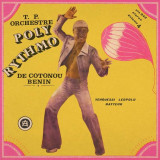
The latest instalment from Acid Jazz’s Albarika Store series, ‘Afro Funk’ compiles the very best of the legendary T.P. Orchestre Poly-Rythmo’s funk cuts.
Formed in 1968 by leader Clément Mélomé, T.P. Orchestre Poly-Rythmo became the leading group in Benin and the cornerstone of the Albarika Store label and legacy.
The latest instalment from Acid Jazz’s Albarika Store series, ‘Afro Funk’ compiles the very best of the legendary T.P. Orchestre Poly-Rythmo’s funk cuts.
Formed in 1968 by leader Clément Mélomé, T.P. Orchestre Poly-Rythmo became the leading group in Benin and the cornerstone of the Albarika Store label and legacy.
This collection brings together highlights from their extensive career, including tracks as ‘Gbeti Ma Djro’, ‘Segla’ and the collectable ‘It’s A Vanity’: wall-to-wall some of the finest Afro-Funk ever made.
Our Albarika Stores 7-inch series returns with one of the masterpieces of lo-fi Afro-funk: 'It's A Vanity' by Gabo Brown and Orchestre Poly-Rythmo.
Originally released in the early '70s, it is a fine example of the way that Benin's premier group could perfectly nail a James Brown-style groove and then twist it to make it uniquely their own thing.
'It's A Vanity' is one of the masterpieces of low-fi Afro-Funk, and has been widely sought after (and become extremely valuable) since it was comped in 2008. We've paired it with the first reissue of 'Nougbo Vehou (La Verité Blesse)' - licensed directly from bandleader Clement Melomé's family - for a must-have double-sider!
Acid Jazz proudly presents: Orchestre Les Volcans Du Benin - Vol. 1!
Originally released in 1980 on the Albarika label, 'Orchestre Les Volcans Du Benin Vol. 1' has long been a holy-grail LP for Afro-Cuban music aficionados.
It now sees its first official reissue through Acid Jazz and is available for the first time with four infections tracks, including 'Oya Ka Jojo': Latin dancefloor dynamite, and a DJ must-have.
Remastered by Frank Merritt at The Carvery, further igniting these killer recordings.
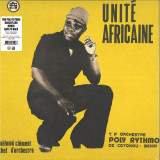
Two monumental full-side tracks from a pair of late 70s Orchestre Poly-Rythmo albums, ‘Unité Africane’ isn’t exactly a compilation, more a combination of the standouts at a time when the band was at the peak of its powers. Originally released in 1977, the title track is an infectious Afro-Latin workout that is interwoven with driving horn stabs by master trumpet player Tidiani Kone. ‘Unité Africaine’ was recorded over the Nigerian border at the state-of-the-art EMI Studios in Lagos, yielding majestic sonic results. ‘Mede Ma Gnin Messe’ is taken from the 1978 ‘Special 30 Novembre’ and this time Poly-Rythmo wore their Afro-funk hat to deliver almost sixteen minutes of dancefloor fire. Propelled by PolyRythmo’s super-tight beats and underpinned by a relentless keyboard refrain, the magic is in the stellar horn parts that take this track to another level. As with much of the Albarika catalogue, copies of the original LPs are incredibly tough to locate in anything approaching reasonable condition, so this should be a gift.
Acid Jazz Records continue their exclusive licensing agreement with Albarika Store, the legendary record label that defined the sound of Benin and influenced the entire region of West Africa and beyond.
'Kpede Do Gbe Houenou’ is a burning piece of Afro-funk from Benin’s finest, the all-conquering Orchestre Poly-Rythmo. With a killer horns line, imploring vocals and a driving groove, this has it all and is just waiting to ignite reopened dancefloors. 'Ma Wa Mon Nou Mi O’ is equally strong, if a little less intense, and features wonderful guitar work to the fore. Without question, this is essential Beninese music. Both tracks were transferred, restored and mastered from the original 1/4 inch tape.
Acid Jazz Records continue their exclusive
licensing agreement with Albarika Store, the
legendary record label that defined the sound of
Benin and influenced the entire region of West
Africa and beyond.
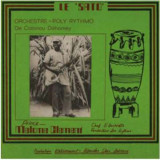
Recorded and issued in 1974, ‘Le Sato’ is one of
the earliest releases on the Albarika label and it is
also one of the deepest.
Sato is the term for the traditional rhythms that
soundtrack Vodun (Voodoo) rituals and
ceremonies in Benin. Performance of Sato is
reserved for these sacred rites, which evoke the
spirits of the dead and can last for several days
and attract hundreds of people. Sato rhythms
cannot be played outside of Vodun.
A large ceremonial Sato drum is used, which
measured over 1.5m in height. This drum is played
using wooden stick beaters, the drummer dancing
while playing. The Sato drummers are supported
by percussionists and other drummers playing
smaller drums. Together, they create unique,
layered, trance-inducing polyrhythms.
Acid Jazz Records are proud to announce an
exclusive licensing agreement with Albarika Store,
the legendary record label that defined the sound
of Benin and influenced the entire region of West
Africa and beyond.
This is the first exhaustive trawl of the archive and
will see the label presented in a way that ensures
its historical importance is recognized.
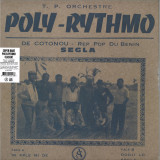
‘Segla’ is a hens’ teeth-rare Poly Rythmo album
from 1978 that was originally released without a
sleeve as ALS059. Recorded at EMI Lagos, Nigeria,
as per most of the Poly Rythmo recordings for
Albarika, the sound quality is from the tapes is
dynamic and fresh.
Transferred from the original tapes and
remastered by Grammy award-winning engineer
Frank Merritt at The Carvery, the album is
presented with beautiful artwork and packaging to
match the sonics. This is the music as it should be
heard.
Over the next few years a comprehensive reissue
campaign is planned, overseen by Florent
Mazzoleni and David Hill for Albarika Store, with
Dean Rudland as executive producer for Acid Jazz.
Albarika Store is home to many rare recordings, from more traditional folkloric and Sato styles, to the funk, blues and psych inspired workouts of the All Mighty Orchestre Poly Rythmo de Cotonou, as they referred to themselves. Many of the original records are sought after by DJs and collectors as prime examples of Afro-funk, Afro-Latin and Afropsych sounds.
The next in the series of reissues by Acid Jazz presents a straight reproduction of the incredibly hard to find Poly-Rythmo ‘Vol. 4’ album, originally from 1978.
For DJs and dancers this album has long been about the killer track ‘Aiha Ni Kpe We’, an incendiary Afrobeat recording which will activate any dancefloor anywhere. “Every time I listen to the Orchestre Poly Rythmo… Wow, I just discover something new in the music” - Gilles Peterson
This is the first exhaustive trawl of the archive and will see the label presented in a way that ensures its historical importance is recognized. Trips to West Africa have secured original master tapes and the process of transferring is ongoing. Over the next few years a comprehensive reissue campaign is planned.
More dancefloor dynamite from Benin's almighty Orchestre Poly-Rythmo de Cotonou Dahomey, this time in the form of 'Gbeti Ma Djro'. Confusingly described on the centre label of the 1971 original issue as ’Soul’, this is in fact a prime slice of Afro-psych-funk complete with wails and grunts over fierce drums and picked guitar. 'Angelina II’ is a much warmer affair that rides a shuffling mid-tempo pachanga groove. Both tracks were transferred, restored and mastered from the original 1/4 inch tape.
- A1: Daniel Forestal Et Sa Guitare - Ces P'tits Je T'aime
- A2: Casimir Létang - Travail Z'enfants! Chantez Après!
- A3: Cyril Diaz Et Son Orchestre - Feeling Happy
- A4: Georges Tinedor Et Manuela Pioche - Collié Et Zanno
- A5: Henri Debs Quintet - Douce Kombass
- A6: Joseph Lacides - Mr. Morin
- B1: Geno Exilie - Lan Misè
- B2: Dolor Et Les Diables Du Rythme - Salvana
- B3: Sydney Lérémon Et Ses Amis Du Calvaire Baie- Mahault - You You Matayango
- B4: Raymond Cicault Et Son Orchestre Volcan - À Mon Ami Lucien Jolibois
- B5: Orchestre Esperanza Et Jean Leroy - Ou Pas Bel
- B6: Henri Debs Sextet Et Paul Blamar - Moin Çé On Maléré
- C1: Le Ry-Co Jazz - Si I Bon Di I Bon
- C2: Remy Mondey - Meringue Mondey
- C3: Henri Guedon Et Les Contesta - Van Van
- C4: Les Shupa Shupa D'haiti - Batterie Shupa
- D1: Paul Blamar Et Vélo - Lovency
- D2: Eric Virgal - Stanislas
- D3: Les Aiglons - Les Aiglons Ka Satisfait
- D4: Tutus De La Guyane - Nanao Nanao
- D5: Guy Conquette - Assez Fait Cancan
- A1: The Loi-Toki-Tok Band - Ware Wa
- A2: Slim Ali & The Famous Hodi Boys - Watoto Nyara
- A3: Orchestre Baba National - Sweet Sweet Mbombo
- B1: Gatanga Boys Band - Wendo Ti Mbia
- B2: Hafusa Abasi & Slim Ali With The Yahoos Band - Sina Raha
- B3: Nashil Pichen & The Eagles Lupopo - Ng'ong'a Wa Mwanjalo
- B4: Nairobi Matata Jazz - Tamba Tamba
- C1: The Lulus Band - Ngwendeire Guita
- C2: Mbiri Young Stars - Ndiri Ndanogio Niwe
- C3: The Lulus Band - Nana
- C4: Afro 70 - Weekend
- D1: The Rift Valley Brothers - Mu-Africa
- D2: Do 7 Band - H.o. Ochiri
- D3: Afro 70 - Cha-Umheja
- D4: Peter Tsotsi Juma & The Eagles Lupopo - Kajo Golo-Weka
- E1: New Gatanga Sound - Thonia Ni Caki
- E2: Sophia Ben & The Eagles Lupopo - See Serere
- E3: Kalambya Boys - Kivelenge
- E4: The Loi-Toki-Tok Band - Leta Ngoma
- F1: Huruma Boys Band - Theresia
- F2: Orchestre Veve Star - Nitarudia
- F3: The Mombasa Vikings - Mama Matotoya
- G1: The Lulus Band - Mutumia Muriu
- H1: Ndalani 77 Brothers - Nzaumi
Selected East African Recordings From The 1970s & '80s !
- A1: Super Boiro Band - So I Si Sa
- A2: Bembeya Jazz National - Armée Guinéenne
- A3: Kaloum Star - Maliba
- A4: Balla Et Ses Balladins - Nyo
- B1: Quintette Guinéenne - Douga
- B2: Le Simandou De Beyla - Festival
- B3: Horoya Band - Zoumana
- C1: Kaloum Star - Gbassikolo
- C2: Sombory Jazz De Fria - Nana
- C3: Syli Authentic - Fabara
- D1: Balla Et Ses Balladins - Paulette
- D2: 22 Band Kankan - Deny
On October 2 1958, after over 60 years of colonial rule, Guineans voted overwhelmingly for their independence, and Guinea was declared a Republic with Sékou Touré as President. Guinea was the first of West Africa’s Francophone colonies to gain independence. To free Guinea from its colonial legacy, president Touré sought to restore dignity to his nation and give cause for Guineans to take pride in their culture, history and newfound freedom. To achieve this, he instructed his government to implement new cultural policies that were intended to revitalise and celebrate indigenous culture. The focus of these new policies was on music.
In 1961, President Touré launched authenticité, the name of his new cultural policy for Guinea. One of its first acts was to assemble the best Guinean musicians into a new state-sponsored orchestras that were tasked with presenting traditional Guinean music in a new and modern style. All musicians in Guinea’s orchestras were officially designated as members of the public service. During the years of Sékou Touré’s presidency (1958 – 1984), the government’s cultural policy of authenticité was applied strictly to the creative arts. Guinea’s sole political party, the Parti Démocratique de Guinée exercised complete authority over artistic production. The scale of the Guinean government’s commitment and efforts to invigorate its indigenous musical cultures was unmatched in Africa, and it presented a clear contrast to the minimal endeavours undertaken by Guinea’s former colonial rulers.
From 1967 to 1983, Guinea’s government presented selections of songs from the Voix de la Révolution catalogue on its own recording label, Syliphone. These recordings were described as ‘the fruit of the revolution’. Syliphone was revolutionary in many aspects: it was the first recording label to feature traditional African musical instruments such as the kora and balafon within an orchestre setting; it was the first to present the traditional songs of the griots within an orchestre setting; and it was the first government-sponsored recording label of post-colonial Africa. Syliphone represented authenticité in action, and over 750 songs were released by the recording label on 12-inch and 7-inch vinyl discs. All are highly sought after by collectors worldwide.
This is the second of a two-volume release which presents a selection of the best songs from Guinea's Syliphone recording label. This volume focuses on recordings from the 1970s, when Guinea’s authenticité policy had transformed the nation's music through a network of over 30 orchestras, each representing their local region, and each presenting Guinean musical traditions alongside the influences of Cuban music, jazz and funk.
- A1: Sungu Lubuka - Petelo Vicka Et Son Nzazi
- A2: Mfuur Ma - Groupe Minzoto Ya Zaïre
- A3: M.b.t's Sound - M.b.t's
- A4: Musique Tshiluba - Abeti Et Les Redoutables
- B1: Lalia - Trio Bydoli
- B2: Adeito - Tabu Ley Et L'orchestre Afrisa
- B3: Ngantsie Soul - Les Bantous De La Capitale
- C1: Nganga - Les Frères Soki Et L'orchestre Bella-Bella
- C2: Tembe Na Tembe Ya Nini - Orchestre Celi Bitshou
- C3: Lolo Soulfire - Lolo Et L'orchestre O.k. Jazz
- D1: Femme Ne Pleure Pas - Zaiko Langa Langa
- D2: Kiwita Kumunani - Orchestre O.k. Jazz
- D3: Fiancée Laya - G.o. Malebo
- D4: Ah! Congo - Orchestre National Du Congo
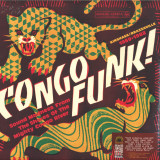
The making of Congo Funk!, our long-awaited journey to the musical heart of the African continent, took the Analog Africa Team on two journeys to Kinshasa and one to Brazzaville. Selected meticulously from around 2000 songs and boiled down to 14, this compilation aims to showcase the many facets of the funky, hypnotic and schizophrenic tunes emanating from the two Congolese capitals nestled on the banks of the Congo River.
On its south shore, the city of Kinshasa – capital of Democratic Republic of the Congo, the country formerly known as Zaïre – is often seen as Africa’s musical Mecca, the city that spawned such immortal bands as African Jazz, O.K. Jazz and African Fiesta, and the place to which aspiring musicians from throughout the continent would go to make a name for themselves.
But the city of Brazzaville on the north shore of the river – capital of the Congo Republic – played an equally important role in spreading Congolese sounds continentally. In addition to producing legendary bands such as Les Bantous de la Capital, it was the powerful transmitters of Radio Brazzaville that allowed the unmistakable groove of Congolese Rumba to be heard as far away as Nairobi, Yaoundé, Luanda and Lusaka thus turning the electric guitar into the continent’s most important instrument!
Although the musical landscape of these cities had been defined by a core group of bands in the late 1950s, the modernisation of Congolese music has been steadily evolving until the events surrounding the Muhammad Ali vs George Foreman boxing match marked a turning point. The promoter of that event known as “Rumble In The Jungle” was none other than the notorious Don King who needed 10 millions dollars to get Ali and Foreman into a boxing ring. The only candidate willing to put this kind of cash on the table was Mobutu Sese Seko, President of the Democratic Republic of the Congo.
Mobutu - the megalomaniac dictator who got to power with the support of the United States and Belgium in exchange for unlimited and affordable access to the riches of the country - had a soft spot for music and it doesn’t come as a surprise that he agreed to a three-day live music festival being organised prior to the “Rumble”. Zaïre 74 - as the festival was dubbed - was meant to hype the boxing match and many stars were invited.
Although a myriads of artists flocked in for the occasion, it was the performance of James Brown on Zairian soil that caused havoc among the younger generation, inspiring hundreds of would-be musicians to take up their electric guitars and reverbs cranked to the max in search of a new sound in which hyperactive Rumba was blended with elements of psych and funk. While the results were very different from the popular music of the three Musketeers - as Tabu Ley, Franco and Verckys were known - they weren’t a complete break with tradition.
These new sounds emerged at a time when the Congolese record industry – previously dominated by European major labels – was experiencing a period of decline due to rising production costs and needed a radical change. The void was filled by dozens of entrepreneurs willing to take chances on smaller scale releases. It was the beginning of a golden age for Congolese independent record labels, and the best of them – Cover N°1, Mondenge, Editions Moninga, Super Contact – preserved the work of some of the region’s finest artists, while launching a generation of younger musicians into the spotlight.
The movement was greatly helped by legendary radio shows but it was the dynamic productions of Télé-Zaïre that set the dynamite on fire. Legend has it that TV shows were so huge that president Mobutu himself ordered RTV du Zaïre to put on daily concerts since it halted criminal activities for the duration of the evening.
Congo Funk! is the story of these sounds and labels, but most of all it is the story of two cities, separated by water but united by an indestructible groove. The fourteen songs on this double LP showcase the many facets of the Congolese capitals, and highlight the bands and artists, famous and obscure, who pushed Rumba to new heights and ultimately influenced the musical landscape of the entire continent and beyond.
- A1: Biguine Willy - Biguine
- A2: Oh Esto Y De Irvaba Cumabo - Mambo Espagnol
- A3: Saoco - Charanga Cubain
- A4: En Guantánomo - Son Montuno
- A5: A M. Decantonio - Son Montuno
- A6: No Me Persigas - Cha Cha Cubain
- B1: Mama Egée - Rumba Lingala
- B2: Vivo Africa - Rumba Lingala
- B3: Ngonga Ebeti - Rumba Lingala
- B4: Minge Rumba Fiesta - Rumba Lingala
- B5: Matulekele - Folklore
- B6: Mitele Ngo Mama - Rumba Lingala
- C1: African Negra - Cha Cha Cha Indubil-Lingala
- C2: Rithmo Ya Suka - Cha Cha Lingala
- C3: Seis Linda Cubana - Son Cubain
- C4: Mi Amor - Cha Cha Cha Espagnol
- C5: Sabrosito - Cha Cha Cha Indubil Lingala
- C6: Nadie No Puede - Cha Cha Espagnol
- D1: Nella Negrita - Bolero Lingala
- D2: Arsene Diongue - Bolero Lingala
- D3: Liliane Yo Nsomi - Bolero Lingala
- D4: Yve Ya Fabien - Bolero Lingala
- D5: Tu Te Rappelles - Bolero Français
- D6: L’edera - Bolero Italien
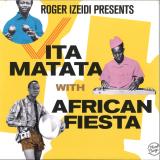
'The creation of the band African Fiesta, founded in 1963 by three well-known musicians, Nicolas Kasanda, Tabu Ley Rochereau and Roger Izeidi, and the contributions of the VITA label, established by Roger Izeidi, occupy an exciting chapter in the history of Congolese popular music. During the mid-1960s, African Fiesta consistently reached the top of the hit parade. The band, which back in the day positioned itself as a competitor to a current called ‘Fiesta Cubana’, breathed new life into Congolese Rumba, continuing the tradition of the African Jazz school started by Joseph Kabasele.
'The VITA label, with African Fiesta as their sole provider, besides four songs of Eduardo De Veracruz Vinagre et Son Orchestre, ran between May 1963 and early 1966. It created a spectacular legacy and back catalog full of tasteful sentiments and sensual melodies, deeply rooted in the Afro-Latin sound.
'This new compilation offers a few of the classic African Fiesta songs and complements them with an eclectic and original selection, divided into four thematic sides: Showcase, Rumba Lingala, Cha Cha Cha & Bolero. This double LP album comes with a 16-page booklet featuring the history of VITA and African Fiesta, song commentary by Congolese journalist Herman Bangi Bayo, and a written catalog of the VITA label. The heirs of Roger Izeidi kindly gave permission in Kinshasa to release this album of African Fiesta on Planet Ilunga.'
- A1: Malavoi - Te Traigo Guajira
- A2: Los Caraibes - Donde
- A3: Tropicana - Amor En Chachacha
- A4: Ryco Jazz - Wachi Wara
- A5: Eugene Balthazar - Dap Pignan
- A6: Roger Jaffort - Oye Mi Consejo
- A7: Les Kings - Oriza
- B1: Les Supers Jaguars - Tatalibaba
- B2: Super Combo De Pointe A Pitre - Serrana
- B3: L'ensemble Abricot - Se Quedo Boogaloo
- B4: Henri Guedon - Bilonga
- B5: Les Aiglons - Pensando En Ti
- B6: Los Martiniquenos - Caterate
In Guadeloupe, many people think that jazz and ka music are like a ring and a finger. To some extent, the same could be said about so called Latin music and the music played in the French West Indies.
Both aesthetics were born in the Caribbean and bear so many connections that they can easily be considered cousins. In constant dialogue, there are lots of examples of their fruitful alliance and have been for a while. The English country dance that used to be practiced in European lounges came to be called kadrille in Martinique and contradanza in Cuba. They both featured additional percussion instruments inherited from the transatlantic deportation. Drawing from shared feelings about the same traumatized identity – later to be creolized – it would be hard not to assume that they were meant to inspire each other. The golden age of the orchestras that graced the Pigalle nights during the interwar period further proves the point. As soon as the 1930s, Havana-born Don Barreto naturally mixed danzón and biguine music in a combo based at Melody's Bar. In the following decade, Félix Valvert, a conductor who was born and raised in Basse-Terre in Guadelupe, also worked wonders in Montparnasse with La Coupole, which was an orchestra made up of eclectic musicians. Afro- Caribbean performers of various origins were often hired on rhythm and brass sections in jazz bands, which used to enliven the typical French balls of the capital. In the 1930s and onwards, Rico’s Creole Band was one of them.
Martinican violinist-clarinettist Ernest Léardée, who would become the king of biguine music as well as the main figure of French Uncle Ben's TV commercials (a dark stigma of post-colonial stereotypes), had musicians from the whole Caribbean sphere play at his Bal Blomet – and they all enchanted "ces Zazous-là" (according the words of Léardée's biguine-calypso piece). In les Antilles (French for French West Indies), music history started to speed up in the 1950s, when trade expanded and radio stations grew bigger. The Guadelupean and Martiniquais youth tuned in their old galena radio sets to South American and Caribbean music. As for the women traders, les pacotilleuses, they bought and sold goods across different islands (the "passing of items through various hands" was thought to be most pleasurable) and brought back countless sounds in their luggage. Such was the case of Madame Balthazar, who once returned from Puerto Rico with the first 45rpm and 33rpm to ever enter Martinique.
Out of this adventure was created the famous Martinican label La Maison des Merengues, a music business she opened and undertook with her husband and which proved to be a major landmark. At the end of the 1950s, in Puerto Rico, Marius Cultier competed in the Piano International Contest playing a version of Monk's Round 'Midnight. He won the first prize and this distinction foreshadowed everything that was to come. Cultier, the heretic Monk of jazz, was quickly praised for writing superb melodies, always tinged with a twist that conferred a unique sound to his music. It didn't take long for the gifted self-taught musician to get to play with Los Cubanos, making a name for himself thanks to his impressive maestria on merengues.
The rest is history. Besides, in the late 1950s, Frantz Charles-Denis, born into the upper middle class in Saint-Pierre and better known by his first name Francisco, went back home after working at La Cabane Cubaine – a club located rue Fontaine where he had caught the Latin fever. Francisco's music was therefore heavily marked by his Cuban cousins' influence, which gave the combos he led a specific style and also led to renewal. Things were swinging hard in La Savane, located in the main square in Fort-de-France. He set up the Shango club close by and tested out the biguine lélé there, a new music formula spiced up with Latin rhythms. Soon afterwards, fate had him fly to Puerto Rico and Venezuela.
As for percussionist Henri Guédon (percussions were only a part of his many talents), he was born in Fort-de-France in May 22nd 1944, the day marking the celebration of the abolition of slavery. As an old man, he could remember that in " his father's Teppaz, a lot of hectic 6/8 music was constantly playing...". In the opening lines of his Lettre à Dizzy, a small illustrated collection of writings published by Del Arco, he highlighted the huge impact that cubop had on him as a teenage boy, around 1960. He eventually turned out to be the lider maximo in La Contesta, a big band steeped in Latin jazz. He was also the one who originated the word zouk to describe music which brought the sound of the New York barrio to Paris. It was the culmination of a journey that started in Sainte-Marie: "a mythical place for bélé, the equivalent of Cuban guaguancó". In the early 1960s, the tertiary economy developed to the detriment of agriculture. Yet rural life was where roots music emerged in Martinique and in Guadeloupe.
Record companies played a major part in the process of Latin versions sweeping across the islands – before reaching everywhere else. Producer Célini, boss of the great Aux Ondes label, and Marcel Mavounzy, both the head of Émeraude records - a firm which was founded in 1953 - as well as the brother of famous saxophonist Robert Mavounzy, were big names to bear in mind. Although there were many of them - all of whom are featured on this record - Henri Debs was definitely the major figure in the recording adventure. He proved to be so influential that he even got compared to Berry Gordy. In the mid 1950s, when he acquired his first Teppaz, he worked on his first compositions: a bolero and a chachacha. Then, he became the one man who made people discover Caribbean music, from calypso to merengue. He was among the first ones to rush out to San Juan, Puerto Rico, to buy records and distribute them through a store run by one of his brothers in Fort-de-France. He had members of the Fania All Star come and perform there, which he was madly proud about. He was also the first one to pay attention to Haitian music, such as compas direct and various other rhythms which would soon flood the market. As a result, many of the combos hitting his legendary studio would end up boosted by widespread "Afro-Latin" rhythms. However, he never denied his identity: gwo ka drums were given a major role, although they were instruments which had long been banned from the "official" music spheres. The present selection bears witness to such a creative swarming. Here are fourteen tracks of untimely yet unprecedented cross-fertilization: all types of music rooted in the Creole archipelago have found their way, whatsoever, to the tracklisting. Whether originating from the city or being more rural, they all go back to what Edouard Glissant, in an interview about the place of West Indian music in the Afro-American scope, called "the trace of singing, the one which got erased by slavery." "It is so in jazz, but also in reggae, calypso, biguine, salsa... This trace also manifests through the drums, whether Guadelupean, Dominican, Jamaican or Cuban... None of them being quite the same. They all point to the idea of a trace, seeking it out and connecting to each other through it. This is the hallmark of the African diaspora: its ability to create something new, in relation to itself, out of a trace. It may be the memory of a rhythm, the crafting of a drum, a means of expression which doesn't resort to an old language but to the modalities of it." The opening track features one of the emblematic orchestras of this aesthetic identity, criscrossing many music types from the archipelago. The 1974 Ray Barretto guajira – Ray Barretto was a major New York drummer influenced by Charlie Parker and Chano Pozzo – is magnificently performed by Malavoi, a legendary Fayolais group (i.e from Fort-de-France). Additionally, the compilation ends on a piece by Los Martiniqueños de Francisco. It symbolically closes the circle as it is a genuine potomitan of Martinique culture which also functions as a tireless campaigner for Afro-Caribbean music. Practicing the danmyé rounds (a kind of capoeiria) to the rhythm of the bèlè drum, it delivers a terrific Caterete, a kind of champeta of Afro- Colombian obedience which was originally composed by Colombian Fabián Ramón Veloz Fernández for the group Wgenda Kenya. The icing on the cake is Brazilian Marku Ribas, who found refuge in Martinique in the early 1970s, bringing his singing to the last trance-inducing track. These two "versions" convey the whole tone of a selection composed of rarities and classics of the tropicalized genre, swarming with tonic accents and convoluted rhythms. It is the sort of cocktail that the West Indians never failed to spice up with their own ingredients. For instance, the Los Caraïbes cover of Dónde, a famous Cuban theme composed by producer Ernesto Duarte Brito, has a typical violin and features renowned Martinique singer Joby Valente and his piquant voice.
The track used to be – or so we think – their only existing 45rpm. The meaningful Amor en chachachá by L'Ensemble Tropicana, a band which included Haitian musicians among whom was composer and leader Michel Desgrotte, also recalls how Latin music was pervasive in the tropics in the mid-1960s. They were the ones keeping people dancing at Le Cocoteraie in Guadelupe and La Bananeraie in Martinique. Around the same time, another "foreign" band, Congolese Freddy Mars N'Kounkou's Ryco Jazz, achieved some success on both islands by covering Latin jazz classics – such as their adaptation of Wachi Wara, a "soul sauce" by Dizzy Gillespie and Chano Pozo whose interweaving of strings and percussions can have anyone hit the dancefloor. How can you resist Dap Pinian indeed, a powerful guaguancó by Eugene Balthazar, performed by the Tropicana Orchestra and published by the Martinique-founded La Maison des Merengues? It also acts as a symbol of the maelstrom at work. Going by the name Paco et L'orchestre Cachunga, Roger Jaffory used to play guaguancó too: his Fania-inspired Oye mi consejo is one example of his style. Baila!!!!! Dancing was also one of the Kings' focus points. Oriza is a Puerto Rican bomba and a "classic" originally composed by Nuevayorquino trumpeter Ernie Agosto, which reserves major space for brasses, giving it a special sheen.
Emerging from the New York barrios crucible was also La Perfecta, a Martinique group originating from Trinidad, whose name directly references the totemic Eddie Palmieri figure as well as his own band, also called La Perfecta. Here they borrow Toumbadora from Colombian producer and composer Efraín Lancheros and interpret it by emphasizing percussions, which set fire to the track even more than the wind instruments. The same goes for Martinique's Super Jaguars, who use Tatalibaba – a composition by Cuban guitarist Florencio "Picolo" Santana which was made famous by Celia Cruz & La Sonora Matencera – as a pretext for sending their cadences into a frenzy. In a more typically salsa vein, the Super Combo, a famous Guadelupean orchestra from Pointe-Noire that was formed around the Desplan family and had Roger Plonquitte and Elie Bianay on board, adapt Serana, a theme by Roberto Angleró Pepín, a Puerto Rican composer, singer and musician also known for his song Soy Boricua. Here again, their vision comes close to surpassing the original. In the 1970s, L'Ensemble Abricot provided a handful of tracks of different syles, hence reaching the pinnacle of the art of achieving variety and giving pleasure. They played boleros, biguines, compas direct, guaguancó and even a good old boogaloo - the type they wanted to keep close to their hearts for ever, "pour toujours", as they sang along together in one of their songs. Léon Bertide's Martinican ensemble excelled at the boogaloo which had been composed by Puerto Rican saxophonist Hector Santos for the legendary El Gran Combo.
Three years later, in 1972, Henri Guédon, with the help of Paul Rosine on the vibraphone, tackled the Bilongo made famous by Eddie Palmieri. Such a classic!!!!! And so were the Aiglons, the band from Guadelupe: choosing to execute Pensando en tí, a composition by Dominican Aniceto Batista, on a cooler tempo than the original, they noticeably used a wonderfully (un)tuned keyboard in place of the accordion. On the high-value collectible single – the first one released by Les Aiglons under the Duli Disc label – there is a sticker classifying the track under the generic name "Afro". Now that is what we call a symbol. Jacques Denis
- A1: Orchestre Du Jardin De Guinée Sakhodou
- A2: Orchestre De La Paillote La Guinée Moussolou
- A3: Bembeya Jazz National Guantanamera-Seyni
- A4: Bembeya Jazz National Sabor De Guajira
- B1: Balla Et Ses Balladins Sakhodougou
- B2: Balla Et Ses Balladins Samba
- B3: Orchestre De La Paillote Kankan-Yarabi
- B4: Myriam’s Quintette Solo Quintette
- C1: Pivi & Les Balladins Ka Noutea
- C2: Horoya Band National N’banlassouro
- C3: Orchestre De La Garde Républicaine Sabouya
- C4: Keletigui Et Ses Tambourinis Samakoro
- D1: Keletigui Et Ses Tambourinis Miri Magnin
- D2: 22 Novembre Band Kouma
- D3: Les Frères Diabaté N’fa
On October 2 1958, after over 60 years of colonial rule, Guineans voted overwhelmingly for their independence, and Guinea was declared a Republic with Sékou Touré as President. Guinea was the first of West Africa’s Francophone colonies to gain independence. To free Guinea from its colonial legacy, president Touré sought to restore dignity to his nation and give cause for Guineans to take pride in their culture, history and newfound freedom. To achieve this, he instructed his government to implement new cultural policies that were intended to revitalise and celebrate indigenous culture. The focus of these new policies was on music.
In 1961, President Touré launched authenticité, the name of his new cultural policy for Guinea. One of its first acts was to assemble the best Guinean musicians into a new state-sponsored orchestras that were tasked with presenting traditional Guinean music in a new and modern style. All musicians in Guinea’s orchestras were officially designated as members of the public service. During the years of Sékou Touré’s presidency (1958 – 1984), the government’s cultural policy of authenticité was applied strictly to the creative arts. Guinea’s sole political party, the Parti Démocratique de Guinée exercised complete authority over artistic production. The scale of the Guinean government’s commitment and efforts to invigorate its indigenous musical cultures was unmatched in Africa, and it presented a clear contrast to the minimal endeavours undertaken by Guinea’s former colonial rulers.
From 1967 to 1983, Guinea’s government presented selections of songs from the Voix de la Révolution catalogue on its own recording label, Syliphone. These recordings were described as ‘the fruit of the revolution’. Syliphone was revolutionary in many aspects: it was the first recording label to feature traditional African musical instruments such as the kora and balafon within an orchestre setting; it was the first to present the traditional songs of the griots within an orchestre setting; and it was the first government-sponsored recording label of post-colonial Africa. Syliphone represented authenticité in action, and over 750 songs were released by the recording label on 12-inch and 7-inch vinyl discs. All are highly sought after by collectors worldwide.
This first volume of a two-volume series presents a selection of the best of early Syliphone recordings. The songs demonstrate not only the essence of Guinea’s authenticité policy and of its subsequent Cultural Revolution, but of a confluence of musical styles from Cuba, jazz, highlife and the diverse influences of Guinea’s cultural groups.
- A1: Are You In The Mood - Stéphane Grappelli & Le Hot Club De France
- A2: Swing 42 - Gus Viseur & Son Orchestre
- A3: Rue De La Paix - Lionel Hampton & Claube Bolling
- A4: Riviera - Aimé Barelli & Son Orchestre
- A5: Blues Of Yesterday - André Ekyan & Son Orchestre
- A6: In A Sentimental Mood - Django Reinhardt & Le Hot Club De France
- B1: Tempete Sur Les Cordes - Michel Warlop & Son Septuor Á Cordes
- B2: Hotel De La Gare - Jerry Mengo & Le Jazz De Paris
- B3: Daphné - The Hot Club Swing Stars
- B4: Verlaine - Alix Combelle & Le Jazz De Paris
- B5: I Got Rhythm - Ray Ventura & Ses Collégiens
- B6: Nuages - Alex Renard & Son Orchestre
Vintage-Pariser Jazz. Vintage-Pariser Ambiente. Paris hat schon immer Jazzmusiker aus aller Welt in seine Clubs & Cafés gelockt. Paris ist insbesondere die spirituelle Heimat des Gypsy-Jazz, wo viele Jazzmusiker in der ersten Hälfte des 20. Jahrhunderts in den Bals-Musettes der Stadt spielten. Django Reinhardt machte sich in den 1930/40ern mit dem Geiger Stéphane Grappelli und seinem Quintette du Hot Club de France einen Namen, ebenso wie mit den Bands von Alex Renard, Alix Combelle, Ray Ventura, Claude Bolling und Jerry Mango. Dieser LP-Sampler gibt einen hervorragenden Überblick über die damalige Szene, als kurz nach dem Krieg die Viertel Saint-Germain des Prés und Latin zahlreiche berühmte Jazzclubs beherbergten. Alle Tracks wurden remastert.
- 1: Time To Say Goodbye
- 2: J.t
- 3: Surprise !
- 4: Ma-Ion
- 5: The Painter And The Boxer
- 6: Lulea's Sunset
- 7: Prayer
- 8: Go
- 9: Calgary
- 10: Magnolia
Airelle Besson, the French multi-award-wining jazz trumpeter, has been lighting up the European jazz scene for several years at the head of her quartet, duo with virtuoso accordionist Lionel Suarez, and the Besson/Sternal/Burgwinkle trio, featured here on 'Surprise!'.
A production without the inclusion of a bass player, the combination of trumpet, piano, and drums is both unusual and intriguing. The result is totally refreshing and provides a new dynamic to the jazz trio format. Featuring ten original compositions, five apiece from Besson and pianist Sternal.
As a much sought-after side-musician, and composer/arranger for the band Metronomy and the Orchestre National de Lyon, Airelle Besson has performed with Charlie Haden and Carla Bley, Michel Portal, Manu Katche, Philip Catherine, Billy Hart, Rhoda Scott, Daniel Humair, Henri Texier, Tom Harrell, Avishai Cohen, Greg Hutchinson, Jose James, and may others.
Airelle Besson: trumpet
Sebastian Sternal: piano, Fender Rhodes, FX pedals
Jonas Burgwinkel: drums
Recorded & mixed by Christian Heck at Loft Studios, Cologne, Germany.
- A1: Segla – Orchestre Poly-Rythmo De Cotonou-Rep. Pop Du Benin
- A2: Get The Music Now (Edit) – Ipa Boogie
- A3: E Sa F’aiye – Orchestre Black Dragons De Porto-Novo Dahomey
- B1: Aiha Ni Kpe We (Edit) – T.p. Orchestre Poly-Rythmo De Cotonou
- B2: Ego-Ibo – Les Sympathics De Porto-Novo Benin
- B3: Gbeti Ma Djro - Orchestre Poly-Rythmo De Cotonou Dahomey
- C1: Oya Ka Jojo (Edit) – Orchestre Les Volcans Du Benin
- C2: It’s A Vanity - T.p. Orchestre Poly-Rythmo
- C3: Bakassine Gabou - Orchestre Anassoua-Jazz De Parakou
- D1: Nan Man Nan - Orchestre Poly-Rythmo De Cotonou-Rep. Pop Du Benin
- D2: Gbe We Gnin Wa Bio (Edit) – Ogassa
- D3: Kpede Do Gbe Houenou - T.p. Orchestre Poly-Rythmo De Cotonou
Founded in the late 1960s by record store owner Seidou
Adissa, Albarika Store is one of the most important
independent record labels on the African continent. That
it was founded in the relatively small ex-French colony
of Benin (then still called Dahomey), is a testament to its
founder’s musical taste and vision for what the local
musical scene had to offer.
This September, Acid Jazz releases the first ever vinyl
and CD overview of the label and its music, compiled by
David Hill of The Soul Revivers and West African
musical expert Florent Mazzoleni, who also wrote the indepth notes.
The compilation provides a look into what was a
developing and then thriving post-colonial music scene.
It focuses on the label’s biggest and most prolific act
Orchestre Poly-Rhythmo and its founder Melome
Clement – who released under a variety of names often
spotlighting on the musicians’ key to their sound. It also
looks at the other established artists on the label such
as the incendiary Les Sympathics De Porto Novo and
Les Volcans. All of these artists create a unique mix of
Westernised Funk, Soul and Latin sounds crosspollinated with the traditional music of the region.
- Lady Sings The Blues
- Good Morning Heartache
- Love Me Or Leave Me
- Willow Weep For Me
- Don't Explain (Live)
- Billie's Blues (Live)
- I'm A Fool To Want You
- My Man
- What A Little Moonlight Can Do
- Yesterdays
- I Cried For You
- God Bless The Child
- Comes Love
- Lover Man (Live)
- All Of Me
- Gloomy Sunday
- Tell Me More
- Time On My Hands
- I Hear Music
- Let's Do It
- The Blues Are Brewin
- Swing Brother Swing
- I Got The Right To Sing The Blues
- The Man I Love
- They Can't Take That Away From Me
- Back In Your Own Backyard
- Strange Fruit
- I'll Never Be The Same (Avec L'orchestre De Teddy Wilson)
- Travelin' All Alone
FYEAR is a Montréal-based ensemble led by composer Jason Sharp and poet/writer Kaie Kellough that fuses spoken word into genre-bending compositions for electronics, two voices, two drummers, and processed saxophone, pedal steel guitar, and violins. FYEAR incorporates drone, out-jazz, post-classical, ambient metal, avant-rock, and modular synthesis in a sonic and stylistic palette the opposite of collage or pastiche: the FYEAR ensemble integrates a unique and unified sound/aesthetic while traversing adventurous and variegated terrain. Kellough’s poetic materiality conveys acute political-existential themes, alternating between declarative, meditative, and cut-up/semiotic manifestations. This self-titled debut album is a supremely innovative 40-minute multi-movement work; an ardent mission statement that mines the interzone where Saul Williams, Moor Mother/Irreversible Entanglements, Shabazz Palaces, Zulu, Angel Bat Dawid, Damon Locks/Black Monument Ensemble, Shabaka Hutchings, and Matana Roberts are all iconoclastic neighbours. FYEAR melds improvisation and composition, traditional notation and graphic scoring, electronic and acoustic instrumentation, lucid recitation and abstract vocalization, balancing intensive structure with an expansive sense of exploration. Through several years of collaboration, development, workshops, commissions and performances conducted by Sharp and Kellough, their wordsound practice has culminated in this nine-piece group which also features poet/writer/activist Tawhida Tanya Evanson (present director of the Banff Centre Spoken Word program) violinists Josh Zubot and Jesse Zubot (Tanya Tagaq, Darius Jones, Joshua Hyslop), pedal steel player Joe Grass (Tim Hecker, Patrick Watson), drummers Stefan Schneider (Bell Orchestre) and Tommy Crane (The Mingus Big Band, Aaron Parks), with live visual typographics from Kevin Yuen-Kit Lo, who also designs the album art. Propelled by the vocal interactions of Kellough and Evanson, FYEAR interrogates our present and future post-capitalist polycrisis, invoking collective anxieties, emotions, and critiques. FYEAR re-poetizes our constructed, manipulated social/conceptual realities, re-inscribing questions about the future by setting them to a wildly dynamic and evocative temporal soundtrack: Who does it belong to? How will it be shared? How do we project a collective future into the contested challenges of climate change, global migration, wealth gaps, safety/precarity, identity/affinity, segmentation / segregation, all our seemingly irreconcilable histories and forward visions for the world we dream to inhabit
T.P. Orchestre Poly-Rythmo 'Le Sato 2' ist eine besonders obskure
Veröffentlichung. Das Nachfolgealbum von "Le Sato" wurde ursprünglich in genau der gleichen Hülle wie der erste Teil des Albums verkauft, die neue Katalognummer wurde dabei einfach auf die Rückseite geschrieben! In den letzten Jahren hat Acid Jazz eine Reihe von Wiederveröffentlichungen aus dem enigmaFc 'Albarika Store' veröffentlicht - eine Goldgrube von Platten aus Benin, West Afrika von den späten 60er bis zu den frühen 80er Jahren.
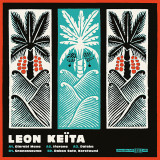
Hier hatten sich die Klänge aus dem nahen Mali und Guinea mit den lokalen Stilen vermischt und eine reiche Musikszene hervorgebracht: Bands wie Bembeya Jazz, Super Djata Band und andere Mandingue-Giganten gehörten zu den Bestsellern der Region. Leon Keïta, eine feste Größe in der malischen Musikszene, wurde 1947 in Conakry an der Atlantikküste von Guinea geboren. Leon half bei der Gründung der legendären Rail-Band, die zu einer gefeierten Stütze des Nachtlebens in Bamako wurde und die internationalen Karrieren von Salif Keita, Mory Kanté u.v.a. begründete. Leon selbst schloss sich Les Ambassadeurs Internationaux an, mit denen er durch Westafrika tourte, bevor er sich der Arbeit an seinen eigenen Kompositionen zuwandte. Als Leon bereit war, ins Aufnahmestudio zu gehen, lud er seine Freunde von Les Ambassadeurs Internationaux ein, ihm als Begleitband zu dienen; aus dieser Zusammenarbeit gingen zwei Platten hervor, die beide 1978 auf dem Label Papa Disco veröffentlicht wurden. Ein Jahr später veröffentlichte Leon "Rythmes et Mélodies du Mali", das er gemeinsam mit seinem Bruder Germain geschrieben hatte und das vom großartigen Orchestre Black Santiago begleitet wurde. Obwohl Leon nicht viele Soloaufnahmen gemacht hat, erwecken seine Lieder weiterhin die Verehrung aller, die das Glück haben, sie zu hören. In den letzten Jahren wurde der Song "Dalaka" von Carlos Estrada, dem Betreiber des Soundsystems in Barranquilla, wiederentdeckt und wurde zu einem unerwarteten Hit an der kolumbianischen Karibikküste. Zwölf Jahre nach der Veröffentlichung der von der Kritik hochgelobten Bambara Mystic Soul Compilation taucht diese neue Zusammenstellung erneut tief in die Mandingue-Kultur ein, die während Leon Keïtas legendären Sessions Ende der 70er Jahre aufgenommen wurden.
Le Magnifique is a cult film. Many a viewer has memorized the lines of this character, whose role was tailor-made for Jean-Paul Belmondo. In the year of our Lord 1973, Belmondo reunited with director Philippe de Broca, a pair who, decades before the Jean Dujardin version of OSS 117, were unknowingly making meta cinema. The film's soundtrack, by Claude Bolling, successfully navigates between the first and second degree, without ever sinking into the clumsiness of "fantasy music". For the record, Claude Bolling is none other than the chief composer of the all-female group Les Parisiennes and of some 100 film scores, including Borsalino, which is certainly the best-known. Above all, he is a genius of French jazz, whose talent makes his music sound relaxed and familiar, even when you're listening to it for the first Tme. From the very first track on the album, "TaQana", postcard images of Mexico spring to mind. Claude Bolling plays with the codes of film music without ever losing a certain communicaTve jubilaTon. With the soundtrack to Le Magnifique, Claude Bolling equals the Anglo-Saxon masters of the easy-jazz pop genre, such as Henri Mancini. Fans of jerks to dance to at the ambassador's parTes will be delighted by the composiTon "Pop Mod". Even today, those who invented the term "lounge core" would go out of their way to own an original Claude Bolling vinyl. Thanks to Claude Bolling and his original French Touch, before thedays of Dimitri From Paris and Bob Sinclar who, if they hadn't been able to take advantage of this musical and cinema to graphic heritage, wouldn't have had anything to sample.
- A1: Maroon Commandos - Bi Sophia N°1 (El Sofia)
- A2: Issa Juma & Waanyka - Ateka (El Corín Tellado)
- B1: Orchestre Shika-Shika - Diabanza (La Gallina Java)
- B2: Viva Makale - Safari (La Mecedora)
- B3: Les Mangelepa - El Trouble Pt 1 (El Trouble)
- C1: Nairobi Matata Jazz - Dada Mwajuma (La Pistola)
- C2: Les Volcano - Hakuna Dawa Ya Mapenzi (La Guitarra Sónica)
- D1: Lawi Somona - Safi (El Mapache)
- D2: Les Kilimambogo - Wakumbuke Wazazi (El Coyote)
- D3: Les Mangelepa - El Trouble Pt 2
This compilation takes us on a journey to the Colombian coast where the passion for African music burns bright.It's impossible to understand this love affair without first looking to San Basilio de Palenque - the first free town in colonial Latin America, established in 1691 as a place of refuge and autonomy for black slaves. It's a place where pride in African heritage and culture could be kept alive, just 50 km away from Cartagena de Indias.
The Afro Caribbeans' connection to their roots gave rise to the "picós" - artisanal, high-powered sound systems akin to those found in Jamaica. These music aficionados have a keen ear for African melodies, leading to a vibrant collector's scene that brought Afro sounds to the streets of Barranquilla, Cartagena, and Santa Marta. This compilation showcases the best of Kenyan Benga music - a unique style with a distinct guitar-picking method that draws from traditional instruments like the nyatiti and orutu. Learn everything about the history and stories behind these African tracks, from the carefully guarded "exclusives" to the piconema - the practice of renaming songs in Spanish based on their lyrics or the reaction of the dancefloor.
The project has been led by Spanish vinyl collector Joan Pujol aka Golfo De Guinea surrounded by a team of passionate music lovers including Don Alirio, a musicologist from Barranquilla who offered a coastal perspective, and George Ouma, a Kenyan DJ, collector, and Benga advocate who helped with track selection and securing rights. The result is a compilation that captures the joy and energy of sub-Saharan polyrhythm, bringing together a vibrant mix of genres that are sure to move your feet. So sit back, turn up the volume, and let yourself be transported to the vibrant streets of the Colombian coast and the shores of Lake Victoria.
From the landlocked tropical savanna of Upper Volta, an ever-evolving cast of musicians brought the world's rhythms to the streets of their native Bobo-Dioulasso. Combining Congolese rhumba, American R&B, French yé-yé, Cuban son, and regional Senufo and Mandingo traditions, Orchestre Volta Jazz was at the epicenter of the West African musical explosion of the '60s and '70s. Air Volta compiles nine original songs originally issued on the Disques France-Afrique and Sonafric labels, a peerless primer of a group that turned the brutality of colonialism into something beautiful and enduring.
Founded in 2006 by Vincent Bertholet (Hyperculte), the Orchestre Tout Puissant Marcel Duchamp is a large-scale project. Designed as a real orchestra, the size of the ensemble has varied over time. Now with 12 members, 14 in the past or 6 at the beginning, the ensemble has scoured the stages of Europe todemonstrate that the formula "the more the merrier" has never been more true than on stage. Whether in prestigious festivals (Paléo Festival de Nyon, Fusion Festival, Incubate, Womad, Bad Bonn Kilbi, Jazz à la Vilette) or on the four albums released since its launch, the group shows an incredible fluidity. The Orchestre Tout Puissant Marcel Duchamp (a mischievous title in homage to traditional African groups -Orchestre Tout Puissant Konono nd1, Orchestre Tout Puissant Polyrytmo etc... -and to one of the greatest dynamizers of 20th century art) embraces the forms of its musicians while pushing them to their limits. The result is a powerful, experimental, unstable and terribly alive, organic sound.
- A1: Aldo Romano, Racmi Vignolo & Baptiste Trotignon - Black
- A2: Eight To The Bar - Rock And Roll
- A3: Vincent Peirani Living Being - Stairway To Heaven
- A4: David Neerman - Friends
- A5: Bonerama - Heartbreaker
- B1: Motohiko Hino (Featuring John Scofield) - The Ocean
- B2: Nguyaªn Laª - Whole Lotta Love
- B3: Pierrejean Gaucher - Kashmir
- B4: The Electric Kings - Bring It On Home
- B5: Orchestre National De Jazz Franck Tortiller - No Quarte
"From Nishinari Osaka Japan Weird Wild Obscure Spooky exotica burlesque toy junk Muzak Trash One Man Band music made with broken cassette desks and fucked up record players feat members of (Acid Mother Temple)" - VRR 20202 Vinyl LP, starker Karton, bedruckte Innenhülle, Download inklusive. Willkommen in der wilden obskuren und seltsamen Welt von DEGURUTIENI und seiner ONE MAN BAND. teuflisch exotischer Striptease Kinder Spielzeug Krach mit ausgedientes Tonbandgerät und zerbrochenen Plattenspielern mit Mitgliedern von ua Acid Mother Temple in einigen Songs. Dies hier ist eine Zusammenstellung mit älteren Songs (selbst Veröffentlichungen und auf kleinst Labels) und viele neue Songs die noch nie vorher veröffentlicht wurden. Ich dachte, es ist an der Zeit, dass die Welt etwas über DEGURUTIENI erfährt (ich hatte Wochen, bis ich seinen Namen richtig buchstabieren konnte, hahaha ) Er tourt ständig durch die ganze Welt (pre Covid-19) und tritt in regulären Konzertsälen sowie in Theatern, Kunstgalerien oder sogar auf der Straße auf. wenn man ihn zum ersten mal sieht ist es eine Lebens Erfahrung die man nicht wider vergisst und es bleibt ein großes Lächeln im Gesicht und ein verzerrtes Fragezeichen in deinem Gehirn. Alco Degurutieni wurde Ende der 60er Jahre im Nishinari Ghetto von Osaka geboren (Alco Degurutieni: Diese Zeit in den 1970er Jahren war eine harte Zeit für alle, einmal im Monat Unruhen auf den Straßen. Rot Licht viertel Prostitution und die Yakuza-Mafia waren uns vertraut. Diese Erinnerungen an ein jugendliches Chaos sind seitdem ein Katalysator für mein Peter-Pan-Syndrom.) Degurutieni schafft Harmonie durch Gegenüberstellung, indem er ihnen Melodie aus Chaos und Dekadenz aus Abfall extrahiert. Mit 13 Jahren bekam er seine erste Boombox und wurde der beste Kunde in seinem örtlichen Leih-Platten und Trödler laden. Er arbeitete sich durch alle Genres von den Beach Boys bis zum Black Sabbath. Ab 16 Jahren begann er, seine eigenen Songs mit den einzigen Dingen zu kreieren, zu denen er Zugang hatte; Müll, umgebaute Kinderspielzeuge und ein ausgedientes Tonbandgerät. All dies spielt noch heute eine wichtige Rolle in seiner Musik. Auf diesem Album findest du ,Acme in the afternoon, ein komplett Hit, Tom Waits Blues Jazz Burlesque, dann mit ,Blur Blur Blur, hörst du ihn super minimalistisch und verloren im All Blues, oder den unglaublichen ,Midnight Express' mit einem orientalischen Trash-Flair der dich in einen neuen Blade Runner film katapultiert, und Zigeuner Fanafare und Rock'n'roll in ,13th Floor City ' zusammen mit: Orchester du Belgistan (aus Belgien) oder mein favorit ,Dreaming party' das wie ein psychedelischer horror film Soundtrack daher kommt LINE UP Alco Degurutieni (mostly all instuments) aditional Musissians on the Album Jyonson Tsu (ACID MOTHERS TEMPLE) Machiko Kuniki (Sujiko Sumoguri) Akiyoshi Kajitani (MOHIKAN FAMILIES) Atsushi Sekitani Watanbe (BRO TÜRK,PATO LOL MAN) Naoya Takami (Ichibanboshi Crue) Kwandae Park (UMA UMA UMA) Akira Ohno Tadahiro Ishihara Keigo Matsunaga (Rock'n'TASUKE'Roll & THE CAPTAIN SWING,MOHIKAN FAMILY'S) Tom Manoury (Orchestre du Belgistan) Mbengue Ndiaga Jordi Grognard (YOKAI) Akiko Igaki (TAYUTAU,COLLOID) Kiri Mochida Takeo Touyama (PATO LOL MAN) Shuichi Hirose (HUMNED) Takeo Touyama (PATO LOL MAN)
- A1: Jean Kely Et Basth – Andosy Mora
- A2: Soymanga – Moramora Zoky
- A3: Roger Georges – Mama
- A4: Ny Anjarasoa – Mahonena
- B1: Charles Maurin Poty – Amboliako Fary
- B2: Mahaleo – Izahay Mpamita
- B3: Papa James – Ngôma Hoe
- B4: Los Pépitos Et Leur Ensemble – B B. Gasy
- B5: Jeanot Rabeson Et Son Orchestre – Jazz Sega
- C1: Feon’ala – Farahy
- C2: Terak’ Anosy Group – Soaliza
- C3: Saka Dit The King – Ody Ody (Tsy Mentsy Mandroso)
- C4: Michael – Razana Tsy Ho Meloko
- D1: Falafa – Rapela
- D2: Los Matadores – Andeha Hanarato
- D3: Nino Rafah – Oa Niny Ê
- D4: Kaiamba Orchestra – Tokatoka
- D5: Atrefy Andriana – Zaka Tiako Mamolaka Keriko
Strut continues its essential compilation series of Indian Ocean sounds with 'Alefa Madagascar', the first compilation to document the unique culture of salegy, soukous and soul on the island during the '70s and '80s.
'Alefa Madagascar' showcases the rich variety of sounds during this heyday of Malagasy music: Roger Georges' 'Mama' and Jean Kely et Basth's 'Andosy Mora' bring the raw energy of salegy, influential band Los Matadores drop military drums and Hammond soul in the classic 'Andeha Hanarato'; Mahaleo's 'Izahay Mpamita' showcases the band's powerful folk sound, a crucial voice emerging from the Rotaka farmer and student protests of 1972, while Terak'Anosy Group work around a stomping Congolese guitar groove. The era paved the way for many of the household names of Malagasy music today including Jaojoby, D'Gary and Lego.
- 1