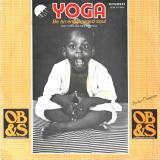
The rare and deeply funky LP "Yoga – Be An Enlightened Soul – Stay Young And Pure With Yoga"
by Osunfisan Brothers & Sisters is set to return to vinyl in an official reissue, marking the first
authorized repress of one of Nigeria’s most elusive spiritual records.
Originally released in limited circulation, Yoga occupies a unique place in many collectors grail list.
According to Mr Femi Osunfisan, the album was conceived by his senior brother and bandleader, "We
chose yoga to as a concept to channel our music, but it was not intended to practise yoga with the
music". Neither pop record nor conventional boogie LP, the album is highly sought-after for the amazing
production by the Sound master Odion Iruoje and for the heavy afro-disco workouts.
At a time when Nigerian music was dominated by Afrobeat, highlife, and disco, Osunfisan Brothers &
Sisters charted a more introspective path—using rhythm, voice, and repetition as tools for enlightenment
and personal grounding.
Odion livingstone News
- 1
- A1: Christy Y Ogbah - Advice
- A2: Johnny O Bazz - Xmas Eve
- A3: Mike Umoh - Look At Me
- B1: Mike Umoh - Shake Your Body
- B2: Bindiga - Disco Connection
- B3: Christy Christy - Aimiuug Wia
- C1: Bindiga - Perfect Disco Machine
- C2: Bassey Black And The Natty Messiah - On My Mind
- C3: Christy Ogbah - Azomonfe
- D1: Godfrey Odili - You Do Good For Yourself
- D2: Eunice Mokus Arimoku - Ariro
Humphrey Aniakor started Duomo Sounds after a trip to Milan. The idea was to produce a new sound for the emerging generation. A sleek funky but refined, Nigerian disco sound. This compilation captures all of that intention with a broad array of artistes. The music is sometimes sung in local Nigerian languages and sometimes in English but always with an African Accent. Modern grooves for an African market.
After several months spent hanging out at studios in Los Angeles and New York, observing the musicians, producers and engineers at work. He went to nightclubs to study what kind of sonic textures made the crowd move. And when he felt he had gotten the hang of it, he returned to Nigeria to set up his record label. A label that would showcase the au courant, cosmopolitan face of the Nigeria’s emerging young generation. That would encompass the boundlessness of imagination, focus, persistence and craftsmanship. That would deliver music that touched the soul.
There was hardly a shortage of available musical talent by 1980, as Duomo was preparing to launch. The seventies had seen a massive flowering of bands offering a wide array of sounds and styles. But 1980 proved to be the year that would change the topography of the music landscape and its approach to packaging talent. Artistes like Mike Umoh (erstewhile drummer with Bongos Ikwue and the Groovies), Bindiga (Ghanian afrofunk musicians), Christy Ogbah (who worked as a policewoman) bring their personal artistry to create the new sound.
And he would call it—what else?—Duomo. Duomo Sounds Limited.
This combination created high-quality Nigerian music but it also marked the end of bands as the focal point for the popular music marketing. After Okotie’s breakthrough, it became clear that the eighties would be the era of the solo artist. And this would lead to the fracture of established bands as members opted to roll the dice on solo careers.
This compilation is more than a selection of songs from Willy Nfor’s solo career in Nigeria—it’s the story of a man’s determination to live his dreams. Known as Willy Ngeh Nfor, he was a founding member of the Mighty Flames. One morning, Willy and his bandmates packed their instruments, grabbed a few clothes, and headed from Cameroon to Nigeria. Crossing the border on foot, they made their way to Onitsha.
“We left Cameroon with no contacts in Nigeria—it was an adventure. We’d heard about the FESTAC Arts Festival and felt we had to be part of it. Our first band in Nigeria was Pentagon Funk Band, sponsored by the 5th Brigade in Port Harcourt. Later, we moved to Onitsha and signed with Right Time Stores, recording Sweet Love (RTLPS 011) as The Mighty Flames. The sessions were at Decca Studios in Lagos, with a 16-track analog system. It was intense—no room for mistakes. We rehearsed endlessly before recording each take.” (Vincent Ekedi, Drummer, Mighty Flames)
Willy’s journey was shaped by his resilience and talent. Losing his mother early and facing family struggles, music became his escape. Inspired by funk and jazz-rock greats like Bootsy Collins, Jaco Pastorius, and Stanley Clarke, he honed his skills on bass and composition, playing with local bands alongside musicians like Vincent Ekedi. Together, they refined their grooves, dreaming of brighter futures.
After his time in Nigeria, Willy moved to Paris, becoming a session bassist for legends such as Manu Dibango, Mory Kanté, Tony Allen, Akendengue, Ray Lema, Jean-Luc Ponty, and Kanté Manfila. Touring extensively, he lived the “Star Life” (Star Life, Cornerstone Records, Feel So Fine, 1981), playing funk grooves with giants in grand venues, fulfilling his dream of the spotlight.
Livy Ekemezie’s Friday Night is widely recognised by DJs and afro-funk aficionados as a UFO (Unidentified Flying Object) grail record. It is one of those rare dance music albums that sounds like a record of its’ time but also has a timeless quality that makes each listen an immensely rewarding experience.
Fueled by teen spirit, every track slaps leaving little or no opportunity to skip. The song concepts circle around sweaty, afropolitan nightly excursions into the nightclubs of Aba, Port Harcourt and Lagos. But they could easily have been the soundtrack to Basquiat and Grace Jones grooving to DJ Larry Levan at Studio 54.
Digital Multitrack Sound Production combined with 80s synths and keyboards ushered in a new era. But what made this different is the bombastic but never overbearing "mélange" of slapping, funky bass lines, choppy synths, crazy, carefree vocals contributing to an intense dance-driven musical experience.
Livy and his friend Franklin Izuora teamed up with Jules Elong a seasoned keyboardist to create the LP in 1982, Franklin was a student in the US and already the experience of producing an album (Be Nice To The People, 1977, EMI) with the soundmaster, Odion Iruoje in the teenage afro-rock band, Question Mark. This gave Livy the confidence to leave most of the creative direction to him.
Livy had completed his secondary school cursus and was waiting to attend college. Jules Elong’s role was to make the record sound professional. The Quincy Jones influence created a reference point, Goddy Oku’s studio, Godiac was the mother ship for this 80s dance music masterpiece.
70s Nigerian psychedelic soul rock to be filed next to Shuggie Otis’ Inspiration Information. Some albums are more than the sum of their parts. This is one of them. Nothing quite explains the luscious layers of sounds. The wholesome feeling that exudes from the first note to the last. Shuggie Otis meets Grotto/Ofege is what comes to mind.
The band was a ragtag band of teenage musicians who hung around Federal Palace Hotel in classy Victoria Island, listening to the resident band, led by the incomparable Yom Yem with Papa Doe and Gboyega Adelaja on keys. Frank who had some experience stringing around studios in Lagos, approached the George Veira (Vocals, Guitar), Nadi brothers (Clifford and Gerrard) with the idea of making a record. Odion Iruoje had enjoyed massive success with Ofege and Frank knew he might be open to the idea of producing the band. “It happened very fast, as Georges had songs already written or half completed. We started jamming with a few gigs at Surulere Night Club, which was run by Tee Mac at the time. Odion heard the material and did not need any convincing. We Then we went into the studio to lay the vocals, drums and guitars. The keys and further production was done in London.
“My routine at the time was to finish records in London, at Abbey Road Studios. It was the best way to get the sound I wanted and allowed my use London based musicians which brought a special flavour. I liked to lay the rhythm tracks and vocals at our Wharf road studio in Lagos. That was the core of the work”. Mr Odion Iruoje
(Resident A&R exec/Producer, EMI Nigeria)
War Head Constriction, a trio that defined an uncompromising afro psych-rock sound, began by playing shows that combined dark proto-metal influences from Black Sabbath and Deep Purple with afro-rhythmic elements. Their raw energy caught the attention of Afrodisia, a progressive record label, which signed them to release a single in 1973: "Graceful Bird" b/w "Shower of Stone." Unfortunately, the record was too experimental for mainstream audiences and quickly faded, leading to the band's breakup. Despite this, they played their biggest show opening for Fela & the Afrika 70 at the National Stadium in Lagos before disbanding. However, the members quickly moved on, continuing to form new groups.
Amenechi recalls jamming with Soga Benson, his cousin Skid, and Ben Bruce at St. Gregory’s, where they wrote and performed together. Benson, who had previously been in rival groups, became close with Amenechi once he joined Greg’s. Benson, a talented guitarist, joined Ofege for their second and third albums in 1975 and 1977. Despite this, his main group, Grotto, had yet to record. That changed when EMI Records, the leading afro-rock label, took interest in Grotto in 1977.
Odion Iruoje, A&R manager at EMI Nigeria, recalls his first encounter with Grotto, noting their cocky attitude and raw material. He sought to help them find an authentic sound, avoiding the typical influences of British rock or groups like Ofege. Iruoje was passionate about youth bands, seeing them as a fresh opportunity to experiment and create something unique. Despite skepticism from EMI Nigeria about the youth market, Iruoje felt confident that Grotto’s originality would shine through.
- 1