Maria Rita is a musical pioneer that was ahead of her time. On first hearing her song, 'Cântico Brasileiro No.3 (Kamaiurá)’, we thought it sounded like a contemporary remix that an artist such as Carl Craig could have produced. In fact, it came out in 1988 and was taken from Maria's 'Brasileira' album, released on the Brazilian, independent Acorde imprint. The song would go on to gain cult status with its inclusion on John Gomez's superb 'Outro Tempo' compilation, released on the Music From Memory label in 2017.
The album fuses new-age electronics with indigenous vocals and Amazonian rhythms. It is beautiful and unique and takes you on a journey through different moods, textures and ethereal planes. Through the sounds Maria created, you join her on a timeless voyage gazing into the future whilst embracing her powerful roots.
Maria Rita Stumpf was born in the southern inland of Brazil, in the mountains of Aparados da Serra. She started writing music at the age of 14, and through participation in festivals and song contests, she developed her material and sound. A move to Rio de Janeiro in 1985 furthered her career and led to the release of the 'Brasileira' album. The record features the legendary pianist Luiz Eça, alongside the group Uaktí and Ricardo Bordini.
1993 saw the release of 'Mapa das Nuvens (Map of the Clouds)' on CD via the Leblon label, but soon after, Maria would have a hiatus from the music industry, dedicating herself to her cultural and arts agency, Acorde. She left the stage and recordings behind, but quality always shines through and years after its original release, international diggers, producers and DJs rediscovered the greatness of Maria's music. This would lead to a re-issue of the ‘Brasileira’ LP, and later Optimo Music/Selva Discos released a 12” EP of ‘Brasileira’ remixes by Selvagem, Carrot Green and Joakim. Maria also spoke at the Red Bull Music Academy Festival in São Paulo, performed at both the Kino Beat Festival and the Brazilian leg of the Dutch festival, Dekmantel. Her two latest albums received critical acclaim, ’Inkiri Om’ in 2020 and ‘Ver Tente’ in 2022. At last, Maria has got the credit and kudos she deserves, inspiring new and future generations of producers and music lovers.
Though previously re-issued, it was after a conversation with Maria that we learned that she wanted to keep this sublime record in press, and this was something that we couldn’t wait to put into action. So here it is, the Mr Bongo pressing of ‘Brasileira’, housed in a gatefold cover.
Cerca:rictus
- 1
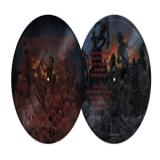
Limited Edition 12" Picture Disc Vinyl featuring the 16th studio album from the undisputed masters of death metal!
goat (JP) are renowned for two albums released in 2013 and 2015 that took Kraftwerk’s man-machine concept back to its roots with swingeing, inch-tight drums, bass and guitar patterns that needed to be heard to be believed. For their long-in-the-making new album ‘Joy In Fear’, band leader Koshiro Hino (YPY, KAKUHAN) describes the process as “90 percent pain” - and we can well believe it - few other records we can think of transmute DAW-composed rhythmic precision into such an expressive instrumental performance. It really is a feat of determination, skill and execution that seems to defy human dexterity.
Make no mistake - an academic exercise it ain’t - in the most visceral sense, goat (JP) make BODY music, for dancing, flailing, for losing yourself in completely. As usual, Hino plays guitar, backed by bassist Atsumi Tagami, while Akihiko Ando joins on saxophone, while Takafumi Okada and Rai Tateishi step in to handle percussion, with the latter moonlighting on flute. Every sound is sculpted into a fragment of cadence: guitar and bass prangs alternately echo and dance between the drums, and Ando's sax is mutated into a respiratory slobber of guttural smacks and phantom breaths.
In some respects, it's tempting to label it jazz, but the kind of jazz that Miles Davis spearheaded on the game-changing 'On The Corner', the blueprint for so much post-punk, electronic music and avant rock. goat (JP) take that raw alloy and sharpen it like a blade, mangling the template with the knotty metrics of Autechre or Ryoji Ikeda. The accuracy is galvanic; it's almost impossible to comprehend each player keeping a mental note of the mathematical time signatures, and yet they floss them out with trills and icy stutters that seem to evaporate around the thick, taiko-like thuds.
They practically get our teeth gnashing with the bruxist rictus chatter of ‘III I IIII III’ , before ‘Cold Heat’ introduces subtly harmonised, new aspects to their sound with slivers of Hassellian flute and ringing overtones of their percussion, while the winding sensuality of ‘Warped’ slips down very nicely. Their links to OG no-wavers like Glenn Branca & Wharton Tiers’ Theoretical Girls - is manifest in the 8 mins of chipping stop/start pulse and parry to ‘Modal Flower’, while a total left turn into Mark Fell-meets-Ligeti-esque messed up metronomics in ‘GMF’ ties it off with a properly beguiling flourish.
- Mar Vista - Visions Part 1 Her Eyes Are Closed
- Kennlisch - Kennlisch
- Crystal Eyes - Crystalzed
- Warlus - Girl Like You
- Gerard Alfonsi - Fana Stickle
- Geoffroy - Viking
- Amphyrite - Symphonie Pour 3 Oeufs Brouilles
- Eole - Friendship
- Capucine - Les Elephants
- Rictus - Flashes
- Inscir Transit Express
- Polaris - Polaris
- Joel Boutolleau - Force
- Spotch Forcey - Frustre
- Demon Wizard - Black Witch
- Temple Sun - Voyage Sans Retour
- Chantal Weber - Ballade Aux Chataignes Tombees
- Jean-Claude Zemour - X Kmh
- Rhodes Co - Baoum
- Guidon Edmond Et Clafoutis - Stormy Sunday
"For a long time, I'd come across these discs without really understanding what connected them, apart from a button and that famous logo designed by René Dessirier. Then, with a little more digging, I discovered the "self-production" link. For choirs, schools, folk singers, young pop groups, popular homes and even great composers who engraved unique copies of certain recording sessions...
The French equivalent of the English "Derby Service", the Kiosque d'Orphée, formerly at 7 Rue Grégoire de Tours in the 6th arrondissement, was taken over by Georges Batard in 1967 and moved to 20 Rue des Tournelles in the 4th arrondissement of Paris. The adventure lasted until 1991. Georges Batard was a sound engineer who used a Neumann tube engraver to engrave acetates from the tapes he received, before printing the precious vinyls in the press factories of the day, where he was able to produce very small runs of between 50 and 500 copies.
Of course, there were other structures for releasing his records, such as Voxigrave or, later, FLVM, but none of them had so many records in their catalog. Le Kiosque d'Orphée was neither a label nor a publisher, but a structure that allowed you to press your own vinyl, at a time when it was quite an adventure to get your first 45 rpm or 33 rpm album released!
Georges Batard was described as passionate and conscientious. His son, bassist Didier Batard, wrote of him:
"Georges was passionate about recording and reproducing the stereo sound of his great passion, music. He paid close attention to distortion rates, signal-to-noise ratios, response curves, rise times and other damping factors in audio equipment. He was looking for the exact reproduction of concert hall sound in his living room (with the same sound level, if possible...). In the late '50s/early '60s, he found other sound enthusiasts in AFDERS (Association Française pour le Développement de l'Enregistrement et de la Reproduction Sonores). He became its honorary president. Every Saturday afternoon, its members met to test au- dio equipment. Their opinions were published in the monthly Revue du Son.
All you had to do was send in your tapes and choose the number of record copies you'd like to take home with you, so you could finally share your creations and, in a way, exist. You could opt for a generic sleeve, available in several colors, directly customizable with your name and credits, or you could design your dream sleeve yourself in your living room or at a printer's.
This "Do It Yourself" temple gave birth to some superb pouches. Stencilled, hand-written, illustrated with paintings, drawings, illustrations by friends or girlfriends of the time, photo prints hastily stuck in the middle of a blank, white sleeve, on which the traces of time would leave their imprints, so that collectors and the curious would come and buy them decades later, with the promise of a musical discovery, unfortunately not always fulfilled...
What most of these records have in common is the youth of their songwriters, whether or not they've had a career. Stories of buddies, of getting by and dreams of glory made up this catalog. Most of them were amateur productions, both in terms of the level of the musicians and the quality of the recordings, made on a two-track or, the ultimate luxury, a 4-track in a teenager's bedroom or parents' living room.
It was the beginning of the home studio, thanks to the advent of the Revox portable tape recorder. A bit of a shaky DIY system, but, in return, the luxury of setting no limits: one-sided tracks, no outside censorship, no artistic director, no manager, no Barclay or EMI/Pathé Marconi logos...
When you finally had your own record, you could give it away or sell it to friends, family or after concerts. You could also drop it off at the nearest record shop, with undisguised pride.
It was also a calling card that could be sent to radio stations or music labels, in the hope of launching a career...
Many of the protagonists in this story tried to sign with labels, but in those days, bridges were not so easy to build between one's hometown, or even one's village, and the major or more specialized label that might have released these records. At the time, the advertisements published in the press by the Kiosque d'Orphée opened up the field of possibilities for provincial composers. It was now possible to make their own record, without having to go through the process of signing with a label.
Some of the composers who have gone on to make a career have used this channel to release their first record or parallel projects (Claude Engel, Dominique A, Andy Emler, Michel Deneuve, Claude Mairet, Mick Piellard, Tristan Mu- rail...) and sometimes even single or very limited pressings of work or promotional copies (Bernard Parmegiani, Jef Gilson...).
This album is the conclusion of a long investigation, begun six years ago. It took a long time to find the records, scattered all over the place, in the homes of collectors and sometimes the musicians themselves, and then to listen to them, sometimes painstakingly, to unearth these moments of grace.
From this work, 23 tracks remain, but there are dozens of others that could have been included, so we had to choose, and the choice had to be as universal as possible. This selection is obviously not objective, but I hope you'll like it.
Today's music is raw, touching and powerful. "
Jean-Baptiste Guillot - Born Bad Records
180 g black Vinyl, Gatefold, DLC, Insert
Seit 1988 stehen Cannibal Corpse an der Spitze des Death Metal und haben das Genre geprägt und definiert. Im Jahr 2021 setzten sie mit ihrem 15. Album Violence Unimagined die Messlatte erneut höher. 2023 kehren sie mit dessen Nachfolger, dem ebenso monströsen Chaos Horrific, zurück und schlagen damit ein neues Kapitel ihres Vermächtnisses auf. Kurz nach Abschluss der Violence Unimagined-Sessions geschrieben, finden sich in Chaos Horrific Anklänge an jenes Album. "Für mich fühlt sich dieses Album wie eine Art Fortsetzung von Violence Unimagined an. Der Stil ist ziemlich ähnlich, aber im Einzelnen klingt keiner der Songs auf Chaos Horrific wie die Songs auf Violence Unimagined", sagt Bassist Alex Webster. "Es ist ein vollwertiges Death-Metal-Album im Stil von Cannibal Corpse."
Ltd. Ltd.burned flesh marbled Vinyl, Gatefold, DLC, Insert
Seit 1988 stehen Cannibal Corpse an der Spitze des Death Metal und haben das Genre geprägt und definiert. Im Jahr 2021 setzten sie mit ihrem 15. Album Violence Unimagined die Messlatte erneut höher. 2023 kehren sie mit dessen Nachfolger, dem ebenso monströsen Chaos Horrific, zurück und schlagen damit ein neues Kapitel ihres Vermächtnisses auf. Kurz nach Abschluss der Violence Unimagined-Sessions geschrieben, finden sich in Chaos Horrific Anklänge an jenes Album. "Für mich fühlt sich dieses Album wie eine Art Fortsetzung von Violence Unimagined an. Der Stil ist ziemlich ähnlich, aber im Einzelnen klingt keiner der Songs auf Chaos Horrific wie die Songs auf Violence Unimagined", sagt Bassist Alex Webster. "Es ist ein vollwertiges Death-Metal-Album im Stil von Cannibal Corpse."
Mick has been active in the seedier corners of electronic music for more than 30 years, first immersing himself in the world of hi-NRG and new wave before embracing the house, techno, acid and electro explosion of the late 1980s. Aligned with DJ Hell in the 90s and more recently the Intergalactic FM crew, he's the quintessential selector. A life spent digging in the undergrowth for deviant dance music has given him the edge that makes a truly gifted spinner, without riding on hype or studio productions. However, Mick isn't adverse to the odd outing on vinyl, having previously appeared on International DJ Gigolos both solo and as The Kinky Lovers with sometime partner Isabella Venis, but these moments are few and far between. For this release on Arma, Mick has given us two edits that speak to his distinctive style as a DJ - the original tracks are cult choices re-moulded into deadly, subversive club weapons. The brooding darkwave of 'Himmelfahrt 89' is enough to turn the most indifferent bar crowd into swaying, baying denizens of the night, while 'Stay Silent' pummels out a relentless electro motif that teeters on the edge of destruction for 11 thrilling minutes. These aren't crowd-pleasing DJ tools, and neither are they slick and easy edits of obvious classics. This is a peek into the inner workings of a man with decades of experience working masses of flesh into a sweaty fever pitch using sounds you've never heard before. The mastering on Mick's edits was undertaken by none other than Dutch electro legend Rude 66, while the striking artwork on the sleeve sees Arma reach out for the first time to French artist Judex. The nerve-shredding, broken Op-Art assault was originally found in a book published by cult illustrator Sam Rictus. Cover Artwork by J
- 1