Поиск:sel 6 secular music

Стили
Все
  • 1
The Nu' Rons - You Came Thru / Hurry Up Tomorrow
 
1

The Nu’rons were a family group consisting of two sets of brothers and cousins, the four young men in question being brothers Daryl Howard and Raymond Gibson (Daryl’s mother registered him under his father’s surname of Howard and Raymond under her maiden name of Gibson) together with Otho Bateman and Charles Bateman. They were all born and raised in Salem, New Jersey and from the age of ten and eleven began singing with a fifth member and Gibson brother Rudolph as a group called The Gospel 5. They eventually decided to crossover to secular music and as a group known for their energetic dance routines they came up with the new performing name of ‘The Nu’rons’ (taken from the word ‘Neuron’ which is a cell that transmits nerve impulses). However Rudolph was soon to leave the group due to physical illness. Also Daryl Howard and Charles Bateman had also been part of a working group known as The Devotions prior to becoming The Nu-Ron’s.Following hours of practice The Nu’rons eventually felt confident enough to put their own shows together and began to perform at local dances and parties around New Jersey and Philadelphia, often being used as a non-paid warm up act for bigger named artists. They moved between several different managers including Jimmy Bishop (Duo Dynamic Productions) until they came under the tutelage of WDAS radio DJ Georgie Woods (his wife Gilda, being the owner of the Philadelphia Gil, Dion and Top & Bottom record Labels). It was Georgie who introduced them to Manny Campbell who in turn invited them to an audition at his and partner Charles Bowen’s Emandolynn Music studio in Chester P.A. The song The Nu’rons chose to audition with was the self penned “I’m A Loner”, the audition went well, as during late January/early February of 1970 Manny and Charles took The Nu’rons into the Sigma Sound Studio’s with Tom Bell and the TSOP musicians to record “I’m A Loner” and “All My Life” which was released on the Nu-Ron label in April of the same year. The two studio takes presente don this release came short after the band moved on from the collaboration with producer Emanuel Campbell to take music matters in their own hands. Beside recording "Disco Hustle" to be part of the disco boom in Philly of the times, they recorded also “You Came Thru”, a rough yet beautiful heavy bassline driven soul funk recording, and the just amazing “Hurry Up Tomorrow”, here presented in one of the original Studio takes.

Сделать предзаказ19.06.2026

он должен быть опубликован на 19.06.2026

19,75
MULUKEN MELLESSE - MULUKEN MELLESSE WITH THE DAHLAK BAND (ETHIOPIQUES)

Swan Song

The vinyl LP at the heart of this éthiopiques 31 tracks 2 to 11 was one of the very last vinyl records ever released in Ethiopia. But above all it represents, we felt, the absolute masterpiece of the Ethiopian Groove – the Swan Song of Swinging Addis. The album leaves a clear idea for posterity of the level of sophistication and mastery that modern Ethiopian music had achieved, before being crushed under the Stalino-military heel of the Derg – as the bloody revolution that was unfolding came to be called.

Ethiopia1976.

The Revolution that broke out in February 1974 rolled on in a ruthless march. The whole of Ethiopian society was utterly stunned. The bouquets of flowers handed joyfully to the first tanks of the coup d'état were to wilt very rapidly. From September 1976 to February 1978, 18 months of Red Terror (the name given by the junta itself) spilled blood throughout the country. This fratricidal conflict took its heaviest toll among students and youth. The shift from feudalism to a cruel and primitive Stalinism left the country's citizens deeply traumatised, and snuffed out any pretence of activism, whatever the sector of society. This ice age was to last for seventeen long years.

ሙሉቀን፡መለሰ Mulukèn Mellèssè Muluqän Mälläsä

It was three tracks by Muluken that served as the opener for éthiopiques-1 more than 25 years ago. Seven more tracks appeared on éthiopiques-3 and 13, all accompanied by The Equators, which was soon to become the Dahlak Band.

The first track, Hédètch alu, also the very first piece that Muluken ever recorded, left audiences both unsettled and amazed. Reflecting the singer's extremely young age (he was just 17 at the time), this angelic voice mystified many, who thought they were in fact listening to a feminine voice. He was not yet 22 when he released his last vinyl record in 1976 with Kaifa Records (KF 39LP), one of the very last to be issued in Ethiopia, before the cassette tape became the dominant medium for music distribution – and before the new revolutionary regime put a stop to all independent musical life, via an unspeakable barrage of prohibitions and other persecutions.

Mulu qèn, literally, “A well filled day”. This tender maternal intention wasn't enough to ward off the cruelty of fate. His mother's premature death drove Muluken to leave his native Godjam, in northeast Ethiopia, to live with an uncle in Addis Ababa. Born Muluken Tamer, he took his uncle's last name – Mèllèssè.

The spelling Muluken appeared in his administrative records. Transcription of Amharic to the Latin alphabet, both in Ethiopia and for scholars, gives rise to controversies and quibbles that can never be neatly settled. French allows for a closer approximation of the original pronunciation, thanks to its battery of accent marks, confusing as they may be to anglophones.

Between rather accommodating administrative record-keepers and the various versions that pop up in interviews given by the artist, Muluken's year of birth oscillates between 1953 and 1955…

1954? One thing is certain: the artist's talent made itself known very early indeed, because he got his start in 1966-67, at the age of 13 or 14. Photos from the period attest to his extreme youth. It's a strange sort of initiation for a very young teenager to become a sensation in the heart of Addis's nightlife at the time, Woubé Bèrèha – the Wilds of Woubé. And what's more, in the club of the Queen of the Night, the Godjamé Assègèdètch Alamrèw herself, the very same that was portrayed by Sebhat Guèbrè-Egziabhér in his novel-memoir Les Nuits d’Addis Abeba2… The legendary female club owner who is remembered to this day by the capital's ageing boomers.

Muluken first tried his hand at the drums, before he grabbed the microphone. He emigrated briefly to the Zula Club, across the street from the old Addis Post Office, one of the ground-breaking bars of the burgeoning musical scene, before joining the Second Police Band in 1968, for around three years. He spent a few months with the short-lived Blue Nile Band founded by saxophonist Besrat Tammènè. As the musical scene grew increasingly successful, and pulled slowly but decisively away from its institutional ties, Muluken released his first 45rpm single in February 1972 (Amha Records AE 440). It was included in two LP Ethiopian Hit Parade compilation albums in September of the same year. All in all, Muluken released eight two-track 45s and the same number of original cassette tapes between February 1972 and 1984, the year that he departed for permanent exile in the USA. After converting to Pentecostalism in 1980, Muluken gradually abandoned all secular musical activity. In 1985, at the end of a concert in Philadelphia, he decided to quit concerts and recording for good. Mèlakè Gèbré, the historic bass player from the Walias band who was playing with him that night, recalls that everything appeared so irredeemably diabolical in Muluken's eyes, that it was to be the end of his contribution to Ethiopian Groove.

The end of the story, the beginning of a legend.

Dahlak Band, forgotten by History

Aside from his personal history and vocal talents, it must be remembered that Muluken Mèllèssè was one of the biggest names in the musical innovations that marked the end of the imperial period. These éthiopiques aim to convince those who are just discovering this hidden gem... As for Ethiopians themselves, they are to this day captivated by this singular and atypical figure in the Abyssinian pop landscape – even though he withdrew from public life some 40 years ago. Incorrigible devotees of poetic twists, of more or less hidden meanings, Ethiopians appreciate above all the care Muluken took in choosing his lyrics and the writers who penned them, such as Feqerte Haylou, Alemtsehay Wodajo and, here, Shewalul Mengistu (1944-1977). Love songs, written by women, a far cry from the conventional drivel that pleases sappy sentimentalists.

Muluken is equally acclaimed for his perfectionism when it came to music, the opposite of the overly casual approach that is all too common. He remained a faithful partner of musicians who came from a lineage that borrowed from several inventive and pioneering bands (Venus, Equators, Dahlak). Amongst them were certain artists who began their musical lives with Nersès Nalbandian at the Haile Sellassie Theatre and who come of age in around 1973 – at just the wrong time, you might say. Among them were the pillars Shimèlis Bèyènè (trumpet), Dawit Yifru (keyboards) and Tilayé Gèbrè (sax & flute). Most notably Tilayé Gèbrè, certainly one of the most important musicians, composers and arrangers of his generation, of the end of the imperial era, and of the early years of the Derg.

It was only in 1981 that a miraculous opportunity arose for Tilayé to escape the Stalinist paradise of the dictator Menguistou Haylè-Maryam. Once again it was Amha Eshèté (1946-2021) who provided a solution. The spirited and courageous producer, who had been in exile in Washington since 1975, succeeded, thanks to his incredible perseverence, in bringing the Walias Band to the USA. It was, in fact an extended Walias Band comprising ten musicians3, six of whom chose to slip away after a few concerts and the recording of an LP (The Best of Walias, WRS 100). Tilayé Gèbrè was one of these. He has been living in the USA ever since. There he joined the then-nascent Ethiopian diaspora, which lived largely unto itself, and was making only very modest headway in the American musical market. It seems unfair that Tilayé Gèbrè and the Dahlak Band were not able to benefit earlier from the public recognition that they do deserve.

A similar draining away of the top-rate talents would lead to the reorganization of the major groups of the “Derg Time”. The remaining artists spread themselves around between Ibex Band (renamed Roha Band), Ethio Star Band and a remodeled Walias Band. That spelled the end of the Dahlak Band.

With this record, produced by the essential Ali Abdella Kaifa a.k.a. Ali Tango, we can appreciate everything that the Derg not only destroyed, but also prevented from flourishing. This gem of Ethiopian-style afrobeat came out in 1976 (and, by way of a parenthesis, before the FESTAC 1977 in Lagos, which was attended by an impressive delegation of Ethiopian musicians — although Fela was already personna non grata in his own country). Despite everything that might distinguish this ethio-groove from Fela’s music – no colonial axe to grind, no question of political confrontation with the authorities, no claims to negritude or Africanism for the Ethiopian musicians, and less extrovertion! –, this LP fits beautifully into the saga of intense and electrified soul of the new “African” groove that Fela and Manu Dibango embodied so well from that point onwards.

In restoring this record to its place in the afrobeat epic, it can be seen that, if nothing else, the timeline bestows a legitimate pedigree and a historical primacy to works that had no international impact when they were originally released.

Warning! Masterpiece!

нет на складе

Закажите сейчас, и мы закажем товар для вас у нашего поставщика.

20,59

Последний логин: 4 мес. назад
GABRIELLE ROTH & THE MIRRORS - SELECTED WORKS 1985-2005 LP 2x12"

Ground-breaking percussive ambient recordings from Gabrielle Roth & The Mirrors, inducing altered states of consciousness through ecstatic dance. "Selected Works from 1985 to 2005" finally available on Time Capsule

Despite featuring an extraordinary cast of musicians (with credits including Pharoah Sanders, Miles Davis, Sun Ra, Santana and Milton
Nascimento) and selling hundreds of thousands of albums, the music of Gabrielle Roth & The Mirrors remains largely unheard beyond their sphere. Conceived as live, improvised soundtracks to Roth’s transcendental dance workshops, musical acclaim was never on the agenda.Instead, for a passionate dancer and spiritual polyglot like Gabrielle Roth, movement was a means through which to channel a wide spectrum of teaching, from experimental psychology to psychedelic counter-culture. It was from this heady mix that she devised a movement meditation known as 5Rhtyhms, which came to define her life’s work.

As “guide and catalyst”, Roth would dance to inspire the percussion-led instrumentals that would in turn fuel her 5Rhythms workshops, stimulating a secular form of ecstatic dance with roots in Native American shamanic traditions, Afro-Brazilian Candomblé and Yoruba drumming. Using anything from a Sioux pony drum to East African kihembe and Japanese Kabuki drums, Gabrielle’s lawyer-turned-drummer husband Robert Ansell set the foundational rhythms for The Mirrors’ recordings, each of which would then feature a rotating cast of friends and professional musicians.

“The secret of everything we’ve done is that we never told anybody what to play,” Robert shares. “Instead of our albums being a musical vision of one person like me or Gabrielle, they were the musical vision of a whole bunch of people.”At times the recordings have a Middle Eastern flair, at others, West African and spiritual jazz modes come to the fore. Hints of kosmische musik, proto-house and electronic ambience are laced like LSD through the organic rhythmic structures. This was kaleidoscopic ambient music to stir the body and free the mind.

In practice, the task of synthesising these different elements fell to Scott Ansell, Robert’s son and a recording engineer whose credits now include Nile Rogers, Duran Duran, Grace Jones. With meticulous attention to detail he captured and translated the dynamic energy of each drum onto record. Their sessions became legendary, and with access to the best studios in the NYC, The Mirrors sparkled.

Despite being initially overlooked by the burgeoning ‘80s New Age market, which preferred pipes and gongs to The Mirrors’ heavy-grooving drums, Robert Ansell set up Raven Recording to self-release the music, creating a vast sonic archive of sixteen albums over almost forty years. The breadth of Raven’s catalogue is such that curator Pol Valls had to cut an initial selection of sixty-six tracks down to the eleven featured here. What crystallises is a stunning, mind-altering collection which spans, in Pol’s words, “a variety of genres, styles, and vibes within their catalogue, whether it is emotional, esoteric, spiritual, melancholic, hypnotic, dark, or at times a combination of these elements together.”Music for immersive and intimate environments, Gabrielle Roth & The Mirrors were born from the dance. In the hands of the right DJ, at the right time, in the right place, they might just return there.

нет на складе

Закажите сейчас, и мы закажем товар для вас у нашего поставщика.

28,36

Последний логин: 5 г. назад
DÍDAC - DÍDAC

Dídac

DÍDAC

12inchFA022
Fasaan Records
04.11.2025

In between the folds of ceremony and commonality lies a perennial spring of musical expression.

A statement along the time continuum, or a testament to the resilient resourcefulness embedded in that truth, forms the philosophical approach of this album – the first outing of Dídac.
Studying an extensive archive of instruments, artifacts, and field recordings at the Musée d’ethnographie de Genève—a space steeped in folkloric gesture – Dídac encountered a cosmos of liturgical music and folk song. Anchored in reverance for tradition and transformation alike, this album navigates the old-world Mediterranean lore through a post-modern ambient lens, threading drone, gentle rhythm, electroacoustic textures and the crude tactility of archival material into one woven tapestry.

Under the guidance of Dr. Madeleine Leclair, Dídac was invited to work within one of the world’s most extensive ethno- musicological archives—L’AIMP. In the saturated basements and tape-lined backrooms of the museum, he submerged himself in the sounds of ritual and rural life: wax cylinders from the Eastern Mediterranean, tapes of liturgical hymn, the worn edges of communal song.
In a makeshift studio on the fourth floor of the museum, he sifted through the hours of material he collected, gradually discovering that the archive was no static source – It did not dictate; rather, it served as a companion—offering not answers, but questions. Not a beaten track, but a cluster of sonic clues and riddles. Samples do appear occasionally, tenderly interwoven into the dialogue of the songs. In Dídac’s self-titled debut, the past is not worn as ornament or kitsch; it is listened to and responded to. The museum, its archives, and the visit to Geneva became a foundational culisse of sorts, igniting a myriad of rough cuts and improvisational outtakes.
Dídac, or Diego Ocejo Muñoz, was born in Madrid in 1994 to a family of both Catalan and Castilian origin.

Brought up in a religious household, the influence of the Catholic Church innately shaped the social fabric, schooling and daily life. This lingering dominance led the adolescent Diego into a path of rejection of everything sacramental, promptly resorting to subversion in the shape of grafitti, skateboarding and underground music. Only later in life, after a rigorous venture as an acid and electro producer, the Church re-emerged before him in new light, invoking a deep fascination for its mysticism, iconography and choral tradition.

Spain in general and Catalonia in particular, has long served as a crossroads of the eastern–western Mediterranean continuum, with many of its cultures sharing aspects of way of life and ceremony. At the MEG, Diego found himself puzzled with this realization, resulting in a sonic amalgamation that reaches farther away from the rugged mountains of Catalonia than you might perceive at first encounter.

The deeply embedded memory of rite and public ceremony, religious hymn and landscape—sieved through the undercurrent of personal re-emergence, forms the emotional topography of this album. The record does not trace this landscape; it inhabits it. Its repetitive mysticism and ambient, wide-eyed gaze could possibly evoke (perhaps redundant) comparisons to artists such as Dimitris Petsetakis, or Popol Vuh’s late 70’s cinema scores.
The delicate lines between the sacred and the secular – between memory and re-invention – serve as a cipher to understanding this album in its entirety. Titles like Malpàs Mines or Pantocrator’s Portal Outro nudge toward a folkloric and devotional bedrock—places where labor and spirituality coexist, where names preserve both dust and veneration.

Nevertheless, this is far from mere nostalgia. It is a reclamation — singing alongside the spirits of the past, nurturing what still hums beneath the soil. It is an intimate reflection on tradition, rebellion, adolescence, ceremony and fantasy – a pastoral contemplation on what once was and what is to be.

нет на складе

Закажите сейчас, и мы закажем товар для вас у нашего поставщика.

18,45

Последний логин: 6 мес. назад
The Lemonheads - Car Button Cloth LP
  • A1: It's All True
  • A2: If I Could Talk I'd Tell You
  • A3: Break Me
  • A4: Hospital
  • A5: The Outdoor Type
  • A6: Losing Your Mind
  • B1: Something's Missing
  • B2: Knoxville Girl
  • B3 6: Ix
  • B4: C'mon Daddy
  • B5: One More Time
  • B6: Tenderfoot
  • B7: Secular Rockulidge
  • C1: If I Could Talk I’d Tell You (Single Version)
  • C2: The Outdoor Type (Remix)
  • C3: Pin Yr Heart
  • C4: Balancing Act
  • C5: Galveston
  • C6: Arise
  • D1: Keep On Loving You
  • D2: It’s All True (No Drums)
  • D3: Losing Your Mind (Live Acoustic Version)
  • D4: How Will I Know (Acoustic)
  • D5: I Don’t Want To Go Home
  • D6: Fade To Black
  • D7: Live Forever

Car Button Cloth' is an extraordinary affair of musical and emotional extremes, a soundscape spanning “the most beautiful piano-led mourning in the history of the broken heart” that switches into perky jangle-pop for fleeting moments and contains the ultimate self-deprecating classic ‘The Outdoor Type’, penned by Smudge cohort Tom Morgan, as well as a cover of the bluegrass standard ‘Knoxville Girl’ and ‘If I Could Talk I’d Tell You’ co-written with The Vaselines’ Eugene Kelly. All bases are covered. “One of the most distinctive voices of the ‘90s” The New York Times. To further unravel where Evan’s head was at during the period of its creation, this deluxe double album comes with a record of exquisite and typically eclectic scene setting covers that occupied B-sides and alternative format versions, plus other super rare offcuts, live takes and remixes. A diet of Volcano Suns, Glen Campbell, The Jacobites, The Sir Douglas Quintet and Whitney Houston influenced Evan’s thinking and added further colour to an album that remains something of a Dorian Gray-style masterpiece. The first side of extras is rounded off with the never before released ‘Arise’, originally set for the remake of Great Expectations and later realised as Rancho Santa Fe on solo album ‘Baby I’m Bored’.

Сделать предзаказ01.08.2025

он должен быть опубликован на 01.08.2025

43,66
Amuleto Apotropaico - Amuleto Apotropaico

Amuleto Apotropaico has a way to fend off demons by channeling a secular spiritualism rooted in a rigorous but playful connexion to the infinite possibilities of noise. The propulsion of their continuous music ebbs into and flows out of this primordial flux through their unique brand of brutalist liturgy.

Amuleto Apotropaico is a Portuguese duo consisting of António Feiteira (drums & electronics) and Francisco Pedro Oliveira (guitar, flute & electronics) formed in 2021. Having grown up together, saturated in the lore of their hometown of Santa Maria da Feira, the duo now resides in Porto and continues to moor their rhythmic rituals in the traditions of Northern Iberia.

None of this is a nostalgic look back to a time-that-never-was. Amuleto Apotropaico's cycles are ouroboric: every step forward invokes a simultaneous step backward such that their observance of sonic ceremony (seeming to invoke a now-forgotten tradition) becomes a constructivist gesture that shapes its own legacy. If time-travel exists, this duo has found out how.

For their self-titled first release (also the first release of the Perf label), António Feiteira has culled, recomposed and processed recordings from the band's last two years of concerts in order to create a exciting 4-tracker. Apotropia I & II, which open sides A and B on the vinyl release, are both textural meditations on subtle density. Feiteira's sensitive percussion flourishes are married to Oliveira's modular-enhanced flute and guitar patterns. Albedo e Rito showcases the duo's sense of melodic contour while crescendoing to a peak of lightness. Bruxa do Calhau Branco, lifts the whole journey into an astral dimension where multi-layered drums, synths and digital clicks breathe out, announcing that their moment of worship has settled back into the ubiquitous hubbub of room hum.

Сделать предзаказ23.05.2025

он должен быть опубликован на 23.05.2025

27,52
The Lemonheads - Car Button Cloth LP 2x12"
  • It's All True
  • If I Could Talk I'd Tell You
  • Break Me
  • Hospital
  • The Outdoor Type
  • Losing Your Mind
  • Something's Missing
  • Knoxville Girl
  • 6: Ix
  • C'mon Daddy
  • One More Time
  • Tenderfoot
  • Secular Rockulidge
  • If I Could Talk I'd Tell You (Single Version)
  • The Outdoor Type (Remix)
  • Pin Yr Heart
  • Balancing Act
  • Galveston
  • Arise
  • Keep On Loving You
  • It's All True (No Drums)
  • Losing Your Mind (Live Acoustic Version)
  • How Will I Know (Acoustic)
  • I Don't Want To Go Home
  • Fade To Black
  • Live Forever
также имеющийся в продаже

Yellow 1LP[46,64 €]


VERY VERY LTD DELUXE CLOTH BOUND GATEFOLD SLEEVE RED VINYL EDTION, 2LP W/ DLC! "The first three songs alone are like love at first hearing." - Deluxe 2xLP clothbound sleeve edition of 'Car Button Cloth', featuring Lemonheads classics 'If I Could Talk I'd Tell You' and 'The Outdoor Type'. This reissue includes the original record alongside a whole extra LP of rarities and unreleased cuts, continuing Fire Records in-depth series of reissues from the legendary band. 'Car Button Cloth' is an extraordinary affair of musical and emotional extremes, a soundscape spanning "the most beautiful piano-led mourning in the history of the broken heart" that switches into perky jangle-pop for fleeting moments and contains the ultimate self-deprecating classic 'The Outdoor Type', penned by Smudge cohort Tom Morgan, as well as a cover of the bluegrass standard 'Knoxville Girl' and 'If I Could Talk I'd Tell You' co-written with The Vaselines' Eugene Kelly. All bases are covered. To further unravel where Evan's head was at during the period of its creation, this deluxe double album comes with a record of exquisite and typically eclectic scene setting covers that occupied B-sides and alternative format versions, plus other super rare offcuts, live takes and remixes. A diet of Volcano Suns, Glen Campbell, The Jacobites, The Sir Douglas Quintet and Whitney Houston influenced Evan's thinking and added further colour to an album that remains something of a Dorian Gray-style masterpiece. The first side of extras is rounded off with the never before released 'Arise', originally set for the remake of Great Expectations and later realised as Rancho Santa Fe on solo album 'Baby I'm Bored'. "One of the most distinctive voices of the '90s" The New York Times

Сделать предзаказ31.01.2025

он должен быть опубликован на 31.01.2025

44,12
Mariah Carey - Merry Christmas LP

Mariah Carey

Merry Christmas LP

12inchLMF33UD1S1-060
Sony Music
15.12.2024

The Holiday Album That Turned Mariah Carey into the Queen of Christmas: Featuring the Standard “All I Want for Christmas Is You,” the Singer’s Blockbuster Merry Christmas Exudes Joy, Spirituality, and Conviction
Sourced from the Original Master Tapes, Presented in Audiophile Sound for the First Time, and Strictly Limited to 3,000 Numbered Copies:

Mobile Fidelity’s UltraDisc One-Step 180g 33RPM LP Set Plays with Superb Detail, Openness, and Definition
1/2" / 30 IPS / Dolby SR analogue master to DSD 256 to analogue console to lathe

Mariah Carey didn’t become the Queen of Christmas just because of her fervent love of the holiday. Or as the result of a brilliant marketing plan. The iconic singer earned her title by way of her blockbuster Merry Christmas, a 1994 album that quickly joined the likes of Bing Crosby’s White Christmas, A Jolly Christmas from Frank Sinatra, and Nat King Cole’s The Christmas Song as an all-time holiday vocal classic. Featuring a balanced mix of inspired originals and well-chosen covers, Carey’s fourth studio record has only grown in stature as new generations discover its magic. Mobile Fidelity’s 30th anniversary edition reissue of Merry Christmas makes her spellbinding performances and upper-tier register come alive like never before.

Sourced from the original master tapes, pressed at Fidelity Record Pressing, and strictly limited to 3,000 numbered copies, the pioneering label’s UltraDisc One-Step 180g 33RPM LP set of Merry Christmas plays with superb detail, depth, and dimensionality. Available in audiophile quality for the first time since its original release three decades ago, and featuring the bonus track “God Rest Ye Merry, Gentlemen,” the nine-times-platinum set breathes with a newfound openness and transparency that enhance the spirituality, passion, and festive tenor of Carey’s singing.

Benefitting from superb groove definition, a nearly inaudible noise floor, and dead-quiet vinyl surfaces, the music takes on a heightened energy and anticipatory emotion synonymous with the holiday season. Carey’s signature vocals explode with liveliness and dynamics, the full scope of her acrobatic range presented in clear, transparent sound that practically places her on a small stage in your listening room. This collectible version also breathes with the kind of warmth, intimacy, and coziness you want from a landmark vocal album.

Recorded when Carey helped put “diva” back into everyone’s vocabulary, Merry Christmas gave the New York native another smash right out of the box. What nobody knew at the time was the degree of the album’s staying power — and how, many years removed from its initial promotion cycle, its legend would still grow and even spark a 2010 sequel. Having re-entered the Top 200 charts every year since 2019, Merry Christmas ranks as one of the three most commercially successful holiday LPs ever made and, in due time, will likely earn the top distinction in that class. A global blockbuster, it seamlessly ties together Christian, gospel, and secular threads and speaks to a boundless audience, independent of denomination.

Most obviously, the record remains inescapably connected to “All I Want for Christmas Is You,” an uptempo anthem that towers as a holiday standard and one of the biggest-selling singles in history. Punctuated with celesta chimes, sleigh bells, springy keyboards, and joyous beats, the song echoes the simple albeit engaging melodies and doo-wop style of beloved holiday classics of yore — and blends such elements with contagious dance-pop rhythms to create an atmosphere rich in joy, wonder, and excitement. Radiant with golden soulfulness and sincere conviction, Carey’s exuberant singing and on-point phrasing put it all over the top. And how.

The song stands as the only effort in Billboard history to top the Hot 100 chart during at least three separate runs. Carey’s blockbuster has already hit No. 1 during five runs, spanning every year between 2019 and 2024. That’s just one of the many records the singer holds — and only one of the multiple highlights from Merry Christmas, which includes two other Carey-penned originals, “Miss You Most (At Christmas Time)” and “Jesus Born on This Day.”

Though slightly lesser known, Carey’s remarkable rendition of Darlene Love’s “Christmas (Baby Please Come Home)” further links her album with the big, lush, Wall of Sound heritage that helped inspire its production. Carey’s heartfelt take and transformation of the traditional “Santa Claus Is Coming to Town” into an animated tune that even adults can believe, as well as her clairon reading of “Joy to the World” — cleverly augmented with bits of Three Dog Night’s 1971 hit of the same name — further reinforce her status as Queen of Christmas.

At the peak of her powers, Carey finds equivalent success when tapping more spiritual veins. Witness the reverence she brings to the timeless carol “Silent Night,” the piousness she invests in “Jesus Oh What a Wonderful Child,” and the sacred feeling she conveys throughout “O Holy Night.” You’ll also never think of “Hark! The Herald Angels Sing” and “Gloria (In Excelsis Deo)” the same way again after hearing Mimi pour her heart and soul into them, and pair the songs together.

Indeed, it’s Carey’s pliable voice, melismatic technique, and five-octave range — on display here in definitive fashion — coupled with her undeniable love for Christmas and understanding of the religious significance of the season that make Merry Christmas a must-have holiday staple. And on Mobile Fidelity’s LP, something you better add to your wish list.

Сделать предзаказ15.12.2024

он должен быть опубликован на 15.12.2024

163,82
FRANK SINATRA - A JOLLY CHRISTMAS FROM FRANK SINATRA

180 Gram Vinyl The album `A Jolly Christmas from Frank Sinatra' was released in 1957 and features the Ralph Brewster Singers along with an orchestra conducted by Gordon Jenkins. It's devided in two parts with side one featuring secular holiday tunes, while side two has more religious Christmas carols. Sinatra is regarded as one of the most popular entertainers of the mid-20th century. He is among the world's best-selling music artists, with an estimated 150 million record sales globally. Over the course of his career Sinatra received eleven Grammy Awards, including the Grammy Trustees Award, Grammy Legend Award, and the Grammy Lifetime Achievement Award. He was included in Time magazine's compilation of the 20th century's 100 most influential people. American music critic Robert Christgau called him "the greatest singer of the 20th century" and he continues to be regarded as an iconic figure.

Сделать предзаказ15.11.2024

он должен быть опубликован на 15.11.2024

19,54
FRANK SINATRA - A JOLLY CHRISTMAS FROM FRANK SINATRA

180 Gram, gold marble Vinyl The album `A Jolly Christmas from Frank Sinatra' was released in 1957 and features the Ralph Brewster Singers along with an orchestra conducted by Gordon Jenkins. It's devided in two parts with side one featuring secular holiday tunes, while side two has more religious Christmas carols. Sinatra is regarded as one of the most popular entertainers of the mid-20th century. He is among the world's best-selling music artists, with an estimated 150 million record sales globally. Over the course of his career Sinatra received eleven Grammy Awards, including the Grammy Trustees Award, Grammy Legend Award, and the Grammy Lifetime Achievement Award. He was included in Time magazine's compilation of the 20th century's 100 most influential people. American music critic Robert Christgau called him "the greatest singer of the 20th century" and he continues to be regarded as an iconic figure.

Сделать предзаказ15.11.2024

он должен быть опубликован на 15.11.2024

27,10
Various - Sam Cooke’s SAR Records Story 1959- 1965 LP 4x12"
 
67

Sam Cooke’s SAR Records Story 1959-1965 gathers significant recordings of SAR Records – the label Sam Cooke co-founded, produced the majority of records for and was instrumental in operating. Groundbreaking artists such as The Soul Stirrers, Johnnie Taylor, Billy Preston, and Bobby Womack’s group The Valentinos are all featured, in addition to Sam himself. “The whole SAR Records Story is infused with Sam Cooke’s rapturous sense of how sacred gospel and sexual soul flow together, unbroken,” stated Milo Miles on NPR’s Fresh Air upon the set’s initial release almost three decades ago. In an era where black-owned labels were a rarity, Los Angeles based SAR Records was founded at almost exactly the same time as Motown, its Detroit counterpart. SAR was established in 1959 by Sam Cooke, music publisher J.W. Alexander, and S. Roy Crain, Cooke’s road manager and founder of gospel group The Soul Stirrers. The acronymous name standing for Sam Alex Roy, SAR sought to keep gospel music alive while simultaneously crossing over to pop audiences in the secular world. LPs 1 and 2 of the set focus on the former, while LPs 3 and 4 encompass the latter. From choosing talent, to writing a great number of songs, to producing, SAR was entirely the fulfillment of Cooke’s vision on a musical/creative level. The superstar singer, who had already crossed over from the gospel world himself, tirelessly coached the vocalists during SAR recording sessions, emphasizing diction. His methods are heard throughout the collection, as he is heard speaking to artists between takes. “And by Sam being there with you and just giving you that special attention, you wanted to give it to him like it was supposed to be. I think that’s what made SAR, SAR. Because he was selling himself through different artists.” – Bobby Womack. VERY LIMITED 1-2 COPIES ONLY PER SHOP

Сделать предзаказ10.05.2024

он должен быть опубликован на 10.05.2024

79,41
That's Why - The Best Of That's Why LP

Sublime Christian folk jazz from 1970s Norway. In the '60s and '70s churches throughout Europe had serious competition for the attention of its younger members. The ecclesiastical establishment was shocked to hear teenagers expressing 'Sympathy for the Devil' rather than sympathy for Christ and his teachings. In Norway at this time the same situation was prevalent as was happening across Europe; teenagers were turning their back on the church and embracing the temptations and pleasures of the flourishing new pop culture. Priest Olaf Hillestad was all to aware of what was going on, and instead of relying on the floundering traditional methods of rounding up his flock, he embraced the musical aspirations of his younger followers. In so doing he founded the Forum Experimentale in Oslo, an organisation that promised in its statutes to "boldly work for a renewal in service life, church music and church art". It was here in the late '60s where That's Why founder members Jan Simonsen and Per Arne Løvold became responsible for the jazz masses at Forum Experimentale's chapel. Together with some top-notch musicians from other Christian music centres around the Oslo district, they recorded two albums in 1970 and 1971 under the moniker That's Why. That's Why blended deep acoustic and electric jazz with elements of Norwegian folklore and Christianity. They also included interpretations of young and old transcendental Norwegian poets such as Sidsel Mørck Krogdahl, Alfred Hauge and Aslaug Vaa, as well as introducing English and Swedish songwriters such as Åke Rosenstrøm and Charles Wesley and even William Blake's "Children of the Future Age" into the mix. This highly original fusion of secular rhythmic music, jazz improvisation and a distinguished selection of transcendental lyrics is one of the standout qualities of That's Why, separating them from more programme-orientated Christian music. The unique mix leads the listener to think they are hearing among the record grooves the tightness of grey, sober Protestantism along with the ecstasy of a lay preacher. This listener, for one, has never heard anything quite like it.

нет на складе

Закажите сейчас, и мы закажем товар для вас у нашего поставщика.

22,43

Последний логин: 10 мес. назад
KALI MALONE - ALL LIFE LONG LP 2x12"

Kali Malone's anticipated new album "All Life Long" is a collection of music for pipe organ, choir, and brass quintet composed by Kali Malone, 2020 - 2023. Choral music performed by Macadam Ensemble and conducted by Etienne Ferschaud at Chapelle Notre-Dame-de-L'Immaculée-Conception in Nantes. Brass quintet music performed by Anima Brass at The Bunker Studio in New York City. Organ music performed by Kali Malone and Stephen O'Malley on the historical meantone tempered pipe organs at Église Saint-François in Lausanne, Orgelpark in Amsterdam, and Malmö Konstmuseum in Sweden. Kali Malone composes with a rare clarity of vision. Her music is patient and focused, built on a foundation of evolving harmonic cycles that draw out latent emotional resonances. Time is a crucial factor: letting go of expectations of duration and breadth offers a chance to find a space of reflection and contemplation. In her hands, experimental reinterpretations of centuries-old polyphonic compositional methods become portals to new ways of perceiving sound, structure, and introspection. Though awe-inspiring in scope, the most remarkable thing about Malone's music is the intimacy stirred by the close listening it encourages. Malone's new album All Life Long, created between 2020 - 2023, presents her first compositions for organ since 2019's breakthrough album The Sacrificial Code alongside interrelated pieces for voice and brass performed by Macadam Ensemble and Anima Brass. Over the course of twelve pieces, harmonic themes and patterns recur, presented in altered forms and for varied instrumentation. They emerge and reemerge like echoes of their former selves, making the familiar uncanny. Propelled by lungs and breath rather than bellows and oscillators, Malone's compositions for choir and brass take on expressive qualities that complicate the austerity that has defined her work, introducing lyricism and the beauty of human fallibility into music that has been driven by mechanical processes. At the same time, the works for organ, performed by Malone with additional accompaniment by Stephen O'Malley on four different organs dating from the 15th to 17th centuries, underscore the mighty, spectral power that those rigorous operations can achieve. All Life Long simmers in an ever-shifting tension between repetition and variation. The pieces for brass, organ, and voice are alternated asymmetrically, providing nearly continuous timbral fluctuation across its 78-minute runtime even as thematic material reiterates. Each composition's internal framework of fractal pattern permutations has the paradoxical effect of creating anticipated keystone moments of dramatic reverie and lulling the listener into believing in an illusory endlessness. On an even more granular level, the historical meantone tuning systems of each organ used, and the variable intonation of brass and voice, provide further points of emotional excavation within the harmony. The titular composition "All Life Long" appears twice on the album, first as an extended canon for organ and again in the final quarter, compactly arranged for voice In the latter, Malone pairs the music with "The Crying Water" by Arthur Symons, a poem steeped in language of mourning and eternity. For organ, "All Life Long" moves with a patient stateliness, the drama concentrated in moments when shifting tonalities generate and release dissonance and ecstasy. For voice, each word is saturated with feeling, the singers swooping gracefully downward to capture the melancholy of the narrator's relationship to the timeless tears of the sea. "Passage Through The Spheres," the album's opening piece, contains lyrics in Italian pulled from Giorgio Agamban's essay In Praise of Profanation. In it, Agamban defines profanation as, in part, the act of bringing back to communal, secular use that which has been segregated to the realm of the sacred, a process Malone enacts each time she performs on church organs. This is not music of praise, or of spiritual revelation, but it is an artistic enactment of translating the indescribable. It carries the gravity of liturgical chant, and its fixation on the infinite, but draws its weight from the earthly realm of human experience. A music that draws the listener into the present moment where they can discover themselves within the interwoven musical patterns that can come to resemble the passage of days, weeks, years, a lifetime.

нет на складе

Закажите сейчас, и мы закажем товар для вас у нашего поставщика.

33,19

Последний логин: 7 мес. назад
GREG BELSON'S DEVINE DISCO - VOLUME TWO: OBSCURE GOSPEL DISCO 1979-1987

Available april 30th

Heavy heavy heavy gospel compilation.. Including a few tracks that are under the radar or recently discovered such as Harrison Jones - On that Other Shore, Converters, I've Been Converted and the super limited self-released 45 by Mr Jesse R. McGuire – Jesus Is On the Mainline. Only 50 copies were ever pressed... Also holds Paradise's brilliant "Keep the Fire.".. TIP!!

Although gospel and disco music seem like polar opposites—one is secular while the other has embraced a hedonistic culture—the marriage of the two genres has birthed the uplifting spirituality and dance floor thump found in gospel disco. By the mid-'70s many established and independent gospel artists started creating records with a tight four-on-the-floor beat that touched both churchgoers as well as patrons of the drug-fueled establishments of the '70s.

Cultures of Soul Records is proud to present the second installment of Greg Belson's Divine Disco. Belson is one of the world's leading authorities on the funky gospel sound; for this collection he dug deep into his crates to
undercover the rarest independent and private press gospel disco records ever recorded. Greg Belson's Divine Disco sound is one that's been heard around the world from his DJ appearances at Glastonbury's NYC Donwlow stage to LA's Funky Sole to soul nights across
Europe.

Many tracks are under the radar or recently discovered such as Harrison Jones - On that Other Shore, Converters, I've Been Converted and the super limited self-released 45 by Mr Jesse R. McGuire – Jesus Is On the Mainline. Only 50 copies were ever pressed. This volume even includes gospel disco from the UK with Paradise's brilliant "Keep the Fire." This compilation also includes remixes and edits by Steve Cobby (who was a member of Fila Brazillia) and the Divine Situation production duo of Greg Belson and Paulo Fulci.

нет на складе

Закажите сейчас, и мы закажем товар для вас у нашего поставщика.

31,05

Последний логин: 7 г. назад
Cucina Povera - Hilja

An ethereal, unresolved presence fading into the stereo field, Hilja breathes into life with a haunted synth line and self-sampling vocal hook that instantly creates an enchanted space. Hilja is the debut album by Glasgow-based musician Maria Rossi aka Cucina Povera. Named after a style of southern Italian traditional cooking associated with precarity and making-do, a philosophy of simplicity and stoicism that applies perfectly to the spare but beautiful music Rossi experiments with. Hilja's marriage of minimal synth, field recordings and the hymnal dexterity of Rossi's vocal performances creates a new language, sometimes literally, to be spoken in some mythological Fourth World we've yet to create.
Originally from Finland, Rossi brings an acute sense of space, surroundings, and practicality to her working practice, with each composition often relying on a limited sound palette to create deeply affecting messages which transcend language. Cucina Povera's power is to communicate purely, often down to the solo-choir nature of Rossi's multi-layered voice, an achingly beautiful instrument which has seems to have an innate spirituality in its grain. The tension between the means and the end is at the heart of Cucina Povera, the invocation of a kind of secular spirituality at times using nothing but Rossi's voice. Indeed there's almost a Dogme-like purity to the arrangements: Elektra is a soothing song based around the lapping waves of Rossi's wordless backing vocals and a simple field recording of stones knocked together. Kehoitus is completely a cappella, a haunted fairytale told in glossolalia, evoking a quasi-religious experience with very little.
For music often minimal and simple there's a boldness that belies Hilja's status as a debut. Rossi allows each word, each sound and rhythm to exist in its own space, finding its own relationship with its surroundings. Mesikämmenen Veisu is perhaps the most ecclesiastical sounding composition here, burbling water trickles below a virtuoso vocal, with incredible arrangements in several registers undulating above. A meditation to relieve hunger and restriction, it's a perfect summing up of Hilja, a music ambient but completely earthed, finding enchantment in what you have to hand, the realism of magic, the magic of realism.
First Press limited to 300 with hand-screened sleeves.

нет на складе

Закажите сейчас, и мы закажем товар для вас у нашего поставщика.

18,28

Последний логин: 8 г. назад
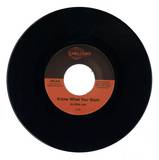
Gloria Jay - Know What You Want

Melodies International proudly moves forward with an elusive piece of mid-tempo Chicago soul originally performed by Gloria J. Jennings in 1977.

Gloria was signed to Stage Productions as a gospel singer with pure and raw talent she had developed in the choir of her father's Southern Baptist Church. She was 16 years old at the time. To tutor her for R&B vocals, Willie C. Nance of Stage Productions spent 3 months taking the artist back and forth for vocal training 25 miles each way, 3 days per week.

At the time, Mr. Nance had made plans to work with singer and songwriter Theresa Eagins to record Know What You Want'. However, two days before the recording was set to begin, Ms. Eagins refused to move forward with the recording as she chose to take her religious faith more seriously and forgo the singing of secular music. Hence, Stage Productions turned to Gloria Jay to perform a song that would go on to move people thousands of miles away, many years later.

One of them was Patrick Forge: Back around 1990 I had a residency upstairs at the Wag Club on a Friday night alongside Paul Martin (he was Gilles P's A&R right hand man at Talkin Loud), the night was called Respect and we played mainly Soul, Boogie and Jazz-Funk. Many years later I bumped into Paul at a record shop and he quizzed me about a tune I used to play at the end of the night at Respect. Hhe described it as being an independent Soul seven inch on a red label, slow to mid tempo... and more to the point a bullet of a record. It piqued my curiosity so much I burrowed through my seven inches and even made Paul a compilation of likely contenders, his response was lovely selection, but it's not on there!'. Damn, a mystery! Many moons later whilst I was living in Japan, my tenant in my London flat said she'd found an old mixtape I'd done for her way back when and was desperate to know the identity of something she was calling the choo choo song'. Eventually when I was back in London she played the mixtape and I quickly identified her tune as Fabrica' by Cesar Mariano, however letting the tape play some time later a familiar descending chord sequence catapulted me back to those Friday nights at The Wag, and Gloria Jay's plaintive vocals reminded me of a record that had been absent from my life for far too long. I've no idea what happened to my original copy, I hunted another one down straight away, and I've kept it close ever since. Know What You Want' is a song that goes deep in such a simple, unaffected, almost naive way, Gloria's voice is both sweet and raw, it's built on simple chords and obvious instrumentation, but it's so much greater than the sum of its parts.

Know What You Want' is soul music, pure and unadulterated, there's nothing getting in the way of the feeling, it's straight from the heart.' Carefully re-mastered from the tapes, MEL008 comes forth in its original 7' format with a 14'x14' poster.

нет на складе

Закажите сейчас, и мы закажем товар для вас у нашего поставщика.

12,40

Последний логин: 8 г. назад
  • 1
Продуктов на странице:
N/ABPM
Vinyl