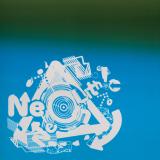
With Neolithic Neon, Appleblim creates a kaleidoscopic reflection of the spirituality inherent within electronic music — the ineffable frequencies and communal traditions that spring from exploratory synthesis, deep-rooted rhythms and myriad other sonic codes.
Throughout his third album for Sneaker Social Club, Laurie Osborne continues to express a fascination with the ancient resonance held within modern rave as he guides his own studio practice towards more purposefully analogue processes. It's reflective of his desire to let go and trust his instincts within the more chaotic realm of voltages and signals, not to mention turning to a wider spread of instrumentation and opening up to noisier avenues. This direction defines the character of Neolithic Neon, which bristles with the living imperfections of the gear in the context of incisive and wide-ranging cuts touching on jungle, dubstep, techno, electro, acid and experimental electronic music of all stripes.
Across Osborne's solo output from 2018's Life In A Laser to 2021 tape Infinite Hieroglyphics, a strong melodic sensibility spills out of the richly layered production. It's equally audible in his Wrecked Lightship collaboration with Adam Winchester, and it charges Neolithic Neon with its star-gazing, contemplative streak. From the knotty plucks and licks weaving through opener 'Moorland' to the vaporous synths darting across the top of hardcore conductor 'Thunderstorm', a dreamlike evocation takes the sound off terra firma, musing on cosmic events and our connection to the enormity of the universe.
Eternally in thrall to the maverick vocabulary of pioneering beat scientists and fuelled by the inspiration of great thinkers dwelling on our purpose and place, Neolithic Neon unfurls big ideas without heavy-handed messaging. Instead, it trusts in the universal and time-honoured language of experimentation and rhythm to present its ideas, true to Appleblim's legacy to date while opening a new chapter in his ongoing sonic quest.
Поиск:the voltage club
Все
Beat Machine Records is proud to drop the sixteenth chapter of its iconic Swinging Flavors series, starring Newcastle’s own Nectax — a breakbeat alchemist pushing jungle and D&B into jagged, unpredictable territory — backed with a remix from forward-thinking bass manipulator Fracture.
Cool Runnings is exactly that: a hypnotic, mid-nineties-tinged jungle cut stripped back and dubbed out, but sharpened with modern production techniques that give every snare and sub-bass a punchy, alive quality. Razor-sharp breaks collide with rolling basslines, weaving a track that’s at once nostalgic and fully of-the-moment.
The B-side flips the energy with Fracture’s remix, injecting fractured percussion, jagged fills, and high-octane bass tweaks. It’s a modern take that preserves the original’s laidback groove while kicking it into full-blown club chaos. Together, the two tracks form a high-voltage 7” that bridges classic jungle aesthetics with contemporary sonic experimentation. “Cool Runnings is my take on a laidback mid-nineties tipped Jungle track. Stripped back, dubbed out, but with a subtle focus on modern production techniques to tie it all together,” says the artist.
Following recent Swinging Flavors contributors like Ac1d Vicious, DJ Sofa, and Ornette Hawkins, Nectax marks the next evolution for the series: tense, textured, and unafraid to push the floor into new territory.
The release continues Beat Machine Records’ mission to highlight forward-thinking club music rooted in underground culture, with a sharp focus on physical formats and hybrid rhythms.
We don’t follow trends—we redefine them. Deep In Dis proudly unveils the highly anticipated physical debut on the label of Rawaï, a dynamic Parisian artist you need on your radar.
Expect a fusion of raw percussion, peak-time rave energy, and cutting-edge house grooves, all woven together with mind-altering samples. These tracks aren’t just powerful—they’re designed for maximum impact in the darkest corners of the club.
Across four original cuts, Rawaï delivers a statement of intent: uncompromising, high-voltage music built to ignite the dance floor. This one’s strictly for true heads.
Spread across two discs for maximum fidelity, this is sound system music with grooves primed for mixing and dialed-to-a-Tee bass weight, but hovering above the grounded structures are fleeting rhythmic textures that veer things off into a world worth getting lost in. Throughout its 11 tracks, “Club Dream” plays out like a full mix, ebbing and flowing through a variety of energy levels and moods. Some of the range you’ll find here includes half-time dream-step, peak time pulses, and dubbed out mid-tempo tech, all done with a cohesive restraint and appreciation of atmosphere. The record imparts it’s own kind of dance floor dream logic onto the listener, inviting us to let go of making sense of things and trust in its fuzzy logic.
Returning to his roots in live production, OTON shares the 4-track EP Aurora on his imprint Alliance Club. Following his previous neo-rave stylings on the label, Aurora is the product of hours spent in OTON’s Brussels-based studio, where he worked with a DAW-less setup and a newly acquired tangle of gear. Such tools remained instrumental in crafting the sonically rich textures of Aurora and OTON’s forthcoming album, New Forms Of Silence, drawing from a palette of mental techno, hypnotic tribe, and psy tek. Two tracks from the album—due for release in spring 2025—feature on Aurora, comprising the title track and ‘Voltage Controls’.
Nightclub E Replacement stylus
Nightclub E is equipped with Special Elliptical diamond. Perfect for usage in clubs. Superb sound quality.
Club DJs and studio workers believe the Nightclub E to be an absolute high-end cartridge. It is indeed a no-nonsence performer with fascinating musical resources.
It's output is superb with a frequency responce rating high enough to compare the Nightclub E to any audiophile cartridge.
The special elliptical stylus guarantees sound with insignificant scratching.
Nightclub E Stylus Technical Data
Output voltage at 1000Hz, 5cm/sec. - 8 mV
Channel balance at 1kHz - 1,5 dB
Channel separation at 1kHz - 23 dB
Channel separation at 15 kHz - 15 dB
Frequency response - 20-20.000 Hz +/- 1.5 dB
Tracking ability at 315 Hz at recommended tracking force - 65 μm
Compliance, dynamic lateral - 20 μm/m N
Stylus type - Elliptical
Stylus tip radius - r/R 8/18 μm
Tracking force range - 2.0-5.0 g (20-50 mN)
Tracking force recommended - 3.0 g (30 mN)
Tracking angle - 20°
Internal impedance, DC resistance - 1000 Ohm
Internal inductance - 580 mH
Recommended load resistance - 47 kOhm
Recommended load capacitance - 200-600 pF
Concorde cartridge weight - 18.5 g
Nightclub MkI Replacement Stylus
Following in the footsteps of the legendary Nightclub series, the re-engineered Nightclub MkII boasts numerous sonic improvements in both club and studio settings.
With a new cartridge body, the Nightclub MkII offers increased output voltage for powerful, energetic sound and enhanced performance from integrated phono preamps such as the ones found in DJ mixers. Superb sound quality!
Club DJ and studio workers believe the Nightclub MkII to be an absolute high-end cartridge. It is indeed a no-nonsence performer with fascinating musical resources. Its output is superb with a frequency response rating high enough to compare Nightclub MkII to any audiophile cartridge. The special elliptical stylus guarantees sound with insignificant scratching.
Nightclub MkII Stylus Technical data
Output voltage at 1000Hz, 5cm/sec. - 8 mV
Channel balance at 1kHz - 1.5 dB
Channel separation at 1kHz - 23 dB
Channel separation at 15 kHz - 15 dB
Frequency response - 20-20.000 Hz +/- 1.5 dB
Tracking ability at 315 Hz at recommended tracking force - 80 μm
Compliance, dynamic lateral - 20 μm/m N
Stylus type - Special Elliptical
Stylus tip radius - r/R 13/25 μm
Tracking force range - 2.0-5.0 g (20-50 mN)
Tracking force recommended - 3.0 g (30 mN)
Tracking angle - 20°
Internal impedance, DC resistance - 1.000 Ohm
Internal inductance - 580 mH
Recommended load resistance - 47 kOhm
Recommended load capacitance - 200-600 pF
Concorde cartridge weight - 18.5 g
2025 Repress
Chontane delivers six dynamic techno cuts via his 'Sycamore' EP on Mutual Rytm.
A firm fixture of the VOLTAGE roster and a rising name originating from Ukraine making an impact, Berlin-based DJ and producer Chontane is quickly finding his feet following a string of EPs via ARTS, Lobster Theremin and Rekids Special Projects. Already playing key clubs at the age of just 18, blurring the lines between techno, breaks and electro with his growing trademark sound, his performances across Berlin and beyond have captured the attention of many as he showcases his up-front and powerful sound. Next, he heads to SHDW & Obscure Shape's Mutual Rytm imprint for the first time as he reveals his six-track 'Sycamore' EP.
Lead cut 'Preserved' is a rugged yet soulful opener, settling into a rolling groove guided by crisp hats and sharp stabs, while 'Arakis' propels into more eerie and menacing spheres as waling vocals emerge and disappear into the track's relentless dynamic. Opening the B-side, 'Sitka' fuses jacking drums with playful flute interludes for a production set to get dancefloors moving, while 'Laboe' keeps things fiery as a peppy track which launches into fiesta mode. Closing the flip side, B3 'After Images' reveals the most emotive production on the package,
balancing the hard-hitting kicks with soulful vocals and hazy melodies for a classy slice of techno.
Once again, digital purchasers are treated to an exclusive bonus with 'In Roots' raising the temperature and jumping right back into the action to serve up another energising anthem from a label and artist on the rise.
Ortofon Concorde Club MKII System, universal elliptic tylus, especially for Clubs and studio applications, high output voltage requires less gain thomann from the preamps and less susceptibility to feedback in live applications, also for transferring to anny digital storage media, output power: 8 mV, frequency range: 20 - 20.000 Hz, Tracking force: 3g, without replacement stylus, set comprising 2 pieces, incl. case
Ortofon Concorde Club MKII System, universal elliptic stylus, especially for Clubs and studio applications, high output voltage requires less gain thomann from the preamps and less susceptibility to feedback in live applications, also for transferring to anny digital storage media, output power: 8 mV, frequency range: 20 - 20.000 Hz, Tracking force: 3g, without replacement stylus
DJ Support by Fabrizio Mammarella, Sean Johnston (ALFOS), Erol Alkan, Ame, Fango, Jaye Ward, SHMLSS, Camilo Miranda, Marco Passarani, Logan Fisher, Massimiliano Pagliara, Otto (Bordello a Parigi), Phil Mison, Giulia Gutterer, Pete Herbert, Franz Scala, Lauer, Pedro Bertho, Feel Fly ...
New music from legendary Adriatic DJ and producer Verdo is as rare as an MP3 in the golden age of disco. Which is why you should be hella excited for GRATIS CLUB, his first full-length album and a love letter to the iconic club he once called home in Senigallia.
A true Loyal Hell Yeah Recordings member and consummate musician, Verdo brings his signature piano melodies to Italo disco, hi-NRG, and trance magic across X cuts that are equal parts dancefloor propulsion and cosmic exploration.
GRATIS CLUB captures the energy, eccentricity and euphoria of the club Verdo played and directed, translating the pulse of a local institution into a timeless, high-voltage record. With previous releases on Danny Was A Drag King and this label, including his 2020 Symmetry EP, Verdo continues to prove he’s one of Italy’s best-kept secrets with this new album.
Opener and lead single ‘Let In The Light' is pure Italo disco adrenaline: shimmering arps soar over lush chords and retro analogue drums, igniting the dancefloor. Second single ‘Boulevardier’ is introspective yet radiant with rugged synths spiralling inward while shiny 80s chords inject colour and retro soul, all carried by supple, marching drums. 'Eyes Melody' is an ascent to a higher state with acrobatic drums and bass and more luminous synth magic, 'Ballad' has a more downbeat and late-night feel with pensive pads and sad vocoder, then the title cut is bold, bright and unabashed in its stomping disco brilliance. 'Our Love Come Back' has a sense of yearning that surely translates the sadness felt at the closing of Gratis Club, then 'Lest We Forget' is a reminder of how pumping and sweaty the main room got with Verdo in the booth. 'Little Blue's is the gentle comedown and comforting hand that leads you home in a reverie.
GRATIS CLUB is a pure hit of unbridled Italo disco joy.
- 01: Funky Raver
- 02: Get The Groove
- 03: I Misplaced You
- 04: Funky Raver (Victor Muerte Remix)
- 05: Get The Groove (A.fruit Remix)
- 06: I Misplaced You (Nite Fleit Remix)
Belgian producer and DJ Ethan Fawkes returns with Funky Raver, a vibrant six-track vinyl release that channels the spirit of 70s funk and disco through a modern electronic lens. It features three originals alongside remixes from Victor Muerte, A.Fruit and Nite Fleit.
Fawkes, known for pairing raw rhythm with emotional punch, dives headfirst into the golden age of groove and rebuilds it for today's dance floor. The result feels warm and energetic, fresh take that nods to disco's roots while pushing forward.
Each remixer takes the core idea in a new direction without losing its heartbeat.
Victor Muerte takes "Funky Raver" track into a remix out a driving techno rework marked by hypnotic whiper repetition. It taps into the darker side of the groove, building steady pressure and giving the release a powerful late-night edge.
A.Fruit flips her version of "Get the Groove" into a fast, broken beat-driven workout full of tight percussion and futuristic low-end, giving the original a kinetic bass-forward storm that keeps the momentum surging.
Nite Fleit, the producer with a reputation for bold, genre-blending club tracks, injects her remix with electro pressure. She delivers a high-voltage version of "I Misplaced You" to take that turns the funk foundations into pure rave.
Taken together, the originals and remixes trace a full arc, from glittering disco lights to the throb of the warehouse. Funky Raver is a celebration of groove, motion and emotion. A reminder of how timeless dance-floor energy can be.
From the heart of his own Safe Space imprint, Ackermann returns with a powerful new statement that traces a high-voltage line between techno and house. Known for his raw yet precision-tooled club cuts and a sound that moves from warehouse grit to late-night euphoria, the Stuttgart-based producer once again delivers tracks that are direct, functional and full of character, built for DJs who like it tight, driving and emotional at the same time.
On remix duties, Berlin icon Anja Schneider flips Ackermanns ideas into elegant, rolling peak-time material, balancing subtle tension with her trademark sense of groove and warmth. Rising force Confidential Recipe pushes things further into raw, percussive territory, upping the pressure with jacking drums and rave-soaked energy made for smoke-filled rooms and redlined sound systems.
True to the Safe Space motto, this release is all about the dancefloor: no filler, just stripped-back, high-impact tracks that lock you in and don’t let go.
Island disco-soul... modern soul... tropical boogie... plus killer break-beats: Recorded in the Bahamas in 1980, Portia’’s ‘I Wanna Thank You’ Club Mix by Sean P. is exclusive to this single. Two versions, vocal and Instrumental both mixed from the original multi-track session tape. Sung by vocalist Portia and backed by Naussau’s High Voltage Band, led by guitarist and producer Patrick Carey of 5th Degree.
RYC presents a four-track journey at the junction of their respective universes, teleporting us straight to a propulsive, mind-expanding headspace as we're invited to explore sonic territories still uncharted and harmonics yet unravelled. The collaborative A-side begins with the dynamic title-track, 'Cross Passage', a proactively future-facing number packing the kind of utopian drive that used to define the original techno sound. A highly cinematic narrative boasting Detroit-style vision and epic breath, 'Cross Passage' builds bridges between hi-tech elation and organic integration, transcending mere functionality to push back and expand the limits of techno as a deep communication vessel between the individual and the mass. Firing off like a binary script gone astray, 'Fibre Axis' takes us on a further bumpy ride across shape-shifting interfaces and blurred-out digital scapes, via abrupt pixel landslides and fractured 3D renderings. Side-B finds each producer dishing out a slice of his/her own musical idiom. Polygonia strikes first with the pulsating 'Voltage Blues' - a mesmeric roller cut from pure eerie synth algebra, boundary-pushing abstraction and surgical but experimental-leaning rhythmic assault. The result is a piece of cutting-edge techno hoodoo, ready to take on clubs with utmost abrasive swagger. Sniping a hail of rainbow-like analogue synth outpour, Wata Igarashi's solo contribution 'The Tunnel Dreams' rounds off the journey on a fiercely nonconformist note. Merging a hard-hitting main swing with 8-bit-esque audio pointillism and brooding bass undertones, the Japanese producer cuts a path of antigravitational abandon and relentless rush towards absolving euphoria, which shall leave all in the room levitating somewhere between sheer daze and love-thirsty XTC. *Clad in the sleekest cover art courtesy of designer Atact, RYCL024 is pressed to red & white marbled vinyl for you, fancy platter collectors and picky audio-visual aesthetes alike.
The Cocoon x Ortofon Stylus is a cartridge designed for club environments, renowned for its robust build and exceptional audio fidelity. It's able to withstand heavy back cueing, ensuring high output for clear sound from a mixer or preamplifier. With premium sound quality, this cartridge offers an exceptional listening experience.
High output
Special Elliptical Stylus
Withstands heavy back-cueing
Premium sound quality
Optimized for club use
Developed in collaboration with Ortofon
Channel balance at 1 kHz
1,5 dB
Output voltage at 1 kHz, 5cm/sec
8 mV
Channel separation at 1 kHz
23 dB
Frequency response 20 Hz - 20 kHz
+/-1,5 dB
Tracking ability at 315Hz
80 μm
Compliance, dynamic, lateral
7 μm/m N
Stylus type
Special Elliptical
Tracking force range
2.0-5.0 g (20-50 mN)
Tracking force, recommended
3.0 g (30 mN)
Cartridge weight
stylus = 1 g
- A1: School Days-Chuck Berry 1957
- A2: Lucille-Little Richard 1957
- A3: That's Alright (Mama)-Arthur Crudup 1949
- A4: Blue Suede Shoes-Carl Perkins 1955
- A5: Bye Bye Johnny-Chuck Berry 1960
- A6: Jailhouse Rock-Elvis Presley 1957
- B1: Baby,Please Don't Go-Muddy Waters 1953
- B2: Johnny B.goode-Chuck Berry 1958
- B3: Tutti Frutti-Little Richard 1955
- B4: Shake Rattle And Roll-Big Joe Turner 1954
- B5: Carol-Chuck Berry 1958
- B6: Heartbreak Hotel-Elvis Presley 1956
Rock and Rock roots, deep down under You'd better believe it! The roots of Australian rockers AC/DC lie in the whirlwind of original fifties rock and roll.
In the early days the group would cut their teeth on the club circuit with a live set that would include a handful of band originals,a few Rolling Stones numbers plus many crowd pleasing Rock and Roll classics.
The Sydney club and bar scene was rough so you had to get the punters on your side.
With their original singer Dave Evans at the helm the group who play residencies at the likes of the New Hampton Court Hotel in Sydney entertaining with their own brand of loud guitar takes of 'Carol' and 'Bye Bye Johnny'by Chuck Berry,'Tutti Frutti'by Little Richard,as well as rocking standards like 'Shake,rattle and roll' and 'Blue Suede Shoes'.
Cranking out cover versions didn't die even when the group composed more original material,a version of 'School Days' by Chuck Berry would appear on their second album' TNT',whilst 'Baby Please Don't Go' would be pulled from their original 1975 debut album'High Voltage' and issued as a single in America.
These roots are the reason that AC/DC have become one of the best loved bands on the planet who never fail to deliver the goods everytime.......
Es war 2003, als "Fire", das Debütalbum von Electrix Six aus Detroit quasi aus dem Nichts erschien, um weltweit die Dancefloors zum Beben zu bringen. Hitsingles wie das ikonische "Gay Bar" oder "Danger! High Voltage!", zu dem gerüchteweise Jack White persönlich Backing Vocals beigesteuert haben soll, laufen noch heute in den Clubs und Indie-Playlisten. Zum 21sten erscheint jetzt eine remasterte Version von "Fire" auf Vinyl und CD. Die CD wird außerdem fünf Bonustracks enthalten. "Fire" wurde zwischen 2002 und 2003 in Michigan aufgenommen mit ergänzenden Arbeiten in den Londoner Abbey Road und Olympic Studios. Bereits die erste Single "Danger! High Voltage!" schlug medial ein. Pitchfork schrieb über den Song: "it drops a hard beat, announcing itself with taut wah-wah guitars before exploding into fuzztone and horns while singer Dick Valentine duets with the White Stripes" Jack White". Die Folgesingle "Gay Bar" stieg in die Top 5 der britischen Single-Charts ein und wurde von Q und Kerrang für das "Video des Jahres" ausgezeichnet. Auch "Dance Commander" kam mit einem epischen Video vom gefeierten Regisseur Ruben Fleischer.
In the late 1980s, as techno and house made its way around Europe, mutating as it hopped from city to city, one young DJ from Curacao made a mistake that would inspire a brand new sound. While he was performing at Den Haag's Club Voltage, DJ Moortje accidentally dropped a dancehall track at 45RPM rather than 33, and let it play out. Thirsty for a hi-NRG sound, the crowd loved the squeaky vocals and rapid beat, and bubbling (or bubbling house) was born.For the next couple of decades, bubbling was a crucial part of Holland's Afro-diasporic club landscape. And as a new generation of wide-eyed young DJs and producers began to take the reins, it evolved accordingly. In the late-2000s, Den Haag-based teenage prodigy Guillermo Schuurman followed in the footsteps of his uncle DJ Chippie (one of the genre's co-founders) and cousins DJ Daycard, DJ Master-D, Stiko Jnr and DJ Justme, and began performing and writing beats. Using Fruityloops, he fused familiar bubbling rhythms with rap and R&B samples, trance synths and electro house wobbles, and his tracks quickly became a regular fixture on the Dutch circuit."Bubbling Inside" is a collection of Schuurman's most essential cuts from the era (2007-2009), with a couple of newer productions added for context. Crafted solely for the dance, most of these tracks were never properly released and have been painstakingly hunted down and collected by the Nyege Nyege Tapes together with Sascha Roth from Pantropical in Rotterdam and De Schuurman himself. Hearing them together highlights just how forward thinking the young producer was, steering a Dutch institution into the future.2008's 'First One' is a proto-Berghain belter, with booming bass-heavy kicks underpinning the kind of cheeky melodies that remain the calling card of the genre. 'Pier Je Bil!!' ratchets up the tempo, twisting bubbling's syncopated dancehall kicks into a rapid-fire club clatter and decorating them with steel-pan melodies. Elsewhere, 2019's 'Domina' shows how Schuurman's production style has developed as he mutates trap percussion, dubstep bass and eerie synth textures, while retaining the DNA of bubbling. "Bubbling Inside" is a testament to the evolution of the bubbling genre, as witnessed by one of its most visionary producers.