An obscure and deep acoustic jazz-funk LP from 1974, remastered and repressed in an edition of only 300 copies !
“Profile” is the first and only Ken Rhodes LP as a leader. This intimate and rare recording captures an explosive concoction between blues, jazz and a touch of funky swing. Though an acoustic performance, this LP offers overwhelming grooves, breaks as well as introspective moments .
The upbeat and funky titile track “The Profile” forshadows the raw grooves of the session.The composition is driven by Rhode’s very soulful and bluesy improvasitions in a colorful dialogue with Joachim Knauer’s percussive and obsessive bassline which embraces the funky rhymthms of George Greene. However, this raw “in-your-face” formula is beautifully constrated in “Nothing New” and the piano solo “Robyn’s Lullaby” where the trio slows down to play deep, dreamy and hazy tunes.
Biography
Ken Rhodes was born August 14, 1945 in Memphis, USA and grew up in a family of excellent musicians. He attended the American Convervatorium of Music in Chicago, studied classical music and received Bachelors and Masters Degree. At the age of 16 he toured with his own jazzband throughout the eastern states. During this time he wrote classical compositions for symphony orchestras and organ-music. Gerry Mulligan called him for an extended tour. Studying at the University of Cincinnatti he received the Down-Beat Prize in 1970 as “Best Arranger”. In August 1970 he came to Germany and worked four years as writer, arranger and conductor at the theatres in Augsburg and Nürnberg. Besides that he played with wellknown european musicians at the famous “Domicle” club in Munich, he founded his own group and performed in Germany and Austria. Since July 1975 he works as a professional jazzmusician travelling Europe.
Search:a drive
Dominique Fils-Aim is a JUNO Award winning singer-songwriter from
Montreal who draws inspiration from soul icons of the 40’s and 60’s such as Billie Holiday, Etta James, and Nina Simone.
While her musical roots are grounded in early soul and jazz, her voice transcends contemporary urban soundscapes. Her sophomore record Stay Tuned!
won the 2020 JUNO Award for “Vocal Jazz Album of the Year” as well as the Felix prize for “Best Jazz Album” at the ADISQ Gala.
Her 3rd album THREE LITTLE WORDS is a startlingly self-reflective look at affecting societal change while reminding the listener that it is equality and love which feeds the soul and inspires us to do better. Fils-Aim has a disarmingly literal interpretation of soul music as music that comes from the soul, and the album pays homage to a plethora of musical genres that fed and nurtured her love of lyric-driven jazz and soul music.
Love and loving oneself is the common link throughout, and Fils-Aim is certain that love is the key that will provide us with a path to equality. We need to, and deserve to, fight for the right to love both ourselves and each other.
Whtie Vinyl
Freund der Familie invite Christopher Rau, Pole, Roger Gerressen and Van Bonn to remixes cuts from their 2018 ‘Panorama’ EP this February.
Leipzig, Germany’s Freund der Familie, the producer and label name, has long been respected in the world of raw, underground house and techno. The past decade has seen the founders Klaus Rakete & Mirko Hunger unveil a number of releases under the alias,
exploring a wide range of styles influenced by dub, leftfield electronica and much more.
Here the label revisits the ‘Panorama’ EP from a few years back, welcoming remixes from some esteemed artists in the industry.
Christopher Rau returns on remix duties following his take on Symbian for FDF005 and also FDFALFA01, this time round Rau delivers a hazy take on ‘PRS’ driven by raw analogue drums, woozy synths and winding subs. Dub master and Scape mastering head
honcho Pole steps up next with his take on ‘CRM’, delivering a typically intricate twist employing expansive swells, snappy percussion and swirling low end tones.
Irenic boss Roger Gerressen delivers his take on ‘PRS’ next, taking a more groove-driven feel with stripped-back drums, ethereal pad textures and crisp bass stabs before Van Bonn wraps up the package, reworking ‘CRM’ with a heavily swung drum groove,
menacing synth flutters and a dynamic, ever-evolving feel.
Quattrovalvole is the future/past/disco/drive project designed by Joone and Miss Zagato. Four on the floor Italo-disco, glossy 80s new wave pick us up in this afterdark lifestyle EP. The title track ‘Into the Night’ is a curb crawler’s seduction. Dedicated to the leather hand-notated black book, our dial up lover calls with arpeggiators demanding, then teasing like feathers over the phone. Big chords push us to drive fast, ready for what we long for.
B-side ‘Too Many Lights’ squeezes us, just what we need when broken glass is swept up from the disco floor. Tame drums and retro claps dictate, as the chords are stargazing with Miss Zagato’s vocals. They preside over the party, with potions of bliss and intoxication, we are invited intimately into this dream life.
Joone’s ‘Into The Night’ remix takes us into the future, driving at the wheel of an alcantara suede upgraded Ferrari 308 Vetroresina. The layers of well-informed 80s synth wave sends us into another dimension.
These are three high class disco tunes with real song craft at their heart.
Score by Oscar, Golden Globe and BAFTA nominees Dustin O'Halloran and Volker Bertelmann (aka Hauschka) (‘Lion’, ‘The Art of Racing in the Rain’, ‘The Current War’).
“A unique score… quite striking, and I can’t wait to hear more” - collider
“A healthy dose of moving string parts and engaging synth and electronic passages” - vehlinggo
- Boss City
- Misty
- Take Five
- Burning Spear
- Billie Joe
- Summertime
- Georgia
- Every Day I Have The Blues
Self-released in 1969 ‘Our Thing’ is the debut album of the performing Houston unit known as Kashmere Stage Band. The Texas student band came together at the Kashmere High School and under the direction of musical director Conrad O. Johnson, released a series of cult album on Kram Records, before disbanding in 1978. Raw funk, that’s basically what they’ve been playing and clearly there was a blacksploitation feel all over the place, but their drive was quite unique. Rediscover the myth
- A1: Vassilis Vassiliadis - Tsiftetelli 1969
- A2: Stelios Kazantzidis & Litsa Diamandi - Den Sou Eleipe Tipota (You Had It All) (You Had It All)
- A3: Stratos Dionisiou - Allaxe Koritsi Mou Myalo (Change Your Mind Girl!) (Change Your Mind Girl!)
- A4: Vassilis Vassiliadis/Dimitris Xanthakis & Litsa Diamandi - Nkount Bai (Goodbye) (Goodbye)
- A5: Michalis Menidiatis - Ena Tefariki
- B1: Panagiotis Michalopoulos - Anastenazo Kaigontai (I Sigh Everything Is Burning) (I Sigh Everything Is Burning)
- B2: Podromos Tsaousakis & Litsa Diamandi - Ti Thes Kai Pas Stis Magises (Why Do You Visit The Witches) (Why Do You Visit The Witches)
- B3: Katy Grey - Dos Mou Tin Kardia Mou Piso (Give Me Back My Heart) (Give Me Back My Heart)
- B4: Vangelis Perpiniadis & Ria Norma - Naxera Pios Pire Ti Chara Mou (I Wish I Knew Who Stole My Happiness) (I Wish I Knew Who Stole My Happiness)
- B5: Ria Norma & Vangelis Perpiniadis - Konta Mou Irthes Pali (You Have Returned To Me) (You Have Returned To Me)
- C1: Stratos Dionisiou - Tsiftetelli Pechnidiariko (Flirting Belly Dance) (Flirting Belly Dance)
- C2: Vangelis Perpiniadis - Ego Den Eimai San Tous Beatles (I'm Not Like The Beatles) (I'm Not Like The Beatles)
- C3: Vassilis Vassiliadis - Solo Tsiftetelli '72
- C4: Manos Papadakis/Babis Tsetinis & Litsa Diamandi - Mavros Kapnos (Black Smoke) (Black Smoke)
- C5: Charoula Lambraki & Vassilis Tsitsanis - Andra Mou Paraponiari (Man, You Grumble Too Much) (Man, You Grumble Too Much)
- D1: Panos Gavalas & Sofia Kollitiri - Tha Fygo Kai Tha Me Zitas (I Will Leave, & You Will Search For Me) (I Will Leave, & You Will Search For Me)
- D2: Sofia Kollitiri - Ego Pono Ki Esy Gelas (I Suffer While You're Having A Good Time) (I Suffer While You're Having A Good Time)
- D3: Charoula Lambraki & Theodoros Sinaidis - Kai Na Fygis Tha Gyrisis (You Will Come Back) (You Will Come Back)
- D4: Giota Lydia - Nacha Ekato Kardies (I Wish I Had Hundred Hearts) (I Wish I Had Hundred Hearts)
- D5: Stelios Kazantzidis & Litsa Diamandi - Efige Efige (She Left She Left) (She Left She Left)
Monster grooves, driven by a perfect symbiosis of fiery oriental rhythms and the deep, relaxed heartbeat of the bass line, with virtuosic, intoxicating solos on bouzoukis, Farfisa organs, clarinets and violins. This is the sound of laika, Greek-oriental pop music from the 60s and early 70s that sets every dance floor on fire!
These 20 carefully selected songs serve as an introduction to this mind-blowing music for the non-aficionado, as it is the first album of its kind to be released outside of Greece or the Greek migrant communities. The extended and illustrated liner notes take you back to the heyday of Greek pop music and put this cultural movement into an historical perspective.
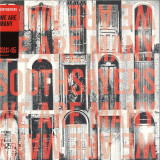
South London-based band Soothsayers are set to release their ninth studio album 'We Are Many'. Held together by heavy basslines, solid grooves, and socially and politically charged lyrics; the album takes the listener into different sonic spaces with elements of dub, Afrobeat, improvisational jazz and electronica.
The initial steps in recording 'We Are Many' came in January 2019 when the band's founders - saxophonist Idris Rahman and trumpeter Robin Hopcraft - set out on a journey to Brazil. With executive production in the Sao Paulo studio by renowned music journalist and author David Katz, they hooked up with bass player and producer Victor Rice who they'd met sharing the bill at Freedom Sounds festival in Cologne, Germany a year earlier. Victor organised a session in Studio Traquitana, home of acclaimed Brazilian band Bixiga 70, and invited a selection of local musicians. Percussionist and singer Ligia Kamara contributed lyrics and melodies written in the studio, and drummer Bruno Buarque, guitarist Joao Erbetta and bassist Victor provided some solid, personality-driven input. Fresh and vital, what came out was a fascinating blend of Soothsayers' dub and Afrobeat mixed with distinctly Brazilian inflections.
After arriving back in the UK, Idris and Robin set about creating the remainder of the album in a different, yet complimentary way, and called on the services of Wu-Lu and Kwake at their The Room studio in South London. Things started to take shape very quickly, Wu-Lu and Kwake combining Soothsayers' music with electronic elements, while also referencing elements of the current UK jazz scene.
When lockdown hit in March 2020, there was still a lot of work to do in order to complete a full album and Robin and Idris set about working on tracks with their musicians remotely. Having time to consider the album as a whole, they found strong connections between the music recorded in Brazil and the tracks recorded in London and they set about fusing and combining these elements further into a satisfying whole.
UK based Sengalese singer Modou Toure was enlisted to guest on one track while percussionists Satin Singh and Maurizio Ravalico were engaged to help affirm a sound-world where Brazilian flavours, such as the low-end Surdo drum, were combined with sounds more readily associated with reggae and Afrobeat.
Soothsayers' three part vocal harmony is a defining factor in this album. With strong references to the vocal styles of reggae legends such as The Gladiators, Mighty Diamonds, Heptones, and Abyssinnians; it has benefited from the long-standing friendship between Robin, Idris and Julia Biel. Lyrics, melodies and harmonies were presented, discussed, explored and recorded at Idris' and Julia's home studio in Streatham in a relaxed and positive way, with concepts from social and political commentary turned into powerful songs.
Themes cover political observations of Trump and beyond alongside Brazil's president Bolsanaro (Rat Race), speaking out against increasing levels of violence from the Brazilian government towards its native and indigenous people (Love And Unity) and keeping hopeful despite the impending horrors of a no-deal Brexit (We Won't Lose Hope).
Elsewhere they discuss striving to create space for meditation and reflection against the background noise of 24/7 news and social media (Move In Silence), the daily grind (No Sacrifice) and workers' rights (Slave), while highlighting those that fall through the cracks in society and end up without a permanent address, what led to this and how close we all are from this happening (One Step Away).
'We Are Many' represents a positive and uplifting statement in the face of challenging times - the overriding force, power and positivity of the music to continue forward, pushing the boundaries of musical concepts into the future.
"Whilst heavy questions of life and death and the future of our species surround us all, music is a guide that can help us perceive the challenges in a different way - a guide that can help us towards a deep inner peace. If we listen, music can help light the way. We hope you will listen, and we hope you will experience the joy, meditative power and beauty in the connection of different musical cultures that was experienced in the creation of this album."
‘Giants of All Sizes’ was recorded at Hamburg’s Clouds Hill Studio, The Dairy in Brixton, 604 Studios in Vancouver and Blueprint Studios in Salford with additional recording taking place at various band member’s home studios spread across Manchester. As with their previous four studio albums, ‘Giants’ was produced and mixed by Craig Potter. Guests across the album include Jesca Hoop, The Plumedores and South London newcomer Chilli Chilton.
Given such bleak, if ultimately redeemed, subject matter, it is also, perversely, the most relaxed record which elbow have made in some time. On ‘Giants of All Sizes’, each band member extended their usual process of working on demos alone and followed their vision to its conclusion rather than, as Craig Potter puts it, ‘taking the edges off things to find compromise’. In tandem with this, they returned to playing live in the studio, encouraged to experiment with the banks of analogue equipment at Clouds Hill in Northern Germany, giving songs a looser, more live feel. The result is the most starkly dynamic record from the band in recent times, “Sonically unabashed”, as Guy would have it. Whilst album closer ‘Weightless’ has the gossamer melodies and communal harmonies for which the band have latterly been known, this album echoes earlier elbow work at times whilst also breaking new ground.
‘White Noise White Heat’ is motorik, metal machine soul driven by a vocal that is rage incarnate, ‘Doldrums’ mixes John Carpenter with The Plastic Ono Band to brilliantly disturbing effect and ‘On Deronda Road’ hitches stark bass beats and glitches to an ad-hoc choir. ‘Empires’ delivers dark resignation via an insidious melody and ‘Seven Veils’ continues the subversion by inverting the perception of elbow as a band for lovers into a band for haters, a double-barrelled fuck-you song par excellence. ‘The Delayed 3:15’ marries mariarchi guitars to jazz dynamics, Morricone via Buddy Rich, and ‘My Trouble’ is a clockwork, analogue shuffle housing a delicate melody that builds over the course of the song into a fragile monolith to the power of love.
Lead track, ‘Dexter & Sinister’, released on 10” ahead of the album, encapsulates the whole. A seven-minute musical journey that blends deep bass grooves, sudden keyboard stabs, dislocated piano and guitar runs and soul stylings then abruptly shifts gear, parts the storm clouds and takes wing, flying towards the heat of the sun. It is the soundtrack for these ‘hope free, faith free, charity free days’, a denial of the divine and a reconciliation, two songs in one song, two emotions for one emotion, human, fragile and brilliant like the album which it opens.
"Don't Turn Me From Your Door" - John Lee Hooker (g, voc), Earl Hooker, Eddie Kirkland (g), a.o
John Lee Hooker is not only a mystery but also an interesting man to study. Some, like the author Jacques Demêtre called the musician from Mississippi »the most raw and African of all blues players from a musical point of view«, while the critic Net Hentoff was awestruck by Hooker’s unfiltered power of expression that could scare the pants off a listener taken unawares. The numbers on this LP bear witness to the fact that Hooker’s musical language could stir one’s emotions deeply, even without the meaty 'boom boom'. Each title is like a raw diamond, which is intentionally uncut and is to be perceived with directness. With a stutter and a slur in his speech, the singer declaims his song over a twangy guitar, which is driven along by the rhythmic meter. A final farewell is taken sluggishly and sullenly in the forthright text of "You Lost A Good Man", and even a song without words ("Misbelieving Baby") ponders a question in a purely instrumental monologue. Apart from a dash of boogie ("Pouring Down Rain") Hooker avoids all manner of sweet sounds and harmonies. He remains austerely raw, mercilessly honest, occasionally unforgiving and denies all thoughts of any kind regarding going 'back to the roots'. This sound IS the root of it all.
This Speakers Corner LP was remastered using pure analogue components only, from the master tapes through to the cutting head. More information under pure-analogue.
All royalties and mechanical rights have been paid.
Recording: 1953 in Cincinnati (OH) and July 1961 in Miami (FL)
Production: Henry Stone
- A1: Seventh Street & Collie Smith Drive (Dub)
- A2: First Street & West Road (Dub)
- A3: Second Street & Collie Smith Drive (Dub)
- A4: Fourth Street & West Road (Dub)
- A5: Seventh Street & West Road (Dub)
- A6: Sixth Street & Collie Smith Drive (Dub)
- B1: Jungle Man (Dub)
- B2: Trench Town Man (Dub)
- B3: Rema Man (Dub)
- B4: Jungle Woman (Dub)
- B5: Concrete Jungle (Dub)
- B6: Spanish Town Road (Dub)
Red LP[22,06 €]
12” album of previously released Dub album by Nkrumah “Jah” Thomas from Kingston, Jamaica. Re-issued on WHITE vinyl.
Nkrumah “Jah” Thomas is an esteemed reggae deejay and record producer who first came to prominence in the 1970s, later setting up his own labels ‘Midnight Rock’ and ‘Nura’.
South London-based band Soothsayers are set to release their ninth studio album 'We Are Many'. Held together by heavy basslines, solid grooves, and socially and politically charged lyrics; the album takes the listener into different sonic spaces with elements of dub, Afrobeat, improvisational jazz and electronica.
The initial steps in recording 'We Are Many' came in January 2019 when the band's founders - saxophonist Idris Rahman and trumpeter Robin Hopcraft - set out on a journey to Brazil. With executive production in the Sao Paulo studio by renowned music journalist and author David Katz, they hooked up with bass player and producer Victor Rice who they'd met sharing the bill at Freedom Sounds festival in Cologne, Germany a year earlier. Victor organised a session in Studio Traquitana, home of acclaimed Brazilian band Bixiga 70, and invited a selection of local musicians. Percussionist and singer Ligia Kamara contributed lyrics and melodies written in the studio, and drummer Bruno Buarque, guitarist Joao Erbetta and bassist Victor provided some solid, personality-driven input. Fresh and vital, what came out was a fascinating blend of Soothsayers' dub and Afrobeat mixed with distinctly Brazilian inflections.
After arriving back in the UK, Idris and Robin set about creating the remainder of the album in a different, yet complimentary way, and called on the services of Wu-Lu and Kwake at their The Room studio in South London. Things started to take shape very quickly, Wu-Lu and Kwake combining Soothsayers' music with electronic elements, while also referencing elements of the current UK jazz scene.
When lockdown hit in March 2020, there was still a lot of work to do in order to complete a full album and Robin and Idris set about working on tracks with their musicians remotely. Having time to consider the album as a whole, they found strong connections between the music recorded in Brazil and the tracks recorded in London and they set about fusing and combining these elements further into a satisfying whole.
UK based Sengalese singer Modou Toure was enlisted to guest on one track while percussionists Satin Singh and Maurizio Ravalico were engaged to help affirm a sound-world where Brazilian flavours, such as the low-end Surdo drum, were combined with sounds more readily associated with reggae and Afrobeat.
Soothsayers' three part vocal harmony is a defining factor in this album. With strong references to the vocal styles of reggae legends such as The Gladiators, Mighty Diamonds, Heptones, and Abyssinnians; it has benefited from the long-standing friendship between Robin, Idris and Julia Biel. Lyrics, melodies and harmonies were presented, discussed, explored and recorded at Idris' and Julia's home studio in Streatham in a relaxed and positive way, with concepts from social and political commentary turned into powerful songs.
Themes cover political observations of Trump and beyond alongside Brazil's president Bolsanaro (Rat Race), speaking out against increasing levels of violence from the Brazilian government towards its native and indigenous people (Love And Unity) and keeping hopeful despite the impending horrors of a no-deal Brexit (We Won't Lose Hope).
Elsewhere they discuss striving to create space for meditation and reflection against the background noise of 24/7 news and social media (Move In Silence), the daily grind (No Sacrifice) and workers' rights (Slave), while highlighting those that fall through the cracks in society and end up without a permanent address, what led to this and how close we all are from this happening (One Step Away).
'We Are Many' represents a positive and uplifting statement in the face of challenging times - the overriding force, power and positivity of the music to continue forward, pushing the boundaries of musical concepts into the future.
"Whilst heavy questions of life and death and the future of our species surround us all, music is a guide that can help us perceive the challenges in a different way - a guide that can help us towards a deep inner peace. If we listen, music can help light the way. We hope you will listen, and we hope you will experience the joy, meditative power and beauty in the connection of different musical cultures that was experienced in the creation of this album."
- Idris Rahman and Robin Hopcraft
- 1: Prologue: Rain
- 2: A Trail Of Wind And Fire
- 3: Second Born Child
- 4: Tokyo Music Experience
- 5: The Rise And Fall Of The Plague
- 6: Another Year
- 7: Fragments
- 8: The Disappearance Of Dr. Duplicate
- 9: Excerpt Taken From Chapter 3
- 10: Where Is My Dream?
- 11: Part One: The Long Drought
- 12: Part Two: Crossing The Desert
- 13: Epilogue: Big Poisonous Shadows
BLACK vinyl with deluxe origami fold out sleeve & obi strip & DL Card. CD Wallet. The third album from Dutch punk-laced noiseniks adds new maturity and a conceptual feel that pulls the extremes of their sound together. A psyche-fuelled journey into the id punctuated with rhythmic kabuki modal mood swings, thunderstorms, digital beeps, traffic noise, and just plain old beautiful cacophonous reverb-drenched sound when needed. The 'third chapter' refers to the last five years that the Dutch band have spent creating their "difficult" third album. Each song spins a yarn; there are plagues, dreams, wind and fire, 'mythical' characters, and the search for the secret government warehouse. Lead single, Tokyo Music Experience, resonates with a conveyor belt-propelled modal guitar, reflecting the halcyon days of Japanese super-productivity; a mesmerising mantra, infected with news bulletin on-the-hour bleeps underlining its time-sensitive nature; a pristine super-commercial anthem to drive loyalty and reinforce solidarity with the party! Having been described as creating "underground noise with a bracing, warped pop appeal" (Mojo), their new album is a coming-of-age post-classic with a unique worldview - inspired by Van Dyke Parks (Song Cycle) Scott Walker (3 & 4), Moondog (Elpmas), White Noise (An Electric Storm) and Beach Boys (Smile). If their previous effort (Tape Hiss) was their very own sketch of a sketch for an incomplete concept album, a noisy reaction to their previous life, then 'Excerpts From Chapter 3..', with all its interlaced intricacies, is the realisation of their transition from punk-spiked-pop to psyche-pop protagonists. Evolving, testing, infectious...
- 1: Bridge Over Troubled Water - Simon & Garfunkel (4.56)
- 2: El Condor Pasa (If I Could) - Simon & Garfunkel (3.09)
- 3: Cecilia - Simon & Garfunkel (2.55)
- 4: Keep The Customer Satisfied - Simon & Garfunkel (2.38)
- 5: So Long Frank Lloyd Wright - Simon & Garfunkel (3.4)
- 6: The Boxer - Simon & Garfunkel (5.13)
- 7: Baby Driver - Simon & Garfunkel (3.1)
- 8: The Only Living Boy In New York - Simon & Garfunkel (4.02)
- 9: Why Don T You Write Me - Simon & Garfunkel (2.46)
- 10: Bye Bye Love - Simon & Garfunkel (2.53)
- 11: Song For The Asking - Simon & Garfunkel (2)
St Leonard’s premier manipulator of drones, loops and echoes delivers his most buzzed out, kosmische and beat driven work to date in a deluxe white vinyl album release for Castles in Space.
Here, Kieran explains the genesis and production of his masterwork:
“Eternal Return was unusual for me in that I actually set out to make an album, rather than find myself with a set of tunes that evolved into a project.
The “Eternal Return” is a concept I have been inspired by before. However it clicked with me in a more profound way recently. Far from seeing the prospect of living life over, unknowingly, on an endless loop as depressing, I suddenly felt amazing comfort in the theory. The Stoic emperor Marcus Aurelius said, “Waste no more time arguing about what a good man should be. Be one.” Far from being trapped in the loop I am elated to feel that it's simply about living the best life you can. One that you wouldn't fear having to live again.
To place the album in context against this newly realised perception, I think of the Side One as the battle to get to that realisation and enlightenment and Side Two represents the acceptance and the decision on how to proceed. The turning point is from thinking about the things I love most and what I would want to experience over and over again. I hope it is an uplifting listening experience. As it happens, the album originally had a darker ending. I think I actually learned a bit about my point of view during the process. There are drums, which wouldn’t often feature in my music (there are in fact more drums on this LP than in my combined output over the last 8 years) and the pieces are noticeably shorter, more focussed and concise than my usual longer form work.
Musically this album is probably the least clearly influenced by anything I regularly listened to. The main outcome was wanting to challenge myself and to add whatever the pieces needed and go with that. I think I was also probably pushed on by the wealth of amazing music being made by my peers across Bandcamp and social media. 2020 was an incredible year in this particular sphere of electronic music. The album was made as I started to transition from a semi-modular to a modular synth set up. I think that this was a key driving force, since a lot of the time I didn’t know exactly what I was doing. It is nice to be surprised by what you’re creating.
Finally, whilst this is in no way a “lockdown album”, the period of time in which much of it was recorded definitely had a bearing on how it sounds. For one thing I spent a lot more time around my studio space when working from home. In keeping with the album's theme, the lockdown also helped consolidate my feelings on what is important in life and what isn’t. One piece was in fact sketched out as a first draft while I sat on mute during a Zoom meeting.
Having established himself as a core Apollo artist with three fantastic EPs since 2016, Sieren now steps up with a first full length for the label. 'Timelapse' is a majestic 13 track trip into this unique artist's very emotional fusion of post-bass bliss. Sieren aka Matthias Frick is a master of intricate electronics and bittersweet emotions, of deep atmospherics and compelling rhythms. He has been building a dedicated following for some years now, putting out his debut album on Christian Loffler's Ki Records in 2016. Inspired by a rich history of bass-driven UK sounds, he pairs that with a love of field recording and experimental soundscaping, and now shows he is an ever evolving master of his art on this stunning new record.
The Anticipatory Organization is an energetic EP that could only be the work of The Sun God. There are three rousing tracks to stir the attention. The Things We Don't Know is a mesmerising key driven journey. It features gorgeous keyed sparkles, washing waves of acid and clopped beats. The Disbelief Habit is driven by a strong melody that really grabs you and won't let go. This is accompanied by a strong bassline, focused keys and closely held percussion. The Achievement Factory rounds off the EP with another distinctive musical effort that marches straight into the middle of the dancefloor. Punishing percussion and an in-step cavernous bassline are joined by loose acid and riffing keys. Once more, The Sun God delivers as only he can.
Linus Hillborg’s solo debut Magelungsverket lures listeners through despaired soundscapes of justly tuned electroacoustic orchestral arrangements seeped in rich harmonic synthesis.
Magelungsverket is a rendering of materials from Hillborg’s own computer game hacking project, Orphan Works, where an obsolete game engine was modified to create an interactive installation in which participants drive through the purple midnight streets of a decrepit and abandoned Stockholm. The game's generative soundtrack interacts with the player’s haphazard navigation of a ceaseless digital void of factories, housing projects, run down bars, ditches and lakes. Displaced, uncanny narratives and depictions of both real and semi-fictional locations in Stockholm that could have existed - but do not - procures distinct sequences of sound constructed with the Buchla 200 system, programmed synthesis, bowed cymbals, metal clarinet and tape machines.
The rendered pieces on Magelungsverket have been adapted from Orphan Works’ interactive and generative material into separate, fixed compositions, bound by duration, each one named after a location in this fictional, virtual Stockholm. For instance, Vårbergsobservatoriet (The Vårberg Observatory), draws its name from an artificial mountain that exists in the outskirts of Stockholm, amidst the sprawl of residential areas far beyond the sparkling city center. It was built from garbage scraps left behind after the underground metro system was constructed in the 1970s. In this fictional version, a public observatory was wishfully imagined to have been built on top of it. However fictitious Hillborg has imagined these locations, it is a bittersweet reflection and fragmented mental image of a Stockholm that never existed. Magelungsverket will be released on the 4th of December in a limited run of 200 black vinyls and across digital platforms.
Linus Hillborg (b. 1989, Stockholm) is a composer, musician and sound artist based in Stockholm, operating in numerous fields, ranging from experimental musics and audio-visual installations to post-punk and noise formations.
“Instead of landscape sketches I wanted to go into more personal areas of my reality,” says Jim Ghedi of his third album In The Furrows Of Common Place. “To hold up certain aspects of society that were laying bare in front of me.”
Whilst Ghedi’s previous idiosyncratic take on folk has often been instrumental, exploring the natural world and his relationship to it through his music as seen on 2018's A Hymn For Ancient Land. His new album In The Furrow Of Common Place is a deeper plunge inside himself to offer up more of his voice to accompany his profoundly unique and moving compositions. “There were things I was seeing around me and being affected by in my daily life,” he says. “Socially and politically I saw defiance but also hopelessness. I wanted to be honest with the frustration and turmoil I was experiencing.”
The decision to include more of Ghedi’s vocals was a conscious one and driven by a need to say something. However, this isn’t a brash raging political polemic. As is now customary with Ghedi’s work, it is rich in nuance, history, poetry and allegory. Musically, the album is equally locked into this ongoing sense of evolution. Ghedi’s intricate yet deft guitar playing still twists and flows its way through the core, weaving in and out of gliding double bass, sweeping violin, gentle percussion and vocals that shift from tender solos to overlapping harmonies.
As with much of Ghedi’s work, there’s a rich connection between the past and the current. Musically, he continues to sit in a singular position of sounding distinctly contemporary yet also with a touch of traditional flair. This expands itself into the lyrical terrain here too. “I've been exploring contemporary issues and in that process discovering sources that correlate with similar issues in the past,” he says. “Which proves that these issues throughout history - environmental destruction, working class poverty etc - are ongoing.”
For all the socio-political and historical backdrop to the record it is not one that feels overwhelmed by it. Much like Ghedi’s work when it was largely instrumental - and some of it still is here - it flows and unfurls thoughtfully, with space still being utilised masterfully, creating room to pause and reflect. It’s another inimitable record from an artist that truly sounds like nobody else right now.
Following the 2020 release of RoundAgain, Nonesuch reissues on vinyl Joshua Redman's first album with his own band — pianist Brad Mehldau, bassist Christian McBride, and drummer Brian Blade — originally released in 1994. MoodSwing was Redman’s third recording as a band leader and his first featuring all-original compositions. The young saxophonist sought to change what he believed to be the public perception of jazz — a largely academic and overly intellectualized form of music devoid of the emotional themes that drive many other genres. As he explains in the original liner notes, jazz was seen as, “an elite art form, reserved for a sophisticated intelligentsia who rendezvous in secret.” With MoodSwing, Redman makes the case that jazz can be an accessible musical medium that could evoke basic and visceral emotional reactions.
From the playfully coy ‘Chill’ to the urgent energy of ‘Rejoice’, Redman offers up a communicative and inspired record ofemotional diversity. Joining him in this task was a young band of his peers, all of whom have since become established and esteemed figures in jazz. MoodSwing was one of the first exposures the jazz community had to young pianist Brad Mehldau, then beginning his career in Redman’s quartet. Mehldau anchors these compositions behind Redman’s lyrical playing, occasionally stepping out front to show his talents in ‘The Oneness of Two (In Three)’ and ‘Past in the Present’. The band’s rhythm section has since been recognized as one of jazz’s best, with Christian McBride on bass, and then little-known Brian Blade on the drums.
As the follow-up to his breakout Wish, MoodSwing was universally praised by critics and enjoyed commercial success, selling over 300,000 units worldwide. Entertainment Weekly wrote, ‘saxist Redman finds ingenious ways of creating a modeof acoustic jazz that is both entertaining and enlightening.’ This record continues to provide a cornerstone for Redman’s currentcareer; many of these compositions are still featured in the saxophonist’s live sets today.
Redman’s previously announced European summer 2020 tour dates with Mehldau, McBride and Blade have been rescheduled for 2021, including London’s Barbican, now on July 11.