Before coming to Europe, in 1970, pianist Manuel Villarroel was a vet in his native Chilli. A few years later, as leader of the Machi Oul Big Band, he returned to the animal kingdom. A very specific kind of animal, for sure, the Quetzalcoatl, also known as the Feathered Serpent. What is behind this title (also the name of one of the three original compositions on this album released on the Palm label in 1976), is first and foremost a sort of homecoming...
After discovering the jazz of Herbie Hancock, McCoy Tyner, Miles Davis and John Coltrane, Villarroel was taken by the free jazz which was all the rage at the time in America and Europe, and this would inspire the first version of his Machi-Oul, project. This was a septet, with which the pianist would record, in 1971, the tremendous Terremoto (re-released by Souffle Continu FFL085). After this masterstroke Villarroel was invited to record with Perception (Perception & Friends) and with Baikida Carroll (Orange Fish Tears). While these were notable contributions, Villarroel was already looking into other combinations.
“I had to deal personally with my situation as an expatriate, without disavowing it. I tried not to betray my roots, I tried to translate into my music what was essential to me, to reflect my origins – Latin America, its musical and above all human feelings – while remaining faithful to jazz, which is the mode of expression of the musicians in the group”. This then is the ‘homecoming’ we mentioned, which would incite Manuel Villarroel to compose what he would call “structured free music”. In January 1972 the pianist enlarged his formation to reach the size of a real big band: the Septet became the Machi-Oul Big Band. Three years later in January 1975, with producer Jef Gilson at the helm, fifteen musicians including those from the old Septet (Jef Sicard, François and Jean-Louis Méchali, Gérard Coppéré) worked on a rare form of jazz. From togetherness to dissonance, we danse to it “Bolerito” then shake it up on “Leyendas De Nahuelbuta”. As for the concluding serpent, it is a piece which is impossible to pin down: “Quetzalcoat” is as impressive as it is difficult to grasp. To remind ourselves of this, lets listen to it again.
Suche:ab project
Over atmospheric instrumentation expanded by cinematic structure and pacing, Pearlty presents Knifeplay somewhere between dream-pop influenced shoegaze and lofty slowcore, never fully committing to one or the other in its insistence on creating an immersive, organic world. Originally released in 2019, Knifeplay’s vivid debut Pearlty documents songwriter Tj Strohmer’s expressions of early adulthood in what he describes as “the journey from innocence to experience.” Written during a time of immense inspiration, Strohmer was able to peel himself away from detached nihilism, uncovering the physicality and therapeutic powers of songwriting. Newly emboldened by this discovery and the talented community surrounding him, Strohmer channeled this revelation into his work, taking Knifeplay from a bedroom experiment that merely wrote songs to a more substantial project with a purpose. Pearlty’s various climactic passages, like those heard on the impressionist album opener “Tears”, envelop listeners in textured walls of distorted guitar and noisy breakdowns, a distinct hallmark of shoegaze – but Knifeplay’s compositions go far beyond such conventions. Also featured are downtempo compositions – such as the tribute track “Angel” – that call on a range of influences, from grunge to lofi pop, all the way back to slowcore. Layers of Strohmer’s falsetto lilt adorn the songs with another dimension of sentimentality, while rounding out the sonic vastness of the group’s emotionally enrapturing style, lending impressive depth to the band’s debut full-length.
"Pearlty" by Knifeplay includes the following tracks: "Feel U", "Mirage", "Held My Hand", "Lemonhead" and more.
HJirok is a mythical figure, conceived as a fictional character by Iranian-born Kurdish singer and artist Hani Mojahedy. Together with versatile music producer And Toma of Mouse On Mars, she combined a variety of sounds collected during their joint travels to Iraqi Kurdistan and elsewhere with heavily processed recordings of Sufi drum rhythms and setar melodies. The result is a driving, dubbed-out, and deeply intricate soundscape that perfectly sets the stage for Mojahedy's extended, unconventional vocal techniques and polyglot lyrics. Both informed by tradition and rigorously forward-looking, »Hjirok« (with a lowercase J) is at once a profoundly personal album and a universal utopian promise. As a ghost from the past, HJirok draws on Mojtahedy's memories to mould a new future out of them.
The foundation for »Hjirok« was laid in the city of Erbil in the Kurdish part of Iraq. During one of their stays in the region, Mojahedy and Toma recorded the three percussionists Hadi Alizadeh, Jawad Salkhordeh and Serdar Saydan as well as setar player Ali Choolaei from Motahedy's backing band while they were playingthe rhythms and notes that she had grown up with in the house of her grandfather in the Iranian city of Sanandaj. Her memories of that place revolve around hypnotic Sufi music, dervishes in deep trance, and ecstatic singing. Much like this music seemed to open a portal to other dimensions, the inhabitants of the house lived in a sort of alternative reality: It provided them with a hideaway from political circumstances. Following the Iranian revolution in 1979, a Kurdish rebellion ensued but was met with the utmost brutality by the new regime, which resulted in the death of thousands.
It is no coincidence that the music on »Hirok« would draw on rhythmic patterns that were passed on from one generation to the next for hundreds of years. »The project is rooted in the figures of the Sufi dervishes and thus a culture that precedes today's political, social, cultural, and religious systems,« explains Mohtahedy. »The Sufi sound travelled around the entire world. I like to think of it as a dialogue between peoples-one based on the rhythms of the drums and the sound of their voices.« Toma adds that by electronically transforming the recordings and enriching them with field recordings from both rural and urban spaces, they were able to use the stories told by the drums and the setar to create an entirely new narrative.
The story told by these eight pieces is hence a deeply personal, but also inherently political one. Moitahedy herself left Iran in 2004 and relocated to Berlin in 2010. Having continued to use her art as a platform to tirelessly advocate for the rights of the Kurdish people and women under oppressive regimes, she has not been allowed to return to her country of origin ever since. »Hani is singing for equality and there are people who are afraid of that-her femininity, her strength.« Toma says. Much like earlier Hirok sound installations addressed human-made climate change and other systemic ills, also »Hjirok« can hardly be disconnected from far-reaching struggles for liberation and equality.
This is also true on a thematic and even linguistic level. »The lyrics are about a promise,« Mojahedy says, citing Kurdish writer Ebdulla Pesêw as an inspiration. »At their core, these are about that day on which violence and fear become a thing of the past; what they tell you is ot not give up, to keep hoping,« she adds. The promise embedded in them is an emancipatory one. These contents are mirrored on a linguistic level: The lyrics were written in both Kurdish and Farsi, blurring the lines between the two languages and thus, Kurdish and Persian cultures.
Mojahedy, or rather HJirok, conveys these philosophical themes with elegance. Herversatile vocal performance is only loosely basedo n established styles. »Of course everything started with traditional rhythms, but we kept pushing things further and further, so Idid the same with my voice,« Mojahedy explains. »There were no boundaries.« The same can be said of the field recordings that she and Toma used. Whether it's conversations between members of the Pesmerge, the Kurdish armed forces, having a chat in meadow full of bunnies or the humming and buzzing of metropolises like Tehran: »Hirok« paints a sonic picture that is quite literally autopian one; that of a non-place in which different soundscapes, cultures and ways of life coexist peacefully.
What the album conjures up from Mojahedy's memory is not only a very specific place during a unique time in history as experienced by a single person. It is also ametaphorical home open to anyone who wishes to enter - promise of a better, more egalitarian future for everyone. Hence, HJirok will bring it on tour, presenting the material as an audio-visual live show that makes use of the photo and video material that Mojahedy and Toma have collected during their travels through Kurdistan.ja
- A1: Long Life Death
- A2: Vortix
- A3: Zarathustra Dance
- B1: Eternal Sunshine Of Solitary Mind (W/ Massimiliano Pagliara)
- B2: Sadness Is Only Way To Happiness
- C1: Raver's Heart Is A Mess (W/ Brame & Hamo)
- C2: Memory Is A Clock
- D1: We Don't Know The Way, We Just Stay (W/ Pablo Bozzi)
- D2: Music Will Never Stop, Party Will Never End
Younger Than Me announces his debut full length "The Golden Age Of Love", to be released on 90's Wax this coming March 2024. The record is the perfect example of the breadth of his irrepressible and unique sound. Featuring collaborations with Massimiliano Pagliara, Brame & Hamo and Pablo Bozzi. The artist is an Italian native known for a modern interpretation of '90s club music' - a dynamic blend of Progressive House, Trance, EBM, Breakbeat, and Techno ideas. This first album is a love letter to a deep-rooted passion for the idiosyncrasies of rave culture and the crossover points with contemporary electronic music.
Younger Than Me, an artistic project by Francesco Mingrino that is steeped in the nostalgia of ‘90s rave, yet not at all trapped in that past. A project that has cemented a special place in the electronic music scene with a string of records on labels like Bordello A Parigi, Amsterdam-Utrecht based platform XXX, Rotterdam’s Bar and Jennifer Cardini’s Dischi Autunno. To this point Francesco has pushed his fun yet forceful sound, with many releases on his own 90's Wax, and collaborations with people like Skatebård, Francesco Farfa, Timothy Clerkin and Curses (as Y2C).
"The Golden Age Of Love" as a package is curated in Younger Than Me's characteristic style. Opening with "Long Life Death", a track that sets the stage with a cinematic soundscape in a classic Carpenter vibe. Picking up the tempo "Zarathustra Dance" takes you right into the golden age itself, its low slung beat and carefully sequenced lead line pushes an ever building tension designed to crack any dancefloor. The track with Massimiliano Pagliara, "Eternal Sunshine Of Solitary Mind", is one of the highlights, perfectly building around a catchy lead with tight arpeggio and sequenced acid. Leading us into the 2nd half of the record "Sadness Is The Only Way To Happiness" is a proto-trance beast, inspired by that period in the early 90s when Trance was less bright lights and big stages and more dark rooms and smoke filled spaces, an ever building progressive run of haunting vocals, rave stabs and rolling bass.
Whilst YTM is at home presenting dancefloor focussed material, we see him explore the other side too, with "Memory Is A Clock" like the earlier "Vortix", he ditches the 4x4 for breakbeat territory. Whilst the bass keeps the solid metronome you would expect, "Memory Is A Clock" is a track that takes a few moments, contemplative melody and trademark arpeggios take the lead. When it comes to the other collaborations on the record, the appearance of Brame And Hamo on "Raver's Heart Is A Mess" sees them lean into the Progressive nature both artists love so much. Then Pablo Bozzi lends his own unique outlook to "We Don't Know The Way, We Just Stay" in one of the standout tracks, epitomising Younger Than Me’s ability to create profound experiences.
The album concludes with "Music Will Never Stop, Heartbeat Will Never Fade, Party Will Never End", less of a title and more of a personal philosophy – the perpetual essence of rave culture and its timeless impact on music. A rhythmic belter, juxtaposed with incendiary synth-lines and staple catchy sequence work, finishing the record with one of the true highpoints. In addition the release also features four digital bonus tracks, including "The Other Face Of Loneliness" and a Prog Dance Reshape of one of the records more eclectic cuts "Zarathustra Dance" all offering an extended exploration into the creative landscape YTM inhabits.
"The Golden Age Of Love" is a debut album that ticks all the boxes; it's a celebration of a bygone era through the lens of the contemporary. Younger Than Me stands as a testament to the enduring spirit and evolving nature of the music that began in the ‘90s rave scene, with an LP that pushes Love, Progression and Fun to the forefront.
- 01: In
- 02: The Big Idea (Feat. Lewis Parker)
- 03: Push
- 04: The Art Of Celebration
- 05: Tea Break
- 06: Chef Yg
- 07: Gringo Lingo (Feat. Red &Amp; Nico Suave)
- 08: I.c
- 09: What Eye See, Pt. 2 (Feat. Devise)
- 10: City Breaks
- 11: Liquid Love
- 12: Everything Is Alright
- 13: Dancing Shoes (Feat. Mr Thing)
- 14: Spit Fire (Feat. Kyza Smirnoff)
- 15: Out
First Word Records is proud to bring you 'The Essance' - the classic debut album by Essa (formerly known as Yungun), originally released in 2004, now released on vinyl & digital for the first time, 20 years on!
A lyricist, lawyer and a Londoner, legendary MC Essa has earned praise over the years from artists such as Nas and Mark Ronson, as well as performing and recording with legends like De La Soul, Wu-Tang Clan, Guru, Slum Village and Pharoahe Monch.
This 15-track album is considered one of the greats to emerge during UK Hip Hop's "golden era"; a vibrant time for the genre when artists such as Ty, Jehst, Roots Manuva, Klashnekoff, Skinnyman, Task Force, Doc Brown and Foreign Beggars were garnering huge fanbases, and an eco-system of shops like Deal Real, club nights like Kung Fu, labels like Lowlife, and stations like Itch FM were prevalent, while BBC 1Xtra was a mere infant.
'The Essance' includes production and features from luminaries such as Harry Love, Mr Thing, Lewis Parker, Kyza, Devise & Ben Grymm, to name a few.
Esteemed author Musa Okwonga says on the reissue liner notes "the most startling thing about 'The Essance' was its range. Yungun (Essa) was one of the few MCs who could perfectly walk the paths of hope and melancholy with equal ease, whose artist name belied the wisdom of his lyrics. Beyond that, his delivery was supremely self-assured, filled with a swagger he could always justify.
Yungun's gifts also extended to the stage, where he was one of the best young actors that many of his contemporaries had seen, and to languages, which saw him writing and rhyming in Spanish with a notable flourish. He was also someone who constantly walked between two worlds, excelling in one of the country's most competitive academic environments during the day and then delivering a soaring radio set by night. Raised in a vibrant vein of North London, endlessly curious about the world around him, Yungun's fine ear for music and passion for the variety of life made him someone who could reach all audiences.
'The Essance' is a beautifully-woven meditation on the human condition, one which takes you from the dancefloor to the summer afternoon barbecue to the bathroom mirror; yet it is also the opening statement of a unique career."
In the words of Essa himself "my key goal for this album was to span so many moods and styles that I couldn't be categorised, leaving me free to then go in whatever direction I chose. I was almost too successful with this – I would later struggle to pin down my own identity, both on and off the mic, as a rapper slash lawyer, of mixed-heritage, blessed to be able to enter many circles but feeling truly at home in none. As I write this, twenty years (plus a marriage and several children) on, I finally feel more at peace with being undefinable, and am getting better at bringing my full, authentic self into as many aspects of life as I can. I am grateful to be able to look both back and forward, with equal passion."
'The Essance' was followed with a collaborative album with DJ Mr Thing ('Grown Man Business'), then some years later on First Word with 'The Misadventures of a Middle Man' in 2014. There's also a forthcoming project in the works, due for release Summer 2024 with all-new material produced by Pitch 92. Both these releases also coincide with the 20th anniversary of the First Word label (named "label of the year" at the 2019 Worldwide Awards).
A timeless piece of work, 'The Essance' is true-skool boom bap through and through that stands up two full decades later, from the ethereal anthem 'Liquid Love', to the uptempo bounce of 'Dancing Shoes', to the grit of 'The Big Idea', to the thought provoking 'What Eye See Pt.2', to bangers like 'Push' or 'Spit Fire', this is an essential addition to the collection of any discerning hip hop head.
'The Essance' is due to be released on vinyl & digital worldwide on February 23rd 2024.
- A1: Garden Of Eden (Feat. Charlotte Savary) - 3’38
- A2: Middle Of Nowhere (Feat. Charlotte Savary) - 4’22
- A3: Insomnia - 3’46
- A4: The Trip (Feat. Charlotte Savary) - 3’44
- A5: Andy’s Dream - 4’27
- B1: Game Over (Feat. Charlotte Savary) - 3’43
- B2: Around The Corner - 2’58
- B3: Stranger Night - 3’19
- B4: One Day (Feat. Charlotte Savary) - 3’30
- B5: Last Call From Earth - 3’29
The Trip is the first solo album by N'Zeng, better known as Sébastien Blanchon. It has to be said that he hid behind his (hollow) nose to sniff out the right projects (ex Le Peuple de l'Herbe, member of Entourloop). His nose is hollow, but not for the trumpet, and yet it's with this instrument that he started out. And he reinvents it, giving it a subtle place on this musical road trip we call The Trip.
A journey open to all, with no tolls and no filters, apart from the cinematic filter of this lover of original soundtracks and trip hop. Beautiful images flash before our eyes, and in our ears, the smooth voice of Charlotte Savary (Wax Tailor). An album, a very good trip for lovers of Portishead, Gorillaz, and well-felt scratches in the form of controlled skids.
He's making a name for himself as N'Zeng, with his smooth arrangements.
N'Zeng's father played trumpet with his grandfather in the Feurs brass band in the Loire department. When he arrived in Saint Etienne, young Sébastien started out with a cornet à pistons at the Conservatoire. His teacher at the time, Marcel Heyte, had won a prize in Paris at the same time as a certain Maurice André.
His father took lessons in orchestral conducting, accompanying the offspring's budding musical career, which included a course at the Festival de Cuivre in Monastier-sur-Gazeille, where he met the soloists of the Radio France orchestra. A new awareness, a new confidence: off to Lyon, not for a soccer derby, but to "beef up his game". In 1997, he was awarded a gold medal for trumpet by a unanimous jury at the Conservatoire National de Lyon.
Lyon, capital of the Gauls, was the starting point for N'Zeng, who went on to become a member of the group Le Peuple de l'Herbe. 15 years later, with several successful records to his credit, a concert in 2003 at the Transmusicales with Beth Gibbons (Portishead), and a Victoire de la Musique award, it was time for N'Zeng to move on to other things.
Arrival in the City of Light, the place where dreams come true. Nzeng's dreams are not only sonic, but also visual, for Sébastien is not only a friendly presence and a talented musician, but also a cinephile. His knowledge of music theory, acquired during his years at the conservatory, enables him to tackle music for pictures.
He created a soundtrack for the cult film Alien - The 8th Passenger, and worked with musician Rone (collaborating with Baxter Dury) and his bandmates from Le Peuple de l'Herbe, composing 2 tracks for the soundtrack of Virginie Despentes's hard-hitting film "Baise-moi". On the album "Hollywood Hustlers", with the group "Mustang Force", he pays tribute to the soundtracks of Lalo Shiffrin, Ennio Morricone... The album is also well received by the critics. He conducts the arrangements and orchestrations for the Degiheuga Orchestra, and composes the original music for the Hôtel Bellevue dance show, another success!
2019 sees the birth of "The Trip" project. On this record, no masks, but a female voice, that of Charlotte Savary (Wax Taylor), laid on a carpet of strings. With this musical voyage, trip hop takes pride of place, with a balance between the body of the instruments and the mechanics of beatmaking.
There's no getting off track on this well-balanced record, with its silky orchestrations. N'Zeng accompanies us elegantly, with his trusty trumpet as GPS, here used subtly. The album cover is a photograph taken by Sébastien Blanchon's mother, in 1973, a year when Saint Etienne was about to become French champion for the 7th time.
This is an absolute mythical hardcore legend of a release. Originally put out in 1993 on Dance Force Records, a record label run out of Norfolk by Les Howlett, a former bouncer for many London raves. But it was his son, Danny, who made the tracks in the backroom of the record shop – at the young age of just 15!
The tracks were never mastered and when doing a deal with Vinyl Fanatiks Danny wanted the tracks remade and finally mixed down – so we put him in touch with Ellis Dee and between them and us, we sourced all the original samples and the EP was remade, with the mixdown that he always wanted!
Originally released on yellow vinyl on Vinyl Fanatiks in 2019 it quickly sold out on the website and no copies ever made it to distribution – until now!
Only 140 have been pressed on 180g pink marbled vinyl.
- A1: Sandpaper Lullabye (2024 Remaster)
- A2: Sleep Fantasy Dreams (2024 Remaster)
- A3: Sad World (2024 Remaster)
- B1: Come To Daddy (2024 Remaster)
- B2: Sweethome Under White Clouds (2024 Remaster)
- C1: Beast (Seven Bastard Suck) (2024 Remaster)
- D1: Abbágall (2024 Remaster)
- D2: Brain Damage (2024 Remaster)
- D3: No Birds To Fly (2024 Remaster)
- E1: Din Glorious, Pt. 1 (2024 Remaster)
- F1: Din Glorious, Pt. 2 (2024 Remaster)
"A New Form of Beauty (1981) was recorded and produced by the band itself. It includes the tracks of the first four parts of what was a five-part, mixed-format project with Rough Trade Records. Part 1 was a 7” record, Part 2 was a 10”, Part 3 was a 12”: these were recorded between July and October 1981. Part 4 was ‘Din Glorious’, released as an audio cassette, was a recording of extracts of a live event on 8th November 1981 at the Douglas Hyde Gallery in Dublin. Part 5 was to be a film of ‘Performance, Exhibition, Event staged at the Douglas Hyde Gallery on 7th and 8th November 1981.
This deluxe edition features all four parts remastered from original tape in a 3LP Tri-fold reverse board sleeve deluxe package with a 16 page 11 inch deluxe artbook containing brand new sleevenotes by Jon Wood and original Guggi drawings. "
“But into my miserable brain, always concerned with looking for noon at two o’clock" - Charles Baudelaire (1869)
The Foreign Department is the second album by Astrel K, the solo project helmed by Stockholm-based British ex-pat, Rhys Edwards. Those already familiar with Edwards’ work will likely know him for fronting the cultishly great Ulrika Spacek, and given he operates as the principal songwriter in both projects, much of the same hallmarks of his cathartic, elliptical songwriting are present in Astrel K. Nonetheless, The Foreign Department feels like a rubicon moment of sorts, and the album that Edwards has unconsciously been working towards his entire creative life.
As a title, The Foreign Department offers an instructive guide for the listener, framing a life-in-transition/artist-in-exile document that maps two impromptu moves in twelve months for its songwriter: the first from London in pursuit of a relationship, the second between homes in Stockholm as that decade long relationship then suddenly dissolved. Indeed, diffusion, dissolution and reconstitution feel like appropriate touchstones for its recurring themes. Written amidst the flux of two states, at once isolated from home and then any established emotional anchor, the resulting eleven tracks came to represent a precognitive search for shifting identity and with it forming an unwittingly biographical record. It's commendable and somewhat telling that during this shake up, Edwards somehow landed upon his most realised and original work.
With a former life stripped away, there emerged an opportunity to reinvent a sense of self through art, now not just as a writer, but a composer also. Developing the confidence to arrange songs in ways he'd previously considered off-limits, while also taking cues from the opulent string and brass arrangements of records like Mercury Rev's Deserters' Songs and Death of A Ladies Man by Leonard Cohen, Edwards enlisted a range of performers to bring to life the mini-symphonies forming in his head. Perhaps it's inevitable that an album written while facing the consequences of being alone would eventually ossify around the process of bringing people together.
For all its troubled origins, The Foreign Department is a remarkably warm sounding collection. Edwards' lyrics are typically knotty and neurotic, dancing around the poetry of quarter-life anxiety, but the music itself is often joyous and even uplifting, the combination expressing that neat duality of melancholic euphoria. Edwards sings variously of crises, "torrid pieces of art", of "houses on fire" and not "having the guts for it", yet these troubling sentiments are framed by seemingly incongruous swelling strings, chirping horns or motorik percussion, creating that sense of pushing forward or floating above, of wrapping your troubles in dreams, a salve for the moments when you get a bit too much for yourself.
Lead single, 'Darkness At Noon', likely captures this all best. Named for the French idiom "midi a quatorze heures", the maddening idea of attempting the impossible for the sake of some greater possibly pointless cause, it directly grapples with the opposing notions of wanting and not wanting, of being here and being there at the same time. The conflicting and impossible self. It’s something Edwards addresses in the song at perhaps his most open, opining, “I know I want to be seen, but I hate most of what comes out of me”. And yet here is, putting it all out in the open and on the line, the dialectics of his enlightenment up on show.
Étrange Hiver (Strange Winter) is UK songwriter, Tom McRae's 9th studio album. An exquisite collection of original duets with renowned French artists, such as Keren Ann, Chien Noir, Alex Beaupain, Clou and more. McRae decided to collaborate on these 11 new songs with various artists as a way of acknowledging his deep love of French music, and deepen his relationship with mainland Europe, following Britain’s disastrous decision to leave the EU. Tom’s debut album went Gold in France in 2001, selling over 60,000 copies, and he has divided his time between Paris and Wiltshire since 2021. Says Tom: “I grew up being intrigued by classic French songs. Before streaming services made all music readily available, only the huge crossover pop songs made it across the channel, but while my friends were listening to Vanessa Paradis, I was listening to Serge Gainsbourg. It seemed exotic, adventurous, and to be from another planet, let alone a country only 21 miles away from my own.” During Covid, McRae released a single with his Belgian friend, Wannes Cappelle, a reworking of one of Tom’s songs in English and West Vlaams, as well as an album of duets with a Welsh artist, Lowri Evans. Both projects sparking his interest in collaboration with other artists. “It’s not been a great time to be British since 2016”, says McRae. “We’ve become politically, economically and culturally isolated since Brexit - and I want to show that I feel more of a European than simply just an English person.” “But mostly this album, Étrange Hiver, is about beautiful songs, some in English, some in French. Sung as duets with friends (some established artists, as well as some new or undiscovered voices) and creating 11 little emotional moments in a crazy world. Some cinematic, some more intimate and personal, all of the songs addressing the important things in life: love, loss, political populism, impending climate collapse… written at a time when it feels as if the world may never escape from this long, strange winter.“ Artists duetting on this album with Tom include: Keren Ann, Chien Noir, Clou, Alex Beaupain, Rose, Naya, Vanille, Helena Noguerra, Alma Forrer, Aïtone, Julien Brocal, and now more are lining up to sing with Tom on a volume 2
- A1: The Great Hen-Yuan’ River
- A2: Summer Will Not Come
- A3: Six Coral Devils (Part Ii)
- A4: Six Coral Devils (Part Iii)
- A5: Six Coral Devils (Part Iv)
- A6: Six Coral Devils (Part V)
- A7: Six Coral Devils (Part Vii)
- A8: Definitely That Ketsal
- A9: The Waltz Windows On The Floor
- B1: Blue
- B2: Kwolyj Twist (Slow Twist)
- B3: Argolida (Part I)
- B4: Argolida (Part Ii)
- B5: Argolida (Part Iii)
- B6: Argolida (Part V)
- B7: Argolida (Part Vi)
- B8: Argolida (Part Vii)
- B9: Argolida (Part Viii)
- C1: All Secrets Of A Poem (Part Iii)
- C2: All Secrets Of A Poem (Part Iv)
- C3: All Secrets Of A Poem (Part Vi)
- C4: All Secrets Of A Poem (Part Vii)
- C5: Poliuwannia (The Hunt)
- C6: Smilywo Chodit’ Do Zymy (Walk Brave To The Winter)
- D2: Widen Spyt’ (Vienna Is Sleeping)
- D3: Wartowyj (The Stand Guard)
- D4: Procesija Mertwych (Dead Ceremony)
- D5: Na Skryni (On The Basket)
- D6: Untitled (Bonus Track)
- C7: Zradnyky (The Traitors)
- D1: Obminaj Misce (Around This Place)
The founders of Cukor Bila Smert’ (Ukrainian: Цукор– Біла Смерть, English: Sugar – White Death) band were Svitlana Okhrimenko (a.k.a. Svitlana Nianio), Oleksandr Kohanovs’kyi, and Tamila Mazur, who studied at the Reinhold Glier Kyiv Academy of Music in 1984-1988. In the summer of 1988, they got acquainted with Eugene Taran, a young guitarist and artist. He joined the band and also became the ideologist of Sugar – White Death. Moreover, Eugene coined the name for the band: the irony towards the Yellow Press. The musicians gathered at Kohanovs’kyi’s house, where they spent their free time not only playing music but also listening to and discussing new records and thinking about the conception of their new project.
For two years, the band recorded a few home-made albums, such as “Rhododendrons Coral Aspides” in 1988 (which is considered lost), where Kostyantyn Dovzhenko took part as a guitarist and sound engineer. He also replaced Taran during the recording session because Eugene was passing an exam at that time. The band also recorded another album – “Lilies and Amaralises,” in 1989, which is also considered lost. Eugene remembers that the band made a lot of recordings but did not pay so much attention to them. Sugar – White Death played live occasionally but spent more time creating their own sound, which was named by Oleksii Dekhtyar (a founder of “Ivanov Down”) as a “sugar calypso sound.” At that time, the music was mostly created by Oleksandr Kohanovs’kyi, and the lyrics were written by Svitlana Okhrimenko and Eugene Taran.
In February 1990, a quartet came to the Scientists House Studio in Kyiv, where they had one studio session only, recorded by Valerii Papchenko. Musicians played live for about one take. This session was represented on the “Mannered Music” compilation by several blocks – “Venus with Long Neck,” “The New Sissies,” and “Rhododendrons Coral Aspides,” which was shortened to “Rhododendrons” on the cassette (two songs from which – “Summer Will Not Come” and “The Great Hen-Yuan’ River,” dedicated to Grigorii Khoroshylov, the sinologist from Kyiv). The compilation cover design was created by Eugene Taran. Later, this tape got to Vlodek Nakonechnyj, the founder of Koka Records, a young Polish label, who released “Mannered Music” on cassettes and made efforts to invite Sugar – White Death to play several gigs in Poland.
In November 1990, Sugar – White Death played their last gig as a quartet in Kharkiv. They were invited by Sergii Myasoyedov, who curated the art association “Nova Scena” (The New Scene). The band played selected tracks from the albums “The New Sissies” and “The Shellfishes in Gold Wrappers” (the last one is also considered lost). Due to Sergii Myasoyedov's efforts, the performance was documented: he saved a lot of photos and fragments of soundboard recordings on reel-to-reel tape.
Later, Oleksandr Kohanovs’kyi and Tamila Mazur left Sugar – White Death: Oleksandr founded his own project Pan Kifared, and Tamila became a bass player of Shake Hi-Fi (whose co-founder was Eugene Taran). Sugar became a duo of Svitlana and Eugene. They started to focus on their next work: “Antinoy Is Leaving” in late 1990.
In 1992, they were also invited by Sergii Myasoyedov for a studio session in Kharkiv, where due to the efforts of Oleksandr Vakulenko, Sugar recorded the new album called “All Secrets Of A Poem”. Some tracks from the work (“Dead Ceremony,” “Vienna Is Sleeping,” and “Untitled”) were released on their next and last album, “Selo” (“The Village”). The rest compositions were published as a part of the compilation for the first time.
In the autumn of 1992, the musicians went to Poland, where Vlodek Nakonechnyj, who wanted Sugar to come to a “real” studio, organized their last recording session. Although the journey’s beginning was unsuccessful (Eugene’s guitar was taken away by a customs officer when crossing the border), the musicians worked fast during the session at the Arek Was studio at Marki on an 8-track reel-to-reel machine. Boleslav Blazhchyk took part as a cellist, playing the parts created by Svitlana. The album was completed in three days – the musicians spent two days recording and one-day mixing, mostly done by Eugene Taran. In 1993, this work was released as “Selo” (“The Village”) album on cassette tapes by Koka Records (remastered by Tadeusz Sudnik). Later, Sugar – White Death was disbanded.
Credits:
Cukor Bila Smert’: Svitlana Okhrimenko (lyrics, keyboards, piano, vocals), Eugene Taran (lyrics, keyboards, guitar), Oleksandr Kohanovs’kyi (piano, A1-B2), Tamila Mazur (cello, A1-B2), Boleslaw Blaszczyk (cello, C5-D6)
Cover photo by Vlad Urazovs’kiy
Photo archive courtesy: Vlad Urazovs’kiy, Vlodek Nakonechnyj (Koka Records),
Oleh Yuhrinov, Sergii Myasoyedov
Audio archive courtesy: Vlodek Nakonechnyj (Koka Records), Guido Erfen,
Sergii Myasoyedov
Liner notes: Vlad Yakovlev
Compiled by Dmytro Nikolaienko, Dmytro Prutkin and Sasha Tsapenko
© ? Shukai / Cukor Bila Smert’
2024
Hot wiring dancefloors with their immersive orchestration of uplifting sonic waves, Soft Crash sets out to soundtrack the unified, euphoric heartbeat of the crowds they foster with their mechanical yet fantastical, Italo Body Music. Presenting their highly anticipated EP ‘NRG’, the Berlin-based collaborative project of Berghain resident and BITE label head Hayden Payne (aka Phase Fatale) and French prolific producer Pablo Bozzi works to forge Soft Crash’s unique vocabulary of post-humanist production with the harmonic grandeur of their rhythmic, machine-made anthems.
Fresh off the back of their 2022 debut album ‘Your Last Everything’, Soft Crash present their latest 4 track EP ‘NRG’, chronicling their synonymous surrealist visuals infused with the contagious punch of Italo and Synth-wave. Geared towards the dancefloor from a fresh perspective, Bozzi and Payne pull from their respective wheelhouses to curate a sound additionally influenced by Wave-Pop, Acid House and Post-Punk sensibilities.
Procuring their cerebral yet zealous indentation of dance music, the EP features sanguine vocals from Kyiv-based singer and musician Ready in LED on the first single ‘Free Yourself’. She comments about the track “I became captivated instantly with the idea of the track that Hayden and Pablo sent me. At that moment, I was a bit tired of carefree disco and wanted to reveal my dark side in music. The demo sounded very daring. This track demands attention to itself from the first seconds. My sources of inspiration were glam rock and grunge. I had a blast in the studio, and I hope the people on the dance floors will feel that energy too.”
While full throttle vitality and booming grooves on the title track ‘NRG’ showcase Soft Crash’s take on 90’s sample-filled techno. Closing the extended play with an updated cut of the bewitching ‘Your Last Everything’, featuring Canadian musician and producer Marie Davidson, Soft Crash breathe a new life into the namesake track from their preceding album, concluding with an additional remix of the track by cult favourite producer Alen Skanner. The intrinsic dance floor vigour emulated in NRG further fleshes-out the pair’s recognisable DNA of nurturing a revitalised techno sound, cementing them as pioneers of the Italo Body genre.
Written and produced by Hayden Payne & Pablo Bozzi
Mastered by Conor Dalton at Glowcast Mastering
Alternative pop duo, YOVA release their brand new album ‘Dreamcatchers’ on 1st March 2024. Featuring nine tracks the album was written over a nine year period stretching from the duo’s inception in 2014 through to 2022. The album was recorded and mixed 2021-23 between home studios in Dorset and London. Discussing the themes behind the record YOVA explain: “The lyrics of the songs delve deeply into our lost and unrealised dreams and ideals, whether from a personal perspective or within a more global context. The tracks relate to how our dreams are caught then nurtured, realised, abandoned or destroyed. This can apply to our personal lives, but it equally informs our helplessness and on-going quest for self-identity at a time of deep geopolitical and ecological uncertainty.” Produced by YOVA in collaboration with Rob Ellis, Alex Thomas and Martin McDougall, the record features the duo’s earlier singles “Dreamcatchers”, “Hurt Like No Hurt” and “Feel Your Fear” alongside six brand-new tracks. YOVA assembled a collective of like-minded musicians to create the sonic tapestry of Dreamcatchers including Terry Edwards (NIck Cave, Gallon Drunk, The Jesus & Mary Chain), James Sedwards (The Thurston Moore Group/ And This Is Not This Heat), Rob Ellis ( PJ Harvey, Marianne Faithfull), Daniel O’Sullivan ( Grumbling Fur, Tim Burgess), and Alex Thomas (John Cale, Anna Calvi). YOVA are Jova Radevska and Mark Vernon. With Vernon a seasoned veteran of the alternative music scene who has managed and recorded with John Cale and co-produced tracks on PJ Harvey’s debut album ‘Dry’, a chance encounter with Macedonian vocalist and songwriter Jova paved the way for their bewitching collaborative project. Their debut album ‘Nine Lives’ was released in late 2021 to praise from the likes of Louder Than War, Electronic Sound and MOJO, with the latter hailing the album as “a beguiling debut from a duo of sonic adventurers” in their four star review
Coke bottle green[28,95 €]
Pissed Jeans has never been a band that goes halfway-they're known for their feral vocals, biting lyrics, buzzsaw guitars, and unhinged live shows, and their sixth album, Half-Divorced is no exception. These songs skewer the tension between youthful optimism and the sobering realities of adulthood, and when viewed through frontman Matt Korvette's scowl, everything takes on a level of violent absurdity. Pissed Jeans' notorious acerbic sense of humor remains sharper than ever as they dismember some of the joys that contemporary adult life has to offer, from helicopter parents to stolen catalytic converters to being $62,000 in debt. On "Seatbelt Alarm Silencer," Korvette growls, "Call it a death drive but that ain't fair / Drive implies I'm headed somewhere." Korvette, Brad Fry (guitar), Randy Huth (bass), and Sean McGuinness (drums) weren't in any rush to finish Half-Divorced, which was recorded by Don Godwin at Tonal Park in Takoma Park, Maryland. "We're not the kind of band that bangs out a new record every two years," Korvette said. "Pissed Jeans is truly like an art project for us, which is what makes it so fun." This lack of restraint rages within the songs that unexpectedly veer into classic hardcore punk territory-often coming in at under two minutes long and erupting like the "butane tank explosion" Korvette sings about in "Junktime." In the last song, "Moving On," Korvette sneers, "Cheesing into my camera phone / Pretending that I'm not alone / Life's the first thing that we all postpone." One gets the sense that Pissed Jeans refuses to "postpone" life in quite the same way-life, like art, is something that happens now, not later. - Chelsea Hodson
Black Vinyl[27,52 €]
Pissed Jeans has never been a band that goes halfway-they're known for their feral vocals, biting lyrics, buzzsaw guitars, and unhinged live shows, and their sixth album, Half-Divorced is no exception. These songs skewer the tension between youthful optimism and the sobering realities of adulthood, and when viewed through frontman Matt Korvette's scowl, everything takes on a level of violent absurdity. Pissed Jeans' notorious acerbic sense of humor remains sharper than ever as they dismember some of the joys that contemporary adult life has to offer, from helicopter parents to stolen catalytic converters to being $62,000 in debt. On "Seatbelt Alarm Silencer," Korvette growls, "Call it a death drive but that ain't fair / Drive implies I'm headed somewhere." Korvette, Brad Fry (guitar), Randy Huth (bass), and Sean McGuinness (drums) weren't in any rush to finish Half-Divorced, which was recorded by Don Godwin at Tonal Park in Takoma Park, Maryland. "We're not the kind of band that bangs out a new record every two years," Korvette said. "Pissed Jeans is truly like an art project for us, which is what makes it so fun." This lack of restraint rages within the songs that unexpectedly veer into classic hardcore punk territory-often coming in at under two minutes long and erupting like the "butane tank explosion" Korvette sings about in "Junktime." In the last song, "Moving On," Korvette sneers, "Cheesing into my camera phone / Pretending that I'm not alone / Life's the first thing that we all postpone." One gets the sense that Pissed Jeans refuses to "postpone" life in quite the same way-life, like art, is something that happens now, not later. - Chelsea Hodson
Following his blissfully abstract, piano-based collaborations with Harold Budd and Ruben Garcia over the last 20 years, The Arcades Project is John Foxx’s first solo piano album, released on vinyl for the first time. This latest work has a fresh sense of wonder, as if returning to the instrument after the raging analogue noise of his last major work, 2020’s Howl (by John Foxx And The Maths) necessitated a further retreat into quiet, minimal music. Reviews for The Arcades Project: “Delicate evocation of the ambience of a city’s galleried passages.’ Mojo 4 ****. 'This exquisite and refined solo piano work is a fine addition to a body of work made by an artist always investigating memory and imagination.’ The Quietus Album of the Month for April 2023. 'His most evocative music.’ Uncut Magazine 8/10. ‘Delicate, drifting and hypnotic.’ Record Collector 4 ****. ‘Unmissable’ Electronic Sound Magazine. 'Its minimalism is moving; its restraint rich in reverie. Foxx's 21st-century body of work grows ever more absorbing.’ Prog magazine. ‘An album that has the potential to be a classic of modern times and a reference point for classical ambient for years to come.’ Louder Than War. ‘Awed wonder . . . and frequently beautiful.’ Classic Pop. 'Foxx has created 12 stunning pieces of music . . . sparse, minimalistic, and extremely moving . . . It goes a long way in demonstrating just how much of a genius he is' Spill Magazine.
- A1: Wear Your Love Like Heaven
- A2: Mad John's Escape
- A3: Skip-A-Long Sam
- A4: Sun
- A5: There Was A Time
- B1: Oh Gosh
- B2: Little Boy In Corduroy
- B3: Under The Greenwood Tree" (Words By William Shakespeare, Music By Leitch)
- B4: The Land Of Doesn't Have To Be
- B5: Someone Singing
- C1: The Enchanted Gypsy
- C2: Voyage Into The Golden Screen
- C3: Isle Of Islay
- C4: The Mandolin Man And His Secret
- C5: Lay Of The Last Tinker
- D1: The Tinker And The Crab
- D2: Widow With A Shawl (A Portrait)
- D3: The Lullaby Of Spring
- D4: The Magpie
- D5: Starfish-On-The-Toast
- D6: Epistle To Derrol
Donovan’s Original
A Gift From a Flower to a Garden made for a few firsts: the first double LP of Donovan’s
career, one of the first box sets in pop and, most importantly for Donovan himself; the first
pop album for the children of tomorrow.
He resolved to make A Gift From a Flower to a Garden an album of two halves. The first,
Wear Your Love Like Heaven, was intended for his own generation as they started to think
about the kind of world they wanted to leave behind. The second, For Little Ones, was for
the children they had or would have in the years to come. The result was a kaleidoscopic
folk-jazz suite on the power of love, imbued with all the romance and mystery of an Arthur
Rackham illustration for an ancient English fairy tale. The songs, remarkably adventurous
given Donovan was a globally famous singer at his commercial height, combined the
influences he had amassed so far.
There is something about A Gift From a Flower to a Garden that could never be repeated,
though. It is such an innocent evocation of the childlike imagination, so redolent of its time,
yet set apart from it too. All these years later, the peaceful qualities of this pioneering,
enchanting, deeply unusual album feel more valuable than ever.
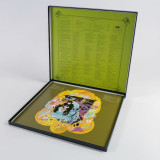
The state51 Box Set
With authenticity core to the project, The state51 Conspiracy engaged one of the UK’s
leading experts in box set design, Daniel Mason at Something Else, to painstakingly recreate
the box, records and accompanying ephemera. The first challenge was to find the deep blue
leatherette paper the original box set was covered in; a problem since it was no longer in
production. “I knew people who had stacks of it, gathering dust on top shelves, so I bought it
up wherever I could find it,” says Mason. Then came the reproduction of 12 loose leaf lyric
sheets on fine art watercolour paper, each of them featuring a watermark and a fairytale-like
illustration by Donovan’s artist friends Sheena McCall and Mick Taylor. Where, though, to
find the same paper stock? “I found out that it was made at a paper mill in North Wales
called Abbey Mills. Unfortunately the mill dissolved in the early 70s and very little of the
paper remained. However enough paper remained to allow us to produce the numbered
certificate also signed by Donovan that sits within the box.”
Then to the iconic cover image. Donovan and Jimi Hendrix’s personal photographer Karl
Ferris, used infra-red film to achieve the psychedelic effect on the cover, but the original
negatives couldn’t be found. Mason then used digital technology to ramp up the colour levels
on a reproduction from an original copy of the album while allowing it to remain a little bit
faded, as it would be after half a century. The same labour of love and care has gone into
producing all elements of the box; from the rebuilding of the famous front cover font to the
hand-numbered and signed certificate; letterpress printed on the original paper stock of the
1968 UK release lyric sheets.
To cap it all off the original mono master tapes were waiting safely in the EMI Donovan
Archive and transferred from tape to digital by Abbey Road Studios where new lacquers
were cut, ensuring Donovan's favoured mono version of the album would be presented both
physically (and digitally for the very first time) in striking audiophile quality. The final touch to
What the listener might encounter on this album goes all the way down to the sound of a neuron transmitting pain, beatitude or any one of the countless senses and impressions we feel on any one day of life. N E U R O is the debut album by CURA MACHINES, a new project by Daniel Lea whose tracks are at once scientific in their capturing of the morphing of body cells as well as the larger expanses of a poetic filmscape of the contemporary metropolis.
The name CURA MACHINES comes from a sign Lea saw on a trip to Ancona, Italy at an abandoned hospital: Prima E Dopo La Cura (Before and after the cure). The sound in between, of what was lost or found, transmuted in the heavily manipulated and pulsating synthesisers, is the restoration here. With a physically visceral mix by Ben Frost and soaring re-amped bass textures from Yair Elazar Glotman, the album is lush with trans-morphing apeggia that shudder, quack and soar into ashen sparks.
Back in the turn of the 20th century the poet Rilke posited that the suture patterns of fused skull plates could potentially be played by the then-new technology of the gramophone, with each of us having our own personal tonal source code or anthem etched onto our skulls. And with a track like 'Suture' we have such an embodied sound: the close-up exhumation of the neural brain casing, stitched and sewn together in fleeting pulses of whisper and alarm.
The individual is exposed and isolated, but not without the promise of succour.
Or one also has the soundtrack to the loneliness of a morose private eye – a pulp novel set in a future time of neurosis or washed out euphoric beauty. It is here in tracks such as 'Terminal Zone' or 'Inversion Layers', music that is blinking in celluloid frames. The plot could easily be a sci-fi, paranoid tale of brain emulation, transhumanist crimes against humanity itself. After all this is Lea's soundtrack to Los Angeles, the city of angels that has been captured in countless movies: the racing tracking shot of the 2nd Street Tunnel at night, the freeways spreading out in a glorious sprawl of lit up veins and arteries. The last track 'Zosa' marks out the boundary line that delineates between day and night, when the lunar strains wane, the tides subside and the city comes to life.
Red Vinyl[20,97 €]
REKORDER is "a kind of retrospective of myself", says M.RUX about his second, long-awaited solo album. For over 10 years, Marten Rux aka M.RUX appears as a DJ, producer, editor, remixer and multi-instrumentalist all over the world and has developed an idiosyncratic sound that opens up subtle fields of tension: M.RUX mixes a sound between experimental sound design and hooklines that stay in your ears forever. Between wild percussion and contemplative harmonies, between ecstasy and meditative calm. In his DJ and live sets, M.RUX usually steps up to the controls with a smile, discreetly bobbing his head, while the audience goes wild. He circumnavigates clichés with trustworthy certainty and develops his very own guiding threads in his selection beyond BPM or genre straitjackets. One constant is his warm, often stoically slow kick drum, which holds all that playfulness together. REKORDER is a manifestation of this typical M.RUX sound. Similar to his concept album "Vermonische Melodien" from 2020 (on the Pingipung label), the artist's curiosity is directed towards the musical visions of the past. When new music technology projected great visions of the future and when new sounds had not yet solidi ed into clichés. REKORDER refers to the recording device, spelled in a German way, because most of the recordings were made in Germany (and in England as well). Phonography is a miracle that has only been around for 150 years: Technology gifts upon us prosthetics for remembering sound. Every recording is a process, and every playback a new performative act. Recordari (Latin) is a beautiful word. It literally means to take something to heart (cor) once again (re-). This doesn't just refer to remembering, but also to a ponderous, loving, sometimes doubtful contemplation. It is a perfect headline for M.RUX’ approach to processing sound. REKORDER draws deeply from its own archive, which has ourished quite splendidly during the pandemic. Multi-instrumentalist M.RUX mixes his own recordings of banjo, guitar, auto-harp, synths, percussion and jews harp with fragments from sessions with friends that have accumulated since 2020. They unfold in the process of re-listening in the mix and transform into a solid musical tapestry. A typical gesture for this album? M.RUX bows deeply to the history of pop music - especially the blues and its melancholy, coolness and shuf ing groove. The harmonic framework of the album is based on blues scales throughout. Instead of conveying blue emotions via lyrics or the tone of the voice, as the original genre does, the synthesizer takes on this role on REKORDER. With his sound design, M.RUX achieves an ecstatic sorrow in his melodies, this gurgling portamento that is reminiscent of R&B (or even the ingenious title melody of the series "Bojack Horseman”). If voices are heard on REKORDER, then as hypnotic fragments that guide us through the groove as conjunctions: "Because...", says the voice in the track of the same name. That's enough. There are no lyrics, no literal weariness, no love-songs or storytelling, REKORDER processes all of this into timbres and groove as vessels for the album’s individual, contemplative melancholy. Never forgetting, with a gentle smile, to swing a leg.
Black Vinyl[17,61 €]
LIMITED RED COLOURED VINYL!
REKORDER is "a kind of retrospective of myself", says M.RUX about his second, long-awaited solo album. For over 10 years, Marten Rux aka M.RUX appears as a DJ, producer, editor, remixer and multi-instrumentalist all over the world and has developed an idiosyncratic sound that opens up subtle fields of tension: M.RUX mixes a sound between experimental sound design and hooklines that stay in your ears forever. Between wild percussion and contemplative harmonies, between ecstasy and meditative calm. In his DJ and live sets, M.RUX usually steps up to the controls with a smile, discreetly bobbing his head, while the audience goes wild. He circumnavigates clichés with trustworthy certainty and develops his very own guiding threads in his selection beyond BPM or genre straitjackets. One constant is his warm, often stoically slow kick drum, which holds all that playfulness together. REKORDER is a manifestation of this typical M.RUX sound. Similar to his concept album "Vermonische Melodien" from 2020 (on the Pingipung label), the artist's curiosity is directed towards the musical visions of the past. When new music technology projected great visions of the future and when new sounds had not yet solidi ed into clichés. REKORDER refers to the recording device, spelled in a German way, because most of the recordings were made in Germany (and in England as well). Phonography is a miracle that has only been around for 150 years: Technology gifts upon us prosthetics for remembering sound. Every recording is a process, and every playback a new performative act. Recordari (Latin) is a beautiful word. It literally means to take something to heart (cor) once again (re-). This doesn't just refer to remembering, but also to a ponderous, loving, sometimes doubtful contemplation. It is a perfect headline for M.RUX’ approach to processing sound. REKORDER draws deeply from its own archive, which has ourished quite splendidly during the pandemic. Multi-instrumentalist M.RUX mixes his own recordings of banjo, guitar, auto-harp, synths, percussion and jews harp with fragments from sessions with friends that have accumulated since 2020. They unfold in the process of re-listening in the mix and transform into a solid musical tapestry. A typical gesture for this album? M.RUX bows deeply to the history of pop music - especially the blues and its melancholy, coolness and shuf ing groove. The harmonic framework of the album is based on blues scales throughout. Instead of conveying blue emotions via lyrics or the tone of the voice, as the original genre does, the synthesizer takes on this role on REKORDER. With his sound design, M.RUX achieves an ecstatic sorrow in his melodies, this gurgling portamento that is reminiscent of R&B (or even the ingenious title melody of the series "Bojack Horseman”). If voices are heard on REKORDER, then as hypnotic fragments that guide us through the groove as conjunctions: "Because...", says the voice in the track of the same name. That's enough. There are no lyrics, no literal weariness, no love-songs or storytelling, REKORDER processes all of this into timbres and groove as vessels for the album’s individual, contemplative melancholy. Never forgetting, with a gentle smile, to swing a leg.