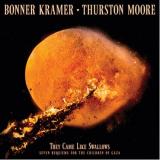
They Came Like Swallows is the first album-length collaboration between Thurston Moore and Kramer (now officially Bonner Kramer), two giants of alternative/ experimental music. The accomplishments and influence of these two artists in the world of independent music cannot be overstated and the result of their artistic union is a startlingly cohesive statement that burns through landscapes of primitive outsider rock, avant-garde composition, progressive ambient and further locales boldly and beautifully unnamable. “Kramer and I reconnected in Miami, Florida, a few years back, many many years after each of us had departed NYC on separate life adventures. It was only a matter of time before Kramer and I started making plans to record together and with his irrepressible due diligence he quickly set up a mobile recording contraption in the pad I was decamped in, the Florida sunshine flowing through the palm leaves, lithe lizards skittering across the windowsills, and we just went for it.
Kramer had the idea to cover a Joy Division tune, a left turn from the improvisations we had been tracking, though wholly in keeping with both our sensibilities of light and dark unifying in transcendent songwriting, both of us devotees of 'the song' as well as 'the freedom.’ What transpired is They Came Like Swallows, a session we immediately felt should exist as a prayer to the war-torn souls of the families of Palestine continually decimated by the brutality of genocide. We agreed beyond words to offer our music as a sonic activism and as a beneficent energy. This album is our duo exchange for human dignity, it is our soul music for any semblance of a peaceful planet.” ~ Thurston Moore “For the first time in our nearly 45 years of friendship, we had identical time windows open to make a record together,” recounts Kramer. After all this time not a moment is wasted as the duo immediately taps into the heightened core of improvisational tension across these seven offerings. Volcanic opener “Urn Burial” notches a similar historic union (John Cale and Terry Riley) to meet the circumstances of the moment, with swirling mists of organ and pounding toms over guitar that thickens the atmosphere with jagged, grimy dissonance.
Solemn strings open the second track, “The Redness In The West,” with Kramer’s cello and viola in dueling bow beneath the high tension drive and sustain of Thurston’s electric guitar, tapping out a Morse code of tension that mounts endlessly into a fog of inevitable war by the end. Moore and Kramer’s sense of experimentalism is in free and full grandeur throughout They Came Like Swallows, though the duo keep a strong and constant sideways eye on melody, composition and architecture, to the ends that any strict lines between song and improvisation are blurred beyond qualification.
As if to punctuate this point, Swallows closes with a nightwork cover of Joy Division’s “Insight,” a doleful coda that breathes out with a solemn inner grace under Thurston’s instantly stylistically recognizable guitar melodies as they weave into he and Kramer’s unison voices. As the lone vocal piece and only traditional ‘song’ form on the album, “Insight” is unique to this set and as a closing statement draws connective lines back to the kind of dynamic, electrified melodicism that wove deep, melancholy patterns into the untamed fire of Sonic Youth’s Sister and Daydream Nation. In the album’s final moments, the two voices repeat the lyric “I’m not afraid anymore” as mantra, underscoring the heavy, unsettled themes and methods that preceded it. Kramer describes the creative process of They Came Like Swallows: “I had composed and recorded a few pieces at my home studio over the course of a couple weeks. Thurston was spending the winter in South Florida, so I flew down and spent a few days recording his guitar parts in his home there. Watching him spontaneously compose his parts was pretty astonishing, to say the least. Once we'd finished working on those pieces, we began improvising and following wherever the music pointed us, and another few pieces were born. We got straight to it, without anything driving us other than the joy of finally working together.
My personal goal was to remain present and catch as many surprises as I could from Thurston's guitar work, and there were plenty during those few days. We had a fucking blast.” Thurston’s contributions here will be readily familiar to any acolytes of his other works, the through-line between his inspired playing, cradled in Kramer’s meticulous, solid arrangements. “If I had to make this record again, I'd do it all exactly the same way,” Kramer says. “It’s like jazz, you don't think about it. You just do it. It was miraculous, and you don't fuck with a miracle.”
Cerca:acolytes
- 1: Urn Burial
- 2: The Redness In The West
- 3: The Third Migration
- 4: They Came Like Swallows
- 5: The Living Theater
- 6: The Oceans Are Crying
- 7: Insight
Black Vinyl[30,67 €]
They Came Like Swallows is the first album-length collaboration between Thurston Moore and Kramer (now officially Bonner Kramer), two giants of alternative/ experimental music. The accomplishments and influence of these two artists in the world of independent music cannot be overstated and the result of their artistic union is a startlingly cohesive statement that burns through landscapes of primitive outsider rock, avant-garde composition, progressive ambient and further locales boldly and beautifully unnamable. “Kramer and I reconnected in Miami, Florida, a few years back, many many years after each of us had departed NYC on separate life adventures. It was only a matter of time before Kramer and I started making plans to record together and with his irrepressible due diligence he quickly set up a mobile recording contraption in the pad I was decamped in, the Florida sunshine flowing through the palm leaves, lithe lizards skittering across the windowsills, and we just went for it.
Kramer had the idea to cover a Joy Division tune, a left turn from the improvisations we had been tracking, though wholly in keeping with both our sensibilities of light and dark unifying in transcendent songwriting, both of us devotees of 'the song' as well as 'the freedom.’ What transpired is They Came Like Swallows, a session we immediately felt should exist as a prayer to the war-torn souls of the families of Palestine continually decimated by the brutality of genocide. We agreed beyond words to offer our music as a sonic activism and as a beneficent energy. This album is our duo exchange for human dignity, it is our soul music for any semblance of a peaceful planet.” ~ Thurston Moore “For the first time in our nearly 45 years of friendship, we had identical time windows open to make a record together,” recounts Kramer. After all this time not a moment is wasted as the duo immediately taps into the heightened core of improvisational tension across these seven offerings. Volcanic opener “Urn Burial” notches a similar historic union (John Cale and Terry Riley) to meet the circumstances of the moment, with swirling mists of organ and pounding toms over guitar that thickens the atmosphere with jagged, grimy dissonance.
Solemn strings open the second track, “The Redness In The West,” with Kramer’s cello and viola in dueling bow beneath the high tension drive and sustain of Thurston’s electric guitar, tapping out a Morse code of tension that mounts endlessly into a fog of inevitable war by the end. Moore and Kramer’s sense of experimentalism is in free and full grandeur throughout They Came Like Swallows, though the duo keep a strong and constant sideways eye on melody, composition and architecture, to the ends that any strict lines between song and improvisation are blurred beyond qualification.
As if to punctuate this point, Swallows closes with a nightwork cover of Joy Division’s “Insight,” a doleful coda that breathes out with a solemn inner grace under Thurston’s instantly stylistically recognizable guitar melodies as they weave into he and Kramer’s unison voices. As the lone vocal piece and only traditional ‘song’ form on the album, “Insight” is unique to this set and as a closing statement draws connective lines back to the kind of dynamic, electrified melodicism that wove deep, melancholy patterns into the untamed fire of Sonic Youth’s Sister and Daydream Nation. In the album’s final moments, the two voices repeat the lyric “I’m not afraid anymore” as mantra, underscoring the heavy, unsettled themes and methods that preceded it. Kramer describes the creative process of They Came Like Swallows: “I had composed and recorded a few pieces at my home studio over the course of a couple weeks. Thurston was spending the winter in South Florida, so I flew down and spent a few days recording his guitar parts in his home there. Watching him spontaneously compose his parts was pretty astonishing, to say the least. Once we'd finished working on those pieces, we began improvising and following wherever the music pointed us, and another few pieces were born. We got straight to it, without anything driving us other than the joy of finally working together.
My personal goal was to remain present and catch as many surprises as I could from Thurston's guitar work, and there were plenty during those few days. We had a fucking blast.” Thurston’s contributions here will be readily familiar to any acolytes of his other works, the through-line between his inspired playing, cradled in Kramer’s meticulous, solid arrangements. “If I had to make this record again, I'd do it all exactly the same way,” Kramer says. “It’s like jazz, you don't think about it. You just do it. It was miraculous, and you don't fuck with a miracle.”
*all original recordings from mid 90s Estonian released cassettes. Fascinating interpretations of the UK breakbeat and Jungle sounds recorded when the world felt like a much bigger place.
Since hearing the first breakbeats via the Finnish radio nightly shows introducing the burgeoning UK scene, Virko Veskoja, later head figure of Lu:k, was completely swept away by this new technological language that sounded like machines trying to initiate contact with people. The fluttering rhythm patterns, strings and vocal lines haunting the pathways of the infinite network. Like hip hop taken over by Skynet.
Reimagining it all in mid-90’s Estonia, a fresh and dirt-poor republic newly welcomed to the family of sovereign states on the outskirts of Eastern Europe, was challenging, to say the least. Finally, with the help of entry level music programs, custom-made soundcards and self-built computers by the other Lu:k-head Tõnis Valk, Lu:k took the first tentative steps in the history of Estonian jungle.
Eight Lu:k cuts have been compiled into a handy selection, a true sign of the times when uncertainty came with certain hope and optimism – new territories to chart, new frontiers to conquer. A time of innocence captured so sublimely in Lu:k’s music.
The compilation starts with menacing orchestration that sounds like the birth of a civilization, like in „2001: A Space Odyssey“, or the arrival of Godzilla, only to give way to sweeeet strings and the inimitable Minnie Riperton in “Lovin U”, combining all the essential elements of Lu:k in a track that has remained uncorroded by time since its inception in 1994.
The following “Demo 3” is its antithesis – fast and nervous, a harbinger of the darker days of neurofunk and techstep ahead. More in line with the social realities of the time, when something (or someone) could materialise out of thin air and attack you just as violently as those beats here.
“La:v” was Lu:k’s signature track throughout their brief career that went on only for a few years, 1994-1997. Lifted to heaven’s by Petula Clarks’s wonderful vocals, it perfectly captures the pure essence of creation. “I made it in my bedroom. Something like that just came out. Sorry”, says Virko apologetically.
From the themes of love we are led towards darker scenarios again with “Drunk-Drive”, a more vengeful cut reminiscent of early Ram Records’ nocturnal dangers, skylines shaped by basslines. Previously only available on the uber-rare “Raadiomaja valvelauas” CD compilation from 2005.
“In the Limelight” is lifted from their second album “Dreams in Drums” from 1996 (only released on cassette), and if it’s meant to address their new-found underground celebrity status in Estonia, there is surprisingly little elation here – the track rather consists of introspective strings and beats that sound almost melancholic.
Out of the remaining three tracks, “Proov2mix” and “Kadunud leitud” are the result of a treasure hunt amongst the old, obsolete harddrives – little nuggets that were condemned to obscurity until now. Between them, another vocal-led cut “010”, a non-album track only featured on two comps until now, is a strong reminder of Lu:k’s prodigious ability to handle vocal lines and morph them together with their own weaving synthetic melodies, strong pads and commanding beats.
Lu:k’s music has been largely unavailable for the better part of this century, with original tapes and CD’s changing hands for a small fortune. This vinyl release couldn’t come at a better time, bringing a seminal chapter of Estonian dance music’s mythical history to light again, both for the old-school acolytes and new converts.
All music by Virko Veskoja
Kumquat is back with their second release and it’s a VA filled to the brim with sleek cuts for the movers and the shakers. Four acolytes of the now mythical french parties deliver the perfect combination of wonk and bounce across four groovy joints that are sure to stay in any connaisseur's bag for extended periods.
Jimmy Whoo and Muddy Monk have definitely never left each other's side. Since their first - and divine, like the title of the song - collaboration in the summer of 2019, the French producer and the Swiss singer have enjoyed meeting up in the studio to compose four-handed. Their budding friendship has quickly developed into a lasting artistic bond. There's an instant chemistry between them in their joint compositions. After once again inviting Muddy Monk on the track Aqua from his Motel Music trilogy, Jimmy Whoo has come up with a more developed collaboration for a fascinating EP, To the Moon, which will brighten up the autumn.
Gathered in the Ciel Rouge Studio in Paris, the two acolytes bring their instruments and machines, a priori to compose instrumentals, and we know their affinity for contemplative, floating and addictive music. When we work together, we produce sounds that have a common touch," explain Jimmy Whoo and Muddy Monk. We share the same taste for freedom, travel, dreams and the desire to ride in music". As always between them, their circumstantial meeting leads to a healthy emulation, an obvious magnetism. There's a clear cinematic quality to the heady melodies and harmonic patterns, reminiscent of some of the big names in dreamy electronica (Boards of Canada) or retro-futurist pop (Air).
Of the four tracks on the EP, To the Moon and So Close to You sound like potential singles on first listen. Muddy Monk must have written a few lyrics on these instrumental tracks, and you'll immediately recognise his free-spirited style ("Walking on the moon/Let me please come home", co-written with Jimmy Whoo on vocals) and pensive style ("Perdu en terre étrangère/J'éliminais quelques doutes"). Mixed by Stéphane 'Alf' Briat and illustrated by a graphic cover by 22note, this EP brings together two talents for a superb musical journey from the earth to the moon.
Diagonale des Yeux is the new band formed by two of France’s admired and adventurous artists. Laurène Exposito, we know as EYE, our longest regular contributor to the label — and friend Théo Delaunay, member and producer of Parasite Jazz, panoptique, De Klok & Violent Quand On Aime.
In Knekelhuis we have a particular fondness for artistic outputs that resist easy categorisation, and Diagonale des Yeux inhabits precisely that kind of territory.
Every aspect of the project is DIY/homemade. Their world drifts along the fringes of cabaret, strange 1980s French underground pop music to contemporary lo-fi scene — evoking the spirit of Nini Raviolette and The Residents — while delivering beautifully written songs that lodge themselves in your head almost immediately like a Cindy Lee ballad.
The tracks on Madeleine squeak and creak, wobbling on fragile hinges before suddenly opening onto moments of pure beauty.
Drums and guitars follow up synths and electronic percussions captured on tape between living rooms, studios and a concert space.
The band has a kink for choirs and playfully uses diverse languages. Their lyrics emerge through a homemade, patented four-hands cadavre exquis (Exquisite Corpse) process, where chance and dialogue shape meaning as much as intention.
Diagonale des Yeux is a singular project — equally strange and irresistibly pop-leaning. Music like weeds pushing through pavement cracks and, against all odds, turning into flowers.
Marking more than three decades of one of the most influential albums of all time, five-time GRAMMY® Award-winning band Green Day releases a new colored vinyl. Dookie’s influence remains downright inescapable. It has sold a staggering 20 million copies worldwide and stands out as "the first punk album to be certified Diamond by the RIAA for North American sales in excess of 10 million.” Out of four 1995 GRAMMY® Award nominations, it notably garnered “Best Alternative Album.”Rolling Stone touted it on the “500 Greatest Albums of AllTime” and Pitchfork retrospectively christened it “one of the greatest teenage wasteland albums of any generation.” The Daily Beast remarked on “How Green Day’s Dookie Defined the 1990s and Changed Music Forever.”Speaking to its sustained impact, it has generated billions of streams to date. To put it in perspective, Dookie has lived through five presidential administrations, Y2K, social media, a global pandemic, and the birth of countless acolytes.
- A1: Basis Rahouma - بسيس رحومة,- Yana Alla Nafsa Masouda يانا اللي نفسي مسدوده (Blocked From What I Want)
- A2: Sheikh Amin Abde -L Qader الشيخ أمين عبد القادر, Mould Fi Madina Tanta مولد في مدينة طنطا (Born In The City Of Tanta)
- A3: Samah سماح, - Shawish Aldawriat شاويش الدورية, (Patrol Sargeant)
- A4: Mahmoud Al-Sandidi محمود الصنديدي, - Ana Mish Hafwatak (Part 2) انا مش حفوتك, (I Don’t Miss Your Love)
- B1: Abu Bakr Abdel Aziz (Aka Abu Abab) أبو بكر عبد العزيز,- Al Bint Al Libya أل بينت أل ليبيا (The Girl From Libya)
- B2: Sheikh Amin Abdel Qader الشيخ أمين عبد القادر, - Mawal Al Layl Kolo Makasib موال الليل كله مكاسب (Mawaal: The Spoils Of An All-Nighter)
- B3: Abu Saber أبو صابر, - Ya Allah Ank Zinat يا الله انك زينة (Oh, God, You Are Beautiful)
- B4: Reem Kamal ريم كمال, - Baed Al Yas Yjini بعد اليأس يجيني (After Hopelessness, He Comes To Me)
“Egypt’s “official” popular music throughout much of the 20th Century was a complex form of art song steeped in tradition, well-loved by the middle and upper classes, and even accommodating to certain non-Arabic influences. It was highly structured by professional musicians working an established industry centered in the capitol, Cairo. However, far from the bustling cosmopolitan center of Cairo, north and northwest, in towns like Tanta and Alexandria and extending across the Saharan Desert to the Libyan border, dozens of fully marginalized artists were developing a raw, hybrid shaabi/al-musiqa al-shabiya style of music, supported by smaller upstart, independent labels, including the short-lived but deeply resonant Bourini Records. Launched in the late 1960s in Benghazi, Libya, Astuanat al-Bourini اسطوانات البوريني (Bourini Records) published some 40 to 50 titles from 1968 to 1975. Bourini released 7-inch 45 RPM singles by 15 artists, all but one of them Egyptian, igniting brief careers for Alexandrian singer Sheikh Amin Abdel Qader and the blind Bedouin legend Abu Bakr Abdel Aziz (aka Abu Abab). The tracks compiled here comprise a full range of styles covered by the label, while highlighting some of its most gobsmacking moments, from Basis Rahouma’s beastly transformation into a growling and barking man-lion by the end of “Yana Alla Nafsa Masouda,” to Reem Kamal’s hopeful-if-bitter handclapping party pivot “Baed Al Yas Yjini,” which descends into an almost Velvet Underground outro-groove of nihilistic dissonance. All the tracks on this compilation were laid down in stark divergence from the mainstream Egyptian popular music topography of heightened emotions buoyed by lush arrangements. The contrast is most evident in Mahmoud al-Sandidi’s “Ana Mish Hafwatak,” wherein his voice weaves heavily but deftly through a constant accordion drone, and Abu Abab’s “Al Bint al Libya,” a sparse, slow-burning lament with minimal percussion, violin, and Abab’s nephew Hamed Abdel Muna'im Mursi on lyre. Whereas the Egyptian mainstream was aspirational, attempting to reflect Egyptian culture at its most refined, the performances captured by Bourini were manifestations of everyday life lived by the mostly otherwise ignored masses. More than half century old, this music has lost none of its urgency, presence, or relevance. We hear these artists as if they’d just joined us in our living room, and not on a stage decades ago surrounded by tens of thousands of long-forgotten acolytes.
- A1: Like A Ship
- A2: I'm Drunk & I'm Real High (In The Spirit Of God)
- A3: Yes God Is Real
- A4: Packing A Grip
- A5: Pray A Little Longer
- B1: If Jesus Came
- B2: Troubles Of The World
- B3: I Know I've Been Changed
- B4: God Will Answer
- C1: Same Thing It Took
- C2: Somebody's Watching You
- C3: Peter & John
- C4: I Know Him
- D1: Share Your Love With The Master
- D2: I Thank You Lord
- D3: Come On Strong Stay Along
- D4: Been Trying
- D5: I'll Take Jesus For Mine
Unofficially the third entry in our Good God! series of ecstatic worship, Born Again Funk picks up where A Gospel Funk Hymnal leaves off. Yes, the prodigal sons of Thomas Dorsey arrived in there multitudes, only some of them toting fuzzboxes and Fender amps. These are the most devout songs, but done up amid the hot, sweaty, earthy moonshine rhythms downed by any blues singer thumbing his way up north from the Mississippi delta. Born Again Funk hones in on wholly modern vulgarity brought to a joyful strain of American composition, and performers unafraid of expressing their devotion with both inspiration and invention. They were acolytes faithful to a spirit, but never to an ordained sound.
"In 1971, Dr Tree emerged as a highly innovative jazz-fusion ensemble from Auckland, formed by two of New Zealand's most seasoned session musicians, Frank Gibson Jr. and Murray McNabb - the pair had jammed together since grammar school. Drawing sizable crowds while working the Auckland circuit, the band caught the attention of EMI scout, Alan Galbraith, who wasted no time signing them up for an album. Galbraith, a trained musician and adventurous producer, brought in additional support from Julian Lee, an internationally acclaimed arranger and producer (who had recently returned to New Zealand after a decade Stateside on Frank Sinatra's insistence).
The album's an all-instrumental excursion into territory mapped out by the likes of Return To Forever, Weather Report and Tony Williams Lifetime - all acolytes of Miles Davis's late- 60s explorations. The session combines experimental studio techniques with blazing artistry, juxtapositioning trippy electronic textures and improvised jazz, creating a hypnotic kaleidoscope of sound."
Double LP featuring previously unreleased recordings and outtakes.
Restored and remastered at�Abbey Road Studios by Grammy award-winning engineer Sean Mage.
Heavyweight tip-on gatefold sleeve featuring archival band photography.
Restored and newly remastered at Abbey Road Studios.
Limited edition of 600 copies (300 in New Zealand, remaining 300 worldwide).
Palomino Blond are an independent rock trio from Miami releasing sophomore album You Feel It Too on October 4, 2024 on Kanine Records. With a stout, multi-dimensional sound spanning grunge, shoegaze and dream pop, Palomino Blond are acolytes of the `90s, but their music is no basic redux. Instead, they're part of a surging young class that's bringing new blood, perspective and verve to the classic alternative-rock aesthetic, resulting in a distinctly 21st century resonance.Palomino Blond weave a dynamic duality of heavy and heavenly, like Lush reinterpreting Siamese Dream.
The group formed by the legendary Joseph Hill, accompanied by his two acolytes Albert Walker and Kenneth Dayes, delivers an album recorded at Mixing Lab and mixed at the Lion & Fox studio (reference studio for the RAS label) in 1989.
Recorded with 3 brass instruments, bass, drums, keyboards and percussion, it's in the pure roots tradition, with a few interesting dub twists. There's also a tribute to Bob Marley entitled ‘Psalm of Bob Marley’ and the excellent ‘Cousin Rude Boy’.
This is a pure roots album remastered to the highest standards, with a 350g cardboard sleeve showing off the full extent of Mitch Goldberg's graphic design. Never reissued on vinyl since its release, and only once on CD in the 90s.
Clear Vinyl[30,67 €]
Spectres have been stirring in the shadows for years now. Dark eyes watching from pallid faces. Siren songs calling to lost souls. In the blackest corners of the UK underground, a name whispered relentlessly amongst the faithful, first with curiosity, then soul-shuddering awe: Zetra.
Zetra is also the title of their striking debut LP. Ten tracks whose indefinable blend of shimmering shoegaze and pulsating goth-metal work deep beneath the skin, it is a masterclass in intimate dark romanticism and sweeping elemental beauty. It could be seen as a reaction to the geography of a strange new world, but also to the jagged topography of the human psyche itself. Is it a manifesto? A roadmap? A riddle waiting to be solved? Profound pleasure lies in peeling back its many layers.
Travelling alone, armed only with synths, guitar and drum-machine to compose, The Wanderers’ music could sound skeletal. Instead its early metallic bones have been fleshed-out with the electronic new-wave of Gary Numan and Pet Shop Boys and dreamy, droning guitars that hark to heroes like Slowdive and Sonic Youth as well as dark contemporaries Deafheaven and Alcest. As harsh as the truths with which they deal may be, these songs deliver beguiling brilliance.
Acolytes to spread the word of Zetra aren’t hard to find. British ‘contemporaries’ like Burner and Wallowing, Celestial Sanctuary and Employed To Serve have been dementedly singing their praises as far back as they can remember. Tours with the heavyweight likes of Creeper and Godflesh, VV and SKYND have taken their once-subterranean sounds into the spotlight. Unto Others’ Gabriel Franco (‘Moonfall’), Svalbard’s Serena Cherry (‘Starfall’) and Sólveig Matthildur Kristjánsdóttir from Iceland’s Kælan Mikla (‘Shatter The Mountain’) even crop up amongst these recordings, dissolving into the cult of Zetra themselves. But none are as important as the legions of fans Zetra are yet to reach with a dark gospel still unpicking all manner of psychological knots and existential truths.
Eleventh album consisting of eleven songs, Pink Air, by Elysian Fields, cult New York band led by Jennifer Charles and Oren Bloedow, was released in September 2018. Recorded in the mountains around Woodstock, Pink Air was finalized in Thomas Bartlett's studio (The National, Sufjan Stevens) in Manhattan. A single rock wave unites the tracks with its cavernous reverberation, as if shrouded in the darkness of a night club or pinned to the shadow of a modern nightmare. Pink Air is a post-apocalyptic rock'n roll getaway. The album tackles themes as varied as the ecological threat, the regime of a potential narcissist dictator, white supremacy, censorship, the erasure of history, the social drama of families ... as well as meditations on time, friendship, loss, death. Despite the biting tone, the words never sound too heavy, lightened by many touches of humor. Jennifer Charles's vocals are at their highest, infusing each song with its legendary languid charisma, in a lyrical breath whose spellbinding power has remained intact. By portraying the landscape of the present day with her precise, often caustic lyrics, Jennifer sets her special veil on the intimate, the spiritual, brushing her characters, friends and lovers, in a pure novelist style. All against a background of fear of our time, of its social and political drifts. With Elysian Fields, the angelic singer and her acolytes have always been carried by the highest currents of the sky. For Pink Air, they fold their wings, land on the ground, and roam the scorched lands of America, animated by the rock'n roll spirit of the animal. The feathers turned into so many spiky hairs
Perpetually out of print, much sought after and universally worshipped amongst those in the know, Winter's "Into Darkness" was a game-changing classic. "Into Darkness" was a gateway drug to the dark depths of sludge metal, and now awaits a whole new throng of
acolytes who bow down before the throne of heavy doom. Svart Records is proud to rerelease it once more, putting the album back in print for a new generation of listeners. Eternal Winter awaits!
Perpetually out of print, much sought after and universally worshipped amongst those in the know, Winter's "Into Darkness" was a game-changing classic. "Into Darkness" was a gateway drug to the dark depths of sludge metal, and now awaits a whole new throng of
acolytes who bow down before the throne of heavy doom. Svart Records is proud to rerelease it once more, putting the album back in print for a new generation of listeners. Eternal Winter awaits!
- A1: Brand New Girl - Billy Garner
- A2: Mister Bass Man - The Fatback Band
- A3: Bad On Bad - Chet Ivey
- A4: Grits And Gravy - The Fame Gang
- A5: Foolish Man (Part 1) – The Huck Daniels Co (Featuring Johnny Adams)
- A6: Funky Kingston - Tribe
- A7: Over Dose (Of Your Love) – The Two Things In One
- B1: Stop! - Camille "Lil" Bob
- B2: Hypocrisy - Millie Jackson
- B3: Do It - Billy Sha-Rae
- B4: Mother Popcorn - The Mello Matics
- B5: Here Comes The Judge - Larry & Tommy
- B6: Soul Feeling Pt 1 - Eddy Giles
- B7: Get Me Back On Time, Engine #9 – National Soul Review
This Is Street Funk” is part of a new series aimed at vinyl buyers who want a genre specific compilation to excite their ears. They will appeal to long-standing, discerning music acolytes and recent converts alike. Two sides of fantastic music, at an affordable price, hand-picked with TLC from Ace and its associated catalogues.
Compiled by Dean Rudland, who also writes the liner notes, “This Is Street Funk” brings you 14 tracks of hard hitting, heavy funk, and sums up the sound of 70s Black America. A combination of fatback drums, syncopated bass, rhythmic guitars and explosive vocals.
The line-up of tracks includes classics from the Fatback Band and Millie Jackson, dancefloor favourites from Billy Garner and Billy Sha-Rae and screaming organ instrumentals from the Fame Gang and Larry & Tommy.
This is fourteen tracks that defy you to start dancing.
For 46 minutes Alex Zhang Hungtai punctures our perception of linearity, working like a conductor, encouraging percussive flurries to trip and fall over each other, sometimes tempered by contact mic feedback to help skewer the chronology. He’s assisted by three additional percussionists - Wet Hair’s Ryan Garbes and Shawn Reed, and Leonard King - while Signal Decay’s Nick Yeck-Stauffer plays trumpet, with each extra voice blurred into the middle distance, curling like pipe smoke into convulsive whorls.
The piece is frankly astonishing in its grasp of the maelstrom. Initially tentative, searching, with higher register hits like moths butting lone lightbulbs in an abandoned apartment block, the distant, plangent peal of twin brass wafts between rooms to impart a distinctly floating, OOBE- like feel for space. The brass recedes while the drums’ low end thickens and roils like a gamelan tempest, blurring impressions of knackered buildings or the temple rituals of ancient epochs, with sounds wafting in from other rooms to mess with the stereo field like ghosts of worshippers doing their thing. Remarkably, it conjures a fever dream miasma of ricocheting, thunderous polymetric clatter and proprioceptive fuckry without ever losing its head.
Hungtai’s canny use of contact mic feedback drone and cymbal saw gives the whole thing a sense of gauzy delirium that unites the grouches like mildewed grout and cobwebs, coarsely gelling the elements in a way that resonates with Pauline Oliveros and co’s Deep Listening band acousmagique as much as Basil Kirchin’s keeling ‘World Within World’ classic, the ghosts of Sun Ra’s ‘Nuclear War’, the possessed atmosphere of the cabin where Harley Gaber recorded ‘Wind Rises in the North’, and no doubt Harry Bertoia’s massive metallic sculptures, agitated at midnight.
Humid, menacing, and wraithlike, the album’s’ sense of keening chronics belies a visionary hand at the tiller, here tightened by Rashad Becker’s mastering, which faithfully brings to light, and shadow, the depth of perception and wild but concentrated energies at play, sealing in place a truly staggering session for adventurous ears, cineastes and Lynchian acolytes alike.
Vocal Shades And Tones is a miraculous leftfield library classic from the genius mind of celebrated UK composer/singer/vocal arranger Barbara Moore. It's a heavenly groove-based blend of jazz, Latin, soft-psych, folk-funk and gospel soul. Recorded for the legendary Music De Wolfe in 1972, it's an audacious start-to-finish listen, as dizzying as it is dazzling. It's a perfect snapshot of a musical era, supported by Moore's glorious vocal arrangements. Widely regarded among collectors, DJs, and lounge/easy-listening acolytes as an absolute essential it is viewed as the holy grail by many production music heads, rarely appearing for sale and disappearing in a flash when it does. Indeed, originals now go for over £300 and it's easy to see why. Just one of the reasons why this fresh Be With reissue, part of a wider De Wolfe reissue campaign, is so utterly crucial.
Racing out the gate, the driving "Hot Heels" is a bright, sophisticated scat groove which sounds Brazilian, richly produced as if coming by the hand of Arthur Verocai. Yes, *that* good. It's followed by "It's Gospel" which is, er, a wonderfully slow and deeply soulful gospel treasure. The appropriately monikered "Steam Heat" is a darker, breathy gem, one for salacious crates and one of the record's most infamous tracks. "Fly Away" is pastoral West Coast soft rock, very much in conversation with John Cameron and Keith Mansfield's epochal KPM recording, Voices In Harmony. "His Name Was" is a stop-you-dead-in-your-tracks Beach Boys accapella church-organ stunner, whilst "Swing Over" is another carefree, richly produced sun-dappled smasher. The gentle Bossa and sunshine soul of the aptly-titled "Touch Of Warmth" closes out a virtually perfect A-Side.
The B-Side opens with the easy grace and dramatic build of "Voice Force Nine". The jaunty "Very Fine Fellow" may be the only track to slightly grate so we advise heading to the slower, moody "Shades-Tones", eminently more compelling with sparkling, hypnotic piano throughout, underpinning the gorgeous wordless vocals. Just beautiful. It was sampled by Redman for his Method Man-featuring "Do What Ya Feel" on the great Muddy Waters. We're back in Brazilian territory with the cool, uptempo "I'm Feather" before swooning to the warm, relaxed "Drifting", another total highlight which was famously sampled by Koushik on his legendary remix of Madvillain's "America's Most Blunted (Doom's Verse)". The penultimate track, "Take Off" is a bright, organ lounge groove before this remarkable set is rounded out by the beaty "Fly Paradise". It's so so good, it sounds like Rotary Connection fronted by The Mamas & the Papas. As noted in a recent Guardian article on Moore's life, "there is a plushness and electricity in the tight vocal harmonies that spring out, sung with the precision of cathedral choristers decades before Auto-Tune." Amen.
In the 1960s, Barbara Moore was a member of Top of the Pops’ resident vocal-harmony group, The Ladybirds and sang backing vocals for Dusty Springfield’s TV show. Her own outfit, the Barbara Moore Singers, were regulars on TOTP, singing with Jimi Hendrix when he performed "Hey Joe" live in Lime Grove Studios. An important detail for Moore was the shepherd’s pie she bought Hendrix when she found him alone, looking emaciated, near the BBC canteen. By 1970, she was working as a session singer for De Wolfe and, by 1972, was composing her own tracks for De Wolfe and working within their tight creative strictures. Each short track had to evoke an obvious mood and theme, with no significant key or tempo changes. Her response, this very album, managed to stay between the lines while cohering as an overarching artistic masterpiece.
The audio for Vocal Shades And Tones has been carefully remastered by Be With regular Simon Francis, ensuring this release sounds better than ever. Cicely Balston's expert skills have made sure nothing is lost in the cut whilst the records have been pressed to the highest possible standard at Record Industry in Holland. The original, iconic sleeve has been restored here at Be With HQ as the finishing touch to this long overdue re-issue.
NITE stammen aus einer langen und geschichtsträchtigen Linie des Heavy Metal. Die Bay Area hat Thrash-Titanen wie Metallica hervorgebracht, und obwohl es nicht das ist, was sich die meisten Metalheads vorstellen, wenn sie an ihren glücklichen Ort gehen, hat das sonnige Klima Nordkaliforniens Death dazu inspiriert, sich dem Death Metal zuzuwenden.
Diese San Franciscans tragen diese Fackel mit Stolz. Alle fünf Mitglieder haben in anderen Bands gespielt, die von Küste zu Küste reichen, aber sie kamen 2018 in Nordkalifornien zusammen. Es hat auch nicht lange gedauert, bis NITE ihre Präsenz bekannt gemacht haben. Ihr Debütalbum spricht alte Metalheads und Nu-Comers gleichermaßen an.
Man höre sich nur "Genesis" an, das "Darkness Silence Mirror Flame" mit Duell-Leads eröffnet, die mit den hellen, arena-rockenden Melodien der NWOBHM schmettern. Aber NITE sind nicht daran interessiert, vergangenen Ruhm wieder aufleben zu lassen. Van Labrakis' düsteres Knurren verleiht diesen leckeren, altmodischen Riffs einen schönen, geschwärzten Charme.
Darkness Silence Mirror Flame" ist jetzt zum ersten Mal über Season of Mist erhältlich.




