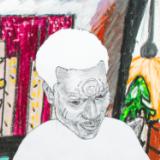
Janaka Stucky is a poet, performer, and author of two poetry collections published by Third Man Books & Records. Janaka’s poems are at once incantatory, mystic, and epigrammatic.
His esoteric & occult influences, combined with a mesmeric approach to performance, create an almost ecstatic presence on stage. Of his live shows, VICE writes, “Janaka Stucky performs poetry readings like he's part fire-and-brimstone preacher, part doom-metal frontman … For him, lighting incense, dropping acid, and creating some of the most ecstatic lines of verse you’ve ever read is just another day at the office.”
Praised by Jimmy Page as “riveting,” Janaka Stucky’s book length poem, Ascend Ascend, published by Jack White’s Third Man Books in 2019, gets a mesmerizing treatment on this album by the same name, accompanied by experimental cellist Lori Goldston. Goldston, known for her work with a number of acts—including Nirvana, Cat Power, and Earth—provides otherworldly layers of distortion and natural reverb over Stucky’s dirge-like vocal performance.
Recorded at the All Pilgrims Church in Seattle while Stucky was on a 7-city tour produced by Atlas Obscura in 2019, the performance is served well by the room’s ambiance and was recorded, mixed, and mastered by Mell Dettmer—who has engineered albums for acts such as Earth, Sunn O))), Master Musicians of Bukkake, and Wolves in the Throne Room.
Search:arche
A selection of unheard tracks by argentine cult proto-industrial band Quum, recorded between the years 2012/2014. Xtraqt Vol. 1 is the second release of Tecnologías Elementales, a record label founded by Djs Diamin and F.A.N.G.O.
Formed in 1978, Quum is an argentine group (currently consisting of brothers and founders members Gustavo and Daniel Gatti) that offers hypnotic and rhythmical improvisations in the language of experimental electronics, with a great participation of randomness, risk and uncertainty. Their music is inspired by science fiction, Zen Buddhism, chaos theory, ecology, the UFO phenomenon and the wabi-sabi concept.
Quum subscribes to the driving attitude of the Madí Movement ("invent and create"), coinciding in a conceptual vector that unites their teachers Jorge L. Borges, Gyula Kosice and Xul Solar.
Quum is a quiché-maya word extracted from the Popol Vuh that means "the secret", "that which is hidden behind the apparent", or "the mystery". The symbol that identifies them is a replica of the huge spider drawn mysteriously on the Nazca-Peru plateau.
Quum is, in addition to music, a living gesture of alternatives to conventional paradigms and pre-established archetypal behaviors.
Some kind of dirty ambient, cybernetik trance and organic industrial music.
Contact our cult!
a A1 Traslación Activada Intro
- A1: Neal Howard - Indulge (Discomedments Homage Re-Edit)
- A2: Minimalarchiv - Seduced By Theory
- B1: Nexus 21 - Silicon (Don't Need The Bleep Mix)
- B2: Discomendments - Herd Immunity
- C1: Doggy - Neurosilence (Unreleased)
- C2: Mark Archer - The Presence Of Beauty
- D1: Mg - 2 Sensual
- D2: C&M Connection - Bio Rhythms
It’s not normal to take 31 years to release a follow up album. But then Network was never a normal sort of record label, and often opted for the quirky rather than the quick buck. The logo was launched in 1990 and that year, along with a slew of startlingly good singles, created and issued two bio-rhythm compilations, each of which showcased cutting edge USA techno rubbing shoulders alongside its’ sparse UK bleep counterpart.
At the time the words quality and dance music compilations were not phrases shared that much. bio-rhythm 1 and it’s almost instant follow up bio-rhythm 2 bucked the trend with groundbreaking exclusive tracks, iconic minimal artwork and surreal sleeve notes.
Each of the albums have been hailed by many as piece de resistance primers to electronica music.
As well as capturing the zitgeist of a blurry everything of that moment experimental time, they have endured to be acclaimed as all time iconic classics. So why was there no follow up? One reason was that things were moving so bewilderingly fast at the time for Network that the emphasis was always on the next thing, not regurgitating repetitive beat ideas.
Another was that the opportunity arose to direct the acumen gained from the bio-rhythm experience at the release of two (now equally acclaimed) compilations from Frank and Karen Mendez’s cult Nu-Groove label.
The current Network reconstruction meant an opportunity to re-indulge and finally release bio-rhythm 3. Matt Anniss’s splendid sleeve notes are reproduced below and tell you all you need to know about the carefully selected (and mostly exclusive to this collection) tracks on 2 x 12 vinyl for increased sonic joy. Network. We continue.
EDNET001 is a hard hitting take on high octane modern electro and UK Bass by british prodigy Tom Place, Shedbug remixing. Checkpoint reached, Eavesdropper Network has entered the game. EDNET is an Echocentric Records operation.
- A1: I Forgot That You Existed
- A2: Cruel Summer
- A3: Lover
- A4: The Man
- A5: The Archer
- B1: I Think He Knows
- B2: Miss Americana & The Heartbreak Prince
- B3: Paper Rings
- B4: Cornelia Street
- C1: Death My A Thousand Cuts
- C2: London Boy
- C3: Soon You'll Get Better (Feat Dixie Chicks)
- C4: False God
- C5: You Need To Calm Down
- D1: Afterglow
- D2: Me! (Feat Brendon Urie Of Panic! At The Disco)
- D3: It's Nice To Have A Friend
- D4: Daylight
BLUE & WHITE COLOUR IN COLOUR VINYL
In the culinary arts, it’s easy to overcomplicate the final product. Theme, presentation, texture…they’re important but should work to complement the raison d'etre of any food. At the end of cooking a dish, it should taste good and feed people. Some dishes, like barbeque or provoleta, resist the tendency towards hollow showmanship. One of their expressions can be more or less aesthetic, but the first purpose is to be simple and tasteful. Argentinian provoleta goes so far as to blur the line between ingredient and dish. It relies on the inherent flavor of provolone being heated at the right speed for the perfect amount of time. You can add garlic or chives or red pepper to the slice, but ultimately they serve to bring out an essence that’s already there.
Los Angeles’ Cousin Feo has developed his rapping acumen in the five years since releasing Provoleta, but returning to the project today shows that he always had the penmanship, grit and delivery that christens an emcee worthy of remembrance. Like the bubbles rising up in the appetizer that is the album’s namesake, Feo showed that true profundity is found in the simple gestures.
Since dropping the project in 2019, Cousin Feo has expanded his vision of a world where hip-hop and football, two proletarian art forms, mingle in creative and compelling ways. He has collaborated across multiple continents, chronicled football histories, aided in canonizing legends, kept the flames high in age-old rivalries and constantly forced his audience to search for the last time they heard bars this hard. In anyone else’s hands it would be too great a task.
The maturity he showed on Provoleta wasn’t nascent, it was an inherent quality forcing itself to the surface. The songs refract his experience as a working class Angeleno through the archetypes of Argentinian football legends. The kernel that unites the two worlds is hustle. When Feo was coming up, missteps had greater consequences than crashing out in the group stage and street deals had the weight of a Boca-River Plate match.
Each track uses slightly different ingredients to let Feo’s underlying talent shine. “Maradona” feels salvific, fitting for a football legend canonized from the Andes to the Alps and a Los Angeles rapper looking to inspire similar hope in the neighborhoods that raised him. On “Di Stefano” Feo massages the instrumental with the same composure of the late forward, until he pierces through the headphones like one of Di Stefano’s arrows. It’s also refreshing to hear a song celebrating Messi before his meme-ification, focusing on the universal truths contained in his footballing talent instead of using number 10 as a stand-in to make a point in a fruitless argument. And he still finds space to show deference to Batistuta, Kempes and other members of the Argentinian pantheon who’ve been erased from the popular imagination by the national team's contemporary success.
Real ones know that true players, true rappers, and true artists will always stand the attacks of time and consensus. In Provoleta’s first verse, Cousin Feo says he moves with the hand of God. Maybe one day he’ll tell the whole truth and let us know how he was able to wrestle the pen away too. Limited edition of 300 hand-numbered copies.
- A1: Infinito Em Nós
- A2: Segredo
- A3: Transe
- A4: Retrato De Maria Lúcia
- B1: Da Menor Importância
- B2: Morena
- B3: Essa Confusão
- B4: Hexagrama 28
Mr Bongo proudly presents, ‘AFIM’, the second solo album by one of Brazil’s most exciting new talents, Zé Ibarra. You may be familiar with the hypnotic, entrancing tones of Ibarra’s vocals through his work with the Latin Grammy award-winning, four-piece, Bala Desejo and the band Dônica. He has also toured with the musical titan, Milton Nascimento, performing guitar and vocals, which is quite the honour and a testament to Ibarra's craft. As a solo artist, he has performed headline solo shows in Japan, Portugal and the US, as well as recently completing a support tour with the great, Seu Jorge.
‘AFIM’ is comprised of eight tracks, featuring Zé’s own compositions as well as cover versions of tracks by contemporaries and friends, Sophia Chablau, Tom Veloso, and Dora Morelenbaum. It combines elements of MPB, jazz, pop and progressive rock in a bold, authoritative style. The album represents the intersection between different facets of the artist, from the stripped-down, intimate, guitar singer-songwriter, to dense arrangements with sweeping strings sections. Writing this album allowed Ibarra "to explore sides of myself that had not yet been organized in an album: a certain darkness, a more cinematic musicality, a desire for new soundscapes.
The album features the single, 'Transe', a song with an instantly comforting tone reminiscent of classic Brazilian songs of the past (think Caetano Veloso). It is built on a rhythmic guitar that supports dynamic sound layers, opening space for Ibarra's intense interpretation. Cinematic atmospheres that lend an air of mystery come courtesy of string arrangements by Jaques Morelenbaum.
His unique cover version of Sophia Chablau's 'Segredo' is equally compelling, taking Sophia's punky-indie original in a different direction and making it feel like his own. 'Essa Confusão', a song celebrating the intensity of love and co-written by Dora Morelenbaum, is steered into epic, 70's AOR, singer-songwriter territory with wind arrangements by Ibarra, Jorge Continentino and strings by Jaques Morelenbaum.
The album is the result of the collaboration of experienced musicians and long-time partners of Ibarra. Fellow Bala Desejo and Dônica member Lucas Nunes co-produced the album. The core band featured on the record consists of Lucas Nunes on organs, Alberto Continentino on bass, Daniel Conceição and Thomas Harres on drums and percussion, Rodrigo Pacato on additional percussion, Chico Lira on Fender Rhodes and Guilherme Lírio on guitar.
The overall feel of the record is archetypically quintessential without slipping into retro mode. It is a stunning album from one of the finest musicians of his generation. A true star of Brazil’s blooming contemporary scene.
How do losers dance? According to Helmut, almost weightlessly, with soft feet, warm gestures, sometimes alone, sometimes together. Content Creatures, Helmut's fourth album, evokes the pop archetype of the "beautiful loser", who had almost disappeared from view in so-called late capitalism. In a present in which even suffering is often similarly instrumentalised and tailored to clicks like a competitive sport, this album sets a counterpoint: those who listen to it suddenly want to be enchanting losers again, useless and joyfully messing up, losing something beloved, having their hearts broken, giving up a dream, sinking into beauty.
You don't sink alone. Comforting harmonies envelop you, the voices of friends appear, accompany you for a while and then disappear again. Warm grooves, floating synths and delicate guitar lines characterise an indie sound that remains open and breathes.
Self-produced for the first time in his home studio in Neukölln, 'Content Creatures' sounds thoughtful and light at the same time. The album will be released digitally and on vinyl on 10 April 2026 on Berlin-based label St.Vladimir. There are four songs on one side and four songs on the other. The cover is adorned with an exceptionally pretty guinea pig. Helmut shows the special in the seemingly ordinary: a child's pet, the most ordinary of all, is his cover star and headstrong protagonist.
Wie tanzen Verlierer? Wenn man nach Helmut geht, dann fast schwerelos, mit weichen Füßen, warmen Gesten, manchmal allein, manchmal gemeinsam. Content Creatures, Helmuts viertes Album, evoziert den Pop-Archetypus des "beautiful loser", der im sogenannten Spätkapitalismus fast aus dem Blick geraten war. In einer Gegenwart, in der sogar das Leid oft ähnlich durchinstrumentalisiert und auf Klicks getrimmt ist wie ein Leistungssport, setzt dieses Album einen Kontrapunkt: Wer es hört, möchte auf einmal gern wieder ein bezaubernder Verlierer sein, nutzlos und freudvoll abkacken, etwas Geliebtes verlieren, das Herz gebrochen bekommen, einen Traum aufgeben, in Schönheit versinken.
Man versinkt nicht allein. Tröstende Harmonien legen sich um einen, die Stimmen von Freundinnen tauchen auf, begleiten einen ein Stück weit und verschwinden wieder. Warme Grooves, schwebende Synths und feine Gitarrenlinien prägen einen Indie-Sound, der offen bleibt, atmet. Erstmals in seinem Neuköllner Homestudio selbst produziert, klingt "Content Creatures" bedacht und leicht zugleich.
Das Album erscheint digital und auf Vinyl am 10.04.2026 auf dem Berliner Label St.Vladimir. Es hat vier Songs auf der einen und vier Songs auf der anderen Seite. Das Cover ziert ein außergewöhnlich hübsches Meerschweinchen. Helmut zeigt das Besondere im scheinbar Gewöhnlichen: Ein Kinderhaustier, das normalste von allen, ist bei ihm Coverstar und eigensinnige Protagonistin.
How do losers dance? According to Helmut, almost weightlessly, with soft feet, warm gestures, sometimes alone, sometimes together. Content Creatures, Helmut's fourth album, evokes the pop archetype of the "beautiful loser", who had almost disappeared from view in so-called late capitalism. In a present in which even suffering is often similarly instrumentalised and tailored to clicks like a competitive sport, this album sets a counterpoint: those who listen to it suddenly want to be enchanting losers again, useless and joyfully messing up, losing something beloved, having their hearts broken, giving up a dream, sinking into beauty.
You don't sink alone. Comforting harmonies envelop you, the voices of friends appear, accompany you for a while and then disappear again. Warm grooves, floating synths and delicate guitar lines characterise an indie sound that remains open and breathes.
Self-produced for the first time in his home studio in Neukölln, 'Content Creatures' sounds thoughtful and light at the same time. The album will be released digitally and on vinyl on 10 April 2026 on Berlin-based label St.Vladimir. There are four songs on one side and four songs on the other. The cover is adorned with an exceptionally pretty guinea pig. Helmut shows the special in the seemingly ordinary: a child's pet, the most ordinary of all, is his cover star and headstrong protagonist.
Wie tanzen Verlierer? Wenn man nach Helmut geht, dann fast schwerelos, mit weichen Füßen, warmen Gesten, manchmal allein, manchmal gemeinsam. Content Creatures, Helmuts viertes Album, evoziert den Pop-Archetypus des "beautiful loser", der im sogenannten Spätkapitalismus fast aus dem Blick geraten war. In einer Gegenwart, in der sogar das Leid oft ähnlich durchinstrumentalisiert und auf Klicks getrimmt ist wie ein Leistungssport, setzt dieses Album einen Kontrapunkt: Wer es hört, möchte auf einmal gern wieder ein bezaubernder Verlierer sein, nutzlos und freudvoll abkacken, etwas Geliebtes verlieren, das Herz gebrochen bekommen, einen Traum aufgeben, in Schönheit versinken.
Man versinkt nicht allein. Tröstende Harmonien legen sich um einen, die Stimmen von Freundinnen tauchen auf, begleiten einen ein Stück weit und verschwinden wieder. Warme Grooves, schwebende Synths und feine Gitarrenlinien prägen einen Indie-Sound, der offen bleibt, atmet. Erstmals in seinem Neuköllner Homestudio selbst produziert, klingt "Content Creatures" bedacht und leicht zugleich.
Das Album erscheint digital und auf Vinyl am 10.04.2026 auf dem Berliner Label St.Vladimir. Es hat vier Songs auf der einen und vier Songs auf der anderen Seite. Das Cover ziert ein außergewöhnlich hübsches Meerschweinchen. Helmut zeigt das Besondere im scheinbar Gewöhnlichen: Ein Kinderhaustier, das normalste von allen, ist bei ihm Coverstar und eigensinnige Protagonistin.
- A1: Volleyball
- A2: Ignored
- A3: 9-2-5
- A4: Boyfriend
- A5: Demolition Man
- A6: Shift
- A7: Gusto
- B1: Imagine
- B2: In The Dark
- B3: Shadow Work
- B4: Enemy
- B5: Beast
- B6: Gimmie Love
Swedish visionary Boko Yout is releasing their long-awaited debut album GUSTO, out via Hoopdiggas Recordings.
GUSTO is Boko Yout’s debut album – a kaleidoscopic journey through memory, trauma, humour and healing. Framed as a fictional therapy programme led by the eccentric Dr. Gusto, each track represents a confrontation with a different shadow of the self: unspoken fears, inherited burdens, or unresolved inner conflicts. But GUSTO is not just about darkness – it’s also about hope, longing and the light that makes those shadows visible in the first place.
Boko Yout weaves together raw emotion, spiritual symbolism and bold experimentation. Referencing vodun philosophy, Jungian archetypes and post-genre production, they draws inspiration from artists like Yves Tumor, Odd Future and LCD Soundsystem. The result is a debut that feels more like a sonic manifesto – driven by love, intention and a deep commitment to artistic freedom.
- A. Untitled (30:03)
- B. Untitled (25:27)
Written in 1971 and read here by the author himself "Through the Billboard Promised Land Without Ever Stopping" is Derek Jarman's only known work of narrative fiction. Providing a prelude to some of the imagery Derek Jarman would use later in his career, particularly the alchemical dreamscapes in the film "Blue", it is a surreal, hallucinatory fairytale, signposted with elements of modernity, that has much of the mythic and archetypal about it. With tantalising autobiographical details and a panoply of chromatic landscapes and psychosexual symbols, this richly poetic story details a journey with no destination or purpose across a mythical America, undertaken by the young blind King Amethyst and his valet John. Previously only ever released on cassette (2022, Prototype Publishing, Ltd 80), this vinyl edition features facsimile images of the story's handwritten drafts from Jarman's archive and photos by the artist Michael Ginsborg, a close friend of Jarman's throughout the period of the story's writing. Licensed from House Sparrow Press / Prototype Publishing, and The Estate of Derek Jarman.
• Ltd x 500 copies on heavyweight 180gm black vinyl in gloss sleeve.
- A1: Tiger, Tiger
- A2: Nude In Solitude
- A3: Songs Hurt Me
- A4: The Ship Song
- B1: Moans
- B2: The Passionate One
- B3: Shanghai My Heart
- B4: In The Meadow
You probably have at least one friend who is completely obsessed with Marnie Weber. Her dark, punk-infused humour and fearless embrace of eccentric feminine power archetypes combine with gut-punch viscerality and a strange beauty that is anything but pretty.” Village Voice “This neo-gothic fairytale wavers between happiness and sadness, amusement and tragedy, attraction and repulsion.” The White Review “Weber reaches a new scale for her work…The sentimentality and romance at its root fearlessly sets it apart.” BOMB “Wild multimedia works that often dwell on the ghostly and the monstrous. Think: Fairy tales gone seriously awry.” LA Times Acclaimed LA multidisciplinary artist and musician Marnie Weber collects highlights from a long and storied career on Returning Home: The Music of Marnie Weber, a collection of neo-goth art-pop that steers between kankyō ongaku pop songs, noise-rock, and haunted fairytale darkness. The career of Marnie Weber (b. 1959) began with gigs paid in beer at an LA trucker bar in 1977. Her band, Party Boys, formed when Weber was then 19 and had just left home. By the early 80’s, the band began regularly performing at LA’s fabled Al’s Bar, sharing the stage with generational talents that passed over its beer-drenched floors. L7, Beck, Arto Lindsay, Ry Cooder, The Fall, Fear, Hole, Hüsker Dü, Social Distortion, Nirvana, The Residents, Sonic Youth, Urge Overkill, Jesus Lizard, the Misfits, among plenty more, played to audiences that included Bret Easton Ellis, Steve Buscemi, Tommy Lee, Bill Murray, Al Pacino, Sean Penn, and Chloe Sevigny.
- 1: Flatulent
- 2: Two
- 3: Timeaftatime
- 4: Suckas
- 5: The Rapper
- 6: Papsmear
- 7: Fbi
- 8: The Archer
- 9: J-O-B
Dudley Perkins, aka Declaime, is a visionary wordsmith and sonic architect who has been a pivotal figure in the underground hip-hop scene since the mid-90s. Renowned for his introspective lyricism, intricate rhyme patterns, and innovative production techniques, he has consistently pushed the boundaries of the genre. Declaime's music is a fusion of soulful samples, jazzy undertones, and raw, unfiltered emotion.
His ability to seamlessly blend intricate beats with thought-provoking verses has earned him a dedicated following and critical acclaim. Throughout his career, Declaime has collaborated with a diverse range of artists, including Madlib, Oh No, Georgia Anne Muldrow, Flying Lotus, knxwledge, Aloe Blacc, Kankick, Saul Williams, Latoya Williams, Hudson Mohawk, Casual and many other notable names. His solo projects and collaborative efforts have left an enduring impact on the hip-hop landscape, inspiring countless artists and shaping the sound of future generations.Dudley has unveiled his latest 9-track album titled "Flatulent," set to be released on the esteemed Urbnet label. The album, produced by German beat maker and producer Der Brxwnsxn, highlights Declaime's signature blend of intricate rhythms, haunting samples, and ethereal melodies.
- A1: Dun
- A2: Sleep
- A3: Make My Feat Big Krit & Dice Raw
- A4: One Time Feat Phonte & Dice Raw
- A5: Kool On Feat Greg Porn & Truck North
- A6: The Otherside Feat Bilal Olivier & Greg Porn
- B1: Stomp Feat Greg Porn
- B2: Lighthouse Feat Dice Raw
- B3: I Remember
- B4: Tip The Scale Feat Dice Raw
- B5: Redford (For Yia-Yia & Pappou) (Redford Suite)
- B6: Possibility (2Nd Movement)
- B7: Will To Power (3Rd Movement)
- B8: Finality (4Th Movement)
Undun is the story of a man, Redford Stevens, dying in reverse, rewinding from the moment he became a statistic and hitting the points in his life where he's at his most self-aware. That he's a criminal who got caught up in the familiar street-hustle trappings that the modern media's documented countless times is a pivotal detail-- it's hit at an angle that seems to emphasize the futile inevitability of it all. His life could be any number of misdirected narratives that ends with a toe tag, and what details listeners learn about him are hazy, buried under archetypal turns of fate and decisive struggles. That this protagonist is a fictionalized composite of a handful of real people, filtered through a matter-of-fact narrative that splits character ambivalence with journalistic impartiality, only makes his lack of direction and the failure of any real closure stand out even more. "Lotta niggas go to prison," Dice Raw states on "Tip the Scale", "how many come out Malcolm X?"
So the Roots' latest album isn't a sprawling, rise-and-fall crime story, not a condemnation or a veneration of a man living outside the law, not a bullet-riddled grand guignol heavy on explicit details of soldiers getting cut down. It's a character study of a man whose existential crisis ends only with his death-- a death gone largely unspecified, the glamor and tragedy washed over with a doomed resignation. That's a hard thing to pull off, even for a band as given to deep-thinking concepts as the Roots are. And when your main lyrical catalyst is Black Thought-- a man more given to allusions than direct statements-- it's likely that it'll take a while for the full scope of Undun to really sink in.
If and when it does, it might strike listeners as a bit skeletal: omit the mood-setting instrumental bookends, including a brief, four-part orchestral suite that builds off Sufjan Stevens' "Redford (For Yia-Yia and Pappou)", and you've got maybe a half hour's worth of material. By ?uestlove's accounts, writing Redford's story introduced the headaches and challenges that come with scriptwriting into their songwriting, and what's left on Undun is the end result of frequent revisions and rewrites that attempt to reconcile character, theme, and continuity. If it comes at the expense of nuance, it's not always obvious: There's an easy-to-trace narrative line from Redford's acceptance of his fate ("Sleep") to his acknowledgement of how close it's approaching ("Make My"), back through declarations of aggravated toughness ("One Time"), and celebratory fatalism ("Kool On"), along ups and downs that juxtapose motivation ("Stomp") and helplessness ("Lighthouse"). When the vocal portion of the album ends with two of the bleakest sets of verses in the Roots discography, peaking with the estrangement of "I Remember" and the desperation of "Tip the Scale", Undun reveals itself as a story where a man's actual death isn't quite as tragic as the circumstances that pushed him to it.
- World Of Trouble
- Hellbent On Colorado
- Loud And Clear
- Carolina
- The Wicked
- Plains Of Ohio
- Cincinnati
- Runaway Horse
- Overtime
- Funeral Singer
- Our Lady
- Eastern Bluebird
Inspired by the long tradition of radical country and folk artists, longtime friends Sally Buice and Molly Rochelson use their passion for literature and storytelling to craft an album that reckons with the current global fever pitch. The album's 12 introspective, thematically and sonically layered tracks chart a transformative pilgrimage through an inextricably connected world. A woman desperate to save her community from a gas pipeline in "Plains of Ohio," a devout grandmother traveling across the world to Yugoslavia in search of the Virgin Mary in "Our Lady," and a trouble- making Bible College misfit in "Loud and Clear" are just a few of the archetypes listeners meet.
The Cincinnati-based duo cut their teeth as teens busking on Market Square in Knoxville, TN. Produced by Eli LoPinto (Chris Stapleton), the duo opted for a bigger sound and the result is a bonafide, left-of-center indie country record. Path of Totality does not shy away from the weight of political strife and catastrophe, opting instead to boldly confront it, bringing to bear the power to unite us all.
Period Music is a research process involving Susanna Gonzo, Merma Suelo, Tuce Alba, Elizabeth
Gallon Droste, Agnese Menguzzato, and Farah Hazim. The six artists aim to attune to the different
temporalities experienced through our bodies, drawing from multiple meanings of period – from the
menstrual cycle to musical repetitions and astronomical revolutions.
r'tu
A central meaning of the Sanskrit word for ritual, r'tu, is menstruation, the original ritual. The root of
r'tu is in arithmetic and rhythm/.
Period Music has been staying with essential matters on how we listen to time and rhythms in our
bodies and in the world. Questioning the tempo of everyday life in an accelerated system like that of
modern society, the group has opened up co-creation spaces to listen to embodied memories.
Through dialogue, improvisation and jam sessions, the six artists attuned to e ach other’s processes,
composing music, word scores and drawings – ultimately sounding together.
This work embodies other notions of community through archetypes, embracing the impermanence
that reveals the countless rhythms of life. Period Music speaks of friendship and connection, and
invites you to take on a journey of interconnectedness between our rhythms and the broader social
structures influencing our lives.
The project emerges from conversations that began in Berlin in the fall of 2023, including a one-week
residency at Atelier Josepha in Ahrenshoop by the Baltic Sea in April 2024. The first physical iteration
of this project will consist of a book and a vinyl. The album features looping improvisational compositions encoded with messages about multiple temporalities. The accompanying book gathers poetic memories, letters, photographs, symbols, and drawings that emerged during the process
1. Special remarks: 116 pages A5 format, risograph printing with thread binding, exposed spine
2. GENRE/S: Poetry/Art/Photography
3. SHORT INFO:
Period Music is a research process involving Susanna Gonzo, Merma Suelo, Tuce Alba, Elizabeth Gallon Droste, Agnese Menguzzato, and Farah Hazim. The six artists aim to attune to the different temporalities experienced through our bodies, drawing from multiple meanings of period – from the menstrual cycle to musical repetitions and astronomical revolutions.
r'tu
A central meaning of the Sanskrit word for ritual, r'tu, is menstruation, the original ritual. The root of r'tu is in arithmetic and rhythm1.
1Judy Grahn, Blood, Bread, and Roses: How Menstruation Created the World (Boston: Beacon Press, 1993), 45.Period Music has been staying with essential matters on how we listen to time and rhythms in our bodies and in the world. Questioning the tempo of everyday life in an accelerated system like that of modern society, the group has opened up co-creation spaces to listen to embodied memories.
Through dialogue, improvisation and jam sessions, the six artists attuned to each other’s processes, composing music, word scores and drawings – ultimately sounding together.
This work embodies other notions of community through archetypes, embracing the impermanence that reveals the countless rhythms of life. Period Music speaks of friendship and connection, and invites you to take on a journey of interconnectedness between our rhythms and the broader social structures influencing our lives.
The project emerges from conversations that began in Berlin in the fall of 2023, including a one-week residency at Atelier Josepha in Ahrenshoop by the Baltic Sea in April 2024. The first physical iteration of this project will consist of a book and a vinyl. The album features looping improvisational compositions encoded with messages about multiple temporalities. The accompanying book gathers poetic memories, letters, photographs, symbols, and drawings that emerged during the process
- Healing The Wound
- The Blink
- Accabadora
- Wear The Night As A Velvet Cloak
- Le Diable And The Snake
- Mother Death
- Drops Of Sorrow
- Sacred Fires
Purple vinyl. With Abyss Calls to Abyss, their third full-length album, Skulld bring to completion a path that began in 2019, a journey through old-school death metal, esoteric mysticism, and radical punk-rooted activism. Written and recorded in 2025, the album unfolds as an eight-track odyssey exploring the furthest edges of human and spiritual experience through a feminist, pagan, and anti-authoritarian lens. The abyss evoked by the album is not only an external, cosmic void, but also an inner, personal, and collective chasm, the place where death and rebirth collide, where wounds and healing, desire and destruction intertwine. Each song delves deep into the essence of being, merging ancestral ritualism, female mythology, social critique, and archetypal symbolism into a single, cohesive vision.