REBELLION präsentieren ihr erstes Live-Album, aufgenommen im berühmten Paberse Club in Valencia, Spanien!
Zum ersten Mal in der 20-jährigen Karriere der Band, veröffentlichen REBELLION ein Live-Album!
Das mittlerweile 10. Album der Band, beinhaltet eine Aufnahme des Konzerts im berühmten Paberse Club in Valencia, Spanien, am 15.05.2022.
Nur wenige Details wurden angepasst, um die Live-Atmosphäre zu bewahren, daher ist das Album fast wie ein Bootleg, nur mit besserer Soundqualität.
Suche:ari
- A1: Jamie Cullum Ev’rybody Wants To Be A Cat (Aristocats)
- A2: Melody Gardot He’s A Tramp (Susi Und Strolch)
- A3: Stacey Kent Bibbidi-Bobbidi-Boo (Cinderella)
- A4: Gregory Porter When You Wish Upon A Star (Pinocchio)
- B1: China Moses Why Don’t You Do Right? (Falsches Spiel Mit Roger Rabbit)
- B2: Raphael Gualazzi I Wan’na Be Like You (Das Dschungelbuch)
- B3: The Rob Mounsey Orchestra A Dream Is A Wish Your Heart Makes (Cinderella)
- C1: Hugh Coltman You’ve Got A Friend In Me (Toy Story)
- C2: Anne Sila Let It Go (Frozen)
- C3: Melody Gardot, Raphael Gualazzi The Bare Necessities (Das Dschungelbuch)
- D1: Laika Once Upon A Dream (Dornröschen)
- D2: Nikki Yanofsky Un Jour Mon Prince Viendra (Schneewittchen)
- D3: Stacey Kent Give A Little Whistle (Pinocchio)
Part 2[35,71 €]
Ein ganz besonderes Disney-Erlebnis: weltberühmte Film-Ohrwürmer in Interpretationen einiger der größten Pop-Jazz-Stimmen!
2016 erschien erstmals ”Jazz Loves Disney”, nach dem großen Erfolg dann 2017 der Nachfolger ”Jazz Loves Disney 2 - A Kind of Magic”.
Beide Doppel-LPs waren viele Jahre vergriffen und sind nun endlich in Neuauflagen wieder erhältlich.
Diorama is the fourth studio album by Australian alternative rock band Silverchair. The album won an ARIA Music Award for Best Rock Album in 2002. With the release of Diorama they were growing more into their own sound, with a fine mix of orchestral pop and rock. Their alternative rock sound has changed to a more melodic one. With the sounds of the harpsichord, organ and orchestra they created their own rock opera. Leadsinger Daniel Johns is bringing the best of rock and opera together in his high and impressive vocal parts. But there's still a tough of their alternative rock sound in songs like 'Without You' and 'Too Much Is Not Enough'. All in all, Silverchair released an ambitious and gorgeously produced album.
Silverchair were an Australian rock band formed in 1992 and have sold over 9 millions albums worldwide. Their sounds evolved during the years from the grunge and alternative rock to pop and art rock. In 2011 they announced their 'indefinite hibernation' and it is still unknown to date if they ever going to return on stage.
Diorama is available as a limited edition of 2.000 individually numbered copies on solid yellow & transparent green mixed vinyl.
The roots of Leo Anibaldi's sound. “Pro Pop” (2023) is his first instrumental hip hop album, or an incredible mix of different musical genres, always among his favorite listens, as well as a constant source of inspiration during his 'early life' as an electronic producer. The 'second' starts now. Over the months of the pandemic, the historic Italian artist has literally centrifuged blues, funk, jazz, r 'n' b and, of course, hip hop sounds within eleven brand new songs. The idea behind the project entrusted to Neo Life Records is simple: create music that can be enjoyed by everyone and listened to in company in all circumstances. A choice that also coincides with an 'old school' recording technique with old 60s microphones and tape recorders in order to obtain an apparently 'dated' sound with a melancholy background. “Pro Pop” thus embodies a different style than the noisy glories of a rave past, revealing his desire to get back into the game once more and, above all, to continue experimenting. After branding the history of made in Italy techno, experimenting with acid, breakbeat and house sounds, here is a more intimate Leo Anibaldi and, as always, against the tide.
- A1: Erstes Kapitel (Verschliffen)
- A2: Zweites Kapitel (Ruckartig)
- A3: Drittes Kapitel (Ungesagt, Dann Vergessen)
- A4: Viertes Kapitel (Bewusstseinsfrei)
- B1: Fünftes Kapitel (Kreuzweis)
- B2: Sechstes Kapitel (Herausgewunden)
- B3: Siebentes Kapitel (Verflochten)
- B4: Letztes Kapitel (Halb Vermutet, Halb Gesehen)
11th album by the one-of-a-kind collective: psychedelia and free form jazz (not jazz) trigger a sophisticated excursion into weird textures with drastic turns. Dislocated dense music full of secret connections!
Kammerflimmer Kollektief – "Schemen"
Before reason prevails, invoked by those who want everything to remain as it is, Kammerflimmer Kollektief disrupts the established supply chains of sound. It seeks more interesting ways to assemble them. Trusting in this, because of the fact that every sound that still comes out of a guitar, a bass, a harmonium, drums and electronic devices has already been taken into the common mangle of meaning anyway. Enough of all that. Here, nothing is explained. Here we speak in schemes. Polished and jerky.
The images that Kammerflimmer Kollektief conjures up therefore happen not in the focus of consciousness, but rather in its outer realms. In those to which one does not give one's full attention at the moment, but which are nevertheless perceived. For example, when a leaf falls from the ground back up to the tree in the corner of your eye, and for an instant you think this is possible, before you realize it was a small bird flying into the tree; it is in just such irritating moments between perception and realization that the art of the Kollektief also unfolds. On "Schemen", familiar fragments float gently around their core – a Fender Rhodes tone, a bass figure, a guitar motif, a masterful drum shuffle, a moment of icy stasis borrowed from the harmonium playing of Christa 'Nico' Päffgen. Triggering brief associations, they slowly rush off in other directions through free jazz-informed editing work, whereupon such zones can also arise in which perception has a few tricks ready and earlier experience suddenly breaks into the now in a completely different way. Half suspected, half seen.
Half-music like Can from Cologne – also masters of improvised editing – sometimes produced a few decades ago in their in-between moments. The first minutes of "Future Days" for example, which fade in gently, sketch a barely graspable figure emerging from all directions of the room. Kammerflimmer Kollektief also engages in similarly open moments of development. Loosely, it eludes the first formative impressions, keeping itself ready for moments that do not follow any logic of appointment. This looseness in handling makes Kammerflimmer Kollektief so fluidly audible, even when dissonant peaks and free playing arise. What Karlheinz Stockhausen is to Can's understanding of composition, the recordings of The Cocoon are to Kammerflimmer Kollektief. The Cocoon, a meeting of garage psychedelics from the Hannover area with free jazzers from the Galaxie Dream Band, whose album "While The Recording Engineer Sleeps", recorded in 1985 in unguarded moments, operates in a very similar way with decentralized perceptual ambivalences and only appeared more or less secretly four years later on Wilhelm Reich Schallspeicher. Other traces of "Schemen" lead to the debut album of Quicksilver Messenger Service. The guitars of Gary Duncan and John Cipollina, which refer to themselves in an unforced manner, are instructions to let go. They don't want to be traced in every note as a solo, but they give their music a sense that the essential takes place off center, in the mutual and intuitive gift of loving attentions. Consciousness-free.
Loving turns like the little guitar phrase that, like a kind of leitmotif, is repeatedly ghosting more or less unchanged through all of the Kammerflimmer Kollektief albums. A Coricidin induced, very catchy slide idea filtered out of ancient Æther, which – who knows – maybe even centuries ago found its way from somewhere to America – the old, the eerie – and from there wafted on through the ages to southern Germany, to a smoky studio in the Upper Rhine lowlands. A memory of which even the memory no longer knows what it once reminded. Unsaid, then forgotten.
In Kammerflimmer Kollektief you will also find a friend of slowly building, unhurried music, which probably would have been appreciated by the old Franz Mesmer, who 200 years ago, after tranquilizing treatments, sometimes used to play for his patients ambient melodies on the enormous glass harmonica. However, in order not to surrender completely to the flow of one's own life energy, as Mesmer had in mind with his therapies, Kammerflimmer Kollektief occasionally adds hectic tensions, gently embraced by the droning of a sine wave generator, as if a trance could briefly refesh. This old analog sine wave generator is new in the Kammerflimmer assortment of sounds. So, the art of the Kollektief likes to dock occasionally in modern times, yet with the past in mind. Mental states begin to flicker between imagination and certainty, between culture-bound art expression and coincidences: A cawing and scraping can always just be a cawing and scraping with Kammerflimmer Kollektief, the way Andy Warhol's mushroom eater just eats a mushroom.
Heike Aumüller's cover works, which illustrate all the Kammerflimmer Kollektief albums, additionally act as amplifiers of unexplained refractions. Her style consists of eye-corner art that remains so, even when looked at directly. Her shots remain disquieting because they do not jolt themselves into a reassuring order, even in retrospect. Rather than evading the fear that arises when looking at them by trying to impose some irrational rhyme or reason, that fear must simply be endured. This strategy of endurance is equally applicable to the music. The trick is to let parts be parts without compulsively seeking delusional patterns that lull us into a false sense of security and in doing so, possibly delude ourselves. In this context, freedom means not having to anxiously attach a fantasized superior meaning to everything. "Schemen" has an conspiracy disintegrating effect.
b A2 Zweites Kapitel (ruckartig) [feat. Heike Aumüller]
Roher, urwüchsiger Epic Heavy Metal aus dem Kopf des legendären Ross Friedman. ROSS THE BOSS sind mit ihrer Best Of Compilation "Legacy Of Blood, Fire & Steel" zurück und feiern ihr 15 jähriges Jubiläum. Erhältlich nur auf roter Vinyl & digital.
Es ist ein Vermächtnis. Eine "Legacy Of Blood, Fire & Steel", die ROSS THE BOSS mit seiner Band seit nunmehr 15 Jahren geschaffen hat. Zeit, das zu feiern und eine grandiose Best-Of-Compilation mit den besten Tracks der letzten vier Platten, wie "Hailstorm" oder "Born Of Fire" zu veröffentlichen.
Ross Friedman hat als Gründungsmitglied der legendären Manowar Musikgeschichte geschrieben. Sein Einfluss in der Metalszene reicht bis heute und er ist als derjenige bekannt, der maßgeblich am Schreibprozess der besten Manowar Alben beteiligt war. Darüber hinaus sagen viele Fans, dass er den Manowar Sound mit ROSS THE BOSS weiterführte, wie es sich Fans der True Metal Legenden gewünscht hätten. Eine gute Ausgangsposition mit ROSS THE BOSS in den Heavy-Metal-Olymp aufzusteigen. Nach vier ROSS THE BOSS-Alben, die fast alle in die deutschen Charts einstiegen kann man sagen, dass diese Band definitiv zu den wichtigen Akteuren der Szene gehört und sich dementsprechend zum 15-jährigen Jubiläum etwas Besonderes einfallen lässt. So gibt es am 28. April 2023 die "Legacy Of Blood, Fire & Steel" nur auf rotem Vinyl, wie es sich für den True Heavy Metal gehört. Freut euch auf Tracks wie "Denied By The Cross", "Blood Of Knives" oder "We Are The Night", die in typischer ROSS THE BOSS-Manier mit einem wunderschönen True Artwork versehen sind. Kingdom Arise!
My name is King So So.
I am, because you are.
I created the Disco in the Sky solely for you, and it is now, finally ready for your glorious arrival. Here, I will welcome you, to dance in the light with me, where you will have fellowship with me, and with one another, and gone will be the days of darkness. Listen, I now stand at your door, Hippie Dance. I am knocking. If you have an ear, hear my voice and let me in. Grant me the pleasure and honour to sit with all of you, and I will allow you to sit with me on my throne in the Sky. Hear what the Spirit of So So says to you: Come dance in the Disco in the Sky, and swim in the Lake of Sweet Dreams with me and there I will manifest myself to you. If you love me, I will give you my Word that I will teach you all things sound and bring you memories of the light for you to return to the Sky. Peace I leave with you. Summon your friends, Hippie Dance. Tell them that I am waiting for all of you. I am ready for you. Tell them to arise! Tell them to go forth to the Disco in the Sky where we will be together until the Kingdom goes.
Yours, like I am, sincerely, King So So“
10th Anniversary des 'Back to the Roots'-Klassikers der Emo-Core Götter Architects als Picture-Vinyl. Zurück zu sich selbst zu finden, kann so simpel sein und gleichzeitig so komplex klingen. “Daybreaker” ist ein schlaues, kunstvoll zerkratztes Album, dessen subtile Schönheit entschlüsselt werden möchte. Exemplarisch wirkt “Alpha Omega” wie ein brillantes Kaleidoskop, das je nach Blickwinkel neue Facetten offenbart, bei dem Störgeräusche als Stilmittel funktionieren und die Gitarren heftig am stählernen Käfig rütteln wie eine Furie, die ihren Zwinger sprengen möchte.
Puscifer wurde irgendwo in der Wüste von Arizona geboren und ist eine Elektro-Rock-Band, ein Multimedia-Erlebnis, ein Wanderzirkus und Überlebende einer Entführung durch Außerirdische. Der Katalog der Gruppe besteht aus drei Studioalben - V is for Vagina (2007), Conditions of My Parole (2011) und Money $hot (2015) - sowie einer Reihe von EPs und Remixen.
Neben dem Kerntrio, bestehend aus Maynard James Keenan (Gesang), Mat Mitchell (Gitarre, Produktion) und Carina Round (Gesang, Songwriting), umfasst die Gruppe Greg Edwards (Bass, Gitarre, Keyboards), Gunnar Olsen (Schlagzeug), sowie eine Reihe von Charakteren wie Billy D und seine Frau Hildy Berger, Major Douche, Special Agent Dick Merkin und viele mehr. Die Gruppe ist
bekannt für ihre mitreißende Live-Show, bei der die Grenzen zwischen Konzert und Theater verschwimmen.
The duo WILDES from the south of Germany, consisting of Jana Pantha and Jenny Tulipa, presents a musical mix of electro-synth-pop, post-punk and dark disco influences. After the release of their first EP “RAWWR” in 2021, their debut album entitled “KLISCHEE” will be released on 3 February 2023. Released via the Kommando 84 label, the album features 11 songs and a musical re-interpretation of German-language Neue Deutsche Welle sounds. The songs combine spoken word passages in which the singers combine a certain irony with word-playful rhymes. In addition to world-political, social issues, the songs revolve around the complexity of the new romance in love - between cosmos and stereo. The strong and experimentally avant-garde lyrics accompany the danceable pulse of the drum computer, melodic synth waves and the shimmering solos of the lead guitar.
The album “Klischee” begins with an electro-pop track that combines consistent grooves with atmo- spheric sound arrangements and a lead guitar that accompanies our journey to the moon. With the chorus’ high-pitched words, „Konsum - leg mich auf den Moon“ (“Consumption - put me on the Moon”), WILDES dryly yet humorously allude to a society that couldn’t fly “higher”.
The following cheeky song Leger in Schwarz combines impeccable post punk with influences from the NNDW scene. A short love story led by the electronic beat of the synthesizer makes the hearts of the night beat faster. With casual reduction, a guitar riff leads through the song. The guitar solo finally rounds off the plea about the longing for a good flirt.
Italo disco shimmers and pulsates on the driving song Capri. With lyrics like “Pack the boats - Vai a bordo”, Capri is a homage to the tried and tested Italo feeling with a cappucino on the terrazza, or indeed on the yacht with a view of the rocky walls of the island. An electric charge of sequencers and synth tracks acts here as a lightness of being in contrast to the porosity of the rock.
An electrifying electric guitar solo kicks off the fourth track with a mysterious invitation to Steig ein translated, get in. Hypnotised by the lights of the road, dazzled in the side mirror, a clearly repeating rhythm leads into the chorus and through the coming verses. English spoken-word lyrics add to the stoicism of the German language. The song’s great power ends with the line Lost in the dark, holding open the finale of the “Night Drive” encounter.
Digital and stereo on all channels, the distinctly tight and robust rhythm sounds in the song Apparat. A clear and simple synth melody is heard as a contrast and the electric bass gives the balance of the machine at points. Hiddenly, WILDES points here to the superior power that can control human action beyond all limits. A piece as a laudation to all the science fiction novels that play with the switching of the individual parts.
Side One of the vinyl is finalised by a song called La Grande Bellezza that motivates to dance and sing along. The punky pop craft lives through the recurring beat of the rhythm guitar. Here the focus is on the woman in all her facets. The great beauty, una donna, who can do everything as well as wanting everything and nothing...a strong woman who, however, also staggers and wants to jump off the cliff. Clearly and distinctly, the musical accompaniment of the drum machine and the accompanying synth melody reflect hidden parallel worlds and the ambiguity of character - of life? We get a desire for more and turn the round record.
The B side starts with a powerful guitar riff, complemented by a catchy and strong bassline that runs through the song. In this work, WILDES provocatively describes the West’s lust for the much-cov- eted Schwarzes Gold black gold. The song is reminiscent of the works of the band D.A.F. and thus ties in with the electronic punk sound spate.
The driving guitar riff joins in with the reduced synth bass sequence - the electro-pop song with the title Hitze (Heat) came onto the digital music market as the first single from the LP in the summer of 2022. Pulsatingly, the drum computer lets the beats vibrate to the rhythm of heated air. The duo po- etically describes heat with supercooled voices, a clarity in the sky that makes everything flow, that makes the breath dry. The work ends with a melodic synth solo.
Ich lad dich ein, I invite you - we have all said or heard this sentence before. A chance meeting of two people later leads to the altar in love. A far-reaching question that more or less arises in many love relationships at some point “Do you dare?” positions itself in lyrical contrast to the simple ques- tion in the refrain “Do you need sugar?”. WILDES plays with laconic poetry and, full of irony, makes the listeners think about living together. Krautrock contours are skilfully used in this piece. Reduced to the essentials, the chorus immediately sticks in the ear. A cheerful mix of steel drums and infec- tious solo.
Toccami - touch me! We sit on padded leather chairs - “you’re a rocket! Peng Puff Peng” - this song by the band WILDES joins experimental art-punk-pop, electronically with flowing synth waves we take off immediately. Melodically sung, lyrical layers of lyrics dance loosely light and gracefully in the ears of the viewer. The rhythmic beat visualises the feeling of floating in a spaceship. It’s love in the universe - “I love you, my darling” sounds tipsy in the beat-heavy disco refrain.
Hypnotically, WILDES launches into the final song of the entire LP. The title Zone takes us on a journey through time. Inspired by the film Stalker, we find ourselves in a science fiction setting that couldn’t be more present in today’s European events. The musicality of the electric guitar riffs ac- companied by simple new wave drums drives the listener into unknown realms.
Repetition and electronic synth sounds play a compositional role alongside rocking guitar riffs like their forerunners in the NDW scene. Lyrically, each song varies between pop-romantic and politically critical passages. Listeners start pondering about hedonistic life and its consequences. Sometimes it feels like listening to a Tarantino soundtrack in German, other times it feels like listening to an 80s track by a James Bond. Science fiction fantasies and reality add up in dadaistic theatricality to spir- ited synthpunk of the New German Wave from the South. Discoid beats and driving drums in digital are included.
blue/pink vinyl[28,15 €]
Repress!
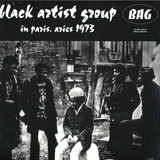
Outstanding free jazz session recorded in 1973 in Paris by Chicago outfit BAG.
It was Lester Bowie, trumpeter with the Art Ensemble of Chicago, who suggested that the Black Artists' Group (BAG) should head for Paris. In 1972 several members of BAG took his advice and flew to France for an extended stay. The following year a concert featuring saxophonist Oliver Lake, trumpeters Baikida Carroll and Floyd LeFlore, drummer Charles Bobo Shaw and trombonist Joseph Bowie (Lester's younger brother) was recorded and subsequently issued as In Paris, Aries 1973, a strictly limited edition LP on the group's own label.
Since the formation of Black Artists' Group in 1968, the home of this multidisciplinary arts collective had been St Louis, Missouri, the city where the Bowie brothers had grown up. It was there that Lester Bowie had started to investigate the expanding horizons of jazz before moving, in 1966, to Chicago where he joined the recently established Association for the Advancement of Creative Musicians (AACM). His close friend Oliver Lake visited Bowie, attended AACM concerts and meetings and was inspired not only by their artistic vision and integrity but also by their efficient organisation. In Chicago musicians were making things happen for themselves, taking control of their own destinies and giving shape to their lives as creative artists.
In June 1969, the Art Ensemble of Chicago had taken their music to France. During the preceding decade Paris had established a reputation for audiences that were unusually well-informed and open-minded, receptive to the uncompromising music of black American innovators such as Cecil Taylor, Ornette Coleman, Albert Ayler and Sun Ra. The city that had nurtured not only Cubism and Surrealism, but also Jean-Luc Godard and contemporary cinema's Nouvelle Vague was well prepared for the sonic collage forms and stylistic dislocations of the Art Ensemble. During that same month violinist Leroy Jenkins, trumpeter Leo Smith and saxophonist Anthony Braxton also arrived in Paris, three further emissaries from the AACM.
The adventure of collective improvisation resonated with the Parisian zeitgeist. Enthusiastic audiences attended their concerts and coverage in the media. In Paris, Aries 1973 offers an isolated and fascinating glimpse into that phase of the group's existence. The album is dedicated to the memory of Kada Kayan, a bassist who had hoped to make the trip from St Louis to France but, tragically, had grown ill and died. His absence adds special poignancy to the sound of the bass when it appears on this recording, played by Baikida Carroll. Listeners keen to hear Kayan himself in the company of Lake, Bowie, Shaw, LeFlore and Carroll should seek out Red, Black and Green by the 10-piece Solidarity Unit, Inc. That album, recorded on 18th September 1970 and dedicated to Jimi Hendrix, who died on that day, features an earlier version of Shaw's composition 'Something to Play On.'
In Paris, Aries 1973 reveals BAG's musical affinities with the Art Ensemble of Chicago. Both groups preserved an independently minded approach to the notion of free jazz and a carefully filtered awareness of pan-African musical practices, while their creative interest in space, mobile structure, chance occurrences and simultaneity also suggests parallels with the concerns of leading experimental composers working at that time. These performances in Paris of Shaw's 'Something to Play On' and Lake's 'Re-Cre-A-Tion,' plus two collective compositions/improvisations, display the dedication to structural fluency and sensitivity to coloration that accompanied BAG's unorthodox group dynamics and their unconventional instrumental combinations. In this case the musicians embrace congas, log drums, marimbas, woodblocks, cowbells and gongs. This is not a showcase for solos, but a shape-shifting and multi-centred statement of togetherness, quest and discovery. Removed from BAG's original multidisciplinary context the music still exudes an exhilarating spirit of collaborative exploration and shared excitement.
Juan Pablo Torres was one of the best trombone players in the Latin-jazz community of the second half of the 20th century.
He was the director of Algo Nuevo and a member of Irakere, two of the leading exponents of Afro-Cuban jazz in the 1970s and 1980s. He has also directed various Cuban supergroups such as Estrellas de Areito and Cuban Masters.
Almost all of his albums were made for Areito de La Habana, Cuba.
‘Cuba Disco’ was the only album released in his name in Europe; recorded in Milan in 1984 and produced by Aldo Pagani. In Italy in the same year he participated in two records by Pino Daniele and one by Astor Piazzolla.
Accompanied by his faithful Gruppo Algo Nuevo, with the addition of some guests such as the Italian jazz guitarist Angelo Arienti, his traditional Afro-Cuban vein is contaminated by disco and balearic moments; as in the case of the magnificent ‘Bermuda Triangle’ which anticipates the current atmosphere of Nu Genea.
Limited edition. Released from the transfer of the original master tape.