Search:art fact

Styles
All
múm - Smilewound

Múm

Smilewound

12inchMORR124LP
Morr Music
18.02.2026

You don’t need to be Freud to regard teeth as a delicate issue. They can make joy look joyous and pain look painful, and on the cover of the new múm album they do both at the same time. As »Yesterday Was Dramatic – Today Is Okay« (2001), »Finally We Are No One« (2002) and »Sing Along To Songs You Don’t Know« (2009) »Smilewound« is another example of the band’s art of juxtaposing two conflicting meanings and taking advantage of the energy created through the tension between both.

Sparser in sound than many of its predecessors, »Smilewound« is an airy, relaxed record. The múm-core-duo of Örvar and Gunni doesn’t make you laugh out loud (except maybe for the quirky vintage Arcade-sound-start of »When Girls Collide«), but it will make you smile often - despite the heavenly voices singing about violence in one form or another in most songs. Musically, múm’s capability to build playful electronic sound-ornaments around simple melodies is in full bloom. And these days they know that trimming the ornamentation can strengthen the melody. Take »The Colorful Stabwound«: an aguish drum’n’bass piece and »Smilewound« gets close to a straight pop-song. Even that isn’t very close, but it combines its rhythmic strength with a simple yet effective piano-line and the soothing lushness of a female voice to something compelling that follows you like the smell of a delicate eau de toilette. Or »Candlestick« which started out as a little ditty strummed on an acoustic guitar many years ago and has grown into this bouncy piece of synth-pop that changes its musical colours every couple of beats until you feel comfortably dizzy. Perfect pop in very fancy clothes. No wonder that antipodean pop-princess Kylie Minogue wanted to collaborate with múm on the »Whistle«, the main song in 2012-movie »Jack & Diane«.

Recorded in, among other places, the band’s practice-space, an old baltic farmhouse and on the kitchen-table after dinner, the album was produced by múm themselves. And being the revolving collective they are, it comes as no surprise that we see the return of former member Gyda. Defining satellites as part of the core fits nicely with the band’s penchant for ambivalence - in fact that's part of the album's charm.

out of Stock

Order now and we will order the item for you at our supplier.

21,64

Last In: 86 days ago
CHROMOGEN - CHROMOGEN

CHROMOGEN

CHROMOGEN

12inchSGH00002
Irma Records
13.02.2026
  • A1: Bleach
  • A2: Ether
  • B1: In Bloom
  • B2: Opiate
  • B3: Halogen

The Italian music scene is enriched by an intriguing new jazz trio: Chromogen.
Led by bassist and composer Matteo Magnaterra, the project features three members: tenor saxophone, bass, and drums. Using an unconventional lineup, they pursue a well-defined exploration of sound and timbre, creating ample space for dialogue and experimentation. They
pave the way for a new, holistic jazz style, clearly defined in their first album, "Chromogen."
The name is inspired by a parallel passion of the artist-composer: analog photography.
Chromogen is, in fact, the English name for the chemical compound capable of transforming a negative image, dyeing it with color. Those
same colors will then animate the artist's songs, developing imagery tied to his way of observing, portraying the world around him in vivid
colors.
CREDITS
Matteo Magnaterra: compositions, electric bass
Matteo Diego Scarcella: tenor saxophone
Vincenzo Messina: drums
Jacopo Trapani: recording, mixing
Francesco Brini: mastering

pre-order now13.02.2026

expected to be published on 13.02.2026

22,65
ELIZABETH DAVIS - FLOWERS

ELIZABETH DAVIS

FLOWERS

12inchSON12-006
SOUTH OF NORTH
13.02.2026

'Flowers', the new EP from Elizabeth Davis, finds itself at the cross-section of many factors. In part, it’s the result of Davis’ obsession with a seminal folk song. But it also coincides with her rediscovery of the voice and language as an instrument. It was recorded during an autumn residency at Sternhagen Gut, the cultural refuge run by Gudrun Gut and Thomas Fehlmann, located deep in the Uckermark countryside halfway between Berlin and the Baltic coast.

The six tracks on 'Flowers' all take Pete Seeger’s ‘60s protest-folk song 'Where Have All The Flowers Gone' as their starting point. However, they veer off in different directions, from vocal loops and deconstructed lyrics, to instrumental drones and glitchy, manipulated rhythm tracks. Like many musicians, Davis has learnt composition by a process of disassembly, analyzing musical works piece by piece, and 'Flowers' began as one such forensic exercise. “But sometimes,” says Davis, “a source is so loaded up on meaning that the studies and experiments can become worthwhile and meaningful works in their own right.” 'Flowers' began to take on a life of its own, raising renewed questions about age-old themes such as war, authorship, translation and historical structures.

Davis is no stranger to cover versions. From studying violin to playing in free jazz and punk bands, interpreting other artists’ works has long been a key part of her musical approach. And since her radio show 'Deep Puddle' recently drew to a close after seven years, her experiments with narration and sound collage have found their way into her musical work once again. For 'Flowers', she cut up the source material (with a nod to Gysin and Burroughs), and reassembled the lyrics, the musical notes, and recordings by different performers, to create uncanny new forms.

But perhaps the biggest influence on 'Flowers' was conversations about music, art and pop subcultures with Gut. These dialogues helped Davis find a balance between far-out sound design experiments and catchy melodies, combining a certain avant-garde element and modern day songcraft. And it’s this sense of conversation, this revisiting of topics and renewal of ideas, that will keep us coming back to 'Flowers' long into the future.

pre-order now13.02.2026

expected to be published on 13.02.2026

20,59
Group Rhoda - Phase 5 LP

Group Rhoda

Phase 5 LP

12inchDE-356
Dark Entries
12.02.2026

Group Rhoda returns to Dark Entries with Phase 5, a new LP of synthesizer-driven art-pop. An integral member of the West Coast electronic music scene, Mara Barenbaum has been writing, performing, and plunging into oneiric depths as Group Rhoda since 2009. Barenbaum’s songcraft is at once stylistically diffuse and laser-focused, a synesthetic approach that allows her to effortlessly glide between genres and soundworlds while centering her singular poetics. On Phase 5, her fifth LP as Group Rhoda, we find Barenbaum waxing nondualistic. Lines between fairytale and fact, between nature and art, between subject and object all dissolve under contemplation.

The songs on Phase 5 are perpetually in-between states, deftly shifting form at the blink of an eye. With sleight of hand, “Field Tone” transmutes from brooding John Carpenter-esque electro into vocoder-driven space disco. “Dragon Pine” darts from cosmic dub to cybernetic dancehall and back again. The uptempo darkwave-leaning number “Aeolian Crossing” dissolves into the void, like sand falling through one’s fingers, like a retreating wave. The cover artwork for Phase 5 is by Shawn Reed, and features purple lilies and light refracted through water. All songs on this album were mastered by Ruud Lekx. The digital version of Phase 5 will be released via Katabatik, a label and sound system that Barenbaum has had close ties to for the past decade.

out of Stock

Order now and we will order the item for you at our supplier.

20,38

Last In: 45 days ago
Various - MUSEK 03

Various

MUSEK 03

12inchMSK03
MUSEK
02.02.2026

COLLECTING ORDERS FOR REPRESS

Third release for Musek with another various artists showcasing the wide musical approach of the label. On the A side, label heads Francesco Farfa and Hamsa offer their remix of a minimal wave hidden gem by Swedish 80’s band Art Fact. On the B side, Hamsa teams up with Luca Piermattei for a deep and introspective techno cut. Roberto Manolio closes the EP with a powerful classic Acid track to keep the energy high on the dancefloor.

out of Stock

Order now and we will order the item for you at our supplier.

14,71

Last In: 37 days ago
Artillery - Terror Squad LP

Artillery

Terror Squad LP

12inchMOVLP3523C
Music On Vinyl
30.01.2026
  • A1: The Challenge
  • A2: In The Trash
  • A3: Terror Squad
  • A4: Let There Be Sin
  • B1: Hunger And Greed
  • B2: Therapy
  • B3: At War With Science
  • B4: Decapitation Of Deviants

Terror Squad is the second album by Danish thrash metal band Artillery. It was originally released in 1987 via Neat Records. It's the successor of Fear of Tomorrow (MOVLP3190) and was later followed by their most succesfull album By Inheritance (MOVLP3935).Terror Squad; the opening track "The Challenge" immediatly kicks your door down and from there on their thrash metal is aggressive, relentless, and executed with deadly precision. At the time it lacked commercial success, but it made up for it with sheer musical intensity. The album's combination of blistering riffs, thunderous drumming, and commanding vocals still leaves its mark decades later. When Artillery hits, it leaves a crater Fun fact: Metal Hammer included the album cover on their list of "50 most hilariously ugly rock and metal album covers ever" Terror Squad is now available as a limited numbered edition of 1000 copies on red translucent coloured vinyl and contains an insert.

pre-order now30.01.2026

expected to be published on 30.01.2026

33,19
Anar Band with E.M. de Melo e Castro - Dou Dou Doudo: Ao Vivo Na Cooperativa Árvore

Audio taken from a live performance by Anar Band (Jorge Lima Barreto and Rui Reininho) with E.M. de Melo e Castro in November of 1978 at Cooperativa Árvore, Porto. The performance was filmed. A segment was included in »Obrigatório Não Ver«, a weekly programme presented by Ana Hatherly on Public Television’s Second Channel. It was not possible to determine the exact date of the event, and no documentation seems to be available in the relevant archives.

»Encontro que Tenho« and »Profissões«: these titles are specific to this release. Having failed to locate the respective poems after a thorough search in E.M. de Melo e Castro’s body of work, it was deduced both texts were created for the occasion.

Even without a full contextualisation, the sound transmits the spirit of cultural agitation proper to these sessions. When this show happened, Anar Band were Jorge Lima Barreto (ARP Odyssey synthesizer) and Rui Reininho (Ibanez double-neck guitar), with the addition of E.M. de Melo e Castro, whom we shall call a poet but whose creative intervention was far reaching. Besides poetry, also continued his efforts in linking up diverse artistic areas (painting, drawing, collage, performance, video) and his official training in textile engineering. He was one of the artists featured in Henri Chopin's »OU Revue« in 1966, establishing his natural connection to the European concrete/visual/sound-poetry avant-garde. Melo e Castro was also proficient in the agitation of minds and political awareness. A good example in »Profissões«, where initially separate professionals (an intellectual, a fisherman, a soldier, a factory worker) are gradually mixed in a show of interdependency. Symbolically, through his words one listens to a transformation of society, although the same conclusion arises twice: surplus always finds its way to the hands of the capitalists.

That was the state of affairs many were looking to change, an economic and social malaise that the 1974 Revolution in Portugal fully uncovered, when dissident voices could finally be heard in public. Each in his own way, all three participants in this recording were non-believers in the structure of society such as it was presented. Through his books and press writings, mainly concerned with Jazz, Jorge Lima Barreto pushed his way into Portuguese artistic and critical circles since the late 1960s. Consciously and unwittingly, he collected enemies and pointed them by name, people he labelled as reactionary, people who delayed progress, social and cultural mixes, the avant-garde; they even delayed the chaos from which new forms and attitudes arise.

Rui Reininho, a non-conformist by heart, experienced incomprehension from an early age. His anarchic ways, a tendency to baffle others, were revealed through the choice of clothes and accessories, public behaviour, and »real life« performances. Just as Lima Barreto, and even together with him, he enjoyed provoking the extremes: Maoists on one side, right-wing conservatives on the other. He translated leftist books and joined Anar Band precisely on the day a duck or swan or goose (one of them) was thrown on stage in Porto, 1976.

This record documents a concrete action, a snapshot of the agitation, something we have no problem calling punk activism, something which allowed two people with little to no musical training to play and record music. By then, Anar Band had managed to release their only LP in 1977. It’s this performance, however, that reveals the naked rawness of the music: improvisation, mutual listening, and choice of intervention between both musicians and Melo e Castro, clearly sensing when the synth has to change tone, the voice has to make pauses, the guitar punctuates both and finds the space to… scream. The sound was captured by the film crew, adding to the rawness: the instruments are palpable, the voice often too close to the mic. Everything was preserved. First time on disc.

pre-order now30.01.2026

expected to be published on 30.01.2026

23,95
The Mars Volta - Noctourniquet

The Mars Volta

Noctourniquet

2x12inch4250795604969
CLOUDS HILL
30.01.2026
  • A1: The Whip Hand
  • A2: Aegis
  • A3: Dyslexicon
  • B1: Empty Vessels Make The Loudest Sound
  • B2: The Malkin Jewel
  • B3: Lapochka
  • C1: In Absentia
  • C2: Imago
  • C3: Molochwalker
  • C4: Trinkets Pale Of Moon
  • D1: Vedamalady
  • D2: Noctourniquet
  • D3: Zed And Two Naughts

Noctourniquet And then everything went black, at least for a while, at least for The Mars Volta. In the months and years following their fifth full-length, Octahedron, Omar kept on at his usual fearsome creative pace. In fact, he ramped up his output considerably, starting up his own Rodriguez Lopez Productions label and releasing a slew of solo albums. It was a practice he’d begun shortly after De-Loused’s release, with his solo debut A Manual Dexterity: Soundtrack Volume One, but as the decade reached its close, Omar grew to rely upon his solo recordings as an outlet for his prolific creativity, these albums often exploring musical pastures far beyond even The Mars Volta’s wide-ranging parameters. Before choosing to release music under his own name, Omar would always play it to Cedric first, to see if the frontman thought it had potential to become Mars Volta music. Shortly after Octahedron’s completion, Cedric flagged one batch of tracks Omar had cut with Deantoni Parks, a brilliant drummer and composer who’d briefly occupied the Mars Volta drumstool in-between Jon Theodore and Thomas Pridgen’s tenures, and whose volcanic creativity and unique, unpredictable approach to rhythm and composition had quickly made him one of Omar’s favourite artistic foils.

As with the music that made up Octahedron, the new tracks Cedric had optioned for The Mars Volta often veered far from the riotous, Grand Guignol visions of their earlier releases. It possessed the punchy, song-based focus of Octahedron, though this was a considerably darker, more menacing strain of pop, with synthesisers figuring heavily in the productions. Cedric took the tracks in 2009 and set about writing songs to the music. But no more new Mars Volta music would be heard until 2012. The years that passed in-between were nonetheless momentous, and busy, witnessing an unexpected reunion of the members of At The Drive-In, and Cedric joining his own side-project, Anywhere. But there wasn’t any sign of life within the Mars Volta until Omar, Cedric and their bandmates took to the road for a series of live shows in the spring of 2011, billed as The Omar Rodriguez-Lopez Group, debuting the songs that would become Noctourniquet. The album followed the next year, and it remains one of The Mars Volta’s finest, its electronic textures staking out unfamiliar but fertile new ground.

An unsettling, subtly turbulent listen, Noctourniquet found Cedric sketching out a story about “some sort of device that stops the darkness from bleeding”, drawing influence variously from the nursery rhyme Solomon Grundy, the Greek myth of Hyacinthus and the song Birth, School, Work, Death by British underground rockers The Godfathers. It was an album of dystopian futurism, signalled by the paranoid cyber-rock of opener The Whip Hand and its unnerving chorus, “That’s when I disconnect from you”. But it was also an album of inspired, unexpected moves and uncanny invention, like how Dyslexicon seemed to eerily evoke Blondie’s Rapture, before rushing headlong into its bruising chorus, tempos shifting restlessly throughout like quaking earth beneath the listener’s feet, or how Aegis put a brave new spin on The Mars Volta’s trademark rewiring of salsa’s overdriven passions, or how Cedric had never sounded as scary as he did on The Malkin Jewel’s mutant burlesque shuffle. Tracks like Molochwalker were sleek and concise in a way The Mars Volta had never really attempted before – which was all part of Omar’s plan.

“It had all been guitar, guitar, guitar, overdubs, everything fighting for space in the same frequency,” he explains. “So for Noctourniquet, it was all about subtracting elements, of sticking to how I made demos.” Deantoni’s presence helped revivify the group, playing against cliché and expectation, and taking each song in unexpected directions. “I’d beatbox a rhythm for him to play, to go with my guitar part, and he’d come back with three or four alternate options. It was so great.” Similarly, Cedric had never sung better than on Noctourniquet, staking out a fearsome spectrum from the chilling Tom Waitsian growl of The Malkin Jewel to the keening, beautiful vocalisation on Vedamalady, rising to match some of Omar’s most deft, most immediately effective and melodic songs yet. Indeed, Noctourniquet is the sound of a band discovering new ways to do familiar things, renewing their commitment to their mission, finding fresh inspiration a decade in, and shaking off any complacency that might have come with ten years of acclaim and success.

pre-order now30.01.2026

expected to be published on 30.01.2026

27,69
Derrick Sound - UPLIFTMENT
  • A1: Upliftment - Bugle & Agent Sasco (Assassin)
  • A2: Blessings - Lutan Fyah
  • A3: Jah Is Always So Near - Sizzla
  • A4: Jah Is In Charge - Chezidek
  • A5: Knock Knock - Turbulence
  • A6: Change We Want - Eesah
  • B1: Can’t Break Our Souls - Peetah Morgan
  • B2: Tired Of The Drama - Capleton
  • B3: Bla Bla Bla - Lutan Fyah
  • B4: Rumours Of War - Jah Mason
  • B5: Old School Rule - Luciano
  • B6: Badda We Badda - Brother Culture & Eesah
  • B7: Double Standard - Fantan Mojah

black vinyl All riddims produced by Derrick Sound (Etienne et Nicolas Maître). This album is dedicated to the memory of our friend Chaouki Abbas. All brass instruments are played by Romain Tingueli (saxophone) and Zacharie Ksyk (trumpet and trombone). Featuring artists like Sizzla, Capleton, Peetah Morgan, and Luciano, this album stands as a true tribute to reggae excellence.Side A1.UpliftmentBugle & Agent Sasco (Assassin)2.BlessingsLutan Fyah3.Jah Is Always So NearSizzla4.Jah Is In ChargeChezidek5.Knock KnockTurbulence6.Change we wantEesahSide B1.Can’t Break Our SoulsPeetah Morgan2.Tired Of The DramaCapleton3.Bla Bla BlaLutan Fyah4.Rumours Of WarJah Mason5.Old School RuleLuciano6.Badda We BaddaBrother Culture & Eesah7.Double StandardFantan Mojah

pre-order now30.01.2026

expected to be published on 30.01.2026

22,27
Girls Of The Internet - Secular Music Vol. 1

A reflection on how we hold each other and how we let go, ‘Secular Music Vol 1’ is the first instalment in a triptych of albums by multi-limbed live dance music outfit Girls Of The Internet. Continuing their ongoing policy of “therapy through music”, the album touches all points on the shifting landscape of human connection: belief, doubt, loss, forgiveness. Emphasising human elements of songwriting, performance and production within the lineage of house, disco and electronic music; this first record furthers the band’s flair for manifesting the creative and communal spirit that birthed the scene. Joining the dots that have not been joined for a long time, the collective takes on people of all sexualities, gender expressions and body types. House music was created as an inclusive artform and Girls of the Internet are here to assert we are all invited. The group is completed with a rotating assembly of talented collaborators, including the live band with Nandi and Wynter on vocals and Tommy Peach on bass and trumpet. ‘Secular Music Vol 1’ also features guest appearances from Dani Siciliano, Sió, Pinty, i am an island, and James Alexander Bright - also a regular member of the live band. Girls Of The Internet’s 2024 album ‘When I Was Lost, I Found Myself’ was the follow-up to the acclaimed ‘Girls FM’, one of BBC 6 Music’s Albums of the Year in 2019. Firmly on the radar of key DJs Gilles Peterson, Tom Ravenscroft, Trevor Nelson, Pete Tong, and Lauren Laverne for some time, the band’s songs have more recently found fans in BBC Radio 1’s Sian Eleri and BBC 6 Music’s Nick Grimshaw as well as around the rest of the planet on tastemaker stations Byte FM, FIP, NTS, KALW, KCRW, KEXP and Soho Radio. Girls Of The Internet have performed on home turf at Glastonbury, The Warehouse Project’s Homobloc, Drumsheds, Printworks, Latitude, Lost Village festival, and a residency this summer at London’s Colour Factory. With Ibiza shows at Pikes and Glitterbox at #1 Club in the World Hï; this July saw Tom take on their first US dates with DJ sets in New York, LA and San Francisco. The live band are currently in the middle of an extended live tour that runs through to December. ‘Secular Music Vol 1’ is set for release on 14th November 2025 on Girls Of The Internet's own recently launched House Of the Internet label.

out of Stock

Order now and we will order the item for you at our supplier.

26,47

Last In: 3 months ago
Braen / Peymont - Paese Sotto Inchiesta

At the end of the Sixties, the production of soundtracks for small and big classics of Italian cinema is now joined by another business which has proved to be less profitable but more creative and, in best case, free from the constraints imposed by clients on duty: the composition of music libraries. Almost all of the artists for the eighth art have finalized at least one or more music libraries. Names famous and not, old and young composers, real outsiders and meteors, usually hidden behind pseudonyms: this is the case, for example, of Braen and Peymont. The first needs no introduction, it was the one adopted by the former arranger, multi- instrumentalist, singer and composer Alessandro Alessandroni. The second is closely linked to the mysterious American composer, but resident in Italy, David Hoyt Kimball. The two are authors in different measure of an interesting album with an experimental background, “Paese Sotto Inchiesta” (1971), originally published by Flirt Records.

The titles of the tracks appear in connection with the socio-cultural climate of Italy after 1968 and can be relocated as a background for journalistic-like images. The latter is a hypothesis not supported by facts, but some titles seem to be referred to the perception of a subsisting economic backwardness of the southern regions compared to the other ones; to a situation of collective tension, thanks to the global revolutions; in addition to the new concerns with an ecological background. Overall, the seventeen tracks on the album are mostly 'dirty', characterized by an even atonal setting, with long repetitions in a noisy key, more fundamental reverbs and echoes for the different keyboard instruments. In a few words, abstract sounds, some guitar notes, echoes of Gruppo Di Improvvisazione Nuova Consonanza, flute melodies and proto- ambient intuitions. Composers like Alessandro Alessandroni and David Hoyt Kimball deserve to be rediscovered.

*Following the essence of the work, for this press, MPI release a 100% recycled vinyl that reduce waste, minimize environmental impact and support the planet*

out of Stock

Order now and we will order the item for you at our supplier.

23,32

Last In: 3 months ago
Ben Bekele - Zawsze coś LP
  • 01: La Clave En Medio De La Nada
  • 02: R-4
  • 03: Niosą
  • 04: Phillip Jeffries
  • 05: Zawsze Coś
  • 06: Linoleum (Shining)

Limited edition (numbered 100 copies) 180g black vinyl with insert.

"BEN BEKELE does not exist. At least not the one I'm thinking of.


It's a mix of memories and fantasies from the mid-80s when it was my father who visited Ethiopia, returning with two small drums, a couple of pictures and tons of tales.
One of them was a story of a boy named Bekele, who taught him a traditional Ethiopian song.

Father passed this song on to us, as best as he could - now I'm having doubts as to what the message is actually about - but back then I was fascinated. Many years later, when I was preparing a song for a compilation "Portrety" at U Know Me Records, I realized that the bass line that I created resembled a fragment of that exact song. Apparently the melody buried itself somewhere deep in my subconscious and unexpectedly revealed itself at that moment. Therefore I decided to honor the memory of my deceased of 30 years dad (whose friends called him Ben) naming the composition: "The Life and Death of Ben Bekele". The song turned out to be very happy to me - its success definitely exceeded expectations, while in my head an idea to go further after Ben Bekele began to form.

This time I didn't want to work alone. I invited Kamil Piotrowicz and Igor Wiśniewski to cooperate with me. Incredibly creative, sensitive artists and wonderful companions on stage as well as off it. The music on this album is similar to a small extent to the "founding" piece.
It has however a couple of common features, with focus on the rhythm as the form-forming factor at the forefront. It's also organic, emotional, at times trance-like and illustrative.

I sincerely hope that when listening to this record, for these tens of minutes you'll escape from the surrounding us not-so-pleasant everyday life."

pre-order now16.01.2026

expected to be published on 16.01.2026

33,82
MULUKEN MELLESSE - MULUKEN MELLESSE WITH THE DAHLAK BAND (ETHIOPIQUES)

Swan Song

The vinyl LP at the heart of this éthiopiques 31 tracks 2 to 11 was one of the very last vinyl records ever released in Ethiopia. But above all it represents, we felt, the absolute masterpiece of the Ethiopian Groove – the Swan Song of Swinging Addis. The album leaves a clear idea for posterity of the level of sophistication and mastery that modern Ethiopian music had achieved, before being crushed under the Stalino-military heel of the Derg – as the bloody revolution that was unfolding came to be called.

Ethiopia1976.

The Revolution that broke out in February 1974 rolled on in a ruthless march. The whole of Ethiopian society was utterly stunned. The bouquets of flowers handed joyfully to the first tanks of the coup d'état were to wilt very rapidly. From September 1976 to February 1978, 18 months of Red Terror (the name given by the junta itself) spilled blood throughout the country. This fratricidal conflict took its heaviest toll among students and youth. The shift from feudalism to a cruel and primitive Stalinism left the country's citizens deeply traumatised, and snuffed out any pretence of activism, whatever the sector of society. This ice age was to last for seventeen long years.

ሙሉቀን፡መለሰ Mulukèn Mellèssè Muluqän Mälläsä

It was three tracks by Muluken that served as the opener for éthiopiques-1 more than 25 years ago. Seven more tracks appeared on éthiopiques-3 and 13, all accompanied by The Equators, which was soon to become the Dahlak Band.

The first track, Hédètch alu, also the very first piece that Muluken ever recorded, left audiences both unsettled and amazed. Reflecting the singer's extremely young age (he was just 17 at the time), this angelic voice mystified many, who thought they were in fact listening to a feminine voice. He was not yet 22 when he released his last vinyl record in 1976 with Kaifa Records (KF 39LP), one of the very last to be issued in Ethiopia, before the cassette tape became the dominant medium for music distribution – and before the new revolutionary regime put a stop to all independent musical life, via an unspeakable barrage of prohibitions and other persecutions.

Mulu qèn, literally, “A well filled day”. This tender maternal intention wasn't enough to ward off the cruelty of fate. His mother's premature death drove Muluken to leave his native Godjam, in northeast Ethiopia, to live with an uncle in Addis Ababa. Born Muluken Tamer, he took his uncle's last name – Mèllèssè.

The spelling Muluken appeared in his administrative records. Transcription of Amharic to the Latin alphabet, both in Ethiopia and for scholars, gives rise to controversies and quibbles that can never be neatly settled. French allows for a closer approximation of the original pronunciation, thanks to its battery of accent marks, confusing as they may be to anglophones.

Between rather accommodating administrative record-keepers and the various versions that pop up in interviews given by the artist, Muluken's year of birth oscillates between 1953 and 1955…

1954? One thing is certain: the artist's talent made itself known very early indeed, because he got his start in 1966-67, at the age of 13 or 14. Photos from the period attest to his extreme youth. It's a strange sort of initiation for a very young teenager to become a sensation in the heart of Addis's nightlife at the time, Woubé Bèrèha – the Wilds of Woubé. And what's more, in the club of the Queen of the Night, the Godjamé Assègèdètch Alamrèw herself, the very same that was portrayed by Sebhat Guèbrè-Egziabhér in his novel-memoir Les Nuits d’Addis Abeba2… The legendary female club owner who is remembered to this day by the capital's ageing boomers.

Muluken first tried his hand at the drums, before he grabbed the microphone. He emigrated briefly to the Zula Club, across the street from the old Addis Post Office, one of the ground-breaking bars of the burgeoning musical scene, before joining the Second Police Band in 1968, for around three years. He spent a few months with the short-lived Blue Nile Band founded by saxophonist Besrat Tammènè. As the musical scene grew increasingly successful, and pulled slowly but decisively away from its institutional ties, Muluken released his first 45rpm single in February 1972 (Amha Records AE 440). It was included in two LP Ethiopian Hit Parade compilation albums in September of the same year. All in all, Muluken released eight two-track 45s and the same number of original cassette tapes between February 1972 and 1984, the year that he departed for permanent exile in the USA. After converting to Pentecostalism in 1980, Muluken gradually abandoned all secular musical activity. In 1985, at the end of a concert in Philadelphia, he decided to quit concerts and recording for good. Mèlakè Gèbré, the historic bass player from the Walias band who was playing with him that night, recalls that everything appeared so irredeemably diabolical in Muluken's eyes, that it was to be the end of his contribution to Ethiopian Groove.

The end of the story, the beginning of a legend.

Dahlak Band, forgotten by History

Aside from his personal history and vocal talents, it must be remembered that Muluken Mèllèssè was one of the biggest names in the musical innovations that marked the end of the imperial period. These éthiopiques aim to convince those who are just discovering this hidden gem... As for Ethiopians themselves, they are to this day captivated by this singular and atypical figure in the Abyssinian pop landscape – even though he withdrew from public life some 40 years ago. Incorrigible devotees of poetic twists, of more or less hidden meanings, Ethiopians appreciate above all the care Muluken took in choosing his lyrics and the writers who penned them, such as Feqerte Haylou, Alemtsehay Wodajo and, here, Shewalul Mengistu (1944-1977). Love songs, written by women, a far cry from the conventional drivel that pleases sappy sentimentalists.

Muluken is equally acclaimed for his perfectionism when it came to music, the opposite of the overly casual approach that is all too common. He remained a faithful partner of musicians who came from a lineage that borrowed from several inventive and pioneering bands (Venus, Equators, Dahlak). Amongst them were certain artists who began their musical lives with Nersès Nalbandian at the Haile Sellassie Theatre and who come of age in around 1973 – at just the wrong time, you might say. Among them were the pillars Shimèlis Bèyènè (trumpet), Dawit Yifru (keyboards) and Tilayé Gèbrè (sax & flute). Most notably Tilayé Gèbrè, certainly one of the most important musicians, composers and arrangers of his generation, of the end of the imperial era, and of the early years of the Derg.

It was only in 1981 that a miraculous opportunity arose for Tilayé to escape the Stalinist paradise of the dictator Menguistou Haylè-Maryam. Once again it was Amha Eshèté (1946-2021) who provided a solution. The spirited and courageous producer, who had been in exile in Washington since 1975, succeeded, thanks to his incredible perseverence, in bringing the Walias Band to the USA. It was, in fact an extended Walias Band comprising ten musicians3, six of whom chose to slip away after a few concerts and the recording of an LP (The Best of Walias, WRS 100). Tilayé Gèbrè was one of these. He has been living in the USA ever since. There he joined the then-nascent Ethiopian diaspora, which lived largely unto itself, and was making only very modest headway in the American musical market. It seems unfair that Tilayé Gèbrè and the Dahlak Band were not able to benefit earlier from the public recognition that they do deserve.

A similar draining away of the top-rate talents would lead to the reorganization of the major groups of the “Derg Time”. The remaining artists spread themselves around between Ibex Band (renamed Roha Band), Ethio Star Band and a remodeled Walias Band. That spelled the end of the Dahlak Band.

With this record, produced by the essential Ali Abdella Kaifa a.k.a. Ali Tango, we can appreciate everything that the Derg not only destroyed, but also prevented from flourishing. This gem of Ethiopian-style afrobeat came out in 1976 (and, by way of a parenthesis, before the FESTAC 1977 in Lagos, which was attended by an impressive delegation of Ethiopian musicians — although Fela was already personna non grata in his own country). Despite everything that might distinguish this ethio-groove from Fela’s music – no colonial axe to grind, no question of political confrontation with the authorities, no claims to negritude or Africanism for the Ethiopian musicians, and less extrovertion! –, this LP fits beautifully into the saga of intense and electrified soul of the new “African” groove that Fela and Manu Dibango embodied so well from that point onwards.

In restoring this record to its place in the afrobeat epic, it can be seen that, if nothing else, the timeline bestows a legitimate pedigree and a historical primacy to works that had no international impact when they were originally released.

Warning! Masterpiece!

out of Stock

Order now and we will order the item for you at our supplier.

20,59

Last In: 4 months ago
BERSARIN QUARTETT - III LP 2x12"

Reissue of the 3rd full length by Thomas Bücker aka Bersarin Quartett.

Melancholia. Longing. It is difficult to speak about these moods or states of the mind without invoking stereotypes. In ancient medicine, melancholia was considered to be one of the four temperaments, matching the four humours. In fact, melancholia, meaning "black bile" in Ancient Greek, was thought to be caused by an excess of this very body substance. By contrast, in more modern interpretations, literates and Freudians relate many variations of longing to the one primordial longing, the desire to return to one's mother's womb. In this context, the womb is considered to be the place of absolute comfort and cosiness, of total bliss. Thus it should not be surprising that to many of us melancholia is a mood which we like to invoke and to maintain, we like to envelop ourselves in it like in a warm blanket. Our brain and our sensory systems appear to be made for perceiving and emotionally responding to music in a very immediate fashion. Consequently music is the obvious drug for all of us melancholia-addicts. However, there is a thin line between melancholia and sadness, and music which is meant to be melancholic too often crosses this line by far. Only very few artists succeed in avoiding this crossing, and in creating music which is melancholia in its most pure form. It is safe to say that BERSARIN QUARTETT - the electronic music project of Thomas Bücker - is one of them.

After his debut in 2008 and the sophomore "II" in 2012 - album of the month in many magazines and in numerous "Best of the year" lists - Bücker in 2015 returned with his third BERSARIN QUARTETT album "III". Much like his two predecessors, III is a pure paradox. It is the creation of a perfectionist, an adamant control freak. Every element, be it a note, an ambience layer, a string arrangement, a field recording, a baseline, a vocal (Clara Hill on Track 11) or a beat, is meticulously modified and then assigned its place in Bücker's vast but still minimalistic arrangements. Thus, superficially Bücker's pieces seem to radiate a certain mechanical bleakness. However, there is a unique reduced warmth and liveliness emerging from these stainless compositions and transcending them. This transcendence is precisely the point where Bücker ironically looses control over his creations. In contrast to the first two BERSARIN QUARTETT albums, III offers a few darker shades and succeeds even further in narrowing down the arrangements to the absolute essentials without loosing the characteristic grandeur of Bücker's sound. Whereas BERSARIN QUARTETT's debut was merely a description of melancholia in its most pure form, III maybe even goes as far a defining what melancholia really is. It is the only emotion in the vast spectrum of human states of mind which one can bear forever.

out of Stock

Order now and we will order the item for you at our supplier.

29,37

Last In: 4 months ago
NPVR - 33 34 LP

NPVR

33 34 LP

12inchEMEGO312V
Editions Mego
15.01.2026

NPVR is the avant garde duo made up of the late Peter Rehberg and Nik Void. Editions Mego is proud to present their second and final release. No this is not some kind of Beatles synthetic AI that raises the dead reconstructed recordings but rather a new album made by the humans and their machines.

The initial meeting of Rehberg and Void was in London in 2016 and despite or due to their mutual awkwardness found solace and compatibility in the fact that they both had a similar electronic modular set up, along with matching cases to transport all. The idea to collaborate was an obvious and organic process as a means to connect their individual gear together and observe the outcome. The fruits of these initial experiments, recorded in London, resulted in the playful experimentation of their acclaimed 2017 release 33 33 (eMego 251).

Now in 2024 Editions Mego presents the logically titled follow up, 33 34. These sessions were recorded six months after the initial recordings at Peter’s home in Vienna. This was planned out as a mirror city release to the original London recordings. With Peter having access to his full studio set up this time around we encounter a rich audio landscape which organically folds together a variety of musical genres blurring any distinction between these forms so the resulting music hovers as a new cloud of sound. Any musical form, be it industrial, electro-acoustic, ambient, drone and techno all coexist and melt into the other as the ensuing result unveils a hypnotic swarm of divergent sounds (music). When active there were no lines or contexts with NPVR, either between sound or genre within these recordings or live where NPVR were at home playing at a techno club one night and an avant garde venue the next.

The initial session of these recordings was edited by Rehberg and sent to Void to further develop. Over time the final versions were agreed on and then shelved as other outside projects took over. The awkwardness had been surmounted and the two had become close friends. NPVR performed at a range of venues such as Tresor, Sutton House, Corsica, Blitz, Paris GRM #Focus2, LEV Festival and Rigas Skanumezs Festival. Following Rehberg’s untimely passing Void had difficulty listening back to the sessions but eventually thought it fit to complete and release this album, of which even the artwork (like 33 33, an image from Zurich photographer, Georg Gatsas) had been decided upon prior to Rehberg parting ways.

There is an unmistakable joy to these recordings. One encounters an enthralling exploration of their chosen machines which conveys the excitement of what can be randomly conjured when people speak through such devices. There is no grand statement or argument here, just the sheer thrill of creation and the recorded results of random encounters. The art of collaboration was always a mainstay of Rehberg’s practice from the advent of the MEGO adventure. Rehberg & Bauer was an initial collaboration with former business partner Ramon Bauer. Even at this stage one can hear a relaxed sense of delight in the sheer discovery of sound.

A mix made for the Wire magazine following the release of 33 33 hints at the freedom that comes with endless urge for exploration and discovery. Abstract tracks from Z'EV. Jérôme Noetinger and Jung An Tagen are included alongside British stalwarts The Fall and New Order. There were no lines between pop / academic / underground or mainstream in Rehberg’s world. All of it sat at the same table. It is just matter in the atmosphere, like the diverse exploration found in these recordings that comprise 33 34.

Towards the end of his life Rehberg was obsessing over the immense output of the German ambient musician Pete Namlook. An artist renowned for not only his sprawling catalogue of ambient masterpieces but one who often said his main inspiration was nature. This is apt with regards to the work of NPVR which also aligns with such thought as the intertwining of the two individual artists and their machines results in a natural symbiotic flow, as it happens, just like in the world around us.

out of Stock

Order now and we will order the item for you at our supplier.

24,16

Last In: 4 months ago
LOLO - LOLO LP

Lolo

LOLO LP

12inchBS097
BLACK SWEAT RECORDS
Release unknown

The roots of African music are always open to new possibilities. This is revealed in the music of this unprecedented quartet. Alongside the Malian singer Rokia Traore', Mamah Diabate, Malian griot and djeli ngoni player, has been playing for several years with Stefano Pilia (Afterhours, Massimo Volume). Now, their path intertwines with the artistic and human partnership between Jabel Kanuteh, Gambian griot and kora virtuoso, and percussionist Marco Zanotti(Classical Afrobeat Orchestra, Cucoma Combo). The union of these two pairs develops unusual geographies and architectures, where dual African and Italian identities merge into one universal sensibility. The predominant Malian and Gambian modes chase each other, but all is fused into a broader rhythm factory or embellished by more abstract and liquid experimental digressions. The curiosity and pliability of the individual musicians search for a language that is both current and contemporary, always poised between ancient and modern, landscape and narrative, with jazz, rock and folk influences.

pre-order now

This item has not yet been released. You can pre-order the product now.

18,28
Van Halen - Fair Warning 2x12"
  • Mean Street
  • Dirty Movies
  • Sinners Swing!
  • Hear About It Later
  • Unchained
  • Push Comes To Shove
  • So This Is Love?
  • Sunday Afternoon In The Park
  • One Foot Out The Door

The song titles on Van Halen's aptly titled Fair Warning don't lie. The likes of "Unchained," "Mean Street," "Push Comes to Shove," "One Foot Out the Door," and more indicate the mood the band channels on its double-platinum 1981 record — the nastiest, darkest, and fiercest album of the group's storied career. For the fourth time in four years, Van Halen throws down the gauntlet to all challengers and emerges victorious.


Sourced from the original analog tapes, pressed on MoFi SuperVinyl at Fidelity Record Pressing, and strictly limited to 5,000 numbered copies, Mobile Fidelity's UltraDisc One-Step 180g 45RPM 2LP set plays with unfettered clarity, dynamics, and immediacy. Benefitting from superb groove definition, an ultra-low noise floor, and dead-quiet surfaces, this vinyl edition captures what went down in the studio with tremendous realism and involving presence.

Taking a more controlled approach in the studio and still completing everything in less than two weeks, Van Halen and producer Ted Templeman relied on studio amplifiers to direct the sound. Further diverging from the live-on-the-floor approach of its earlier albums, the ensemble also employed overdubs to great effect. The result: Dense, stacked architecture that underlines the hard-hitting tenor of the songs — and which comes alive like never before on this reference edition that looks as good as it sounds.

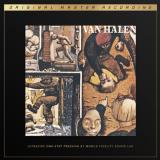
The premium packaging and gorgeous presentation befit the reissue's select status. Housed in a deluxe slipcase, it features special foil-stamped jackets and faithful-to-the-original graphics that illuminate the splendor of the recording. Aurally and visually, it is made for listeners who want to immerse themselves in everything involved with the album, including the iconic cover art adopted from William Kurelek's haunting painting, "The Maze."

Isolated frames from Kurelek's childhood-inspired work — including a man bashing his head into a brick wall, a guy pinning down an adversary as he delivers bare-fist blows to his face and others watch with apparent glee, a boy tied down on a conveyer belt and being sent through the equivalent of a meat saw — adorn the front and back covers. The sunnier visual disposition of Van Halen's prior efforts gives way to something sinister and tortured, traits reflective of the music within. The band members, too, are visually depicted not in glamorous shots but in a serious black-and-white portrait in which the quartet is clad in black leather jackets.

Tough, aggressive, stark: Fair Warning comes on like a series of bare-knuckled punches to the solar plexus and boasts lyrical narratives to match. Though not a concept record, the concise album revolves around themes of roughing it on the streets and struggling to survive amid dim prospects. Singer David Lee Roth reportedly penned many of the initial lyrics after traveling to Haiti and observing extreme poverty. The characters and situations populating Fair Warning reflect hardscrabble existence, last-chance desperation, and underlying danger.

Witness the crazies, poor folks, and hunters of “Mean Street”; the former prom queen turned pornographic actress on “Dirty Movies”; the menace and vice of “Sinners Swing!”; the streetwise hustle of “Unchained”; the isolation and alienation of “Push Comes to Shove”; the desire for escape on “One Foot Out the Door”: A carefree California beach party Fair Warning is not.

Having said he felt angry and frustrated during the sessions, guitarist Eddie Van Halen uses the forceful arrangements as a playground for his seemingly unlimited arsenal. Supported by a crack rhythm section and a hyped-up Roth, he performs with an almost impossible combination of punk-like intensity, technical finesse, lyrical fluidity, and unbridled emotion. The virtuoso was increasingly butting heads with Templeton and seeking a freedom in the studio he believed denied him.

No wonder he plays like a bat out of hell. Listen to the rapid-fire manner in which he slaps the high and low E strings on the 12th fret of his instrument on “Mean Street,” instilling the tune with funk flair and metal-spiked sharpness. For the pouty strut of “Dirty Movies,” Eddie Van Halen contributes slide guitar magic made possible after he sawed off the lower portion of a Gibson SG so he could reach further down the fretboard.

Related intensity, urgency, and daredevil momentum punctuate the surging “Sinner’s Swing!” A heavily flanged, delicately melodic introduction frames the attitudinal “Hear About It Later,” among the most creative arrangements of Van Halen’s career. And do riffs come any bigger or magnetic than those on the high-wire kick of “Unchained”? As for the out-of-left-field “Sunday in the Park,” an instrumental composed on an Electro-Harmonix micro-synthesizer: Who but Eddie Van Halen to supply creep factor in such an ingenious way?

Despite selling fewer quantities than Van Halen’s prior efforts, Fair Warning remains for many diehards the record that epitomizes all of the band’s immense strengths —Roth’s manic energy and tongue-wagging humor, Alex Van Halen’s rhythmic heartbeat-in-your-chest bombast, and Michael Anthony’s lucid bass lines included. Arriving when the New Wave of British Heavy Metal and new-wave movements were taking flight, it signaled a shot across the bow from a band determined to stay a step ahead and provide proof nobody could touch what it delivered.

More than four decades later, Fair Warning still sounds that alarm.

pre-order now

This item has not yet been released. You can pre-order the product now.

186,13
MUNA - MUNA

MUNA

MUNA

12inchSADLPC25
SADDEST FACTORY
12.12.2025
  • Silk Chiffon (Feat. Phoebe Bridgers)
  • What I Want
  • Runner's High
  • Home By Now
  • Kind Of Girl
  • Handle Me
  • No Idea
  • Solid
  • Anything But Me
  • Loose Garment
  • Shooting Star

MUNA sind magisch. Welche andere Band hätte das verlorene Jahr 2021 mit Pailletten und Pompoms geprägt - und dich dabei ganz nebenbei zum Singen bringen können (und vielleicht sogar zu glauben), dass "Life's so fun, life's so fun" ist? All das während der vielleicht unruhigsten Phase deines Lebens? "Silk Chiffon", der Instant-Hit von MUNA mit Labelchefin Phoebe Bridgers, schlug wie ein doppelter Regenbogen in den grauen Himmel der anderthalbjährigen Pandemie ein. Pitchfork nannte es einen "Strudel von Schmetterlingen im Bauch", NPR einen "Queerwurm", der US-Rolling Stone "eine der süßesten Melodien des Jahres, die die Art von purer Pop-Seligkeit ausstrahlt, die so viele Bands anstreben, aber fast nie richtig hinbekommen." Für MUNAs Gitarristin und Produzentin Naomi McPherson war es ein "song for kids to have their first gay kiss to." Und so blühten mehrere Tausend verrückte Twitter- und TikTok-Memes auf. Seit Beginn ihrer Karriere haben MUNA den Schmerz als Fundament der Sehnsucht, als Zentrum der radikalen Wahrheit, als Teil des Erwachsenwerdens und als inhärenten Faktor der Erfahrung von Marginalität betrachtet - die Bandmitglieder gehören Queer- und Minderheitengemeinschaften an und spielen ihre Songs vor allem für diese. Gavin, McPherson und Josette Maskin - die Gitarristin von MUNA - verbindet eine bald zehnjährige Freundschaft. Sie begannen im College an der USC zusammen Musik zu machen und veröffentlichten 2017 mit der Single "I Know a Place" einen frühen Hit als eine aufgestaute Beschwörung zur LGBTQ-Zuflucht und Transzendenz. Jetzt, in ihren späten Zwanzigern, ist das Trio so etwas wie eine Familie geworden. Sie verbrachten einen Großteil der frühen Pandemie als eine Gruppe, die füreinander und für MUNA da war, selbst als sie sich über nix in Bezug auf Zukunft sicher sein konnten. Sie wurden von ihrem vorigen Label RCA gedroppt und es gab nur wenig Einkommen, kein Adrenalin, mit dem sie arbeiten konnten, keine Live-Shows mit Publikum, das sie an den Beistand erinnerte, den ihre Songs bieten können. "Muna", das selbstbetitelte dritte Album der Band, ist mehr als eine Rückkehr. Die Zeit der Unsicherheit und des offenen Hinterfragens der Band hat alles weggebrannt und ein Meisterwerk von einem Album hinterlassen - die kraftvolle, bewusste, dimensionale Leistung einer Band, die niemandem außer sich selbst etwas beweisen muss. Der Synth auf "What I Want" funkelt wie eine ROBYN-Tanzflächenhymne; "Anything But Me", das im 12/8-Takt galoppiert, erinnert an SHANIA TWAIN im Neonlicht der Achtziger; "Kind of Girl" mit seinem aufsteigenden, klagenden THE CHICKS-Refrain bittet darum, mit deinen besten Freund*innen bei maximaler Lautstärke gesungen zu werden. MUNA arbeiteten mit dem Quellcode des Pop, der das Herz berührt - das Album ist voller Sehnsucht und Offenbarung und hart erkämpfter Freiheit.

pre-order now12.12.2025

expected to be published on 12.12.2025

22,27
Unknown Artist - KNWN7.5

Unknown Artist

KNWN7.5

12inchKNWN7.5
KNWN
09.12.2025

Knowone! Fully recycled vinyl, recycled cover. 180g. Analog mastering, vinyl only. Manufactured by Matter Of Fact Vinyl - Andre Kronerts own pressing plant.

out of Stock

Order now and we will order the item for you at our supplier.

11,72

Last In: 3 days ago
SNK Sound Team - SNK Sound Waves - Wayô Piano Collection
  • A3: Main Theme & Final Boss Medley
  • A4: Dignity Palace (Kain R. Heinlein Stage)
  • A5: All Over With Blood (Freeman Stage)
  • A6: Fullmoon - A Groan (Gato Stage)
  • A7: Destruction Maniac (Grant Stage)
  • B1: The Twelve Challengers (Player Select), Exotic Lady (Charlotte)
  • B2: Darkness (Shiro Tokisada Amakusa 2)
  • B3: Banquet Of Nature (Nakoruru) - Part 1 & Part 2
  • B4: Ryuhaku Todoh Stage
  • B5: The Primitive Age
  • B6: The Age Of Rome
  • C1: Ponponella
  • C2: Vixen
  • C3: The Super Spy, New World
  • C4: Imputation
  • C5: Game Start, Powering Up
  • C6: Stage Medley
  • C7: Change (Theme 2)
  • C8: Termination (Ending 1)
  • D1: Bioinformatics (Ufo Interior Passage 3)
  • D2: The Cenotaph (Stage 4 Alternative Route~Ancient Ruins), Desert (Stage 4)
  • D3: Secret Factory (Stage 3 Alternative Route~Armory)
  • D4: Into The Cosmos (The Void Of Space)
  • D5: Opening, Napolitan Blues, Duel R&D, Yuu, Psycho Soldier "K.o.f Version
  • A1: Snk - Rhapsody For Piano
  • A2: Intro, Stage 1, Stage Boss Medley

Relive the excitement of SNK's greatest games with this album featuring cult titles arranged entirely for piano!


Arranged and performed by pianist Nicolas Horvath, a Steinway and Sons artist renowned as a leading interpreter of composers such as Philip Glass, Franz Liszt, Claude Debussy, and Erik Satie.


The album contains a rich selection of tracks composed by the legendary SNK Sound Team, ranging from Prehistoric Isle to The King of Fighters 94, Samurai Shodown, The Last Blade, and Metal Slug 3.


Sometimes dark, sometimes bright, the arrangements beautifully and emotionally revisit the melodies that have marked several generations of gamers!


b a2 Intro, Stage 1, Stage Boss Medley [PREHISTORIC ISLE]
[c] a3 Main Theme & Final Boss Medley [PREHISTORIC ISLE]
[d] a4 Dignity Palace (Kain R. Heinlein Stage) [GAROU: MARK OF THE WOLVES]
[e] a5 All Over With Blood (Freeman Stage) [GAROU: MARK OF THE WOLVES]
[f] a6 Fullmoon - A Groan (Gato Stage) [GAROU: MARK OF THE WOLVES]
[g] a7 Destruction Maniac (Grant Stage) [GAROU: MARK OF THE WOLVES]
[h] b1 The Twelve Challengers (Player Select), Exotic Lady (Charlotte) [SAMURAI SHODOWN]
[i] b2 Darkness (Shiro Tokisada Amakusa 2) [SAMURAI SHODOWN]
[j] b3 Banquet of Nature (Nakoruru) - Part 1 & Part 2 [SAMURAI SHODOWN]
[k] b4 Ryuhaku Todoh Stage [ART OF FIGHTING]
[l] b5 The Primitive Age [TIME SOLDIERS]
[m] b6 The Age of Rome [TIME SOLDIERS]
[n] c1 PonPonella [ALPHA MISSION]
[o] c2 Vixen [THE SUPER SPY]
[p] c3 The Super Spy, New World [THE SUPER SPY]
[q] c4 Imputation [THE SUPER SPY]
[r] c5 Game Start, Powering Up [Vanguard]
[s] c6 Stage Medley [Vanguard]
[t] c7 Change (Theme 2) [THE LAST BLADE]
[u] c8 Termination (Ending 1) [THE LAST BLADE]
[v] d1 Bioinformatics (UFO Interior Passage 3) [METAL SLUG 3]
[w] d2 The Cenotaph (Stage 4 Alternative Route~Ancient Ruins), Desert (Stage 4) [METAL SLUG 3]
[x] d3 Secret Factory (Stage 3 Alternative Route~Armory) [METAL SLUG 3]
[y] d4 Into the Cosmos (The Void of Space) [METAL SLUG 3]
[z] d5 Opening, Napolitan Blues, Duel R&D, Yuu, Psycho Soldier "K.O.F Version" [THE KING OF FIGHTERS '94]


[b] a2 Intro, Stage 1, Stage Boss Medley [PREHISTORIC ISLE]
[c] a3 Main Theme & Final Boss Medley [PREHISTORIC ISLE]
[d] a4 Dignity Palace (Kain R. Heinlein Stage) [GAROU: MARK OF THE WOLVES]
[e] a5 All Over With Blood (Freeman Stage) [GAROU: MARK OF THE WOLVES]
[f] a6 Fullmoon - A Groan (Gato Stage) [GAROU: MARK OF THE WOLVES]
[g] a7 Destruction Maniac (Grant Stage) [GAROU: MARK OF THE WOLVES]
[h] b1 The Twelve Challengers (Player Select), Exotic Lady (Charlotte) [SAMURAI SHODOWN]
[i] b2 Darkness (Shiro Tokisada Amakusa 2) [SAMURAI SHODOWN]
[j] b3 Banquet of Nature (Nakoruru) - Part 1 & Part 2 [SAMURAI SHODOWN]
[k] b4 Ryuhaku Todoh Stage [ART OF FIGHTING]
[l] b5 The Primitive Age [TIME SOLDIERS]
[m] b6 The Age of Rome [TIME SOLDIERS]
[n] c1 PonPonella [ALPHA MISSION]
[o] c2 Vixen [THE SUPER SPY]
[p] c3 The Super Spy, New World [THE SUPER SPY]
[q] c4 Imputation [THE SUPER SPY]
[r] c5 Game Start, Powering Up [Vanguard]
[s] c6 Stage Medley [Vanguard]
[t] c7 Change (Theme 2) [THE LAST BLADE]
[u] c8 Termination (Ending 1) [THE LAST BLADE]
[v] d1 Bioinformatics (UFO Interior Passage 3) [METAL SLUG 3]
[w] d2 The Cenotaph (Stage 4 Alternative Route~Ancient Ruins), Desert (Stage 4) [METAL SLUG 3]
[x] d3 Secret Factory (Stage 3 Alternative Route~Armory) [METAL SLUG 3]
[y] d4 Into the Cosmos (The Void of Space) [METAL SLUG 3]
[z] d5 Opening, Napolitan Blues, Duel R&D, Yuu, Psycho Soldier "K.O.F Version" [THE KING OF FIGHTERS '94]

pre-order now05.12.2025

expected to be published on 05.12.2025

36,93
Items per Page:
N/ABPM
Vinyl