
vorbestellen17.10.2025
erscheint voraussichtlich am 17.10.2025
26,68 €
erscheint voraussichtlich am 17.10.2025

erscheint voraussichtlich am 30.09.2025

Prolific Norwegian trumpeter and ECM veteran Arve Henriksen returns with Estonian guitarist/composer Robert Jürjendal in tow, matching his idiosyncratic shakuhachi-style melodic condensations with Jürjendal's glassy electro-acoustic soundscapes and sonorous percussion.
Henriksen releases a lot but is remarkably reliable; his playing is so versatile that hearing it dematerialise into different ensembles and individual methodologies is always a treat. Jürjendal is a veteran guitarist, but doesn't approach his instrument from a purely classical standpoint, taking a Fripp-inspired path towards texture, processing and looping his sounds until they're barely recognisable. The duo share a similar love for Hassell's Fourth World ambience, and here inject new life into that mood.
Jürjendal's percussion is impressive: he offsets cascades of oddly-tuned electronics on 'Tuonela' with booming, ritualistic tom hits that punctuate Henriksen's melancholy phrases; and on the brilliant 'Ancient Bells', plays a set of gongs and gamelan-style instruments, creating swirling hammered tonal clusters that quiver beneath Henriksen's echoed-out, spirited improvisations. It's not always that corporeal, either; on 'A Remarkable Flow', he loops guitar phrases, creating gentle vibrations that rumble in the background while he mirrors Henriksen's pitchy zig-zags with high-pitched oscillator vamps.
Even on the peaceable 'Miraculous Lake', discreet kalimba loops set a celestial tempo that anchors the duo's gaseous soundscapes. And although they veer towards end-credits loveliness on the Göttsching-influenced 'Reunion Hymn', it’s balanced by the album's darker passages, like 'Rebirth' and 'Another Me'. On the latter, Henriksen's trumpet is transformed into a voice-like warble, while Jürjendal replies with glacial E-bowed drones that resonate creepily alongside his lysergic FM pads.
erscheint voraussichtlich am 21.02.2025

erscheint voraussichtlich am 05.04.2024

Istanbul born performing artist, producer, composer and instrument builder Berke Can Ozcan, in collaboration with critically acclaimed Norwegian trumpet mastermind Arve Henriksen and Brooklyn-based baritone saxophonist Jonah Parzen-Johnson, takes you on a captivating journey through the depths of nature on the Lycian Way, immersing the listener in a mesmerizing soundscape that echoes the wonder and mystery of the trail leading to the ancient Lycia As Ozcan ventures deeper into uncharted territory, he stumbles upon a sight that would spark an artistic flame - the Twin Rocks. This collaboration weaves together a tapestry of sonic explorations that capture the essence of Ozcan's journey. The ambient-jazz album's delicate balance between organic sounds and electronic manipulation creates a dreamlike atmosphere that transports the listener to the rugged terrain of the Lycian Way. Mastered by three time Grammy winner Dave Darlington, each track on this ethereal album mirrors a different aspect of the journey to the Twin Rocks, meticulously composed by Ozcan, Parzen-Johnson and Henriksen with each section of the trail in mind. The album is infused with melodic bird songs and sound walk memories that add depth and texture to the ethereal soundscape. Ozcan's array of self- crafted instruments made out of bamboos, soda bottle caps, straws, house keys, terracotta flower pots alongside with his long time companions like his steel drums, chimes, gongs, and vibraphone, serve as the medium through which he expressed the reflections of his encounters in his own world of rhythm and melody
erscheint voraussichtlich am 17.11.2023

Properly transcendent deep-dream jazz fantasy from prolific trumpet virtuoso Arve Henriksen (Supersilent) and Norwegian pianist Kjetil Husebø, together shaping an album that’s much, much more than the not so inconsiderable sum of its parts. Like a fever-dream comedown, it takes us from insanely rich sounding 4th world topographies to fizzing, electric ambience and fluttering prepared piano, perfectly soundtracking the humid un-reality we’re living through. read on / listen
erscheint voraussichtlich am 19.08.2022

With Uma Elmo, his fifth album as a leader for ECM, Danish guitarist Jakob
Bro presents a new trio featuring Norwegian trumpeter Arve Henriksen
and Spanish drummer Jorge Rossy.
Astonishingly, given the trio’s musical synergy, the first time these three musicians ever performed together was for the album’s sessions at the Swiss Radio
studio in Lugano, with ECM founder Manfred Eicher producing.
Uma Elmo reaffirms the observation about Bro’s work by London Jazz News
that “there is no hurry to this music, but there is great depth.” Among the
album’s highlights is opener “Reconstructing a Dream,” a darkly lyrical reverie.
“To Stanko” is Bro’s hushed tribute to the late, great Polish trumpeter Tomasz
Stanko, who featured the guitarist in his quintet for the ECM album Dark Eyes.
Another homage to a late elder is “Music for Black Pigeons,” which was given
its evocative title by saxophone sage Lee Konitz.
Listeners will recognize Henriksen’s whispering, poetic sound from his 2008
ECM album Cartography, as well as his collaborations for the label with Trio Mediaeval and Tigran Hamasyan. Rossy is well known to jazz fans on both sides of
the Atlantic, particularly for his decade-plus tenure in Brad Mehldau’s careermaking first trio.
As for the leader, DownBeat aptly noted in its review of his previous ECM album, Bay of Rainbows, that “Bro’s guitar is luminous... his music both hypnotic
and dramatic.”
Jakob Bro: guitar
Arve Henriksen: trumpet, piccolo trumpet
Jorge Rossy: drums
erscheint voraussichtlich am 26.03.2021

Curated by Brian d'Souza (aka Auntie Flo), Plants Can Dance is a forthcoming new compilation bringing together a global community of artists, exploring the creative possibilities of biosonification - transforming signals from plants, ecosystems and the natural world into sound. Out June 26th, the project marks the culmination of several years of d'Souza’s work across music, ecology and technology.
The album arrives at a time when more artists are turning toward nature as both subject and collaborator, such as Brian Eno’s Earth Percent, which formally recognises “Nature” as an artist. Plants Can Dance sits within a wider cultural shift, which is redefining the relationship between sound and the living world.
The project builds on several years of work by d'Souza, whose Plants Can Dance events have taken place across the UK, Europe, India and Africa, appearing in institutions including the V&A, Tate and the Design Museum. What began as a series of intimate gatherings has since evolved into a global platform, reflecting a growing appetite for work that reconnects music with the natural world.
The compilation features contributions from leading practitioners including Modern Biology (Tarun Nayar) in collaboration with saxophonist Zekarias Musele Thompson, OMMA (Olga Maximovam founder of Playtronica), Jason Singh, Dr Helen Anahita Wilson, Justin Wiggan in collaboration with celebrated Norwegian jazz musician Arve Henriksen, Lamine Touré, Bit Marten and Balam, alongside new work from d'Souza himself. Using a range of tools - from commercially available devices to bespoke modular systems - artists translate electrical activity, environmental data and organic processes into musical material.
The processes behind each piece differ - from interpreting plant biodata to translating wind patterns into compositional structures - and the results are as varied as they are compelling. The record spans ambient, jazz, electronica and modern classical, yet all pieces are unified by a shared intent: to reimagine music as a space of collaboration between human and more-than-human worlds.
At the core of Plants Can Dance is a question about how we define music, and how we choose to listen. Traditional musical forms, with their fixed tempos and predictable structures, give way here to something more fluid and less easily controlled. The listener is invited to surrender expectation and engage with sound as an evolving environment rather than a linear narrative. In this context, the compositions function as what d'Souza describes as “acoustic ecologies” - sonic systems shaped by biological, environmental and elemental forces unfolding in real time.
Accompanying the release is a printed zine offering reflections from each artist, and deeper insight into the ideas and debates surrounding this practice. Rather than presenting definitive answers, Plants Can Dance positions itself as an artistic exploration grounded in curiosity, experimentation and critical thought.
Ultimately, Plants Can Dance is less concerned with proving whether plants “make music” than with changing how we listen. By inviting audiences to engage with sound shaped by non-humans, it opens up new ways of perceiving the environments we inhabit - not as passive backdrops, but as active, dynamic participants in a shared ecological network. In doing so, it offers a quietly radical proposition: that by listening differently, we might begin to relate to the natural world differently too.
Bei uns am Lager und sofort versandfertig
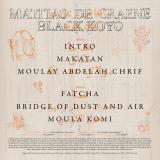
With Black Koyo, Mattias De Craene enters a sound world at once intimate and vast. Born from journeys in Morocco and Brussels, the project traces the rhythms, chants, and spirits of the Gnawa tradition, revealing a quiet resonance that echoes De Craene's own search for depth and presence. Guibri, qraqueb, call-and-response chants, saxophone, loops, and electronics come together in a trance-induced dialogue - ritualistic, elemental, and dreamlike - creating a space where listening becomes immersion, tradition meets imagination, and music unfolds as a shared act of reflection and wonder.
About Mattias De Craene
Mattias De Craene's artistic path is marked by rare coherence. As a central voice in Nordmann and MDC III, he developed a physical, rock-inflected jazz language driven by propulsion, volume, and trance-like collective energy. Over time, a period of personal rupture - burnout, tinnitus, depression - shifted his focus inward. The saxophone became a breathing, textural presence, and in his solo work, he weaves saxophone, electronics, loops, and minimal forms into a cinematic, hushed world where repetition, resonance, and silence slow perception. Rooted in ambient and introspection, his music prizes attention over impact, precision over excess - a quiet intensity recognized with a nomination as Musician for the Music Industry Awards (MIA's).
About Black Koyo
Black Koyo is a Brussels-based ensemble and one of the most compelling voices of the Gnawa tradition outside Morocco. Led by maalem Hicham Bilali, the group brings guibri, qrraqueb, and call-and-response chants to life with trance-like intensity and ritual precision. Their music is both rooted and contemporary, weaving earthbound rhythms and vocal invocations into ecstatic, immersive soundscapes, creating a space where ancestral resonance meets present-day imagination.
About Jan Bang
Jan Bang is a pioneering Norwegian producer and musician, celebrated for his mastery of live sampling and his ability to merge electronics with improvisation, rhythm, and texture in real time. He mixed the album and occasionally joins live performances, bringing his signature approach to sound as co-founder of the influential Punkt Festivaland collaborator with artists such as Jon Hassell, David Sylvian, Arve Henriksen, and ECM Records' roster. As a performer and sound architect, Bang creates immersive, trance-like sonic textures where silence and sound carry equal weight. Within Mattias De Craene ftBlack Koyo, his live sampling becomes an organic instrument, weaving saxophone, electronics, and Gnawa rhythms into hypnotic, physically charged soundscapes.
Line-up & credits
Mattias De Craene - sax, electronics | Hicham Bilali - guibri, vocals, qraqueb |Ismael Akhraz - vocals, qraqueb | Marwan Abantor - vocals, qraqueb
All tracks are original gnawa traditionals played by Black Koyo and arranged by Mattias De Craene.
Album produced & recorded by Mattias De Craene in Essaouira, Morocco and hometown Ghent, Belgium 2025.
Text by Hicham Bilali.
Mixed by Jan Bang at Punkt Studio
Mastered by Lieven Van Pee
Artwork by Marina Sviridova
Design by Benoit Van Geel
Manufactured and distributed by N.E.W.S.
Executive production by W.E.R.F. records
Supported by Flemish Government, Jazzlab, nona, HA Concerts, Aubergine artist Management,
KAAP, La Bestia (Wout Van Putten) & mdcmu.sic vzw.
2026 (c) W.E.R.F. records
Bei uns am Lager und sofort versandfertig

Un-easy listening from »anti-singer« and improviser Sofia Jernberg, a celebration of the voice in its rawest, most malleable form. Jernberg was born in Ethiopia and grew up in Vietnam and Sweden, so one can only imagine these diverse languages opened up a wealth of phonetic possibilities before she entered academia to study jazz and composition. If you dive into her catalogue you’ll clock her startling range – working as a jazz soprano and as an improviser, collaborating with everyone from Stefan Schneider to Mats Gustafsson, as well as appearances on the stage and screen, most notably in Matthew Barney, Erna Ómarsdóttir, and Valdimar Jóhannsson’s »Union of the North«.
On »Voice«, Jernberg provides a ground-level entry point to her work, meticulously running through a litany of unconventional techniques (non-verbal vocalisation, split tones, toneless singing, and distortion) without any effects, just pure batshit sonics designed to show off the voice’s scope as an experimental instrument. On »Mouth Synthesizer« she purses her lips to make ratcheting pops like some analog oscillator, hoarsely mimicking the sort of blustery, Merzbow-coded distortions you might get if you patched a RAT pedal into a broken guitar amp. It isn’t an act of caricature, it’s Jernberg’s way of demonstrating that expensive modular rigs aren’t an essential tool for experimental music, before throwing a side-eye to the field recording industrial complex on »Birds«, transforming her vocal chords into a nightmare aviary. But it’s Jernberg’s startling »multiphonic« experiments that hit hardest. The album opens on »Multiphonic I«, and it’s difficult to tell that you’re listening to a human voice at first – you could just as well be on Colin Stetson’s overblown sax airstreams. Jernberg creates a captivating spiral of crooked, phased tones and hoarse, guttural croaks that she develops over three movements. On »Multiphonic II«, her voice is turned into a storm of pained shrieks, and on the third and final segment, it almost resembles Arve Henriksen or Jon Hassell’s muted brass curlicues. Each track pulls a different musical muscle, whether it’s »One Pitch« with its unsettling yodel-like quivering drones or »Gurgle«, sounding like a close mic-ed recording of a small pot gently simmering.
erscheint voraussichtlich am 20.02.2026

Kjetil Mulelid's various projects have received international acclaim, ranging from his duo with Siril Malmedal Hauge, his trio, and the quartet Wako. His first solo album, "Piano" (Rune Grammofon, 2021) received plaudits that placed him in the same company as pianists like Keith Jarret, Brad Mehldau, and Bill Evans. With "Agoja" Mulelid demonstrates what a musician and composer worthy of such acclaim can do with an ensemble cast of musicians of the highest calibre. On "Agoja" three features are immediately apparent. First, that Mulelid's compositions are melodic, yet frequently surprising in their path from their beginning to end; second, that he is a generous band leader, allowing the musicians both to be themselves and to express themselves, often while he merges almost completely into the background; finally, that each composition has its own unique identity, yet bears Mulelid's hallmark clearly and distinctly. Kjetil Mulelid (b.1991, Hurdal, Norway) has distinguished himself as an inventive artist, blending jazz, psalms, and improvised music in both his own playing and compositions. After graduating from the famous "Jazzlinja" in Trondheim back in 2014, he has been heavily touring the world's nooks and crannies with his own music and projects. He has played concerts in large parts of Europe and Japan and released several well-received albums as a solo artists, as well as with his own Kjetil Mulelid Trio, the jazz quartet Wako, with singer Emilie Storaas as the duo Kjemilie, and with singer Siril Malmedal Hauge - both as a band and as a piano / vocal duo.
erscheint voraussichtlich am 29.03.2024

Die in Montréal lebende schwedische Sängerin und Komponistin hat in den letzten 20 Jahren sechzehn unabhängig produzierte Alben vorzuweisen und ist zahllose Kollaborationen eingegangen. Sie ist eine poetische und kühne Kraft in der Musik, die sich dem Genre entzieht. Ihre Stimme wurde als "eine führende Präsenz" (Exclaim) beschrieben, die "den Unterschied zwischen dem Göttlichen und dem Dämonischen aufspaltet, gekonnt aus den Angeln hebt" (Under The Radar) und "neben den größten Indie-Künstlerinnen steht, die vor nichts Angst haben" (Le Devoir). Aufgewachsen auf einer Insel an der schwedischen Westküste, begann ihre musikalische Laufbahn, als sie 2004 nach Stockholm zog und Mitglied des renommierten Kollektiv-Labels und Veranstaltungsortes Fylkingen wurde (die älteste Organisation in Europa für experimentelle Musik und Kunst, gegründet 1933). Seit ihrem Umzug nach Montréal im Jahr 2012 erstreckt sich ihre Karriere über zwei Jahrzehnte und ist geprägt von einem unerschrockenen Streben nach Originalität, einem unerschöpflichen Wunsch, Genres zu überschreiten, und einem Engagement für künstlerische Zusammenarbeit. Angell verschmilzt musikalische Bereiche von Klassik, Folk, Rock und Pop bis hin zu Jazz, Elektronik, freier Improvisation und Avantgarde. Bekannt ist sie vor allem für ihr unkonventionelles künstlerisches Schaffen mit der gefeierten und für den Polaris nominierten Avant-Rock-Band Thus Owls, die sie seit 2007 gemeinsam mit ihrem Mann Simon Angell leitet. Zu ihren früheren Ensembles gehören das schwedische Vokal-Bass-Duo Josef & Erika und die elektronische Noise-Gruppe The Moth. Zur Unterstützung dieser und anderer Projekte unternahm sie ausgedehnte Welttourneen, bei denen Daníel Bjarnason (Ben Frost, Sigur Rós), Liam O'Neill (SUUNS), Karl Lemieux (Godspeed You! Black Emperor), Lisen Rylander Löve (Midaircondo) und Anders Jormin (ECM) zu ihren zahlreichen Partnern zählten. Ihre unverwechselbare und virtuose Stimme hat Aufnahmen und Live-Auftritte mit einem breiten Spektrum von Künstlern geziert, darunter Loney Dear, Patrick Watson, Leonard Cohen, Kim Myhr, Arve Henriksen, Land Of Kush, Wildbirds and Peacedrums, La Force und The Besnard Lakes, um nur einige zu nennen. Kürzlich gründete Angell zusammen mit Róisín Adams und Peggy Lee das Neue-Musik-Trio Beatings Are In The Body und vollendete ein Solo-Debütalbum mit uneingeschränkter stimmlicher Erkundung und expressionistischen avant-elektronischen Kompositionen, das Anfang 2024 auf Constellation erscheinen soll.
erscheint voraussichtlich am 08.03.2024

This 40 year anniversary collection traces Brother Culture's career and includes some of his biggest hits, with remastered versions of these classics. The album includes his hits Jump Up Pon It (25 million streams), Supanova (15 million streams), My Selecta (2 million streams), and some of his most listened-to tracks ever released on vinyl.
A composition simply means things being put together. In music, we usually think of composition as a classical idea. But in recent years, the possibilities of what ‘composing’ can be, have dramatically increased. Based in Oslo, Norway, Deathprod (aka Helge Sten) has been making his own forms of music with no compromise since the early 90s. His specialty is a deeply atmospheric, grainy minimalism that slows time down and explores the very particles of sound itself. This music can sound forbidding and alien at first, but compared to his more brutal output, it’s an extraordinarily close and intimate experience. The first new Deathprod studio project since 2019’s OCCULTING DISK, Compositions is the result of an intense period at his legendary Audio Virus Lab studio in central Oslo. All tracks are released in chronological order – in other words, the order in which they were recorded. Helge used a personal, unique combination of obsolete digital audio processors and sound generators, combined with his own secret-sauce tuning system. Like gazing at the wonders revealed by an electron microscope with Helge compositional control directs your attention to a succession of ever more spellbinding details and textures. Helge adopted the Deathprod alias in 1991. A complex array of homemade electronics, samplers, sound processing and analogue effects – cumulatively known as the ‘Audio Virus’ – combined with obsolete samplers and playback devices, to distort and transform sounds into unrecognizable relatives of their former selves. On the new album Compositions, the virus has evolved into even more fascinating and kaleidoscopic new strains. Electronically generated sounds vibrate and tremble like undiscovered metals ringing and resonating together. Sonic forms attract or repel each other as if under the influence of a strange magnetism. None of the tracks are over four minutes, but no way are these ‘miniatures’. Each one contains its own fully-formed galaxy of tones and clusters, while all tracks audibly belong in the same universe. These are 17 compositions in search of a sonic ideal. His off-grid audio control centre created a parallel acoustic universe which he filled with mutated samples and electronic textures. Even the gaps between the tracks are part of that universe. Helge left the almost silent, twitching crackles of his snoozing analogue gear intact, ensuring a smoother transition between them. Helge is continually striving to find new parameters and possibilities for what music can be – what you can affect with the medium of sound. From the intricate homemade miniatures of Treetop Drive to the bonecrushing electronic barrage of Morals and Dogma and OCCULTING DISK, the different sides of Deathprod are all products of the same obsessive focus and self-discipline in pursuit of sonic exploration. His Compositions are private rather than public music: like introspective chamber or solo compositions instead of the more strident, outward-looking tones of a symphony. Helge is a founder of Norwegian improvising group Supersilent and has produced records by Motorpsycho, Susanna, Jenny Hval, Arve Henriksen and others. He recently composed music for Harry Partch’s legendary instruments, which can be heard on Sow Your Gold in the White Foliated Earth, released in 2022 on Smalltown Supersound.
Bestelle jetzt und wir bestellen den Artikel für dich beim Lieferanten.

REMASTERED
Grönland Records announce a revised, remastered reissue of “Sleepwalkers” by DAVID SYLVIAN. Available as a gatefold 2LP with exclusive art print and as a gatefold digipack CD, this new edition also features the previously unreleased track “Modern Interiors”.
in the 00s, DAVID SYLVIAN produced two of his strongest and most solitary statements, BLEMISH and MANAFON. but those records don’t tell the whole story. during that the same period, SYLVIAN created an alternate body of work: a series of collaborations and side projects with leading talents of pop and improv, electronic and contemporary classical music. the best of these recordings are gathered here on SLEEPWALKERS, meticulously sequenced and remixed: the fruits of one-off meetings and lifelong partnerships, they jump from bliss to intrigue, romance to sensuality, as arch experiments lead into the lushest pop.
the single ‘world citizen – i won’t be disappointed,’ written with RYUICHI SAKAMOTO, is a sublime example, with an impeccable melody and lyric warmed by SYLVIAN’S gorgeous tenor. SYLVIAN has worked with SAKAMOTO for close to three decades. by contrast, on ‘pure genius,’ a collaboration with CHRIS VRENNA aka tweaker, he sounds like he’s walked into a heist flick, singing the part of a delusional, dangerous bedroom genius. as sylvian explains, tracks like this ‘give me a chance to write in a way that’s completely non-personal, playful. it’s an exercise of some kind, working within the parameters of a given assignment.’
intrigue of a different kind drives ‘sugarfuel,’ with music by JEAN-PHILIPPE VERDIN, aka READYMADE FC. the lyrics offered ‘an opportunity to grapple with a more overt sexual theme than anything i’d previously attempted, as suggested by a vocal sample in the original track provided, a threateningly insistent ‘i’m on your side.’ so i took that as my point of entry and ran with it. i would love to write more on this subject should i find the right context. you’re always aware of walking a thin line exploring sexuality with language alone. the failings of the great and the good are strewn all around.’
NINE HORSES’ ‘wonderful world’ strolls in on a black tie bassline and the echoing coos of swedish chanteuse STINA NORDENSTAM, whose high chirps brush hands with SYLVIAN’S lead; there’s the blistering ‘money for all’ by FRIEDMAN and SYLVIAN, an oblique response to the fallout of 9/11 and the war on iraq. this is followed by the last known recording of SYLVIAN’S singing voice in over a decade, ‘do you know me now?’, a live studio recording later augmented by JAN BANG, EIVIND AARSET and ERIK HONORÉ. it’s certainly a title that’s become more relevant over time as SYLVIAN, in the latter stages of his career, repeatedly comes face to face with a new generation of admirers fixated on the life and times of the band formed by his younger self. SYLVIAN is one of only a handful of musicians to have successfully moved on from overt pop beginnings into a domain all his own but is consistently plagued by the misguided desires or expectations of some unfamiliar with his evolution to do a u-turn, pick up where he left off in the late 90s. although this compilation, as well as his writing for NINE HORSES, adequately shows SYLVIAN’S traditional love of melody is
intact, that it’s consistently remained part of his output, there’s no denying his focus has shifted, evolved.
the refusal to embrace complacency, the need to cover new ground ‘as older generations of popular musicians have a moral duty to explore despite, or because of, the greater possibility of failure’ will, i believe, lead to a reassessment of his later work that embraces a sightly more complex relationship with what we’re referring to as ‘melodic’, accompanied by an exploration of improvisation without dogma or beholden to any ‘givens’ for which he’s not infrequently been castigated. for SYLVIAN, there are no such boundaries. it’s obvious that different facets of his work co-exist without conflict but not necessarily for the majority of his audience. again, this places SYLVIAN in the odd, rare, unenviable(?) position of moving forwards leaving many in his devoted audience behind as, should he decide to return to music, it’s unlikely he’ll be aiming to placate an audience in love with work that preceded the 00s. in fact we’ve no idea where new work, should it surface, may lead.
SLEEPWALKERS also spotlights the innovators who contributed to MANAFON and BLEMISH. CHRISTIAN FENNESZ hangs a crackling, shimmering curtain behind the vocal on ‘transit,’ matching his signature mass of sui generis sounds to sylvian’s stately performance. and the title track began with an instrumental handed to SYLVIAN by MARTIN BRANDLMAYR of POLWECHSEL, soon after the first recording session for MANAFON. spite crackles in the gaps between the percussion, and onkyo artists TOSHIMARU NAKAMURA and SACHIKO M set the stage for the scathing lyrics in the chorus.
it cuts close to the bone and so do the two spoken word cuts, ‘angel’ and ‘thermal,’ produced by SAMADHISOUND recording artists JAN BANG and ERIK HONORÉ (and featuring ARVE HENRIKSEN on trumpet). SYLVIAN describes the latter work as a ‘love poem’ to his daughter. ‘‘thermal’ reflects on a period when our time in sonoma, ca was coming to an end. we’d stayed in temporary accommodation which had lulled us into a false sense of security. we had pear, apple, lemon, and figs trees growing in the yard. a small but exotic paradise. a cocoon. but the cracks were beginning to show in the relationship between ex-wife INGRID CHAVEZ and i which is where i think this underlying sense of anxiety, which runs throughout the poem, is derived from, coupled with the need to provide physical and spiritual stability to the children, the youngest of whom was just under two at the time. the poem is addressed to her. our world was dissipating, coming apart at the seams, but we were an island unto ourselves.’
‘five lines’ marked the start of a new partnership with acclaimed young composer DAI FUJIKURA, who at the time of recording was also working on remixes of MANAFON for what became DIED IN THE WOOL. the string quartet was performed by the celebrated ICE ENSEMBLE and written for SYLVIAN, who FUJIKURA cites as an early influence. says SYLVIAN, ‘the composition moves through numerous changes in time signature but as i had no knowledge of what these were i just relied on my gut instinct, and responded, as i always do, with what felt right to me, composing an entirely new melody in the process. some months later i was working in a studio in london and dai dropped by. i rather tentatively asked if he’d like to hear a rough mix of the song as it stood, painfully aware that my contribution might make no sense to him at all but, to my relief he loved the result.’
there’s one further new addition to this collection, the first official release of a track composed in response to the tsunami in fukushma, ‘modern interiors’, featuring SYLVIAN once again in collaboration with BANG and AARSET.
like 2000s EVERYTHING AND NOTHING, SLEEPWALKERS is a retrospective of a particular decade when SYLVIAN was free of major label interference and could follow his own instincts without having to explaining himself – but it’s also an eye-opening complement to his solo releases. as SYLVIAN explains, ‘some collaborations seem to be a one-off exchange but you can never be too certain of that fact. others have been long term. in this respect, RYUICHI comes to mind. there’s others with whom you hope to continue working as you feel you’ve barely scratched the surface. other times offers come out of the blue, welcome, inspired. regardless, it’s wonderfully explorative to have so many possibilities to juggle with. each collaboration seems timely. it’s as if there’s a rightness to the exchange at a given moment in time.’
in the meantime, we hope you enjoy the work presented here, personally selected, remixed and sequenced and entirely remastered. these are the orphans, abused, estranged, exotic, migrating from diverse corners of the globe, brought together under one roof which they're learning to share despite their differences.
‘as many of you will already be aware, despite relatively continuous work on solo albums, i’ve maintained strong ties with a number of musicians throughout my life in one context or another. on this new collection, let’s call it SLEEPWALKERS 2.0, a selection of collaborative work produced over the period encompassing blemish through to manafon, i’ve included compositions by nine horses as well as more fleeting flirtations and one-offs. neglected offspring. represented also is long term friend and writing partner, RYUICHI SAKAMOTO, as well as more recent but potentially equally productive partnerships such as CHRISTIAN FENNESZ, ARVE HENRIKSEN and contemporary classical composer DAI FUJIKURA.
i hope you enjoy the work presented here, personally selected, remixed and sequenced and entirely remastered. these are the orphans, abused, estranged, exotic, migrating from diverse corners of the globe, brought together under one roof which they're learning to share despite their differences.
we contain multitudes. we’re nothing if not contradictory.’
DAVID SYLVIAN, 2010
(consistency is contrary to nature, contrary to life: aldous huxley)
Bestelle jetzt und wir bestellen den Artikel für dich beim Lieferanten.

The US-born, Norwegian-Mexican musician and producer Carmen Villain, real name Carmen Hillestad, has spent the last nine years and four albums gently unraveling song into the sound of emotional impulse. From the tilt and croon of her first two albums to the expansive warmth that flows and pulses beyond ambient in her more recent output, Hillestad's journey is artful musical deconstruction but also somehow spiritual growth.Hence new album Only Love From Now On, her fourth full-length and the culmination of a build-up that really began with the turn in sound evident from third album Both Lines Will Be Blue (2019, Smalltown Supersound) and the subsequent releases Affection In A Time Of Crisis (2020, Longform Editions) and Sketch For Winter IX: Perlita (2021, Geographic North). While the seed of her aesthetic was planted earlier, it has blossomed into something unexpected, benevolent in its composure and altogether luxuriant in its sensuality. If her themes, especially now, are wide, philosophical, and occasionally abstract, the emotional tenor of Hillestad's music is clear and purposeful. Makes sense that her key musical touchstones are dub, ambient, and cosmic jazz - flexible vehicles for tranquil wonder. While it may not contain voice or lyrics, as her two earliest records do, she describes it as, "wishing to maintain a sense of careful optimism for the future, while on the cusp of something unknown." Listening to Only Love From Now On is simultaneously comforting and alluringly strange. Partly it's the contributions of guests Arve Henriksen (trumpet, electronics) and Johanna Scheie Orellana (flutes). Partly it's the fluidity between instruments - such as clarinets - field recordings, the studio, jam, and careful composition. She calls the process a conversation with sound that occurs in her deliberate attempts to experiment with new methods, like granular synthesis, for her music-making. But mostly that strange comfort is in the peace and grateful contentment she has found via the stark recognition of her own privilege - laid bare by the pandemic. Only Love From Now On is fueled by the sense of scale in feeling small in the face of things so large, the contemplation of how the biggest impact we can have is in the people close to us, the attempt to make sure that impact is a positive one, and the choice to try to focus on love instead of fear.
Bestelle jetzt und wir bestellen den Artikel für dich beim Lieferanten.

Binding a deep social and political conscious with rigorous musical experimentation, the Brussels based, Italian pianist, performer, composer, Giovanni Di Domenico, delivers Downtown Ethnic Music, the 4th instalment of Die Schachtel’s Decay Music series, focused on inspired contemporary experimental efforts in the ambient, ethereal, and emotively abstract music.
Over the last decade or so, Giovanni Di Domenico has carved a deep path through a diverse number of discrete fields within experimental music, working in various ensembles - Abschattungen, AufHeben, Bonjintan, Cement Shoes, Delivery Health, Going, etc. - as well as producing a discography of critically heralded solo efforts, and intimate collaborations with Jim O'Rourke, Tatsuhisa Yamamoto, Akira Sakata, Arve Henriksen, Tatsuhisa Yamamoto, Alexandra Grimal, Nate Wooley, Chris Corsano, and others.
Downtown Ethnic Music encounters Di Domenico reimagining the future of urban music, pluming the mysterious and emotive depths of self, to arrive at vision of sonorous utopia, radically divergent from those of the past. Hybridizing numerous forms of musical practice, while making a conceptual nod to Jon Hassell’s notion of the "fourth world”, as well as the cross-temporal transnationalism of Roberto Musci, Aktuala, Futuro Antico, and the Third Ear Band, Di Domenico’s vision of democracy - rendered through the creative metaphors of sound - is a true to life, bristling conflict, as open-ended as it is ordered, and as dramatic and tense as it is beautiful, playful, and refined.
A colorful tapestry of ideas, experiences, histories, and reference points, woven from a pallet of electronics, synthesis, and various acoustic sources - the intervening rhythms of drummer João Lobo, vocals by Pak Yan Lau and Patshiva CIE women choir, the horns of Ananta Roosens and Jordi Grognard etc. - across the length of Downtown Ethnic Music, the boundaries between idiom, expressive concept, collective, and individual blur, giving way to a visionary, forward-thinking rendering of electroacoustic music, that subtly reminds us of the social and political potential of art.
Seamlessly incorporating bubbling electronic abstraction, sprawling ambience and long tones, throbbing kosmische, acoustic free improvisation, and the human voice, Giovanni Di Domenico’s Downtown Ethnic Music represents a high-water mark in an already astounding career. Issued by Die Schachtel in a one-time edition of 250 copies, pressed to 180g marble vinyl and housed in a pro-printed inner sleeve and jacket, contained in a silk-screen PVC sleeve.
erscheint voraussichtlich am 09.07.2021

The second solo album on Jazzland (and fourth in total) by Tortusa, a NorwegianAmerican electronic musician and producer from Stavanger, Norway. The album has
taken three years to create, and features
contributions from some of Norway’s finest musicians, including three of his idols:
Arve Henriksen, Eivind Aarset and Erland Dahlen.
‘Bre’ is composed of ambient experimental music heavily inspired by nature, and takes
the listener on an emotional journey. Tortusa paints with sounds, and the music inspires
inner visualisation of the story he tells through his weaving and blending of abstract sonic
material.
The sampling of acoustic instruments forms the foundation of the album. Tortusa takes
essentially familiar instrumental sounds, and warps, mangles, distorts and modulates
them, defamiliarising them, repositioning them both in the context of themselves and
other sounds, creating a new sonic vocabulary that is neither exclusively organic nor synthetic, but is an aesthetically balanced combination of both.
This process is the source of the album’s originality and distinction from more conventional approaches to sampling and synthesis. Tortusa composes his music with an array
of hardware and software samplers, that are then fed into various effects or effects chains
for further manipulations. His draws inspiration from producers like Biosphere, Flying Lotus, Teebs, and Nils Frahm. Field recordings are an important part of the production and
lend additional dimensions to the music and extend the textures and moods.
erscheint voraussichtlich am 04.06.2021

Ståle Storlokken - Rhodes piano, Hammond organ, grand piano, Eminent 310, Mellotron, Continuum Nikolai Hængsle - Electric bass, electric and acoustic guitars Torstein Lofthus - Drums, percussion. After a solid run of five studio albums and 2019's two double live albums, Psychedelic Backfire I and II, Elephant9 had taken their groovy mix of high energy rock and power jazz as far as they could. In this respect Arrival Of The New Elders comes as a welcome and most timely addition to their recorded output. More varied, mature and reflective, don't let the self-ironic (?) title mislead you, they are as groovy as ever, but more structured and less jam oriented, with the longest track clocking in around the seven minute mark. Rather short, by their standards.Having built a solid live reputation even before their brilliant 2008 debut Dodovoodoo, the trio boasts what is probably the strongest rhythm section in Norway, complemented with keyboard magician extraordinaire, the one and only Ståle Storlokken. And boy, does he excel himself on this album, notably with more focus on the Rhodes than before. That said, this is nothing if not another strong group effort from what has been a very tight unit straight from the outset. Seven brand new compositions from Storlokken and one from Hængsle make way for what we consider to be their finest and most cohesive album to date. Arrival Of The New Elders was recorded by trusted stalwart Christian Engfelt, with early Dungen producer Mattias Glavå handling the mixing duties.Ståle started his musical journey in Veslefrekk with Jarle Vespestad and Arve Henriksen in the 90s, soon morphing into Supersilent with Helge Sten on board. He's also a member of Moster! and Humcrush, and have collaborated with a number of artists, most notably Motorpsycho. Nikolai is also a member of Bigbang, Needlepoint and Band Of Gold and have appeared on a couple of hundred records. The same goes for Torstein, an associate member of numerous bands ranging from pop and soul to free jazz. But Elephant9 has always been their special baby.
erscheint voraussichtlich am 05.03.2021
