
Search:asha b

Me Da A Onnda by K. Frimpong and his Cubanos Fiesta isclassic and essential Hi-Life & Afro
Funk album from one of the greatest Ghanaian singer and composer, finally reissued for the first time!
This legendary K Fimpong's fantastic rare album was recorded in 1980.
K . Frimpong was born on July 22nd, 1939 at Ofoase in the Ashanti - Akim district and entered right
into music after elementary school by joining "Star de Republic" and later "Oko's band" after which he left
to K. Gyasy's band where he worked for more than 6 years. As a prolific songwriter and singer, here's
the reissue of his amazing album, a modern fusion of Hi- life and Soul.The excellent background is given
by the famous Cubanos Fiesta with members of Vis-A-Vis band.
Originally produced on the major Polydor, this four songs recording is a blend of danceable and
spiritual Soul and straight Hi-Life. A must-have vinyl of percussive Afro Funk for all the music
connoisseurs, K. Frimpong backed by Cubanos Fiesta LP is a true masterpiece, so hard to find and
reaching crazy skills for a decent copy affordable.
Remastered by Frank Merritt at The Carvery. Pressed on Replika format. Fully licensed by the Alhadji
Kwame Frimpong Family

12
The Ethiopians are one of the great vocal groups to come out of Jamaica. Singing songs of life and times as they found them, themes that resonated with the people of the Island that made them such a treasured group. Lenard Dillon (b. 9 December, 1942, Port Antonio, Jamaica) the founding member of the Ethiopians began his singing career at Clement 'Coxonne' Dodd's Studio One. Initially he recorded under the name of Jack Sparrow, and backed by the Wailers, cutting 'Ice Water' and 'Suffering In The Land'. Under The Wailers encouragement, he went on to form his
own vocal group. Recruiting singers Stephan Taylor (b.1944, Portland, Jamaica) and Aston 'Charlie' Morris to become The Ethiopians. They cut 'Live Good', 'Why You Gonna Leave Me Now' and 'Owe Me No Pay Me'. Although receiving favourable response, Aston Morris decided to leave the band and the remaining pair carried on and cut 'I'm A Free
Man' and 'Don Dead Already' and 'For You'. On meeting contract builder Leebert Robertson who had recently returned to live in Jamaica, ashad he wanted to get into the music business, a session was booked for Treasure Isle Studios. The session produced their seminal 'Train To Skaville' track, which became an immediate hit in Jamaica and in the UK, when in 1967 it reached number 40 in the charts. They also cut 'Engine 54', which became the title of their debut album. Its
follow up 'I Need You / Do It Sweet', did not fare so well and the band moved over to Sonia Pottinger's stable, where they cut 'The Whip / Cool It Amigo' which revived their fortunes and proved another big hit for the band. Two more hits followed 'Stay Loose Mama' and 'The World Goes Ska', after which the band decided to return to a trio, adding
Melvin 'Mellow' Reid to the line up. The band now hit another run of successes with producer JJ Johnson 'Everything Crash, 'Gun Man', 'Hong Kong Flu' and 'The Selah'. Many hits followed leading the band to work with a variety of Jamaican producers. Such tracks as 'I Want To Be a Better Man, ' Conquering Lion', 'Fire A Mus Mus' Tail', and the timeless 'Reggae Hit The Town' to name a few. Two albums 'Reggae Power' (1969) and 'Woman Capture Man' (1970), pulled a lot of these tunes together. Sadly Taylor was killed in 1975 after been struck by a van in a road accident. Dillon returned to Port Antonio till 1977, when he was persuaded to return to Treasure Isle studios with producer Niney The
Observer and cut the Rasta based album 'Slave Call'. Additional members who joined for this album were Bro Fatty, Bro Ewing, Bro T, Mello and Hychi Dread. An album that showed all the Ethiopians magic had not been lost.
For this release we have included the full 'Slave Call' set, 'Ethiopian National Anthem', 'Slave Call', 'Guilty Conscience', 'Hurry On', 'Mus Follow Babylon'(on CD Edition), 'Train To Skaville (1977 version, on CD Edition), 'Culture', 'Obeah Book', 'Let It Be' and 'I Love Jah'. Alongside some of the bands early hits including the original version of 'Train To Skaville', 'Engine 54', the great and poignant 'Everything Crash', 'Reggae Hit The Town' and 'The Selah'. An interesting set to remind us what a great group the Ethiopians really were.

14
Breakneck audio level destruction from Quarantine on their first full length release. The demo was a glimmer of perfected USHC pastiche but “Agony” pushes the limits of aggression to some kind of land speed no man’s land where UNITED MUTATION, GUDON, and “MY AMERICA” (FU’s) are firing live ammunition into each other’s boomboxes in a bid for hardcore punk long play supremacy. Instant classic from a group of utterly blue chip musicians on the label that can’t be beat. (Jonah Falco)

- A1: The Blowflys - Funky In The Hole
- A2: Funkadelic - If You Don't Like The Effects, Don't Produce The Cause
- A3: Ohio Players - Hustle Bird
- A4: The Armada Orchestra - For The Love Of Money
- A5: The Sylvers - Handle It
- A6: Malone & Barnes & The Spontaneous Simplicity - Road Man
- B1: James Brown - Smokin' & Drinkin
- B2: Kc & The Sunshine Band - I Get Lifted
- B3: T-Connection - Lady Of The Night
- B4: Asha Puthli - Flying Fish
- B5: The Jimmy Castor Bunch - The Mystery Of Me
11

6
Soul Jazz Records’ new oxblood red coloured vinyl
LP (plus download code) issue of this very rare
deep spiritual jazz album, first released as a
private-press album in 1970 on flautist Lloyd
McNeill’s own Asha Record label in Washington
DC.
Lloyd McNeill is an African-American flautist,
painter, poet and photographer born in Washington
D.C., in 1935. His multi-disciplinary creative life led
to encounters and friendships with Nina Simone,
Picasso, Eric Dolphy, Nana Vasconceles and other
legendary cultural figures. Lloyd McNeill’s hypnotic
‘Washington Suite’ was originally commissioned as
a piece of music for the Capital Ballet Company, in
Washington.
McNeill grew up through the era of the Civil Rights
Movement in the 1960s and his life and work is a
reflection of those ideals. In the mid-1960s he
moved to France where he became friends with
Picasso, working with a number of émigré-jazz
musicians whilst living in Paris. In the late 1960s
he taught jazz and painting workshops at the New
Thing Art and Architecture Center in Washington.
In the 1970s he travelled throughout Brazil and
West Africa studying music and taught music
anthropology in the US.

Ahemaa Nwomkro, which means queens of Nwomkro, are Victoria Osei and Theresa Owusuaa. Nwomkro is an old Ashanti musical style, which played an influential role in the origin of the typical more roots-like Highlife style of Kumasi, the cultural capital of Ghana in the middle of the jungle.
On this release the two singers have teamed up with the young generation of Highlife muicians of Kumasi. On guitar is Akule Pepe, who served for years in the group of Highlife legend Alex Konadu, the most on demand band in its time. The two songs are a rare example of how good pure Nwomkro gets together with typical Highlife.

In early 2018, Nathan Jenkins returned from the coast of Arrábida to his new home studio in a cottage tucked behind the grand hotel setting of Wim Wenders’ Lisbon Story. Breaking for lunches under a Datura tree in the garden and a far cry from the Finsbury Park basement flat he rented the previous year, a set of recordings followed that galvanised into an EP - ‘We Had A Good Time’. Music informed by out-of-town trips in a 1987 Renault 9 Super, Pitchfork attributed “remarkable healing powers” to lead song ‘Hula’.
After leaving London for a spell in Portugal, Nathan lost his taste for the night life and drew a line under a long-running NTS radio show. Much of the time spent abroad was dedicated to a longstanding collaboration with Westerman, whose album they recorded in a remote part of the Algarve countryside in 2019. Nathan’s own discography opened in 2007 with ‘Pet Sounds: In The Key Of Dee’, before pivoting in a more electronic direction via ‘Get Familiar’ and ‘Young Heartache’. From the sampledelia of 2011’s ‘Too Right’, the new wave and rave of ‘Say Arr Ee’ to the Robert Wyatt-influenced ‘Love Me Oh Please Love Me’, he’s mapped a deliberately peculiar path. 2015’s ‘Rooster’ was Eno & Byrne’s ‘Bush Of Ghosts’ given a shangaan-electro lick and clip. While Nathan’s partnership with fellow out-there pop auteur Jesse Hackett, as Blludd Relations, staggered like a half-cut Prince.
Collaged, rhythmic alternatives. Syncopated avant-garde sambas. Off kilter Sci-Fi jazz. Think Asha Putli in the spot at the Star Wars cantina. Arty, angular. Rich, but uncluttered. Frenetic, electric, blurring the boundaries between what is sampled, what is played. Nathan’s is a wilfully weird Pop, showcased in 2016 on his album ‘Loop The Loop’. Wayward but woven with hooks that come out of nowhere. Lyrical, often beautiful, solos on violin, oboe and desiccated guitars. Songs that demonstrate a nose-thumbing playfulness, a refusal to sit still. Where there’s always the urge to interrupt a carnival beat with a burst of galloping horse hooves. Or juxtapose ambient chords with a kazoo.
A roll call of Nathan’s broader musical adventures encompasses work with Paul Epworth, Sampha, Westerman and Nilüfer Yanya. Commissioned remixes reach from Dita Von Teese to Model 500, Tricky, Todd Terje and Lee “Scratch” Perry. Solo efforts gracing labels Honest Jon’s, R&S, Young Turks, Whities and The Trilogy Tapes. ‘Blue Pedro’, on the latter, making it into Crack Mag’s Top 100 Tracks Of The Decade.
In 2012 Nathan started his own label, DEEK Recordings, assuming the role of inhouse producer to collaborators. The imprint’s tagline and aesthetic - Pop, not slop! - is illustrated by an ongoing playlist of the same name and further explored in a series of compilations where Nathan and friends cover and reinterpret unsung ‘unclassics’ from alt. country to obscure 80s European arthouse scores, bouncing between Captain Beefheart, The Pixies, Sade and Mazzy Starr. DEEK’s roster is equally eccentric, non-linear and pop-literate. Laura Groves and Nautic - the realization and crystallization of a shared love for the Cocteau Twins.
12” pressed on crystal clear vinyl.

11
Hailing from late-'60s Detroit, Black Merda (pronounced "Murder") were both aesthetically and musically way ahead of their time. When most black groups (including Parliament/ Funkadelic) were still sporting suits, singing about love and using a horn section, Black Merda had already become a tight guitar-heavy freak-funk four piece. By weaving guitar rock and psychedelia into soul and R&B they were the gods of the underground "black rock" movement which fell somewhere between Jimi Hendrix and Parliament and MC5. But it wasn't just about the music, the message was just as important.

11
"Lost Ark Music" proudly present to you another labour of passion "Praying for the Angels" by Pura Vida. 'The heart of the Last Ark' is beating on the riddim of the drums" ... Play it loud!
"Crawling" is about Puraman's personal struggle in life (...) trying to blend a stepping, jazzy reggae groove with some psychedelic stuff, Pieter De Naegel & Mathieu Vilain provide some "Last Ark Fyah Horns". "Song to Bob" is Puraman's tribute to Bob Marley, with a haunting Bassline provide by Aston "Familyman" Barrett, Orginal Wailer (...) His son Aston Barrett Junior hits the drums like Lightening!
"When the right time come" was recorded in an oldschool fashion, Recording the riddim in one take (...) Puraman on Vocals and Guitar, Boris Perck on the bass, Xan Albrecht on the drums, Wouter Rosseel on Lead Guitar. Bos Debusscher provides a wicked synthline!
Are you ready?
"Pretty Stranger I wrote this song for you... You shurely look like danger but that's what I like about you". Pura Vida goes Psychedelic Rock (...) "Les Eaux Sauvages" is a Love-Song with the Wonderfull voice of Nina "Vitalia" Schelfthout!
"O sopro de Inae" features the warm voice of Alessandra De Queiroz...Straight from Brazil she came to the Mare Altar forest under the guidance of Maarten Rosa in search for the "Arka Perdida".
This song has Portugese Lyrics, praying for the Spirits of Iemanja and Inae (...) The Spirits of the Ocean! "Find a way Home" is a Soultune features Alessandra De Queiroz!
The Title Track "Praying for the Angels" is another combination of Puraman & Alessandra's voice. In a Sixties Psychedelic Spirit (...) Singing about the Lost Souls dwelling the streets of the Ancient City! It was recorded on Puraman's Birthday (...)
"And the lights of the city, drive them crazy. And there's nowhere to run (...) And they're praying, hear them praying for the Angels...".
"Blessings from the Last Ark" features the amazing voices of Roydel "Ashanti Roy" Johnson, Derrick "Watty" Burnett & Kenroy "Tallash" Fyffe from 'The Congos'. Ashanti Roy provides the Bassline and Percussion. Watty & Tallash provide extra magic percussion. Puraman on Vocals, Melodica & Guitar. Pieter De Naegel & Mathieu Vilain play humble and bright on this Deep Roots Tune. Blessings from the Ark. Beyond Time & Space (...)
"Ancestor Spirit Dance" is an Afrobeat inspired tune features the voice of Puraman's Great-Grand-Mother Mathilde Spruytte, who
was a local folk singer.

- A1: We No Be Machine
- A2: Mr Ali
- A3: Yenimno
- A4: Material Microdots
- A5: Hey No I Say
- B1: Digital Timeline
- B2: Fire
- B3: Makoma (Feat Wiyaala)
- B4: Smoke Screen
- B5: Nipa Bi
- C1: Free Up (Feat Morena Leraba, Spoek Mathambo & Syntax)
- C2: Safari Ya Muziki (Feat Pendo & Leah Zawose)
- C3: Gamashie Choice (Feat Afla Sackey)
- C4: Sohaa Gb3K3
- C5: Waters Of Congo
- D1: Onipa (Feat Wiyaala)
- D2: Kukuru
- D3: Kon Kon Sa (Feat Wiyaala)
- D4: Promised Land (Feat Jally Kebba Suso)
19
Afro futurist sensations Onipa unleash their debut album, combining Afro grooves, electronics and fierce energy for an effervescent celebration of cultural and musical encounters.ONIPA means ‘human’ in Akan, the ancient language of the Ashanti people of Ghana. It’s a message of connection through collaboration: from Ghana to London, our ancestors to our children, Onipa brings energy, groove, electronics, Afro-futurism, dance and fire! Born out of deep collaboration between long-time friends K.O.G (Kweku of Ghana of KOG and the Zongo Brigade) and Tom Excell (MD, guitarist and writer of acclaimed jazz/ soul afrobeat pioneers Nubiyan Twist), the group features KOG on vocals, balafon and percussion, Tom Excell on guitar, percussion and electronics, Dwayne Kilvington (Wonky Logic) on synths and MPC and Finn Booth (Nubiyan Twist) on drums.
The group have worked closely with Ghanaian star Wiyaala who features on three tracks, singing in the Sisaala language from the North of Ghana. The album also features collaborations with South African rapper Spoek Mathambo, Lesotho star Morena Leraba, Ghanaian percussion master Afla Sackey and Tanzanian sisters Pendo & Leah Zawose, each adding their own flavour to the project. “Through the musical prisms of London and Ghana our influences join together to create, a fundamental thread of traditional African rhythms, instrumentation and storytelling, interwoven with electronics, urban soundscapes and synth bass. We use technology, but it should never use us, our music is live and about deep human connection.” (Onipa)

8
buffering juju, the title of dumama + kechou's debut album, relates to the process of "excavating spiritually charged content from within". The duo's textural sound, driven by cyclical song structures and chant making, not only captures the angst of the modern world but mines this state of affairs for regenerative potential.
dumama (vocalist and uhadi player) + kechou (multiinstrumentalist with a focus on indigenous African instruments and handmade instruments) met in Cape Town in 2017. There was an instinctive pulse to the initial clutch of shows they played together, blowing open vast sonic and conceptual possibilities. "I guess we were in similar places with our music processes in trying to push healing music to the edges and be more experimental with it," says dumama. The narrative of the album unravels as a piece of magical realism informed by South African folklore and reality, detailing a woman's liberation story where the characters shift shape and traverse multiple realms, deploying various iterations of their power or lack thereof. "It has an organic, natural, cyber and modern kind of energy - all rooted in African aesthetics of sound and storytelling," says kechou. All of this sits on a bed of the duo's unique musical language, one that, although applied electronically in the form of looping and soundscaping, is founded on approaches to string, vocal and percussion tones that reflect a merger between Northern and Southern African heritage.
Recorded primarily in Cape Town and Johannesburg over the first quarter of 2019, buffering juju is a conduit to a past we were not necessarily present for, and a future where threatened indigenous technologies thrive in an increasingly digitised world.

Sarah Benabdallah and Alexis Lebon are a very 21st century musical coupling, absorbing their metropolitan surroundings while tapping into a rich cultural heritage, not unlike fellow countrymen PNL or the Dutch band Altin Gün. A Paris-based duo set for greatness they might be, but it’s fair to say Mauvais Oeil are operating under a misnomer: while their name means “evil eye” in French, you’ll only experience enlightenment when you lay eyes (and ears) upon them. Mauvais Oeil are set to release their debut EP Nuits de velours, a magical melting pot of musical shibboleths and contemporary grooves. On opener “Mes nuits de velours”, we’re transported in the land of 1001 Arabian Nights, with the music every bit as smooth and alluring as the subject matter. “Afrita” is a trance-inflected musical acclamation evoking all
the madness and gayety of a midsummer souk. Sung entirely in Arabic with delightful blasts of strings, it’s a North African-influenced banger with a delicate wistfulness. “Asha” meanwhile is in a reference to Asha Vahishta, the middle-eastern concept of truth
according to the ancient religion of Zoroastrianism. Sung again in Arabic, it features catchy Phrygian guitar manoeuvres played over ambient analogue keyboard strokes. The E.P. is completed by “Constantine”, a song of longing, dedicated to the home of Sarah’s forebears. Having met in the arty northern faubourgs of Paris, Sarah and Alexis soon developed a musical telepathy and a shared sonic agenda, mining their own histories for the profound
cultural roots that underscore Mauvais Oeil, while absorbing the ubiquitous sounds of the suburbs, where Turkish, Armenian and Ethiopian music ring out. The band’s moving and melancholic chansons are delivered with a delightful French pop sensibility, making Mauvais Oeil one of the most exciting and musically diverse prospects in 2019.

2
Frank Karikari is the son of legendary Highlife musician Ralph Karikari who played bass on countless classic albums such as "Sikyi Highlife" by Dr. K. Gyasi & His Noble Kings. So, Frank grew up surrounded 24/7 with high class Highlife music plus he has inherited the natural talent of his father. Now he teamed up with the Polyversal Souls to keep the spirit of Highlife alive.
"Siakwaa / Nana Agyei" are two songs taken from above mentioned album "Sikyi Highlife". Frank gets here some vocal support from the original court singers of the Ashanti king, which fits perfectly, as both songs are praise songs to the king.
"Odo Agye Gye Me" is composed by legendary Kumasi based singer Baffour Kyei, who sang for such groups like Kyeremateng Stars or B.B. Collins & His Powerful Believers. Besides creating this song, he is part of the choir on this future Highlife classic.

2 track Single from Ashanti Wah released by Dub Store Records

2
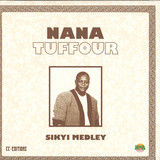
Kalita Records and CC:EDITIONS (a new venture by
Australia's CC:DISCO) jointly announce a 12' EP
comprised of four of Nana Tuffour's greatest electronic
burger highlife tracks, accompanied by interview-based liner
notes. Here, in partnership with Nana, we select two highly
sought-after songs from his 1993 release 'Genesis', namely
'Sikyi Medley' and 'M'Anu Me Ho', and pair them his with two
lesser known yet equally deserving tracks 'Asamando' and
'Jesus' from his 1997 CD-only release 'Highlife Tropicana'.
Hailing from Kumasi, the capital of the Ashanti region in Ghana,
Nana Tuffour is by far one of the most important exponents of
modern highlife music. He studied piano at college and cut his
teeth in the '70s as an organist and vocalist for the incomparable
Kyeremanteng Atwede and Dr. K Gyasi's Noble Kings Band.
Fast forward to 1981 and Ghana was at the apex of its golden age
of music. This era was brought to an abrupt end by political
upheaval when the military took over the government and as a
result a restrictive dusk to dawn curfew was imposed between
1982 and 1984. This resulted in a total obliteration of the country's
night life, and Nana just like many other prominent musicians
including Pat Thomas and George Darko left Ghana for greener
pastures, the most popular destinations being Nigeria and
Germany. The Rheinklang Studio in Düsseldorf run by a young
inimitable German sound engineer Bodo Staiger and another
'exiled' Ghanaian musician Charles Amoah played a crucial role
for those musicians who had chosen Germany. This studio
became the focal point for Ghanaian musicians and the birthplace
of a new sound, now known as 'Burger highlife' - traditional
Ghanaian highlife infused with the more up to date electronic and
disco sounds of the West. It is arguable that Nana has played a
crucial role in Burger highlife and developing the sound of
traditional Ghanaian highlife more widely to what it is today, with
his innovative use of electronic accompaniment pushing its
boundaries to its creative extremes.
It is Burger highlife's transcendence of traditional musical
boundaries that helps make it so accessible to listeners,
appealing not only to Ghanaians back home but now highly
regarded and sought-after by those in the West interested in
more occidental disco and electronic sounds. We hope that you
enjoy the four songs offered here, each chosen to demonstrate
Nana's singular influence on the development of Burger highlife.

* As we all know, reggae music was created in the Ghettos and has helped many people in their struggle & creating many opportunities for those who worked hard for it. Reggae developed its own alternative industry with the support of sound systems and gave opportunities to so many deejays, toaster and singers. In Brasil, with the rise of sound systems inspired by the UK and JA scene, Monkey Jhayam was one of the first artists to express his art and also build a solid and prominent career alongside many sound systems in his country. Out of São Mateus, Monkey broke barriers and has been collaborating with producers from all over the world with his uplifting Portuguese message.
Kendrick Andy's Roots song 'Great Old Men' lends itself to a new version by the major Brasillian Reggae artist, Monkey Jhayam. The 7 single features back to back versions, both in English (A) and Portugese (B). Rhythm: Alien Dread. The tracks also feature Alvin Davis (Hornz), Asha B (Congos & Percussion) and Rhythm/Lead Guitar by Steven 'Marley' Wright.

8
The amazing Romeo and Jermaine - Big Chiefs from different ends of the city -came together to celebrate their shared devotion to the deep roots of NO's 'Indian' culture. Vocals and percussion only but these guys deliver a fearsome wallop. Ooooh na na.

- A1: Thelove
- A2: Alone
- A3: Heavensent (Feat. Arthi)
- A4: Drowning In Tomorrow
- A5: I Ain\'T Scared Of No Devil (Feat. Dj Godfrey Ho)
- A6: Somethingtochewon (Feat. Henry Wu)
- B1: Yesiknw (Feat. Quentin Kane)
- B2: Doooooooooooooooooo
- B3: Wejustcousins
- B4: Later
- B5: Goodlord (Feat. Nick Walters)
- B6: Trinkets
- B7: Youkilledmyson (Feat. Loretta Smith)
13
We are very excited to present the new collabo release between Cosmic Compostions and Jitwam's selftitled album " ".
Born in Assam, Gauhati, in Northeast India, but currently based in New York's storied borough of Brooklyn, Jitwam spent his formative years in New Zealand and Australia, before living in monasteries in Thailand, orphanages in South Africa, and washed out apartments in London. Of everywhere and nowhere, his music draws influence from a litany of iconoclasts including, but not limited to RD Burman, Moondog, The Velvet Underground, Yayoi Kusama, Jay Electronica, Jay Dilla, Moodymann, Leon Thomas, Madlib and Asha Bhosle.
Across " (selftitled)", he utilizes knowledge acquired through years spent digging through dusty crates, and talents honed as a multi-instrumentalist, producer, and vocalist. A series of stumbling, jazz/soul-rooted beat sculptures, each buried beneath a haze of fuzzy psychedelia, broken microphone blues, and articulated through a freestyled process he describes as "first thought, best thought", " (selftitled)" solidifies Jitwam's spot as a major emerging talent.
Recalling the fourth world dreamscapes explored by oddball songwriters like Connan Mockasin, Clarence Clarity, Jai Paul, Silicon, and Unknown Mortal Orchestra, it represents a time of transition and remembrance for Jitwam, while still fulfilling the core qualities he looks for in song. In his words, "Music is a refuge. A shelter from the storm. A place you can go to close your eyes."
Since he first shared his music with IZWID Records boss Kutmah at a Brainfeeder afterparty in London, Jitwam has released through Leaving Records, Cosmic Compositions, and The Jazz Diaries (the label he co-runs with Casey Van Reyk and Nigel Mphisa). He's also written with Inkswel (BBE) and Paul White (R&S), featured on Moodymann's K7! "DJ-Kicks" compilation and been championed by Gilles Peterson, Alexander Nut, Andrew Jervis (Bandcamp), and Funkineven. Mainly mixed and mastered by Matthewdavid at Stones Throw studios in Los Angeles, " (selftitled)" will be available on vinyl and digital formats.
