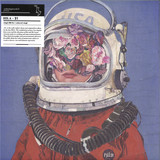
Today, internationally acclaimed interdisciplinary artist Hyd, nee Hayden Dunham, announces her first solo musical project, along with the announcement of her self-titled EP that arrives November 5th via PC Music. More disclosure than debut, Hyd’s four-track offering lets us feel the heat that’s been building underneath, calling us back down to earth. Written on an island formed from underground volcanic eruptions 15 million years ago, the EP is produced by A. G. Cook, Caroline Polachek & umru. The EP follows Hyd’s robust career as a sculptor and conceptual artist. Deeply enmeshed in the art world and music communities, she has dedicated her practice to reinventing systems - systems of communicating, systems of sexuality, systems of interacting with our environments. Her large-scale sculptural practice, where she creates fluid, transformative art installations, has been exhibited in museums and galleries across America, Asia and Europe. Past works include GEL, a vapor that travelled through the air vents of Andrea Rosen Gallery in NYC, and 7 Sisters, a seven-act performance at MoMA PS1 that incorporated dance, music, poetry, video and scents, with additional exhibitions and performances at Fondation Louis Vuitton, Paris, the Irish Museum of Modern Art, Dublin, etc. Apart from appearances on A. G. Cook's recent Apple LP, "No Shadow" marks the first time we've seen Hayden step out musically since Hey QT, the enigmatic and controversial project she created in collaboration with A. G. Cook and SOPHIE. The EP cover and singles’ artworks were photographed by renowned artist, Torbjørn Rødland, whose images are saturated with symbolism, lyricism and eroticism. The graphic design identity is by Bureau Borsche, celebrated for their work with clients including Balenciaga, Supreme and The Face, among others. Creative direction by Hyd and Jordan Richman.
quête:asia call
- A1: Let Us Begin (Intro)
- A2: Star (Feat Sadat X, Lord Jamar & Sirius)
- A3: Feels So Good (Feat Keak Da Sneak & Ur67)
- A4: What Love Is
- A5: Christie (Feat Rum Boss)
- B1: Worldwide Peace (Feat Frequency Konstruct)
- B2: Cornbread
- B3: Eye 4 Eye
- B4: Godz Return (Feat Planet Asia)
- B5: Nice Like That (Guru Tribute) (Guru Tribute)
A Breath of Fresh Air is the triumphant, inspiring new album from Bread of Kaliwild, a longtime staple of the underground rap scene who continues to grow and shine as an emcee. And while he certainly made waves with the release of his solo debut, Daily Bread in 2019, Bread is on another level with the ten tracks on this project. It’s all part of his plan to capture the sound he loves and holds so dearly, all while pushing himself as a lyricist.
Specifically, the L.A. rap staple calls out “What Love Is” as one of his favorite lyrical moments, and it’s easy to see why when you hear it. During the third verse, he shows love to his children in a creative and heartfelt way like only he can. “What Love Is” is also one of several collaborations between Bread and living producer legend Nottz, one of the emcee’s go-to producers. The two linked for Daily Bread and kept creating magic for their tracks together on this record. Whether it’s on the politically charged “Eye 4 Eye” or on the moving Guru tribute “Nice Like That” (feat. Big Shug), Bread and Nottz are a force.
The Kaliwild rapper’s ear for production doesn’t stop there, either. His two other collaborators—beatsmiths Noah Ayala and Therealasethic—provide a wealth of warm, head-nodding instrumentals for Bread and his guests. Just listen to “Godz Return,” a funky West Coast banger produced by Ayala that also features Planet Asia. Or head to the Bay Area on “Feels So Good,” which boasts Therealasethic’s shimmering production and guest vocals from Keak da Sneak, URG7, and Gemini.
There’s so much to love about A Breath of Fresh Air, though the most remarkable aspect may just be Bread’s passion.
a 1 Let Us Begin (Intro) feat. DJ Romes
Lampen is Kalle Kalima and Tatu Rönkkö. Kalle plays guitar, Tatu plays percussions and sampler. Together they're Lampen, a duo making highly addictive "post jazz" with a musical heart far beyond genre. Call it what you will, but the main point is listening, and there's a high season for that coming as Lampen is set to release their debut album on We Jazz Records on "Kintsugi Gold" vinyl and digitally. Previously a CD only release (Karkia Mistika Records, 2020), "Lampen" presents two artists who have a knack at making music which opens up with each listen, pulling you deeper and deeper. Meditative passages flow by slowly as in a peaceful river stream, erupting into full rapids of sound when the time is right. This is sonic rafting for the curious listener.
Tatu Rönkkö (b.1983) is a Finnish percussionist and drummer who has been active in the experimental music scene of Helsinki and Berlin during the past ten years and has toured Europe, U.S. and Asia extensively. He is a forming member of Liima (DK/FI) and has performed with such artists as Ilpo Väisänen (Pan Sonic), Samuli Kosminen (Múm), Jimi Tenor, Nils Frahm, Efterklang, Raoul Björkenheim, Elifantree and Islaja. Rönkkö has been playing improvised solo concerts in people's kitchens ("I Play Your Kitchen") using only kitchenware found in each home as instruments.
Kalle Kalima (b. 1973 in Helsinki, Finland) has worked with trumpeters Tomasz Stanko and Wadada Leo Smith, sax players Juhani Aaltonen, Anthony Braxton, bass players Greg Cohen and Sirone, guitarist Marc Ducret, composers Michael Wertmüller and Simon Stockhausen, pianists Jason Moran and Hans Lüdemann, drummers Jim Black and Tony Allen and singers Andreas Schaerer, Linda Sharrock as well as with Ensemble Resonanz and Jazzanova. Kalima has composed orchestral music for Opera Lyon, Ensemble Resonanz (Chamber Ensemble of Elbfilharmony in Hamburg), String Trio of Munich Symphony, NDR Big Band, Umo Big Band and Jousia Ensemble among others.
"The past 5 years we have taken our music all over the world: Europe, Asia, Africa besides our homeland Denmark, and even though we cannot speak with many of the people we meet, our music is a universal language that transcends borders. The meetings we have had (and continue to have) all over inspire us to create new music. But of course we are the composers of the music, so this is our representation of those meetings.
Our 3rd album is called AFROTROPISM. Tropism is a biological phenomenon that indicates growth of a plant in response to the environment; so when you see a plant turning for the sunlight, this is tropism. In other words, this is not so much about the plant's roots but more about how it reacts when it touches the air, feels sunlight or rain - in other words the outside world. So AFROTROPISM refers to the fact that we are drawn towards the African traditions, but we are "growing" our own music.
On our first two albums we have recorded extensively with African musicians, and AFROTROPISM is centered around The KutiMangoes (TKM) as a band. We are developing our artistic direction by going more in depth with how we can mix our inspirations with our own musical heritage. Our musical mission is (and has always been) to mix cultures and create our own sound.
With our background in jazz music, TKM counts virtuoso instrumentalists with a heartfelt intent and sound innovators with our horns, effect pedals, synthesizers, drums and percussion from all over the world. AFROTROPISM is a further and deeper development of our trademark bold sound that experiments with synthesizers, soundscapes and a bit of electronic effects without losing it's focus on groove, melody, atmosphere and musicianship."
The KutiMangoes, July 2019
About each track:
STRETCH TOWARDS THE SUN
This track opens up with a synthesizer groove that is inspired by the polyrhythmic grooves played by the balafon (a predecessor of the piano) from West Africa. Our rolling sequence could not be played on the balafon because of the key changes, but the basic idea comes from that instrument. Quick and light, we wanted to write a song where you can feel the sun coming out and feel the energy it's rays give. The combination of the programmed groove, the horn-arrangement, the huge percussion section and the live instruments makes for a sound that we have not heard before, and it illustrates what this album is all about (and what the track's title refers to): that we stretch towards the things that give us energy – and that although our roots are in Denmark, when we encounter a musical tradition as rich as in West Africa, it changes us and our music.
A SNAKE IS JUST A STRING
The first time we saw Mali-bluesman extraordinaire Vieux Farka Touré on stage was just after we had played at a huge festival in Burkina Faso, and we almost literally caught on fire. Their groove was so strong and insistent that we were mesmerized, and it inspired us to come up with the opening guitar part of this song. Basically a bluesy tune with some unusual chord changes and a crazy synthesizer solo by Johannes Buhl Andresen reminiscent of that fuzzy guitar-sound we love so much in the Mali blues. The title is an homage to the Nigerian writer Chinua Acheba, who in his masterpiece novel "Things Fall Apart" tells that in the village during the night, to ward off the fear of darkness, people would call dangerous animals by a different name: don't be afraid, a snake is just a string.
KEEP YOU SAFE
It is a basic human necessity to have a place where you can feel safe. But there are far too many people in our world that fear for their safety, their livelihood, their children, their relatives – and this is surely not a feeling that helps us to flourish as humans. With this song we are saying that we all need to make it a priority to help our fellow humans to feel safe. And of course, if our song can offer a feeling of safety and comfort for a short time to those who listen, we are truly thankful.
MONEY IS THE CURSE
This track is directly inspired by Fela Kuti's ability to create music that is both physical and political. Dance music with a serious message about our times. For the solo part we wanted a more melancholy, pensive feel (than the full-on baritone-trombone melody) and also wanted to experiment with some choppy, stuttering effects to make the horns sound desperate. Money is the curse because it can become the objective of our life; money is the curse because it changes the relationships we have with our fellow humans. Money is the curse.
THORNS TO FRUIT
This melody is inspired by the scales and developments of a traditional Bambara folk-song. We love the way these melodies constantly evolve with small developments and changes. We felt like an accompaniment that is really dry, sparse and earthy would fit well and then made a contrasting solo part. As a group we are interested in how to develop our improvisations together and create sonic landscapes that evoke a distinctive atmosphere – so here, we have no soloist, but a collection of synthesizer parts, saxophone lines and guitar-sounds that together create a dreamy and lush ambience.
SAND TO SOIL
We started out with a short ngoni riff played by our good friend and master musician Aboubacar Konaté. We then sampled it, built soundscapes and our own both meditative and pumping groove around it. We created a melody with both melancholy and joy, with afterthought and impulse and then the brilliant Aske Drasbæk added an emotive and blistering saxophone solo. The title refers to the contrasts in our humanism. As part of our human nature, we have a dark side that drives us (and each other) towards destruction – making the fertile soil into barren sand. The title is an encouragement to emphasize the opposite movement in our nature: to create life and help it flourish. We keep ourselves human by insisting that we must never forget this side of our nature no matter how tough, tiresome or trying it might be. Let's keep our focus on the light, the warmth, the positive energy – that can turn the cold stone into fertile ground.
- 01-01: Hail (Ede _ Vietnam)
- 01-02: Celebrating The Festival (Cham Hroi _ Vietnam)
- 01-03: Funeral Music (Krung _ Punong _ Cambodia)
- 01-04: Buffalo Sacrifice (Jarai _ Cambodia)
- 01-05: Kids Routine After School (Krung _ Cambodia)
- 01-06: Duet Gongs (Coho _ Vietnam)
- 01-07: Funeral Music (Churu _ Cambodia)
- 01-08: Ghet Khil (Ede _ Vietnam)
- 01-09: Offering To The Spirits (Punong _ Cambodia)
- 01-10: Sre Don (Ma _ Vietnam)
- 01-11: Preparation For The Buffalo Sacrifice (Vietnam)
- 01-12: Chasing Birds To Protect The Rice Fields (Bahnar _ Vietnam)
- 01-13: Cutting The Bamboo (Mnong Prang _ Vietnam)
- 01-14: Song For A Dead Man (Ede-Bih _ Vietnam)
- 01-15: Harvesting (Mnong _ Vietnam)
- 01-16: Funeral Music (Se Dang _ Vietnam)
- 01-17: Harvesting (Tampuan _ Cambodia)
- 01-18: Buffalo Sacrifice (Jarai _ Vietnam) 01-19. Melody For Funeral Music By Mouth (Tampuan _ Cambodia)
- 01-19: Melody For Funeral Music By Mouth (Tampuan _ Cambodia)
- 01-20: Threshing (Ede-Bih _ Vietnam)
- 01-21: Hail (Ede _ Vietnam)
- 02-01: Rooster Dance (Isneg Grop _ Luzon Philippines)
- 02-02: Music For Funeral Ceremony (Sumba _ Sumba Island Indonesia)
- 02-03: Hedung Dance (Lamaholot _ Solor Island Indonesia)
- 02-04: Gong Music Ensemble (Kenyah _ Borneo Indonesia)
- 02-05: Manang Sirang Ritual (Iban _ Borneo Indonesia)
- 02-06: Tau Todu (Sumba _ Sumba Island Indonesia)
- 02-07: Soka Dance (Lamaholot _ Solor Island Indonesia)
- 02-08: Harvesting (Pagaddot) (Ifugao _ Luzon Philippines)
- 02-09: Tadok (Kalinga _ Luzon Philippines)
- 02-10: Harvesting (Kandingngang) (Sumba _ Sumba Island Indonesia)
- 02-11: Eagle Dance (Turayan) (Kankanaey _ Luzon Philippines)
- 02-12: Cole Oha Ritual (Lamaholot _ Adonara Island Indonesia)
- 02-13: Ritual For Calling Back Spirits (Bissu _ Saluwesi Indonesia)
- 02-14: Ambience_ Rambu Solo (Toraja _ Saluwesi Indonesia)
Gongs have played an integral role in the mythogeography of Asia. This is not music that aligns with national borders or ideas of homogenous populations, let alone racial stereotypes and exotic clichés. What connects all of these tracks is a simultaneous feeling of entrancement and social cohesion. Communal and collaborative, its form is hypnotically repetitious, melodies and rhythms spread out among the players using the technique of hocketing in which a flowing line is distributed among all the musicians. The effect is mesmerising, immediately intoxicating to anybody who loves Chicago footwork, free improvisation, Sun Ra or young hip hop producer Jetsonmade. The music is simple yet mysterious and enveloping, a sound world in which to disappear. A theory exists but this is not explained. - David Toop (extracts from the liner notes)
This project, Massif and Archipelago, is a field recording project initiated by Japanese sound artist Yasuhiro Morinaga, documenting traditional gong music by different Southeast Asian ethnic groups. The project aimed to examine the impact of the natural and social environment on the gong music culture of Southeast Asia. During the project, he visited over 50 different ethnic groups and made hundreds of recordings. This album presents a selection of the unique gong music from different ethnic minorities. The selected music has been divided into two broad sections: one focussing on the music from the Massif, i.e. mainland Southeast Asia (Central Highland of Vietnam and Northeast Cambodia), the other on music from the Archipelago, maritime Southeast Asia (the Luzon Islands of the Philippines, Borneo, Sulawesi, and the Flores Islands of Indonesia).
“As a human being it’s really important to feel and express
emotions whether happy or sad,” says Hiro Amamiya, the
Teleman drummer whose solo guise is Hiro Ama. “I sometimes
struggle to and so these are a collection of songs that explore
different emotions. I want people to feel something through my
music so I called this EP ‘Animal Emotions’.”
Amamiya follows up on swiftly on 2020’s field recording-heavy
EP ‘Uncertainty’ with a record made in his bedroom and during
a time of introspection to create something even more personal.
“On ‘Uncertainty’ I was using sounds from everywhere and
whatever sounded good,” he says. “But for ‘Animal Emotions’ I
stuck with fewer instruments so the EP feels much more united.
I also used more acoustic instruments as I sometimes feel
electronic music in general lacks some organic and human
elements so I tried to make this EP as organic as possible.”
However, buried beneath the warm electronics, gently pulsing
grooves, infectious melodies and immersive soundscapes - that
veer from disco strut to IDM via jazz-laced ambient - you’ll still
find some field recordings. “You might not hear them as
obviously as on my previous EP but field recordings are there,”
he says. “I like them because it's very spontaneous and gives
some human feel. It also adds some air to a recording which I
quite like.” On the opener ‘Free Soul’ - which marries funk bass
with subtle electronics and squelchy grooves - you can hear a
voice sample of a woman from Southeast Asia singing a lullaby.
“I wanted to make an up-tempo and danceable song so I can
dance in my room during the lockdown. I got lost in Jazz music
the last couple of years and it really changed and opened up
the way I make music.” The moods, tones and emotions on the
EP shift as seamlessly as the genres, never quite settling into
one single place and constantly exploring and expanding into
new musical terrain. A process mirrored by Amamiya’s own
varied influences and tastes that were funnelled into the record,
from film soundtracks to IDM to spiritual jazz such as
‘November Cotton Flower’ by Marion Brown and ‘Harvest’ by
Pharoah Sanders.
- A1: Jah Woosh - Woodpecker Sound
- A2: Machine Gun Hogg & Co. - Bed Bound Saga
- A3: Prince Far I & Creation Rebel - Quanté Giubila
- A4: The Chicken Granny - Quit The Body
- A5: Alan Pellay - Parasitic Machine
- A6: London Underground - Dreams Are Better
- B1: Suns Of Arqa - Asian Rebel
- B2: Alan Pellay - Demonic Forces
- B3: The Mothmen - Afghani Dub
- B4: Jeb Loy & The Il Wells - Things That Made U.s
- B5: New Age Steppers - Yipee I Aah
- B6: Judy Nylon - The Dice
First volume – though the 2nd never happened – of this ongoing collaboration between post-punk stalwarts Cherry Red and home of the western dub On U Sound. Adrian Sherwood obviously sitting behind the desk and a cast of marvelous artist leading the way for a reggae renaissance. Stolen and contaminated songs, we may take this as a reference point for 12 unreleased tracks showing the best of the UK underground rhythms. A further development of the Jamaican heritage, with handmade electronics and a forward thinking production. Mothmen ‘Afghani Dub’ is one of the leading track here, with future members of Durutti Column and Simply Red on board, this is a mystical post-industrial trip through upbeat rhythms. Along the way you’ll find the over the top vocal performance of Judy Nylon – more akin to certain no wave expressionism – futuristic vibes from Sun Of Arqa, contribution from New age Steppers supergroup and Creation Rebel teaming up with the so-called Jamaican ‘Voice of Thunder’ Prince Far I. All in all a (natural) mystic experience.
In March 2020, Tahiti 80 had a plan to start recording their new album in the studio. That plan, of course, along with everything else in the world, got derailed. But the five-piece group was resilient and resourceful. They quickly shifted to a socially distanced plan B that included file swapping and virtual sessions, all refereed by producer Julien Vignon. The result, due for release in March 2022, is the buoyant Here With You, a collection of eleven upbeat songs that unfold like a prescription for a post-pandemic panacea.
“When lockdown in France happened, we said, 'We're not going to stay at home not doing anything,'” says singer-guitarist Xavier Boyer. “And our new plan became a hopeful thing, waking up every morning and seeing what the other guys had worked on. It wasn't always easy, but this new method allowed a freer approach where we could really go all the way with an idea without being influenced by each other’s suggestions. It must've been overwhelming for Julien, who ended up selecting all our arrangements. But he stayed positive all the way through.”
To help stay inspired and focused during their time in isolation, the band created a mood board, with the centerpiece a photo of an early '90s rave in the UK.
Boyer says, “Whenever you see pictures from this era, people seem very innocent. There are no cell phones and everybody is in to what they are experiencing. We kept that picture in mind as a kind of mantra that would help everyone feel connected to this idea of people celebrating, gathering and just having fun. We were missing the connection with people, and thought it would be great if we could create music that would inspire that kind of emotion.”
Indeed, the songs on Here With You are brimming the feeling of communion that we've all been missing over the past two years. It's there in the catchy opener Lost in the Sound, which walks the walk with Chic guitar flicks, urban nightfall sparkles and an inviting chorus (“Your heart grooves like a thousand 808s on the right time”). It's there in the Jackson 5-style syncopated bounce of “Vintage Creem,” the lush, dreamy “Breakfast in L.A.” and the panoramic sweep of “UFO.” And it's there in the first single “Hot,” which matches an irresistible groove with a neon-lit, percolating arrangement that evokes the disco clubs of 1979.
What's remarkable is that though Tahiti 80 displays a clear affection for sounds of the past, from bubble gum to '70s soul, they never trade in mere pastiche. Their take is more a slightly warped and playful carnival mirror mash-up of classic pop styles, given depth through Boyer's hang-gliding, coolly emotive vocals and lyrics that often rub against the euphoric grain of the music.
“I like to think of songs as a three-minute drama,” says Boyer. “This concept of drama definitely adds different levels to our music. There's the melody, the lyrics, then the production that can maybe emphasize or counterbalance the interaction between the yin and yang in a song.
“There's a difference between the very upbeat, sunshine-y soft rock and the lyrics, even on our past albums,” he continues. “Not dark, but a little more melancholy, and also looking for some kind of motivation, talking to yourself. Like with a lot of Motown songs, you get that feeling where you body’s dancing while your mind’s reflecting, reminiscing.”
That alluring blend of happy-sad has been a signature part of the Tahiti 80 sound from the time Boyer and bassist Pedro Resende formed the group in 1993, as students at the University of Rouen. Taking their name from a souvenir t-shirt given to Boyer's father in 1980, the duo recruited guitarist Mederic Gontier in 1994, and with the addition of drummer Sylvain Marchand a year later, the lineup was complete. The foursome released a self-produced and self-financed EP, 20 Minutes, in 1996, which resulted a record deal with French label Atmospheriques in 1998. Their full-length debut Puzzle, produced with Ivy's Andy Chase and mixed by Tore Johansson, went gold and featured the international hit “Heartbeat” that established the band throughout Europe and Asia.
In the years since, Tahiti 80 – with the additions of Raphaël Léger on drums and Hadrien Grange on keys - has released eight acclaimed albums. The band has fused what MOJO called a “glorious entente of old and new technology” (including singles like “Yellow Butterfly,” “1000 Times,” “Sound Museum,” “Crush!” and “Big Day,” which was featured on a FIFA video game soundtrack), while collaborating with such producers and arrangers as Richard Swift, Tony Lash and Richard Anthony Hewson, who famously arranged The Beatles' “Long and Winding Road.” Boyer has also put out two solo albums, the first under the anagram Axe Riverboy and the second under his name. In 2019, the band released Fear of an Acoustic Planet, a stripped-down reimagining of some of their best-loved tracks from the previous twenty years. It served not only as a look back but a reminder of their formidable songwriting skills.
Boyer is definitely a student of the timeless three-minute pop song format pioneered by '60s artists like The Beatles and The Beach Boys. He says, “I see it as kind of a frame for a painting. Most of the songs on this album, I wrote a verse, pre-chorus and chorus. There aren't many middle eights. I wanted it to be very concise. I feel like people have less attention. There's so much music. It's too easy to switch off or skip to another track, so I want to hook the listener. The three-minute song is kind of an easy code to crack, but at the same time you have to figure out a new way to tell the stories that we've heard before.”
And the stories on Here With You are very much about the longing for connection. Of the album title, Boyer says, “In the world right now, that can mean a lot of different things. Like missing our fans, missing going to concerts. In a way, it can be a statement of what happened last year, and a wish of 'I want to be here with you again.' It's our ninth album. We've had some had some very open, conceptual titles like Puzzle, Activity Center. Sometimes they were more specific like Fosbury orWallpaper for the Soul. Here with You, seems more personal, more engaging in terms of relationships. When I suggested that title, everyone in the band said, 'Yeah, that's it.'”
Until Tahiti 80 can resume a full tour schedule, Boyer says he hopes the new record will make that personal connection. “If I see from the point of view as a music fan, sometimes I see albums I like as companions throughout my life. So if we can be a part of people's existence, even if it's a song that reminds them of the time they were driving with the windows open and it was sunny. Or a sad song that resonates with them after a breakup. That's what we're all looking for when we're making music. You do this very personal thing and you want it to touch as many people as possible.”

Multi-instrumentalist UMUT ÇAĞLAR (KONSTRUKT, KARKHANA), former BABA ZULA-drummer FAHRETTIN AYKUT and the Finnish saxophone player / shakuhachi specialist JONE TAKAMAKI join forces in a stunning improvised live set that blends Free Jazz with East-Asian ZEN-sounds.
The idea for "Myth Of The Drum. Urban Transformation" dates from an art exhibition in Istanbul 2017 where FAHRETTIN AYKUT exhibited an installation called "Urvban Transformation" that combined painting and music, dealing with the relation of humankind and earth which is symbolized through a tree put upside-down.. AYKUT, former drummer in the Turkish group BABA ZULA and these days a well-known architect in Turkey, asked his longtime friend UMUT CAGLAR, multi-instrumentalist in KONSTRUKT and KARKHANA, to join for an actual performance … CAGLAR on his side was in touch with JONE TAKAMAKI who has been a central figure of the Finnish Free Jazz / Avantgarde scene since the 1970s. His album "Universal Mind" (1982) is a sought-after collector's item of European Spiritual Jazz, he was a member of the group ROOMMUSHKLAHN (with RAOUL BJÖRKENHEIM a.o.) and in 1991 he joined the ECM signed Finnish jazz/rock/improv collective KRAKATAU, founded and run by RAOUL BJÖRKENHEIM, and last but not least TAKAMAKI received the first ever Pekka Pöyry Award. Besides being deeply rooted in jazz, he is also a specialist in Japanese shakuhachi and hocchiku flute playing which makes this adhoc-trio so extraordinary: repetitive drumming, shamanistic throat sounds and plenty of string and reed instruments, a constant ebb and flow of sounds and energy … neither pure jazz nor world music but a blend of both, forming a fascinating third! Meditative in its continuously pulsating rhythm, cathartic in the moments of sonic outbursts …
A few months after the Istanbul art fair performance, the trio (augmented to a quartet by ALAN WILKINSON) played 2 showsatLondon's Cafe OTO and gossip has it saying that THURSTON MOORE who attended the show confessed afterwards that he was very touched emotionally.
Credits:
All Music by Fahrettin Aykut/Umut Çağlar/Jone Takamäki.
A Konstrukt Joint.
Jone Takamäki: tenor saxophone, ney, shakuhachi, clarinet.
Umut Çağlar: guimbri, kalimba, gralla, zurna, mey, flutes.
Fahrettin Aykut: electronic percussion; drums, cymbals.
Recorded live at BantMag. Havuz/Bina in Istanbul (October 3rd, 2017) through a Tascam portable recorder.
Produced by Umut Çağlar.
Mastered & cut by Anne Traegert at D&M, Berlin
"Social injustices are implanted into our society, and the powerful are not willing to make way for real change. Urgency is the force driving us both in musical improvisation and life. Our sounds are war sirens against an ongoing disaster."- Simon Grab & Francesco Giudici
Simon Grab & Francesco Giudici's 'No Surrender' is a strong and uncut manifest against social injustices, packed into screaming feedbacks and towering drones. Grab lures tender noises and pulsating frequencies from his fragile no-input-mixing-setup, while Giudici adds linear and visceral guitar drones, opening a dialogue between the two musicians, the room, and the surrounding context. Together, they create a uniquely soft but angry musical creature that feeds from emotions of loss and anger to become a haunting call for change.
The album's cover presents a portrait of 'Madame Rochat' by photographer and film maker Aline d'Auria. The seemingly indestructible concierge was stripped from her home of half a century on the day of her retirement. Still, she persistently continued to fight for the working class' rights. '
Focusing on reduction and the peculiarity of self-referential systems, Simon Grab plays fragile feedbacks, pulsating drones and opulent outbursts of noise on a no-input-mixing setup. His has previously released"Posthuman Species" and "Extinction" on -OUS, while "Diamonds", a collaboration with Togolese rapper Yao Bobby and Asian Dub Foundation's Dhangsha, came out via LavaLava.
Experimental musician and sociologist Francesco Giudici plays guitar in bands and creates music for films, installations and theatre pieces. He has released three albums with his band 'Black Fluo' on PulverUndAsche Records. His research as sociologist and demographer focuses on social and economic inequalities, social gradient in health, gender inequalities, occupational and familiar life trajectories.
- A1: Summer (Feat. Matt Blaque & Rydah J Klyde)
- A2: Just A Celebrity (Feat. Sky Balla)
- A3: Glamorous Lifestyle (Feat. Andre Nickatina)
- A4: Greatest Alive (Feat. E-40, Mitchy Slick & Jynx)
- A5: They Don't Know (Feat. Freeway)
- B1: Dream (Feat. Ampichino & Zion I)
- B2: Won't Be Right (Feat. Cellski)
- B3: Keep Callin' (Feat. Devin The Dude)
- B4: Girls
- B5: Scared Money (Feat. Krondon & Ap.9)
- C1: Get It In (Feat. Paul Wall & Masspike Miles)
- C2: What's Your Zodiac (Feat. Phil Da Agony)
- C3: Dopest Forreal
- C4: Callin' My Name (Feat. Mistah F.a.b.)
- C5: What Happened To The World
- D1: The Movement (Feat. Planet Asia)
- D2: Storm (Feat. Cormega)
- D3: Our Heroes (Feat. Dubb 20 & J. Stalin)And "Glamorous Lifestyles Feat. Andre Nickatina
Released in 2009, Tear Gas is the fourth and arguably most notable studio album from The Jacka. Peaking at #93 on the Billboard Top 200, the 19-track album is packed with features from both Bay Area and national legends, such as Andre Nickatina, Matt Blaque, E-40, Mistah F.A.B., Cellski, Zion I, AP.9, Dubb 20, J. Stalin, Devin The Dude, Paul Wall, Masspike Miles, Planet Asia, Cormega, Ampichino, and Freeway. The album features the hit singles, "All Over Me feat. Matt Blaque," and "Glamorous Lifestyles feat. Andre Nickatina"
"Kazakh artist Galya Bisengalieva’s debut album was released by One Little Independent in September 2020 and is a concept record about the shrinking of the Aral Sea, which has been called one of the “20th century’s more jaw-dropping ecological catastrophes, a consequence of the Soviet-era policy of diverting the two tributary rivers to irrigate cotton plants across Central Asia” (NY Times)
Now, roughly a year later, Galya is releasing Aralkum Aralas. In Kazakh aralas means mixed/reworked. Galya has thoughtfully curated a remix album of artists to respond to her work having previously commissioned new work for her label NOMAD Music Productions. Those musicians are; Coby Sey, Jing, Moor Mother, Jlin, CHAINES and Nazira. Galya approached artists whose practise she judged would resonate with her source material and bring new light to the narrative. She was interested in getting responses from artists from diverse backgrounds for their insight into her voice."
Tony Scott (born Anthony Joseph Sciacca June 17, 1921 – March 28, 2007) was an American jazz clarinetist and arranger with an interest in folk music around the world. For most of his career he was held in high esteem in new-age music circles because of his involvement in music linked to Asian cultures and to meditation. Tony performed with many star as Billie Holiday, Sarah Vaughan and Harry Belafonte and before moving to Italy in the early ‘70’s he just cut two sought after masterpiece moving forward from his early idea of bop and cool jazz. In particular ‘Djanger Bali’ (1967 Saba) - recorded with The Indonesian All Stars - and the self titled Tony Scott (1968 Verve) - featuring Richard Davis on bass, John Berberian on oud and Attila Zoller on guitar – set the pace for a revolution in terms. This set recorded in Africa around the mid 90’s is a pure rhythm festival pushing the boundaries of his afro fusion agenda
The trio of fiddle player Erlend Apneseth with guitarist Stephan Meidell and drummer Oyvind Hegg-Lunde follows up their Nordic Prize-nominated album of 2019, ‘Salika, Molika’, with a remarkable suite of tunes inspired by the rhythms and physicality of the human body in motion.
Originally commissioned by FRIKAR Dance Company to accompany the performance of a new work, ‘Skaut’, dealing with the covering of the body in different cultures, the music of ‘Lokk’ takes the trio further than ever before into completely fresh areas of electro-acoustic improvisation.
The sounds of their original instruments are integrated with electronic beats and treated textures to form a kind of enhanced digital-folk style whose influences stretch from traditional south Asian ragas to contemporary dance culture from around the globe.
The result is intense, and intensely rhythmic, music where the normally separate realms of the cerebral and the corporeal can appear to fuse into one irresistible groove.
As the trio rocks on - in a dream of perfect interplay between instruments and players, soloists and ensemble - deep, trembling sub-bass intersects with ethereal ambient soundscapes. Elsewhere, the twittering of birdsong - from both real bird-calls and the uncanny imitation of them by Apneseth’s Hardanger fiddle - meets archival recordings of Norwegian herdswomen.
“Our musical idea for this project was to unite different extremes, connections that felt “forbidden” in one form or another”, says Stephan Meidell. “For example, by using the sampled recording of traditional herd-calling, blended together with aesthetics from more contemporary music styles. This exploration has led us further into a rhythmic and danceable landscape than in previous releases. We also wanted to use this opportunity to deliberately make more dance-related music. As regards the original commission, were pretty free to do what we wanted, but there was one specific dance in mind, ‘Valdresspringar’, for which Erlend wrote the melody. It’s a traditional, asymmetrical dance and has a very particular form. The melody is on the track called ‘Springar’, which we then messed around with.”
This “messing around with” element is key to the sound of ‘Lokk’, whose playful experimentation over the nine separate tracks creates a beguiling, constantly surprising sense of adventure and intrigue that both draws the listener in, and then keeps them on their toes as to where the next stage of the journey will take them. It also becomes inescapably obvious that this is a group of three equals.
The contributions of Stephan Meidell and Oyvind Hegg-Lunde, as musicians, co-composers and producers, appear every bit as important as that of Erlend Apneseth, who performs superbly throughout. “Even though the trio carries Erlend’s name, it’s a band in every sense of the word”, says Stephan Meidell. “We make the music together, where everyone brings their ideas and we build on each other’s input and output. This is not our “coming out” as a band, but the group is sometimes interpreted as having a hierarchical structure, as a soloist and accompaniment.”
As is evident from the trio’s live performances, where each member seamlessly integrates the acoustic and the electronic elements in their respective sounds through constant monitoring and tweaking, Apneseth, Meidell and Hegg-Lunde are also pioneers,
creating real-time effects that in the past were only available through post-production or the intervention of a sympathetic engineer and a truck-load of kit. ‘Lokk’ translates this fleet-footed improvisational approach, and the players’ lightning-speed reaction times, back into the environment of the recording studio, where the music composed for the original FRIKAR dance piece was further embellished and adapted. Played live, it will continue to change again, as improvised music always does.
After NEF's album in 2019, Ici Bientôt is happy to present today the reissue of Comme Au Moulin by Nyssa Musique.
Paris 1985... ‘Extra-European’ Traditions meet Jazz and Minimal Music. An unusual array of instruments turn music into a dialogue. For a unique record ... vivid, full of texture, somewhere between Midori Takada, Don Cherry and Jon Hassell.
Beginning of the eighties, 5 musicians rehearse in a contemporary dance class hall, upstairs from the ‘’New Morning", renowned Music venue in Paris. Nyssa Musique is born. Passionate for a long time about traditional music, like those of the Middle East, India and East Asia, but also about African traditions, they throw a bridge between Jazz and ‘Extra-European’ traditions, resulting in what would be called "Spiritual Jazz" today, a little bit in the style of Don Cherry's Organic Music or Pharoah Sanders. With the notable difference, however, that their creations are strongly infused by contemporary classical and repetitive music, notably Steve Reich's work with whom they share a great interest for the traditional cultures of Southeast Asia, particularly Indonesia and its gamelans.
In the original group we have Armand Amar, Ballet Music composer and John Boswell. Both specialists of traditional hand percussion which they had been studying for a long time in India and the Middle East, they are also very fond of synthesizers. Three other talented musicians quickly join them: Jean-François Roger, percussionist, marimba and vibraphone specialist, Henri Tournier, multi-flutist and Renaud Garcia-Fons, double bass player, who has a passion for the Middle East and has developed a virtuosic play of the bow, reminding that of Cecil Mc Bee.
Each of them enriches the ensemble with their personality, originality and musical generosity. The rehearsal hall is rapidly invaded by the phenomenal instrumentarium put together by Armand Amar. A great opportunity for the musicians, for the dancers, to have access to an endless choice of instruments, offering infinite possibilities for mixing different colors and timbres. Their sense for being a group and their great capacity for improvising culminates, in 1986, in the composition of their first and only album Comme au Moulin (« As by the windmill"), testimony of years of creating without hidden agenda.
Authentic, free and vibrant, still today, this album has no real equivalent. Even though it recalls the Fourth World current by its combination of traditional instruments with a subtle use of synthesizers, Comme au moulin gives more space to improvisation. It may also recall those of Midori Takada, less the New Age esthetics. An album that should delight as well lovers of "Love Supreme" by John Coltrane, of "Vernal Equinox" by Jon Hassell, as those of Moondog, an artist who, like them, invented a music based on the use of untypical percussions, at the confluence of 'Extra-European' traditions, Jazz and Classical, all together complex and hypnotic.
Kink Gong is back with his unique take and re-interpretation of the music he’s been recording and documenting for years in the South East Asian highlands.
Zomia Vol.1 takes the conceptual idea of ZOMIA, proposed by James C Scott in The Art of Not Being Governed, an Anarchist History of Upland South East Asia, to construct its very own mythological soundscape inspired by a semi-utopic region where state rules don’t apply. Zomia might be (almost) gone but Kink Gong is keen keep its spirit alive by releasing a series of albums celebrating the region’s quasi mythological features.
‘’Zomia is an idea, a concept that, not so long ago, there were two very distinct worlds in southeast Asia, the valley VS highland/hinterland, the civilisation VS the primitive, paddy rice VS slash and burn agriculture, Buddhism VS Animism, fixed territory VS movement/migration, written system VS oral culture, the state VS anarchy, property VS squat, controlled population VS autonomy, bricks VS bamboo and wood and, at my level museumified traditional mainstream music VS real emotions/songs of devastated lives and/or gongs ceremonies with buffalo sacrifices, extreme heat in the valleys VS shade in the jungle. I could go on and on but let’s not forget that ZOMIA is disappearing fast, if not altogether already. How many of the people I’ve recorded are still alive?
As you might know, before composing new music from my own ZOMIAN experience (from 2001 to 2014 in Cambodia, Laos, Vietnam, Thailand and China) I had to find those musicians, be able to communicate with them, record them as good as I could with very limited finances and gradually release a collection of 160 CDrs. It is very important for me to make sure you to listen to the fantastic original recordings before or after you’ve listened to this experimental reconstruction I called ZOMIA!
Expect more volumes to come, this is my biggest source of inspiration, and the reason why I’ve been involved for years in constructing a mythological experimental musical ZOMIAN soundscape.’’
Laurent Jeanneau, Berlin 2020
"21" is the well-crafted, sharp and original first album by the duo HILA, composed by American cellist Artyom Manukyan (who already worked with Kamasi Washington, Daedalus, Flying Lotus, Run DMC, Gretchen Parlato, Raphael Saadiq, Clive Lowe Mark...) and french producer Dawatile.
The combination of jazz, Los Angeles beat-scene and the vibrations of 80s and 90s Soviet Armenia make it a striking and unprecedented fusion. These kind of nostalgic and unconventional references forcefully shake the codes of mainstream culture to create a sincere, raw and intimate expression.
"HILA" was born from a spontaneous and intense creative impulse between Artyom Manukyan, a Los Angeles-based Armenian celloist and his partner in crime, David Kiledjian aka Dawatile, a French multi-instrumentist of Armenian descent. This project is proving to be a true master stroke given that it only took 21 days for the duo to make it a reality.
"HILA" was made in less a moon cycle but captivates and electrifies audiences upon its first outings. "H.I.L.A" colors the warmth of the Californian "High" with Armenian vibes. The artists chose this name for their creation since both have a close and valuable connection to these locales. This journey began in 2007, on the day Dawatile went to Yerevan, the capital of this small country in the Caucasus mountain to realize a first fusion project centered around local folkloric music genres.
There he was introduced to local musicians including the Armenian Navy Band, one of the country's foremost groups in which Artyom played the bass and cello. In this context, he also met many musicians such as Tigran Hamasyan and Norayr Kartashyan. This will be the beginning of connections between Lyon, Yerevan and Los Angeles. The following year, the two artists will be be seen performing next to Taylor Mc Ferrin at the Jazz à Vienne festival. More recently, they partnered up again when the cellist, who had freshly relocated in California, invited Dawatile to produce his album. As soon as the studio’s threshold was crossed, they decided to postpone this record and create a joint project: Hay (as the Armenians call themselves) / High In Los Angeles. HILA was born at the end of these 21 days of intense creation. The association of Artyom Manukyan and Dawatile is the combination of two visions, two versions of Armenia, two personalities, the reunion of the Eastern and Western blocs.
One grew up nurtured by the sounds of hip-hop and jazz in Europe and the other by art music and Russian-influenced 1980s Armenian folkloric music before moving to L. A., Ca. The cornerstone of it all, the glue that unites everything : Armenia and music. They generate a new identity synthesizing two perceptions, their complicity transcending these cultural discrepencies. To achieve this, they will scour through images of Artyom’s childhood, within the popular culture of Soviet Armenia. Together, they revisit this decidedly retro vibe, based on the work of Caucasian groups inspired by African American music. This background is rehashed and fused with ancestral Armenian sounds. The DNA of the album "21" is molded by these dear influences.
We can also hear the ancestral sounds of Armenia, a country at the edges of both Europe and Asia. The presence on two tracks of Armenian music Master Norayr Kartashyan, infuses the languor of past melodies and traditions. These purposeful anachronistic sounds offer a fantastic depth to this powerful opus. Listening to the album, one can appreciate the successful fusion of styles and influences. Those combinations, however, manage to preserve individual identities only to enhance the art through an adamant musical dialogue.
Being driven by the urge to transpose Armenian musical traditions into a unique universe, the daring artists, offer an innovative combination by blending, for the first time, these ancestral sounds with the world of Los Angeles beat-scene and jazz. An invention largely fueled by the magic strings of Artyom and maestro Miguel Atwood-Ferguson, a pillar of the genre in Los Angeles combined. These associations resonate with a triumphant equilibrium. HILA is musical uncharted territory in which Artyom's cello strings intertwine to ignite the harmonies of keyboards, the machines, the vocals and electronic layers Dawatile pieced together. HILA plays the soundtrack of an adventure set between Armenia around the end of the Soviet era and a mysterious near future.
Artyom Manukyan grew up in Armenia in the 90s. At the time, he studied Russian classical music while learning jazz with assistance by his father, a music journalist. Being an unconditional music lover, he went on to sharpen his skills at the prestigious Berkelee College of Music. Subsequently, he’s been lucky enough to travel the world touring with numerous acts and mainly with the Armenian Navy Band. The group has fostered alacritous success honored by a BBC Award as a crowning achievement. He moved on 10 years ago and made his way to L.A. with his cello on his back. In the City of Angels, he quickly became a popular figure of the jazz and hip-hop scenes thanks to his first album "Citizen". He’s accompanied prestigious musicians such as Kamasi Washington, Melody Gardot, Daedalus, Flying Lotus, Run DMC, Gretchen Parlato, Raphael Saadiq, Clive Lowe Mark, or Vulfpeck. He released his solo album on the cello, "Alone" in October 2019.
Dawatile is a bold producer and multi-instrumentist as well as a passionate and resolute musician molded by jazz. As a versatile artist, he handles and juggles the saxophone, the keys, the bass and composition. Simultaneously, Dawatile produces cross-over projects and soundtracks for the movie industry. He, as well, has had the opportunity to be a part of many tours, including with his electro hip-hop band, Fowatile and more recently with the "Future Kreyol" trio, Dowdelin. Being the ever workaholic, he has under his belt a string of prestigious collaborations with the likes of Talib Kweli, Foreign Beggars, Roy Ayers, Tigran Hamasyan, Mathieu Boogaerts, Voodoo Game and Piers Faccini. His taste for developing new musical recipes and his know-how in production make him a much sought-after album producer. In concert, the HILA duo offers a sober, precise and rhythmic performance. "21" is an aerial and lively album taking the audience on an at times joyous and sometimes melancholic dreamlike journey. The magic of "HILA" operates at the speed of light and positions it already as an avoidable group.
Tape / Cassette
Mark Gergis is a producer, musician and audiovisual archivist known for his radio and video productions, recordings and performances. His work has focused on regional folk-pop music from the Middle East and Southeast Asia, including choubi and dabke from Iraq and Syria. As an archivist, Gergis is currently working on the project Syrian Cassette Archives, for which he aims to restore, preserve, catalogue and share his large collection of Syrian media from what can be called Syria’s ‘cassette era’ (1970s–2010). As an artist, under his name and others (Porest) he has released music on the Sublime Frequencies, Discrepant and Nashazphone to name just a few. It’s a wonder that amongst this hectic schedule he still finds time to present us with a new (old) collection of early century recordings (1999-2013).
Locational recordings, radio and TV intercepts, cassette excerpts, environments and street music all expertly all expertly meshed up into a vivid sound journey from places that were (and might) never be again.
Luciano Berio/Pierre Boulez/Olivier Messiaen/Karlheinz Stockhausen
Serenata I / Sonatine / Cantéyodjayâ / Zeitmasze
The avant-garde composer and conductor Pierre Boulez was a titan of post-War experimental classical music. Born in the small cheesemaking town of Montrbrison in central France in 1925, Boulez studied at the Paris Conservatoire with the composer and organist Charles Messiaen and received private tuition from pianist Andrée Vaurabourg; after moving to the Marais district in 1945, he briefly studied with Schoenberg disciple, René Leibowitz, and further influence came from immersion in Balinese gamelan, Japanese classical music and African drumming, among other sources. Earning money by playing an early electronic keyboard called the ondes Martenot on theatre productions, Boulez soon became music director of the Renaud-Barrault theatre company (led by actor/direction Jean-Louis Barrault and his actor wife, Madeleine Renaud), leading to tours of Belgium, Switzerland, Britain and both North and South America. American composer John Cage became an ally, though they subsequently clashed over Cage’s commitment to the role of chance in his compositions, paving the way for an intense and lasting friendship with the German composer, Karlheinz Stockhausen, who arrived in Paris in 1952 to study with Messiaen. In July of that year, the pair attended the International Summer Course for New Music in Darmstadt, leading to contact with Italian composer Luciano Berio and other noteworthy figures. Then, in 1954, with backing from Barrault and Renaud, Boulez began staging a series of concerts of experimental music at the Petit Marigny theatre, titled Le Domaine musical. The pieces collected on this album are all taken from performances staged for the 1957 Domaine musical season, beginning with Berio’s “Serenata I,” conducted by Boulez, which debuted in Paris in March of that year; arranged for flute and fourteen instruments, Berio said that the idea behind the piece was for the solo flute to be confronted by continuously interchanging elements, rather than mere accompaniments or oppositions. Boulez’s own “Sonatine,” composed in 1946 for flute and piano, is a 12-tone piece that evidences Messiaen’s influence, with shades of Asian classical music in places; then, Stockhausen’s monumental “Zeitmasze” or “Time Measures,” a serial composition for five woodwinds, played in different combinations of tempos and speed, was partly inspired by Webern’s principles of homogenous and harmonic textures. Finally, Messiaen’s 1949 work “Cantéyodjayâ,” delivered by pianist Yvonne Loriod, takes it shape from the classical Hindu rhythms of ancient India, as with much of the composer’s oeuvre.
Untameable Anatolian feline fuzzy folk funk finally uncaged. A spontaneous Turkish-Norwegian-Dutch expedition, where seafaring jazz cats entangled with fugitive roadies and Tee-Set mods, makes the story of Durul Gence’s highly anticipated/ill-fated Asia Minor Mission group the stuff of lost-rock legend and remains one of Turkish music’s great “what ifs?” The black cat is finally out of the bag...
Having forged a celebrity status as one of Turkey’s premier percussionists and bandleaders, Durul Gence assembled the underground fusion group known as Asia Minor Mission (AMM) in early 1972 (with Irfan Sumer, Oguz Durukan and Ugur Dikmen) while trying to escape the constant daze of paparazzi camera flashes that followed him across Turkey. During a far-fetched post-gig brainstorm the group pondered relocating to Norway (based on fact that none of them had ever visited the country) when a local seaman who claimed to have recording studio connections in Oslo overheard them. Enlisting the roadie services of a streetwise Istanbul taxi driver friend on the run from the police AMM took the plunge, accepting the sailor’s offer of passage on his next sailing.
In these new idyllic surroundings, the same region that played host to fellow Turkish percussionist Okay Temiz, Durul found the peace he desired discovering a muse in Norway’s welcoming creative climate. Much like Barıs Manço and Mogollar in France, Cem Karaca and Gökçen Kaynatan in Germany, Gence’s relationship with Norway rekindled a passion for composition in ways he couldn’t have imagined in his homeland, opening doors thought previously unreachable. As a potential prodigal son for Anadolu pop Durul joined a wider pop-cultural diaspora alongside electronic pioneer Ilhan Mimaroglu, Tülay German (aka Tuly Sand) Kardasllar’s “Alex” Wiska (collaborator with Krautrockers Can) and Maffy Falay from the band Sevda.
Despite a blooming fan base and original repertoire the Nordic dream was not to be and after two years without a studio session, AMM called it quits during a tour of Holland after which Durukan and Dikmen went home to join Cem Karaca’s band Dervisan - Dikmen’s keyboards feature on Finders Keepers releases by Turkish singer Selda (FKR011). Retreating to the city of Delft to ponder his next move, Durul met Peter Tetteroo, former vocalist from successful Dutch psych-pop combo Tee-Set, who also found himself in a lonely boat after the demise of his long-running group. As an AMM fan, Tetteroo suggested they record two Gence penned AMM demos for Dutch Philips signed exotic songbird Sasi Naz at Peter’s home studio. A session was hastily arranged and a talented, yet unconfirmed, guitarist was enlisted. Durul maintains it was the work of Ferry Lever from Tee-Set/After Tea, something Ferry has denied, and with Tetteroo having died in 2002 the question remains. Upon entering the humble studio Durul stumbled upon a skeletal drum kit. Lacking hi-hat, toms or even a snare he cobbled together a bongo and a tambourine and set to work. Together, under the watchful eye of Tetteroo, the pair jammed stripped back versions of the AMM live staples Black Cat and Boo Song, with an added freak factor otherwise missing from their jazzier approach. Laid down in just 30 minutes, with Gence’s accomplished guide vocals and fuzzy overdubs, the rudimentary but professional recordings never made it to Philips execs and the tapes returned to Turkey under Durul’s arm as one of only two documented AMM recordings (the other being a live performance in Oslo’s Hennie-Onstad Art Centre in May 1973).
Unintended for commercial release, curiouser and curiouser, Finders Keepers proudly present these previously unheard tracks sourced directly from original tapes, which stand as a testament to the inimitable talent of Gence and the only studio document of the mythical AMM Turk jazz funk troubadours, representing a pop-psych Hollandaise holiday postcard which has taken five decades to be delivered. 45 revolutions later... The cat’s got the cream.