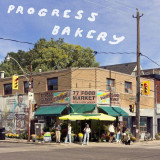
Kneading dough is tricky – you should know how it’s supposed to feel. If you try too hard you could make it worse. It’s a beautiful practice – creation with a gentle touch, to work at something so it can be left alone. “If it’s too drawn out it’s awful. It’s easy to give too much.” Dance in the mirror. Contemplate your veiny hands. Who do they remind you of?
You begin by mixing flour and water. “What happens when your people die? Why’d they move the rock to the other side of Ulster Park?” Eliza Niemi asks two seemingly unrelated questions in a rising melody with guitar accompaniment, like fingers playing spider up to the nape of your neck. Gentle pressure. Strands of gluten form to bind the mix. A new question lingers in the binding. When she admits “but I don’t know how to tell if I’m feeling it or not,” that question surfaces through the text. It is reiterated throughout the album. When I’m working with dough I think the same thing to myself.
On Progress Bakery, her second album as a solo artist, Eliza knows to leave some questions alone – to let juxtaposition and tension be the proof. It doesn’t have to be hard. The feelings and revelations they provoke rise in the heat. The smell is sweet. Crispy on the outside and soft all the way through. She playfully slip-slides through words and sounds and images, delighting in surprise, skimming ideas like stones cast across clear water, touching down briefly with uncommon grace.
The question provoked between those opening lines resurfaces in the strands between songs – “Do U FM” is fully formed and beautifully layered, while “Novelist Sad Face” is a short, acapella rendering of gentle curiosity. What is holding these ideas together? Some songs demand more, seem to carry a whole load – eventually the skipping stone will halt to sink and resume its idle duty – while others drift in and out of focus, the way thoughts and dreams become interwoven before the mind is sunk into true sleep.
Music and words don’t always have to interact. Where she decides to keep them apart gives a new contour to where and how she puts them together. The kind of thing you’re supposed to take for granted with songs and their singers comes alive in Eliza’s hands – the little miracle of mixing, kneading, stretching, and stopping.
So often on Progress Bakery, Eliza teases out truth and meaning by asking questions. “Do I wanna be crying?” “Do you want me good or do you want me bad?” “Do I need an eye test?” “I’m writing songs in my head while you’re going over stuff with me — is that cruel??” In “Pocky” Eliza ends with a question that feels to me like the actual biography, succinct and revealing:
I don’t wanna be made to see
I just wanna ask “what’s that?”
Grace that ought to be rare, but in its care and precision is offered humbly, with great generosity, and without announcing itself. Eliza’s simple, miraculous music is given further form and shape by a group of collaborators – invaluable guest musicians Jeremy Ray, Evan Cartwright, Steven McPhail, Kenny Boothby, Ed Squires, Carolina Chauffe, Dorothea Paas, Louie Short, and Avalon Tassonyi. Together with Louie Short, who recorded, mixed, and produced the album along with Jeremy Ray and Lukas Cheung, Eliza has cultivated a richness in sound and texture that prods and provokes the ticklish ear. Barely audible guitar tinkering, a brief lo-fi field recording of trumpets, the harmonic clicking of a looped synthesizer, a flourish of reeds, a child’s conversation, each uncanny sound perfectly placed, rippling out under a soft breeze.
Lay in bed alone at night and ask aloud to the stillness,
“What were you doing at the Albuquerque Airport?
What were you doing there??”
And hear your question answered by a dream of swelling, undulating cellos. Try to grasp at the melody and structure. It’s not an answer (if there could be one), but it moves deeper, closer to the weird layer of fleeting moments and disconnected images, barely perceptible at its core. Wait for the dream reel to click into place.
Eliza took me for a ride in Nicole (her beloved Dodge Grand Caravan) and told me she’d been thinking of the album as an embodiment of transition – and I think every transition, known or unknown, carries the weight of new meaning, skittering off the surface tension of life as you know it, creating ripples, sometimes bouncing off and sometimes breaking through. There is a trick you can use to tell if a dough is glutinous enough. You’re supposed to stretch it out as thin as you can without breaking it and hold it up to the light. If you can see through, even if it renders the world murky and uncertain, you should leave it alone. I love this trick. It’s one that Eliza seems to know intuitively: work gently and ask questions and don’t always expect answers, and when you can, take a glimpse at something new, and then leave.
Поиск:ask
Все
Every so often an album of such deceptive genius, of such aesthetic clarity, comes across our desk and transfixes us. Thought Leadership's III Of Pentacles is one such work of art. It's an instant classic and glides into the pantheon of timeless guitar-soul totems. Originally out on cassette only, we present the first ever vinyl issue. It's a hideously limited pressing of 300 for the world, so don't sleep on this.
Thought Leadership has already garnered big support from such tastemakers as Ruf Dug, Jason Boardman, Nathan Gregory Wilkins, J Walk, Evan Woodward, Justin Robertson and Heavenly's Jeff Barrett. The first time we heard III Of Pentacles, we nearly wept at the thought that something so beautiful, so bursting with real hope, could even exist in this brutal world. To quote the Quietus, "imagine if Stockport was situated somewhere along the Pacific Coast Highway rather than the M60, and you’ll have some idea of the coordinates to the post-industrial, sunburnt dream space opened up here."
So, who is Thought Leadership? What do we know about them? They reside in Stockport and are obsessed with ethereal guitar records. That’s about it. That and these X ideas shared with you, the listener.
Captured on a multitrack recorder in a terraced house in Stockport, this is as DIY as it gets. Glaringly obvious is a love for classic Factory and early 4AD. Perhaps it is the proximity to the River Mersey where the ideas arrived, and there being but three miles between where this and the Durutti Column’s classic “LC” was recorded, as the two operate across a familiar aural plain. Be it geographic or otherwise, limited by a true economy of means, namely guitar, pedals and drum machine, the fruit borne from these humble tools has been indelibly shaped by the perma-gloom that hangs low over the Manchester and Stockport environs.
Ushered in on 808 kicks, “I” opens the record as a beautiful Sketch for Stockport; a chiming maj7 chord dripping in chorus and delay sets us on our way. The Vini Reilly comparisons are unavoidable. “II” is all John McGeoch, with its trippy goth-psyche arpeggiated pattern cascading across the stereo image. Do those drums swing? But goths don’t swing?! They do here. We’re treated to a bit of crunch on the lead guitar part and some really lush reverb. We even step forth into shoegaze territory, albeit briefly, for the middle eight. “III”, a firm Be With favourite, continues the dreamy psyche leanings of the previous track, with an even bigger melody this time. We’re hearing The Teardrop Explodes on quaaludes here. A proto-dream pop cut soaked in melancholy. But watch out! The coda finds Johnny Marr has gotten into the ‘ludes and gatecrashed the final bars with some incredibly ignorant B minor pentatonic noodling.
“IV” ditches the drum machine for the first in a suite of three beatless electric guitar duets. The first of these semi-improvised rubato ideas is a striking departure from the earlier playful pieces, coming over emo and moody. Greyscale sulking for Stratocaster. Sign us up. “V” contains some really lyrical phrasing; a gorgeous conversation between two guitars. Real Stopfordian Primitive; meditative, crude, rain-soaked. We cycle through the same feels, then end on an alluring chord that breaks the pattern. Sometimes thoughts are like this. “VI” creeps in all plaintive, then a huge reverberating descending guitar line comes tumbling in like something off those classic Dif Juz 12”s. There’s some Maurice Deebank in there too, for sure, and the coda nods to early Meat Puppets.
“VII” rounds out the A Side, and succinctly presents a summary of all ideas explored thus far on our journey. The drum machine is back, this time with some wispy delay, before both guitars enter together playing interlocking lines. As we start, we end, with the delayed 808 guiding us out.
Opening Side B, “VIII” sees us embark on the other side of our journey as we slow down and space out. The drum machine is here, but the guitars are different now. Think Sensations Fix or Göttsching at his most peeled out. Drones, ambient drifts of broken chords and distorted lead lines all swirl round the mix. Side B is one for headphones for sure. “IX” is almost too exquisite for words. A New Age Mixolydian voyage through the cosmos. If you’re unmoved by the end you’ve probably got no pulse. We were left blunted ineffable by this one, such is the smudged elegance radiating from this idea. All hail the Thought Leader.
“X” is a full circle moment, and a fitting end. If you’ve not already elsewhere across the platter, you will be getting heavy Robin Guthrie vibes from this piece. Like the rest of Side B, this improvised jam sticks within a framework of related chords but the celestial energies channelled might invite us to wander “outside”, especially when the Tubescreamer is engaged.
RIYL Durutti Coulmn, Cocteau Twins, Dif Juz, Sensations Fix, Spike and adjacent guitar musicks – but, ultimately, this is just its own thing; such is the strength of ideas presented. "It’s good music to chill out to." (??)
Be With is honoured to present the first ever vinyl release of III Of Pentacles, carefully remastered by Be With's engineer Simon Francisco to ensure it sounds better than ever after its initial tape release. Cicely Balston's expert skills have made sure nothing is lost in the cut whilst the records have been pressed to the highest possible standard at Record Industry, in Holland. The original tape cover artwork, so crucial to Thought Leadership's striking visual aesthetic, has been rejigged for vinyl issue here at Be With. Its stark presentation befits the music contained within. They inform us that they shuffled their tarot deck to ask what the album should be called and the card you see on the cover popped out. The III Of Pentacles tarot card represents teamwork, shared vision and the ability to achieve goals through collaboration. We like to think Thought Leadership and Be With have nailed this one.
- 01: Icarus Phase
- 02: The Last Picture I Took
- 03: Filter Coffee At The Heliopause
- 04: I Am The Furthest Thing
- 05: What Will They Say About Me?
- 06: Interstellar Disco
- 07: Focused Flight
- 08: Durutti Columns On The Astrobelt
- 09: And Then I Saw The Gas Giants
- 10: Super Infinite
- 11: Time Is The Simplest Thing
- 12: I Touched The Empyrion
Martin had been a surprise choice for the commission.
It was the Spring of 1977 and two Interstellar Mariners were to be sent hurtling into deep space. Glass was to provide weekly "sonologues" of their progress, audio diarist for a pair of mute mechanical adventurers.
Delivered with a near fanatical diligence over the course of nearly three decades, these stuttering musical biographies would soon bewilder those who had first asked for them.
Martin's work, they judged, had begun to plot its own eccentric orbit, charting more than just the ships' material progress, but rather their imagined psychogeography ("What will they say about me?" "I will never conserve my instruments" "Nobody has gone further").
With his sonic dispatches increasingly ignored and unheard, all funding for the project swiftly fell to dust.
The very best of these scores, chosen from a vast compendium of source material, are now assembled here for the first time. Their muses, two arthritic spacecrafts now nearly half a century old, limp on through deep space, forever onwards and onwards forever...
- A1: Special
- A2: B.a.b.e
- A3: Fantasy
- A4: Not Hell, Not Heaven
- A5: Tonight (I’m Afraid)
- B1: Fleshed Out
- B2: Let You Down
- B3: Cellophane
- B4: Suffer The Fool (How High Are You?)
- B5: Haunted
- B6: Are We All Angel
Olive Green Vinyl[28,15 €]
Scowl is a band that sounds exactly like their name implies. Venomous, fierce, antagonistic. A sneer not to be crossed. Over the last five years, the Santa Cruz, California, band has firmly planted their flag in the hardcore scene with their vicious sound and ripping live show, sharing stages around the world with Circle Jerks, Touché Amoré, and Limp Bizkit, and filling slots at prominent festivals like Coachella, Sick New World, and Reading and Leeds. But with their new album, Are We All Angels (Dead Oceans), Scowl is aiming to funnel all that aggression through a more expansive version of themselves. Much of Are We All Angels grapples with Scowl’s newfound place in the hardcore scene, a community which has both embraced the band and made them something of a lightning rod over the past few years. Standout single “Not Hell, Not Heaven” outright rejects the narratives cast onto them by outsiders. “It’s about feeling victimized and being a victim, but not wanting to identify with being a victim,” explains vocalist Kat Moss. “It’s trying to find grace in the fact that I have my power. I live in my reality. You have to deal with whatever you're dealing with, and it ain’t working for me.” The band breaks from a sense of disassociation to seek deeper connections on “Fantasy.” “It’s incredibly challenging to try to balance my love for the scene while also feeling, in some spaces, extremely alienated and hated,” Moss says. “‘Fantasy’ is about feeling like I don't know how to connect with these people anymore, because I have shelled myself away so hard.” The album ends in a philosophical place on the closing, titular track, “Are We All Angels,” asking questions like, “Is this all there is?” and ultimately putting it on the listener to decide. “It’s about the personal struggle between good and evil. It doesn’t matter how ‘good’ or ‘bad’ you are, there are systems that will try to rewrite your narrative no matter what you actually do,” explains Moss, noting that punctuation on “Are We All Angels” has been deliberately omitted in an attempt to leave the statement open-ended. Are We All Angels is the highly anticipated follow-up to Scowl’s debut, 2021’s How Flowers Grow, a 16-minute primal scream over punishing riffs. But amidst the pounding chaos, it was the record’s sonic outlier, a cleaner interlude called “Seeds to Sow,” that, true to its name, planted the seed for what was to come for the band. “It kind of laid out this destiny for us, and I feel like now we’re fulfilling that,” says drummer Cole Gilbert. The band continued to expand their sound on 2023’s widely acclaimed Psychic Dance Routine EP, incorporating more pop hooks and favoring gentler singing over heavy screaming, paving the way for what would come next. Scowl’s growth got a huge boost from producer Will Yip (Turnstile, Title Fight, Code Orange, Balance and Composure), who broadened the band’s scope. “Will would say, ‘Everything you have here is correct, but it’s in the wrong place,’” says Gilbert. Moss adds: “Will really helped restructure a lot of the material. Some songs he tore apart to make more space for the really good hooks and choruses.” But even through this more eclectic approach, Scowl loses none of their edge, and still manages to convey the anger and frustration that lies underneath. They are deeply committed to carrying the ethos of punk and its sense of community. “Hardcore and punk have sculpted how we operate, what we want to do as a band, and how we participate,” says guitarist Malachi Greene. “At our core, we are a punk and a hardcore band, regardless of how the song shifts and changes.
Firstly, I want to thank Soulox & Soeneido for their patience because I have slept on their music for years haha
They have both been sending me music for a long time which I was pretty slack on checking (as a lot of people may have also noticed when sending me music, there's a huge backlog to get through and not enough hours in the day!) but it wasn't until Pete Dev/Null was in London for an event and we met up in person to record a mix for Blog To The Oldskool (our show on Jungletrain) that I realised what these two were capable of. Pete started the show with Lavish and I had to know what it was straight away, he told me it was by Soulox & Soeneido and I felt so bad that I had probably not bothered to check this tune if they had sent it to me, but I knew I had to have it!
I messaged Soen the next day asking about this tune and thankfully it was still available, one thing led to another and this release now exists. Big thanks to both of them for their wicked tunes, big up Comfort Zone on his quality remix of Lavish and a special mention to Jay Vaz (of Dreaming Vinyl) who did the design for the b-side of this release.
Zwei Jahre nach dem letzten Album 'Trigger', das von Fans und Kritikern unisono gelobt wurde, melden sich The Mobile Homes mit ihrem neuen Album "Tristesse" zurück. Auf 'Tristesse' verfeinern die schwedischen Elektro-Pop-Urgesteine ihren bewährten Sound zur Perfektion. Inklusive Gastauftritt von Bon Harris (Nitzer Ebb) bei dem Song 'Throne'. Ein schönes und dunkles Album voller Traurigkeit und Schönheit. Eine absolute Empfehlung für alle Depeche Mode-, New Order-, The Cure- und Synth-POP-Fans!
Laurin Rinder & W. Michael Lewis's Seven Deadly Sins is a hugely influential, synth-powered, atmospheric space-disco masterpiece. It's arguably the best American Disco LP ever made. It's certainly one of the most important albums in the history of dance music. And, like its innovative producers, it's absolute genius.
During the mid to late seventies the production team of Laurin Rinder and W. Michael Lewis helped to define the Disco sound that was coming out of Los Angeles with studio projects such as El Coco, Saint Tropez, Le Pamplemousse (with vocals from The Jones Girls), In Search Of Orchestra and many others.
Like all of their work, Seven Deadly Sins comprises beautifully arranged and incredibly well produced deep disco that is revered by aficionados. A seven track, largely instrumental concept album covering each of the sins, it was recorded for AVI in 1977. It's a brilliantly conceived, groove-fuelled album that layers moogy keys and druggy synths over club-ready rhythms. The idea that this record is celebrating rather than condemning the sins is said to be another factor that made the record a big one in the underground clubs.
Opening sin “Lust” is an intense, swelling, seven minute blockbuster synth journey. An ethereal Loft/Garage classic, it's a sprawling, brooding slice of epic dancefloor dynamite that remains a firm favourite of discerning disco heads like Harvey. So ahead of its time, it still sounds ridiculously fresh today, drifting through a multitude of melodies over a smooth, lightly percussive mid-tempo beat. A slow-mo sexy killer.
Up next, the sprightly-manic “Sloth” is nothing like its title. A driving, swaggering instrumental incorporating the same Euro-disco elements as our Daft Parisian friends did a few decades on, it's certainly not for the faint-hearted.
A clear highlight, the cosmic, throbbing proto-techno of “Gluttony” gets things firmly back on track. Pure industrial vibes with dark synth bass punctuated by uplifting melodic sequences that brilliantly utilise guitar and horns, is this the sound of Wax! Trax being born? You won't be able to get enough of this.
Opening up the B-Side, “Pride” is a breezy slice of classic late seventies jazz/funk with deft Hammond and clavinet grooves and expansive horn sections. It's absolutely fantastic. The wicked leftfield vocal cut “Envy” provides more disco pump with squelchy acid synth flourishes, funky guitar and neck-snapping percussive breaks.
The dark proto-techno/house cut “Anger” is a fully on top tour de force of drums. With heavy African percussion throughout and a short Afrobeat section towards the end, it was sampled by Carl Craig and Laurent Garnier for their Tres Demented project and was also a massive Ron Hardy / Music Box favourite. The album is rounded out by the hard-grooving “Covetousness”, another driving jazz-funk workout par excellence with liberal use of the syndrum.
As Laurin Rinder recalled in an interview with Dream Chimney, the duo essentially lived in the studio: “we really had cots, beds and the whole thing, we were just pumpin’ them out. 7 days a week, 3 different projects at the same time. I played drums on everything but had to play a little differently. I had to ask the engineer ‘What’s the name of this group?‘”.
Evidently, their prolific output was the result of a crazy cocaine-fuelled production schedule: “The amount of coke we did, to do all this, you can’t even imagine. $300 a day. I had to have plastic inserts in my nose so I could do more.” Looking at the frankly terrifying cover, you'd have never known!
Be With is beyond delighted to present the first ever legit vinyl reissue of Seven Deadly Sins, carefully remastered by Be With's engineer Simon Francisco to ensure it sounds better than ever. Cicely Balston's expert skills have made sure nothing is lost in the cut whilst the records have been pressed to the highest possible standard at Record Industry in Holland. The unforgettable cover artwork has been reproduced here at Be With - dare you stare back at it for too long?
In July 1983, the Hebrew Israelite vocalist and multi-instrumentalist Margeeah Aharon recorded her debut album "Looking For Love", a melange of devotional jazz, soul, funk and reggae. Reissued on Frederiksberg Records for the first time and a very much sought after soul / funk / reggae record.
Am 28. März 2025 erscheint »Field of Lights«, das dritte Album von REGENER PAPPIK BUSCH. Das
Jazz-Trio verschiebt den Schwerpunkt seines Repertoires mit diesem neuen Album in Richtung Cool Jazz
und Post Bop und stellt erstmals drei eigene Stücke vor. Gleich mit dem Debüt, »Ask Me Now«, erreichten REGENER PAPPIK BUSCH 2021 die Spitze der deutschen Jazz-Charts, das Trio spielte bei den
Leverkusener Jazztagen, veröffentlichte 2022 das zweite Album »Things to Come«, gab mit Blixa Bargeld
einen Abend aus Werken der Beatliteratur und Bebop-Klassikern und spielte zahlreiche Konzerte.
»Field of Lights«, ihr drittes Album, ist von maximaler Unmittelbarkeit geprägt. Wir hören auf »Field of
Lights« Klassiker wie »All Alone« und »Billie’s Blues« von Billie Holiday und Mal Waldron, »Nostalgia In
Times Square« von Charles Mingus und eine äußerst raffnierte, pointierte Version von Thelonious Monks
»Bye-Ya«. Wir hören diese und andere bekannte Stücke, aber wir erkennen sie nicht immer gleich – weil
es REGENER PAPPIK BUSCH tatsächlich gelingt, ihnen eine neue Perspektive abzugewinnen.
- A1: Save Something
- A2: Another Day
- A3: Fall For You
- A4: Simple Feeling
- A5: Through The Dark
- B1: Turn Me Down
- B2: Jump Into Life
- B3: Slowly Slowly
- B4: Ask Myself
- B5: Winter
- B6: Draw A Line
Das Duo Sacred Paws aus Glasgow/London ist nach fünfjähriger Pause zurück mit 'Jump Into Life', ihrem neuen Album.
Als die Band mit ihrem Debütalbum 'Six Songs EP' den Durchbruch schaffte, tat sie dies mit Entschlossenheit und großem Erfolg. Das Duo Ray Aggs (Trash Kit, Shopping) und Eilidh Rodgers (Golden Grrrls) hat seine Wurzeln im Punk, den sie mit einer Vielzahl von Einflüssen von Afrobeat über Pop bis hin zu Post-Punk zu einer glorreichen und einzigartigen Mischung verwoben haben.
- A1: Do U Fm
- A2: Novelist Sad Face
- A3: Green Box
- A4: Dusty
- A5: The Linda Song
- A6: Dm Bf
- B1: I Tried
- B2: Melodies Like Mark
- B3: Wildcat
- B4: How U Remind Me
- B5: Pocky
- B6: Bon Tempiii
- B7: Pt Basement
- B8: Alberqurque Ii
- B9: Mary's
Kneading dough is tricky – you should know how it’s supposed to feel. If you try too hard you could make it worse. It’s a beautiful practice – creation with a gentle touch, to work at something so it can be left alone. “If it’s too drawn out it’s awful. It’s easy to give too much.” Dance in the mirror. Contemplate your veiny hands. Who do they remind you of?
You begin by mixing flour and water. “What happens when your people die? Why’d they move the rock to the other side of Ulster Park?” Eliza Niemi asks two seemingly unrelated questions in a rising melody with guitar accompaniment, like fingers playing spider up to the nape of your neck. Gentle pressure. Strands of gluten form to bind the mix. A new question lingers in the binding. When she admits “but I don’t know how to tell if I’m feeling it or not,” that question surfaces through the text. It is reiterated throughout the album. When I’m working with dough I think the same thing to myself.
On Progress Bakery, her second album as a solo artist, Eliza knows to leave some questions alone – to let juxtaposition and tension be the proof. It doesn’t have to be hard. The feelings and revelations they provoke rise in the heat. The smell is sweet. Crispy on the outside and soft all the way through. She playfully slip-slides through words and sounds and images, delighting in surprise, skimming ideas like stones cast across clear water, touching down briefly with uncommon grace.
The question provoked between those opening lines resurfaces in the strands between songs – “Do U FM” is fully formed and beautifully layered, while “Novelist Sad Face” is a short, acapella rendering of gentle curiosity. What is holding these ideas together? Some songs demand more, seem to carry a whole load – eventually the skipping stone will halt to sink and resume its idle duty – while others drift in and out of focus, the way thoughts and dreams become interwoven before the mind is sunk into true sleep.
Music and words don’t always have to interact. Where she decides to keep them apart gives a new contour to where and how she puts them together. The kind of thing you’re supposed to take for granted with songs and their singers comes alive in Eliza’s hands – the little miracle of mixing, kneading, stretching, and stopping.
So often on Progress Bakery, Eliza teases out truth and meaning by asking questions. “Do I wanna be crying?” “Do you want me good or do you want me bad?” “Do I need an eye test?” “I’m writing songs in my head while you’re going over stuff with me — is that cruel??” In “Pocky” Eliza ends with a question that feels to me like the actual biography, succinct and revealing:
I don’t wanna be made to see
I just wanna ask “what’s that?”
Grace that ought to be rare, but in its care and precision is offered humbly, with great generosity, and without announcing itself. Eliza’s simple, miraculous music is given further form and shape by a group of collaborators – invaluable guest musicians Jeremy Ray, Evan Cartwright, Steven McPhail, Kenny Boothby, Ed Squires, Carolina Chauffe, Dorothea Paas, Louie Short, and Avalon Tassonyi. Together with Louie Short, who recorded, mixed, and produced the album along with Jeremy Ray and Lukas Cheung, Eliza has cultivated a richness in sound and texture that prods and provokes the ticklish ear. Barely audible guitar tinkering, a brief lo-fi field recording of trumpets, the harmonic clicking of a looped synthesizer, a flourish of reeds, a child’s conversation, each uncanny sound perfectly placed, rippling out under a soft breeze.
Lay in bed alone at night and ask aloud to the stillness,
“What were you doing at the Albuquerque Airport?
What were you doing there??”
And hear your question answered by a dream of swelling, undulating cellos. Try to grasp at the melody and structure. It’s not an answer (if there could be one), but it moves deeper, closer to the weird layer of fleeting moments and disconnected images, barely perceptible at its core. Wait for the dream reel to click into place.
Eliza took me for a ride in Nicole (her beloved Dodge Grand Caravan) and told me she’d been thinking of the album as an embodiment of transition – and I think every transition, known or unknown, carries the weight of new meaning, skittering off the surface tension of life as you know it, creating ripples, sometimes bouncing off and sometimes breaking through. There is a trick you can use to tell if a dough is glutinous enough. You’re supposed to stretch it out as thin as you can without breaking it and hold it up to the light. If you can see through, even if it renders the world murky and uncertain, you should leave it alone. I love this trick. It’s one that Eliza seems to know intuitively: work gently and ask questions and don’t always expect answers, and when you can, take a glimpse at something new, and then leave.
BLACK/RED VINYL
A match made in heaven and hell, since forming in the cradle of Europe Athens, back in 2012, dark synth duo Selofan have paved their own perditious way, reinventing the modern Darkwave scene throughout the continent and worldwide with their prolific creativity and work ethic over the past decade. Through varied experimental synth-scapes conjured with keen ears for sound design, production, and theatrical aesthetics, Selofan rest not on the laurels of just creating highly danceable coldwave infused music, but with together with Joanna Pavlidou's haunting vocals, and Dimitris Pavlidis' throbbing bass guitar, and modular synth compositions, the pair conjure whole other worlds and narratives throughout each album and music video they create. Thus far the Selofan have released 5 studio albums, issued through their own legendary label they curate themselves: Fabrika Records. Through their Fabrika family, Selofan have championed such acts as Lebanon Hanover, and She Past Away, aiding these bands in becoming two of the most popular Darkwave acts worldwide. Drab Majesty even cameoed in a She Past Away video while being hosted by Selofan during one of the band's frequent stays in Athens, and Kaelan Mikla, a handpicked favorite of The Cure, were first championed by Selofan, through the release of the Icelandic Trio's self-titled debut in 2016. In the Spring of 2020, Selofan released the video for the hopelessly plaintive "There Must Be Somebody", the first single from their forthcoming sixth studio album Partners In Hell, the follow-up to 2018's widely popular Vitrioli LP. "There Must be Somebody" is a discordant composition, mimicking the startled song of birds after a disturbance in a wooded enclave on a mountainside, while a magick ritual unfolds. The album itself opens with "Grey Gardens", a menagerie of morose melodies setting a sombre tone for the rest of a bleak record whose sound design and dreamscapes evoke the best sounds of British and German post-punk of the 80s. "Almost Nothing" is a brooding bell-driven track with a dark and pirouetting melody that is the perfect soundtrack to a figurine twirling in a music box. The German language "Nichts" means No, and this song is both sinister and cinematic with sighing keys, shuddering drum machines, and German lyrics sung with sorrowful conviction. "Zusamen", is a word often asked if you are together, or separate, is a dark ballad whose shadowy keys weave a nightmarish delirium, evoking the soundscapes of a lullaby sung in a haunted dollhouse. "4am" is a restless rhythm, whose soft percussive melody tosses and turns alongside subtle bass and string accents overlaid with despondent vocals. "Happy Consumers" sounds like the swirling of a finger drawn upon the edge of crystalline glass, with vocals and drum machines coming emanating from an adjacent room with echoing acoustics, collectively evoking the sound like lingers when the somnambulist wakes from his dream. "Absolutely Absent" hums onward like a phantom train ride that is a one-way ticket to madness, and with the next track "Metalic Isolation" the locomotive beats gather more steam, propelled forward with anachronistic melody. The album closes with "Auf Dein Haut", which translates as on your skin, and the song is both tactile and tenebrous with sensuously dark synth textures amidst howling German vocals that take flight like witches during a sabbat. Partner's In Hell was mixed and produced by Serafim Tsotsonis, and mastered by Doruk Ozturkcan. Genre: Alternative / Post-Punk / Cold Wave
Now on album number seven , Metronomy has continued where many of their 2000s ‘cool’ band peers have dropped off along the way. Small World is a return to simple pleasures, nature, an embracing in part of more pared down, songwriterly sonics (some moments wouldn’t sound amiss on a Wilco release), all while asking broader existential questions: which feels at least somewhat rooted in the period of time during which it was made – 2020. For all that Mount seems to think he has made a comparatively sombre record, much of Small World still pulses with the zesty, tongue-in-cheek joie de vivre you’d expect of a Metronomy record.
So sure, things are different now Joe Mount is getting older and what’s on his mind is changing, but that doesn’t mark a change in quality for Metronomy. An immaculate set of tracks, Joe Mount’s ability as a songwriter and arranger shines through on Small World, evergreen. Metronomy might be growing up, but they’re not afraid to still have fun with it all. Through the tumultuous ebb and flow of the years, Metronomy continues to endure and make great pop music – and, really, that’s all that we could ask for.
- Hiss
- Letters From Sing Sing
- Face Of Love
- Pray To Me
- Holy Bones
- Elena’s Dream
- Because You Asked
- Dive Shrine
- Smoke
- Loretta
Bambara, eine außergewöhnliche, zur Nacht neigende, modernistische Rockband, die von der Southern Gothic durchdrungen ist, hat ihre makabre Vision mit ihrem fünften Album „Birthmarks“ zur Perfektion weiterentwickelt. In Zusammenarbeit mit Co-Produzent Graham Sutton von den britischen Experimental-Pionieren Bark Psychosis (einem Mann, der auch maßgeblich für die bahnbrechenden Platten von These New Puritans verantwortlich ist) entstanden, handelt es sich weniger um ein Konzeptalbum als vielmehr um ein erstaunlich komplexes Werk der Erzählkunst, das unvergessliche Charaktere enthält, darunter die bereits erwähnte C&W-Karaoke-Bar-Sirene mit Heiligenschein-Haar und einem einäugigen Mörder, der um den elektrischen Stuhl bettelt – alles nicht gerade vertonte Musik, sondern tatsächlich daraus entstanden.
- A1: Don't Pick Her Up
- A2: Wax & Dust
- A3: Grand Telescopio Canarias
- A4: Frying Brains
- A5: A Bmx On Broadway
- A6: The Champion's Sister
- A7: The Game
- B1: Pretty Empty
- B2: Motivation
- B3: I Wonder
- B4: Pure Honey
- B5: Without The Sky
- B6: Little Magic
You may not require any introduction to the members of ROACH SQUAD, or at least one or two of the band. Needless to say, Hugo Mudie (The Sainte Catherines), Frankie Stubbs (Leatherface), Graeme Philliskirk (Leatherface) have all graced the Paradise Gutters around the Punk Rock world for some time. Joining them is Alex Keane (The Murderburgers), along with another local Sunderland Lad, Sim Robson. As with many of the members previous works, a DIY approach to writing and recording the album was taken. The bulk of the recording took place at their own Rocket Studios in Sunderland, UK with the exception of Hugo laying down the vocals from his home in Montreal (Quebec, Canada). Some of you will have noticed the line-up contains two vocalists, and indeed this is the case. For this new Band, Frankie wanted to take some time out from vocal duties and concentrate on playing his guitar. This sees Hugo taking front stage... Not for every song, though! Who knows what you expect, but what we do ask of you before listening is that you find your comfortable spot, abandon any preconceptions, and as always play it loud.
"At the end of the day, a new one begins. Sometimes dust covers the wounded human spirits, nebulizing their ambitious world with melancholy from some far place. Today we met and melded our emotions. Improvisation is the art of becoming sound. Loose lyrics on Hollywood dreams, galaxy economy, and algorithm poetry, banned and warped in drama industrial, synth-journey-music, ghost pop, anger electronics, and analogue deserts. Improvised recording sessions for epochs where head liquefies the concrete. It’s all about fashion, now, that we have recession. Dressed to kill with murder fabrics. The anger of the machines. The happiness in their language. Inkasso & ML asked themselves"
(Limited edition to 500 copies, remastered audio, pressed and printed in Indonesia) The 13 tracks contained in this compilation “Begadang: Soneta Group Best Songs, 1975-1980” are some the most innovative music that came out of Indonesia’s music scene in the 1970s, tunes that has cemented Rhoma Irama’s status as the king of the genre.
Dangdut is the biggest musical genre in Indonesia. Dangdut, onomatopoetic name from the sound of hand drums used in this type of music, is what reggae to Jamaicans, country to Americans or skiffle to mid 20th century British people. And in this genre of dang dut, the name Rhoma Irama looms large. He is until today the undisputable king of dangdut and his role as pioneer of the music is already in the history book. In fact, there's one book documenting the outsized role of Rhoma in establishing dangdut as the father of this music. The book is aptly titled Dangdut Story, written by Pittsburgh University music professor Andrew N. Weintraub.
Among Indonesian fans of dangdut, there’s this one misconceptions that dangdut music is that it is an indigenous art form from Indonesia and that it constitutes an amalgamation of local, traditional music of this Southeast Asian nation, with Malay music being the most prominent feature in the mix.
Dangdut pioneer Rhoma Irama is among the first to reject this assertion. “Dangdut music may have originated in Deli (in North Sumatra) but then got the influences from the West and India”, he said.
Indeed, most of Rhoma’s well-known compositions may have been influenced by Indian tunes but some of his best quality works owed much to the West.
Rhoma had long found home in Western pop music. In the early 1960s, after honing his guitar playing skill, Rhoma set up his first band Gayhand to play the tunes of The Beatles, Paul Anka and Tom Jones. In 1972, Rhoma won best singer title in a Southeast Asia singing competition in Singapore playing Tom Jones “I Who Have Nothing.”
Yet, nothing changed Rhoma’s fortune in the music industry, to a point where he decided to leave pop and switched to playing Orkes Melayu (Malay Orchestra) music, first with Orkes Melayu Purnama and later with Soneta Group.
His career soon took off with Soneta, especially after he introduced what ethnomusicologist William H. Frederick considered as “theatre”, through which Rhoma borrows many elements from stage performances of British and American rock bands. These elements, kitsch and pomp, he liberally adopted and became an inseparable part of dangdut itself; tight pants, long hair, platform shoes, glitter and glamour which would not be out of place in Elton John and David Bowie stage show.
And this is actually the contradiction of Rhoma’s brand of Malay music. “One might legitimately ask how imaginative, not to say bizarre, costuming and dancing with abandon could be related to some of the objectives of Rhoma has set for himself and soneta group”, Frederick wrote on his seminal work on the singer, Rhoma Irama and the Dangdut Style: Aspects of Contemporary Indonesian Popular Culture, published in 1982.
From technical point of view, Rhoma not only replaced the acoustic elements from Melayu Music with electric instruments but also created new synthetic sounds that has never been attempted before in Indonesia’s music industry.
Detractors like to point out how much he was indebted to Deep Purple, but a closer inspection reveals how he in fact had mined his influences even deeper.
Notice how Rhoma reproduced funk, which is all the rage in early 1970s, in the song “Santai” (Relax), this album’s closer or “Credit Title (Instrumentalia)” which opens this Darah Muda (Young Blood) soundtrack. The rubbery bass lines that open both songs can easily find home in any Sly and the Family Stone’s or Isaac Hayes’ tunes from that era. Other highlights of the song is the funky guitar licks and the droning Hammond a la George Clinton that stabs deep in the record groove. In the guitar solo, you can also hear the bark of George Harrison’s licks from “Taxman”.
The 13 tracks contained in this compilation “Begadang: Soneta Group Best Songs, 1975-1980” are some the most innovative music that came out of Indonesia’s music scene in the 1970s, tunes that has cemented Rhoma Irama’s status as the king of the genre. Only 500 copies were pressed for this compilation.
“Do you still believe it?” John Ross asks that question after journeying through the wreckage. The genesis of Dulling The Horns goes back to late 2022, when Ross began workshopping new material during soundcheck on the ILYSM tour. Last summer, Wild Pink decamped to western Massachusetts to reunite with engineer Justin Pizzoferrato. Ross decided to record Dulling The Horns live in the room, in an effort to capture Wild Pink’s onstage style — rawer, grainier. Gone are the glimmering atmospherics and studio affectations of recent Wild Pink outings. Instead, Ross’ voice is haggard against the humid distortion coating every song. “I wanted to make economical songs,” Ross explains. “Music that is very much at its core three or four people rocking.” If before, Wild Pink took notes from Springsteen and Petty, they’ve now entered their Crazy Horse era. On Dulling The Horns, you can hear him rediscovering the fire in real time. Tropes discarded along the roadside, songs pulled from the formative DNA of rock music, all filtered through years of messy fog. “There is no answer to these problems,” Ross says, having eventually yielded. But as far Dulling The Horns is concerned, there’s at least one path forward: Burn it all away, and keep moving. The album was mixed by Alex Farrar in Asheville NC, mastered by Greg Obis in Chicago, IL and is out in October on Fire Talk.
When I started the second Hylozoists record in 2004 my goal was to make it an album we could perform live and put together a real band. The first record I was so proud of but not a practical affair! It was great because I didn't think of it that way but after playing in the Sadies for years my focus was performing this music live and bringing it to people in person. It also helped forge some of my most meaningful relationships that I would have musically, Jason Tait, a drummer looking to vibraphone more, was such a great motivator and made this music come to life in a way it hadn't before. Patrick Conan also had bought a vibraphone and having a three man mallet show it was coming to life but also meant there were extra drummers around and how we would find ourselves settling into the two drummer formula. While a real headache for trying to open for people and tour ourselves it was another magical part of this set up.
With that core in place the next huge relationship took place which was with Cuff the Duke as Paul Lowman, Wayne Petti and Matt Ferris. Paul was the greatest bass player I could have ever asked for and loved playing the music and was so gracious of playing the parts I had written and then brought his own great playing to the band. Cuff and the Hylos would tour together allowing me to tour the band in a way I could have never done without them. Without them I am not sure how much the Hylozoists could have done, forever grateful.




