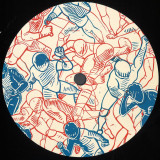
Francois Dillinger coming directly for the metallic jugular here. Right hooking the all the AI bots , tearing down mainframes , and anything else his edge out sharp electro sound can rattle . Made to oil the pistons on the dancefloor ONLY .
It's almost a shame were putting online . But this heat seeking missile of a 4 tracker EP is just too good to not let all the fake profiles hear . So grab it quick , before we change our minds , and wipe the data base !
quête:ask
“I am OBSESSED with the 80s. I love the loud neon colours and fashion and the kinetic energy of the music. It’s uplifting and bittersweet with a ton of keyboards, what’s not to like?” reasons Morgane when asked what it is she likes about the decade. This exuberance is brightly reflected in the mirror ball synthpop of her third album released at the end of September. It is her second long player to appear on vinyl after the release of Between The Funk And The Fear debut on the Polytechnic Youth label.
Morgane was the keyboard player in Stereolab between 1995 and 2001 during which time they released Emperor Tomato Ketchup (her favourite) and Dots And Loops. As a teenager though she first played the drums, then guitar and bass. She only learnt the keyboards one month before joining the group. “They gave me 40 songs to learn, it was a baptism of fire”.
After leaving Stereolab, Morgane first moved to New York for nine years; she’d always planned to move to America having spent a lot of time there with her parents and of course those space-pop pioneers. The warmer weather of LA enticed her though and you can hear its pulse in Day-Glo Chaos. The album’s thumping heart is pumped by the city’s night sky and when asked she cites three particular albums as her favourites: the oddball analogue electro of Jacno’s 1979 debut; John Carpenter’s ‘Escape From New York’ and The B-52’s ‘Cosmic Thing’. There’s also a strong nod to the playful computerised harmonies of Yellow Magic Orchestra whilst she’s somewhat partial to the synth prog of Yes and Soft Machine. “I actually created a synth on Ableton Live named after Rick Wakeman’. I should create one after Mike Ratledge next!”
Throughout her work (but especially on this record) you can hear the influence of computer games. “I’m an avid gamer and have been one since I was a teenager and fell in love with my Commodore 64”. Though not a fan of Hotline Miami or the GTA series (“too violent”) she liked Hang On and loved Outrun which she used to play a lot on her Sega Master System. “I just got the soundtrack reissue from Data Disc and it is beautiful” she enthuses.
You’ll see and hear such influences on the lead single from the album ‘Midnite Rogue’ the video to which pays (im)perfect juddering homage to such arcade culture. Car tyres glued to sticky tarmac, French pop music lost in the air. The title was inspired by a Fighting Fantasy book which she adored as a kid. “I love the idea of this entity causing mischief during night time”, she beams. It’s not hard to see why.
- A1: Eyes Unclouded / 05 20
- A2: Another Skin To Wear / 05 28
- A3: Poise / 06 13
- A4: Arpeggino / 05 15
- B1: You Know This Isn't Going To End Well / 05 22
- B2: Yonghegong Lama Temple Exit F / 05 38
- B3: Anhedonic / 05 38
- B4: 8Am On The Train To Work You Ask Me To Send You Something That Makes Me Happy (For Maarten) / 06 01
For Dutch artist Stefan Vincent, the feeling of melancholy also offers the opportunity for beauty to be found. “Decay and loneliness can serve a purpose. Depression can teach you things. To feel deep sadness also means the ability to feel profound
emotions.” he says. With this in mind, his debut album on MUSAR Recordings, “Post- Melancholy”, unpacks the twists and turns of grappling with this emotion, drawing from breaks, electro and IDM to make his most intricate work to date, after previous releases on Token, Dynamic Reflection, Symbolism, and Non-Series. Throughout “Post-Melancholy” Vincent traces the wave of melancholy and how it moves through the body, which allows for lighter moments alongside darker moods. Perhaps the lightest track on the album is its acidic-breaks opener, “Eyes Unclouded”, with its soaring acid lines and dazzling synths, which acts as a false pretense for the rest of the album. Tracks like “Poise”, “Arpeggino” and the meditative “Yonghegong Lama Temple Exit F” also break up the intensity. However, nestled between the more pacey, bass-weighted tracks on the album, these lighter openings still feel like tear-jerkers.
The more common associations of melancholy show up on tracks like “Another Skin To Wear” and “You Know This Isn’t Going To End Well”, which all create a more ominous feel via IDM and the polyrhythmic structures of drum’n’bass. Particularly on “Another Skin To Wear”, which borrows its name from a Radiohead lyric, the track's swooping motion feels realistic to melancholy’s chaotic and often unpredictable path. But, like all great storytellers, Vincent leaves the most poignant moment of the album for last with the rolling “8AM on the Train… (For Maarten)” devoted to his dear friend, Maarten, who sadly passed away at the young age of 36. This LP is dedicated to Maarten de Vries (1986-2022)
LTD. COL. VINYL[23,95 €]
France-based, prog-rock power trio LIZZARD are out to reclaim the creative, collaborative energy that has fueled them for over a decade. On `Mesh', the band's fifth full length album, LIZZARD capture the energetic, lightning-in-a-bottle optimism of the late `90s post-punk/art-rock scene and reinvigorate it as something empowering, inspiring and simmering with potential. Recorded by the band in the abandoned factory they use as their creative base and produced again by now long-time friend and collaborator Peter Junge, `Mesh' is LIZZARD unleashing the raw, spontaneous might of their pent up live sound through the production precision of their studio experience. As such, themes of duality and control, whether it's regaining it or letting it go, run right through the album. Resounding with Elwell's inimitable, thundering drums and a barrage of colossal riffs, `Black Sheep' explores the dichotomy of body and mind, of black and white, that we all wrestle with on a daily basis whilst the mellow polyrhythms and plaintive melodies of `Mad Hatters' ask pressing questions of the people who are supposedly in charge of society. Epic album closer `The Beholder' captures the reinvigorated LIZZARD at their bracing best; bittersweet guitar refrains are bolstered by Will Knox's signature driving basslines and crashing half-time grooves as frontman Ricou considers the great cycle of life from his own perspective. Testament to the band's formidable compositional prowess, `The Beholder' ends as it starts, a closed loop. With only Ricou's playful, pithy refrain of "What goes around, comes around" left ringing in our ears, LIZZARD masterfully frame `Mesh' as both a poignant conclusion to the last chapter and as a bright new beginning.
Black Vinyl[21,22 €]
France-based, prog-rock power trio LIZZARD are out to reclaim the creative, collaborative energy that has fueled them for over a decade. On `Mesh', the band's fifth full length album, LIZZARD capture the energetic, lightning-in-a-bottle optimism of the late `90s post-punk/art-rock scene and reinvigorate it as something empowering, inspiring and simmering with potential. Recorded by the band in the abandoned factory they use as their creative base and produced again by now long-time friend and collaborator Peter Junge, `Mesh' is LIZZARD unleashing the raw, spontaneous might of their pent up live sound through the production precision of their studio experience. As such, themes of duality and control, whether it's regaining it or letting it go, run right through the album. Resounding with Elwell's inimitable, thundering drums and a barrage of colossal riffs, `Black Sheep' explores the dichotomy of body and mind, of black and white, that we all wrestle with on a daily basis whilst the mellow polyrhythms and plaintive melodies of `Mad Hatters' ask pressing questions of the people who are supposedly in charge of society. Epic album closer `The Beholder' captures the reinvigorated LIZZARD at their bracing best; bittersweet guitar refrains are bolstered by Will Knox's signature driving basslines and crashing half-time grooves as frontman Ricou considers the great cycle of life from his own perspective. Testament to the band's formidable compositional prowess, `The Beholder' ends as it starts, a closed loop. With only Ricou's playful, pithy refrain of "What goes around, comes around" left ringing in our ears, LIZZARD masterfully frame `Mesh' as both a poignant conclusion to the last chapter and as a bright new beginning.
- The Death Of R.m.f
- Sweet Dreams (Are Made Of This) Eurythmics, Annie Lennox, Dave Stewart
- Hotel Cheval
- Hymn Matia Ponos Stoma Fthonos
- How Deep Is Your Love Margaret Qualley
- R.m.f. Is Flying
- Le Marteau
- Maritime Achievement Awards
- Kindness (Dream)
- Hymn Matia Vlemma Stoma Psema
- Rainbow In The Dark Dio
- R.m.f. Eats A Sandwich
- Dream (Pool)
- The Little One
- Kindness (Pool)
- Hymn Me Skotosan Oloi Oi Chori
- Brand New Bitch Cobrah
- King Lear (Demo) Jerskin Fendrix
"In partnership with Milan Records, Waxwork Records is proud to release KINDS OF KINDNESS (ORIGINAL MOTION PICTURE SOUNDTRACK) with music by multi-instrumentalist, producer, and Oscar®-nominated composer JERSKIN FENDRIX. The album reunites Fendrix with director Yorgos Lanthimos following the breakout success of Poor Things, which earned the first-time composer an Oscar® nomination and marked Lanthimos’ first-ever collaboration with a composer. For Kinds of Kindness, Fendrix has crafted a soundscape rooted in solo piano and choral music, peppering the 22-track collection with hymnals throughout. Rounding out the soundtrack album are pop tracks like Cobrah’s “Brand New Bitch” and Eurythmics’ “Sweet Dreams (Are Made of This),” both of which were featured in the film’s trailers, plus a cover of “How Deep Is Your Love” by film star Margaret Qualley as well as a demo from Fendrix’s personal discography. Searchlight Pictures’ Kinds of Kindness is available in theaters now.
Similar to Poor Things, Fendrix began working on Kinds of Kindness with relatively few materials, utilizing only the film’s script, black and white photographs from set, and conversations with Lanthimos as a guide. This time around, however, Lanthimos provided Fendrix with specific guidance on instrumentation, instructing the composer to craft a soundscape rooted in piano and choral music.
“I love working with Jerskin, and I guess he’s the reason why I am now working with a composer – I’ve found someone that works for me,” says director Yorgos Lanthimos, continuing, “Jerskin worked on this in the same way he worked on Poor Things, which is before even seeing a frame of the film. I gave him the script and started sending him black and white pictures that I shot on set. Our agreement in the beginning was, ‘This time, I want to use piano and choir, and go down that direction,’ which was very different to Poor Things. When I went into the edit, he had this library of music that he created to work with, and it turned out great.”
Also helpful to Fendrix at the start of the project was a conversation with Kinds of Kindness star Jesse Plemons, who helped the composer wrap his mind around the complexity of Lanthimos’ triptych story.
“I was very lucky to go on set at the very beginning of filming, and I asked Jesse about the emotions because I was struggling to understand where so many of these characters were coming from,” composer Jerskin Fendrix confesses. “He spoke to me about his interpretation, and how he planned to embody his characters, which was great. I ended up thinking about the abstract space between the emotions and whether that space was empty or noisy. From there, I utilized the piano and choir to explore those spaces.”
Waxwork Records is thrilled to release KINDS OF KINDNESS as a picture disc featuring artwork and design by Vasilis Marmatakis housed in a crystal clear poly-bag.
ABOUT KINDS OF KINDNESS
KINDS OF KINDNESS is a triptych fable, following a man without choice who tries to take control of his own life; a policeman who is alarmed that his wife who was missing-at-sea has returned and seems a different person; and a woman determined to find a specific someone with a special ability, who is destined to become a prodigious spiritual leader."
Cool Calm Pete has been featured in the past with MF Doom, RJD2, El-P, Morcheeba, Sharon Jones & The Dap-Kings, Aesop Rock, and others. More recently with Kool Keith, Real Bad Man, Heems, and Lee Scott.
Lost (Director’s Cut) kicks off Petes return with some new projects on deck.
Sometimes it takes time for something to establish its proper place in culture, and the modern-day discourse never fails to rush to label an album to be a classic or a flop. Then there are albums like Cool Calm Pete’s “LOST.” Adored by its dedicated fan base upon its original release in 2005 on Embedded Records and Definitive Jux, this record has continued to garner attention over the years from those who are familiar with it. While word-of-mouth alone may not have been sufficient to propel the album to mainstream success, its enduring popularity two decades later is a testament to its well-deserved recognition as an indie rap cult classic. The Korean-American emcee born as Pete Chung wasn’t asking to be a pioneer but having been raised in Queens NY during the golden era of hip hop, rhyming better than his peers just naturally became his identity. Throughout his debut album, his slow-paced, conversational flow fit like a glove to the self-produced “working class” beats that color most of the album. His education in fine arts as a painter and his day-job with a then-burgeoning lifestyle brand called Supreme sometimes took precedence in his professional life, but his dedication to the craft as a hip hop artist was evident, and fans took notice. The album hasn’t been re-released since its initial 2005 drop. and vinyl copies haven’t sold on the collectors’ market for less than $100 in years. With its first official re-release, the laws of supply-and-demand will surely alter that market, and chances are that with more ears to hear the album, those original pressings will only become hotter. In the meantime, the new “LOST (Director’s Cut)” has been re-mastered and extended for release on Cool Calm Pete’s own label Bubble Wife Records, with never-before-heard cuts led by a remix of the title track by Blockhead. Find it.
Long time in the vaults, soon out in pop heaven: Andrea & Alexander, a handsomely nostalgic pop project by Andrea Noce aka Eva Geist and Alexander Arpeggio. Originally launched in 2014, revitalized in 2023, the project originated as a live set-up consisting of synthesizers, ePects pedals, and analogue drum machines. From there it slowly metamorphosed into a crew of songs with raw minimal-wave grooves and romantically haunting English and German pop lyrics, loosely evoking the aura of Siouxsie Sioux, Gudrun Gut or Nadine Bal. After becoming a live mainstay in the Berlin based underground club Sameheads, they went on a tour through Lithuania and soon after several unfortunate troubles led to the break-up of the band, prompting both Andrea and Alexander to focus on their solo careers. Andrea became Eva Geist and released for various international labels, played live and formed the female duo As Longitude. Alexander founded his own label Eine Welt, took over the management of the renowned underground festival Camp Cosmic and created two musical projects with Cid Hohne, Otto and Aufgang B. Now, years later, almost becoming a Soundcloud corpse some Andrea & Alexander recordings caught the attention of the R.i.O. folks and just seconds later they offer six freshly recorded cuts of Andrea & Alexander tunes that stood the test of time as authentic, soulful pop music. “What are we going to wear for tonight’s party?” Andrea Noce asks in their song “Tiney Party”. The answer is “Loved Up” a musical celebration outfit of six sincere recorded, emotionally accorded songs, who make the dance, give verve a chance, to be there, in that moment of all moments. An album for the listener that likes to dance. In his head, on the local carpet. “Loved Up” humming Andrea & Alexander tunes.
Cultivated Electronics Ltd's ''For The Floor'' series features split EPs available on vinyl (only) with Electro tracks aimed strictly at the dance floor, bringing together CE regulars alongside new artists. Previous instalments have presented tracks by DeFeKT, Rico Casazza, Tripeo, Cycloplex, Steve Allman and Alex Jann. Volume 4 now delivers 2 new tracks apiece by Ben Pest and Maelstrom. Bristol's Ben Pest has established notoriety as an exponent of jacking live hardware-based techno and electro with numerous releases on labels including Asking For Trouble, I Love Acid, No Static / Automatic, Orson Records, Don't and more. Here he delivers heavy bass, vocal distortions and tough beats on ''Who Would Have Thought I'd Be'' and the accompanying ''26 Hybrid''. Maelstrom has a history of aliases and side projects, illegal raves thrown in warehouses, fields and basements, but he came into his own under his Maelstrom moniker, releasing music on the likes of RAAR (the label he co- founded with Louisahhh), Cultivated Electronics, Central Processing Unit, Mechatronica, Private Persons and Discos Atonicos.
From Karma Recordings comes their thirteenth EP. Following on from the superb remix of Crystals Blame was asked once again to step to the controls to rework DJ Ande’s Be Bold which featured on the Almost There EP which was Karma’s fifth release. Blame mentioned that he loved the piano riff so it seemed obvious to ask him to Blame it up !! The results as they always are with Blame are outstanding. Flip the vinyl over and first up is Haunting from DJ KOS which was made some time ago and has had excellent reaction through our social media channels and this seemed a great addition to the release. Now, a Karma Recordings staple DJ Terrace delivers once again with XXL, superb samples and Terrace doing what he does best with the synths. Bound to be another classic to behold…
We want our own Monaberry Garden. So partnering with Monaberry seemed the right thing to do!
Monaberry is helping countless people cultivate their own tomato gardens. More than any other gardening community. And every
year, we support thousands of new gardeners. Saving with Monaberry could well be the first step to your own Monaberry. So,
for sound, friendly advice, drop by and see us soon. We offer you great growth tips too. Monaberry has a variety of gardening
plans—all designed to yield great results. One of them is sure to be right for you. For instance, with our Flexible Planting Plan,
you can sow seeds whenever you like. Or, if you want an even bigger harvest, just ask about our Seasonal Monaberry Plan.
Remember, your crops are always accessible—we‘re even open on Saturday mornings! There‘s a Monaberry branch near you.
With locations across the globe, there‘s bound to be one close to you. Visit us anytime, you‘ll find us more than ready to advise
and help. To find us, just look for the address in your local directory.
Monaberry ... Cultivating the world’s finest gardens.
Though she was Stax Records' Queen of Soul (and Otis Redding was her king), there was much more to Carla Thomas. In 1967, even while being promoted by the name of her most recent album, The Queen Alone, she was expanding her sound, developing a cabaret act that showcased a mix of genres and styles and that was built around her beautiful voice. She was exploring new vistas when these two sides were recorded.
Isaac Hayes wrote "Loneliness". Carla's suave delivery evokes Diana Ross, and the shiny brass horns call out a Burt Bacharach arrangement as much as Stax. This is Carla with a nice polish on the groove.
Labelmate and friend Deanie Parker wrote "If It's Not Asking Too Much". A sparer presentation, the organ drives the tango rhythm and also—a second keyboard, I think—swells behind Carla, everything entwining and deepening the song's brooding tone. This is the kind of side that can both start your night or finish it.
Carla Thomas has got it all.
What an unbelievable record. From the wild cover to the iconic breakbeats, Roots from Ian Carr’s Nucleus is one of the dopest albums we know. This is seriously thick, funky-prog jazz-rock heaven. Originally released on Vertigo in 1973, other than a couple of versions at the time for other territories, Roots was never re-pressed since so it’s gone on to become another one of those impossible to find records.
Maybe it was a little too out there for the time, but it’s aged very, very well indeed and this Be With re-issue, re-mastered from the original analogue tapes, shows off just why this deserves to be back in press.
Genius trumpeter and visionary composer Ian Carr was one of the most respected British musicians of his era. He was a true pioneer and saw the potential in fusing the worlds of jazz with rock, just as Miles Davis and The Tony Williams Lifetime did in the US. In late 1969, following the demise of the Rendell-Carr quintet, and tiring of British jazz, Carr assembled the legendary Nucleus. Regarding music as a continuous process, Nucleus refused to “recognise rigid boundaries” and worked on delivering what they saw as a “total musical experience”. We can get behind that.
Under bandleader Carr, Nucleus existed as a fluid line-up of inventive, skilled musicians. This constant evolution and revolution was all part of the continuous musical exploration and discovery that took jazz to new levels.
Working together with producer Fritz Fryer and engineer Roger Wake, the seven compositions by Carr, Brian Smith and Dave MacRae that make up Roots flirt with perfection, and Nucleus at that time made up of the cream of 1970s UK jazz with Brian Smith on tenor saxophones and flutes, Dave MacRae on piano and electric piano, Jocelyn Pitchen on guitar, Roger Sutton on bass, both Clive Thacker and Aureo De Souza on drums and percussion, Joy Yates delivering the vocals and of course Carr on trumpet.
The spellbinding title track immediately renders the album indispensable. Riding the illest of loping breakbeats, “Roots” is low-slung, doped-out heist-funk. An absolute monster. If it sounds familiar then that’s likely down to it being sampled by Madlib for Lootpack and Quasimoto’s “Loop Digga”, as well as by a whole host of beat manipulators. “Roots” conjures prime instrumental hip-hop / beat music, only 20 years ahead of its time. Truly, these are the roots. Through sinuous bass, twinkling keys and a hypnotic guitar riff, a smoky brass motif weaves its way into a gloriously deep haze around Carr’s solos. “Roots” is over 9 minutes long, but there’s not a single wasted second, not surprising given that this is a condensed version of an originally 40 minute long commissioned composition.
The soothing vocal fusion delight of “Images” follows. Meticulously constructed, with gorgeous flute work from Brian Smith, with Joy Yates’ silky vocals and Dave MacRae’s Rhodes never sounding better. The cool, driving “Caliban” closes out the first side. Originally the third movement in a four part commission to celebrate Shakespeare’s birthday it stands up on its own, all robust rhythms and blended brass. Keyboard colour and Carr’s trumpet are splashed across the funk drums and basslines (and there’s even some bamboo flute). This really is fusion: the elements of jazz and rock coming together in beautifully synthesis.
Side two opens in riotous fashion with the short, thrilling samba of “Wapatiti”. Next up, “Capricorn” forms a smoothed-out, jazzy constellation. Mellow and dreamy, its twinkling percussion and languid horns slowly build the vibe before head-nod drums and a killer bassline enter the fray. With a distinct heaviness that Black Sabbath would’ve envied, “Odokamona” is a venomous slice of riff-soaked jazz metal (yes, you read that right), elevated by Carr’s wah-wah horns.
The album closes with MacRae’s exceptionally cosmic “Southern Roots and Celebration”. Very much in conversation with Weather Report, it opens as a languorous, spiritual jazz of chiming keys and serene guitar that turns slowly, gorgeously into a mid-paced, brass-laced banger. It’s another sure-fire party starter and the sound of the band having a righteous blast, building an ecstatic chaos that ends with Yates screaming.
And of course we need to talk about Keith Davis’ cover for Roots. Perhaps the coolest record cover of all time? Certainly one of the most bonkers. Just your run-of-the-mill high-gloss, acid-tinged airbrush dystopian/utopian living-room party scene. Consider this your chemical flashback trigger warning.
Front-and-centre the hip-to-death green robot holds court with their giant ball of yellow barbwire wool, hooked up to… something(?) being teased out from under the stairs (probably best not to ask). A thoroughly zoned-out, long-legged Pop Art party-goer lounges half-plugged in to the painting behind her as a pair of legs flail into shot from the the top of the stairs opposite. We won’t even begin to guess what the chap’s up to in the middle, but the view out of the windows is rather nice, and someone’s already got the hoover out ready to tidy up. All of the Nucleus sleeves are something special, but this particular one? Crikey.
This Be With edition of Roots has been re-mastered from the original Vertigo master tapes, Simon Francis’ mastering working together with Pete Norman’s cut to weave their usual magic with these wonderful recordings. The crazy cover has been restored at Be With HQ as the finishing touch to this long overdue re-issue.
- 1: No-Intro
- 2: Interlude
- 3: I'm Gonna Find Out
- 4: Something I Had Said, I Shouldn't Have Said
- 5: Last Chance To See
- 6: You Wouldn't Ask A Fire To Stop
- 7: Always Freaking Out
- 8: Stabbed In The Small Of The Back
- 9: That's What
- 10: Best Friend On The Cross
- 11: Stay Next To Me Tonight
- 12: How Many Will I Make
- 13: Still I Struggle
In 2013, a New Zealand teenager named Daniel Johann Lines quietly uploaded his debut album, melanchole, to Bandcamp under the moniker salvia palth. The LP was a homespun collection full of vulnerable, self-recorded songs about the overwhelming messiness that comes from growing up and figuring out who you are. Despite modest intentions, the record resonated profoundly with millions on platforms like Tumblr and Youtube, maintaining momentum through the TikTok and streaming era. menchole remains a wildly influential lo-fi release, a moving portrait of youth in turmoil. Over a decade later, Lines returns to the project with a new full-length titled “last chance to see”. Out February 16 via Danger Collective Records, the now 27-year-old musician offers his most fully formed and ambitious effort yet. last chance to see is not only a complete artistic reinvention but one that gracefully closes the chapter on a formative period of the songwriter’s life. His decision to revisit the salvia palth moniker is intentional and integral to the album.
Cassette[14,08 €]
'In `All This and So Much More' Tasha is an artist flung open. For Tasha, the last few years have been propulsive, dynamic, bursting at the seams. They've included painful encounters with grief; a sudden break up; new flirtation; new hair; the glitter of world travel and not least, a role in Tony-nominated Broadway musical `Illinoise' which adapts Sufjan Steven's `Illinois' for the stage. If `Tell Me What You Miss The Most' was an introspective meditation on love with a few moments of glancing toward what's next, `All this and So Much More' is Tasha turned outward, flourishing, telling us what it's like to take life by the chin and look it in the eye. Take, for example "Eric Song." This was the first song to be written on the album, penned while Tasha grappled with the sudden, tragic death of Eric Littman, the co-producer of her last album. Though the instrumentation is a familiar 3/4 guitar strum, lulling us into a comforting waltz, Tasha's voice is breathy with grief, adding depth and dimension to the hushed sound. "No, I'm not alone after all / You must be near / Facing this soaring sprawl," she sings, transforming the experience of loss into a talisman of love and courage meant to help usher in a new self. Said a different way, `All This and So Much More' is a full-throated ode to all of the ups and downs of becoming. In the opening track, "Pretend," when Tasha sings about "feelings outgrowing this little life," we get the sense, both lyrically and sonically, of someone in the throes of growth. This is an album crafted with a big, ambitious sound (in part, thanks to the production of Gregory Uhlmann)_cinematic droning, orchestral woodwinds, dazzling arrays of jangling guitar, all lining up to capture a sweeping moment in Tasha's life. Written over the course of 2022 and 2023, right on the cusp of Tasha being cast in Illinoise, the songs in this album invoke friendship, heart ache, flirtation, doubt. From the social anxiety of "Party" ("Do they think I'm funny? / Did they like my jokes last night?") to the questing for meaning in "So Much More," Tasha brings us along on a journey of finding out that the person you wanted to be was inside of yourself, just waiting to bloom all along. She sums it up neatly in her final track, "Love's Changing," charging us with a brilliant, sweeping vision of the future, singing: "Suddenly the world is bigger than it ever felt before / Feel the weight of my future sinking in / See the joy I'm running toward." In `All This and So Much More,' Tasha asks us to consider abundance in its truest form. Our lives, a deluge of possible experience if only we will surrender to it, all the way from the citric ache of heartbreak to the chest bloom of new adventure.
Black Vinyl[23,49 €]
'In `All This and So Much More' Tasha is an artist flung open. For Tasha, the last few years have been propulsive, dynamic, bursting at the seams. They've included painful encounters with grief; a sudden break up; new flirtation; new hair; the glitter of world travel and not least, a role in Tony-nominated Broadway musical `Illinoise' which adapts Sufjan Steven's `Illinois' for the stage. If `Tell Me What You Miss The Most' was an introspective meditation on love with a few moments of glancing toward what's next, `All this and So Much More' is Tasha turned outward, flourishing, telling us what it's like to take life by the chin and look it in the eye. Take, for example "Eric Song." This was the first song to be written on the album, penned while Tasha grappled with the sudden, tragic death of Eric Littman, the co-producer of her last album. Though the instrumentation is a familiar 3/4 guitar strum, lulling us into a comforting waltz, Tasha's voice is breathy with grief, adding depth and dimension to the hushed sound. "No, I'm not alone after all / You must be near / Facing this soaring sprawl," she sings, transforming the experience of loss into a talisman of love and courage meant to help usher in a new self. Said a different way, `All This and So Much More' is a full-throated ode to all of the ups and downs of becoming. In the opening track, "Pretend," when Tasha sings about "feelings outgrowing this little life," we get the sense, both lyrically and sonically, of someone in the throes of growth. This is an album crafted with a big, ambitious sound (in part, thanks to the production of Gregory Uhlmann)_cinematic droning, orchestral woodwinds, dazzling arrays of jangling guitar, all lining up to capture a sweeping moment in Tasha's life. Written over the course of 2022 and 2023, right on the cusp of Tasha being cast in Illinoise, the songs in this album invoke friendship, heart ache, flirtation, doubt. From the social anxiety of "Party" ("Do they think I'm funny? / Did they like my jokes last night?") to the questing for meaning in "So Much More," Tasha brings us along on a journey of finding out that the person you wanted to be was inside of yourself, just waiting to bloom all along. She sums it up neatly in her final track, "Love's Changing," charging us with a brilliant, sweeping vision of the future, singing: "Suddenly the world is bigger than it ever felt before / Feel the weight of my future sinking in / See the joy I'm running toward." In `All This and So Much More,' Tasha asks us to consider abundance in its truest form. Our lives, a deluge of possible experience if only we will surrender to it, all the way from the citric ache of heartbreak to the chest bloom of new adventure.
Nina Ryser's music has always inhabited its own world; a singular and cohesive collection of Keyboard-centric home recordings that marry her undeniable pop sensibilities with a truly bizarre dreamlike aesthetic. With a solo career spanning 7 releases as well as her work in the highly influential art-punk trio Palberta, Nina's artistic voice has been a staple in the American underground for over a decade, her distinctive and consistent sound earning a cult following. Her latest effort Water Giants signifies a departure in both sound and artistic practice - her first solo release recorded outside of her home studio, with a myriad of first time collaborators, it's Nina's most lavish and expansive offering to date, honing in on the heartfelt songwriting at the core of her work. After completing her usual process of demoing the songs for Water Giants, Nina felt that she wanted to try something new, escaping the confines of her minimal studio setup and the limitations of working alone. At the recommendation of several friends, she began working with Lucas Knapp, a Philly based producer who has contributed work to many Dear Life releases (including Florry's The Holey Bible, Hour's Ease the Work, and Joey Nebulous's Joey Spumoni Creamy Dreamy Party All the Time ). Lucas and Nina's recording sensibilities aligned quite seamlessly, breathing new energy into the songs in what she describes as an "effortless collaboration". The result is some of her most pristine experimental pop offerings to date, centering Nina as a dynamic performer and lyricist without foregoing the surreal qualities of her previous work. The album features contributions from many of her peers in the Philly music community, including Jill Ryan (Great Time), Victoria Rose and Nino Soberon (@, Brittle Brian), Eli Kleinsmith (The Knee Jerk Reaction), and her husband Gabe Adels, whom she frequently collaborates with in the synth-pop duo Data. Even the cover art is a departure for Nina, who has previously crafted it herself or with longtime friend/visual artist Izzy Kross, this time assembling a collage of photographs taken by Eve Alpert (Palm) fit for the album's newfound dimensionality. Lyrically, Water Giants stands as Nina's most personal work to date. Taking a cue from her previous release, I Miss My Dog, which was written as Nina was processing the imminent loss of her and Gabe's dog Billy, Nina approached the writing process with unbridled honesty and chose not to edit or overthink her words as she had in the past. The result is a number of candid, heartfelt reflections on love, illness, addiction, anxiety, and the beautiful absurdity of a trash pile on the street. Interspersed throughout the album are Nina's signature woozy instrumentals, which add some escapism to the grounded nature of the material. By putting faith in a newfound collaboration without straying from her natural instincts, Nina has crafted the most dynamic album in her discography, an exciting testament to her songwriting prowess and what can be accomplished by stepping out of your comfort zone as an artist.
Permanent Parts is the second album released by visual artist Katharina Grosse (synthesizer) and musician Stefan Schneider (synthesizer; So Sner, To Rococo Rot). Grosse and Schneider were joined at Galerie Max Hetzler on 29 April 2023, performing as part of the Spectrum without Traces exhibition, by three artists who all generally work within improvised music – Carina Khorkhordina (trumpet), Tintin Patrone (trombone and electronics), and Billy Roisz (noise generator, piezo and mini cymbal). Permanent Parts is an extraordinary set of recordings that inhabits multiple zones at once: within its thirty-five minutes, we can hear the interactions of non-idiomatic collective music making, and the electronic glimmers of electro-acoustics, while, at the same time, the music remains untethered to genre.
This capacity to work within liminal zones makes perfect sense when thinking about both Grosse’s and Schneider’s prior work, whether the energetic diffusions and spatial explorations of Grosse’s artistic practice, or the slippery texturology of Schneider’s recent work with electronics. Khorkhordina, Patrone and Roisz all find their own ways into this dynamic, too, and Permanent Parts feels like an equal exchange of presence and contribution; there are no hierarchies here. This might explain the music’s curious sense of development, where several elements are allowed to exist alongside each other, not in direct contact but in a mode that’s somewhere between carefree layering and unconscious juxtaposition. The musicians are listening, but not just with their ears – their skin, their bodies are hearing, too.
When talking about Permanent Parts, Schneider is careful to place it within contexts that are specific, to some degree, but which allow for difference to blossom. “Although it was recorded live, it somehow was not meant to be a documentation of a live event in the first place. The five piece line up that appears on the record had met for the first time only a few hours before the concert took place.” While it might take a leap of faith for all parties to walk together, and so willingly, into a place of such freedom, of such risk, there is clear sympathy here between the musicians, and a shared appreciation of the immediacies of the situation.
It also throws some of our preconceptions about this music out of the window. “The record does not feel like a document of a performance as the music was not pre-composed and there was no reference,” Schneider continues. “Perhaps it was not even an improvisation?” For Grosse, her musical relationship with Schneider similarly shakes free from expectation: “My sound does not exist without Stefan’s. It is neither written down nor is it improvised. It is instantaneous.” When thinking about the five-piece exploration on Permanent Parts and asked to expand on what each musician brings to the table, she continues, “We all love the thrill of an unknown encounter and we seem to have a need for building connections through the thicket of our voices.”
There’s a curious phrase on the back cover of the album, before the artists are listed: “Wir sind eine Batterie / We are a battery.” This sums up the spirit of Permanent Parts. Schneider recalls that Grosse said this phrase to the musicians at the start of the performance. Grosse explains further, “The figure of the battery referred to our placement in the space building out a small circle facing one another from where the sound could spill into the impressive volume of the gallery.” The battery as an arrangement of similar devices; but I also think of charge, and the conversion of chemical energy, and of fortification. It’s a poetic metaphor that sums up much of the febrile pleasure of the music contained on these Permanent Parts.
– Jon Dale, Melbourne
"Do you dream too?" Tomemitsu"s Martin Roark asks on his sophomore album with Friends of Friends Music. The question is also what stemmed from the album title, "Dream 2", a shorthand written in the lyrics. "Dream 2" is quite possibly Tomemitsu"s dreamiest LP, if not his most diverse. It is brimming with both new territory and nods to his past. This record reveals a more buoyant side to accompany his traditionally spaced out productions.