Blue Cloud Vinyl. Hailing from Bozeman, MT, Kitchen Dwellers embody the spirit and soul of their home with a sonic palette as expansive as Montana's vistas. The quartet_Shawn Swain Mandolin, Torrin Daniels banjo, Joe Funk [upright bass], and Max Davies [acoustic guitar]_twist bluegrass, folk, and rock through a kaleidoscope of homegrown stories, rich mythology, American west wanderlust, and psychedelic hues. After amassing 5 million-plus streams, selling out shows, and receiving acclaim from Huffington Post, Relix, American Songwriter, and more, the group brings audiences back to Big Sky Country on their third full-length album, Wise River, working with Cory Wong of Vulfpeck as producer.In the end, Kitchen Dwellers share timeless American stories from the heart of one of its greatest treasures."When you listen to Wise River, I hope you hear some of the original qualities that made us who we are, but you also recognize aspects that are new and adventurous," Max leaves off. "I hope you hear what it sounds like when the four of us are at home and have the space to create something together. This album is really how we sound as a band."
Cerca:aud
- 1: Anne
- 2: Give Me Back To The Sky
- 3: Have You Been Eating That Sandwich Again
- 4: The Way We Were With People
- 5: Cop Graveyard
- 6: Dan Collins Vs. The Maryland Judicial System
- 7: Dead Bird Skeleton
- 8: Grim Reaper
- 9: The Same Things Happening To Me All The Time, Even In My Dreams
- 10 0: Swallow
- 11: Dead Cat
- 12: Spooky Ghost
- 13: No, The Moon
- 14: I Am My Own Hell
- 15: Afterlife Dating
- 16: If I Cleaned Everything
- 17: Untitled-Oct19
- 18: Yr Glow (Acoustic Demo)
teen suicide's first & only proper album, `i will be my own hell because there is a devil inside my body', has been a sought after release for many collectors after it's ultra-limited vinyl release in 2012. Now, Run For Cover Records will be reissuing my own hell, with remastered audio, expanded artwork and 8 never-before-issued bonus tracks. Across the album's 10 songs, the band displays a knack for different sounds and styles. Intimate, keyboard driven tracks like `cop graveyard' and `grim reaper' sit beside more energetic full-band outings like `dead bird skeleton and `give me back to the sky', the latter even adding an evocative viola, piano and choral arrangement to it's chaotic center. It's to the band's credit that their more outré moments feel necessary, not distracting. What becomes clear upon listening to `my own hell' is that beneath the dreamy haze & noisy apathy of teen suicide's recordings exist ernest, extremely well-written pop songs that reflect and express the uncertainty and desperation of reality
Morikawa Seiichirou, vocals, bass
Yamagiwa Hideki, electric & classical guitar
Takahashi Ikuro, drums & percussion
je prie pour que la goutte ne tombe pas
(I pray that the drop does not fall) is the first international release by Japanese trio Chi To Shizuku. While they have released five albums and a 7” in Japan, their spectral, haunted rock songs haven’t yet reached a much wider audience overseas. With this album, then, a live recording taken at Koenji HIGH, Suginami, Tokyo on 23rd November 2021, the unique, quartz-like character of Chi To Shizuku’s music is writ large, the bleak bliss of their songs carved onto twelve-inch vinyl.
Perhaps the best-known member of Chi To Shizuku, at least for audiences with an ear turned to Japanese psychedelia, is drummer Takahashi Ikuro, known for his membership of almost every group worth a damn from that scene – Fushitsusha, Nagisa Ni Te, Ché-SHIZU, Kousokuya, High Rise, Maher Shalal Hash Baz, LSD March, the list goes on. But the core of Chi To Shizuku’s music is the collaboration between vocalist, bassist and lyricist Morikawa Seiichirou, and guitarist and arranger Yamagiwa Hideki. Morikawa is a member of long-running punk/goth group Z.O.A., and has also played with YBO , Zzzoo, and as collaborator with Takeshi and Atsuo of Boris in A/N; he’s also recently been performing with Mitsuru Tabata. Yamagiwa’s history takes in stints with Katsurei and Cock C’ Nell, and he also recently guested with la scene 裸身.
All this contextual information does relatively little, though, to prepare you for the unique vibration of Chi To Shizuku’s lustrous songs. They shimmer in the same half-light, perhaps, as Shizuka and the quieter moments of LSD March, sharing a similar poise and classicism, and there’s a tenderness and wracked poetry to Morikawa’s voice that reminds of the emotional intensities both of traditional Japanese folk, and of British folk music: on “Musuu No Nemuri No Naka De Kumo Wo Tukamu”, the combination of his singing, backed with gorgeously plangent guitar, reminds of no-one so much as it does The Pentangle or Spriguns Of Tolgus. Chi To Shizuku’s love for the ballad as form gifts their music an archaic, sometimes arcane resonance, and from what you can hear on this album, it’s clear they’re in love with graceful melancholy.
But this is not a folk album, by any means; it just shivers with the same eternal spirit. There are also hints of prog rock, and you can catch some passages of scratchy, distended free rock, on the extended spirit invocation of “Nanhito Hanhito”. je prie pour que la goutte ne tombe pas is an extraordinary album, a melancholy surprise, that reminds dedicated listeners of the seemingly bottomless well of great music to be found via the Japanese underground in its many forms. Perhaps Michel Henritzi says it best, though, in his liner notes, when he writes, “Chi To Shizuku’s music reminds us that our life is a dream that lasts only a season, and that oblivion will follow.”
Recorded at Koenji High Suginami, Tokyo, 23 November 2021
Mix & Mastering: Taku Unami, photography : Noriko Akiyama
Liner notes by Jon Dale Printed by Alan Sherry
The Complete Full House Recordings wurde anlässlich des hundertjährigen Jubiläums des einflussreichen Jazzgitarristen Wes Montgomery veröffentlicht und vereint alle Aufnahmen der Full House Sessions mit zwei bisher unveröffentlichten Auftritten. Mit Johnny Griffn, Wynton Kelly, Paul Chambers und Jimmy Cobb enthält diese Sammlung neue Linernotes des Journalisten Bill Milkowski und ist auf 180-GrammVinyl gepresst, das von Joe Tarantino von den analogen Originalbändern gemastert und von Kevin Gray bei Cohearent Audio lackiert wurde.
Rising indie artist BROCKHOFF. Her sound combines the 90s influences blossoming in the American pop scene with contemporary themes – performed by her predominantly female band.
The rocking sound of BROCKHOFF can do both: appealing a young indie audience identifying with US artists like Phoebe Bridgers, Soccer Mommy or beabadoobee, as well as cross-generational followers of artists like Fleetwood Mac, Sheryl Crow or The Cardigans.
*LTD BLUE VINYL* Having cut her teeth as part of dream pop band Snakadaktal then as half of Two People, Melbourne’s Phoebe Go solo break out has seen her discover her own voice and potential, a process that has been both daunting and liberating for her. Her self-released debut, the Player EP, opened the world to Phoebe’s vulnerable, sincere and gut-wrenchingly honest songwriting; posing questions about her career, relationships and existence, yet still emerging with heartfelt hope for the future. A word-of-mouth success when released late last year, the likes of NME, Notion, Wonderland, triple j Unearthed, Double J and Under The Radar have already sung her praises. Having just wowed audiences at The Great Escape, her Player EP is finally getting the vinyl release outside Australia it deserves, being released by tastemaker label Dalliance Recordings (Gia Margaret, HighSchool, Francis of Delirium, lilo). Formats Available: Limited edition (300) 12” Blue Vinyl with a lyric sheet and an exclusive track ('To Love Me Now’).
A hidden gem of Uruguayan music, Los Terapeutas's second album, released in 1990, is an original take on candombe and its hypnotic groove, blending pop songcraft with expansive soundscapes, never losing their rhythmic pulse. Los Terapeutas is a band of songs, where new wave, candombe beat, funk and rock were mixed in a unique way, with a strange frontman who had traces of Eduardo Mateo, Damo Suzuki, Frank Zappa and David Byrne. "Candombe del no sé quien soy" is related to what the group did live at that time: looking for a state of hypnotic hanging with their songs. The playing of the candombe drums was obviously an inspiration to look for that trance state, as was the music of Mateo and that of Opa, but influences can also be traced from the rhythmic experiments of German band Can of the 70s. The album was released in the late 1990s, a complicated time for Uruguayan music. The album was released on vinyl, a format that was losing weight compared to the CD. They would not release an album together again until 1997. In the 2000s, Los Terapeutas slowly expanded their audience, while also leaning towards a more electric sound. The new generation of Uruguayan musicians recognized the pioneering work of the band and Alberto Wolf was seen as a kind of godfather by several of the rock groups that were beginning to become massive.
D'Angelo is an American R&B and neo soul singer-songwriter, multi-instrumentalist and record producer. His debut solo album, Brown Sugar, released in July 1995, received rave reviews and was certified Platinum in the US. Following this, D'Angelo embarked on a hiatus before releasing Voodoo in January 2000 which debuted at number one, its lead single "Untitled (How Does It Feel)", was a smash on the R&B charts and won a Grammy for Best Male R&B Vocal; likewise, Voodoo won for Best R&B Album. Both albums are pressed as 180g heavyweight LPs and include an audio download voucher.
432 pages, 20cm x 13cm x 3cm
What was it about Bob Marley that made him so popular in a world dominated by rock’n’roll?
How is that he has not only remained the single most successful reggae artist ever, but has also become a shining beacon of radicalism and peace to generation after generation of fans across the globe?
On May 11, 1981, a little after 11.30 in the morning, Bob Marley died. The man who introduced reggae to a worldwide audience
in his own lifetime he had already become a hero figure in the classic mythological sense. From immensely humble beginnings and with talent and religious belief his only weapons,
the Jamaican recording artist applied himself with unstinting perseverance to spreading his prophetic musical message.
And he had achieved it: only a year earlier, Bob Marley and The Wailers' tour of Europe had seen them perform to the largest audiences
a musical act had up to that point experienced. Record sales of Marley's albums before his death were spectacular;
in the years since his death they have become phenomenal, as each new generation discovers afresh the remarkable power of his music.
Chris Salewicz, who had a sequence of adventures with Bob Marley in Jamaica in 1979,
offers us a comprehensive and detailed account of Bob Marley's life and the world in which he grew up and came to dominate.
Never-before-heard interviews with dozens of people who knew Marley are woven through
a narrative that brings to life not only the Rastafari religion and the musical scene in Jamaica, but also the spirit of the man himself.
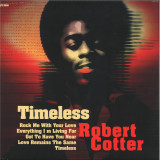
Worthy re-issue of Robert Cotter's second late 70's soul album! Comprising five songs, with four of them being quite lengthy and well-structured for the dance floor, was entirely recorded in the United States by top-notch American musicians. "Timeless", a fresh and lively expression of late 70s soul music, was recorded at the Sundragon Studio in New York. This studio was home to legendary bands such as Talking Heads and Ramones, as well as a few 'disco studio groups' like Andrea True Connection, Tony Valor Sound Orchestra, and Camouflage, who recorded songs that later became considerable hits. For this reason, it's believed that the positive outcome of the album can be partially attributed to Ned Liben, an eclectic New York musician and co-founder of the studio in the Flatiron district of Manhattan, served as an exhaustive interlocutor for any artistic and technical needs. He was also the arranger of "Rock Me With Your Love", the most significant song on the album. Ned's successful mission was to capture the maximum timbral fidelity of Robert Cotter's voice using appropriate recording techniques, assisted by Michael George Ewing, a talented engineer who had previously worked on similar projects with well-known artists like Carol Williams, Maryann Farra & Satin Soul, Touch and Tony Valor. In fact, the piece features original and melodious lines, coupled with an excellent steady rhythm, spanning approximately 8 minutes and 30 seconds - in short, "a delightful sound for every beat." This ensured that the performance of the young singer-songwriter from New Jersey was faithfully reproduced without neglecting the overall musical landscape. The other four songs, arranged by Ben Lazzaroni with the same musicians as the first piece, are no exception. Best Record also delivered on the promise to Robert's older brother, Karl Potter, a powerful percussionist transplanted to Rome, for whom the roman label produced "Sweet & Salty Cha-Cha-Cha" (12", 1986). Robert Cotter, an artist about whom almost nothing has been written, is poised to gain recognition once word spreads about his album, which has been entirely remastered by Dom Scuteri and features a more congenial tracklist. This album is destined to be truly 'timeless', ready to captivate audiences around the world. Even the new cover artwork, created by Nerina Fernandez, pays homage to an artist who, despite expressing himself with elegance and simplicity, radiates energy and exudes love. "Timeless" is an inevitable revelation for anyone who missed it at the time, and for the next 40-plus years, it will remain an absolute must-listen for Robert Cotter's many fans, leaving them all in awe. In addition to the reissue on the classic glossy black vinyl, a strictly limited edition on red vinyl will be released exclusively by Clone Distribution.
Worthy re-issue of Robert Cotter's second late 70's soul album! Comprising five songs, with four of them being quite lengthy and well-structured for the dance floor, was entirely recorded in the United States by top-notch American musicians. "Timeless", a fresh and lively expression of late 70s soul music, was recorded at the Sundragon Studio in New York. This studio was home to legendary bands such as Talking Heads and Ramones, as well as a few 'disco studio groups' like Andrea True Connection, Tony Valor Sound Orchestra, and Camouflage, who recorded songs that later became considerable hits. For this reason, it's believed that the positive outcome of the album can be partially attributed to Ned Liben, an eclectic New York musician and co-founder of the studio in the Flatiron district of Manhattan, served as an exhaustive interlocutor for any artistic and technical needs. He was also the arranger of "Rock Me With Your Love", the most significant song on the album. Ned's successful mission was to capture the maximum timbral fidelity of Robert Cotter's voice using appropriate recording techniques, assisted by Michael George Ewing, a talented engineer who had previously worked on similar projects with well-known artists like Carol Williams, Maryann Farra & Satin Soul, Touch and Tony Valor. In fact, the piece features original and melodious lines, coupled with an excellent steady rhythm, spanning approximately 8 minutes and 30 seconds - in short, "a delightful sound for every beat." This ensured that the performance of the young singer-songwriter from New Jersey was faithfully reproduced without neglecting the overall musical landscape. The other four songs, arranged by Ben Lazzaroni with the same musicians as the first piece, are no exception. Best Record also delivered on the promise to Robert's older brother, Karl Potter, a powerful percussionist transplanted to Rome, for whom the roman label produced "Sweet & Salty Cha-Cha-Cha" (12", 1986). Robert Cotter, an artist about whom almost nothing has been written, is poised to gain recognition once word spreads about his album, which has been entirely remastered by Dom Scuteri and features a more congenial tracklist. This album is destined to be truly 'timeless', ready to captivate audiences around the world. Even the new cover artwork, created by Nerina Fernandez, pays homage to an artist who, despite expressing himself with elegance and simplicity, radiates energy and exudes love. "Timeless" is an inevitable revelation for anyone who missed it at the time, and for the next 40-plus years, it will remain an absolute must-listen for Robert Cotter's many fans, leaving them all in awe.
Standard Sleeve singles & Engraved Wooden Box. Vinyl comes with Download Card & Custom Laser Engraved Wooden Box. Recommend If You Like: Kramer, Jad Fair, Britta Phillips, David Grubbs, Paul Leary, Rob Crow, Danielson, Eerie Wanda. “In 2022, the pandemic seemed to be receding to the point where artists could work together again, literally side by side. So, as a kind of 'follow-up' to my Joyful Noise 2020 Artist-in-Residence box set, I revisited the notion of a limited-edition vinyl box celebrating the joys of collaboration. i thought about it for a good long while, and eventually, it felt good. I then put the idea under a microscope and found that it felt even better when I minimized the project to six 33rpm EP's on 7" vinyl. The borderless landscapes of audio art, tempered by the imaginations of the artists I chose to work with, then cast against the myriad infinities of mysteries betwixt those ageless, spinning rings...those rings that seem to sing, "...listen to us..." Rings of Saturn won't change the world, but the words & music dervishing off these grooves accurately expresses the Love poured into the foundations beneath these Nocturnes (w/ Britta Phillips), Psalms (w/ David Grubbs), Preludes (w/ Eerie Wanda), Elegies (w/ Jad Fair & Danielson), Laments (w/ Paul Leary), and Hymns (w/ Rob Crow). Working with others is my lifeblood. I am nothing without them.” Kramer, 2023.
Introducing the 2nd Volume of Super Biton of Segou’s Afro.Jazz.Folk collection, led by Malian conductor Amadou Bah, also known as “The Armstrong Malian”.
Deviation Records is thrilled to present this collaboration with The Mieruba Label Team, showcasing the diverse musical roots of 1970s Mali, combining Afro-Latin percussion, Mandingo songs, jazzy brass, and funky guitar. The album also features the captivating ArtCollage of Emma Margo incorporating visuals of Segou, Mieruba Art Center, and Françoise Huguier.
The graphic design is conceived by Les Mouches Graphic Design, with a selective varnish made from traditional Bogolan fabric of the Segou area. The audio was remastered by Raphael Jonin and cut by MB Mastering Studio in Aubervilliers.
Get ready for a full sensory experience!
Straight Outta Caledonia is the first commercially available “Greatest Hits” of the outsider songwriter Jackie Leven, an artist
who has largely remained in obscurity in his native Scotland despite being one of the greatest wordsmiths – and singers – it ever
produced. A well-travelled musician who began making psychedelic, progressive music in the late 60s before emerging as an
epic storyteller full of pathos, humour and humanity in the 90s, Leven lived and wrote like many of the fragile, gregarious
characters of his songs; large, full of life and empathy. Leven passed away in 2011 after recording 30+ albums under different
guises or with his briefly successful New Wave band Doll by Doll. Straight Outta Caledonia is a compilation collated by Night
School Records on its Archival label School Daze that seeks to introduce Leven’s music to new generations.
In an age of isolation, alienation and loss of visceral experience, Jackie Leven’s music can be massive and welcoming. It feels
connected to some universal humanity and vibrates with vitality. His songs are often full of tragedy and comedy simultaneously,
cutting straight to the heart, often plugging directly into the nervous system of the listener. His lyrics are rich, dense with imagery
that can veer from apocalyptic to the comically banal in a sentence, with a songwriting panache that can be heavy handed to
almost bursting point before skewering the song with a clownish, warm punchline. His productions ranged from Bob Dylan’s
Rolling Thunder Revue style rock band orchestrations with strings and organ as on the epic Ancient Misty Morning or they could
be pared down to the purest form of folk song as on Poortoun: Leven on stage alone with an acoustic guitar, albeit played with a
mastery of the instrument that he often only hinted at. Musically his sound can bend traditional structures or stay completely
confined within them yet still forever push towards an ecstatic release, as on the cinematic Snow In Central Park.
The most exciting, jaw-droppingly effective tool at Leven’s disposal was his voice. A multi-octave instrument that, though
damaged during a savage assault in Fife, he used with flair; he had both a brazen disregard for the rules and a deep humility, all
of which is evidenced with every phrasing. A baritone that could flit up through the register – always touched by his gentle
Kirkcaldy accent – it’s the prime delivery method for his songs. Leven’s voice enabled him to inhabit the characters in his songs to
an uncanny degree, a skill that in turn enables the listener to empathise with them and, subsequently, the singer. It’s most evident
in stand out song The Sexual Loneliness Of Jesus Christ, a breathtaking re-telling of the life of its protagonist, not as a pure,
sinless messiah but as a sexually frustrated, solitary man condemned to an existential loneliness no one else will ever feel. In
many ways the track is the archetypal Jackie Leven song. Produced by Pere Ubu’s David Thomas, what strikes the ear first –
after the samples of unemployed workers in Glasgow following the closing of the Clyde shipyards – is the audacious, rhythmic
tremolo effect Leven employs through the verses before the production opens up to allow Leven’s vocal to lift into a soar, a
freeing glide powered both by the force of the singer’s chutzpah and the inherent, doomed destiny of the protagonist. With any
other singer such subject matter could come across as gauche or worse, pretentiously sonorous, but Jackie Leven’s genius was
such that he could be this cinematic and brazen while touching something elemental and true in the beholder. It’s a skill evident in
every song on Straight Outta Caledonia, the trademark of a songwriter who revelled and excelled in intensity with a lightness of
touch.
In his lifetime, Jackie Leven toured, wrote and recorded at a ferocious rate. He recorded under aliases to avoid record contract
restrictions, played house shows in Europe after or instead of official concerts, events which were often spoken word story telling
masterclasses as well as performances of his often bewilderingly dense songbook. His music has traditionally been catalogued
as “folk” music and has been largely banished to a small, dedicated group of international fans and apostles both private and well
known, like author Ian Rankin or Glenn Matlock. Since his passing in 2011 however, there has been a growing recognition
amongst a newer generation, with artists like James Yorkston or Molly Nilsson publicly stating the influence of the unsung
troubadour on their own craft. Jackie Leven’s fairytales for hard men are often forensic deconstructions of masculinity, sad and
ecstatic, light and shadow, always endlessly rich, a resource as bountiful as Leven himself’s human spirit undoubtedly was.
- A1: Drift On
- A2: Piñata 02 50
- A3: Gunz
- A4: First Among Misfits (Ft The Narrator) 04 28
- B1: La Vacanza (Ft Kidä)
- B2: Sublime
- B3: Exit To Cisco
- B4: Lady (Ft Bbymutha) 03 44
- C1: O Vampiro
- C2: Bonehead Behavior
- C3: Vicious Chambers
- D1: Ultra Scuro
- D2: And There Goes The Challenger
- D3: Less Burners Bigger Hearts (Ft The Narrator, Azekel)
Multidisciplinary artist GAIKA returns with a new track titled “LADY” featuring bbymutha from his forthcoming album, Drift out on September 8th.
Thrashing drums and droned out guitars take immediate effect on “LADY” but it’s the two mavericks' electrifying chemistry that is the driving force of this track. Enlisting KIDÄ (Yves Tumor) on production with additional contributions from Azekel (Gorillaz) and Max Winter, alternative rock and audacious rap come crashing together as GAIKA and bbymutha flex their lyrical prowess, unapologetically expressing their devotion to their lovers on this twisted, feverish affair.
Newly signed to Big Dada Recordings, home to Roots Manuva, Yaya Bey, Kae Tempest, Brian Nasty and more, GAIKA jumps back into music with new invigoration after delving into work as a composer to unveil Drift - his most expansive work to date. The visionary invites listeners on a high-speed journey where love, pain, brutality and beauty collide to produce a vivid and provocative cinematic masterpiece. The sonic universe of Drift is the most stylistically accurate representation of GAIKA’s personal tastes to date, stitching musical influences past and present such as Prince, Wu Tang Clan, Massive Attack, John Coltrane, Pink Siifu and A$AP Rocky to land on a gritty, distorted sound pulsating with an unwavering, formidable energy that’s disruptive yet timeless.
Drift is 14 tracks of nostalgic escapism, a shape-shifting body of work with hip hop and club music cultures at its core, as those simply run through the veins of GAIKA. Analogue and retro in feeling, Drift’s psychedelic feel is formed by incorporating 90s grunge, dark wave, post-punk and alt-rock into its tapestry. It’s a representation of his heritage and environment, featuring calypso steel pans to gospel vocals, reverberating dub to frenetic rap and elements of sound design taken from recordings of the real world. GAIKA’s music transcends borders and his nomadic nature means he simultaneously belongs and doesn’t, his music cannot be confined to just one genre and this unique new record further cements him as one of the most progressive artists of our time, telling the tale of modern day renaissance man driving away from the economic hierarchy he doesn't believe in.
GAIKA endeavoured to create a waking dream by constant participation in communal art making, removing the separation between art and life, his imagination and community and breaking the boundary between real life and any spectacular representation of it. He set up a number of situational arts facilities in the heart of London including shows at ICA, 180 the Strand, Now Gallery and as the world reopened, created pop up galleries, studios, exhibitions and raves with the intention to enhance the experience of real life by dreaming. To achieve this coherently and authentically the process became akin to a form of psychological examination of memories made before music “mattered” to GAIKA - before becoming commodified, individualised and his name capitalised.
Drift became the term used to describe the creative happenings in these spaces and the name for the collective of people who made this record. GAIKA is the central writer and composer working closely with KIDÄ on production and a group of classically trained musicians with contributions from Azekel, Charlie Stacey, Brbko and The Narrator over an extended period of time where they recorded music late into the night, night after night.
First release via Agricultural Audio, label of acclaimed producer Ben Hillier. Agricultural Audio is the name of the South Downs studio, and now also a record label, of the producer Ben Hillier (Blur, Elbow, Depeche Mode, Nadine Shah). The debut release from Hillier’s new label, launched this month in partnership with The Orchard, will, fittingly, be a project of Hillier’s own. The first time he has stepped out from behind the producer’s desk for an artist project in his own right, Storm Franklin sees Hillier join up with the Howling Bells front woman and solo artist, Juanita Stein. Hush Now is a tantalising introduction to Hillier and Stein’s work together, the first single from a Storm Franklin album that will be released later this year.
The last twelve months have been a whirlwind for Henry Counsell and Louis Curran, the men who make up Joy (Anonymous). Having established themselves during the Covid-19 era by playing impromptu meet-ups on London’s South Bank, they have graduated to bigger venues, travelled to far-flung locales and recorded their second album, Cult Classics, while maintaining the spontaneous energy and irrepressible joy that made their name. Their music revels in the euphoria of being alive and all the feelings, good or bad, that come with it. It invites us into a community, draws us close and promises the night of our lives.
Recorded over the course of a year, the blueprint for Cult Classics was laid down over a two-week span at Imogen Heap’s Round House in east London. Joy (Anonymous) invited friends old and new to visit - they’d record live instruments in jam sessions upstairs and then retreat to a second room to flip and loop and generally mess with the sounds, moulding them into sizzling dance tracks. “Loads of people were coming up to me like ‘I thought this was going to be a dance record?’” Louis says, remembering the quietly beautiful music they’d be recording. “I’d be like, don’t worry about that, just keep playing.” He’d send it back to people later and they’d be floored - “That was my bit and you’ve made it... jungle!”
It was an organic and creatively fulfilling approach, one that didn’t allow any of the music to get stale or stagnate. As they built the tracks from the sounds they’d collected, Joy (Anonymous) would weave the new songs into their famously improvised live sets, testing them, refining them, taking note of the audiences’ reactions. In a year punctuated by a lot of travel, they’d also incorporate the voices of people they met along the way - “Beazley’s Poem”, which opens the record, features the words of a man who was working security at a Fred Again show at New York’s Terminal Five. “He was basically doing the opposite of his job and being a hype man, climbing on the fence and ramping up the crowd - we ended up hanging out with him - like, who’s this legend?” Louis explains. “He just speaks really amazingly about his life, all these amazing thoughts and opinions - he started jumping on the mic when we were playing, preaching these amazing messages to the crowd, like that we all need to be nicer to each other. The first time we played the record in its entirety, he introduced us and that’s the recording we’ve used.”
Joy (Anonymous) remain dedicated to the spirit of spontaneity. They shut a street down with a surprise waterside party in New York. On a trip to Copenhagen they played an impromptu set in a cafe, which turned into a house party and a night-long good time. In Lithuania, they ended up playing in a decommissioned prison. It’s harder, perhaps, to keep that spirit alive now that they are operating more within the confines of the music industry but they will keep lugging their kit to wherever the party calls for as long as they can. “I think if we lose that, we’ve kind of lost what makes us us,” Henry says.
Bursting with multi-genre reference points and disparate influences, Cult Classics is very much a dance album. The samples we made ourselves or we took from music that is quite different to dance music, but we definitely wanted to shout out a lot of the dance influences that we love,” Henry says. They listened to a lot of Daft Punk and Basement Jaxx as well as The Prodigy (“more rage stuff”), taking songwriting tips from their dance forebears, but also recording bits that felt more like jazz and motown (see: A Place I Belong and the lovely album closer, You’re In Or You’re Out). Emir Taha’s gentle classical guitar runs like a thread throughout Cult Classics, washing into the undertones of the record, tying it all together.
The album follows the beat of a night out, from frenetic, sweaty movement to the gentler winding down as the dawn breaks. At times it is euphoric, celebratory and pure, whirling fun, at others it seeks the joy in the darker emotions that life throws our way. 404 is designed to encapsulate everything about the Joy (Anonymous) journey so far. Skittering beats and ghostly vocals give way to vibrating house chords: sirens blare as we approach a dubstep drop. It’s dramatic and wild, ratcheting up, seeming to settle then hitting you with an intense and frantic breakdown before the ghostly vocal returns to lull us back into the world. It has the feel of a hungry cat playing with a mouse, toying with it before letting it get away.
What sounds like someone playing the spoons on playful, housey How We End Up Here is actually Louis’ restless habit of clicking his rings on everything, one of a myriad of calling cards and easter eggs that day one fans will recognise. They rework Miley Cyrus and Swae Lee’s Party Up The Street into a French-electro-inspired future classic, adding a note of melancholy to a tune that you can imagine hearing blaring from every car on a summer drive. The lyrics on Cult Classic are generally reassuring, inspirational, originally drawn from Henry in stream-of-consciousness freestyles. You’re fine the way you are, they seem to say - the repeated “No need to try” of A Place I Belong, the assurance that “It’s in me all the time” on In Me All The Time. Even the summery but regretful Did You Wrong hints at the growth that is possible from less than ideal behaviour. For Joy (Anonymous), joy isn’t about just being “happy” all the time - it’s about relishing every element of your being.
The name ‘Joy (Anonymous)’ is taken from the work Henry did with Alcoholics Anonymous groups: it is a way to build a community around sharing joy. Their impromptu live sets are known as ‘meetings’; they encourage fans to share moments of joy to their website. They care deeply about the scene they’ve come up in and are determined not to leave it behind. Every show is another chance to reach out and connect with people who love to come together and revel in music as loud as it can go.
Support slots for Fred Again and The Streets, wild B2Bs with Fred and Skrillex, and a set at Four Tet’s Finsbury Park all-dayer this summer have given the duo the opportunity to live out childhood dreams and introduced their infectious live shows to new audiences at huge venues.
With an album as assured and joyful as Cult Classics on the horizon (and a killer collab with The Blessed Madonna coming up), they’re only going to reach higher heights. But the essence of Joy (Anonymous) remains on the South Bank. Between shows at Ally Pally in September, they dragged their camping chairs and gear back down to the banks of the Thames: and it just felt right.
Dreyblatt"s minimalist conception - a rhythmic drone played on a double-bass strung with piano wire, playing in concert with other stringed instruments performing in 20 unequal microtones per octave and changing key but keeping the same fundamental pitch - dates back to the 1970s, while he studied under La Monte Young and Pauline Oliveros. Resolve acts in intermittent dialogue with the first Orchestra of Excited Strings release, 1982"s Nodal Excitation.
Since then, Dreyblatt has formed new orchestras across various countries and decades, with each phase of his music requiring several overlapping periods of gestation and arrangement.
The current Orchestra is formed by Konrad Sprenger, Joachim Schütz and Oren Ambarchi. On Resolve, each of the members" playing brings new angles to the compositions. Konrad Sprenger"s involves solenoids, sine waves and a computer-controlled multi-channel electric guitar (as well as a relentless style behind the drum kit and oversight of the album production), while Joachim Schütz"s individual conception of electronics and electric guitar and Oren Ambarchi"s undeniable innovations with signal path work together with Dreyblatt"s bass (still strung with piano wire) as magnetic component parts of Resolve.
These contributions lead to Resolve"s dialogue with the early Orchestra of Excited Strings canon - for instance, the track previewed here, "Flight Path" takes off at a pace not often found in the minimalist genre - a rolling lope! Yet the sense of play is palpable: the ensemble scale their microtonal keys with punkish brio, a stance sharing much with the original Orchestra"s downtown pulse, even as as the new Orchestra burn their own path through Dreyblatt"s music.
Approaching his 70th birthday, with over 40 years of work as a solo artist, collaborator, composer, educator and bandleader, Arnold Dreyblatt views Resolve as an important expression within the long story of The Orchestra of Excited Strings. The album title"s tendency to mean different things is an indicator of the dynamic qualities of his music in all its different phases - an evolution that continues to produce new dimensions in acoustic sound with every new release.
- A1: Euphoria 1 49
- A2: Soft Hallucinations 2 00
- A3: Sky Move 2 40
- A4: Destroyed Dreams 2 06
- A5: Horror Trip 1 39
- A6: Floating Illusions 2 23
- A7: Lost Chance 1 46
- A8: The Morning After 3 15
- A9: Random Thoughts 1 12
- B1: Heroin 2 44
- B2: Night Trip 2 54
- B3: Day Trip 1 21
- B4: Dealer's Corner 3 23
- B5: Sad And Hopeless 1 53
- B6: Riding Pegasus 3 32
- B7: Hopeless Chaos 2 15
- B8: Goin' Mad 2 06
Sven Torstenson's notorious Drugs is a loopdigga's fever dream, bursting with breaks for days and featuring possibly the most iconic cover of all library music's cult classics. First released in 1980, it's now a hyper-rare and seriously sought-after electronic album full of experimental soundscapes and samples just waiting to be flipped. It's both terrifying and terrifyingly good. So much so, it's been brilliantly sampled by Kendrick Lamar and Chance The Rapper.
The sleeve describes Drugs as containing "the newest dimensions of electronic sounds. Dramatic underscores for all problems of today's life and society, at the border between reality and delusion." That's pretty spot-on. The fast moving "Euphoria" is an incredible, unignorable opener. It's loaded with disorientating effects and really needs to be heard to be believed. It's followed by the gorgeous "Soft Hallucinations", containing quiet, meditative and beautiful sounds - as the title suggests. One listen and you'll want to live in the warm embrace of this beatless, harmonic gem. Sinister squelchy synth stabs don't distract from the sheer beauty of the track's main (gentle) thrust. They only serve to elevate its trippy magic.
Next up, "Sky Move"'s agitated and repetitive rhythm makes it an intense listen but with a broad melody that will appeal to many. "Destroyed Dreams" utilises a muffled church organ and it sounds heavenly to begin with but it gradually invites increasingly distorted elements. Yes, you've had trips like this, we're pretty certain. Mental! Talking of bad trips, never have they sounded so good as "Horror Trip"; this fractured drama-synth just needs some some dusty beats to hold it up - get involved.
"Floating Illusions" almost sounds like a beatless Spiritualized bomb from the early-mid 90s; melodic, synthy, church organ-drenched. The mournful, dramatic "Lost Chance" pulses along on a bed of acidy synths whilst "The Morning After" is the sonic equivalent of the extreme fear and doom experienced in the aftermath of the previous night's carnage. Whilst somewhat uncomfortable listening, again, it's pretty compelling thanks to the myriad effects being expertly utilised. Fascinating. The sprawling, fragmented "Random Thoughts" is described as containing "confused melody phrases" - yeah, pretty much sums this one up.
The B-Side is ushered in by "Heroin" and it's as sketchy as you might think, all mysterious minor chords with a dominating - but not overbearing - bass refrain. Next up, the dream-like synthy fanfare of "Night Trip" climaxes after a few minutes of dramatic, ecclesiastical sounds whilst "Day Trip" layers its melody over a repetitive rhythmic base.
Next up, one of the *REAL* highlights makes itself known. Absolutely not to be missed, "Dealer's Corner" is all shifting tenors from quiet to hectic and back around again. The hectic parts are like a totally synthed-out-the-eyeballs jazz-funk collective wigging out with the latest electronic toys from 1980. This one totally SMOKES.
The dramatic "Sad And Hopeless" is appositely replete with dissonant, minor church-organ chords whilst "Riding Pegasus" uses a creepy ostinato bass melody to create irrational bleepy menace that's ripe for sampling. The penultimate track, "Hopeless Chaos" is another disorientating trip, a bleepy confection of sounds and phrases whilst closer "Goin' Mad" is all electronic percussion with an unpleasant rhthymic feel and irritating melody. Music to annoy your partner with!
Established in Munich in 1965 by Gerard and Rotheide Narholz, Sonoton introduced library music to Germany. Initially intended to cater to the country's new TV market, the library also provided an avenue for Gerhard Narholz's astonishing musical prolificacy, and soon became a haven for a wide range of European composers and musicians. In 1969, Sonoton struck a deal with the British label Berry Music for international publishing rights, exposing its catalog to a worldwide audience; when Berry was bought out by EMI in 1973, Sonoton transitioned into a full-fledged international label, with successes in the library and commercial fields and many innovations to its credit. Now a worldwide operation with hundreds of producers and composers under its employ, Sonoton nonetheless remains an independently run business still helmed by its founders - a remarkable achievement in an era when nearly every other major library has been absorbed by a multinational conglomerate.
The audio for Drugs has been remastered by Be With regular Simon Francis, ensuring this release sounds better than ever. Cicely Balston's expert skills have made sure nothing is lost in the cut whilst the original, iconic sleeve has been restored here at Be With HQ as the finishing touch to this long overdue re-issue.