"Electric Taal Band was a project that came out of the Covid pandemic, a necessity to work alone and some happenstance. I had stumbled on a box of Punjabi records for sale at Bollywood Music Center on Gerrard St. East in Little India -- a store where I had been buying hindi film records for years. I wasn't too familiar with Punjabi music beyond UK Bhangra, took a chance and loved the records; over some time I bought every Punjabi record in the store. I studied the records and bought a tumbi from Kala Kendar, a shop next to the music store that sold instruments. I learned the tumbi from Youtube videos and copying the sounds on the records.
Over time I acquired both a vintage Radel Talometer and electronic Tanpura locally via classifieds and experimented with integrating their sounds into the recordings as well. The basic idea was to take these machines designed for practice, which had their own incredible sound due to technological limitations and apply them to Indian music. Everything I had heard of these machines in recordings and videos only used them in an abstract electronic context. The main intent was and still is to use these sounds in collaboration with South Asian musicians and vocalists in the Toronto area, but this album came from both casual exploration and experimentation with the tools, as well as an inability to collaborate in-person due to pandemic restrictions at the time."
Suche:b box
To mark the 50th anniversary of the Wild Magnolias' first album release, Decca Records France presents a vinyl box set featuring the 2 original Barclay albums plus 4 bonus tracks and 2 previously unreleased remixes. The complete Barclay Sessions are presented on 140gm vinyl in a limited 3LP lift-off lid box with original jackets.
Die limitierte Deluxe Edition von Archives Vol. III enthält Aufnahmen und Filme, die
die unangekündigte Bandbreite von Young’s Bemühungen aus der Zeit von 1976-1987 zeigen. Es ist eine der umfangreichsten Anthologien in seiner aufgezeichneten Geschichte. Insgesamt sind es 22 Discs, davon 17 CDs in 11 Softpaks und 5 Blu-Rays in 3 Softpaks. Es sind 11 Filme auf Blu-Ray, davon 4 bisher unveröffentlichte. Die insgesamt 198 Musiktitel enthalten 121 bisher unveröffentlichte Live-, Studio-, Mix- oder Schnittversionen und 15 bisher unveröffentlichte Songs, die hier zum ersten Mal überhaupt. 62 Tracks waren bereits auf verschiedenen Aufnahmen erhältlich. Die Blu-Rays enthalten 128 Tracks, über 14 Stunden Film. Die Box enthält außerdem ein 176-seitiges Buch und ein Poster. Mit über 28 Stunden können Sie von New York nach Denver fahren, die ganze Zeit hören und bei Ihrer Ankunft immer noch Stunden übrig haben.
Boxset[37,77 €]
’Lament’ is the 6th studio album from Ultravox. The first disc of this 2009 definitive edition consists of the original album remastered and a second disc containing remixes, B-sides and previously unreleased "work in progress" versions of songs. Including a special mix of ’White China’ and an extended mix of ’One Small Day’.
Dawson’s latest offering, The Tinnitus Chorus, is an album of wide-eyed collaborations. He is joined by an inspired cast of revered friends and kindred strangers including Suso Saiz, M. Sage (Fuubutsushi), Eli Winter, K. Freund, (Trouble Books / Lemon Quartet), Dasom Baek, Lina Langendorf (Langendorf United), Vumbi Dekula, Jairus Sharif, Yutaka Hirasaka, and his bandmates in Peace Flag Ensemble. The collection is bookended by two pieces with Michael Grigoni. From birdsong and decaying tape to Western sprawl, each of Dawson’s previous solo records have moved in a singular direction but here he approaches things through a kaleidoscopic lens. While his weathered ambient sketches serve as a through line, they are woven with all manner of instrumentation from clarinet and modular synth to steel guitars and flugelhorn. Improvised Congolese guitar nuzzles next to American experimental folk. Handmade electronics give way to spiritual sax. M. Sage contributes something referred to as a “mystic music box”. The result is a strange and beautiful journey that feels lost between genres and yet wholly unified. Dawson reflects on the genesis of album with a smirk and a shrug. He has been marred by ear troubles in recent years and had been struggling to complete an album of solo material. The clicks, ringing tones, and hiss in his ears had been drowning out the ringing tones, clicks, and hiss in his studio. When he reached out to We Are Busy Bodies to provide an update on the record he was met with an unsuspecting proposal that perhaps he shift focus to an album of collaborations. The truth is he had been ruminating on the idea for years and the nudge from WABB proved to be the motivation he needed to shelve his insecurities and invite artists he admires to join him for The Tinnitus Chorus.
Künstler Übersicht
Michael Giacchino ist ein Komponist von Musik für Film, Fernsehen und Videospiele. Er hat viele Auszeichnungen erhalten, darunter einen Oscar für seine Arbeit an Up (2009), einen Emmy für seine Arbeit an
Lost (2004) und drei Grammys für seine Arbeit an Ratatouille (2007) und Up (2009). Ab 2018 wagte er
sich auch an die Regie und ist als Regisseur vor allem für Marvel Studios’ Werewolf by Night bekannt.
Album-Übersicht
Star Trek Into Darkness ist die Fortsetzung von J. J. Abrams’ Reboot der kultigen Franchise aus dem Jahr
2009 und folgt Captain James T. Kirk und der Besatzung der USS Enterprise, die auf die klingonische
Heimatwelt geschickt werden, um ein ehemaliges Mitglied der Sternenflotte zu suchen, das sich in einen
Terroristen verwandelt hat, John Harrison. Diese allererste Vinyl-Veröffentlichung der Deluxe Edition der
Filmmusik von Michael Giacchino enthält 51 Titel, die in einer 3-LP-Box in einem gestanzten Schuber
verpackt sind.
The impact, influence, and importance of Run-D.M.C.'s self-titled debut – the album that invented hardcore hip-hop and bridged rap, rock, and funk in then-unparalleled ways – cannot be measured. The first full-length record released by Profile Records, the 1984 set permanently changed the sound of music, broadcast streetwise wisdom to every corner of the country, and made the notion of a one-man band a distinct reality. Bolstered by an incendiary blend of staccato deliveries, stark beats, aggressive exchanges, evocative hooks, and socially conscious messages, Run-D.M.C. still hits listeners in the jaw with the same intensity it did nearly 40 years ago when it could be heard booming from ghetto blasters carried around city blocks nationwide.
Sourced from the original master tapes, pressed on MoFi SuperVinyl, and strictly limited to 3,000 numbered copies, Mobile Fidelity's 180g SuperVinyl 33RPM LP is the definitive-sounding version of the groundbreaking work cited by Rolling Stone as the 378th Greatest Album of All Time. This reissue also represents the first time this gold-certified effort has been presented in audiophile quality. Benefitting from the ultra-low noise floor, superb groove definition, and dead-quiet surfaces of SuperVinyl, Run-D.M.C. now plays with a clarity, immediacy, punchiness, and directness worthy of the artistry, urgency, and intellect of the trio's material.
The brilliance of Russell Simmons and Larry Smith's production comes into view as if the music is being broadcast on a giant system in a small club — only more focused, lively, and unlimited. Free of dynamic constraints and fatiguing harshness, this LP invites you to turn up the volume and experience the raw, rough, invigorating songs that changed the look, sound, and feel of hip-hop overnight. Think the trio’s sparse framework of drum machines, tag-team rhymes, keyboard accents, and turntable scratches is stuck in the mid-80s? Spin MoFi’s SuperVinyl LP and gain new appreciation for the music, messages, and production on display on Run-D.M.C.
Recorded in the wake of two successful and pioneering singles, both included on the album, Run-D.M.C. effectively took a sheet of coarse-grit sandpaper to the polish, sheen, and linear presentation of all the hip-hop that preceded it. Stripped to bare-bones foundations, the songs grab your attention and shake you by the collar with a combination of industrial-leaning rhythms, staggered deliveries, dance drama, and hard, minimalist percussion. Then there are the lyrics.
The LP broadcasts a smart mix of boots-on-the-ground reports, uplifting advice, and then-nascent b-boy culture. In one fell swoop, its narratives and music rendered the scene’s proclivity toward glamor and softness passé. Run-D.M.C.’s tough, cool-minded fashion sense showed the trio walked its talk and gave fans — particularly those living in long-ignored urban areas — heroes which with they could identify. Kangol hats, black jeans, leather jackets, Adidas sneaks, and gold chains were the new currency.
In every regard, Run-D.M.C. signifies the birth of modern hip-hop. Never more obviously than on the groundbreaking “Rock Box,” where rap and rock were first fused. As the first hip-hop video to receive regular rotation on MTV, the track eviscerated racial and social boundaries, awakened musicians and listeners to new possibilities, and redefined both popular music and, ultimately, popular culture. As the Roots’ Questlove has stated, it “ knocked down many obstacles, enabling hip-hop to become the new gospel."
Such teaching includes the real-world scripture of “Hard Times,” utopian hopefulness of “Wake Up,” and observational truths of “It’s Like That.” Released as the group’s debut single well before its eponymous album, the latter tune established themes and outlooks Run-D.M.C. would embrace during its career. Namely, the keen awareness of various prejudices, economic ills, and disruptive violence as well as the knowledge that education, self-motivation, and hard work were the ways to escape disadvantages and disillusionment.
Inspired and inspirational, the song reflects the spirit and shrewdness that courses throughout Run-D.M.C. That includes a detailed account of the trio’s not-so secret weapon (“Jam-Master Jay”), purpose statement (“Hollis Crew (Krush-Groove 2)”), and a revolutionary hybrid autobiographical narrative-dis track (“Sucker M.C.’s (Krush-Groove 1)”) widely regarded as one of the best hip-hop songs ever created. The same can be said for every moment on Run-D.M.C.
MoFi SuperVinyl
Developed by NEOTECH and RTI, MoFi SuperVinyl is the most exacting-to-specification vinyl compound ever devised. Analog lovers have never seen (or heard) anything like it. Extraordinarily expensive and extremely painstaking to produce, the special proprietary compound addresses two specific areas of improvement: noise floor reduction and enhanced groove definition. The vinyl composition features a new carbonless dye (hold the disc up to the light and see) and produces the world's quietest surfaces. This high-definition formula also allows for the creation of cleaner grooves that are virtually indistinguishable from the original lacquer. MoFi SuperVinyl provides the closest approximation of what the label's engineers hear in the mastering lab.
- A1: Moon's Milk Or Under An Unquiet Skull (Part One)
- A2: Moon's Milk Or Under An Unquiet Skull (Part Two)
- B1: Bee Stings
- B2: Glowworms/Waveforms
- B3: Summer Substructures
- B4: A Warning From The Sun (For Fritz)
- C1: Regel
- C2: Rosa Decidua
- C3: Switches
- C4: The Auto-Asphyxiating Hierophant
- C5: Amethyst Deceivers
- D1: A White Rainbow
- D2: North
- D3: Magnetic North
- D4: Christmas Is Now Drawing Near * Featuring – Robert Lee, Rose Mcdowall
- E1: Copal
- E2: Bankside
- F1: The Coppice Meat
- F2: Ü Pel (Insense Offering)
Black Vinyl[54,58 €]
Red in Clear Vinyl. First compiled as a double CD in 2002, Moon's Milk (in Four Phases) is a suite of four EPs that Coil released seasonally via their in-house Eskaton imprint across 1998. The line-up for these sessions were John Balance, Peter "Sleazy" Christopherson, Drew McDowall, and William Breeze. Recorded primarily at their home studio in Chiswick, London on the eve of a permanent relocation to the small seaside town of Weston-super-Mare, the collection has long loomed as a pivotal and pinnacle work in the group's discography, but has never been officially reissued, or repressed on vinyl. Time has only ripened its tapestry of regal strangeness.Arranged sequentially in tribute to the equinoxes and solstices, Moon's Milk captures Coil at a revelatory crossroads, leaning deeper into improvisation, spontaneity, and sound design. "Moon's Milk or Under an Unquiet Skull" initiates the proceedings on Spring Equinox, a two-part netherworld organ séance woven from vocal drones, cathedral keys, seasick strings, and opiated undertow. From there, Summer Solstice skews lighter but no less incantational, with Balance embracing his voice-as-instrument across lucid dream torch songs ("Bee Stings"), purgatorial spoken word ("Glowworms/Waveforms"), sultry chamber pieces ("Summer Substructures"), and falsetto ravings ("A Warning From The Sun (For Fritz)").Autumn Equinox exudes more of a pensive and twilit mood, from the Rose McDowall-sung folk ballad "Rosa Decidua" ("I hear your voice sing near to me / I've put away the poisoned chalice (for now) / And lie down amongst the flowerbeds") to hall-of-lords hallucination "The Auto-Asphyxiating Hierophant" to the liminal string-plucked classic "Amethyst Deceivers," featuring excellent alien guitar by Breeze layered with Balance's oft-quoted couplet: "Pay your respects to the vultures / For they are your future."The album's final chapter, Winter Solstice, is its most swooning, remote, and ceremonial. Opener "A White Rainbow" stirs strings, layered choral vocals, and shivering rhythm into an imploding burial hymn. "North" oscillates bleakly, a ghost in the machine murmuring opaque prophecy ("This black dog has no owner / This black dog has no odour"), while "Magnetic North" is its inverse, a guided meditation of gently flickering software and surreal chakra poetics ("Red rose filling the skull / Yellow cube in the lower pelvis / Silver moon crescent below the navel"). The suite fades to grey with a traditional English carol ("Christmas Is Now Drawing Near"), rendered like an executioner's song by Rose McDowall's doomed, beautiful voice.The Dais box set includes the entirety of the rare Moon's Milk Bonus Disc CD-R / 2019 Threshold Archives CD, which includes three collaborations with Thighpaulsandra. This material is as rich and intoxicating as the previous four phases, ranging from electro-acoustic singing bowl rituals ("Copal") to dissonant electronic recitations of visionary Angus MacLise poetry ("The Coppice Meat") to ominous classical melancholia ("Bankside"). Once again, Coil confirm the vastness of their confounding, infinite alchemy, explored and refined across decades of experimentation - both sonic and bodily. From post-industrial to post-everything, theirs is an art untethered, in the wilds of its own design.
Formed in 2007, The Boxmasters have recorded an impressive and diverse catalogue of music that touches on their love of a wide array of influences, but most importantly, the rock and roll of the 1960’s. Love & Hate In Desperate Places is their 17th album and the ten songs evince a wry perspective on human nature and love. The lively melodic rock cloaks the wry wit of the lyrics. The album was produced by The Boxmasters, Billy Bob Thornton and J.D. Andrew, who also wrote every song. Listening to The Boxmasters, one can hear obvious odes to the Beatles, Byrds and Beach Boys, but also important to The Boxmasters are The Mothers of Invention, Kris Kristofferson, John Prine and Big Star. Since forming The Boxmasters, several long-time friends have contributed to the sound of the band, but the core of The Boxmasters has always been Andrew and Thornton. As primary songwriters, the sound of the Boxmasters has been an evolution as the duo constantly strive to find new inspiration, new sounds and new ways of expressing what is in their hearts and on their minds. But at the core, there is a backbeat, a lyric with meaning and music played with emotion. As a touring band, The Boxmasters have cultivated a rabid cult fanbase across the United States and Canada. Opening for the likes of ZZ Top, Steve Miller, George Thorogood and Kid Rock The Boxmasters have proven to win over large audiences. As a headliner, frequent stops in Kansas City at “Knuckleheads”, Springfield, Illinois at “Boondocks” and “Merrimack Hall” in Huntsville, Alabama have shown dedicated yet still growing audiences. Two appearances at Levon Helm’s “Midnight Ramble” in Woodstock, New York were highlight performances for the band, as well as the “Ramble at The Ryman” that Levon hosted in 2008. The Boxmasters performed on “The Grand Ole Opry” in 2015, another in a growing resume of must-play venues.
- A1: My Last Stand
- A2: Liberation
- A3: Rude And Reckless
- A4: The Decisive Blow (Normal)
- A5: The Decisive Blow (Climax)
- B1: Neo City (Normal)
- B2: Neo City (Climax)
- B3: Tamashii (Normal)
- B4: Tamashii (Climax)
- C1: Colosseum (Normal)
- C2: Colosseum (Climax)
- C3: Hangar Rules (Normal)
- C4: Hangar Rules (Climax)
- D1: Storm Rising (Normal)
- D2: Storm Rising (Climax)
- D3: Kakuri-Yo Kagura (Normal)
- D4: Kakuri-Yo Kagura (Climax)
- E1: Volcanic Bomb (Normal)
- E2: Volcanic Bomb (Climax)
- E3: Twilight Party Cruise (Normal)
- E4: Twilight Party Cruise (Climax)
- F1: Deep Space (Normal)
- F2: Deep Space (Climax)
- F3: Golden Meadow (Normal)
- F4: Golden Meadow (Climax)
- F5: Baroque Attack (Normal)
- F6: Baroque Attack (Climax)
- G1: Silenty Boisterous (Normal)
- G2: Silenty Boisterous (Climax)
- G3: Delusional Reality (Normal)
- G4: Delusional Reality (Climax)
- H1: Our Tekken Ball (Normal)
- H2: Our Tekken Ball (Climax)
- H3: Be Stylish
- I1: Time Will Reveal
- I2: Silent Signal
- I3: Dive Into The Arcade
- I4: Game Changer
- J1: Back To Kids
- J2: Neon Ramp
- J3: Mars' Gravity
- J4: Hibiscus
Bandai Namco Europe S.A.S. und Laced Records haben sich zusammengetan, um die Musik des brandneuen Teils des legendären 'TEKKEN 8'-Franchise auf Vinyl zu bringen.
Diese komplette OST-Box enthält 42 Tracks, die speziell für Vinyl gemastert wurden. Sie werden in einem Schuber aus festem Karton geliefert und sind in Spined Sleeves untergebracht. Das atemberaubende Cover-Artwork stammt von Bandai Namco Entertainment Inc. und Illustrator Samuel Donato und zeigt Jin und Jun Kazama, Kazuya Mishima sowie die Neuzugänge Azucena, Victor Chevalier und Reina.
Das 'TEKKEN 8'-Musikteam hat für den Soundtrack einen Knaller nach dem anderen abgefeuert und dabei den für die Serie typischen Sound aus knallharter Dance-Musik und Electronica beibehalten. Viele der Komponisten sind langjährige Mitarbeiter der Serie, das gesamte Team besteht aus mifumei, Hiroshi Okubo, AJURIKA, Yoshihito Yano, Go Shiina, sanodg, Rio Hamamoto, Sho Okada, Yuu Miyake, Shogo Nomura, Ayako Saso, Mitsuhiro Kitadani, Shinji Hosoe, Yoshinori Hirai und Qing Yan.
Dank des soliden und einzigartigen Gameplays und der epischen Geschichte verkaufte sich die TEKKEN-Reihe über 57 Millionen Mal und ist damit die meistverkaufte 3D-Kampfspielserie aller Zeiten.
Steve Moore returns to the library music fold and it's a total doozy: Cursed Objects is truly sensational prog-synth-wave. Featuring epic electronic explorations with chamber music and symphonic flourishes, it's our favourite thing Steve has ever done. In keeping with the horror heat of the music contained within, this vinyl release is frighteningly limited, with just 500 pressed for the world.
New York-based multi-instrumentalist/producer/film composer Steve Moore is probably best known for his synthesizer and bass guitar work as Zombi, together with Anthony Paterra. But he is also part of Miracle and Titan as well as being a prolific solo artist releasing music as Gianni Rossi, Lovelock and under his own name. Steve’s music has found a home across hallowed labels like Future Times, Mexican Summer, LIES, Static Caravan, Kompakt, Death Waltz, Ghost Box and, of course, Be With Records.
Steve released Cursed Objects for fresh library label Fold. Run by ex-KPM head Paul Sandell, it's a library with values we can all get behind. It's the first production music platform working exclusively with independent labels, publishers and artists to create a truly authentic artist-led sound, at production music rates. Here's what Steve had to say: "I had worked with Paul before, at KPM. After he left, he mentioned that he had started a new library - Fold - and I was very interested in being a part. And I happened to be working on a bunch of music at the time that I thought could fit." So here we are!
The LP opens by letting in "The Uninvited One". Calm and relaxed arpeggiated synths build around sweeping strings and plucked harp to create a mystical and hopeful feel. The title track sees dark synths merge and swell with a piano, string and harp melody that is dark, mysterious and brooding. "Evolutionary Steps" is an electro synthwave track that builds with epic strings and beats, offering an expansive and dreamy approach with a mystical and driving rhythm. Next up, "The Icarus Feather" is daring, pulsing and cinematic synthwave that builds with arpeggiated synths to a hopeful end. "Daily Affirmations" offers calm and meditative ambient synths with plucked harp and strings for a reflective, peaceful, daydreamy feel.
“Mesmer's Bauble” ushers in side two, its dark synth backing builds with plucked harp and strings building with a sense of unknown and dread; it's introspective and heartfelt. "Quiet Springs" is all mystical synths, harps and strings, building to an epic panoramic scope with a hopeful and poignant atmosphere. "Festival Of Samhain" presents a dark and brooding piano melody which builds with synths and strings to create a slow and desolate feel. "The Icarus Feather (Revisited)" is epic building synthwave with arpeggiated synths and strings and a driving rhythm - the beat builds with the strings entering a forceful and marching mood. To close, "Shard Of Medusa" rides a serious and dark piano melody and, in concert with harp and strings, it creates a suspenseful and solemn atmosphere.
Steve recorded Cursed Objects, as always, at his home studio in Albany, NY. For synths, he mostly used his trusty Prophet 6, as well as his Moog Minitaur and lots of Korg Polysix too. But he also utilised a lot of virtual instruments - he doesn't have the budget for a full string section, or a harpist, alas.
The album’s cover was designed by Chris Stevenson. The artwork is a nod to first wave cyberpunk and in particular Neal Stephenson’s Snow Crash and the idea of mind viruses and cursed data. Mastering for this vinyl edition was overseen by Be With regular Simon Francis, and it was cut by the esteemed Cicely Balston at AIR Studios to be pressed in the Netherlands by Record Industry. Far from being cursed, this is another future classic library LP.
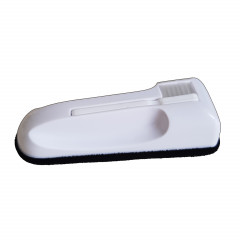
"analogis Super soft velvet brush »Brush 5«
With needle brush and box for dust-free storage.
White plastic with black velvet flocking"
"analogis Super soft Samtbürste »Brush 5«
mit Nadelbürste und Schachtel für die Aufbewahrung"
- July 17, 1955, Newport Jazz Festival
- A1: Spoken Introductions By Duke Ellington And Gerry Mulligan
- A2: Hackensack
- A3: ‘Round Midnight
- July 17, 1955, Newport Jazz Festival
- B1: Now’s The Time
- July 3, 1958, Newport Jazz Festival
- B2: Spoken Introduction By Willis Connover
- B3: Ah-Leu-Cha
- July 3, 1958, Newport Jazz Festival
- C1: Straight, No Chaser
- C2: Fran-Dance
- July 3, 1958, Newport Jazz Festival
- D1: Two Bass Hit
- D2: Bye Bye Blackbird
- D3: The Theme
- July 4, 1966, Newport Jazz Festival
- E1: Gingerbread Boy
- E2: All Blues
- July 4, 1966, Newport Jazz Festival
- F1: Stella By Starlight
- F2: R.j
- F3: Seven Steps To Heaven
- F4: The Theme / Closing Announcement By Leonard Feather
- G2: Gingerbread Boy
- G3: Footprints
- July 2, 1967, Newport Jazz Festival
- H1: ‘Round Midnight
- H2: So What
- H3: The Theme / Closing Announcement By Leonard Feather
- July 5, 1969, Newport Jazz Festival
- I1: Miles Runs The Voodoo Down
- I2: Sanctuary
- I3: It’s About That Time / The Theme
- November 1, 1973, Newport Jazz Festival
- J1: Spoken Introduction By Ronnie Scott / Band Warming Up
- J2: Turnaroundphrase
- J3: Tune In 5
- November 1, 1973, Newport Jazz Festival
- K1: Ife
- K2: Untitled Original
- November 1, 1973, Newport Jazz Festival
- L1: Tune In 5 / Closing Announcement By Ronnie Scott July 1, 1975, Newport Jazz Festival
- L2: Mtume
- October 22, 1971, Newport Jazz Festival In Europe
- M1: Directions
- M2: What I Say
- October 22, 1971, Newport Jazz Festival In Europe
- N1: Sanctuary
- N2: It’s About That Time
- July 2, 1967, Newport Jazz Festival
- October 22, 1971, Newport Jazz Festival In Europe
- O1: Bitches Brew
- October 22, 1971, Newport Jazz Festival In Europe
- P1: Funky Tonk
- P2: Sanctuary
- G1: Spoken Introduction By Del Shields
The 8-LP box set Miles At Newport 1955-1975 - The Bootleg Series Vol. 4 features of live performances by Miles’ stellar band lineups from 1955, 1958, 1966, 1967, 1969, 1971, 1973, and 1975, in New-
port, Rhode Island, New York City, Berlin, and Switzerland. From Miles’ debut performance at NJF in 1955 (a hastily arranged jam session featuring Thelonious Monk and Gerry Mulligan), to his final public performance of the ‘70s in 1975, the box set traces the ascen- dance of Miles’ music as the jazz superstar he has become known to be.
The full-length concert performances alone of Miles’ famed “Kind Of Blue” Sextet (with Cannonball Adderley, John Coltrane, Bill Evans, Paul Chambers, and Jimmy Cobb), and second great quintet in ‘66 and ‘67 (with Wayne Shorter, Herbie Hancock, Ron Carter, and Tony Williams) represent templates that reverberate in jazz and popular music to this day.
Miles At Newport 1955-1975 - The Bootleg Series Vol. 4 is available as a deluxe 8LP box set, housed in a lift-off box. The set includes print- ed innersleeves, a mini poster of Miles, and a 12-page booklet with extensive liner notes and rare photos.
Kompakt is proud to announce, finally, a reissue of the first, self-titled GAS album. Originally released on electronica imprint Mille Plateaux back in 1996, it’s been unavailable in its original form ever since – the version of GAS included in 2008’s Nah Und Fern box featured several different tracks. Here, however, GAS is restored in all its glory, the debut full-length from Wolfgang Voigt’s most enigmatic, quixotic project.
There had, of course, been signs of what was to come. Back in 1995, Voigt essayed the first GAS release, a slender, yet remarkable four-track EP, Modern. Its centre label featured a reduced symbol – an overhead or lamp light, switched on, its glow radiating outwards in four bold black lines – a perfect representation of the tight, stylised ambient electronic pop contained on that 12”. A few curious compilation tracks were floating around, too, for Mille Plateaux’s Modulation & Transformation and Electric Ladyland series. If you were attentive enough, you could tell something was up.
But nothing quite prepared us for the languorous, effervescing loops and regular-like-clockwork beats that Voigt folded together on GAS. Its six long tracks, all untitled, neither begin nor end but hazily fade into earshot, vibrate majestically in your cochlea for fifteen-or-so minutes – some a bit shorter, some longer – and then meander away, reading the mise-en-scène for the next example of Voigt’s drift and dream logic to unfold. The material is referential in the most distant way, and you can sense only the most evanescent of ghostly presences, haunting these six compositions.
GAS feels, also, like a more pliable hint at what’s to come, as the GAS concept really solidified on its successor, 1997’s Zauberberg, and reach its apotheosis on Königsforst and Pop. Those three albums share a very similar palette – blurred, hazy samples, often of classical music, stacked and cross-thatched across a muted 4/4 thud. GAS, then, is an outlier of sorts: it’s more expansive in its remit, lighter in its mood, perhaps more fleet of foot. This, of course, is part of its charm.
In clearing space for Voigt, by preparing the terrain, GAS sits both at the edge of the forest, and at the verge of an expansive, wide-eyed future; one where GAS would become truly eternal.
Text by Jonathan Dale
Kompakt ist stolz, endlich eine Neuauflage des ersten, selbstbetitelten GAS-Albums ankündigen zu können. Ursprünglich im Jahr 1996 auf dem Electronica-Label Mille Plateaux veröffentlicht, ist es seitdem nicht mehr in seiner ursprünglichen Form erhältlich – die gleichnamige Version von GAS, die 2008 in der Nah Und Fern Box enthalten war, enthielt verschiedene andere Titel. Nun liegt das 3er Album in seinem naturbelassenen Originalzustand wieder vor.
Bereits 1995 zeichnete sich mit der Maxi GAS - Modern auf Profan, sowie einigen Kompilation-Beiträgen auf Modulation & Transformation und Electric Ladyland auf Mille Plateaux dieser frühe, weltentrückte, rätselhafte GAS Sound ab, der sich erst in den sechs scheinbar endlosen, majestätisch-sprudelnden Tracks des Albums voll entfaltete. Die Musik ist von ätherischer Leichtigkeit, in der wie aus einer anderen Sphäre abstrakte Referenzen aus weiter Ferne nur andeutungsweise herüberzuwehen scheinen.
Dieser frühe, eher sphärisch-leichte, gleich einer sonnendurchfluteten (Wald-)Lichtung anmutende GAS Sound, stellt gewissermaßen den Ausgangspunkt der audiovisuellen „Welt“-Reise in den düster-romantischen Acid-Wald dar, in den sich GAS ab 1997 mit den Alben Zauberberg, Königsforst, Oktember und ab 2000 mit Pop an anderer Stelle wieder hinaus und in seine ganz eigene Ewigkeit begeben hat.
"Music On Vinyl proudly presents the first installment of the acclaimed Miles Davis Bootleg series on pristine 180 gram vinyl!
The explosive transformation of Miles Davis' 'second great Quintet' with Wayne Shorter (tenor sax), Herbie Hancock (piano), Ron Carter (bass), and Tony Williams (drums) is laid bare on Live In Europe 1967: The Bootleg Series Vol. 1.
Culled from original state-owned television and radio sources in Belgium, Denmark, and France, this 5 LP box set spans three northern European festival performances over the course of nine days in October-November 1967. The audio shows consist entirely of previously unreleased or previously only bootlegged material. Miles' Quintet lineup of 1965 to '68 is acknowledged as one of the high reference points in 20th century jazz, and its influence continues to reverberate in small group jazz today, and it was the quintet's live performances, as they evolved into Miles' ideal of a ""leaderless"" jamming ensemble, that truly immortalized them.
Live In Europe 1967: The Bootleg Series Vol. 1 is the best historical album of 2012, according to the Downbeat Critics Poll 2012. "
- October 28, 1967, Koningin Elizabethzaal Antwerp, Belgium
- A1: Agitation
- A2: Footprints
- A3: ‘Round Midnight
- October 28, 1967, Koningin Elizabethzaal Antwerp, Belgium
- B1: No Blues
- B2: Riot
- B3: On Green Dolphin Street
- October 28, 1967, Koningin Elizabethzaal Antwerp, Belgium
- C1: Masqualero
- C2: Gingerbread Boy
- C3: Theme
- November 2, 1967, Tivoli Konsertsal Copenhagen, Denmark
- D1: Agitation
- D2: Footprints
- D3: ‘Round Midnight
- November 2, 1967, Tivoli Konsertsal Copenhagen, Denmark
- E1: No Blues
- E2: Masqualero
- November 6, 1967, Salle Pleyel Paris, France
- F1: Agitation
- F2: Footprints
- November 6, 1967, Salle Pleyel Paris, France
- G1: ‘Round Midnight
- H1: Masqualero
- H2: I Fall In Love Too Easily
- November 6, 1967, Salle Pleyel Paris, France
- I1: Riot
- I2: Walkin’
- November 6, 1967, Salle Pleyel Paris, France
- J1: On Green Dolphin Street
- J2: The Theme
- G2: No Blues
- November 6, 1967, Salle Pleyel Paris, France
Live In Europe 1967 - The Bootleg Series Vol. 1 showcases the ex- plosive transformation of Miles Davis’ “second great quintet” with Wayne Shorter (tenor sax), Herbie Hancock (piano), Ron Carter (bass), and Tony Williams (drums). Miles’ Quintet lineup during that time is acknowledged as one of the high reference points in 20th century jazz, and its influence continues to reverberate in small group jazz today. It was the quintet’s live performances, as they evolved into Miles’ ideal of a “leaderless” jamming ensemble, that truly immortalized them.
Culled from original state-owned television and radio sources in Belgium, Denmark, and France, this set contains three northern European performances over the course of nine days in October and November 1967. Live In Europe 1967 - The Bootleg Series Vol. 1 is the best historical album of 2012, according to the Downbeat Critics Poll 2012.
Live In Europe 1967 – The Bootleg Series Vol. 1 is available as a deluxe 5LP boxset, housed in a lift-off box. The set includes printed inner sleeves and a 16-page booklet with exclusive photos and liner notes by jazz-historian Ashley Kahn.
- Fillmore East, June 17, 1970
- A1: Introduction
- A2: Directions
- A3: The Mask
- Fillmore East, June 17, 1970
- B1: It’s About That Time
- B2: Bitches Brew
- B3: The Theme
- Fillmore West, April 11, 1970
- C1: Paraphernalia (Bonus Track)
- C2: Footprints (Bonus Track)
- Fillmore East, June 18, 1970
- D1: Directions (Bonus Track)
- D2: The Mask (Bonus Track)
- Fillmore East, June 18, 1970
- E1: It’s About That Time
- E2: Bitches Brew
- Fillmore East, June 18, 1970
- F1: The Theme
- F2: Spanish Key (Encore)
- F3: The Theme
- Fillmore East, June 19, 1970
- G1: Directions
- G2: The Mask
- H2: I Fall In Love Too Easily
- H3: Sanctuary
- Fillmore East, June 19, 1970
- I1: Bitches Brew
- I2: The Theme
- Fillmore West, April 11, 1970
- I3: Miles Runs The Voodoo Down (Bonus Track)
- Fillmore East, June 20, 1970
- J1: Directions
- J2: The Mask
- Fillmore East, June 20, 1970
- K1: It’s About That Time
- K2: I Fall In Love Too Easily
- K3: Sanctuary
- Fillmore East, June 20, 1970
- L1: Bitches Brew
- L2: Willie Nelson
- L3: The Theme
- Fillmore East, June 19, 1970
- H1: It’s About That Time
Miles At The Fillmore - The Bootleg Series Vol. 3 features four historic perfor- mances from the Fillmore East and West in 1970, at a time when Miles Davis was single-handedly bringing jazz into the commercial rock era.
The visionary Bill Graham had booked Miles on a bill with The Grateful Dead at the Fillmore West and with fellow Columbia artist Laura Nyro in June 1970. The latter recordings are the earliest documented live performances of Miles’s band when he hired the keyboardists Chick Corea and Keith Jarrett, along with saxophonist Steve Grossman who had replaced Wayne Shorter. The rest of the rhythm section - bassist Dave Holland, drummer Jack De- Johnette and percussionist Airto Moreira - were the backbone of his band throughout this explosive period.
Curated by Carlos Santana, this set features fascinating firsthand accounts and profound insight into a seismic shift in American society, music, and culture. In a rare, in-depth interview, Miles was “so excited about the music that he wanted every set, every note made available to the public...” The searing heat of these concerts, originally issued in severely edited form, are now made whole. This set includes several bonus tracks like Wayne Shorter’s “Paraphernalia” and “Footprints”, an early version of “Miles Runs The Voodoo Down” plus a rare encore performance of “Spanish Key” from the Bitches Brew album.
The Bootleg Series Vol. 3: Miles At The Fillmore is available as a deluxe 6-LP boxset, housed in a lift-off box. This 6LP-set includes printed inner sleeves and a 12-page booklet with extensive liner notes and rare photos.
- July 25, 1969, Festival Mondial Du Jazz D’antibes, La Pinède, Juan
- Les-Pins, France
- A1: Introduction By André Francis
- A2: Directions
- A3: Milestones
- July 25, 1969, Festival Mondial Du Jazz D’antibes, La Pinède, Juan- Les-Pins, France
- B1: Miles Runs The Voodoo Down
- B2: Footprints
- July 25, 1969, Festival Mondial Du Jazz D’antibes, La Pinède, Juan
- Les-Pins, France
- C1: ‘Round Midnight
- C2: It’s About That Time
- C3: Sanctuary
- C4: The Theme
- July 26, 1969, Festival Mondial Du Jazz D’antibes, La Pinède, Juan- Les-Pins, France
- D1: Introduction By André Francis
- D2: Directions
- D3: Spanish Key
- D4: I Fall In Love Too Easily
- July 26, 1969, Festival Mondial Du Jazz D’antibes, La Pinède, Juan
- Les-Pins, France
- E1: Masqualero
- E2: No Blues
- July 26, 1969, Festival Mondial Du Jazz D’antibes, La Pinède, Juan- Les-Pins, France
- F1: Miles Runs The Voodoo Down
- F2: Nefertiti
- F3: Sanctuary
- F4: The Theme
- November 5, 1969, Folkets Hus, Stockholm
- G1: Introduction By George Wein
- G2: Bitches Brew
- G3: Paraphernalia
- November 5, 1969, Folkets Hus, Stockholm
- H1: Nefertiti
- H2: Masqualero (Incomplete)
- H3: This
Live In Europe 1967 – The Bootleg Series Vol. 2 was voted ‘Historical Album Of The Year’ in the Down Beat Readers and Critics Poll. This second volume of The Bootleg Series skips two years ahead to record Davis with his ‘Third Great Quintet’, also known as ‘The Lost Band’ (1969-1970). This line-up consists of Miles Davis, Wayne Shorter, Chick Corea, Dave Holland and Jack DeJohnette at their peak, though they were never recorded in studio. Live In Europe 1967 – The Bootleg Series Vol. 2 was voted ‘Historical Album Of The Year’ in the Down Beat Readers and Critics Poll. This second volume of The Bootleg Series skips two years ahead to record Davis with his ‘Third Great Quintet’, also known as ‘The Lost Band’ (1969-1970). This line-up consists of Miles Davis, Wayne Shorter, Chick Corea, Dave Holland and Jack DeJohnette at their peak, though they were never recorded in studio. Their European tours of 1969
are some of the only existing recordings of the group; the first legitimately released audio recordings by this stellar lineup.
Live In Europe 1969 - The Bootleg Series Vol. 2 captures the short-lived quintet in three separate concert settings across four LPs, containing selections from two nights at Festival Mondial Du Jazz D’Antibes in France and one night in Stockholm, Sweden. Special recordings include a pre-studio recording version of “Bitches Brew” which would be recorded in the studio for the infamous record by the same name a few months later.
Live In Europe 1969 - The Bootleg Series Vol. 2 is available as a deluxe 4LP boxset, housed in a lift-off box. The set includes printed inner sleeves and an insert with extensive liner notes.