In 2022, Soom T is back with her new studio album "Good" entirely self-produced through her own label Renegade Masters.
In this new reggae-dub album, the result of ten years of writing, composition and production, the Scottish MC blends the studio recordings of her musicians, The Stone Monks, with digital productions from various composers. From this multitude of musicians and producers, an original sound is born at the crossroads of reggae, dub and jazz, even sometimes pop.
The tracks "Big Bad World", "Yes My People", "Born Free", "My Struggle", "Your Time" and "My Shelter" composed by the French producer Kiko, bring a distinctive digital sound to an important part of the album. While "Don't Stand for Dis" and "Steps" are signed by London dub legend Gaudi and pay homage to the early hours of dub music with great echoes and reverberations in the purest tradition of the style . "One Real Friend" composed by Alex Dupuis of Flash Hit Records brings a welcome swing and jazz touch.
“World We Live In”, “Our Day”, “I Wanna Live”, “Get the Fruit” and “One More Tune” were composed and recorded in Paris over several years with The Stone Monks, under the supervision of Xavier Waks. He also mixed the entire album in his 31DB studio before passing it on to Simon Capony for mastering at Basalte Studio.
As usual, Soom T continues to denounce nowadays political and social issues, all with a spiritual approach, an inimitable style and an incisive flow of her own. If she deplores the dark sides of our time in songs like "Big Bad World", she also tries to find a ray of hope with tracks carrying positive messages, sometimes very melodic, such as "Don't Stand for Dis ”, or catchy, like“ Yes My People ”. "I Wanna Live" and its heady guitar riff, "Our Day" with its bright major chords or even "Amazing Graces" pour a flood of optimism amidst much heavier themes.
On the cover of "Good" we find a portrait of Soom T, a microphone in her hand, designed by the French street artist specialized in 3D, Nikita.
Get ready for a unique musical journey in search of all that is good in this world with "Good", the long awaited new album from Soom T aka the “The Raggamuffin Queen”!
Suche:back for good
Lance Ferguson is back for a killer follow-up 7" to his second volume of classic re-works and re-imaginings, Rare Groove Spectrum Vol. 2 - released on Freestyle in late January on LP, CD and digital formats.
We just couldn't resist putting this take on Pucho & His Latin Soul Brothers cover of Gladys Knight's Got Myself a Good Man on a 45. Keeping true to the source, yet somehow simultaneously sounding like no-one else, this version is 100% guaranteed to put a spring in the step of any crowd as the sun starts gradually to come out from hiding. Aside from the faithfully executed and expertly recorded drum-track, which sits pretty higher up in the mix than it's precursor, the star of this particular show comes midway through when Lance's lilting and sun-kissed guitar solo comes gliding in. If you can't move to this, even just a little bit, then you might actually be lacking a pulse. Backing things up is the undeniable latin-funk strut of Mandrill's Mango Meat. Given an instrumental work-out here with Remco Keijer's Flute and Daniel Mougerman's keys putting in work over a heavy-as-lead rhythm section, those delectable salsa-inflicted horns upping the spice levels.
Lance's work across the Rare Groove Spectrum series can often be looked on as something akin to a "live re-edit" on the originals, at times switching up sections or extending the groove. These two choice cuts however are a masterclass in subtly teasing out some of the original elements on the tracks that really make them work on a dance-floor, and bringing those to the fore while retaining 100% respect for the OG arrangements.
- A1: Althea & Donna - Uptown Top Ranking
- A2: Susan Cadogan - Hurt So Good
- A3: Sophia George - Girlie Girlie
- A4: Judy Mowatt - I Shall Sing
- A5: Marcia Griffiths - Steppin' Out Of Babylon
- A6: Janet Kay & The Kaylets - Lovin You
- B1: Marcia Aitken - I'm Still In Love With You
- B2: Joya Landis - Angel Of The Morning
- B3: Phyllis Dillon - Perfidia
- B4: Sylvia Tella - Spell
- B5: Nora Dean - Barbwire
- B6: Mille Small - Honey Hush
- C1: Phyllis Dillon - Love Was All I Had
- C2: Faye Bennett - Back Wey
- C3: Lorna Bennett - Good Woman
- C4: Sonya Spence - Come With Me
- C5: Sandra Robinson - Sensi For Sale
- C6: Althea - Downtown Thing
- D1: Marcia Griffiths - Give You & Get
- D2: Dawn Penn - I Let You Go
- D3: Paula Clarke - Dynamic
- D4: Susan Cadogan - If
- D5: Hortense Ellis - My Willow Tree
- D6: Doreen Shaeffer - Back In My Arms Again
Trojan have pulled together some of reggae's finest moments here, and importantly they come from some of the genre's most vital female talents, who can often be overlooked in favour of their more visible male counterparts. Across four sides of vinyl the likes of Millie Small, Althea & Donna, Marcia Griffiths, Phyllis Dillon, and Susan Cadogan all deservingly feature and personal sleeve notes from musician Rhoda Dakar also add real value. Big hits, unknown rarities and some brilliantly wonky numbers like Sandra Robinson's "Sensi For Sale" make this an instant NEED!
- A1: Careful What You Wish For
- A2: Ayor
- A3: Nature Is A Language
- B1: Fire Of The Green Dragon
- B2: Algerian Basses
- B3: Copacaballa
- C1: Paint Me As A Dead Soul
- C2: Backwards
- C3: Princess Margaret's Man In The D'jamalfna
- D1: Ayor (Live Pornmod)
- D2: Ambient Basses (Hijack Mix 1)
- D3: Wur Click Wur Ruff 1994
- E1: Backwards Dist Vox
- E2: Drone Geff Master
- E3: Carny Master
- F1: Drone Skellies
- F2: Choir Droney Skellies
- F3: Backwards (Live Wip)
"“The New Backwards” was conceived by Peter “Sleazy” Christopherson in 2007, revisiting stray tracks which hadn’t seemed to gel with the material he had chosen for the more somber “Ape of Naples” from 2005, COIL’s initial posthumous release, a sort of requiem and a kiss-goodbye to his then recently deceased partner John Balance.
Significantly different to its sister release, this album collects the brilliantly chaotic and outrageously rhythmic material from the original sessions for the album that was begun as early as 1993 and had originally been conceptualised as the follow-up to “Love’s Secret Domain”. These songs are as diverse and wild as the places they originated from, partly infamously spawned in Sharon Tate’s former home in the Hollywood Hills, the Nine Inch Nails home base in New Orleans and London’s Swanyard, remixed and restructured with the help of long-term friend Danny Hyde in Thailand, this collection has its own unique flow and an atmosphere not found on any other COIL release.
Both “AYOR” and “Backwards” had by the time the album was first released already become favourites in COIL’s manic live performances. Some of the other tracks had only leaked in demo versions and are here presented updated and polished as Christopherson and Hyde intended them to be heard. It is interesting to consider Balance’s vocal contributions, too. Whilst on the albums COIL did release at the time this material was first put aside (“Black Light District” and “ElpH”) his voice is all but absent, his vocal performances and his lyric writing here are arguably more closely indebted to the previous “Love’s Secret Domain” era, especially the epic “Copacaballa” is noteworthy in that respect.
The New Backwards” effectively became the final official COIL studio release of all new material whilst Peter was still alive and is here presented for the first time fully supervised by Danny Hyde, its co-creator.
The stunning cover uses a detail from artist Ian Johnstone’s “Cubic Raven” painting, licensed from the estate of IJ..
It is high time to rediscover this timeless album with the Infinite Fog release boasting eight further tracks of previously unheard material from the same sessions, rough working stages and surprising remixes which will surely delight the dedicated COIL archaeologists, as they shine yet another light on the creative process and on what could have been.
Recorded at Swanyard, London and at Nothing Studios, New Orleans, 1996.
Thanks to everyone there, especially Trent Reznor who made it all possible.
Written & Produced by Coil & Danny Hyde.
Remixed by Peter Christopherson & Danny Hyde, Bangkok 2007.
For that session Coil were: Peter Christopherson, Jhonn Balance & Drew McDowall.
Mastered by Jessica Thompson.
Front artwork by Ian Johnstone.
Artwork licensed from The Estate of Ian Johnstone.
Layout Cold Graves and Oleg Galay."
"Off the back of a triumphant sold out show at London’s O2 Kentish Town Forum, Charlie releases a brand new solo album ‘Hope Is A Drug’. Set to be released on 15th April 2022 and supported by a 15 date UK Nationwide Tour kicking off on the 18th/19th April in London and ending in Dublin on the 29th May, the album will be available on vinyl & CD
Charlie’s fourth solo album Hope Is A Drug marks a significant departure from his earlier songs, being his most personal and heartfelt work to date. The majority of the album was self-produced at Charlie’s own recording studio, built from scratch during the global lockdown. With intimate ballads such as ‘I See You’ and ‘One Of Us’, and more uptempo contemporary pop songs ‘Blameless’ and the radio single ‘All The Best’, the album showcases an artist confidently pushing the boundaries of a remarkable 20 year career. "
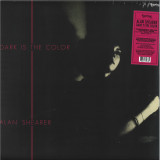
Favorite Recordings presents Dark Is The Color, the first LP by Alan Shearer reissued on vinyl for the first time. Despite being initially composed and produced for the French library label PSI, this rare
and obscure in-demand gem from 1985 sounds retrospectively like a proper album with great coherence and sophistication all along. Indeed, these 11 tracks will delight synthesizers addicts. Expect deeply emotive instrumental compositions, with ingenious analogue sequencing on stimulating chord progressions. The result is a highly retrofuturistic album, sometimes almost anticipating 90's videogames
scores. Just imagine Wally Badarou in a bunker with Talking Heads watching New York 1997 from John Carpenter.
Composed mostly step by step on a Sequential Pro-One synthesizer, Dark Is The Color is the product of the exciting state of mind from the 80's era with new sounds, new tools and new trends on the music spectrum. Influenced by bands like Talking Head or Japan, the sirens of the new wave scene strongly resonate here with Alan Shearer's familiarity and craftmanship with synthesizers.
Back in the days, Alan Shearer aka Frédéric Viger was working for his father’s music label, “Musique Pour L'image”, and their sublabel “PSI”. He started with Marathon Life under his real name before taking the Alan Shearer monitor. These records were produced for radio, TV and cinema industries but as well for companies’ internal communication. They represented a real investment from the label and these catalogues are usually full of amazing music from great artists such as Martial Solal, Vladimir Cosma, Joël Fajerman, Harlem Pop Trotters and even Manu Dibango.
About his musical illustration process, Alan Shearer tells: "Soundtracks are indeed my biggest influences and I'm a real fan of American composers as Jerry Goldsmith or Elmer Bernstein. I've always considered soundtracks as the new classical music or classical music of our century. There is a real state of mind producing music for illustration: you have to stick to the video. You should not tell what the image is saying but accompany what it is saying. You have to find a unique link, people always told me music should not be noticed for itself in a movie, that's what makes it good.”
- A1: Starsailor - All Or Nothing
- A2: Feeder - The Power Of Love
- A3: Sugababes - Killer
- A4: Muse - House Of The Rising Sun
- B1: Stereophonics - Nothing Compares 2 U
- B2: Faithless & Dido - Dub Be Good To Me
- B3: Oasis - Merry Xmas Everybody
- B4: Elbow - Something In The Air
- C1: The Reelists - Back To Life (However Do You Want Me) (However Do You Want Me)
- C2: Manic Street Preachers - Out Of Time
- C3: Badly Drawn Boy & Jools Holland & His Rhythm & Blues Orchestra - Come On Eileen
- C4: Prodigy - Ghost Town
- D1: Jimmy Eat World - Firestarter
- D2: Darius - Pretty Flamingos
- D3: More Fire Crew - Dreams (Feat Gabrielle)
- D4: Mcalmont & Butler - Back For Good
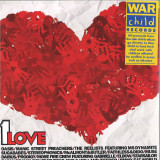
Originally released in 2002 in partnership with NME to celebrate their 50th anniversary and 50 years since NME printed the first ever singles chart in the UK. 1 Love saw the cream of British artists come together to pick their favourite number one to cover. Having appeared on the 1995 HELP album, Oasis continued their support of War Child with an acoustic rendition of Slade’s Christmas classic ‘Merry Xmas Everybody’. Stereophonics chose ‘Nothing Compares 2 U’ with Kelly Jones’s gravelly vocal complementing this stripped back version of the track written by Prince, performed by The Family and taken to number one by Sinead O’Connor in 1990.
- A1: Please The Nation
- A2: Angel Face
- A3: I Am Selfish
- A4: Eniweth
- A5: No More Crying
- A6: Making Life Out Of Music
- B1: Walking Down The Street
- B2: Rock & Roll Soul
- B3: Lovely Lady
- B4: Widow
- B5: Worthless Woman
- B6: Looking For The Day
- C1: Lonely
- C2: No More Crying
- C3: Beginning
- C4: Good Turning Bad
- D1: I Am Selfish
- D2: Dancing
- D3: Are You Satisfied
- D4: Worthless Woman
- D5: Rock & Roll Soul
- D6: Waiting For The Chance
The Effect Of Heavy Music: Rock Music And Revolution In 70s Zimbabwe. Eye Q’s music has never been collated and issued outside of its country of origin. Now, as part of the Now-Again Reserve series, their rare singles and even rarer album are presented in full. Just as the hippie era came to an end in America, a second 60s was beginning: in what is now Zimbabwe, young people created a rock and roll counterculture that drew inspiration from hippie ideals and the sounds of Hendrix and Deep Purple. The kids in the scene called their music “heavy,” because they could feel its impact, and it resonated from Zambia to Nigeria. At its peak in the mid-70s, the heavy rock scene united tens of thousands of young progressives of all racial and social backgrounds. The country was called Rhodesia then, one of the last bastions of White rule in Africa, and heavy rockers defied segregation laws and secret police to make a stand for democratic change. Eye Q is one of the greatest bands of the scene: their rock stands on par with the early Zamrock of WITCH and Ngozi Family. Please The Nation encapsulated Eye Q’s desire to forge forth, in a new, free country, and this set collates their 7” singles, ultra-rare album and songs from master tape and presents their music for the first time outside of Zimbabwe. In the accompanying oversized booklet, a trio of authors collaborate to tell the Eye Q story, and to investigate the genesis of the heavy rock scene under Ian Smith’s racist, oppressive government, and its dissipation after Zimbabwe’s liberation. The set also includes a download card for WAV files for all vinyl tracks, as well as bonus tracks.
Twice JUNO-nominated and two-time Polaris Prize listed, Toronto's soul songstress Tanika Charles unveils her album "Papillon de Nuit: The Night Butterfly".
"Papillon de Nuit: The Night Butterfly" is the third studio album from Canadian Soul/R&B powerhouse Tanika Charles and is slated to be released worldwide on Milan-based Record Kicks label on April 08th. Composed and recorded while in and out of lockdowns, "Papillon de Nuit" is an album anchored in growth and maturity. The thematic inspiration came from an unlikely source, a creature that soars after the sun sets, but often goes unnoticed until the light shines on it. It is the "papillon de nuit" to some, but drably referred to as a moth by others, revealing a bias in language alone.
"I always thought it was a strange insect. Once while in Paris, a friend swatted at one and I asked: 'Was that a moth?'. I was told: 'No, that's a papillon de nuit.' I thought that was the most beautiful description for this otherwise overlooked creature. When I later learned of the symbolism associated with it, I felt that really spoke to both my own situation and also what we've all been going through." Production on "Papillon de Nuit" was helmed by a mixture of old and new collaborators. The Safe Spaceship Records production team, consisting of Scott McCannell (Lydia Persaud, Claire Davis), Ben MacDonald and Chino de Villa (re.verse, Jessie Reyez), produced four songs on the album. The group also assisted as session musicians for songs produced by newcomer Todd "HiFiLo" Pentney (Allison Au Quartet, JUNO Award winner). "The Gumption" contributor Kevin Henkel ("Tell Me Something", "Look At Us Now") returned with three compositions, and old friend Jesse Bear (Sean Kingston, Stan Walker) contributed to one song.
Following the success of "Soul Run" (2016/17) and "The Gumption" (2019), Tanika had found a comfortable pace of releasing albums then hitting the road the following year to bring her show to new markets far and wide. So when things changed for all of us, and plans of touring "The Gumption" properly fell through, there was a realization that getting to work on the next project was the healthiest choice to make.
"I was in some dark places. My energy was stagnant and the only reliable constant was this perpetual uncertainty. I had gone from feeling like I was everywhere to only being in one place. From seeing so many new faces, to only my own, in the mirror, everyday and having to face that. Getting back to work on music allowed me to explore these feelings through the format I know best. And I wanted to make sure that when things were ready to resume, I'd be ready with something new for my audience too."
Tanika, who took part in the writing of most of the album, was also assisted by regular co-writer Robert Bolton ("Soul Run", "Remember to Remember") and accomplished solo performer Tafari Anthony (Priyanka, of RuPaul's Drag Race). Featured guests include the multi-disciplinary artist Khari McClelland and rising Toronto rapper, DijahSB. Both Dakarai Morris-James (Joanna Majoko, BeBe Zahara Benet) and Sean "D/SHON" Henderson ("Love Overdue", Serena Ryder) assisted with vocal arrangements across multiple songs.
"I think this album represents my best work to date. And yet, it also represents me coming to terms with who I am as an artist. For the first time I think I've actually accepted my own voice. I can hear beyond the imperfections, and I realized that when paired with the right music, it can sound pretty good. I still have my doubts and my dark places, but a little less of them."
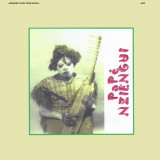
Kadi Yombo, published in 1989, is the most successful album in the quest for a fusion between tradition and modernity in Bwiti harp music of the Tsogho people of Gabon. Combining beating rattles with a layer of synthesizers, Papé Nziengui blends in a contrapuntal dialogue characteristic of harp playing: male song in appeal and female choir in response, male voice of the musical arc and rhythms of female worship. But above all it’s Tsogho ritual music and modern studio orchestration. The result is an initiatory itinerary of 10 musical pieces which are all milestones likely to be simultaneously listened to, danced, meditated on, and soon acclaimed. In the years since, Nziengui has traveled he world from Lagos to Paris, from Tokyo to Cordoba, from Brussels to Mexico City to become a true icon, the emblem of Gabonese music.
Like Bob Dylan, "electrifying" folk and Bob Marley mixing rock with reggae, some purists have criticized Nziengui for having distorted the music of harp by imposing a cross with modern instruments. They even went so far as to claim that Nziengui was just an average harpist covering his shortcomings with stunts that were only good for impressing neophytes; like playing a harp placed upside down behind his back or playing two or three harps simultaneously. Sincere convictions or venomous defamations, in any case, Nziengui never gave in to such attacks, imposing himself on the contrary to pay homage to the elders (Yves Mouenga, Jean Honoré Miabé, Vickoss Ekondo) while instructing the maximum of young people. He is thus the promoter of many young talents, the most prominent of which is certainly his nephew Jean Pierre Mingongué. In a conservative society where the sacred is confused with secrecy, exposing the mysteries of Bwiti in broad daylight can be punished by exclusion or even execution.
Papé Nziengui has always claimed that he faces such risks because he never felt enslaved to a community that governs his life, that regulates his conduct, that has a right of censorship over his activities. Like Ravi Shankar, the famous sitarist, Papé Nziengui is a man of rupture but also of openness, a transmitter of culture. As proof, he has established himself in Libreville, Gabo’s capital, as the main harpist for sessions and concerts, accompanying the greatest national artists (Akendengué, Rompavè, Annie-Flore Batchiellilys, Les Champs sur la Lowé, etc.) as well as foreign artists (Papa Wemba, Manu Dibango, Kassav', Toups Bebey, etc.). In 1988, he was the first harpist to release an album in the form of a cassette produced by the French Cultural Center (Papé Nziengui, Chants et Musiques Tsogho). At the same time, he created his own group (Bovenga), combining traditional music instruments (musical bow, drums, various percussion instruments, etc.) in the framework of a true national orchestra, which gave the first concert and the first tours of a traditional music that was both modern and dynamic, thus "democratizing" the harp, to the dismay of certain purists.
On the other hand, in modern music, dominated by the logic of profit or even commercialism, artistic creation must often be adjusted for a specific audience based on reason rather than heart. But instead of allowing himself to be distorted, Papé Nziengui has always tried to produce music that is not a caricature, worthy in its expression as in its content, of the sacredness and transcendence of the music of the Origins. This is what makes Nziengui not only the musician, but the man someone whose age hasn’t altered any of his freshness or authenticity
Kadi Yombo, published in 1989, is the most successful album in the quest for a fusion between tradition and modernity in Bwiti harp music of the Tsogho people of Gabon. Combining beating rattles with a layer of synthesizers, Papé Nziengui blends in a contrapuntal dialogue characteristic of harp playing: male song in appeal and female choir in response, male voice of the musical arc and rhythms of female worship. But above all it’s Tsogho ritual music and modern studio orchestration. The result is an initiatory itinerary of 10 musical pieces which are all milestones likely to be simultaneously listened to, danced, meditated on, and soon acclaimed. In the years since, Nziengui has traveled he world from Lagos to Paris, from Tokyo to Cordoba, from Brussels to Mexico City to become a true icon, the emblem of Gabonese music.
Like Bob Dylan, "electrifying" folk and Bob Marley mixing rock with reggae, some purists have criticized Nziengui for having distorted the music of harp by imposing a cross with modern instruments. They even went so far as to claim that Nziengui was just an average harpist covering his shortcomings with stunts that were only good for impressing neophytes; like playing a harp placed upside down behind his back or playing two or three harps simultaneously. Sincere convictions or venomous defamations, in any case, Nziengui never gave in to such attacks, imposing himself on the contrary to pay homage to the elders (Yves Mouenga, Jean Honoré Miabé, Vickoss Ekondo) while instructing the maximum of young people. He is thus the promoter of many young talents, the most prominent of which is certainly his nephew Jean Pierre Mingongué. In a conservative society where the sacred is confused with secrecy, exposing the mysteries of Bwiti in broad daylight can be punished by exclusion or even execution.
Papé Nziengui has always claimed that he faces such risks because he never felt enslaved to a community that governs his life, that regulates his conduct, that has a right of censorship over his activities. Like Ravi Shankar, the famous sitarist, Papé Nziengui is a man of rupture but also of openness, a transmitter of culture. As proof, he has established himself in Libreville, Gabo’s capital, as the main harpist for sessions and concerts, accompanying the greatest national artists (Akendengué, Rompavè, Annie-Flore Batchiellilys, Les Champs sur la Lowé, etc.) as well as foreign artists (Papa Wemba, Manu Dibango, Kassav', Toups Bebey, etc.). In 1988, he was the first harpist to release an album in the form of a cassette produced by the French Cultural Center (Papé Nziengui, Chants et Musiques Tsogho). At the same time, he created his own group (Bovenga), combining traditional music instruments (musical bow, drums, various percussion instruments, etc.) in the framework of a true national orchestra, which gave the first concert and the first tours of a traditional music that was both modern and dynamic, thus "democratizing" the harp, to the dismay of certain purists.
On the other hand, in modern music, dominated by the logic of profit or even commercialism, artistic creation must often be adjusted for a specific audience based on reason rather than heart. But instead of allowing himself to be distorted, Papé Nziengui has always tried to produce music that is not a caricature, worthy in its expression as in its content, of the sacredness and transcendence of the music of the Origins. This is what makes Nziengui not only the musician, but the man someone whose age hasn’t altered any of his freshness or authenticity
Kadi Yombo, published in 1989, is the most successful album in the quest for a fusion between tradition and modernity in Bwiti harp music of the Tsogho people of Gabon. Combining beating rattles with a layer of synthesizers, Papé Nziengui blends in a contrapuntal dialogue characteristic of harp playing: male song in appeal and female choir in response, male voice of the musical arc and rhythms of female worship. But above all it’s Tsogho ritual music and modern studio orchestration. The result is an initiatory itinerary of 10 musical pieces which are all milestones likely to be simultaneously listened to, danced, meditated on, and soon acclaimed. In the years since, Nziengui has traveled he world from Lagos to Paris, from Tokyo to Cordoba, from Brussels to Mexico City to become a true icon, the emblem of Gabonese music.
Like Bob Dylan, "electrifying" folk and Bob Marley mixing rock with reggae, some purists have criticized Nziengui for having distorted the music of harp by imposing a cross with modern instruments. They even went so far as to claim that Nziengui was just an average harpist covering his shortcomings with stunts that were only good for impressing neophytes; like playing a harp placed upside down behind his back or playing two or three harps simultaneously. Sincere convictions or venomous defamations, in any case, Nziengui never gave in to such attacks, imposing himself on the contrary to pay homage to the elders (Yves Mouenga, Jean Honoré Miabé, Vickoss Ekondo) while instructing the maximum of young people. He is thus the promoter of many young talents, the most prominent of which is certainly his nephew Jean Pierre Mingongué. In a conservative society where the sacred is confused with secrecy, exposing the mysteries of Bwiti in broad daylight can be punished by exclusion or even execution.
Papé Nziengui has always claimed that he faces such risks because he never felt enslaved to a community that governs his life, that regulates his conduct, that has a right of censorship over his activities. Like Ravi Shankar, the famous sitarist, Papé Nziengui is a man of rupture but also of openness, a transmitter of culture. As proof, he has established himself in Libreville, Gabo’s capital, as the main harpist for sessions and concerts, accompanying the greatest national artists (Akendengué, Rompavè, Annie-Flore Batchiellilys, Les Champs sur la Lowé, etc.) as well as foreign artists (Papa Wemba, Manu Dibango, Kassav', Toups Bebey, etc.). In 1988, he was the first harpist to release an album in the form of a cassette produced by the French Cultural Center (Papé Nziengui, Chants et Musiques Tsogho). At the same time, he created his own group (Bovenga), combining traditional music instruments (musical bow, drums, various percussion instruments, etc.) in the framework of a true national orchestra, which gave the first concert and the first tours of a traditional music that was both modern and dynamic, thus "democratizing" the harp, to the dismay of certain purists.
On the other hand, in modern music, dominated by the logic of profit or even commercialism, artistic creation must often be adjusted for a specific audience based on reason rather than heart. But instead of allowing himself to be distorted, Papé Nziengui has always tried to produce music that is not a caricature, worthy in its expression as in its content, of the sacredness and transcendence of the music of the Origins. This is what makes Nziengui not only the musician, but the man someone whose age hasn’t altered any of his freshness or authenticity
In the vast musical archive that is Roman Flügel’s discography, Ro70 holds a special place. Written, performed and produced between January and July 1995, it is his debut album as a full-fledged solo artist. Enquired and inspired by a certain David Moufang from Heidelberg, who used to share a classroom with Jörn Elling Wuttke at the SAE Institute and revealed himself to be an Acid Jesus fan and also of the Roman IV 12“ project, it seemed like a good fit for his (and Jonas Grossmann’s) Source Records label.
In the days before file sharing that meant going back and forth with various DATs in his mom’s Volkswagen Polo Fox for actual listening sessions between Darmstadt and Heidelberg. The time was as special and idiosyncratic one as was the sound of Source Records and of course Ro 70 itself. While the rave-olution was ready to eat its kids with the commercial outlook of former underground phenomena looked bright and the scene’s prophecy seemed grim, enterprises like Source and artist like Roman Flügel were defying any competition out of those corners with their own means.
Listening back to the ten tracks of Ro 70, it proves them, their taste and artistic vision right. Probably still being put into the ambient, downtempo, electronica or chill out sections of most record shops, this music could have been made, relished and cherished anytime between 1995 and now. Made in Roman’s home studio in his parent’s house or in the Klangfabrik studio in Egelsbach, this was made for before or after the rave – or for people who din’t want to have to do anything with it at all. His signature is all over it. Well balanced soundscapes with an almost uncanny presence and clarity. Bittersweet symphonies that doesn’t seem to be in an inferior position to modern classical or electronic studies.
It is also a very personal testament to a time in the artists’s life that was ready to get caught in the maelstrom of the oscillating techno city called Frankfurt am Main and its halcyon days between the Delirium record shop, Sven Väth’s marathon sets, the early days of the label triumvirate Playhouse, Klang & Ongaku. In a musical journal without lyrics, those memories will have to stay pantomimic and private. All for the better, that we can at least still listen to them.
Back in May 2019, Vancouver trio Corner Boys released their sole album… and promptly split a few months later. In retrospect, they couldn’t have known that the album’s title (‘Waiting For 2020’) would soon seem grimly ironic - and we all know why, right? No reason to go over all that shit again. But while the past two years have at least seen drummer/songwriter Patrick McEachnie staying active across two essential records with hardcore heroes Chain Whip, lockdown saw him switching roles. Basically, he bought a guitar and made an excellent record all on his lonesome, and as followers of his other projects will have come to expect, it’s fucking excellent. ‘Glad To Be Forgotten’ is the debut album by Pack Rat - in some ways you can see some level of crossover with Corner Boys in its manic energy and dedication to hooks (cuts like ‘Next Time Hit Me’ and ‘My Own Reality’ are so damn catchy, you could be forgiven for thinking you’ve already been listening to ‘em on repeat for the past 20 years). Familiar reference points show up (the melodies of the Pointed Sticks; the garage-slanted rifferama of Rudi or The Undertones) while a tinny budget synth keeps things ticking along nicely, just to remind you that this is a homespun DIY project. But honestly, this has the feel of a fully fleshed-out project and leaves you desperate for another fix of its sweet’n’sour tang. For anyone who loves the collision point between ‘New Rose’, powerpop sunshine and sheer rock’n’roll exuberance, this is essential. For everyone else, this is surely the gateway to all of that good stuff. You want to hear the tunes that’ll star on future generations’ equivalents to the Killed By Death comps? That’ll set your pulse soaring and your pogo muscles into overdrive? That’ll remind you of why this punk rock business still feels worth dedicating your life to, even after all this time? Hey, Pack Rat’s got ‘em. Now do your part
7" Black Vinyl limited to 1000 copies.
Teenagehood, brotherhood and a genuine love for alternative music has united THE GOA EXPRESS from the off. Hailing from the industrial town of Burnley and adopted by the Manchester culture carriers, their teenage years can be viewed as something of a hedonistic pilgrimage into the underbelly of suburban rock and roll- their first gig having been 3 songs blasted out their mates garage, the next on top of a local vintage shop where the floor nearly caved in: “when there’s fuck all, you make do with what you got”. The intensity of this friendship has resulted in the occasional bust up along the way, yet it only adds to the burning chemistry that the band offer on record and on stage. Together, brothers James Douglas Clarke (Guitar + Vocals) and Joe Clarke (Keys), along with Joey Stein (Lead Guitar), Naham Muzaffar (Bass) and Sam Launder (Drums) all contribute to a fuzzy wall of diverse sound, becoming harder to pin down with their constantly evolving, psych-umbrella’d, rock and roll. What sets THE GOA EXPRESS apart from other musicians who sit comfortably within scenes is that their identity as a band has been growing organically long before the 5 of them decided to pick up instruments and teach themselves art of killing time. Their genuine joy in the everyday; their attitude and antics seem to hark back to the glory days of the NME- if they talk about a night out, you want to be there because these lads ooze charm and wreak havoc. This purist, old school approach to creating music through unified experiences and stimulated good times is married with the plain fact that they are very much young people of this generation, and while they see its flaws its hyperreality, its sheep-like tendencies, they still understand the importance in the immediacy of pop music: of a banging riff, or a glorious chorus and how effective this can truly be, and they want everyone along for the ride. With influences ranging from Spacemen 3 and The Brian Jonestown Massacre to French existentialism, from Beat Literature to long hours working at the Bookies to the journey into the sunrise on the night bus home, it is their ability to be all these things at once which makes THE GOA EXPRESS a guitar band for the 21st Century. Nothing is ever a compromise because they are so unapologetically themselves in everything they do- proud Northerners with a DIY foundation that aren’t afraid to look into the often dim future and see themselves shining brightly in it, unforgiving and unpretentious. So far, the band have released 3 singles with great success. The first: ‘Be My Friend’, produced by Ross Orton right next Sheffield’s famous ‘City Sauna’ brothel, presents itself to us as a cheeky, snarling pop song, holding undertones of raw cynicism laden with psychedelic sunshine. Ross Orton’s studio was also right next door to where the band recorded their last single ‘The Day’ with Nathan Saoudi of Fat White Family at ‘Champ Zone.’ Both these producers have been able to give these instant pop classics a grittier feel, capturing the essence of the unfettered lifestyle the band were living at the time that they were able to capture themselves in the music video for ‘Be My Friend’. After signing with Ra-Ra Rok, (WU-LU/Bingo Fury) the band released anthemic summer hit ‘Second Time’, that went straight to the 6 music B-List before quickly heading up to the A-List 2 for 2 weeks. This was followed by the release of its B-Side ‘Overpass’ that almost immediately caught the eyes and ears of BBC Radio 1’s Jack Saunders, who had the band on his ‘Next Wave’ Segment. Closing the year that saw them play to 1000 strong crowds at festivals like Latitude & End of the Road, the band headlined their biggest headline show to date at Manchester’s Gorilla. Its fair to say that this really is only the beginning.
Truls Morck has a background as a guitarist in Graveyard and Slowgoldas well as guitarist, singer and songwriter in Den Stora Vilan
In 2015 he released his first solo album and shortly thereafter he returned to Graveyard, this time as bass player. After a few years of waiting, it's finally time for his second solo LP; "What A Time To Be Alive". The sound is inspired by the soft rock of the 70's and you can hear echoes of Harry Nilsson and George
Harrison mixed with dreamy digital keyboards and a modern, relaxed, psychedelic
production."We have tried to create a soft and easy- to- listen- to sound that
somehow still feels interesting and well-made. My lyrics are probably quite selfabsorbed and introspective. The naive and honest I can read between the lines in
rock history's simpler poetry, inspires me", Truls says.
With Plum, the songwriting partnership rooted in the creative rapport between bandleader Molly Hamilton and guitarist Robert Earl Thomas continues to expand on shared visions, delving deeper into what was always there: dusty guitars, ear-worm melodies, warm expansive arrangements. Each entry to their catalog has marked a subtle reimagining of Widowspeak's sound, though perennial points of reference remain the same: 90's dream pop, 60's psych rock, a certain unshakeable Pacific-Northwestness. Speaking to the timeless feeling of each, the albums continue to be discovered well beyond their respective PR cycles, made beloved by new listeners through word of mouth. The band's fifth album feels comfortable and lived-in: humble in structure, heavy on mood. Perhaps that came taking time off from the touring grind, instead working full-time jobs and settling into the rhythm of daily life in a small upstate New York town. Plum was recorded over a handful of weekends last winter by Sam Evian (Cass McCombs, Kazu Makino, Hannah Cohen) at his Flying Cloud studio in the Catskills, and was mixed by Ali Chant (PJ Harvey, Aldous Harding, Perfume Genius). In addition to Hamilton (vocals, guitar) and Thomas (guitars, bass, synth), it features instrumental contributions by Andy Weaver (drums), Michael Hess (piano), and Sam himself (bass, synth). Plum nestles into the band's canon like it was always there, but with new textures coming to the fore, like the polyrhythmic pulse of "Amy" and "The Good Ones", or the watery, Terry Riley-influenced track "Jeanie" Plum navigates the spaces between the lesser emotions of modern life. Hamilton's lyrics speak to the unique turmoil of anyone who creates as their work, who must somehow survive off such "fruits of their labor." Yet, Widowspeak have always made a bitter pill much easier to swallow. The majestic "Breadwinner", the luminous "Even True Love" - these songs here were made to be listened to, enjoyed. "Money" is particularly hypnotic, built around a repeating, cyclical motif that serves as both skeleton and body. "Will you get back what you put in?" Hamilton asks over an insistent guitar riff. The line is delivered with a knowingness that transcends its surface critiques of late-stage capitalism, asking both herself and the listener whether this is, in fact, the world we want to live in. Through Plum, Widowspeak have brought something into the world that seems to know its own worth, even as it wonders aloud about what is to come. What value and meaning do we assign ourselves, our time, and how do we spend it?
The Accra-born pianist and frontman only released a few albums in small quantities, yet two of them are among the most sought-after records from 70's Africa. This was the first.
So what do we know After learning his craft in Benin and playing with the likes of Orchestre Poly-Rythmo de Cotonou, ROB returned to Accra to write his own material and find a sound.
Hooked on the driving funk and raw soul of stars such as James Brown and Otis Redding, he would often imitate his heroes on his father's piano during school holidays.
The title track sets the pace with a JBs-like rhythm, ROB almost shamanic with his sparse yet commanding vocal. The organ and wah-wah guitar spin us out before those imperious horns bring us back in.
And what better way to close this set than with 'More', swept up in a call and response between Rob and his backing singers as a 'Blow Your Head' synth flares and the brass blasts. Good times guaranteed.
As the man himself says, 'Funky music is in my blood. What you hear is the coming out of my mind.' No one sounds like Rob, because there is no one like Rob.
About time – Ebbot and I have finally been able to make an album that is largely an extension of all the time we have spent together and all the concerts we have done
You could say it's a kind of fusion of the two of us in music form. A key ingredient was that Reine Fiske (Dungen) wanted to be part of this musical adventure and record with us. His tone and spontaneous playing were absolutely crucial in making this album. Also at the heart of this album, and which made our recording sessions so edgy and good, were the beautiful poppy bass playing by Marcus Holmberg (Komeda), the dynamic and responsive drumming by Nicklas Korsell
and the funky piano playing by Daniel Kurba. And finally, working as both a musician and sound engineer, Ponus Torstensson, aka Tentakel, played a vital role in creating the psychedelic sound on the album