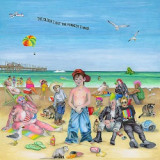
Oliver Johnson alias Dorian Concept veröffentlicht am 28. Oktober 2022 sein neues Album, „What We Do For Others“, auf Brainfeeder. Es ist das dritte Studioalbum des österreichischen Produzenten und Synthesizer-Experten, der für seine einzigartigen, wunderschön detaillierten Klangteppiche und wilden, gar euphorisierenden Live-Keyboard-Jam-Videos bekannt ist.
„What We Do For Others“ ist ein entspanntes, ruhiges, selbstbewusstes und intimes Album, das auf herrlich lockeren Arrangements und rückgekoppelten Klanglandschaften basiert und mit Fetzen seines eigenen verfremdeten Gesangs unterlegt ist, der eher als zusätzliche Instrumentierung denn als lyrische Phrasen präsentiert wird. Alle Elemente und Schichten wurden ohne Unterbrechungen aufgenommen und absichtlich nicht bearbeitet. „Ich glaube, deshalb hat diese Platte so etwas wie einen ‚Bandsound‘.“, erklärt Johnson. „Ich spiele alle Arten von Tasteninstrumenten, singe und benutze Effektgeräte, um diese freien Kompositionen zu schaffen.“ Der in Wien lebende Johnson ist ein fester Bestandteil der experimentellen Jazz-/ Elektronik-Szene, die im Umfeld von Brainfeeders Aushängeschild Flying Lotus floriert und sich diversifiziert hat. Mit frühen Veröffentlichungen auf dem Kindred Spirits-Label Nod Navigators und Affine Records spielte Johnson bei den ersten internationalen Label-Nächten von Brainfeeder im Jahr 2009 (Off-Sónar in Barcelona und die berüchtigte Hearn Street Car Park-Session in London) und bildete eine starke familiäre Bindung mit der Brainfeeder-Crew, die auf der gemeinsamen Liebe zu freaky Elektronik-Jazz-Fusion beruht. Johnson war an der Produktion von Thundercats „The Golden Age Of Apocalypse“ beteiligt, spielte die Tasten auf Flying Lotus' bahnbrechendem Album, „Cosmogramma“, und tourte mit den Live-Bands von FlyLo und The Cinematic Orchestra. Außerdem steuerte er die Tasten auf MF DOOMs „Lunchbreak“ bei, das von FlyLo und Thundercat produziert wurde. Kürzlich arbeitete er mit Kenny Beats an dessen Debütalbum, „Louie“, zusammen, wobei er bei drei Stücken die Tasten beisteuerte, und tat sich mit einem weiteren Pionier zukunftsorientierter Elektronik - Mark Pritchard - zusammen, um Musik für Damien Jalets zeitgenössische Tanzperformance, „Kites“, an der Göteborger Oper zu komponieren. Im Jahr 2020 arbeitete Oliver mit einem der weltweit führenden Ensembles für zeitgenössische Musik zusammen, dem Klangforum Wien, und komponierte ein Stück namens „Hyperopia“, das beim TRANSART Festival in Österreich aufgeführt wurde. Johnson veröffentlichte sein Debütalbum, „Joined Ends“, 2014 auf Ninja Tune, bevor er 2018 auf Brainfeeder landete, um „The Nature Of Imitation“ zu veröffentlichen: ein Album mit schwindelerregenden Partituren, kakophonischen Breakdowns und formidablen Rhythmen, von denen Pitchfork schwärmte: „Dorian Concept schafft etwas, das Elektro-Funk-Autoren der 70er und 80er Jahre wie Kraftwerk, George Clinton und Roger Troutman angedeutet haben: Computermusik, die den Funk unverhohlen imitiert, anstatt ihn nur zu faken.“.
Cerca:bar 1
Expanded Edition[176,43 €]
Double LP[41,13 €]
Blue Vinyl[10,29 €]
Black Vinyl[34,24 €]
Translucent Blue vinyl[35,92 €]
With both sides as vibrant and colourful as a hot and sweaty street party, this latest 45 is the perfect afrobeat soundtrack to end your summer.
A side, Blue G. opens explosively and delivers all that it promises in the opening bars: beautifully orchestrated twists and turn that chug along instrumentally for half the track. South African singer Nongoma unexpectedly adds a vocal spin in English and Xhosa, and with the catchy lyrics of "all the children need love, peace and harmony", it's a delight to be swept up in this swirling, festive, solar energy.
The B side, That Good Thing, follows on at exactly the same tempo, weaving horns, guitars, keys and numerous percussions in and out of an equally infectious groove. A highly polished track, full of rises and falls in all the right places.
The Konkolo Orchestra is, for now, a Zürich studio project led by multi-instrumentalist Alexis Malefakis, but let's hope that changes soon because it feels rather criminal not to have these rich sounds live and in your face. Dexterous musicianship meets fine production and execution.
Unfurled Works is a collection of back-catalogue zake tracks that have been lengthened for this new cassette, which is a slow-moving cascade of ambiance that washes over you in a delightful fashion. It's an album of frayed edges and lo-fi production, of dream-like haziness and heart-warming subtlety. The five carefully layered tracks on it slowly and stylish shift from one to another with meditative pads and organic drones that are gently peppered with sombre keys. Some pieces are light and airy, others are more moody and heavy, and all of them are perfect for daydreaming and re-setting your mood. Silence takes on all new potency and the beauty of the barely-there grows ever more striking.
- 1: Roses (Rumer)
- 2: You're The One (Carly Simon)
- 3: Mona Lisas And Mad Hatters (Elton John, Bernie Taupin)
- 4: Anyone Who Had A Heart (Burt Bacharach, Hal David)
- 5: I Wanna Roo You (Van Morrison)
- 6: The Windows Of The World (Burt Bacharach, Hal David)
- 7: Never Arrive (Hugh Prestwood)
- 8: Old-Fashioned Girl (Rumer, Rob Shirakbari)
- 9: How Deep Is Your Love (Barry Gibb, Robin Gibb, Maurice
- 10: My Lover Lies Under (Simon Aldred)
- 11: Wives And Lovers (Ft. Rory More) (Burt Bacharach, Hal D
- 12: The Folks Who Live On The Hill (Jerome Kern, Oscar Hamm
- 13: Where've You Been? (Donald Henry, Jonathan Vezner)
Award-winning British vocalist and songwriter, Rumer is to release a new album B Sides and Rarities Vol. 2 via Cooking Vinyl. The long-awaited follow-up to 2015's B Sides and Rarities Vol. 1, Vol. 2 is a treasure trove of rarities. As well as two Rumer originals, Vol. 2 features unique cover versions of songs by an eclectic cast of writers including: Elton John and Bernie Taupin, Carly Simon, Burt Bacharach and Hal David, Van Morrison, The Bee Gees, Jerome Kern and Oscar Hammerstein, Simon Aldred, Donald Henry and Jonathan Vezner and Hugh Prestwood, a collection of whose compositions Rumer covered on her highly-praised 2021 album Nashville Tears.
- A1: Let Me Go 2 : 56
- A2: Scarred 2 : 58
- A3: Dec 11Th 1 : 13
- A4: This Will Do 2 : 55
- A5: Get To You 3 : 25
- A6: Tryna Be 2 : 50
- A7: Make You Mine 3 : 20
- A8: July 16Th 1 : 50
- B1: For Tonight 3 : 14
- B2: Lost Me 3 : 00
- B3: Lie Again 3 : 07
- B4: Another Heartbreak 4 : 09
- B5: At Least We Tried 3 : 32
- B6: Remind Me 3 : 24
- B7: Unholy Matrimony 3 : 20
Der 26-jährige Sänger Giveon wurde zu einem der aufstrebenden Stars der internationalen Hip-Hop-Szene, indem er mit seiner einzigartigen Baritonstimme Herz und Tiefe in seine Musik zurückbrachte. Diese Stimme ist es auch, die ihn regelmässig an die Spitze der Charts bringt. Zuerst in Drakes "Chicago Freestyle", dann in Justin Biebers "Peaches" und schließlich auch solo mit "Heartbreak Anniversary", das heute weltweit 670 Millionen Streams hat und in den USA mit Platin ausgezeichnet wurde (400 Millionen Streams). Sein Debütalbum "Give or Take" - mit den Singles "For Tonight" und "Lie Again" - ist eines der am meisten erwarteten internationalen Projekte.Cette année fut celle de l'ascension pour Giveon. Le jeune chanteur de 26 ans est devenu une des stars en devenir de la scène Hip-Hop internationale en ramenant du coeur et de la profondeur à sa musique grâce à une voix baryton unique. Cette voix est celle qui enchaîne les apparitions en haut des charts. D'abord sur le « Chicago Freestyle » de Drake puis sur « Peaches » de Justin Bieber tout en marquant le coup en solo avec « Heartbreak Anniversary » qui cumule aujourd'hui 670M de streams dans le monde et certifié platine aux USA (400M streams). « Give or Take », son tout premier album inclus les singles « For Tonight » et « Lie Again », est l'un des projets les plus attendus à l'international.
The Older I Get, the Funnier I Was, which follows Thomas’ brilliant 2020 HBO special The Golden One and his Can't Believe You're Happy Here EP released earlier this year, surveys a range of emotion and offers a broad sonic palette, moving between pop punk, electro, and the obvious influence of the singer-songwriters he grew up listening to in early childhood. It conjures the ennui of Bright Eyes alongside the barefaced storytelling of John Prine, the overstuffed lists of Fred Thomas with the lackadaisical humor of Colleen Green, among many others.
Thomas attributes the dexterity of the record to Duterte, who recorded and engineered most of it in addition to serving up plenty of encouragement when Thomas got down on the process. “As a comic, I used to test out new songs during sets to see if the funny bits were hitting, but since I wrote this in isolation I ended up writing lyrics and worrying less about making jokes,” Thomas says. That said, the album’s plenty funny. Stand-out and lead single “Rigamarole” opens with a Thomas-voiced infomercial that recalls his oft-cited lookalike Jim Carrey as the Grinch, before launching into a buoyant pop song about being depressed.
Whitmer Thomas will admit that when he traveled home to small town Gulf Shores, Alabama to record his HBO stand-up special, The Golden One, he expected to be greeted as a returning hero, a conquering king, or at minimum, a guy with a moderately successful career as an entertainer in Los Angeles. “I expected a big welcome home, open arms, but when I went back I realized: nobody fucking knows me. Nobody remembers me,” Thomas says. “In the years I’d been performing that show, I’d been romanticizing my childhood in this mythologized place, but the visit made me see that I’m not really from there anymore.”
The sense of alienation compounded when Thomas recognized how few people in town remembered his mom, to whom The Golden One is dedicated and largely about. Thomas grew up watching her perform with her twin sister at the legendary Flora-Bama Lounge, where he set the special, and still counts her as one of his musical influences. His new album, The Older I Get, the Funnier I Was, isn’t overtly about his mom, her presence is deeply felt throughout. While in Gulf Shores, Thomas discovered dozens of her old recordings, all of which had been wrecked by Katrina, but upon returning to LA, Thomas paid “a fancy place in Hollywood” to fix the tapes and hired Melina Duterte (Jay Som, Bachelor, Routine) to mix them. The two struck up a collaborative friendship, and Thomas had the sound of his mom’s voice back. “I was listening to songs she recorded when she was about my age, just these heartfelt, sweet Americana songs,” he says. “I decided then that I wanted to lose the Ian Curtis voice I always sing with; I wanted to do what came naturally, because my mom always sounded like herself, even when she was singing some cheesy reggae song about, like, Jamaica.”
Thus he went into The Older I Get, the Funnier I Was knowing it was time to retire his darkwave persona, and leaning into his natural, chirpier voice, which he says sounds “like a 12-year-old’s.” It makes sense: much of the album chronicles what Thomas calls “being a kid and feeling like you have no control and overcompensating by being annoying.” “So much of the album is about witnessing drug and alcohol addiction as a kid and seeing what it does to people, but also realizing that there's nothing you can do about it,” Thomas says. It’s familiar territory (see: “Partied to Death”) but the methodology is different this time around; true to its title, The Older I Get, the Funnier I Was isn’t always looking for laughs. Thomas might’ve left his hometown behind, but his kid self is still tagging along, a Peter Pan shadow he can’t untether himself from. The first line he sings on The Older I Get, the Funnier I Was is: “There should be a room at every party where you can just sit and watch a movie.” Find a 12-year-old who wouldn’t say the same.
The classic sci-fi series teleports to Demon Records for two thrilling full-cast radio adventures.
From 1977 to 1981, a heroic band of freedom fighters waged war against the merciless Terran Federation,
spearheaded by Supreme Commander Servalan. In the mid-1990s Terry Nation’s intergalactic epic switched from BBC
TV to radio with two new adventures, The Sevenfold Crown and The Syndeton Experiment. Both now come to vinyl
for the first time, alongside cast interviews and extracts from Zen and the Art of Blake’s 7.
Presented across 3 x 140g vinyl discs in three colours, these full-cast dramas star Paul Darrow as Avon with Jacqueline
Pearce as Servalan, Michael Keating as Vila, Steven Pacey as Tarrant, Paula Wilcox as Soolin, Angela Bruce as Dayna,
and Peter Tuddenham as Orac and Slave. Written by Barry Letts (Doctor Who) they feature incidental music by Jeff
Mearns as well as the familiar strains of Dudley Simpson’s iconic theme music.
The removable slipcase cover reveals a trio of coloured LPs - plus a frameable art print - in a widespine sleeve. The
discs are presented in individual sleeves which, when place side by side, reveal a landscape scene of Scorpio in flight.
Full cast and credits are accompanied by graphics illustrating the tech of Blake’s 7.
Make sure you’re Down and Safe with this exclusive limited edition.
(feat. Joe Russo)
The 10-piece ensemble founded by saxophonist Stuart Bogie and drummer Joe Russo is comprised by musicians who hail from a long list of groups, including Antibalas, The Dap Kings, Red Barat, Arcade Fire, Joe Russo’s Almost Dead, David Byrne’s American Utopia, St. Vincent, The Budos Band and Superhuman Happiness. A collaboration between old friends, Bogie's horn arrangements meet Russo's propulsive drumming in an explosive combination of woodwind and brass instruments that reimagine wind music in bold and dynamic new ways.
‘The Struggle (45 Edit)’ is a battle song, musically contemplating the seemingly constant struggle between forces in society. It features solos by Michael Leonhart and Raymond Jay Mason, with the exclusive 45 remix of “Arrival” originally featured on The Prophets in the City LP. Do you remember your first time in the City?
Massimiliano Pagliara returns to Permanent Vacation with his fourth studio album "See You In Paradise". After the highly acclaimed "Nothing Stays In One Place For Long" EP from 2020, this is the first full-length from the Italian-raised and Berlin-based producer for the label. Albums in the dance music genre can often be a challenge in terms of finding the right balance between the dancefloor and listening at home. Massimiliano, however, mastered this craftmanship perfectly while reviving the art of the album format.
Mostly written and produced in the lockdown period of spring 2020 these 10 tracks offer the whole sonic spectrum from the "Massi universe". The hardware enthusiast blends analogue-heavy and bright synthesizer melodies, pop hooks, Chicago house groove with more technoid tracks and atmospheric soundscapes. Taking you on a journey through his mind, body and soul: From his underground disco passion and pulsating dancefloor moments to ethereal and meditative ambience.
Inspired, both musically and aesthetically - one of his favourite carnal catchphrases titles the album - by Disco hero Patrick Cowley, Massimiliano channelled past, present and future in searching for new adventures within his music. For the first time working with live musicians (saxophone and piano) to bring a new facet on the table, that flows with the production seamlessly.
Communication and getting into a dialogue is a crucial part for Massimiliano as an artist. Whether it used to be as a ballet dancer, as a DJ, most prominently as a resident of the legendary Berghain / Panorama Bar, a producer and in collaboration with other artists and musicians: Maestro Massi has gathered an illustrious group of friends and like minded artist such as Snax, Fort Romeau and Init (with whom he has worked before), as well as new collaborators including Curses, Coloray and Vanessa. Under the artistic direction of Massimiliano each artist was able to bring his own unique talent into the album's coherent production and together with Massimiliano they created something that is more than the sum of its parts: A refuge full of beauty and harmony and free from worries in an upside down world. In other words: "See You In Paradise”
On his debut album producer and Squama co-founder Martin Brugger hovers through Ambient, (upbeat) Downbeat and unfulfilled build-ups.
Conceptualized as a blank soundtrack, the music was sent to fellow artists who shared their visual and verbal associations which became the source for the artwork and tracktitles, effectively making the album a collective effort.
Evident in all of his recent projects is Brugger's passion for working and thriving within closely set limits.
The only audio sources in the process of making the album were his record player and a Dave Smith Prophet 08 synthesizer. In an antithesis to most sample-based music, Brugger takes the more ephemeral moments of recorded music and uses pitching tools as a magnifying glass to dive deeper into the sound and bare layers that normally remain unheard.
Stellar Legions is four experienced space cadets from the Antwerp interstellar legion, led by Captain Andrew Claes (STUFF., BRZZVLL, Internal Sun). With a sound rooted in jazz, improv, hip-hop, dub and electronic music, brace yourself for an intergalactic trip through colourful musical worlds and allow yourself to be carried away to indefinable, otherworldly but always hospitable beacons.
Alongside Claes, the delegates on duty are all heroes from the Allied star: Bram Weijters (Raymond Van Het Groenewoud, Crazy Men), Klaas De Somer (Tourist Lemc, Selah Sue) and Fre Madou (ex-DAAU, Namid). With them, come stories and artifacts from the multidimensional cosmos to our beloved mother planet Earth and this autumn, they passionately present their first omnibus 'Stellar Legions', released 21st October via the groove-obssessed Sdban Ultra label.
The album consists of eight tracks recorded in the studio and live, resulting in one big cosmic experience that exhilarates down to every last arrangement. From Claes' twisted sax on the semi-electronic ecstatic dream world that is an 'An Arp in Tunisia' to the jazzy snatches of 'Wessel' where De Somer's hurried drum patterns and Weijters frenzied keyboard solos catch light, Stellar Legions unites the adventure and improvisation of jazz with contemporary sounds.
At the core of the Stellar Legions sound is a rhythm section Sly & Robbie would have approved of: loose and sticky, grinding and unwinding: De Somer's drums fizz with expectation while the relentless bass strokes from Madou provide the beating pulse. It's fresh, it's raw and it keeps us listening, grooving and wanting more. Elsewhere, 'Odyssey' is a cataclysmic mix of feverish sounds and melodies that take you to an extra-terrestrial place, while the live recording of 'Alcyone', basks in a spatial mix of futuristic grooves and ethereal soundscapes before album closer 'Covix', results in a spacious and wonderfully atmospheric affair.
Electronics wizard Andrew Claes has recorded music in a wide range of styles ranging from free jazz outfit Chaos of the Haunted Spire (duo with Teun Verbruggen) to techno icon Marco Bailey and New Wave hero, Marcel Vanthilt. In addition, he has collaborated with Zach Danziger, Zap Mama, Brussels Jazz Orchestra, Hermes Ensemble, Mauro Pawlowski, Josse De Pauw and many others and released music with the electro-jazz collective AAN/EOP and his solo project, Internal Sun.
Claes is also a teacher of 'Live Electronics' at the Conservatory of Antwerp and a doctorate in the arts, where he is currently investigating the possibilities of an electro-acoustic saxophone. He also regularly gives workshops on the Belgian synthesizer microcontroller platform, Axoloti. His latest achievement is AI-driven robot-jazz project 'BotBop' with Dago Sondervan and Kasper Jordaens, which explores the possibilities and limits of 'computer aided music performance'. Their latest project 'Integers & Strings' premiered at the Sònar festival in Barcelona in November 2021.
- 1: Lettuce And Cabbage
- 2: Pay Me
- 3: Flamboyant (Feat. Frankie Storm)
- 4: Beastie Boyz (Feat. Ron Browz & Method Man)
- 5: Billy Joel
- 6: Feast (Bo Blakk & Milly D.o.d.)
- 7: Got It Movin (Feat. Ron Browz)
- 8: Faith (Feat. Ron Browz & American Bboy)
- 9: Shark Tank (Feat. Steel & Ruste Juxx)
- 10: Hood Up (Feat. Frankie Storm)
- 11: Squad (Feat. Ron Browz & Last American Bboy)
- 12: The Answer
Since making his mark in the ‘90s through the early aughts as a part of the legendary Boot Camp Clik and one half of “Da Incredible Rap Team” and duo Heltah Skeltah, Rock (also known as the Rockness Monsta) has been conservative with solo efforts. With one of the most distinct voices in hip-hop, the Brooklyn emcee released his full-length debut solo albumRockness AP in 2017, and now looks to step back into the spotlight with his sophomore album, Ether Rocks.
Produced entirely by Harlem, New York’s Ron Browz (Nas’s “Ether”, Jim Jones’s “Pop Champagne”, etc.), the project sees Rock’s ominous tone and sharp flow transposed from the traditional Boom-Bap beats of Da Beatminerz and others, into a sonic backdrop that retains grit yet bolsters an updated and more sophisticated style from the legendary emcee.
The 12 track LP boasts guest appearances from Method Man, Steele (Smif-N-Wessun), Ruste Juxx and more, and is available via DSPs, CD and vinyl through American B Boy Records in partnership with Fat Beats.
“Dope is dope. I'm trying to break out of the underground rap box and ease into ‘grown man rap’. This album is basically my way of showing y’all more sides to myself musically and conceptually. A lot of our culture wants you to do the same thing over and over. That’s understandable but not realistic as we are forever evolving as human beings. So, while I continue to serve jedi level barbarian bars, I’m adding some things to the menu.” – Rockness Monsta
Red Vinyl[27,69 €]
Up The Bracket arrived like a raging bull in a tired post-Britpop china shop and introduced the world to The Libertines, a new gang of London bohemians, whose ragged tunes, red military tunics, opiated poetry and "live now pay never" lifestyle came to define the millennial angst of the early noughties. At the heart of the band is the blood bond bromance between the ramshackle Music Hall Jagger/Richards, Peter Doherty and Carl Barat, ably assisted by the rock solid rhythm twins John Hassall and Gary Powell. Any bookie worth his salt would have given you short odds on this quartet surviving more than a month or two, given the teetering on the brink lifestyle they chose to lead, but here we are two decades later and our Byronic heroes, though older and wiser, are still fighting the good fight and making music every bit as vital as their debut. The belief, talent and fervour that Doherty spoke of in their earliest manifesto has stood them in good stead. Up The Bracket, justly considered one of the greatest albums of the noughties, was originally released on October 21st 2002 by Rough Trade Records. The album, a heady stew of indie rock, skiffle, blues, dub and English bucolic pop, was a huge shot in the arm to a largely redundant music scene and helped to inspire the rebirth of guitar music, going on to influence countless artists who followed in its wake. Up The Bracket, which was produced by Mick Jones of The Clash, takes you on a wondrously poetic journey into the band"s mythical world and their fevered dreams of Albion, a land of squalid glamour, liberty, equality, fraternity, gin palaces and chip shops. Quite simply Pete, Carl, Gary and John created a hugely compelling timeless British rock"n"roll classic debut as relevant now as it was upon its release.
Perpetual Doom proudly presents the new album from Austin Leonard Jones: Dead Calm. On this collection of nine new tracks, the Texas-based troubadour channels his eclectic talent into a melancholy country groove. Full of signature tumbleweed melodies and his deadpan wit, it is an essential addition to Jones’ unique and varied catalog.
Like any good country record, Dead Calm starts with a joke and ends in tears. “A werewolf walks into a bar,” Jones sings on opener “Cape Fear,” where vampires pour drinks and no one seems to escape. The town might be full of the undead, but it could be anywhere—after all, as Jones says, “It’s hard on the living in Cape Fear.” The slide guitar and faint bright keys set the tone for an album that mixes domestic sorrow with a touch of kitsch, like Conway Twitty at a seasonal Halloween outlet. “I’m the sole survivor of the all-night show,” he sings on “Back in the Black Lagoon,” “and it cost a thousand tears for every episode.” Somewhere between a funeral and a costume party, Dead Calm bursts with classic songwriting sure to get you on the dance floor and crying.
All these ghost towns, desert bars, and haunted capes emerge from the small town outside Austin where Jones wrote and recorded the album. Alongside producer Jesse Woods, he crafted a sound based on the traditional country palette of acoustic and slide guitar, organ and gentle drums. Songs like “Night Parrots” and “Demon Sands” take stock of life’s disappointments as Jones’ maudlin voice and Jesse Siebenberg’s pedal steel twist tighter around each other. “The Australia Song” puts autobiographical storytelling first, while “Exotics” laughs at our tendency to seek satisfaction in far-off places and things. It all comes together on “Its Treachery,” where Jones confronts the intimate betrayals of “a whole life not working out as planned.”
Sound familiar? Austin Leonard Jones invites you to join the club.
Ugandan DJ and producer Authentically Plastic presents their debut full-length on the Hakuna Kulala imprint.
‘Raw Space’ is a brilliant display of their self-described style of “free form femme fuckery”, harnessing East African influences, unstable polyrhythms and glinting techno production flourishes
A unique italo disco masterpiece and one of the most obscure italo “barn finds” that most Italo world learned about thanks to the “Lost Treasures Of Italo disco” mix by Fleming Dalum and Filippo Bachini as well as the Hysteric’s edit from the “Mothball Dance Classics” sampler a few years back. Now Vintage Pleasure Boutique has prepared a fully official 12″ reissue with extended versions and Italoconnection remix. The material has been remastered from the original master tape, which was stored in Vittorio Acunzo’s archives for the entire 35 years.
Available on limited edition translucent gold vinyl and very limited vinyl-style cd. "The Young Ones' Flaming Lips meet Jacques Brel in a pean to lost youth, 'Comme dans un Reve' Dream bossa chanson a la Gainsbourg/ Birkin. ‘Dreams’ is the second of the final trilogy of albums by critical darlings The Real Tuesday Weld following last year's acclaimed noir-themed ‘Blood'. This collection references late sixties songwriting a la Lee Hazlewood, Jimmy Webb and Burt Bacharach with nods to Flaming Lips and Tin Pan Alley, all mixed up with hazy lo-fi electronica, ghostly atmospherics and cinematic instrumentals. Guest vocalists A Girl Called Eddy, Sephine Llo and Oriana Curls provide a counterpoint to main man Stephen Coates' Gainsbourg-like crooning. Continuing the band's long preoccupation with dreams, the songs were written in the early morning or late evening on 'either side' of sleep: ‘I’d rise super early and go straight to it with the emotion of the night’s imaginings still heavy on me or work in that strange space-time just before sleep claims us”. The album is sequenced in an approximation of a life, from youth to age, with the band’s perennial focus on London, love, the English landscape and time passing. ‘Bone Dreams Blood’ in particular is a sonic memorial to friends loved and lost in the life of London. "beautiful...giddily recalls Gainsbourg, Pulp, Cole Porter, early Disney soundtracks and seedy postwar revue bars" SUNDAY TIMES // "Utterly unique, utterly delightful" THE TELEGRAPH // "These heart-pricking songs speak to us all" WORD // 'Utterly decadent and darkly humorous' TIME OUT LONDON // 'Superbly atmospheric' UNCUT // Track listing: 1 The Young Ones 2 Kinky Love 3 Bone Dreams Blood 4 I Awoke to Find I was Dreaming 5 Ever After 6 Lost Endeavour 7 Curtain Call 8 Comme Dans un Reve 9 Bodhisattva of the Gulag 10 Everything 11 Last Light
Rance Allen, from Monroe Michigan, with older brother Tom on drums and younger brother Steve on bass recorded their first record and won a talent contest in Detroit and were subsequently signed to Stax's Gospel Truth label in 1971. After four albums Rance signed to Capitol and made his most highly acclaimed album 'Say My Friend'. It was produced by the Mizell Brothers (responsible for iconic albums on Donald Byrd, Bobbi Humphrey, Gary Bartz and Johnny Hammond). 'Reason To Survive' and 'Peace Of Mind' were the two singles, and both these 7' versions have been impossible to find. Original copies are expensive and extremely sought after. Expansion can now deliver both A sides back to back remastered from the original tapes in all their glory. The full album is available on CD from Soul Brother Records.
- A1: Rock This Mother
- A2: Talk To Me Girl
- A3: You Can Find Me
- A4: Check This Out
- A5: Jesus Going To Clean House
- A6: Hope You Understood
- A7: Is It What You Want
- A8: Love Is Everlasting
- A9: This Is Hip-Hop Art
- A10: Opposite Of Love
- A11: Do You Know What I Mean
- B1: Saving All My Love For You
- B2: Look Out Here I Come
- B3: Girl You Always Talking
- B4: Have A Great Day
- B5: Take My Hand
- B6: I Need Your Love
- B7: Your Town
- B8: Talk Around Town
- B9: Booty Head/Take A Little Walk
- B10: I Love My Mama
- B11: I Never Found Anyone Like You
Vinyl LP[23,49 €]
As the sun sets on a quaint East Nashville house, a young man bares a piece of his soul. Facing the camera, sporting a silky suit jacket/shirt/slacks/fingerless gloves ensemble that announces "singer" before he's even opened his mouth, Lee Tracy Johnson settles onto his stage, the front yard. He sways to the dirge-like drum machine pulse of a synth-soaked slow jam, extends his arms as if gaining his balance, and croons in affecting, fragile earnest, "I need your love… oh baby…"
Dogs in the yard next door begin barking. A mysterious cardboard robot figure, beamed in from galaxies unknown and affixed to a tree, is less vocal. Lee doesn't acknowledge either's presence. He's busy feeling it, arms and hands gesticulating. His voice rises in falsetto over the now-quiet dogs, over the ambient noise from the street that seeps into the handheld camcorder's microphone, over the recording of his own voice played back from a boombox off-camera. After six minutes the single, continuous shot ends. In this intimate creative universe there are no re-takes. There are many more music videos to shoot, and as Lee later puts it, "The first time you do it is actually the best. Because you can never get that again. You expressing yourself from within."
"I Need Your Love" dates from a lost heyday. From some time in the '80s or early '90s, when Lee Tracy (as he was known in performance) and his music partner/producer/manager Isaac Manning committed hours upon hours of their sonic and visual ideas to tape. Embracing drum machines and synthesizers – electronics that made their personal futurism palpable – they recorded exclusively at home, live in a room into a simple cassette deck. Soul, funk, electro and new wave informed their songs, yet Lee and Isaac eschewed the confinement of conventional categories and genres, preferring to let experimentation guide them.
"Anytime somebody put out a new record they had the same instruments or the same sound," explains Isaac. "So I basically wanted to find something that's really gonna stand out away from all of the rest of 'em." Their ethos meant that every idea they came up with was at least worth trying: echoed out half-rapped exhortations over frantic techno-style beats, gospel synth soul, modal electro-funk, oddball pop reinterpretations, emo AOR balladry, nods to Prince and the Fat Boys, or arrangements that might collapse mid-song into a mess of arcade game-ish blips before rallying to reach the finish line. All of it conjoined by consistent tape hiss, and most vitally, Lee's chameleonic voice, which managed to wildly shape shift and still evoke something sincere – whether toggling between falsetto and tenor exalting Jesus's return, or punctuating a melismatic romantic adlib with a succinct, "We all know how it feels to be alone."
"People think we went to a studio," says Isaac derisively. "We never went to no studio. We didn't have the money to go to no studio! We did this stuff at home. I shot videos in my front yard with whatever we could to get things together." Sometimes Isaac would just put on an instrumental record, be it "Planet Rock" or "Don't Cry For Me Argentina" (from Evita), press "record," and let Lee improvise over it, yielding peculiar love songs, would-be patriotic anthems, or Elvis Presley or Marilyn Monroe tributes. Technical limitations and a lack of professional polish never dissuaded them. They believed they were onto something.
"That struggle," Isaac says, "made that sound sound good to me."
In the parlance of modern music criticism Lee and Isaac's dizzying DIY efforts would inevitably be described as "outsider." But "outsider" carries the burden of untold additional layers of meaning if you're Black and from the South, creating on a budget, and trying to get someone, anyone within the country music capital of the world to take your vision seriously. "What category should we put it in?" Isaac asks rhetorically. "I don't know. All I know is feeling. I ain't gonna name it nothing. It's music. If it grabs your soul and touch your heart that's what it basically is supposed to do."
=
Born in 1963, the baby boy of nine siblings, Lee Tracy spent his earliest years living amidst the shotgun houses on Nashville's south side. "We was poor, man!" he says, recalling the outhouse his family used for a bathroom and the blocks of ice they kept in the kitchen to chill perishables. "But I actually don't think I really realized I was in poverty until I got grown and started thinking about it." Lee's mom worked at the Holiday Inn; his dad did whatever he had to do, from selling fruit from a horse drawn cart to bootlegging. "We didn't have much," Lee continues, "but my mother and my father got us the things we needed, the clothes on our back." By the end of the decade with the city's urban renewal programs razing entire neighborhoods to accommodate construction of the Interstate, the family moved to Edgehill Projects. Lee remembers music and art as a constant source of inspiration for he and his brothers and sisters – especially after seeing the Jackson 5 perform on Ed Sullivan. "As a small child I just knew that was what I wanted to do."
His older brother Don began musically mentoring him, introducing Lee to a variety of instruments and sounds. "He would never play one particular type of music, like R&B," says Lee. "I was surrounded by jazz, hard rock and roll, easy listening, gospel, reggae, country music; I mean I was a sponge absorbing all of that." Lee taught himself to play drums by beating on cardboard boxes, gaining a rep around the way for his timekeeping, and his singing voice. Emulating his favorites, Earth Wind & Fire and Cameo, he formed groups with other kids with era-evocative band names like Concept and TNT Connection, and emerged as the leader of disciplined rehearsals. "I made them practice," says Lee. "We practiced and practiced and practiced. Because I wanted that perfection." By high school the most accomplished of these bands would take top prize in a prominent local talent show. It was a big moment for Lee, and he felt ready to take things to the next level. But his band-mates had other ideas.
"I don't know what happened," he says, still miffed at the memory. "It must have blew they mind after we won and people started showing notice, because it's like everybody quit! I was like, where the hell did everybody go?" Lee had always made a point of interrogating prospective musicians about their intentions before joining his groups: were they really serious or just looking for a way to pick up girls? Now he understood even more the importance of finding a collaborator just as committed to the music as he was.
=
Isaac Manning had spent much of his life immersed in music and the arts – singing in the church choir with his family on Nashville's north side, writing, painting, dancing, and working various gigs within the entertainment industry. After serving in the armed forces, in the early '70s he ran The Teenage Place, a music and performance venue that catered to the local youth. But he was forced out of town when word of one of his recreational routines created a stir beyond the safe haven of his bohemian circles.
"I was growing marijuana," Isaac explains. "It wasn't no business, I was smoking it myself… I would put marijuana in scrambled eggs, cornbread and stuff." His weed use originated as a form of self-medication to combat severe tooth pain. But when he began sharing it with some of the other young people he hung out with, some of who just so happened to be the kids of Nashville politicians, the cops came calling. "When I got busted," he remembers, "they were talking about how they were gonna get rid of me because they didn't want me saying nothing about they children because of the politics and stuff. So I got my family, took two raggedy cars, and left Nashville and went to Vegas."
Out in the desert, Isaac happened to meet Chubby Checker of "The Twist" fame while the singer was gigging at The Flamingo. Impressed by Isaac's zeal, Checker invited him to go on the road with him as his tour manager/roadie/valet. The experience gave Isaac a window into a part of the entertainment world he'd never encountered – a glimpse of what a true pop act's audience looked like. "Chubby Checker, none of his shows were played for Black folks," he remembers. "All his gigs were done at high-class white people areas." Returning home after a few years with Chubby, Isaac was properly motivated to make it in Music City. He began writing songs and scouting around Nashville for local talent anywhere he could find it with an expressed goal: "Find someone who can deliver your songs the way you want 'em delivered and make people feel what you want them to feel."
One day while walking through Edgehill Projects Isaac heard someone playing the drums in a way that made him stop and take notice. "The music was so tight, just the drums made me feel like, oh I'm-a find this person," he recalls. "So I circled through the projects until I found who it was.
"That's how I met him – Lee Tracy. When I found him and he started singing and stuff, I said, ohhh, this is somebody different."
=
Theirs was a true complementary partnership: young Lee possessed the raw talent, the older Isaac the belief. "He's really the only one besides my brother and my family that really seen the potential in me," says Lee. "He made me see that I could do it."
Isaac long being a night owl, his house also made for a fertile collaborative environment – a space where there always seemed to be a new piece of his visual art on display: paintings, illustrations, and dolls and figures (including an enigmatic cardboard robot). Lee and Issac would hang out together and talk, listen to music, conjure ideas, and smoke the herb Isaac had resumed growing in his yard. "It got to where I could trust him, he could trust me," Isaac says of their bond. They also worked together for hours on drawings, spreading larges rolls of paper on the walls and sketching faces with abstract patterns and imagery: alien-like beings, tri-horned horse heads, inverted Janus-like characters where one visage blurred into the other.
Soon it became apparent that they didn't need other collaborators; self-sufficiency was the natural way forward. At Isaac's behest Lee, already fed up with dealing with band musicians, began playing around with a poly-sonic Yamaha keyboard at the local music store. "It had everything on it – trumpet, bass, drums, organ," remembers Lee. "And that's when I started recording my own stuff."
The technology afforded Lee the flexibility and independence he craved, setting him on a path other bedroom musicians and producers around the world were simultaneously following through the '80s into the early '90s. Saving up money from day jobs, he eventually supplemented the Yamaha Isaac had gotten him with Roland and Casio drum machines and a Moog. Lee was living in an apartment in Hillside at that point caring for his dad, who'd been partially paralyzed since early in life. In the evenings up in his second floor room, the music put him in a zone where he could tune out everything and lose himself in his ideas.
"Oh I loved it," he recalls. "I would really experiment with the instruments and use a lot of different sound effects. I was looking for something nobody else had. I wanted something totally different. And once I found the sound I was looking for, I would just smoke me a good joint and just let it go, hit the record button." More potent a creative stimulant than even Isaac's weed was the holistic flow and spontaneity of recording. Between sessions at Isaac's place and Lee's apartment, their volume of output quickly ballooned.
"We was always recording," says Lee. "That's why we have so much music. Even when I went to Isaac's and we start creating, I get home, my mind is racing, I gotta start creating, creating, creating. I remember there were times when I took a 90-minute tape from front to back and just filled it up."
"We never practiced," says Isaac. "See, that was just so odd about the whole thing. I could relate to him, and tell him about the songs I had ideas for and everything and stuff. And then he would bring it back or whatever, and we'd get together and put it down." Once the taskmaster hell bent on rehearsing, Lee had flipped a full 180. Perfection was no longer an aspiration, but the enemy of inspiration.
"I seen where practicing and practicing got me," says Lee. "A lot of musicians you get to playing and they gotta stop, they have to analyze the music. But while you analyzing you losing a lot of the greatness of what you creating. Stop analyzing what you play, just play! And it'll all take shape."
=
"I hope you understood the beginning of the record because this was invented from a dream I had today… (You tell me, I'll tell you, we'll figure it out together)" – Lee Tracy and Isaac Manning, "Hope You Understand"
Lee lets loose a maniacal cackle when he acknowledges that the material that he and Isaac recorded was by anyone's estimation pretty out there. It's the same laugh that commences "Hope You Understand" – a chaotic transmission that encapsulates the duality at the heart of their music: a stated desire to reach people and a compulsion to go as leftfield as they saw fit.
"We just did it," says Lee. "We cut the music on and cut loose. I don't sit around and write. I do it by listening, get a feeling, play the music, and the lyrics and stuff just come out of me."
The approach proved adaptable to interpreting other artists' material. While recording a cover of Whitney Houston's pop ballad "Saving All My Love For You," Lee played Whitney's version in his headphones as he laid down his own vocals – partially following the lyrics, partially using them as a departure point. The end result is barely recognizable compared with the original, Lee and Isaac having switched up the time signature and reinvented the melody along the way towards morphing a slick mainstream radio standard into something that sounds solely their own.
"I really used that song to get me started," says Lee. "Then I said, well I need something else, something is missing. Something just came over me. That's when I came up with 'Is It What You Want.'"
The song would become the centerpiece of Lee and Isaac's repertoire. Pushed along by a percolating metronomic Rhythm King style beat somewhere between a military march and a samba, "Is It What You Want" finds Lee pleading the sincerity of his commitment to a potential love interest embellished by vocal tics and hiccups subtlely reminiscent of his childhood hero MJ. Absent chord changes, only synth riffs gliding in and out like apparitions, the song achieves a lingering lo-fi power that leaves you feeling like it's still playing, somewhere, even after the fade out.
"I don't know, it's like a real spiritual song," Lee reflects. "But it's not just spiritual. To me the more I listen to it it's like about everything that you do in your everyday life, period. Is it what you want? Do you want a car or you don't want a car? Do you want Jesus or do you want the Devil? It's basically asking you the question. Can't nobody answer the question but you yourself."
In 1989 Lee won a lawsuit stemming from injuries sustained from a fight he'd gotten into. He took part of the settlement money and with Isaac pressed up "Saving All My Love For You" b/w "Is It What You Want" as a 45 single. Isaac christened the label One Chance Records. "Because that's all we wanted," he says with a laugh, "one chance."
Isaac sent the record out to radio stations and major labels, hoping for it to make enough noise to get picked up nationally. But the response he and Lee were hoping for never materialized. According to Isaac the closest the single got to getting played on the radio is when a disk jock from a local station made a highly unusual announcement on air: "The dude said on the radio, 107.5 – 'We are not gonna play 'Is It What You Want.' We cracked up! Wow, that's deep.
"It was a whole racist thing that was going on," he reflects. "So we just looked over and kept on going. That was it. That was about the way it goes… If you were Black and you were living in Nashville and stuff, that's the way you got treated." Isaac already knew as much from all the times he'd brought he and Lee's tapes (even their cache of country music tunes) over to Music Row to try to drum up interest to no avail.
"Isaac, he really worked his ass off," says Lee. "He probably been to every record place down on Music Row." Nashville's famed recording and music business corridor wasn't but a few blocks from where Lee grew up. Close enough, he remembers, for him to ride his bike along its back alleys and stumble upon the occasional random treasure, like a discarded box of harmonicas. Getting in through the front door, however, still felt a world away.
"I just don't think at the time our music fell into a category for them," he concedes. "It was before its time."
=
Lee stopped making music some time in the latter part of the '90s, around the time his mom passed away and life became increasingly tough to manage. "When my mother died I had a nervous breakdown," he says, "So I shut down for a long time. I was in such a sadness frame of mind. That's why nobody seen me. I had just disappeared off the map." He fell out of touch with Isaac, and in an indication of just how bad things had gotten for him, lost track of all the recordings they'd made together. Music became a distant memory.
Fortunately, Isaac kept the faith. In a self-published collection of his poetry – paeans to some of his favorite entertainment and public figures entitled Friends and Dick Clark – he'd written that he believed "music has a life of its own." But his prescience and presence of mind were truly manifested in the fact that he kept an archive of he and Lee's work. As perfectly imperfect as "Is It What You Want" now sounds in a post-Personal Space world, Lee and Isaac's lone official release was in fact just a taste. The bulk of the Is It What You Want album is culled from the pair's essentially unheard home recordings – complete songs, half-realized experiments, Isaac's blue monologues and pronouncements et al – compiled, mixed and programmed in the loose and impulsive creative spirit of their regular get-togethers from decades ago. The rest of us, it seems, may have finally caught up to them.
On the prospect of at long last reaching a wider audience, Isaac says simply, "I been trying for a long time, it feels good." Ever the survivor, he adds, "The only way I know how to make it to the top is to keep climbing. If one leg break on the ladder, hey, you gotta fix it and keep on going… That's where I be at. I'll kill death to make it out there."
For Lee it all feels akin to a personal resurrection: "It's like I was in a tomb and the tomb was opened and I'm back… Man, it feels so great. I feel like I'm gonna jump out of my skin." Success at this stage of his life, he realizes, probably means something different than what it did back when he was singing and dancing in Isaac's front yard. "What I really mean by 'making it,'" he explains isn't just the music being heard but, "the story being told."
Occasionally Lee will pull up "Is It What You Want" on YouTube on his phone, put on his headphones, and listen. He remembers the first time he heard his recorded voice. How surreal it was, how he thought to himself, "Is that really me?" What would he say to that younger version of himself now?
"I would probably tell myself, hang in there, don't give up. Keep striving for the goal. And everything will work out."
Despite what's printed on the record label, sometimes you do get more than one chance.