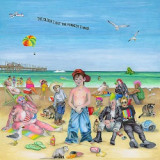
Who is Robert Ellis? At first glance, he's simply a smiling, longhaired,
twenty-two-year old in a hand-stitched western shirt and Dwight Yoakamtight blue jeans - But there's more to this youthful Houston, Texas native
than meets the eye
The young songwriter's second release and debut for New West Records is an
impressive and diverse concept album split between five breathtaking folk songs
and five soon- to- be country standards. Listening to Photographs, one finds it
difficult to pigeonhole Robert Ellis. It's even harder to remember that he's barely
just begun.
Cerca:bare
John Scofield's first guitar-solo-recording ever gives a résumé of all the
influences and idioms he has cultivated over his career in performances
on guitar, accompanied by his own rhythmic pulse and chordal backing
using a loop machine
Besides jazz, John is known to have always also had a soft spot for the rock and
roll and country music he grew up with, revealed here in unencumbered renditions
of Buddy Holly's "Not Fade Away" and Hank Williams' "You Win Again". Between
elegant and personal readings of standards, like "It Could Happen To You", the
traditional "Danny Boy" and Keith Jarret's "Coral", Scofield presents his own
timeless compositions - some new, others known.
For the guitarist, it's all about "the way you get the sound out of the string and
what you do with it after you attack it."
John Scofield: electric guitar and looper
Press:
"Scofield is as fiery as ever, plugged in and using loops to give himself a
background groove on some of his gritty originals or putting a punkish spin on
romantic ballads." - **** The Times
"This isn't an album to listen to in a hurry; but if you were pressed for time, the last
two tracks alone would give you a sense of Scofield's extraordinary range. The
bebop- heavy Trance De Jour is antic, angular, questing. But then we close with
You Win Again, a Hank Williams cover, serene as a sunset over the prairie." - ****
The Daily Telegraph
"Here he has distilled his decades in this crazy business into a baker's dozen of
songs that may appear modest in ambition - only one track runs to more than five
minutes, several run to barely three - yet is mighty in impact...This album needed
no other title. This is John Scofield." - **** Jazzwise
"(8/10) The result offers an intimate insight to Sco's skills as both guitarist and
arranger. It's a late-night album - quiet, introspective and really quite beautiful, too,
with Sco's musical soul laid bare before us." - Guitarist
Ingredient is the elegant collaboration of Toronto poets, composers, producers and dear friends Ian Daniel Kehoe and Luka Kuplowsky. Their self-titled release is an enigmatic electronic avant-pop record attuned to the micro and macro perspectives of the natural world. Ingredient is an album whose lyrics are more poem than lyric, and whose songs exist in a merger of house music, philosophically-minded lyricism and contemporary R&B. One might recall electronic and art-pop luminaries such as Yukihiro Takahashi, The Blue Nile, and Arthur Russell, or connect it to contemporaries like Nite Jewel, Westerman and Blood Orange. A distinct world of dance, of questions, of secrecy and ultimate softness.
Eight years of friendship forges strange telepathy.
In the summer of 2020, Ian Daniel Kehoe was entrenched in a new feeling of heaviness; psychosomatic symptoms had started to proliferate; stress made new pores across the body, bending sensitivity into pain. His days were met with confusion, detachment, sleeplessness and pain without causation. Disfigured, he felt that what had been central and centering was blown out to the periphery of things. In a moment of self-preservation he reached out to his dear friend Luka Kuplowsky to make an album together. For Kehoe, it was an instinctual grasp for the anchoring truthfulness of deep friendship and the potential for a dedicated creative collaboration. Kuplowsky’s presence was light, supportful and curious, eager to explore musically the sounds they were mutually drawn to: house music, ambient pop, dub. The duality between Kuplowsky and Kehoe – between the Aflight and the Unmoored – is a portrait of a friendship whose exchanges came easy and produced an outpouring of song. Creation and therapy crisscross. In email correspondence that catalogs their process of collaboration, affection abounds: “feels bare without the Luka Licks”, or “Love you so much”, or “Kinda just overwhelmed with deadliness coming in at all angles.” When their voices first come in together on “Wolf,” that harmony arrives in a dramatic avant-pop sound that is bold and wondrous.
Kuplowsky and Kehoe both arrive at Ingredient as established artists whose works are committed to language’s propensity to provoke and mystify. Kuplowsky’s 2020 album Stardust is an idiosyncratic and otherworldly blend of pop and jazz romanticism grounded by Cohen-esque vocals and a stirring philosophical curiosity. Kehoe’s entrance into the new decade has hatched four records of pop experimentation, most recently 2022’s Yes Very So, a euphoric and bold album of poetic synth-pop and meditative ambient instrumentals. Kuplowsky and Kehoe’s union as Ingredient is a beautiful and unusual chemistry that integrates their distinct approaches while bringing forth a newness: a sound that alternates between cinematic technicolor and dubbed out fogginess; a lyricism that exchanges their lucid and clear poetics for a playful and obtuse verse. The album intuitively taps into the opposing emotional states of Kuplowsky and Kehoe during the conception of the record, contrasting the buoyancy of trumpeting keyboards (“Resurface”), angelic synthesized voices (“Come”), and rolling bass (“Photo”) with the record’s underlying darkness of whirring buzzsaw textures (“Transmission”), whooping sirens (“Wolf”) and murky ambience (“Illumination”). Lyrically, this duality arises in the record’s flux between openness (“Variation”, “Raindrop”) and existential dread (“Wolf”). “Illumination” most clearly crystalizes this opposition, reconciling the verses’ neurotic yearning for enlightenment with the chorus’ liberating doctrine of negation: “no more devotion… no more delusion”. Amidst the gradations of light and dark, Kuplowsky and Kehoe trade indelible, lush melodies as though their voices are made of a substance that melts easily one into the other. The harmony of poetry, sound, and texture cuts through your brain fog like a wet diamond.
Ingredient’s self-titled record was assembled by Kuplowsky and Kehoe over the course of six months in a home studio they frequented daily. Amidst synthesizers and drum machines they composed, re-composed, and workshopped a wide array of music, ultimately focusing on a set of eight songs that lived in a shared musical and philosophical world. Recording days often ended in basketball games at a local court or a rooftop commune over a pot of tulsi tea and a crossword puzzle. Kuplowsky brought in the Blue Cliff Record – the classic anthology of Chan Buddhism – whose inscrutable and sublime insights remained constant throughout the recording process as an activator of reorientation and reflection. While Kehoe was frequently rendered physically immobile by bouts of anxiety, a patience and mutual caring governed the pace of their creation; rest, stretching and meditation became equally important as the act of arrangement. Invited into their intimate circle of composition was Thom Gill, whose heavenly voice uplifts “Variation” and “Raindrop,” and Karen Ng, whose alto sax simmers and dances around the funky strut of “Raindrop.”
The lyrics on Ingredient reflect the persistence of change, the infinite variability of nature where randomness and divergence are no accidents. In Daoism, duality, in the form of Yin and Yang, is not contradictory as it is in Western idealist philosophy, but rather composes the eternal and lived paradox of our changeless-changing universe: changeless because all is change, and changing because the dynamism of the Dao makes each moment transformational. Kuplowsky and Kehoe refract this way of seeing the world, as in Variation: “Variation in the natural world / there it is.” Ingredient is an experience of the manifold ways of saying there it is of the transformational world, and there it is, unfolding. Elsewhere, change and ephemerality is addressed through the record’s preoccupation with non-human perspectives, reorienting the listener to the wolf, the mouse, the emerald frog, the centipede, the bird, the fly in the lamp. The album cover visualizes this fascination with the striking image of a reddish-orange frog atop a defamiliarized landscape of dark green leaves. Mirroring the exploratory process of the record’s collaboration, the frog also signals the amphibian’s natural inclination to leap into boundless potential. Kuplowsky and Kehoe’s lyrics manifest philosopher and ecologist Timothy Morton’s concept of “the mesh,” drawing attention to the “vast, entangled web” of interconnectedness that connects all life forms and interweaving the songwriters’ shared wonder into the Animal’s unknowability. As Luka narrates in the breakdown of the dance-floor ready “Photo,” “the closer we observe things, the further they retreat into abstraction.” In Ingredient’s ecosystem, perception is a reversible fractal where the world’s minutest details mirror the shape of the cosmos.
According to the Dao, the path to healing starts by reorienting perception away from the self and toward the self’s subsumption in Totality. For Kehoe, collaborating with Kuplowsky became the reorientation necessary for the self-preservation he was seeking, opening up a shared creative practice to navigate and soften the complexity of his psychological shattering. The album begins with Kuplowsky intoning “colossal faith” which bounces around the stereo field in a cloud of echo, and it is the enormity of “faith” that centers both Kuplowsky and Kehoe’s collaboration and their inquisitiveness in the vast mysteries of our very being. Truth in Ingredient is not an essential nugget, but a bending of the light – it is the equivocal entanglement of how we are in nature as nature, but with a plea or prayer under our breath that marks our felt distance from what we are a part of: “carry me towards the mountains of my birth / returning to the nest / the silence of the earth.”
- A1: Louise Dearman, London Music Works - Let It Go (From "Frozen")
- A2: Helena Blackman, The City Of Prague Philharmonic Orchestra - I See The Light (From "Tangled")
- A3: Jen Sygit, London Music Works - Almost There (From "The Princess And The Frog")
- A4: Rachel Davis, Jen Sygit, Zak Bunce, Mark Stiles, London Music Works - We Are All In This Togther (From "High School Musical")
- A5: Helena Blackman, London Music Works - Reflecion (From "Mulan")
- B1: Helena Blackman, London Music Works - Go The Distance (From "Hercules")
- B2: Gaynor Ellen, London Music Works - Colors Of The Wind (From "Pocahontas")
- B3: Chuck Colby, London Music Works - You've Got A Friend In Me (From "Toy Story")
- B4: Helena Blackman, Craig Rhys Barlow, London Music Works - A Whole New World (From "Aladdin")
- B5: Helena Blackman, London Music Works - Tale As Old As Time (From "Beauty And The Beast")
- C1: Helena Blackman, London Music Works - Part Of Your World (From "The Little Mermaid")
- C2: Richard Paris, London Music Works - Under The Sea (From "The Little Mermaid")
- C3: Keith Ferreira, Helena Blackman, Paul Felch (2), Kay Rinker O'neil, London Music Works - Everybody Wants To Be A Cat
- C4: Herbie Russ, Keith Ferreira, London Music Works - I Wanna Be Like You (From "The Jungle Book")
- C5: Keith Ferreira, London Music Works - The Bare Necessities (From "The Jungle Book")
- D1: Helen Hobson, David Shannon, London Music Works - Supercalifragilisticexpialidocious (From "Mary Poppins")
- D2: Helen Hobson, London Music Works - A Spoonful Of Sugar (From "Mary Poppins")
- D3: Keith Ferreira, London Music Works - Zip-A-Dee-Doo-Dah (From "Song Of The South")
- D4: The City Of Prague Philharmonic Orchestra - The Sorcerers Apprentice (From "Fantasia")
- D5: The City Of Prague Philharmonic Orchestra - When You Wish Upon A Star (From "Pinocchio")
Enjoy the major musical themes from Disney movies: from "Frozen" to "The Jungle Book", this collection will take you deep into the marvellous and fantasy worlds imagined by Disney.
CLEAR PINK VINYL
Barely disco and hardly jazz, Rupa Biswas' music the halfway point between Bollywood and Balearic. Tracked in 1982 at Calgary's Living Room Studios with a crack team of Indian and Canadian studio rats alike, both "Moja Bhari Moja" and "East West Shuffle" are the perfect fusion sarod and synthesizer. Remastered from original analogue source material and with permission and blessing of the producers and performers.
In 1968, the future composer of "The Things of Life" (Les Choses de la Vie) seriously considered becoming a director. He wrote and shot "Florence", a short film influenced by the New Wave and composed its soundtrack, under the benevolent eye of Vladimir Cosma. The first spectators of the film are unanimous: failing to have seen a visionary cinematographic opus, they have discovered a real movie musician. From this first attempt, Philippe Sarde imposes his melodic talent on the picture and initiates his sense of counterpoint. This founding soundtrack, however, remained in the boxes for more than 50 years, before finding a place of choice on the B side of our album.
To open the ball, we offer you another forgotten score: the almost unused score of Loulou, Maurice Pialat’s cult classic. In 1980, the naturalist director planned to use original music to accompany the wanderings of his sublime love duo, played by Gérard Depardieu and Isabelle Huppert. He commissioned a bare, impressionistic score from Philippe Sarde, then changed his mind and kept only a
timid end credits. The meeting between the two giants of French cinema did however take place, as evidenced by the first side of this beautiful lp.
Fangst never announced their arrival – without a warning they were just there, and so was the demand for their music. The band’s hook-laden songs were quickly embraced by audience and press alike. Suddenly there was a new challenger to the throne of Norwegian “mother tongue rock”. Fangst appeared with a bang – releasing four singles in quick succession in 2021. Seeing the band live, it’s easy to be seduced by the four band members and their magnetic stage presence. Now they’re ready with their debut album on Jansen Records. But this is hardly a musical debut for the guys who make up this four-headed beast. All members of Fangst come with heaps of musical experience, and the bare mention of their other bands – Death By Unga Bunga, Honningbarna and Hvitmalt Gjerde – will awake fond memories in every concert goer who’s ever encountered those bands. Fangst’s debut full-length will be out in the fall of 2022, and if captivating Norwegian lyricism or very, ehm…rocking rock (or even both!) is your bag, then you’ll get your fill here. The band’ sound is a result of their diverse musical backgrounds and combines to create beautiful rock music – sporadically dangerous and at times plain cute.
Formed in 2018, Brooklyn’s Gustaf have built a kind of buzz that feels like it comes from a different era. The art punk 5 piece rapidly established a reputation and early excitement about their danceable, ESG-inspired post punk expanded outside of their city with remarkable effect despite having released no recorded music and barely having an online presence. As a result of their magnetic live show the band found unlikely early champions, catching the attention of luminaries like Beck – who had the band open for him at a secret loft party he played around the release of his latest album – the New York no wave legend James Chance, and shared stages with buzzing indie acts like Omni, Tropical Fuck Storm, Dehd and Bodega, while word of mouth led to sell out shows when they played their first LA headline dates in late 2019. They finally released recorded music in the form of their debut 7 inch at the end of 2020, which only furthered the growth of their reputation, earning them comparisons to acts like Television, The Talking Heads, The B-52s and LCD Soundsystem. Now, the band release their debut LP, the magnificently titled Audio Drag For Ego Slobs, on Toronto’s Royal Mountain Records (Wild Pink, Alvvays, Mac DeMarco).
"Calling out all enchanted wayfarers and those with the desire to wander off-trail, licking the back of any psychoactive toad en route. For your next expedition into the realm of psychedelic balearia, indulge in the rhythmic tappings, pleading plucking and general propulsion of King Puck by Murrin, his first solo release.
With 3 tracks for the slow connoisseur caravan, and 1 for the vital essence of arpeggiated hysteric euphoria, this is essential listening for the next time you take a lick. "
- 1: An Mp Speaks
- 2: Monetaries
- 3: The International Narcotics Traffic
- 4: The Way Of The World
- 5: Antinature
- 6: Charles Windsor
- 7: The Vision Of Peregrine Worsthorne
- 8: The Well Of Loneliness
- 9: The Wicked Palace Revolution
- 10: God Made The Virus
- 11: The Funeral
- 12: A Child Soon In Chains
- 13: In The Dark Times
- 14: The Procession Of Popular
- 15: Capitalism
- C16: In Purgatory(Re-Recorded Version)
- 17: Comrade Era(Re-Recorded )
- 18: Something Wrong Somewhere
- 19: Red Sleeping Beauty
- 20: From The Damned
- 21: For The Fat Lady
- 22: Frans Hals
- 23: Kill Kill Kill Kill
- 24: You’re Alive
- 25: Bad Dreams
- 26: Someone Worse Off Antiamericancretin
- 27: Unfortunately
- 7: 1 In Purgatory
- 7: 2 Comrade Era
- 7: 3 Something Wrong Somewhere
Pressed on Red vinyl and presented in gloss laminated gatefold sleeve.
Double album set contains the original LP plus 13 bonus tracks taken from their first four singles and the re-recorded version of In Purgatory which originally appeared on the PINK compilation E.P “It sells or it smells” plus bonus 7” a reproduction colour vinyl copy of McCarthy’s first 7” “In Purgatory”
All three tracks have been remastered from the original master tape and presented in a wraparound sleeve, just like the incredibly rare “Wall Of Salmon” original.
Also Includes
20 page 12x12” full colour booklet containing all the lyrics and packed full with photos, many previously unpublished. Press clippings and other memorabilia. Introduction by Nicky Wire of the Manic Street Preachers and track by track commentary by Malcolm Eden.
8 x 10 Black & White press photo
Reproduction European Tour poster “The Well Of Loneliness” Promo poster McCarthy sticker
By the time McCarthy appeared on the NME’s C86 cassette they had already been playing together for a couple of years and released two excellent singles. Their debut “In Purgatory” and the indie masterpiece “Red Sleeping Beauty” (both included on this release). The following year McCarthy released the brilliant “Frans Hals” before unleashing their debut album “I Am A Wallet”
Now recognised as an indie pop masterpiece it has gone on to achieve cult status, receiving praise from the likes of Nicky Wire (Manic Street Preachers) as one of the most important albums of the 80s. Known by today's indie acolytes as the band that spawned Tim Gane and Leititia Sadier (who of course went on to form Stereolab).
It’s a seamless album reminiscent of the Byrds. Wonderful, if slightly twee, jangly guitars with complex and rarely rhyming lyrics, Malcolm Eden’s strident left wing political views are manifest on I Am A Wallet. Cloaked in pretty guitar and propulsive drums, Eden sets about attacking the pillars of the day, MPs, Prince Charles, Fleet Street, religion, the response to AIDS and on almost every song, capitalism. The horrors and inequalities of the capitalist system are laid bare for all the see. The system which enables some to get rich at the expense of others is reviled and attacked.
Following the release of acoustic EP Letters To Our Former Selves – Acoustic late last year, Youth Fountain is excited to be back at it with new single “Peace Offering" “This track was written in the perspective of knowing you could never truly love or be loved by anyone before being comfortable with who you are as a person,” shares Tyler Zanon “No matter what positive aspects can come out of a relationship - if the foundation isn’t there of having that bare minimum of self love, things inevitably tend to tarnish.” As Youth Fountain prepares to move forward, the future perfectly mirrors the past. What began as a solo project by guitarist/vocalist Tyler Zanon in 2013 under the name Bedroom Talk eventually blossomed into a full-blown band by 2017, with the Vancouver-based Youth Fountain (then a duo) proudly announcing their presence with the debut single “ Grinding Teeth ” and a pair of Pure Noise Records releases that expertly toed the line between pop-punk fervor and more reflective emo moments. Alternative Press hailed the band’s 2019 debut full-length, Letters To Our Former Selves , as one of the year’s very best, dubbing it the “ perfect blend of emo-tinged punk to soundtrack reflecting on every single life decision you’ve ever made ,” while North American tours with the likes of Free Throw, Can’tSwim, and Chris Farren cemented Youth Fountain’s sweat-soaked sound as something best experienced live – all while dodging a few stray elbows and overzealous crowd-surfers. Now once again, Zanon finds himself as a solo artist following the departure of co-vocalist Cody Muraro in mid-2020 – but this time, he’s exactly where he wants to be. Youth Fountain’s new release, Letters To Our Former Selves – Acoustic EP, re-introduces Zanon’s project to the world, reimagining fan favorite aterial from the 2019 LP of the same name.
Eighteen spooky rock ‘n’ roll deep 1950s and 60s tracks with three classic
horror movie trailers pressed on limited edition neon orange coloured
vinyl
The ultimate Halloween-themed novelty rock 'n' roll soundtrack featuring
witches, ghouls, teenage monsters, graveyards, haunted houses, devils,
ghosts and zombies
Most of the selections are vintage sides from the 1960s, rounded out by a witch's
fistful of rare 50s cuts. Plus, rare audio of three classic horror movie trailers.
Featuring cover illustration art by NYC cartoonist Cliff Mott, and including tracks
from Bobby Bare, The Shades, Jim Burgett, The Elites, The Ketones, The Phantom
Five and many others. Pressed on limited edition neon orange coloured vinyl!
Daniel Barenboim will turn 80 on November 15th. Warner Classics are celebrating the great musician, who has had tremendous success since the ‘60s both at the piano or conducting, with an album made in the mid-90s that is close to his heart and Argentinian origins, though aside of the classical repertoire. Tangos Among Friends - Mi Buenos Aires Querido (named after a tango by Carlos Gardel) proves again all the talent and swing Daniel Barenboim has, and has been a huge success since released by Teldec on CD in 1996.
“I spent the first nine years of my life in Argentina and only in Argentina. The rest of the world was far away. Everything Argentinian was close to my heart. The concepts of cosmopolitan existence or international thinking were not yet awakened. The air that I breathed was Buenos Aires, the language that I spoke was Spanish porteño and the rhythm to which I danced (figuratively speaking…) was the tango! My idol was Carlos Gardel. Nearly half a century later I came back not only to Argentina, not only to my childhood but especially to my Buenos Aires querido and many other wonderful melodies that make up this sentimental record.”
Daniel Barenboim – from album booklet
In an interview made in the 90s, Daniel Barenboim added: “In Argentina during the late 1940s there was no chasm between classical music and the tango, in the way there was a chasm between classical music and jazz. The tango is a basic part of Argentine popular culture; when you went to a restaurant or a party, that was the music you would hear. (…) Already as a child I was crazy about the tango. I still am.”
“The young Daniel found himself drawn to the bittersweet tales of passion, tragedy and nostalgia sung by Gardel, the tango singer and songwriter who exerted a major influence in popularizing the tango throughout the Western hemisphere and Europe. (…) Over the following decades Barenboim would regale friends at home or at parties with piano arrangements of tangos he heard in his youth. (…) Barenboim never thought of sharing his passion for tangos with the public until last year when he had returned to Buenos Aires for concerts with his Berlin Staatskapelle orchestra. At a reception he found himself talking tangos with a young Argentine. Learning of Barenboim’s interest in performing them, he offered to drum up a few local musicians with whom Barenboim could play tangos at home. That’s how he met Mederos and Console. “The first day we just played for fun,” Barenboim says. “Then we decided to make a recording. So we rehearsed for two days and made the record in one afternoon.” (…) Once he, Mederos and Console set out to record their tango program, Barenboim was surprised at how much of the characteristic tango rubato – a subtle alteration of rhythmic weight and accent – he still had at his fingertips, more than four decades after leaving Buenos Aires. That said, he insists on sharing credit for the success of the disc with his Argentine colleagues. “What they gave me was a pure sense of the tango, especially in the melodic freedom over a very strict rhythmic foundation. Performing tangos, you are constantly anticipating the downbeat or coming after it; this is part of the tradition. What I gave them was the necessity to rethink certain aspects – say, the volume and transparency of sound – so that playing tangos didn’t sound routine.”
– The Chicago Tribune, Oct. 1996
Repressed !
We are proud to present a set of edits of this long-lost classic from the golden age of African music, from a figure who is still beginning to get his props internationally, Eji Oyewole.
Born to a royal lineage in Ibadan, Prince Eji Oyewole has had a career as a flautist, saxophonist and sometime bandleader spanning well over half a century. He trained both in Nigeria and then at Trinity the prestigious music school in London, and his life as an itinerant musician also saw him living for extensive periods in Geneva, Hamburg and in Lyon.
While for many years Fela Kuti (with whom Eji played) and King Sunny Adé commanded international attention to the exclusion of most other Nigerian musicians, as if there was only room for one Nigerian superstar at a time on the world stage, on the domestic scene things were very different. Eji was part of the huge craze for ‘highlife’, a generic term that in fact subsumed many different styles, united in their fusion of traditional west African forms with jazz influences and electric instruments, and in the bands’ working practices as entertainers at the nation’s numerous hotel / nightclubs. As this cracking album, recorded for EMI Nigeria at the tail end of the ‘70s and now remastered, reveals, Eji’s version of highlife was even more distinctive than most, eschewing the usual emphasis on guitars for a brasher, horn- laden sound, seemingly influenced as much by American funk as it was jazz, and of course with the heavy percussive undertow central to most African music.
This gave Eji a chance to shine, and there are some scorching solos as well as tight ensemble playing across the four lengthy (to ears accustomed to the three-minute pop song) songs. Eji also played piano on the session. The material has an element of social commentary (Oil Boom and Unity In Africa) and should help feed the seemingly insatiable appetites of the many who have been turned onto African music by the enterprising efforts of devoted collectors, labels and fellow fans.
Surely one of the few musicians who has played with Fela, Miles Davis and Bob Marley, Eji Oyewole still plays regularly in Lagos, recently had an album of new material out with his current band The Afrobars, and has been a member of Faaji Agba, a super-group that has toured internationally and been dubbed ‘the Nigerian Buena-Vista Social Club’.
- A1: Here If You Want Me 03 01 Min
- A2: Overtime 02 44 Min
- A3: Up To You 03 13 Min
- A4: Second Thought 03 30 Min
- A5: Anytime You Want 04 16 Min
- A6: Heavy Like Air 02 53 Min
- A7: For A Minute 02 49 Min
- A8: Mercury’s Ladder 01 34 Min
- B1: Empty Eyes 02 56 Min
- B2: Bottleneck Boys 03 30 Min
- B3: Balloon 01 43 Min
- B4: Riversong 03 45 Min
- B5: The World Can Wait 03 05 Min
- B6: Not A Blue Sky 02 50 Min
- B7: Coffee Girl 03 11 Min
- B8: ) | Death 01 36 Min
Public Possession proudly presents Aiden Ayers debut album „Venus Copper Rose“. A few words by the artist himself: „ Venus Copper Rose came to me in a dream. The three words are all the same thing, symbols of beauty and material formations of love. Together they are a VCR (videocassette recorder) - a memory machine, a portal into fantasy and myth + a transcriber of dreams. The songs on the album represent the past five years of my life. The oldest of them were written and first recorded in 2017 and the youngest barely made it to the mastering session on time. I am always writing and recording, travelling to and fro, on little islands off the coast of BC, down to the California desert, or in makeshift basement studios throughout Vancouver. Every song has grown up and been captured in a different way - the album is a wild garden of misfits, flowers and weeds. I hope that people feel nourished by this album - I believe that is the ultimate role of music, like another kind of food, light, or love. I hope these songs and this album can help people see the beauty and poetry that flows through their own lives.“
“Home” is a tough thing to pinpoint for someone who’s constantly in motion. Scout Gillett knows this well, but since relocating from Kansas City in 2017, she’s found one in Brooklyn’s DIY scene, playing in multiple live bands and even starting her own booking company to organize local shows. Her intrepid nature results from a childhood spent running barefoot through rural Missouri and coming of age in Kansas City’s punk scene. Her debut solo album no roof no floor is a bold and spirited yet warm, intimate meditation on trust, surrender, and what makes a home.
Following the sudden overdose of a lover in 2018 and the onset of the 2020 quarantine, Scout returned to Missouri in search of reprieve. Instead, she was dismayed to find that her hometown was suffering; friends and family members were caught in the grips of drug and alcohol addiction. Overcome by grief and helplessness, she retreated inward, channeling her fears and frustrations, as she always had, into songwriting. The resulting songs were more vulnerable than any of her prior work
Low Company presents Yuta Matsumura’s Red Ribbon, a sequence of introspective, lavishly melodic dream-songs and amphibian atmospheres recorded in scattered periods over 2018-21. Having played in bands like Low Life, M.O.B. and Orion, and the duo Jay & Yuta (with Jay Cruikshank), Red Ribbon is Matsumura’s first solo outing, and represents a conscious effort to move away from guitar-based songwriting. He composed its nine tracks mostly on piano - layering vocals, bass, keyboards, flute (courtesy of Maeve Parker), violin/cello (Laurence Quinn) and clacking drumbox rhythms into dynamic, dubwise avant-pop structures which are supple and spacious but fizzing with detail and vivid inner life. The laconic 4/4 pulse, heat-warped synth-tones and haunting vaporous melodica of opener ‘Box Garden’ set the tone: its surreal psychedelic patternings barely concealing a deep sting of longing and regret. The cryptic lyrics suggest chance encounters, hidden logic, missed opportunities, fatalism, serendipity. A city submerged: everyone else paused mid-movement, while you’re allowed to swim free and fish-like through the streets, over the rooftops...‘Tangled Orchid’ is a tense night-drive through dry desert heat and into the unknown, running away from your old life, chased down by dust-devils of half-baked schemes and abandoned plans, while ‘Myth Machine’ drops the tempo and something mind-altering, guiding us on a tripped-out dub-disco scuba among alien flora and fauna, a world of impossible shapes and sensations. At which point, the mood of the album decisively shifts, firstly with ‘Sake No Otoh’, sung in Japanese by Haruka Sato: an instant-classic, breathtakingly intimate lover's lament that sounds like it got lost on its way to heaven and is now doomed to orbit the earth forever. The songs that follow continue in this more confessional, imploring mode. As if the travelling's done, the baggage has been cast off, and we’ve arrived at our destination, where the real process of rebirth and repair can begin. The music’s textures become less overtly dubby and electronic, with more of an organic, earthy, chamber-pop/avant-folk feel, at once sad and hopeful-sounding. Three songs in particular bear the influence of Eno’s 70s work (and its mutant bedsit offspring Lifetones, Flaming Tunes, etc): ‘‘E. Potential’, where baroquely chorused vocals - half-agonised, half-beatific - teeter on top of simple oscillating piano loops, and the stately, dawntreading ballads ‘Tabula Rasa’ and ‘No Sleep For Birds’. The bulk of the album was made prior to lockdowns and all of that; its themes of reset, self-examination, the need to f**k it all off and take spiritual stock, are timeless. Though they perhaps have a more bittersweet resonance now the world has returned pretty much to how it was, only worse. Track list: 1. Box Garden 2. Tangled Orchid 3. Myth Machine 4. Red Ribbon 5. Soko No Ato 6. Tabula Rasa 7. E. Potential 8. No Sleep For Birds 9. Zookeeper's Trial
Unfurled Works is a collection of back-catalogue zake tracks that have been lengthened for this new cassette, which is a slow-moving cascade of ambiance that washes over you in a delightful fashion. It's an album of frayed edges and lo-fi production, of dream-like haziness and heart-warming subtlety. The five carefully layered tracks on it slowly and stylish shift from one to another with meditative pads and organic drones that are gently peppered with sombre keys. Some pieces are light and airy, others are more moody and heavy, and all of them are perfect for daydreaming and re-setting your mood. Silence takes on all new potency and the beauty of the barely-there grows ever more striking.
The Older I Get, the Funnier I Was, which follows Thomas’ brilliant 2020 HBO special The Golden One and his Can't Believe You're Happy Here EP released earlier this year, surveys a range of emotion and offers a broad sonic palette, moving between pop punk, electro, and the obvious influence of the singer-songwriters he grew up listening to in early childhood. It conjures the ennui of Bright Eyes alongside the barefaced storytelling of John Prine, the overstuffed lists of Fred Thomas with the lackadaisical humor of Colleen Green, among many others.
Thomas attributes the dexterity of the record to Duterte, who recorded and engineered most of it in addition to serving up plenty of encouragement when Thomas got down on the process. “As a comic, I used to test out new songs during sets to see if the funny bits were hitting, but since I wrote this in isolation I ended up writing lyrics and worrying less about making jokes,” Thomas says. That said, the album’s plenty funny. Stand-out and lead single “Rigamarole” opens with a Thomas-voiced infomercial that recalls his oft-cited lookalike Jim Carrey as the Grinch, before launching into a buoyant pop song about being depressed.
Whitmer Thomas will admit that when he traveled home to small town Gulf Shores, Alabama to record his HBO stand-up special, The Golden One, he expected to be greeted as a returning hero, a conquering king, or at minimum, a guy with a moderately successful career as an entertainer in Los Angeles. “I expected a big welcome home, open arms, but when I went back I realized: nobody fucking knows me. Nobody remembers me,” Thomas says. “In the years I’d been performing that show, I’d been romanticizing my childhood in this mythologized place, but the visit made me see that I’m not really from there anymore.”
The sense of alienation compounded when Thomas recognized how few people in town remembered his mom, to whom The Golden One is dedicated and largely about. Thomas grew up watching her perform with her twin sister at the legendary Flora-Bama Lounge, where he set the special, and still counts her as one of his musical influences. His new album, The Older I Get, the Funnier I Was, isn’t overtly about his mom, her presence is deeply felt throughout. While in Gulf Shores, Thomas discovered dozens of her old recordings, all of which had been wrecked by Katrina, but upon returning to LA, Thomas paid “a fancy place in Hollywood” to fix the tapes and hired Melina Duterte (Jay Som, Bachelor, Routine) to mix them. The two struck up a collaborative friendship, and Thomas had the sound of his mom’s voice back. “I was listening to songs she recorded when she was about my age, just these heartfelt, sweet Americana songs,” he says. “I decided then that I wanted to lose the Ian Curtis voice I always sing with; I wanted to do what came naturally, because my mom always sounded like herself, even when she was singing some cheesy reggae song about, like, Jamaica.”
Thus he went into The Older I Get, the Funnier I Was knowing it was time to retire his darkwave persona, and leaning into his natural, chirpier voice, which he says sounds “like a 12-year-old’s.” It makes sense: much of the album chronicles what Thomas calls “being a kid and feeling like you have no control and overcompensating by being annoying.” “So much of the album is about witnessing drug and alcohol addiction as a kid and seeing what it does to people, but also realizing that there's nothing you can do about it,” Thomas says. It’s familiar territory (see: “Partied to Death”) but the methodology is different this time around; true to its title, The Older I Get, the Funnier I Was isn’t always looking for laughs. Thomas might’ve left his hometown behind, but his kid self is still tagging along, a Peter Pan shadow he can’t untether himself from. The first line he sings on The Older I Get, the Funnier I Was is: “There should be a room at every party where you can just sit and watch a movie.” Find a 12-year-old who wouldn’t say the same.
On his debut album producer and Squama co-founder Martin Brugger hovers through Ambient, (upbeat) Downbeat and unfulfilled build-ups.
Conceptualized as a blank soundtrack, the music was sent to fellow artists who shared their visual and verbal associations which became the source for the artwork and tracktitles, effectively making the album a collective effort.
Evident in all of his recent projects is Brugger's passion for working and thriving within closely set limits.
The only audio sources in the process of making the album were his record player and a Dave Smith Prophet 08 synthesizer. In an antithesis to most sample-based music, Brugger takes the more ephemeral moments of recorded music and uses pitching tools as a magnifying glass to dive deeper into the sound and bare layers that normally remain unheard.