Dauw presents 'babel', the debut album from Belgian duo ZONDERWERK. The duo’s name means ‘’without work’’, but it also comes from “bijzonder werk”, where bijzonder is particular, special, unique. They like to work with images/paintings that are “bijzondere werken”, odd works.
babel is an ambitious exercise in translating images into sound. babel was initially created for the eponymous theatre piece by architect and artist Steve Salembier. Inspired by the biblical legend, Salembier envisions the legendary city as an abstract, sprawling modern metropolis in continuous flux. Its steel and glass skeleton is a representation of both an accumulation of overlapping contemporary cityscapes and a metaphor for the anonymous repetitiveness of our daily routines mirrored by the architecture. Subway lines, sky scrapers and whirling highways converge into a megalopolis of monstrous proportions. Despite the composition’s initial context as soundtrack for a theatre play, for the band this album is seen as a standalone work, whose complex sonic material can be appreciated without having seen the piece.
Their score focuses on fleshing out the imposing imaginary universe both in terms of scale and meaning. One of their biggest inspirations were Michael Woolf’s photographs, which served as the basis for the original theatre piece. His use of grey and repetition is translated into looped harmonies and fine-grained drones that progressively open up like blooming ice flowers.
With sounds of bells and metal as their primary materials, Carrijn and Sanders build soundscapes that are at once seductive and unsettling. The atmosphere on tracks like “DreamArp4Kort4” make for majestic, mysterious synths conjuring otherworldly visions, while the angelic glockenspiel set against subtle explosions in “VuurFeest” suggest a serene yet potentially dangerous place. Other tracks like “RoomCarousselTapeLoop5” create multi- layered textured drones through the process of tape decay, a commentary on the cannibalistic nature of the city.
Resulting from an arduous improvisational processusingold samplers with elements such as the Beam harp, a self-made metal instrument with piano strings, reel to reel tape recorders, field recordings and violin, babel perfectly captures the oxymoron of the man-made concrete jungle that is at once inhospitable yet endlessly awe-inducing.
ZONDERWERK is a duo consisting of Linde Carrijn and Dijf Sanders who started this project during the pandemic as a way of exploring their relationship as creative partners. Carrijn has a background in acting but recently came more to the fore as composer/performer with original scores for theatre and her other band Brik Tu-Tok founded with multi-disciplinary artist Maxim Storms. Sanders is a composer and gear enthusiast, more well-known for his eclectic works that draw from a wide-array of non-Western music. His milestone-album Moonlit Planetarium paved to way to a broader audience and recognition from major press in Belgium. In 2021, his work as a producer was recognized with a nomination at the Music Industry Awards.
Поиск:be angel
Все
Beautiful, soulful jazz record by Jimetta Rose and The Voices of Creation, a Los Angeles-based community choir, a mainstay of the local scene. Highly recommended!!
The Voices of Creation are a community-based choir led by vocalist, songwriter, arranger, producer and mainstay of the Los Angeles scene Jimetta Rose. Made up of a multigenerational group of mainly non-professional singers backed by some of the city’s finest musicians,their music marries hip strains of gospel with layers of jazz, soul and funk. While aspects of their music might recall Kamasi Washington, The Staple Singers or Sly Stone, Jimetta’s unique vision has resulted in new spiritually-charged forms of music whose whole-hearted embrace of love, joy and peace act as sonic healing balms for the soul.
For Jimetta - whose resume includes collaborations with Miguel Atwood Ferguson, Georgia Anne Muldrow, Sa-Ra Creative Partners, Angel Bat Dawid, Shafiq Husayn, MED and Blu - the very act of creation was part of a healing process: “I was very low at the time and I wrote most of the songs going through hardship. But I found comfort in the songs and a way to adjust my mindset to where things got better. So I thought ‘if this music works for me, maybe it will work for other people’ I believe that every person has their own voice and their own note and that we can use our voices to heal ourselves. That’s the intention behind creating the project.”
After putting out a call on social media for people interested in joining her choir she was met with a sea of replies. Members were chosen in less-than conventional fashion: “I recruited people based on their interest in healing themselves and others, not necessarily on their musical experience or being seasoned performers” she says. Among those accepted into the ever-evolving collective, which was begun initially as a community choir, were the likes of Sly Stone’s daughter Novena Carmel, better known as a radio DJ for KCRW’s flagship breakfast show. Jimetta’s upbringing in the Pentecostal church, where she was a youth choir director, fed into her otherwise intuitive teachings of her songs and arrangements to the inexperienced members with help from the group’s seasoned organ player/co-musical director Jack Maeby.
Produced by Mario Caldato Jr. (Beastie Boys, Seu Jorge) and his wife Samantha Caldato the results show the incredible sense of togetherness and communal spirit that the group had built up over time in the rehearsal sessions. The six tracks of their debut album, a mixture of originals and rearranged covers, are performed in a wide-eyed mix of styles that reflect Jimetta’s vision for borderless music: “It’s new black classical music,” she explains. “It’s all the hodgepodge of being an African American but also with creativity and vision for the future. It has a taste of what is to come and what we can do. What we have gone through and who we are now.”
The group’s propensity for warm and buoyant sonics finds representation on album opener Let The Sunshine In, a sparkling rework of the Sons and Daughters of Lite’s deep jazz classic. Their version finds the group’s dynamic group harmonies offset with Allakoi Peete’s nimble afro-percussive touches and plenty of soul- drenched keys courtesy of pianist Quran Shaheed and organ player Jack Maeby. A similarly uplifting take on Rahsaan Roland Kirk’s choral jazz classic Spirits Up Above follows, with Maeby’s groove-laden organ lines inspiring some gorgeous group harmonies as well as prime solo turns from the likes of Kellye Hawkins, Zavier Wise, Tamara Blue, and Khalila Gardner.
Another Sons and Daughters of Lite cover follows as Jimetta leads the choir in the groove-drenched ode to self-affirmation Operation Feed Yourself. Written as a series of mantras for everyday living, the Jimetta-penned composition How Good It Is harnesses the full transformative power of music to generate a stirring and joyful ode to positivity - it’s chanted declarations bringing out some of the group’s most deeply-felt and affecting vocal performances over some superlative piano and organ accompaniment with a surprise feature vocal from Novena Carmel.
Jimetta’s talent for re-imagining songs in her own light is highlighted in Answer The Call, her vivid re-telling of Funkadelic’s Cosmic Slop: “When I listened to the original song, the Mom in the story was really going through it. I thought of how I could turn this into a song that can encompass the glorification of all mothers and I thought of the Egyptian cosmic goddess Nut. To that mother we’re all the seeds planted in the garden. Answering the call in your life is literally that. Finding out exactly what you’re here for through your heart.”
The album finishes with the standout original gospel number Ain’t Life Grand. Over swaying organs and clapped percussion Jimetta’s lyrical mantras serve to emphasise the good feelings that come to those with a grateful heart. Good feeling is an apt descriptor for the mood of the album as a whole. Its shining positivity provides a welcome ray of light in an increasingly dark world. “It’s a shortcut if you will to the better feelings” Jimetta says. “The hope that we need to keep pressing forward. We are saturated and inundated with images of chaos and destruction, death and hatred. There’s so much we can witness. So, I want to make sure that there is a representation sonically of the other parts that are still there to witness so that we can continue to build those things. So that the systems we support actually reflect what we want to experience. So it’s like: “Don’t give up and Let The Sunshine Into You” and then find out what your purpose is and answer the call.”
Following up his score for the japanese Netflix Anime series “Carole & Tuesday”, Mocky returns to album mode with his new orchestral opus “Overtones For The Omniverse”. Just days before the first Covid lockdowns, Mocky brought a 16 person orchestra comprising of his usual who’s who of underground talent into LA’s Barefoot Studios (and into the same room where Stevie Wonder recorded “Songs in the Key of Life”) to record a pile of scores he had come up with during his previous year’s sabbatical in Portugal. The result is a stunning orchestral album recorded in 36 hours in one or two takes straight off the written page. Shunning the “possible perfection” of today's recording techniques, Mocky looked back as a way to find an alternate future.
According to Mocky:
“We had to do it quick with no rehearsal to capture that big open sound of people working together in a room - in all its imperfect glory. In the imperfections you find the humanity. And in today’s tech driven spaces you have to fight to preserve a space for humanity. I felt a deep desire to create a sonic trajectory path for us to follow as we ascend and evolve our understanding of love and what it means to be human. This is the inspiration for „Overtones for the Omniverse“”.
The album runs the gamut from Steve Reich infused minimalism overlaid with Dorothy Ashby style harp runs (“Overtures”) to atonal analogue synth sounds over Martin Denny style percussion (“Bora!”). There's a classic Mocky crooning number that gives a Jim Henson-esque take on the state of “Humans” and the album as a whole captures Mocky's skill of bringing together the joyful energy of a unique cast of LA collaborators.
Featuring:
Randal Fisher / Flute, Vicky Farewell / Piano, Vocals, Harry Foster / Bass, Vibraphone, Tubular Bells, Vocals Joey Dosik / Organ and Glockenspiel, Vocals, Guilermo E. Brown aka Pw / Percussion, Vocals, Jhan Lee Aponte (TossTones) / Percussion, Vocals, Timpani, Paul Cartwright / Violin, Molly Rogers / Viola, Gabe Noel / Cello, Contrabass, Liza Wallace / Harp, Coco O. / Vocals, Mocky / Compositions, Drums, Vocals, Roland Sh-1000
O for the O Choir :
Nia Andrews, Leslie Feist, Moses Sumney, Durand Bernarr, Eddie Chacon
Recorded at Barefoot Studios, Los Angeles March 6 + 7, 2020.
All songs written by Dominic “Mocky” Salole and published by Heavy Sheet Music/Warner Chappell except "Wishful Thinking" written by Dominic “Mocky” Salole and Matt Corby and "Bora!" written by Dominic “Mocky” Salole, Guillermo Brown, Aponte Poro.
Produced by Mocky, Justin Stanley and Renaud Letang. Mixed by Renaud Letang at Ferber Studios Paris
Mastered by Emilie Daelemans. Cover artwork by Rand Sevilla. Photo by Vice Cooler.
ABOUT MOCKY
Performer, producer, songwriter, composer and multi-instrumentalist, Dominic "Mocky" Salole came to prominence in the Berlin electronic scene of the mid 2000s, releasing three acclaimed solo albums, co-writing and producing classics like Jamie Lidell's "Multiply" and Feist's "The Reminder" and making waves on stage with close collaborators (and fellow Canadians) Peaches, Feist and Chilly Gonzales.
In 2009, his music took a jazz-inflected turn to the acoustic with the release of "Saskamodie" and in 2011, after work in Big Sur on Feist's "Metals", Mocky relocated to Los Angeles, where he quickly established himself as a co-writer with uncommon credentials and eccentric working methods collaborating with L.A.’s brightest breakthrough artists like Kelela, Joey Dosik, Vulfpeck or Moses Sumney.
Whilst in L.A. songs he has written have been sung by Mary J. Blige, Jill Scott and many more and he has collaborated with artists as diverse as Mali’s Bassekou Kouyate and the GZA. His monthly rooftops gigs at the ACE Hotel breathed new life into the LA live scene and Mocky channeled those new creative energies into his fifth full length album "Key Change" and four digital mixtapes/EPs "The Moxtapes" Vol. I-IV.
After co-producing and co-writing Feist's "Pleasure", Kelela's "Take Me Apart" and Joey Dosik's "Inside Voice", in 2018 Mocky released two albums: "Music Save Me (One More Time)" - a collection of the best of Japan-only/unreleased gems and favorites from his so far digital only "Moxtapes" series and "A Day At United", an instrumental jazz album, recorded in a single day in the legendary LA recording studio United Recording.
In 2019 Mocky delved into soundtrack work by collaborating with legendary Anime director Shinichiro Watanabe (Cowboy Bebop) on the first two seasons of the breakthrough show “Carole and Tuesday” (Netflix) for which he won Best Score at the Anime Awards 2020.
- A1: Erklärung
- A2: Mein Baby War Beim Frisör
- A3: Vokuhila
- A4: 3-Tage-Bart
- A5: No Future (Ohne Neue Haarfrisur)
- A6: Look, Don't Touch
- A7: Straight Outta Bückeburg
- A8: Medusa-Man (Serienmörder Ralf)
- B1: Haar
- B2: Dauerwelle Vs Minipli
- B3: Der Afro Von Paul Breitner
- B4: Motherfucker 666
- B5: Monika
- B6: Hair Today, Gone Tomorrow
- B7: Am Ende Meines Körpers
- B8: Kaperfahrt
- B9: Zusammenfassung
1996. Eure ärzte aus Berlin machen jetzt Ernst. Also: Quatsch. Ein Konzeptalbum. Also: „Konzept“- Album. Nur ein halbes Jahr nach ihrem immer noch anhaltenden Supererfolg „Planet Punk“. Es ist zum
Haare raufen.
„Le Frisur“ steht in der ansehnlichen Reihe von Schnapsideen der Besten Band der Welt unangefochten auf Platz eins. Eigentlich als kleine Spaß-EP zwischendurch geplant, sind es am Ende 17 Songs über Haare.
Warum? Weil es die Idee gibt. Weil es keinerlei Sinn macht. Weil sie es wollen.
In nur 14 mit absurden Einfällen vollgepackten Tagen eingespielt, ist „Le Frisur“ nach herkömmlichen Musikgeschäftskriterien ein eher … äh … durchwachsener Erfolg. Aber Legende. Mit gleich einer Menge
Fan-Lieblings-Geheimtipps à la „Der Afro von Paul Breitner“, „Vokuhila Superstar“ oder „Motherfucker 666“. Die Todesmetall-Anleihe „Dauerwelle vs. Minipli“ wird zum Dauerklassiker auf den Konzerten. Zwei ausgewachsene Allzeit-die ärzte-Hits gibts mit „Mein Baby war beim Friseur“ und „3-Tage-Bart“ obendrein.
Die ärzte: Jetzt mit ganz viel Hair Metal und Videodreh in Los Angeles. Mit fast ganz echtem NeunzigerBoyband-Charme. Und mit Geili-geili-Supertyp.
„Le Frisur“ erscheint ausschließlich als Vinylalbum (inklusive Downloadcode) am 3. Februar 2023.
Red Vinyl
Infonabeat Records (Mexico) is proud release ISSR A002
A Compilations of tracks from VA producers around the world
that projects a contemporary vision of Techno that emphasizes on industrial and obscure sonic scenarios.
with tracks By:
Olēka:The new alter ego of the already well-known Bosnia & Hercegovina-based DJ/Producer Forest People, He has affirmed himself as a new powerhouse in today's techno scene,
This moniker emphasizes the more industrial, and distorted side of techno.
Dahraxt: DJ producer and label owner based in Berlin Germany has a proposal with heavy basses and delicate rhythmic transitions.
Voca Negra : This project is the collaboration of Label Owners Ricardo Carmona (Ixbalanke) Based out of Tijuana Mx. and Miguel Angel Vazquez (Netika)Based out of San Diego Ca/ Tijuana Mx
This project portraits a contemporary and fresh approach to techno representing the region, displaying it with complex rhythmic patterns,
hard and robust bases with non conventional lead designs and vision.
Ixbalanke: Ricardo Carmona DJ/Producer and Label Owner Portrays a Obscure and abstract landscapes ,penetrating and vibrant sequences with unique Leads
Pink Vinyl[20,55 €]
Last year's Big Time brought Angel Olsen to a deeper, truer sense of self than ever before. Borne from the twin stars of grief and love, the album delivered beautiful sense of certainty, the sure-footed sound of an artist fully, finally at home with herself. But within that wisdom comes the realization that there is no finish line, no destination or static end point to life while you're living it, and Forever Means collects songs from the Big Time sessions that hold this common theme. They are, in Olsen's words, "in search of something else." "I was somewhere traveling," says Olsen, "stopped for a few days and wandering the city, and I was thinking `what does `forever' really mean? What are the things I'm seeking in friendship or love, and how can `forever' be attainable if we're always changing?'" Sitting with the reality of that entropy, Olsen realized "maybe the secret to ongoing love is to embrace change as part of love itself, that forever must have something to do with playing, looking, constantly searching things out for yourself, never letting yourself think you're finished learning or exploring." `Forever'", says Olsen, "remains curious while trying also to be kind and honest." All this packs into the four precious songs that comprise Forever Means, songs from Olsen's roads traveled and the ones ahead. "Nothing's free / like breaking free" Olsen sings, comfortable with the costs of her clarity, her heart and voice fixed on the present, the future, the not-yet-known and the beautifully unknowable
- In The Air Tonight
- Story Of My Life
- Johnny B
- Time After Time
- Where The Streets Have No Name
- Ain't No Sunshine
- Red Baron
- Don't Look Back In Anger
- Mat Piano Song
- Hotel California
- Dancing Queen
- Dream On
- Drum Solo
- Flugzeuge Im Bauch
- Change
- Livin' On A Prayer
- Still Haven't Found
- Seven Nation Army
- When I Was In Town
- Fields Of Gold
”MIXTAPE Live” zum ersten Mal auf Vinyl!
Angelo Kelly ging 2014 das erste Mal auf MIXTAPE-Tour und die daraus entstandenen Liveaufnahmen sind mittlerweile legendär. Zum allerersten Mal wird dieser Klassiker von ihm als Vinyl-Edition erscheinen.
Mit insgesamt 20 Songs wird dieses legendäre Livealbum auf 2 LPs zu hören sein. Beide Schallplatten sind in einem mega coolen White & Black Splattered-Vinyl. Das ganze kommt dann noch in einem Gatefold Cover.
Viele haben danach gefragt und jetzt ist es endlich soweit: ”MIXTAPE Live“ zum ersten Mal auf Vinyl!
Pink Blue Marbled Vinyl
Angelo is an EP, named after a car, featuring nine songs Brijean have crafted and carried with them through a period of profound change, loss, and relocation. It finds percussionist and singer Brijean Murphy and multi-instrumentalist/producer Doug Stuart processing the impossible the only way they know how: through rhythm and movement. The months surrounding the acclaimed release of Feelings, their full-length Ghostly International debut in 2021 which celebrated tender self-reflection and new possibilities, rang bittersweet with the absence of touring and the sudden passing of Murphy's father and both of Stuart's parents. In a haze of heartache, the duo left the Bay Area to be near family, resetting in four cities in under two years. Their to-go rig became their traveling studio and these tracks, along with Angelo, became their few constants. Whereas Feelings formed over collaborative jams with friends, Angelo's sessions presented Murphy and Stuart a chance to record at their most intimate, "to get us out of our grief and into our bodies," says Murphy. They explored new moods and styles, reaching for effervescent dance tempos and technicolor backdrops, vibrant hues in contrast to their more somber human experiences. Angelo beams with positivity and creative renewal _ a resourceful, collective answer to "what happens now?". Angelo the car is a 1981 Toyota Celica they got off Craigslist during their first stint in Los Angeles, where Murphy and Stuart have since settled. "Such a bro-y, `80s dude car, it's been super fun to drive around in a new town," Murphy says. "He's older than us, he's a classic, he's got a story." It is a spiritual vehicle with a cinematic appeal, first dropping them off in an alleyway for the scene-setting intro, "Which Way To The Club." The question is quickly resolved by "Take A Trip" as a cruising bassline mingles with crowd sounds, hand-claps, cuíca hiccups, whip-cracks, even a horse neigh. Brijean have found some club on this cross-dimensional trip - the kind of imagined space or chamber within one's self capable of "shifting a fraction of who you are," says Murphy. They wrote the track with the simple intention to be "as free as we could be," adds Stuart, likening the flip on the B section to a realm unlocked: "What if the world changed completely? You open the door to a new room." Next is "Shy Guy," a motivational anthem for the wallflowers among us. Murphy sets up the daydream: "We are in junior high, we're on the dance floor, what's going down, who is dancing, who is not, how are we gonna make them dance?" The narrator, the MC, hypes up the room as conga-driven rhythms bounce between languid synth and guitar lines. "Show me how to move...I feel something...I know you feel it too," Murphy sings sweetly, calling back to the opening lines of Feelings, and this time the audience chants it back. It is easy to picture Brijean performing this one - something they only got to do a handful of times until more recently, opening shows for Khruangbin and Washed Out, an experience they found informative. Murphy explains, "It was inspiring to be out there and let loose more. To see how people can expand their expression on stage gave me more liberty with how I viewed my musicianship. My role for so long was to be a backup percussionist, so why would I ever leave the drums, you know? But then after playing all these runs, you see these artists and realize you can, you have permission." "Angelo" and "Ooo La La" deliver the danciest stretch in Brijean's catalog to date. The title track adopts a deep house pulse replete with strings, hi-hats, and kicks. The latter opts for a funkier groove that foregoes verses in favor of warbled hums and extended breakdowns. What follows is perhaps the duo's dreamiest run, a comedown initiated with the honey-hued interlude "Colors" drifting into "Where Do We Go?", a tropicália reverie where Murphy contemplates the passage of time and space. It all culminates in "Caldwell's Way," a fond farewell to their Bay Area community - "a part of my life that I knew couldn't come back," says Murphy. Above shimmering organ sounds, lush strings, and the birdcall of their former neighborhood, she wistfully articulates the uncertainty of moving on by remembering the characters dear to them. There's the wisdom of their neighbor, Santos, who refused payment when helping them move out: "I'd rather have 100 friends than 100 dollars." And the song's namesake, Benjamin Caldwell Brown, a friend and club night cohort for many years. "I'm only miles away, maybe I'm just feeling lonely," the line resigns to warm nostalgia, and "Nostalgia" runs the closing credits to this healing and transportive collection.
BLUE & BONE VINYL
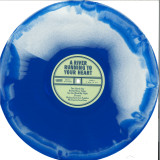
Eric D. Johnson rarely lingers at one location too long. As a kid growing up in the Midwest, Johnson's family moved around a lot, but it wasn't until he became a touring musician years later that motion became a central part of his identity. That transient lifestyle stoked an enduring reverence for the world he watched pass by through a van window. A sense of place is a unifying theme he's revisited with Fruit Bats throughout its many lives. From the project's origins in the late '90s as a vehicle for Johnson's lo-fi tinkering to the more sonically ambitious work of recent years, Fruit Bats has often showcased love songs where people and locations meld into one. It's a loose song structure that navigates what he calls "the geography of the heart." "The songs exist in a world that you can sort of travel from one to another," says Johnson. "There are roads and rivers between these songs." Those pathways extend straight through the newest Fruit Bats album, aptly titled A River Running to Your Heart . Self-produced by Johnson_a first for Fruit Bats_with Jeremy Harris at Panoramic House just north of San Francisco, it's Fruit Bats' tenth full-length release and one that finds the project in the middle of a creative resurgence. After two decades of making music, hard-earned emotional maturity has seeped into Johnson's songs, resulting in a more complex sound that's connected with audiences like no other previous version of Fruit Bats. A River Running to Your Heart represents the fullest realization of that creative vision to date. It's a sonically diverse effort that largely explores the importance of what it means to be home, both physically and spiritually. And while that might seem like a peculiar focus for an artist who's constantly in motion, for Fruit Bats, home can take many forms_from the obvious to the obscure. Lead single "Rushin' River Valley" is a self-propelled love song written about Johnson's wife that clings to the borrowed imagery of the place where she grew up in northern California. Then, there's the gentle and unfussy acoustic ballad "We Used to Live Here," which looks back to a time of youthful promise and cheap rent. But the wistful "It All Comes Back" is perhaps the most stunning and surprising track on the album, Johnson's production skills on full display. Built upon intricate layers of synths, keyboards, and guitars, it's a pitch-perfect blend of tone and lyricism that taps into our shared apprehensions and hopes for a post-pandemic life. "We lost some time / But we can make it back / Let's take it easy on ourselves, okay?" sings a world-weary but ultimately reassuring Johnson in the song's opening lines. It's the kind of performance that makes you hope Fruit Bats stays in this one place, at least for a little while longer.
More in tune now with the rhythm of the sun and moon, Xylouris White (Dirty Jim White and George Xylouris) speak to each other across great distances with the intuition and fellowship that can only be found over years in each other"s company. With fewer distractions, appreciative of the freedom to play with new sounds and spaces, they carve The Forest In Me from unbelievably thin air. Once you set the needle down on the record and hear for yourself, the intimacies and impressionism, abstraction and unfiltered emotion found in The Forest In Me, you may wonder what was the mood of the room in which this music came to be. George, Jim and long-time producer (and secret third member) Guy Picciotto share their thoughts: Guy Picciotto: "In late 2019, we had begun taking steps to working on new material. In a haphazard fashion, Jim and I started tracking drums in my basement, cutting them up into shapes with no set landing in mind. Some of it we sent to Giorgos in Crete - he responded with his lyra and his lute. Without intention we had initiated a process that would soon become more ruthlessly mandated by the world events that separated and isolated us to three corners of the globe in the following year." Giorgos Xylouris: "While we were recording, I noticed that the music had a certain solitude about it, both from the title and from inside. That led us to find more music from within that we had not yet discovered." Jim White: "The idea emerged, naturally nourished and nourishing a record with none of our usual angles and themes, no verbal language, no angst nor sudden dynamics, a more subtle structure. And we found The Forest In Me." The first revelation from The Forest In Me is "Latin White", in which Jim"s jaunty pattern sets the stage for George"s Cretan lyra and lute figurations, giving this short dance piece the feel of a welcome hoedown around the campfire, warding off the encroaching darkness of an emptied world. The repetitions, gathered to induce joy, have a glassy-eyed mechanical drive to them; their dervish-istic seeking betrays any suggestion of balm.
Juan Pablo Torres was one of the best trombone players in the Latin-jazz community of the second half of the 20th century.
He was the director of Algo Nuevo and a member of Irakere, two of the leading exponents of Afro-Cuban jazz in the 1970s and 1980s. He has also directed various Cuban supergroups such as Estrellas de Areito and Cuban Masters.
Almost all of his albums were made for Areito de La Habana, Cuba.
‘Cuba Disco’ was the only album released in his name in Europe; recorded in Milan in 1984 and produced by Aldo Pagani. In Italy in the same year he participated in two records by Pino Daniele and one by Astor Piazzolla.
Accompanied by his faithful Gruppo Algo Nuevo, with the addition of some guests such as the Italian jazz guitarist Angelo Arienti, his traditional Afro-Cuban vein is contaminated by disco and balearic moments; as in the case of the magnificent ‘Bermuda Triangle’ which anticipates the current atmosphere of Nu Genea.
Limited edition. Released from the transfer of the original master tape.
Black Vinyl[20,55 €]
Last year's Big Time brought Angel Olsen to a deeper, truer sense of self than ever before. Borne from the twin stars of grief and love, the album delivered beautiful sense of certainty, the sure-footed sound of an artist fully, finally at home with herself. But within that wisdom comes the realization that there is no finish line, no destination or static end point to life while you're living it, and Forever Means collects songs from the Big Time sessions that hold this common theme. They are, in Olsen's words, "in search of something else." "I was somewhere traveling," says Olsen, "stopped for a few days and wandering the city, and I was thinking `what does `forever' really mean? What are the things I'm seeking in friendship or love, and how can `forever' be attainable if we're always changing?'" Sitting with the reality of that entropy, Olsen realized "maybe the secret to ongoing love is to embrace change as part of love itself, that forever must have something to do with playing, looking, constantly searching things out for yourself, never letting yourself think you're finished learning or exploring." `Forever'", says Olsen, "remains curious while trying also to be kind and honest." All this packs into the four precious songs that comprise Forever Means, songs from Olsen's roads traveled and the ones ahead. "Nothing's free / like breaking free" Olsen sings, comfortable with the costs of her clarity, her heart and voice fixed on the present, the future, the not-yet-known and the beautifully unknowable
REPRESS
Alessandro Cortini (Nine Inch Nails/How To Destroy Angels) composed the Forse series using a Buchla Music Easel. Forse, meaning "maybe" In Italian, is a series of 3 double LP releases Cortini recorded for Imprec to release in 2013.
"All pieces were written and performed live on a Buchla Music Easel, in the span of one month. I found that the limited array of modules that the instrument offers sparked my creativity. Most pieces consist of a repeating chord progression, where the real change happens at a spectral/dynamic level, as opposed to the harmonic/chordal one. I believe that the former are just as effective as the latter, in the sense that the sonic presentation (distortion , filtering, wave shaping, etc) are just as expressive as a chord change or chord type, and often reinforce said chord progressions.
Of all the years with Nine Inch Nails the period spent writing and recording the instrumental record Ghosts I-IV is probably the one which changed my approach to music making the most. After that record I started getting more into instrumental composition, although I tried to approach it in a different way. While we had a vast array of tools and instruments at our disposal then, I decided to approach my pieces limiting myself to one instrument only, as I found myself being more decisive when faced with a limited creative environment."
Das neue Album "Risiko" von Steiner & Madlaina ist einmal mehr eine sehr persönliche Angelegenheit, die sie aber hin und wieder mit einem rotzigen Statement gehörig aufmischen. Nora und Madlaina haben sich für die Aufnahmen der zwölf Songs des neuen Albums neun Tage lang mit ihrer Band in das französische "Black Box Studio" in der Normandie zurückgezogen. Dort wurden alle Takes live eingespielt und zusammen mit Giuliano Sulzberger produziert.
"Die Aufnahmen zählen zu den besten Zeiten, die wir als Band erlebt haben", sagen Nora Steiner und Madlaina Pollina über ihr bereits drittes Album. Genau DAS hört man aus jedem der zwölf Songs heraus. Ob es damit das beste Album ist, das sie je gemacht haben? Die Entscheidung überlassen sie anderen.
Der Vorgänger "Wünsch mir Glück" landete in ihrer Heimat auf Platz 2 der Album-Charts - in Deutschland wurde es Platz 32. Gehen wir also am Ende ruhigen Gewissens mal ins "Risiko" und sagen: Dieses Album würde sich wirklich gut auf der 1 machen. Ob in Deutschland oder der Schweiz? Ach, warum nicht in beiden Ländern?
Caroline Polachek released her solo debut Pang back in 2019 after having been the lead singer of the acclaimed band Chairlift for more than 10 years. Immediately upon release Pang received major hype and critical acclaim, but in the years since, it has practically achieved a monolithic status in modern art pop.
Not surprisingly, expectations are huge for her sophomore album Desire, I Want to Turn Into You, but with excellent singles like "Billions" and "Sunset", it is evident that Polachek is a headstrong and original pop star who is here to stay!
Light in the Attic Records is proud to present the next installment of the Nancy Sinatra Archival Series with the first ever reissue of the classic 1972 album Nancy & Lee Again. Recorded during a 1972 reunion between Nancy and the enigmatic Hazlewood, the album contains some of the pair's most enduring and ambitious duets including the epic "Arkansas Coal (Suite)," the sensual "Paris Summer" and the incredibly powerful Dolly Parton-penned "Down From Dover." Equal parts daring, psychedelic, cinematic, and sweet, Nancy & Lee Again reveals with each track a timeless, natural chemistry between two artists who would remain influential for generations to come. Nancy & Lee Again is available in a variety of formats, including vinyl and CD. The vinyl LP is presented in an expanded gatefold jacket and is accompanied by a 20-page booklet, featuring an array of photos from the legendary singer, actress, and activist's personal collection, as well as in-depth Q&A with Nancy Sinatra, conducted by the reissue's GRAMMYr-nominated co-producer, Hunter Lea (also available in the CD package). All formats have been beautifully designed by Darryl Norsen of D. Norsen Design, and include two bonus tracks, "Machine Gun Kelly" (first time on vinyl) and the previously unreleased "Think I'm Coming Down." Nancy, the eldest daughter of Frank Sinatra, had been working with the Oklahoma-born songwriter since 1965, when she topped the pop charts with "These Boots Are Made For Walkin'." Over the next five years, the two artists forged a prolific relationship in the studio, with Hazlewood writing and producing many of Nancy's solo hits. Soon, the duo found success with a series of duets, including "Sand," "Summer Wine," and "Some Velvet Morning" - all of which appeared on their highly-influential 1968 debut. Not long after the critical acclaim and chart success of Nancy & Lee died down, however, Hazlewood unexpectedly relocated to Sweden, leaving his musical partner in the proverbial dust. America, meanwhile, was in the midst of a cultural shift, as the Vietnam War waged on. By the turn of the decade, the musical landscape had changed significantly. "Trivial music and not profound music became unimportant," recalls Nancy, speaking to Hunter Lea. "It was a tough time." And yet, despite the circumstances, the stars somehow aligned for the duo to record some of their most magnificent music together. Returning to Los Angeles for the project, Hazlewood - who reprised his role as producer - chose to take a new direction with the duo's sophomore album. Nancy recalls, "It was more dramatic; it was more fun to do, more challenging to do_. It was more grandiose." Nancy & Lee Again remains a creative high point in the careers of Sinatra and Hazlewood and, upon its release, garnered rave reviews from Billboard, Record World, and Cash Box, among others. Yet, Nancy & Lee Again never received the spotlight it so utterly deserved. "We didn't have label support at all in those days," recalls Nancy. "Without the strength of a label, records die. We were old. We were old-fashioned. We were just not what was happening. It's a very ageist kind of business." Nevertheless, she adds, "I think it's a very good album. I think it's timeless." Now, after years of being a sought-after rarity, this gem in the Sinatra-Hazlewood canon can finally get its due.
Mit der Veröffentlichung des ersten Full-Length-Albums "Entropic Reflections Continuum: Dimensional Unravel" wurde sofort deutlich, dass VoidCeremony einen Weg beschritten, den nur wenige gehen. Das Album bewies, dass Death Metal mit dem gleitenden, kontrollierten Chaos und dem geschmeidigen Fluss eines Jazz-Quartetts dargeboten werden kann und den Hörer dennoch in einem Kerker gefangen hält, mit wenig HP, ohne Zaubersprüche und umgeben von tödlichen Dämonen.
"Threads of Unknowing" ist eine Reise, die frühere Konzepte wieder aufleben lässt und immer progressivere und technischere Kompositionen hervorbringt. Mastermind und Gitarrist/Sänger Garrett Johnson sowie Gitarrenvirtuose Phil Tougas (Atramentus, Chthe'ilist, Worm, First Fragment) teilen sich hier den Gesang und die Leadgitarre, während Bass-Gott Damon Good sowohl den bundierten als auch den fretless Bass meisterhaft beherrscht und Schlagzeuger Charlie Koryn nicht nur Geschwindigkeit und Brutalität, sondern auch eine feine Mischung aus Präzision und Improvisation aus dem Jazz-Fusion einbringt. Das Endergebnis ist VoidCeremony und ihr unverkennbarer Sound: Zeitschmelzender Death Black Fusion.
Mit einem treffenden Coverbild, das die lyrische und philosophische Vision einer alten und vergessenen Zukunft darstellt, scheint VoidCeremony selbst in einer alternativen Death Metal-Zeitlinie zu operieren, die einst nur kurz präsentierte und bald für mehr kommerzielle Attraktivität zurückgelassen wurde. Doch das Portal hat sich wieder geöffnet und die Verschmelzung dieser grenzenlosen Möglichkeiten und Richtungen wird nun wieder direkt hervorgebracht.
- Das erste Album in voller Länge seit dem Debüt "Entropic Reflections Continuum" von 2020
- Die Vinyl-Version enthält eine Klappeinlage
- Cover-Gemälde von Juanjo Castellano (Majesties, The Black Dahlia Murder, etc.)
- Die Band besteht aus Mitgliedern von Atramentus, Worm, Mournful Congregation, Stargazer, Ascended Dead, Incantation, Chthe'ilist und First Fragment
- Gemischt und gemastert, mit zusätzlichen Synthies von Gabriele Gramaglia von Cosmic Putrefaction
- FFO: Stargazer, Pestilence, Chthe'ilist, Morbid Angel, Immolation, The Chasm, Aenigmatum, Atheist, Timeghoul, Liers in Wait, Innana
Mit der Veröffentlichung des ersten Full-Length-Albums "Entropic Reflections Continuum: Dimensional Unravel" wurde sofort deutlich, dass VoidCeremony einen Weg beschritten, den nur wenige gehen. Das Album bewies, dass Death Metal mit dem gleitenden, kontrollierten Chaos und dem geschmeidigen Fluss eines Jazz-Quartetts dargeboten werden kann und den Hörer dennoch in einem Kerker gefangen hält, mit wenig HP, ohne Zaubersprüche und umgeben von tödlichen Dämonen.
"Threads of Unknowing" ist eine Reise, die frühere Konzepte wieder aufleben lässt und immer progressivere und technischere Kompositionen hervorbringt. Mastermind und Gitarrist/Sänger Garrett Johnson sowie Gitarrenvirtuose Phil Tougas (Atramentus, Chthe'ilist, Worm, First Fragment) teilen sich hier den Gesang und die Leadgitarre, während Bass-Gott Damon Good sowohl den bundierten als auch den fretless Bass meisterhaft beherrscht und Schlagzeuger Charlie Koryn nicht nur Geschwindigkeit und Brutalität, sondern auch eine feine Mischung aus Präzision und Improvisation aus dem Jazz-Fusion einbringt. Das Endergebnis ist VoidCeremony und ihr unverkennbarer Sound: Zeitschmelzender Death Black Fusion.
Mit einem treffenden Coverbild, das die lyrische und philosophische Vision einer alten und vergessenen Zukunft darstellt, scheint VoidCeremony selbst in einer alternativen Death Metal-Zeitlinie zu operieren, die einst nur kurz präsentierte und bald für mehr kommerzielle Attraktivität zurückgelassen wurde. Doch das Portal hat sich wieder geöffnet und die Verschmelzung dieser grenzenlosen Möglichkeiten und Richtungen wird nun wieder direkt hervorgebracht.
- Das erste Album in voller Länge seit dem Debüt "Entropic Reflections Continuum" von 2020
- Die Vinyl-Version enthält eine Klappeinlage
- Cover-Gemälde von Juanjo Castellano (Majesties, The Black Dahlia Murder, etc.)
- Die Band besteht aus Mitgliedern von Atramentus, Worm, Mournful Congregation, Stargazer, Ascended Dead, Incantation, Chthe'ilist und First Fragment
- Gemischt und gemastert, mit zusätzlichen Synthies von Gabriele Gramaglia von Cosmic Putrefaction
- FFO: Stargazer, Pestilence, Chthe'ilist, Morbid Angel, Immolation, The Chasm, Aenigmatum, Atheist, Timeghoul, Liers in Wait, Innana
Malice was one of the more noteworthy bands of the ‘80s Los Angeles metal scene. License to Kill was their second album and was originally released in 1987. Max Norman produced, engineered, and mixed the album, he’s best known for producing several Ozzy albums during the ‘80s, as well as Megadeth’s Countdown to Extinction, and albums of various other metal bands like Y&T, Armored Saint, Savatage, and Lynch Mob a.o.
Old-school Megadeth fans will be tickled to discover that Mustaine and Dave Ellefson are credited with background vocals on two songs. Another guest appearance was made on this album by Tommy Thayer of Kiss. Founder Jay Reynolds later joined Dave Mustaine’s band Megadeth for a brief spell, and after that became a member of Metal Church.
License To Kill is available as a limited edition of 1000 individually numbered copies on translucent blue coloured vinyl