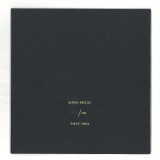
Lydmor's new album 'Capacity' is a musical maze full of alluring mysteries. At the same time, it is part of a process of liberation, which is about opening oneself up and discovering one's capacity. For her previous album, Lydmor travelled to Shanghai. But on her new album, Lydmor has mostly travelled deep into herself. 'Capacity' is a contrasting musical work where fiction and reality merge into a multifaceted sound universe. It is the electronic pop artist's most personal, complex and conceptual album to date. There is almost a David Lynch'ish cut about 'Capacity'. The album is like a winding maze where it is difficult to decipher what is real and what is an illusion. Like a book with countless narratives. Without conclusions. Ambiguous. Full of alluring mysteries, dreams, reflections and messages about gender, identity, love, guilt and liberation. Rich in contrasts: Black/white. Silence/noise. Weakness/strength. Fiction/reality. Labyrinth/compass.
Multiple media has compared the quirky voice to the likes of Grimes, Kate Bush or Björk but inevitably the comparisons fall short. (Kaltblut Magazine) - With brutal honesty, unbelievable vulnerability and yet dreamy, she sings the soul out in her pulsating electronic pop songs. The soft, bright voice is deceptive. Denmark's "hidden gem" is a must-listen. (Flux FM) - She is every bit as innovative as Madonna ever was when she started out. Lydmor ticks all the boxes; the girl has everything. For my money she’s the most ground-breaking, inventive artist in Europe right now, possibly in the world. (God Is In The TV, UK) - A unique artist who somehow manages to combine sophisticated and subtle balladry with strident electronic pop, I’ve declared previously that I believe she is only one step away from becoming a big name. Perhaps the feelings are supposed to be mutually inclusive, as the song swings musically from simply cold to complexly hot. It is one that does try to combine both sides of her song writing persona, the introverted balladry and the more elaborate, extrovert electro-pop. (Nordic Music Review) - Revolting pop pathos, primed with pumped up beats. (Negative White, Switzerland)
Cerca:becoming real
No other pairing in the history of Darkwave ever matched the unfettered creativity, resolve, and DIY attitude from the collaboration between the two creative minds that compromise Lebanon Hanover.
The meeting of the Swiss musician Larissa Georgiou, aka Larissa Iceglass and British artist William Maybelline a decade ago in the latter’s hometown of Sunderland in the UK, was a monumental occasion, reverberating throughout the European music scene and even across the Atlantic.
Lebanon Hanover would emerge from the peak of the world-wide minimal wave revival, with their 2011 split 7-inch record with La Fete Triste issued as the catalog debut of Europe’s most ubiquitous Techno-Industrial EBM labels, Aufnahme + Wiedergabe
With Berlin as their new physical home, William and Larissa would soon, however, join the Fabrika Records family. From here, they would go on to release two full-length albums through the Athens based label, starting in early 2012 with their winter debut LP The World Is Getting Colder, and it’s All Hallows Eve follow up Why Not Just Be Solo.
It was Lebanon Hanover’s 2013 third studio outing Tomb for Two that would go on to cement the duo’s legacy, with the album’s single “Gallow Dance” becoming a post-punk anthem for the times, with artwork became the band’s defacto logo. Not only that, the song “Sadness is Rebellion”, also featured on the album, became the band’s official Mantra.
Two years would pass before the release of 2015’s critically acclaimed fourth record, “Besides the Abyss”. In the intervening years, William and Larissa, initially a couple, would find other partners, and relocate to Athens.
Meanwhile, Lebanon Hanover as a live act would expand rapidly in popularity, exceeding capacity during their performances at Wave Gotik Treffen in Leipzig, and performing sold-out shows across Europe and the UK.
With the playful Babes of the 80s maxi-single released in the interim, three years would pass before the next record from Lebanon Hanover, with 2018’s Let Them Be Alien, the band’s fifth studio album.
At the dawn of the global pandemic, where dystopian nightmares that were only ever seen before within the pages of books and flashes of silver screen celluloid, has become a daily reality, a new kind of darkness envelops the world. It was at this Lebanon Hanover returned, sharing a glimmer of hope with the single “The Last Thing,” the duo’s first song from their forthcoming sixth studio album Sci-Fi Sky.
Spanning an epic journey across ten tracks that wander through industrial landscapes, and ascend beyond the atmospheric aether, Sci Fi Sky is Lebanon Hanover’s most cohesive artistic statement to date. With their icy hearts on their sleeves, this is the culmination of a decade’s worth of musical creativity radiating from the minds of both Iceglass and Maybelline, and altogether an otherworldly beacon of hope in a time of sheer darkness.
Clive Phillips, Dominic Goodman, Peter Blundell are Mosquitoes, a somewhat inscrutable London-based outfit in operation for something close to seven years now, and have released music across a host of celebrated and broad-minded underground labels. Give or take the occasional interview in the less-straight parts of the music press, this is as much formal biography as their music has thus far allowed, for there's something essentially unknowable at the centre of what makes Mosquitoes what they are. So murky is their early history in fact, the first two self-released Mosquitoes records seemed to disappear from sight before really becoming visible. As more records have emerged, those first communications accumulate new meanings, acting as vital documents in tracking the evolution of a band who stand at the vanguard of contemporary British music.
The second of these records, recorded to tape in summer 2016 and first released as a single-sided 12" under the name MOS-002, is arguably the first true iteration of Mosquitoes. Now fittingly renamed Mosquitoes for its reissue as a dubplate-style 10" on World of Echo on 5th March, these five cryptically titled, shape-shifting tracks, see the trio embrace a near-genre-less fluidity, and in doing so express a unique combination of both freedom and intent. By design or instinct, Mosquitoes stand at their own inverted rock nexus, presenting a music that's turned inside out, and in doing so, music that twists the listener the same way.
In that sense, Mosquitoes plug into a long lineage of DIY savant iconoclasts, those outliers who would deny orthodoxy in order to excavate new languages and ideas - The Dead C, This Heat, the anti-formalism of No Wave, David Toop's General Strike. As such, Mosquitoes rely on a musical pluralism in order to take it apart - you must know how something is made before you reassemble it anew. Labelling this an EP may possibly underplay the breadth and ambition of what's on show. Later records would arguably be more cohesive, but what stands as particularly startling with this early work is their fearless and all-encompassing dive into the avant garde. Consider the anti-rockism of the scorched earth 90s re-imagined through a distinctly avant filter of free jazz and dub aesthetics. And it's the latter which perhaps shapes Mosquitoes most, dub the perfect vehicle for the articulation of such wilful anti-formalism. Make no mistake, this is music that's unafraid to be tough, to demand something of the listener and to not ask permission. And to bear witness to a rejection of formalism so aggressively pursued is to be reconciled.
No other pairing in the history of Darkwave ever matched the unfettered creativity, resolve, and DIY attitude from the collaboration between the two creative minds that compromise Lebanon Hanover.
The meeting of the Swiss musician Larissa Georgiou, aka Larissa Iceglass and British artist William Maybelline a decade ago in the latter’s hometown of Sunderland in the UK, was a monumental occasion, reverberating throughout the European music scene and even across the Atlantic.
Lebanon Hanover would emerge from the peak of the world-wide minimal wave revival, with their 2011 split 7-inch record with La Fete Triste issued as the catalog debut of Europe’s most ubiquitous Techno-Industrial EBM labels, Aufnahme + Wiedergabe
With Berlin as their new physical home, William and Larissa would soon, however, join the Fabrika Records family. From here, they would go on to release two full-length albums through the Athens based label, starting in early 2012 with their winter debut LP The World Is Getting Colder, and it’s All Hallows Eve follow up Why Not Just Be Solo.
It was Lebanon Hanover’s 2013 third studio outing Tomb for Two that would go on to cement the duo’s legacy, with the album’s single “Gallow Dance” becoming a post-punk anthem for the times, with artwork became the band’s defacto logo. Not only that, the song “Sadness is Rebellion”, also featured on the album, became the band’s official Mantra.
Two years would pass before the release of 2015’s critically acclaimed fourth record, “Besides the Abyss”. In the intervening years, William and Larissa, initially a couple, would find other partners, and relocate to Athens.
Meanwhile, Lebanon Hanover as a live act would expand rapidly in popularity, exceeding capacity during their performances at Wave Gotik Treffen in Leipzig, and performing sold-out shows across Europe and the UK.
With the playful Babes of the 80s maxi-single released in the interim, three years would pass before the next record from Lebanon Hanover, with 2018’s Let Them Be Alien, the band’s fifth studio album.
At the dawn of the global pandemic, where dystopian nightmares that were only ever seen before within the pages of books and flashes of silver screen celluloid, has become a daily reality, a new kind of darkness envelops the world. It was at this Lebanon Hanover returned, sharing a glimmer of hope with the single “The Last Thing,” the duo’s first song from their forthcoming sixth studio album Sci-Fi Sky.
Spanning an epic journey across ten tracks that wander through industrial landscapes, and ascend beyond the atmospheric aether, Sci Fi Sky is Lebanon Hanover’s most cohesive artistic statement to date. With their icy hearts on their sleeves, this is the culmination of a decade’s worth of musical creativity radiating from the minds of both Iceglass and Maybelline, and altogether an otherworldly beacon of hope in a time of sheer darkness.
For a band that resists repeating itself, picking up lessons from a decade prior is the strange route Cloud Nothings took to create their most fully-realized album. Their new record, The Shadow I Remember, marks eleven years of touring, a return to early songwriting practices, and revisiting the studio where they first recorded together.
In a way not previously captured, this album expertly combines the group’s pummeling, aggressive approach with singer-songwriter Dylan Baldi’s extraordinary talent for perfect pop. To document this newly realized maturity, the group returned to producer Steve Albini and his Electrical Audio studios in Chicago, where the band famously destroyed its initial reputation as a bedroom solo project with the release of 2012 album Attack on Memory.
Another throwback was Baldi’s return to constant songwriting à la the early solo days, which led to the nearly 30 demos that became the 11 songs on The Shadow I Remember. Instead of sticking to a tried-but-true formula, his songwriting stretched out while digging deeper into his melodic talents. “I felt like I was locked in a character,” Baldi says of becoming a reliable supplier of heavy, hook-filled rock songs. “I felt like I was playing a role and not myself. I really didn’t like that role.” More frequent writing led to the freedom in form heard on The Shadow I Remember. What he can’t do alone is get loud and play noisily, which is exactly what happened when the entire band— bassist TJ Duke, guitarist Chris Brown, and drummer Jayson Gerycz—convened.
The band had more fun in the studio than they’ve had in years, playing in their signature, pulverizing way, while also trying new things. The absurdly catchy “Nothing Without You” includes a first for the band: Macie Stewart of Ohmme contributes guest vocals. Elsewhere, celebrated electronic composer Brett Naucke adds subtle synthesizer parts.
The songs are kept trim, mostly around the three-minute mark, while being gleefully overstuffed. Almost every musical part turns into at least two parts, with guitar and drums opening up and the bass switching gears. “That’s the goal—I want the three-minute song to be an epic,” Baldi says. “That’s the short version of the long-ass jam.”
Lyrically, Baldi delivers an aching exploration of tortured existence, punishing self-doubt, and the familiar pangs of oppressive mystery. “Am I something?” Baldi screams on the song of the same name. “Does anybody living out there really need me?” It’s a heartbreaking admission of existential confusion, delivered hoarsely, with an instantly relatable melody.
“Is this the end/ of the life I've known?” he asks on lead single and album opener “Oslo.” “Am I older now/ or am I just another age?” Despite the questioning lyrics, the band plays with more assurance and joy than ever before. The Shadow I Remember announces Cloud Nothings’ second decade and it sounds like a new beginning.
For a band that resists repeating itself, picking up lessons from a decade prior is the strange route Cloud Nothings took to create their most fully-realized album. Their new record, The Shadow I Remember, marks eleven years of touring, a return to early songwriting practices, and revisiting the studio where they first recorded together.
In a way not previously captured, this album expertly combines the group’s pummeling, aggressive approach with singer-songwriter Dylan Baldi’s extraordinary talent for perfect pop. To document this newly realized maturity, the group returned to producer Steve Albini and his Electrical Audio studios in Chicago, where the band famously destroyed its initial reputation as a bedroom solo project with the release of 2012 album Attack on Memory.
Another throwback was Baldi’s return to constant songwriting à la the early solo days, which led to the nearly 30 demos that became the 11 songs on The Shadow I Remember. Instead of sticking to a tried-but-true formula, his songwriting stretched out while digging deeper into his melodic talents. “I felt like I was locked in a character,” Baldi says of becoming a reliable supplier of heavy, hook-filled rock songs. “I felt like I was playing a role and not myself. I really didn’t like that role.” More frequent writing led to the freedom in form heard on The Shadow I Remember. What he can’t do alone is get loud and play noisily, which is exactly what happened when the entire band— bassist TJ Duke, guitarist Chris Brown, and drummer Jayson Gerycz—convened.
The band had more fun in the studio than they’ve had in years, playing in their signature, pulverizing way, while also trying new things. The absurdly catchy “Nothing Without You” includes a first for the band: Macie Stewart of Ohmme contributes guest vocals. Elsewhere, celebrated electronic composer Brett Naucke adds subtle synthesizer parts.
The songs are kept trim, mostly around the three-minute mark, while being gleefully overstuffed. Almost every musical part turns into at least two parts, with guitar and drums opening up and the bass switching gears. “That’s the goal—I want the three-minute song to be an epic,” Baldi says. “That’s the short version of the long-ass jam.”
Lyrically, Baldi delivers an aching exploration of tortured existence, punishing self-doubt, and the familiar pangs of oppressive mystery. “Am I something?” Baldi screams on the song of the same name. “Does anybody living out there really need me?” It’s a heartbreaking admission of existential confusion, delivered hoarsely, with an instantly relatable melody.
“Is this the end/ of the life I've known?” he asks on lead single and album opener “Oslo.” “Am I older now/ or am I just another age?” Despite the questioning lyrics, the band plays with more assurance and joy than ever before. The Shadow I Remember announces Cloud Nothings’ second decade and it sounds like a new beginning.
Rolling through life, an open mind like an ocean, an infinite ride that comes furiously crashing to a halt. This is Whitney K’s ‘Two Years’, a deep dive into the Canadian songwriter’s journey through vulnerability, change and ultimately letting his guard down. Whitney K is the wandering stalwart Konner Whitney, a White- horse Yukon resident who has spent time in Vancouver, Montreal, Burnaby and Los Angeles. We met the character in 2016 through his intoxicating 4-track recorded manifesto ‘Goodnight’, a head on collision into 24 hours of illusioned romance and modern day escapism.
Fast forward to 2021, lift those curtains, aptly titled ‘Good Morning’ is the opening track on ‘Two Years’, a different cracker, a deliberate record about transformation, where to put it simply, Whitney K has arrived. Enlisting the aid of main collaborator and bandmate Josh Boguski, the focus has been shifted, folklore and realism becoming reckoning and truthfulness, what was outsider folk is now political poetry, life in motion delivered through a freeway ridden baritone voice that transforms the mundane into extraordinary.
Close is the debut album from American Dreams Records founder & ONO member Jordan Reyes.
The album is comprised of six songs composed on modular synthesizer working in a rhythmic ambient, electronic realm - songs like ‘Quicksand’ are glacial and melodic while others like ‘Lost Machine’ skew to the kinetic.
On this album, Reyes mused on idea of sobriety, endurance, and being in a state of trance - wading deep in the patch cords of the eurorack synthesizer allowed him to reach a state of non-attachment, similar to running or biking a long distance. This kind of tunnel vision allowed him to perceive himself fading from the day-to-day and exist wholly inside the machine, becoming a more cybernetic organism.
It is often the case with popular music that those recordings which have the most profound impact and long-term appeal are often the ones which are produced in a moment without much deliberation or agenda. And that has certainly been the case with Slow Club’s EP of Christmas songs.
The first single from the E.P, Christmas TV, was actually written in soundcheck at Birmingham Barfly and released as a free download for Christmas 2008. The rest of the EP was written and recorded in a short burst in late summer 2009 at Axis Studios in Sheffield and in their friend’s bedroom. It came at a moment of intense creativity for the band when the songs were coming thick and fast and the duo were really hitting their stride. The differing musical styles of the pair was already becoming apparent across the three original compositions and three covers, and there is a real sense of a band pushing their limits in a way which would coalesce in the recording of their breakthrough second album the following year.
In 1990 Neil Hannon started recording and releasing under the name
The Divine Comedy. Thirty years and twelve great albums later,
Hannon is rightly adjudged one of the finest singer songwriters of his
generation. To celebrate, Divine Comedy Records are remastering
and reissuing nine of the band's classic albums.
The nine reissued albums have been remastered from the original
tapes at the legendary Abbey Road Studios by mastering engineer
Frank Arkwright (Blur, The Smiths). Overseeing the audio throughout
the campaign is engineer / mixer / producer Guy Massey, whose
work on the Beatles Stereo Remasters won him a Grammy Award.
‘Casanova’ was the band’s third album and the first to bring real
success. First released in 1996 it explored and dissected a world of
casual affairs, loose morals and a thousand anxieties in between.
From the NME: “‘Casanova’ fairly teems with sex, with suppressed
desires... with ample evidence of what dicks men can be.” Mojo
described it as a “glorious... sumptuous paean to life, love and
longing.” Select said “Only a barren heart could resist it... Sensible
people simply swooned.” Singles ‘Something For The Weekend’,
‘Becoming More Like Alfie’ and ‘The Frog Princess’ became chart hits
and airplay staples while an alternate version of ‘Songs Of Love’
became the theme music for legendary Channel 4 sitcom Father Ted
Traditionally the liner notes of an album take on a kind of third-party address, where a writer is delivering their thoughts about how an album makes them feel without breaching that space where they are representing themselves or the moment in time directly to the reader. The goal is typically a kind of timelessness, but as we live in unprecedented times, unconventional methods take on new life, and hopefully importance. In the spirit of that idea... man, is this the kind of album we all need right now. So many of us feel like we're constantly walking a tightrope, are feeling like we can't unwind, are in genuine need of a few moments of respite. Every so often an album emerges from an artist that most likely did not realize when they were composing how timely the results would be, and Lofi Dimensions is exactly that kind of record. It doesn't really matter why it's coming when it is, what's important is that it's here, offering peace to the perturbed and inspiration for the downcast. The American Dollar have long been one of those artists operating in a kind of middle ground, a band with a long history of creating moving instrumental rock that has somehow avoided ever becoming synonymous with modern American post-rock acts. They retain a sort of autonomy in a valued position just outside the boundaries of classification. Blending electronic textures with moving guitar and keyboard melodies, their music has always traveled somewhere in the spaces between trip-hop, electronic, post-rock and ambient, and this inability to be defined is ultimately what sets them apart from the trappings of genre, allowing them to be whatever they want The American Dollar to be in a given moment, always on their terms.
Vanish is Julia Reidy’s yearning, fat debut for Editions Mego. Since 2019, Julia’s bubbling 12-string guitar work - sighing streams of crystal plucks drawn closer or echoing on - has moored a tactile, ever-lusher sound. On ‘Guitar’, the Australian, Berlin-based musician melts down sharp synths; electric fuzz and flex; uncanny found sounds; and autotuned voice and harmonica in a heady, overpowering potion.
Reidy’s music sweeps you up. It’s restless, always travelling on. Lonesome tones into machine chorales into hesitant hum. The LP’s side-long cuts sway between scenes but are always rooted: Julia’s guitar and vocal lines seem mapped to the natural ebb and flow of breath and thought, they lull you as they push through vast and secret spaces.
Vanish completes a trio of releases begun with last year’s ‘brace, brace’ (Slip) and ‘In Real Life’ (Black Truffle). The delicious unease, the anxious burning of the preceding volumes has settled, becoming more wide-eyed and resolute. For all its poise, the album’s sense of build - electric licks rasping into glistening synths, punctured by distant kicks - feels freshest. When 'Oh Boy'’s smudged whistle comes, it has fought its way out of the thickets, and hits like heartbreak.
West coast composer, artist, and producer Kaitlyn Aurelia Smith has chartered a pioneering career with multiple critically-acclaimed albums since 2015. Following the release of The Kid in 2017, Smith focused her energy in several directions. She founded Touchtheplants, a multidisciplinary creative environment for projects including the first volumes in her instrumental Electronic Series and pocket-sized poetry books on the practice of listening within. She's continued to explore the endless possibilities of electronic instruments as well as the shapes, movements, and expressions found in the physical body's relationship to sound and color. It is this life-guiding interest that forms the foundational frequencies of her most recent full-length, The Mosaic of Transformation, a bright, sensorial glide through unbound wave phenomena and the radiant power discovered within oneself. "I guess in one sentence, this album is my expression of love and appreciation for electricity," says Smith. While writing and recording, she embraced a daily practice of physical movement, passing electricity through her body and into motion, in ways reflecting her audio practice, which sends currents through modular synthesizers and into the air through speakers. Not a dancer by any traditional definition, she taught herself improvisatory movement realizing flexibility, strength, and unexpectedly, a "visual language" stemming from the human body and comprised of vibrational shapes. Understood as cymatics, as Smith says, "as a reference for how frequencies can be visualized," much like a mosaic. Smith describes her first encounters with this mosaic; "the inspiration came to me in a sudden bubble of joy. It was accompanied by a multitude of shapes that were moving seamlessly from one into the other...My movement practice has been a constant transformation piece by piece. I made this album in the same way. Every day I would transform what I did yesterday...into something else. This album has gone through about 12 different versions of itself." As it has arrived, in a completed state, The Mosaic of Transformation is a holistic manifestation of embodied motions. Smith's signature textural curiosity that fans have grown to adore pivots naturally into a proprioceptive study of melody and timbre. Airy organ and voice interweave with burbling Buchla-spawned harmonic bubbles. "The Steady Heart" quivers to life, peppering blasts of wooden organ between winding vocal affirmations. As with a body, moving one portion requires a balance and counterbalance; here, subtle tonal twitchy signals fire in conjunction with coiling arias to create a mesmeric core. When the beat arrives at the midway mark, a swooping and jittery waltz, a sense of stasis in motion, a flow state, is sonically achieved. As soon as it syncs, it disappears back into the swirling ebbs of electric force. Other tracks stray into more ruminative physical realms. "Carrying Gravity" is built around string-like pads that expand and contract like a solar plexus, becoming taught and then loose. If the record could be summarized in a single movement, it is the 10-minute closing suite, a rapturous collage called "Expanding Electricity." Symphonic phrases establish the piece before washes of glittering electric peals and synthesized vibraphone helix into focus. Soon, Smith's voice grounds it all with an intuitive vocal hook, harmonized and augmented by concentric spirals of harp-and-horn-like sounds. Smith's music doesn't capture a specific emotion as much as it captures the joys of possessing a body, and the ability to, with devotion and a steady open heart, maneuver that vessel in space by way of electricity to euphoric degrees.
Forma by Lucy Railton, is a work that digs into us. It disorients us, plays with us, but without malice. It is like a nocturnal butterfly whose wings reflect a dark light, thus projecting fleeting hallucinations, which nevertheless persist on the surface of our retina. Its trajectories, too, are unpredictable. But such disorientation is not that of a chaotic space, it is rather a mysterious reason that presents itself to us, an imperious unfolding whose logic escapes us, but which nevertheless fascinates. It is also a history of shapes and their becomings. A story, also of their own vanishing.
Metabolist Meter (Foster, Cottin, Caetani and a Fly), by Max Eilbacher is a teeming piece, a matrix where textures and structures merge together, where the polyrhythmic instances become timbre, where the formal abstraction of the harmonic volutes coagulates around a vibrating form that is actualized in the dramatic reality of a dying fly. And this formal mastery is not disembodied in Max Eilbacher's work and the kaleidoscopic forms of the sound spectra that he has deployed know how to resonate in the sensations and experiences of each one.
These two pieces have this in common, but each with their own agenda, that they evolve with grace and inspiration in the vast domain of the sound world and it is a great pride for us to present them in this new collection.
Released in association with Editions Mego.
Coordination GRM: François Bonnet, Jules Négrier
Executive Production: Peter Rehberg
7"
Limited to 300 handmade copies!
We only knew Pop's (Steven) singing voice as a whistle. He whistled while he worked, and he worked all the time. But not even a whistle accompanied him on the guitar. A woodworker by day, he brought his craftsmanship home, softly picking his patient melodies. Those few tunes were played over and over again, becoming smooth and refined as a carefully finished armoire.
It wasn't until Christmas 2008 that we really heard him sing. Our mother pulled out an old cassette tape labeled Steve at Marco's, a brief recording session from 1979. The first thing we heard was the song. The only song. Blue. A thick delay over the entire mix told us he was shy even back then. But then came that voice, which, underneath the wash, wasn't shy at all.
Blue, and the stream of short instrumentals following, seemed a rare capture at the heart of our origin with music. And as we shared these recordings with friends, we soon realized it wasn't just us who found them so warm and beautiful.
A proper closet musician, Pop would never share this music on his own accord, so we've taken the liberty of doing it for him. - Heather & Peter Broderick, August 2011
- A1: China Crisis - Jean Walks In Fresh Fields
- A2: Turquoise Days - Grey Skies
- A3: Simple Minds - Real To Real
- A4: Illustration - Tidal Flow
- A5: Care - An Evening In The Ray
- A6: Soft Cell - Youth
- A7: John Foxx - Europe After The Rain
- A8: Patrik Fitzgerald - Personal Loss (Mono)
- A9: Eyeless In Gaza - Lights Of April
- A10: Orchestral Manoeuvres In The Dark - Sealand
- A11: Thomas Leer - Private Plane
- A12: The Electronic Circus - Direct Lines
- A13: The Pale Fountains - Unless
- A14: Chris & Cosey - October (Love Song) (Love Song)
- A15: New Musik - A Map Of You
- A16: The Human League - Wxjl Tonight
- A17: Paul Haig - Christiana
- A18: The Teardrop Explodes - Tiny Children
- A19: Oppenheimer Analysis - Behind The Shades
- A20: Trevor Bastow - Feather Bed
At the turn of the 80's, a new generation of musicians appeared who saw synthesisers not as dehumanizing machines but as musical instruments that could be coaxed into creating modern, beautiful and decidedly emotional music. It was almost as if the musicians were intentionally creating this music to prove the doubters wrong.
Compiled by Saint Etienne’s Bob Stanley and Pete Wiggs, “The Tears Of Technology” celebrates this brief period when scruffy synth duos from the provinces broke through and took over British pop. Like mellotrons before them, synths could project a strange and deep emotion; listen to OMD’s ‘Sealand’, or the Human League’s ‘WXJL Tonight’, and it was clear that something in the wiring had an inherent melancholy.
In the 60's and 70's, the synthesiser had mostly been regarded as either a novelty or a threat. Tomorrow’s World warned us that the cold, heartless synth would soon make orchestras redundant. But by 1980, Korgs, Moogs and Rolands were becoming affordable for all, and post-punk had created a safe place for new groups to experiment with these new toys.
The influence of Kraftwerk – who had made a landmark appearance on Tomorrow’s World in 1975 – is all over this collection. Big names rub shoulders with obscurities by Turquoise Days, Electronic Circus and Illustration, all highly prized recordings among ‘cold wave’ and ‘minimal synth’ afficionados. There are pioneers like John Foxx and Thomas Leer, alongside unexpected synth sadness from Simple Minds and the Teardrop Explodes.
“The Tears Of Technology” celebrates an era of electronic melancholia, synthesized intimacies and insights – even Tomorrow’s World didn’t see that coming.
Justin Strauss and Max Pask have joined up to form the new project Each Other, who will release their self-titled debut EP ‘Be Nice To Each Other’ on February 7th, 2020 via Soulwax/2manydjs label DEEWEE. While Strauss and Pask have DJ’d together on numerous occasions, this is the first time that they’ve collaborated on a production project.
The EP finds Each Other creating an eclectic range of sounds in the space of just three tracks. The opener ‘Same As It Never Was’ is the most immediate of the set, becoming more hypnotic as the minimalist topline buries itself into your subconscious. The downtempo ‘Burn It Down’ then darkens the mood, feeling closer to a dystopian sci-fi soundtrack than an underground club classic, before the playful and progressive ‘Six Weeks’ up the energy with jittering beats, sparkling synths and a cooly understated vocal.
“What we were trying to do and what we’ve hopefully achieved was to merge our influences with a nod to what many consider to be the ‘golden age’ of New York,” explains Justin Strauss. “You don’t realise that these periods were becoming important markers in history when we were living through them. It only comes later with the added benefit of time. I hope that in years to come, history will find a place for what we’re doing now” - Each Other.
As with all DEEWEE releases, ‘Be Nice To Each Other’ was recorded produced and mixed at DEEWEE.
Emotional Rescue returns to the music of British "pop" band Furniture, with an EP of the band's own extended versions, remixes and unreleased takes of their particular output.
Taken from three 12"s that followed When The Boom Was On (ERC072), the songs included cast a light on their development from 3 to 5 piece, adding Sally Still (bass) and Maya Gilder (keyboards) and the new male/female frontline. The subsequent broadening of their line-up and sound meant they could start to address the kind of pop music they wanted to play.
After the early releases garneered radio play and reviews, Furniture were launched into the melee of '80s pop. An anomaly, the band found they attracted a specific kind of "intense" follower, who were often beguiled by Furniture's freaky normality. This was addressed on the 1984 release, 'I Can't Crack'. A more urgent version of the sound Furniture had debuted with 'Why Are We In Love', the track, sung by Tim, was based around a sequencer-like rhythm played live by drummer Hamilton Lee, and a clarinet part played by Tim's brother, Larry Whelan. A mix of bleakness and euphoria, the song was and is a favourite of the band and considered one of their best self-productions, as well as becoming a latter day club play.
This is followed by the studio experiment 'Throw Away The Script', where the band wrestled with sequencers and synth-pop, but then countered it with a free-jazz sax solo. Found on the flip of the double A -side of 'Love Your Shoes' 12", this instrumental version too became an underground club hit, including a cult play at Fran Lenaer's influential Valencia club, Spook Factory. Played loud, the studio mastery, trickery and oft-accidental discoveries come to the fore, with tissue-damaging frequencies giving extra sound system shaking bottom end.
The B-side continues the band's love of making extended mixes with 'Dancing The Hard Bargain'. Co-produced with Tim Parry (formerly of Blue Zoo), they threw everything at these 12" versions. Able to relax and focus on the sounds they really liked, rather than the ones thought more commercial, this can be clearly heard on this compelling, percussive mix, a stop-start breakdown becoming a band hallmark.
To close this collection is the mammoth 'Bullet'. Again sung by Whelan, an edited version of which debuted on the 1986 Survival compilation of Furniture tracks called 'The Lovemongers', here this previously unreleased original take is centred on a mesmeric tape loop, live drums and a guest appearance by violinist Helena Bjorelius.
“Built By Humanoid” is Humanoid's second album, a mere 30 years after the debut, though Brian Dougans claims the first album wasn't really him anyway.
Humanoid's classic acid house single, ‘Stakker Humanoid’, highly regarded as one of the key tracks from the era (Richard James (Aphex Twin) sights the Stakker project as a major influence), enjoyed massive success in 1988. Reaching No.1 for 5 weeks in the UK dance charts, performances on Top of the Pops, a John Peel session for the BBC and European tours eventually led to an album deal.
Whilst all this was happening, Brian Dougans (one half of electronic legends Future Sound of London) claims he was returning to his squat in Kings Cross with no electricity or water. He not only became disillusioned with the business, but also became increasingly ill from the conditions he was living in. Around 6 tracks into the album, he left London and record label, Streetsounds, returning to Manchester to recover and regroup his thoughts. However, Steetsounds pressed ahead with the album and it was finished in Brian’s absence with guest performers.
Brian left Humanoid behind and went on to create FSOL with Gaz Cobain becoming leading lights in the burgeoning ambient scene, scoring a top 10 album "Lifeforms" on Virgin Records.
In 2003 Rephlex (Aphex Twin’s label) released a posthumous album of 1988 out takes compiled by Brian.
Recently Humanoid tracks have been popping up on modern compilation albums (Touched Music / Gasman, etc) signalling a possible return.
“Built by Humanoid” is a brand new nine track album of future acid cuts, breaks and electronics, a lot of which is credited to 2 synthesisers co-designed by Brian Dougans and English Electronics company Digitana. It is this innovation that has helped usher Humanoid back into the limelight and consequently the album has a rather new and unique sound and style.
The track ‘Polymath’ is created using a possibility / probability theory that results in a track which at no point repeats itself - 303 tinged acidic bubbles. Meanwhile ‘Traktion’ is a break beat, pulse laden, bass heavy monster. ‘Fu*k It’ is the future sound of 303. Fast, frantic and beat driven. Whilst ‘Post Humans’ combines thumping 909 and 303 into an acid hallucination.
repressed !
Justin @Cudmore's 'Are You Ready' is the track that's making you stay at the party long after you started saying you should really get home. Justin tells us that 'Are You Ready' is the result of some early experimentation with the studio setup in his old apartment and one of the first white label acid tracks he began playing out, even before his popular debut for The Bunker NY, 'Forget It' was released. 'The elements came together quickly in an afternoon session -- I had been recently inspired by a trove of acapellas I'd come across. I would say this is when arranging the track really clicked and I started truly assembling it with the dance floor in mind.' Over the next two years, the track became a secret weapon that made its way into the hands of DJs like Craig Richards, Mike Servito, Jackmaster, Derek Plaslaiko and Gerd Janson, becoming something of a sleeper hit.
Literature Recordings Are A Brand New Label Who Have Launched At One Of The Most Successful Times For Independent Dance Music Imprints. It's A Time Where They're Currently Reigning Supreme Over The Charts, Becoming A Formidable Force Against The Majors Who Have For Too Long Dominated The Scene And Proving That Music Is Just As Expansive And Full Of Ideas As It Has Ever Been. The Different Music Alumnus Cuelock Stands At The Helm Of This Brand New Project And He Brings With Him A Range Of Experience To Help Give His Expert A&r Advice To The Artists About To Make Their Debut On The Label. And The First Vinyl Release Comes From Eusebeia - The Upcoming Producer Has Shown His Hard Work And Dedication Through His Forthcoming 'breakdown Of Illusion' Ep, Where He Delivers Seven Brand New Records Which Pedestal His Stellar Talents As An Artist. Between 'truth Is Stranger Than Fiction' And 'annihilation Of Inhibition' There's A Range Of Diversity Which Eusebeia Shows His Audience Throughout The Journey Of 'breakdown Of Illusion'. The Carefully Sequenced Drums And Weaving Bassline Of 'truth Is Stranger Than Fiction' Is The Perfect Way To Begin The Ep, Whilst Tracks Like 'charade' And Titletrack 'breakdown Of Illusion' Continues Eusebeia's High-reaching Trend. Coming Along Next, Both 'no Stone Unturned' And 'camouflage, Pay Homage To The Roots Which Have Built Eusebeia As A Multi Faceted Artist And Demonstrate Why There's So Much Heat Around The Newly Discovered Artist. They Also Highlight The Eye For Blossoming Newcomers Which Cuelock Has Administered For This Release, It'll Be The Gift Which Enables Literature Recordings To Build A Roster Which Will Hold Themselves Up Against Their Counterparts.then Finally You're Left With Both 'dreams Into Reality' And 'annihilation Of Inhibition', Which Leave A Lingering Aftertaste - The Type Which Keeps You Coming Back For More Listen After Listen. It Completes A Package Which Proves The Capabilities Of Eusebeia As Well As Literature Recordings As An Imprint. You Can Expect More Music And Artists Of
Harlem's legendary Disco label Queen Constance has long been a cult favourite among fans of underground dance music for decades.
One of many labels operating under the equally legendary P&P family of imprints Queen Constance was operated by one Peter Brown, a truly colossal figure in NYC's music scene, its catalogue still fascinates music lovers to this day. Covering a wide range of styles including Gospel, early Rap and Disco the label's output continually finds it way into the playlists of respected DJ's and selectors across the globe. This latest repress from the vaults is a real biggie - a true NYC underground disco CLASSIC!
High Voltage is one of the more familiar names in the P&P / Queen Constance galaxy. Led by Peter Brown and Patrick Adams right hand man and producer Michael Campbell who presided over some of the biggest and best sides the labels put out. This one is a must, essential, do not sleep business. 11.00 minutes of Disco fury! One is forgiven in thinking that this would've been huge had it have come out on one of the 'bigger' Disco labels, but that hasn't stopped 'Rock, spank, freak' becoming a true blue club anthem. Appearing in the playlists of DJ's and selectors as diverse as Larry Levan, Danny Krivit and Daniele Baldelli. Rough n'ready, unpolished but musically explosive the sounds contained on this here 12" are indeed High Voltage! As with a lot of these jams, this one's been badly bootlegged, so ignore those wack counterfeits that are out there and bag you a fully licensed reissue of this absolute bomb. Dope.
This is a 100% legit reissue, made in conjunction with Above Board distribution and the Demon Music group, lovingly remastered with love by Optimum Mastering, Bristol UK.
Same track on both sides
London's FYI Chris joined Toy Tonics!
After releases on Rhythm Section, Church and West Friends - the 2 DJs, producers and record shop dons from London/Peckham chose the German Toy Tonics label for their next release.
The guys know what's fresh in club culture. They been store managers at one of London's coolest record stores: Rye Wax/Peckham for the last 2 years. And they are becoming one of the most interesting names of the post-house scene of London.
Their first encounter with Toy Tonics was though label boss Kapote. They quickly realized that there are big similarities in their musical vision and way how dance music should develop... so what makes more sense to make an EP together
So here it comes: FYI Chris next level electronic funk music! MPC style.
Have fun!
'they've quietly found themselves elevated into the psych scenes premier league.' Drowned In Sound
'when they go pedal-to-metal it rarely fails.' Mojo Magazine
'The Lucid Dream are rapidly becoming major players in an ever-increasingly crowded psych scene..utterly seductive.' The Quietus
'one of the most enthralling bands in the UK.' Far Out Magazine
The Lucid Dream return in October with the release of their 4th album, 'Actualisation'.
Driven by fans raising £10,000 to help replace all equipment robbed after a Paris show in early 2017, a new album became the instant focus in the summer of 2017 for a rejuvenated The Lucid Dream.
'Actualisation' is soaked in the influence of acid house, amalgamated with dub and kosmische. It will again see them acknowledged for venturing into pastures new, setting themselves apart from 'genres', 'scenes' or what any other act are currently doing.
The album was penned over the summer of 2017 by Mark Emmerson (vocals/guitar/synths), using only the classic Roland 303/808 synths, bass and vocals as tools for writing. Inspiration for the writing was formed via continuous listening to the Chicago to UK acid house works of 1986-1992, the focus predominantly on the groove.
Several months on from those writing sessions and The Lucid Dream have completed their 4th album in 5 years. A record made for the dancefloor.
Recorded at Whitewood Studios, Liverpool, with Rob Whiteley, the album is produced alongside long-time collaborator Ross Halden (Ghost Town Studios, Leeds), with mastering via Dean Honer (All Seeing I/I Monster/The Moonlandingz).
The confrontational techno-punk of 'Alone In Fear' opens the album, a 9-minute attack fuelled by the frustration and anger spawned by Brexit, government and a realisation of what 2018 Britain currently is.
Recent single 'SX1000' (the first work from the album, unveiled via 12' vinyl in April this year) is the band's first move into pure acid house. The acid house fusion runs throughout the record, represented furthermore by 'Ardency', a track already praised by live critics when aired live for the first time earlier this year as 'even on first hearing, would've raised the roof of The Hacienda'.
The 2-part opus of 'Zenith' follows, commencing with a space-dub/house instrumental groove before building into a track that will go for your head as much as your hips. Only 'Breakdown' harks back to sounds of old for the band, a little reminder of the skull-crushing impact they can make when stripped to the bare bones. 'No Sunlight Dub' closes the album, a dark-dub that invites the classic acid-house tool (Roland 808) into the dub. The track makes a stop-off into drum 'n' bass/jungle along the way before rounding up in a manner suited to Lee Perry, King Tubby, Augustus Pablo and other Jamaican greats.
The Lucid Dream formed in Carlisle, Cumbria, in 2008. A string of sold-out 7s was followed by the debut longer player, 'Songs Of Lies and Deceit', in August 2013. The initial vinyl pressing of the debut album (500 copies) sold out within 2 days, and was backed by a main stage slot at Kendal Calling, and supports to Death In Vegas and A Place To Bury Strangers (full UK tour).
The bands 2nd album ('The Lucid Dream') was released in March 2015 to further acclaim. This included 2 BBC 6 Music sessions and plays across most shows on the station, as well as plays from BBC Radio 1 (Huw Stephens) and BBC Radio 2. Further press followed from Uncut, The Skinny, Louder Than War, and Drowned In Sound, who named the album #7 UK album of 2015. Supports to Clinic and A Place To Bury Strangers also coincided.
3rd album, 'Compulsion Songs' was released in September 2016, on Holy Are You Recordings. The vinyl pressing of the album sold-out within a day, prompting an immediate 2nd press, with pre-sales of the album topping 1,000 before release. The album was backed by a headline UK tour, and a main slot at Liverpool International Festival of Psychedelia (for which they were singled out for major plaudits from The Quietus, The Skinny and Drowned In Sound). The album again received acclaim from the likes of Mojo, Uncut, Classic Rock Magazine, BBC Radio 2 (Huey Morgan) and across the board on BBC 6 Music (Lauren Laverne, Marc Riley, Tom Ravenscroft, Gideon Coe, Stuart Maconie).
'Actualisation' is released on 19th October 2018 (CD/download/ltd red vinyl/standard black vinyl), via Holy Are You Recordings.
'they've quietly found themselves elevated into the psych scenes premier league.' Drowned In Sound
'when they go pedal-to-metal it rarely fails.' Mojo Magazine
'The Lucid Dream are rapidly becoming major players in an ever-increasingly crowded psych scene..utterly seductive.' The Quietus
'one of the most enthralling bands in the UK.' Far Out Magazine
The Lucid Dream return in October with the release of their 4th album, 'Actualisation'.
Driven by fans raising £10,000 to help replace all equipment robbed after a Paris show in early 2017, a new album became the instant focus in the summer of 2017 for a rejuvenated The Lucid Dream.
'Actualisation' is soaked in the influence of acid house, amalgamated with dub and kosmische. It will again see them acknowledged for venturing into pastures new, setting themselves apart from 'genres', 'scenes' or what any other act are currently doing.
The album was penned over the summer of 2017 by Mark Emmerson (vocals/guitar/synths), using only the classic Roland 303/808 synths, bass and vocals as tools for writing. Inspiration for the writing was formed via continuous listening to the Chicago to UK acid house works of 1986-1992, the focus predominantly on the groove.
Several months on from those writing sessions and The Lucid Dream have completed their 4th album in 5 years. A record made for the dancefloor.
Recorded at Whitewood Studios, Liverpool, with Rob Whiteley, the album is produced alongside long-time collaborator Ross Halden (Ghost Town Studios, Leeds), with mastering via Dean Honer (All Seeing I/I Monster/The Moonlandingz).
The confrontational techno-punk of 'Alone In Fear' opens the album, a 9-minute attack fuelled by the frustration and anger spawned by Brexit, government and a realisation of what 2018 Britain currently is.
Recent single 'SX1000' (the first work from the album, unveiled via 12' vinyl in April this year) is the band's first move into pure acid house. The acid house fusion runs throughout the record, represented furthermore by 'Ardency', a track already praised by live critics when aired live for the first time earlier this year as 'even on first hearing, would've raised the roof of The Hacienda'.
The 2-part opus of 'Zenith' follows, commencing with a space-dub/house instrumental groove before building into a track that will go for your head as much as your hips. Only 'Breakdown' harks back to sounds of old for the band, a little reminder of the skull-crushing impact they can make when stripped to the bare bones. 'No Sunlight Dub' closes the album, a dark-dub that invites the classic acid-house tool (Roland 808) into the dub. The track makes a stop-off into drum 'n' bass/jungle along the way before rounding up in a manner suited to Lee Perry, King Tubby, Augustus Pablo and other Jamaican greats.
The Lucid Dream formed in Carlisle, Cumbria, in 2008. A string of sold-out 7s was followed by the debut longer player, 'Songs Of Lies and Deceit', in August 2013. The initial vinyl pressing of the debut album (500 copies) sold out within 2 days, and was backed by a main stage slot at Kendal Calling, and supports to Death In Vegas and A Place To Bury Strangers (full UK tour).
The bands 2nd album ('The Lucid Dream') was released in March 2015 to further acclaim. This included 2 BBC 6 Music sessions and plays across most shows on the station, as well as plays from BBC Radio 1 (Huw Stephens) and BBC Radio 2. Further press followed from Uncut, The Skinny, Louder Than War, and Drowned In Sound, who named the album #7 UK album of 2015. Supports to Clinic and A Place To Bury Strangers also coincided.
3rd album, 'Compulsion Songs' was released in September 2016, on Holy Are You Recordings. The vinyl pressing of the album sold-out within a day, prompting an immediate 2nd press, with pre-sales of the album topping 1,000 before release. The album was backed by a headline UK tour, and a main slot at Liverpool International Festival of Psychedelia (for which they were singled out for major plaudits from The Quietus, The Skinny and Drowned In Sound). The album again received acclaim from the likes of Mojo, Uncut, Classic Rock Magazine, BBC Radio 2 (Huey Morgan) and across the board on BBC 6 Music (Lauren Laverne, Marc Riley, Tom Ravenscroft, Gideon Coe, Stuart Maconie).
'Actualisation' is released on 19th October 2018 (CD/download/ltd red vinyl/standard black vinyl), via Holy Are You Recordings.
4th album from Dutch electronic duo Tangent .
Limited Edition 180gm Orange vinyl LP w/DL of full CD tracklisting.
Previous coverage from Arctic Drones, Collective Zine, Igloomag, Soundblab
Approaching Complexity is the fourth album from Netherlands based ambient-beats duo Tangent.
This follow-up to 2016s Collapsing Horizons finds the duo expanding their sound by adding reoccurring expressive piano themes to their composite of skyward ambience and unfolding beat formations.
The album is said by the duo of Ralph van Reijendam and Robbert Kok to be 'about the transition from basic forms to complex struc- tures which are often seen in nature during the transi- tioning of seasons.' They add that 'Life awakens from hibernation and evolves from being introverted to becoming extroverted, even building upon the remnants of previous cycles and evolving into new realms.'
Approaching Complexity for Tangent is all about their evolution as progression has been a clearly defined constant in their output as a whole. Each work effort- lessly transitioning unto its predecessor.
OTHER TITLES FROM TANGENT
- MD248 / Collapsing Horizons / LP
The keeping of pets marks humans' attempt at taking possession of a part of reality that is not at his disposal. Dressing a piece of the real that lives according to entirely non-human rules and which only in the saddest case does not resist the discipline of the human symbolic order vehemently and in a sustained matter, is a violent act of protection. Because in the non-place of the real, all that which we are helpless in the face of looms: the non-logical and the nameless, the violence and the noise, yet also the unrestrained and unfiltered desire.The innocuous figure of the pet marks a gateway to an investigation of these eerie milieus, while electronic dance music lends itself to this investigation in an outstanding way. This constellation marks the subject of Column's 'Pets II.'
Column is the name of Cologne based renaissance man Jan Philipp Janzen, who, as chief emissary of Cologne's pop internationalism, has been playing the field in various functions for Von Spar, Cologne Tapes, Urlaub in Polen, Owen Pallett, Scout Niblett or The Field, and who has also, in one way or another, been involved in most relevant records coming out of Cologne for the past number of years. After his excellent solo debut 'Pets I' (Areal, 2016), Janzen presents another extraordinary record in 'Pets II,' perfectly complemented by another ghostly oil work of Burkhard Mönnich on the cover.Sonically, 'Pets II' marks a clear development for Column. In its exploration of the thresholds of the real, it sets two points of focus, corresponding with the split in sides A and B.
Side A, on which Janzen teams up with long-time friend myr. (PNN), explores the uncanny as a fissure of the symbolic order, and the subsequent breaking in of the real. It opens with two peaktime rockets that have their wooden, nether-regional groove narrated by grim, down-pitched vocals. The ethereal remix by Leibniz (hundert) seems to be observing the situation from a hiding place, and is the side's clandestine and no less dark closer.
Side B, for which Janzen invited studiomate Marvin Horsch (Dorfjungs/Beats in Space) along, delivers two swaying synthesizer workouts, the second of which, 'Molly and Swerve,' is directed firmly at the dancefloor again. What is at stake here is the transition between a free, undirected jouissance of the real and a more ordered becoming-lust. Here, as in Map.ache's (Kann/Giegling/Altin Village) remix which closes out 'Pets II,' it becomes clear what connections dance music can foster between a free, impersonal desire and the sphere of interpersonal wanting, but also the losses that are negotiated in it. Above all, however, it becomes evident what a courageous daring project 'Pets II' is in all of its conceptual and aesthetic determination; with Von Spar's standout 'Garzweiler' 12' (Altin Village & Mine, 2017), it documents a New Cologne Realism.
On A side, electronic music wizards Kompozyt team up with a Dub Legend Lee 'Scratch' Perry to bring you a heavy-hitting and instant bounce-inducing Dub Techno track 'Hidden Force'. Lee Scratch Perry's amazing and charismatic Dub poetry blends superbly with the neat fusion of spacey and subterranean sounds of Kompozyt productions. The single is not to be missed this summer.
On B side, Kompozyt brings you a 7' version of 'Homesick' - Dub and Trip-hop inspired Experimental Electronica with Olgierd Dokalski on the trumpet. Olgierd's incredible performances of real haunting beauty further reinforce the analog, live and improvisational aspect of Kompozyt's music.
Both tracks come from Kompozyt's debut album: 'Synchronicity' - out everywhere now on CD and DL.
Selected Reviews of Kompozyt's Debut Album and the Single
5/5 Decoded Magazine: 'Incredible album 10/10'
4/5 Lars Berhenrot (Deepershades): 'LOVE THIS .. never-ending deepness ..'
5/5 Pierre Ravan: 'Amazing work from the heart'
5/5 Queensradio.org: 'I'll definitely be playing these guys on air'
4/5 Garth Trinidad (KSRW Radio) 'Exquisite score without a film'
5/5 Hoxton FM (London): 'Incredible release!'
4/5 Stereo MCs: 'Nice vibes refreshing'
4/5 Robert Babicz: 'I love dub. in all forms'
5/5 Adam Hannibal (Balanced) : 'Neat fusion of spacey and subterranean sounds. Reminiscent of the Beyond Recs Ambient Dub compilations with some freshness... Well done'
5/5 Al Bradley (3amrecordings): 'This needs full love because it's excellent :) I can really picture myself just letting this play from the first sound to the last & becoming utterly immersed as it flows through! Gorgeous.'
5/5 Bartlomiej Blesznowski- 'One of the best electronic music albums this year'
4/5 Neil Brown (RMFM; Pro Mobile Magazine): 'Some nice tunes to get your head in gear to.'
5/5 Jorn Kirk (DJ Jay Kay) (Faith Sundays): 'very nice album !!! a joy to listen to'
In its second venture into reissuing hidden gems of electronic music produced in Eastern Europe in the 20th Century, LITTLE BEAT DIFFERENT ISSUES focuses on the work of a Czech composer, musician and producer, Alexander Goldscheider. Born in Prague in 1950, Goldscheider started as a music orrespondent in New York in 1968/69, went onto reading Music at Charles University whilst continuing as a music critic and radio/club DJ, before becoming a record producer at the top Czech label, Supraphon. As a composer, he pioneered the use of synthesizers in his songs for major Czech pop/rock singers as well as in his own instrumental tracks. After moving to London in 1981, he first recorded two albums at the renowned Red Bus Studios, then proceeded to work at the legendary BBC Radiophonic Workshop, before co-founding and establishing Romantic Robot, a software and hardware design and manufacturing company which later moved into music recording and publishing. Of the many original products, THE MUSIC TYPEWRITER was ground-breaking software enabling the writing and printing of real notation on the Sinclair ZX Spectrum. Similarly TEREZÍN: THE MUSIC 1941-44 was the first ever release of CDs with music written in the Theresienstadt Concentration Camp during World War II. Goldscheider's 1980s LPs THEMES FOR A ONE-MAN BAND Vol I & II reflect his work as a solo artist, always writing, recording and producing single-handedly. He had, though, a team of technical aficionados and inventors back in Prague, who adapted and developed his electronic music equipment incl. synthesizers, sequencers and even a Studer multitrack recorder, thus creating a revolutionary set-up, on par with the much later MIDI.This LP samples Alexander Goldscheider's music produced for records, films, TV and even an art exhibition in the space of 25 years starting from 1975.
The ep comes in 300 copies packed in hand burnt sleeves on the front and a silkscreen print on the back
Eocity is the result of a study on technological failure and the imagination of a non-existent urban landscape.
This project features the use of a Yamaha ex5r, one of the rst synths to ever implement VL synthesis.
The "Yamaha Virtual Acoustic" Synthesis tone generation was born to try to accurately emulate the complex vibrations and other acoustic phenomena of real instruments and their sounds within space, but the dubious results of this technology gave birth to something more.
Its nal output sound happens to be cold and synthetic while being also organic and warm at the same time, welcoming the listeners into a feeling of an arti cial world that is neither digital nor analog.
In this world man is not around anymore and the binary language survived him, communicating with the rest of the natural environment, in respect of its laws and dynamics, becoming one indistinct entity.
Eocity is a place that exists in between the imaginary and the real one, gently oating as a digital tactile experience.
- A1: Heron Dance
- A2: Twilight Song
- A3: Yes—Singing
- A4: Dragonfly Song
- A5: A Homesick Song
- A6: The Willows
- A7: Lullaby—Lahel
- B1: Long Singing
- B2: The Quail Song
- B3: A Teaching Poem
- B4: A River Song
- B5: Sun Dance Poem
- B6: A Music Of The Eighth House
Music and Poetry of the Kesh is the documentation of an invented Pacific Coast peoples from a far distant time, and the soundtrack of famed science fiction author, Ursula K. Le Guin's Always Coming Home In the novel, the story of Stone Telling, a young woman of the Kesh, is woven within a larger anthropological folklore and fantasy. The ways of the Kesh were originally presented in 1985 as a five hundred plus page book accompanied with illustrations of instruments and tools, maps, a glossary of terms, recipes, poems, an alphabet (Le Guin's conlang, so she could write non-English lyrics), and with early editions, a cassette of field recordings' and indigenous song. Le Guin wanted to hear the people she'd imagined, she embarked on an elaborate process with her friend Todd Barton to invoke their spirit and tradition.
For Music and Poetry of the Kesh, the words and lyrics are attributed to Le Guin as composed by Barton, an Oregon-based musician, composer and Buchla synthesist (the two worked together previously on public radio projects). But the cassette notes credit the sounds and voices to the world of the Kesh, making origins ambiguous. For instance, The River Song' description reads, The prominent rhythm instrument is the doubure binga, a set of nine brass bowls struck with cloth-covered wooden mallets, here played by Ready.' According to writer and long-time friend of LeGuin, Moe Bowstern (who pens the liners for the Freedom To Spend edition of Kesh), Barton built and then taught himself to play several instruments of Le Guin's design, among them the seven-foot horn known to the Kesh as the Houmbúta and the Wéosai Medoud Teyahi bone flute.' Barton's crafting of original instruments lends an other-worldly texture to the recordings of the Kesh, not unlike fellow builders Bobby Brown and Lonnie Holley. Bowstern notes, Other musician / makers have crafted their own Kesh instruments after encountering the earlier cassette recordings that accompanied some editions of the book.' Both Barton and Le Guin are sensitive to the sovereignty of indigenous Californians and were careful not to trample the traditions of the Tolowa people who lived in the valley long before the Kesh. You research deeply, and then you bring your own voice to the table,' said Barton. Within the Kesh culture, the numbers four and five shape the lives, society and rituals. Barton composed loosely around these numbers, patiently listening to the land of Napa Valley for signs and audio signals from the natural elements. Todd incorporated ambient sounds of the creek by Le Guin's house and a campfire they built together. The songs of Kesh are joyful, soothing and meditative, while the instrumental works drift far past the imaginary lands. Heron Dance' is an uplifting first track, featuring a Wéosai Medoud Teyahi (made from a deer or lamb thigh bone with a cattail reed) and the great Houmbúta (used for theatre and ceremony). A Music of the Eighth House' sends gossamer waves of the faintest sounds to float on the wind.' Like the languages invented in the vocal work of Anna Homler, Meredith Monk, and Elizabeth Fraser, the Kesh songs and poems play with the shape of voice.
The Music and Poetry of the Kesh cassette was meant to accompany and enhance the experience of reading Always Coming Home. Presented in this edition as a long-playing album, where only traces of the book linger (the jacket offers some of Le Guin's illustration, and a letterpressed bookmark featuring the the narrative modes of western civilization and the Kesh valley is included), the music alone breaking the silence of what might be. It can transport—offering a landscape for imagining a future homecoming. One in which we are balanced, peaceful, and tend to the earth and its creatures. A line from the Sun Dance poem reminds us, We are nothing much without one another.' Freedom To Spend gives new life to the recordings of the Kesh people in the first ever vinyl edition of Music and Poetry of the Kesh, out on LP, and digital formats on March 23, 2018. The LP will include a deluxe spot printed jacket with illustrations from Always Coming Home, a facsimile of the original lyric sheet, liner notes by Moe Bowstern, multi-format digital download code and a limited edition bookmark letter pressed by Stumptown Printers in Portland, OR.
This past Monday, January 22, Ursula passed from this realm to another leaving a life spent building and exploring other worlds while challenging social concepts of the real word she inhabited.
Freedom To Spend had been working under Ursula's enthusiastic endorsement and with Todd Barton, her musical collaborator on Kesh, to give the music that accompanied her 1985 epoch a new life. With the Le Guin family's encouragement to move forward with our planned release, we are humbled to play this small role in sharing Ursula's work.
As Pete Swanson, one third of Freedom To Spend, stated, Ursula's legacy is her work which transformed the world, and this is another piece of the universe that her imagination birthed becoming real.' Listen to A Teaching Poem / Heron Dance' below.
'It is now clear that humans are no longer the most important things in the universe, that their knowledge, creativity and intelligence are ultimately limited.'
The Posthuman realises that the ultimate questions about existence and being do not require answers and accepts that humans have a finite capacity to understand and control nature. Even just to know the ultimate nature of the universe would require knowing everything about the universe, everything that has happened and everything that will happen. If one thing were not known it would imply that all knowledge of the universe is partial, potentially incomplete and, therefore, not ultimate.
Humans privilege to order over disorder on the assumption that the essential laws of nature are gradually being discovered. This is a fundamental error; nature is neither essentially ordered or disordered. What we perceive as regular, patterned information we classify as order; what we perceive as irregular, unpatterned information we classify as disorder. The appearance of order and disorder implies more about the way in which we process information than the intrinsic presence of order or disorder in nature.
The humanist era was characterized by certainty about the operation of the universe and the place of humans within it. The Posthuman era is characterized by uncertainty about the operation of the universe and about what it is to be human.
What is a human Is there such a thing
No finite division can be drawn between the environment, the body and the brain. The human is identifiable, but not definable.
Consciousness, (the interaction body-brain) and the environment (reality) cannot be separated; they are continuous that defines the being.
All technological progress of human society is geared towards the transformation of the human species as we currently know it; the posthumans regard their own being as embodied in an extended technological world. In such 'synthetik' reality power no longer needs to impose physical regulations, as it is able to manipulate and shape up the minds directly, becoming part of it.
There won't be any resistance from the individual, as he will have embodied the needs of the system in his own being, and their ambition will serve the economy.
Currently the output of machines is predictable; the Posthuman era fully starts when the output of machines becomes unpredictable, so that complex machines, apparatus whose workings we do not fully understand or control, become an emerging form of life.
In the Posthuman era, the future never arrives.
..from ´The Posthuman Manifesto´, Robert Pepperel, 1995
A multi-platform production that explores the overlap between the digital and the organic through field recordings of Inuit throat singing may sound, on surface level, to be something that is a rather niche. However, Zoe Mc Pherson's exploration of this world on String Figures is a deeply rhythmic, immersive and forward-thinking piece of electronic- leaning music that remains just as danceable as it does experimental.
The album is fundamentally one of duality, exploring the traditional and the contemporary, organic and electronic, audio and visual, history and the future. Rooted in this duality is also a core theme around string being one of the most ancient and playful art forms and the seemingly infinite possibilities it offers in terms of shapes, structures and figures lines up with this as a trans-global art project. One that over time will involve video art, choreography, 3D motion design, macro film, instrumental and electronic sound. Although for now is being presented through an AV performance, films and a record with Mc Pherson collaborating with director Alessandra Leone.!
Over the seven tracks (which are laid out as chapters) the record explores glitchy electronics, dub-tinged grooves, polyrhythms, and a huge array of instruments that takes in quiet blasts of atonal sax alongside wonky synths. This of course cross-pollinates with the throat singing and experimental field recordings to create an utterly inimitable sonic sphere. For Mc Pherson it's about mixing worlds, histories and timeframes and she uses a 1991 quote from Laurie Spiegel to hit home how she has elaborated upon this original thought of history and future overlapping. 'Folk music is considered anonymous common property in a culture and that's what a lot of computer music and other kinds of music data may end up becoming.' However, there's also a purer reason for the exploration of these worlds and colliding them together. 'Basically I thought that electronic music that is only digital is a bit boring and as I'm connected to jazz music for many reasons, I wanted it to sound organic: real instrumentation, field recordings.'
Tachyon Audio is a new vinyl label that's focused on forward-thinking sounds in the techno realm targeting sweaty, dark places, with large, high-quality sound systems.
Inhabitants make a strong offering with their first EP as a duo, IGC. These two primates are often found inhabiting dark spaces, forging ahead on complex math equations. Their distinct, driving, mathematical, and drumming techno is a result. Expect more solid work from these two mysterious beings on Tachyon Audio as the label continues its progression.
Tachyon Audio is coming out of the gates strong with a diverse EP that touches on three techno sounds that are helping to lead the march forward into the future of sound production. The first Tachyon release comes from the mysterious dark studio of Inhabitants, who's inaugural release as a collaboration is sure to move feet on a diversity of dance floors. The A-side track, Mut14 (sc8.18 Mix) (A1) is a futuristic pounder that weaves its way into a frenzy with subtle yet penetrating synths that sweep through the soundscape. The simple and sound drumline will keep even the pickiest selectors satisfied. Side A ends with two separate open-source NASA space samples. The first, Iota_20_0.998_h (A2), is the repeating sound of two orbiting neutron stars. The second sample (A3) is two 50 solar mass black holes spiraling into an inevitable collapse, eventually becoming one. These samples are poised for reuse in production and make for good intro and looping material for performances.
The second side of the EP starts with the dark broken beat track, Mut7 (B1), that starts with a solid groove and works its way into a breakdown that captures the mind with a chopped and effected late 1990's Frankie Bones vocal. By the end of the track you'll be left wanting it to forge on, as it can flow well with a wide range of techno sub-genres, especially the dark, more broken beat tip. Inhabitants then continue to make their impression with Mut10 (B2), a track molded around an originally crafted 303 line that morphs and builds throughout and creates an atmosphere that separates itself from the remainder of the EP with a lighter, yet heady feel.
M=100 (2 - 50 Solar Mass Black Holes)
'Great Many Arrows' is the 6th studio album from Damien Dubrovnik, the Danish duo of Loke Rahbek and Christian Stadsgaard. It is also the 200th release on their Posh Isolation label, marking 8 years for both the label and project. The label's inception came with Damien Dubrovnik's debut album, and since then the two have been inseparable. Without Damien Dubrovnik there would most likely have been no Posh Isolation, and vice versa.
'Great Many Arrows' is undoubtedly a high point in the varied discographies of both Rahbek and Stadsgaard. It is the most realized Damien Dubrovnik recording to date, and a standout in Posh Isolation's troves.
As a record, 'Great Many Arrows' manages to translate the intensity of the duo's often unrestrained live shows in to carefully crafted studio productions. Unlike the pair's earlier and largely electronic recordings, the compositions on 'Great Many Arrows' set organs, cellos, violas, wind and other acoustic instruments against the backdrop of an electronic landscape.
The new toolset is as apparent on the surface as it is in the enclosed detail, taking the project further from its noise roots than it has ever been. This is not to say that Rahbek and Stadsgaard have traded ferocity for formal constraint. It is rather the opposite. While 'Great Many Arrows' is certainly the pair's most 'musical' work to date, its veneer of accessibility might also make it their most terrifying.
The strength of the recording lies here in the interaction between the melodic, acoustic instrumentation and the bulldozing electronics. Moments of beauty and light are transfigured into utter chaos and rage, the mesmerising change an expression of the equal and opposite form's natural sway as it beckons and slips between its own passing.
'Great Many Arrows' takes its name from a historic archery competition in Kyoto, Japan, in which archers would shoot as many arrows as possible for a 24 hour period. On April 26, 1686, Wasa Daihachiro from Kishu successfully shot 8,133 out of 13,053 arrows, averaging 544 arrows an hour, or 9 arrows a minute, becoming the record holder.
Al Massrieen: Disco, Funk and modernized Arabic Pop from Egypt
In the beginning of Habibi Funk, our search was focussed on vinyl records. Around a year ago though, we got to the point where we realized that it became substantially harder to discover music, that we enjoyed and hadn't heard before. It became apparent that it was time to start looking for other formats. Cassette tapes were the obvious alternative. These were introduced in the arabic world around the late 1970s. In some countries they took over a bit earlier, in others a bit later, but eventually they pushed the vinyl format out of the market in the 1980s. In Egypt this trend already even started in the late 1970s.
Al Massrieen was one of the first bands I learned about once I discovered the tape format for myself. They were really popular in Egypt in the 1970s and the more of their music I found on either tapes or Arabic pirate mp3 sites, the more I was becoming a fan. Only very few bands from the region can match the band's versatility as well as their strive for innovation. Hany Shenoda is the man behind the Al Massrieen band. He is a reknown figure of the Egyptian music scene and has worked with everyone from Abdel Halim Hafez to Mohamed Mounir. Al Massrieen was his attempt to introduce his ideas of modernizing Egyptian music, heavily encouraged by Naguib Mahfouz (Egypt's only winner of the Nobel Price for literature) after discussing his ideas with him.
Al Massrieen's sound goes from lush disco like 'Sah' to psych rock like 'Horreya' or incredible jazz fused pop on songs such as 'Edba Mn Gded'. I was shocked to realize the band seemed to be hardly known outside Egypt, even though I feel they're at least on the same level as Ahmed Fakroun. An relative obscurity which I largely attribute to the fact that their releases never have been pressed on vinyl (apart from a Greece best of LP which wasn't a strong compilation of the group's songs). One way or another it felt like this band and especially their composer, band leader and overall brain Hany Shenoda was in need to get some recognition outside of Egypt. The release is fully licensed from the band and comes with an extensive booklet with liner notes, interviews and unseen photos.
'I take my guitar and strum and sing some tings and blow people's mind. But I ain't trying to do anybody's music. I'm doing what I feel' - Shadow
When it came out in 1984 the far-out album Sweet Sweet Dreams by Trinidad & Tobago's Shadow (aka Winston Bailey) was described as 'way ahead of its time'. Undeservedly it was panned by critics and, unable to reach markets, disappeared into the dusty record collections of a few music aficionados. Now, more than three decades later that cosmic dance-floor UFO is about to take off again, change all that and set the record straight. Remastered and cut by Frank Meritt at The Carvery the album is truly a masterpiece.
But who is this Shadow behind Sweet Sweet Dreams Shadow is a man of understated magnitude. A truly enigmatic artist, he first emerged in Trinidad and Tobago during the 1970s, becoming a part of the tapestry of Caribbean music and reinvigorating calypso at the time. Calypso, the indigenous folk music of Trinidad and Tobago, has roots in West African kaiso rhythms, French Creole influences, and the hardships endured by the African slaves brought to Trinbago, whose descendants still use it as a tool for satire, self-expression, and social commentary. Calypso has also given birth to several other music genres, including soca, with its uptempo beats and festival context. Shadow effortlessly moves between both.
Shadow came from a humble but musical family and started writing songs as a youth while tending cattle in the fields. To his family's initial chagrin he chose calypso over church music but his talent and drive were undeniable. In the early days of his career Shadow's style was cramped when working with some of the more conservative music arrangers who felt that calypso and soca should fit a mould. But after a while Shadow teamed up with more innovative arrangers, including Arthur 'Art'de Coteau, who followed their and Shadow's intuitions resulting in a long line of hits.
'The first time we met for me to arrange his music we had a heated argument on the arrangement for one of his songs, I was theoretically correct but Shadow was musically right. Shadow broke all the traditional musical rules and made his own and that made him a musical giant. He changed the face of Calypso music in 1974 with the release of "Bassman" a tune in which Bass and magnificent horn line took central stage changing Soca music for ever. What Shadow did with his music was to put calypso on the International Dance circuit, giving it a totally different groove. You could take his music and swing it in any direction, Disco, Pop, Calypso, you name it. His music was different from anything that existed before'. - Carl "Beaver" Henderson, one of Trinidad's veteran producers.
This inert creativeness culminated in Sweet Sweet Dreams which was arranged by Shadow and deals with burning and ever-relevant themes like love and the ups and downs of relationships. a surprising fact for someone mainly known for his satirical and political lyrics. It prompted his manager to wonder if Shadow had written the lyrics while in a state of 'tabanca' (a word used in Trinidad and Tobago to describe lovesickness).
Sweet Sweet Dreams was recorded at the legendary SHARC studios, located on a hill in Chaguaramas (near Port of Spain) and despite a fantastic sound and monster Soca-boogie tunes like 'Lets get it together', 'Lets Make it Up' and 'Way, Way Out' the album was a commercial flop, probably due to the fact that it didn't sound like anything else coming out of Trinidad & Tobago at the time: It fused a range of different rhythms and new sounds, primarily heavy synth riffs.
Shadow took the album's lack of success in his stride with usual aplomb:
'When I did Sweet Dreams I expect something could happen. But nothing big happen because I have no big market and no distribution and all this thing now. So I just cool myself and move on to another song. I wasn't doing just one song. I used to always have plenty songs at the one time. And be writing music'.
What Shadow didn't realise back then was that the proto-electronic cocktail he had mixed in 1984 would only find the recognition it deserved three decades later. Life has swung full circle: Sweet Sweet Dreams has come true and been elevated to holy grail status becoming one of the most sought-after Caribbean disco records in existence.
For this re-release we carried out extensive interviews with Shadow and the musicians and have included as bonuses exclusive photos from Shadow's personal collection and the dancefloor filler tune 'D'Hardest' was added as a bonus track.
In 2006, Tim Arndt released the first Near the Paren- thesis album "Go Out and See". Arndt had intended to follow up that release with a more beatless ambient album, where percussion was left to the side and com- position took center stage. A shelved Idea that we now get the benefit of a full ten years later.
This new album Helical is the realization of Arndt's stripped down ambient concept. Helical features Arndt's characteristic experimental modem classical instrumentation and compositional style, but slows things down and stretches them out. The focus on the organic is clear, but moments of ethereal breath weave in and out and prevent the album from becoming too self aware.
Helical, as a loose reference to the geometric structure of our very DNA and it contains themes that are driven by a recent discovery of Arndt's past and ancestry. The release seamlessly stitches all of these concepts together and marks an unique release and new direction for Arndt's Near the Parenthesis.
Helical will be available in limited transparent coke bottle green and opaque grey vinyl flavors as well as compact disc on May 20th.
-7th album from bay area experimental composer Tim Arnt.
-Limited Grey and Coke bottle Clear Vinyl
-Near The Parenthesis has 3 tracks with over a million plays on Spotify.
Limited promo stock !
Containing 4 highly refined techno transmissions, da003 is possibly the finest release yet from Dark Darts. No mean feat considering the first two have received widespread support from heavyweights such as DVS1, nd_baumecker (Ostgut Ton), Mr C and Nick Dunton (Surface).
'North from here' is a startling mission statement - jacking drum manipulation slowly becoming engulfed by a hypnotic, reverb-soaked lead line and razor-sharp percussion - killer techno for underground spaces.
'From The Sky' is a deadly space-house jacker. The metallic, rolling groove is dense, but make no mistake, there is a real lightness of touch here provided by galactic sweeps and shards of melody. This will spread the message to the darkest recesses of the warehouse.
From the farthest corner of the stratosphere comes 'Fragile' - weightless dub pressure is under-pinned by a huge, intricate technoid stepper. Droplets of digitized melody complete a unique, widescreen track - driving but as deep as you like.
'String Theory' is a gripping tracky burner. The strings grab you immediately before the rugged sub-bass-led groove takes over, completing an EP that simply demands your attention. A label going from strength to strength. All tracks by S Crosbie.