Limitierte Jubiläumsausgabe des zeitlosen und einflussreichen Indie-Pop-Klassikers von Belle & Sebastian, der der Band einen Brit-Award als Bester Newcomer 1999 einbrachte. Das transparent-hellblaue Vinyl im Gatefold ist dem Original-Werbeposter und T-Shirt von 1998 nachempfunden und kommt mit einem exklusiven Kunstdruck mit Behind-The-Scenes-Fotos aus dem damaligen Promovideo zum Album, aufgenommen von Bandmitglied Sarah Martin. 'The Boy With The Arab Strap' erreichte #12 der britischen Albumcharts, der NME wählte den Titeltrack im Jahr 2011 unter die '150 besten Tracks der letzten 15 Jahre'.
Buscar:bell
- A1: Penn Ar Bed (6 10)
- A2: Tough Times With Jules (5 04)
- A3: Orfeu (Album Mix) (6 47)
- B1: Calcutta Glow (5 05)
- B2: Viajantes (5 30)
- B3: No Catch (4 32)
- C1: Sparks With Steve Spacek (7 00)
- C2: Morbidezza X Modalist (Album Mix) (4 05)
- C3: Tiefer With Jules (4 40)
- D1: Belle Flamme X Modalist (Album Mix) (4 20)
- D2: Höhensonne With Fürsattl (6 16)
- D3: Finistère (4 45)
25 Jahre nach ihrem ersten 12" Release "Night over Manaus" präsentieren Boozoo Bajou ihr 5. Studioalbum. Die Nürnberger Downbeat Funkster haben 12 Tracks parat, die am 3.11.2023 auf ihrem eigenen Label Pilotton unter dem Namen "Finistère" veröffentlicht werden. Das Doppel-Vinyl zeigt neben der digitalen Veröffentlichung die Rückkehr von Boozoo Bajou zu ihren Wurzeln, die sie 2001 mit ihrem zeitlosen Debütalbum "Satta" manifestierten. Als reines Downtempo-Album schafft es "Finistère", all diese Elemente und Einflüsse zu einem warm klingenden Hörerlebnis zu verschmelzen.
- A1: Poor Old Mr Woogie
- A2: Bored Stiff
- A3: Don’t Anyone Speak English?
- A4: Turn That Noise Down
- A5: Beer Belly
- A6: Behave Yourself
- B1: Ain’t No Pleasing You
- B2: I Miss Ya Girl
- B3: Lonnie D
- B4: Wallop
- B5: Rabbit
The whole of the UK mourned when Chas Hodges passed away in September 2018, and the parade of stars (including Eric Clapton, Joe Brown, Gary Brooker, Ralph McTell and Albert Lee) who performed at the tribute concert in December that year is testament to the regard in which Chas and his musical partner Dave Peacock are held.
Originally released on the duo’s Rockney record label in 1981, the “Mustn’t Grumble” album includes their two biggest hit singles – “Ain’t No Pleasing You” (# 2) and “Rabbit” (# 8) – as well as “I Miss Ya
Girl” and “Turn That Noise Down”.
This special edition has been mastered from the recently-found original ¼” production masters, and now also contains a newly-created inner sleeve. This features all the lyrics, photos, singles packshots and a brand new note by Dave Peacock himself about the writing and recording of the album.
Für LORNA SHORE ist das Dreigestirn von Songs im Herzen von '...And I Return to Nothingness' nichts weniger als ein Exorzismus - und ein Eintauchen in etwas Dunkleres. Von der orchestralen Passage, die den Titeltrack der EP eröffnet, geradewegs in einen Bombast aus geschwärzter Intensität und wütender Erhabenheit, sind diese aus New Jersey stammenden Extremisten zurück und erheben sich wie ein Phönix aus der Asche. Wiedergeboren und auf die Dunkelheit eingeschworen. Ein kommendes Feuer, das selbst die LORNA SHORE-Gläubigen fassungslos machen wird.Als die Welt im Jahr 2020 stillstand, tauchten LORNA SHORE tiefer in die kreativen Instinkte ein, die sie ursprünglich mit bahnbrechenden Alben zu einer festen Größe in der extremen Metal-Szene machten: 2015's 'Psalms' und 2017's 'Flesh Coffin'. Seitdem haben sie Einflüsse und Ideen miteinander verwoben, die von der symphonischen Grimmigkeit des europäischen Black Metals bis hin zu den komplexen, tödlichen Klangformeln des Death Metals und der auralen Intensität des Hardcore reichen. Was LORNA SHORE erreicht haben, ist ein neues Level an geschwärzter Technizität und der nächste Schritt auf ihrer Darkside-Reise. Verschönert mit dem Artwork des bekannten polnischen Malers Mariusz Lewnadowski (Bell Witch, Fuming Mouth) bekräftigt '...And I Return to Nothingness' den kreativen Fokus und die Intensität von LORNA SHORE. Die drei Tracks der EP: 'To the Hellfire', 'Of the Abyss' und der Titeltrack sind der Beweis, dass LORNA SHORE nicht nur ihr feuriges Vermächtnis fortsetzen. Sie entfachen es und setzen ihr eigenes Vermächtnis spektakulär in Brand.'...And I Return to Nothingness' ist nun als schwarze LP+CD mit Ätzung auf Seite B erhältlich.
William Eggleston is a famed photographer and musician credited for iconic album covers such as Spoon's Transference and Jimmy Eat World's Bleed American. 512 was inspired and recorded at the Parkview Apartments in Memphis, Tennessee where Eggleston lived for almost ten years. The apartment was full of art and inspiration: cameras, naturally, but also high-end stereo tube amplifiers and objects that you'd rush towards money in hand at your local flea market. But also a gigantic nine foot Bosendorfer grand piano and a massive grand vintage JBL theater speaker console. His home was overwhelmed by music. By recording there the album captures not just his performances, but also the vibe of the place; it often felt as though there were artists lurking in the aether listening along. His visitors over the years were no small change: Lee Friedlander, Carl Sagan, Dennis Hopper , Paul McCartney and many others came to see him and listen to his hypnotic "Musik". You can hear local traffic, a dog barking, weather; reality, in other words. But there was another space layered on top, a kind of surreality echoing his music, as you can imagine a gathering of musicians listening in, eager to join him. Thus came along 512 which features the legendary Brian Eno on bells and production from Leo Abrahams (Regina Spektor, Paul Simon, Jon Hopkins)."
- A1: Queen - A Winter’s Tale
- A2: Elton John - Step Into Christmas
- A3: Bruce Springsteen - Santa Claus Is Comin’ To Town
- A4: Band Aid - Do They Know It’s Christmas?
- A5: The Waitresses - Christmas
- Wrapping
- A6: Shawn Phillips - A Christmas Song
- A7: Dean Martin - Let It Snow! Let It Snow! Let It Snow
- B1: Paul Mccartney - Wonderful Christmastime
- B2: U2 - I Believe In Father Christmas
- B3: Pearl Jam - Someday At Christmas
- B4: The Teskey Brothers - Dreaming Of A Christmas With You
- B5: Melanie Thornton - Wonderful Dream (Holidays Are Coming)
- B6: Chuck Berry - Run Rudolph Run
- B7: Frankie Goes To Hollywood - The Power Of Love
- C1: The Kinks - Father Christmas
- C2: Amy Winehouse - I Saw Mommy Kissing Santa Claus
- C3: José Feliciano - Feliz Navidad
- C4: Andy Williams - It’s The Most Wonderful Time Of The Year
- C5: Jona Lewie - Stop The Cavalry
- C6: Ariana Grande - Santa Tell Me
- C7: Bobby Helms - Jingle Bell Rock
- C8: Billy Squier - Christmas Is The Time To Say “I Love You”
- C9: Burl Ives - A Holly Jolly Christmas
- D3: The Ronettes - Sleigh Ride
- D4: Stevie Wonder - What Christmas Means To Me
- D5: Brenda Lee - Rockin’ Around The Christmas Tree
- D6: Bryan Adams - Reggae Christmas
- D7: Slade - Merry Xmas Everybody
- D8: Nat King Cole - The Christmas Song (Merry Christmas To You)
- D1: Wizzard - I Wish It Could Be Christmas Everyday
- D2: Mud - Lonely This Christmas
It’s time to deck the halls and put up the Christmas tree as the
yuletide season is upon us. Christmas Collected is the brand-new
compilation with both traditional and modern songs celebrating
the festive season. Artist and groups including Queen, Bruce
Springsteen, Band Aid, Paul McCartney, U2, The Teskey
Brothers, Frankie Goes To Hollywood, Amy Winehouse, Ariana
Grande, Mud and many more are featured on the 2LP.
Christmas Collected is available as a limited edition on translucent
green (LP1) and translucent red (LP2) coloured vinyl and includes
an insert.
Bringing together Johannesburg’s two saxophone titans for a supergroup recording project was a
visionary move by Jo’Burg Records in 1976. Following the success of Makhalemele’s debut The
Peacemaker and Mankunku’s long-awaited sophomore release Alex Express, which both appeared in
1975, the bar had been set very high. Enamoured by their jazz contemporaries, the session was
concocted by members of an exciting new South African rock group called Rabbit, who formed a
backing group consisting of guitarist Trevor Rabin, bassist Ronnie Robot and drummer Neil Cloud
alongside jazz pianist Tete Mbambisa. Recorded at the state-of-the-art Satbel Music Recording
Studios, the inspired performances of this diverse cast of young South African artists at the height of
their powers was captured with exquisite fidelity. Packaged as The Bull and the Lion, the album title
references Mankunku’s signature composition “Yakhal’ Inkomo” (which means “the bellow of the
bull”) and Makhalemele’s stage name “Ratau” (meaning "lion"). The pairing of Mankunku and
Makhalemele stands with Moeketsi/Matshikisa and Pillay/Coetzee as one of the epic collaborations of
South African jazz in the 1970s.
- 1: Ángel Cabral (Sung By Edith Piaf) La Foule
- 2: Georges Bizet Carmen: "Habanera
- 3: Mike Wilsh Et Mike Deighan (Sung By Joe Dassin)
- Waterloo Road (Les Champs-Elysées)
- 4: Franz Lehár La Veuve Joyeuse: "Heure Exquise
- 5: Joseph Kosma Les Feuilles Mortes
- 6: Jean- Philippe Rameau Les Indes Galantes: Danse Des
- Sauvages
- 7: Michel Legrand Un Été 42
- 8: Georges Brassens Les Copains D'abord
- 9: Charles Gounod Romeo Et Juliette: "Ah, Je Veux Vivre!
- 10: Francis Lai Un Homme Et Une Femme
- 11: Jean-Jacques Goldman , Arr. Gautier Capuçon/Jérôme
- Ducros Pense À Nous
- 12: Ennio Morriconne Chi Mai
- 13: Maurice Ravel Pavane Pour Un Infante Défunte
- 14: Charles Aznavour La Bohème
- 15: Claude Debussy , Arr. Jérôme Ducros After Jascha
- Heifetz Beau Soir
- 16: Richard Cocciante Belle (Notre Dame De Paris)
- 17: Jean-Jacques Goldman Envole Moi
- 18: Philippe Sarde La Chanson D'hélène, From "Les Choses
- De La Vie" Soundtrack
- 19: Jacques Offenbach Les Contes D'hoffmann: Barcarolle
- 20: Georges Delerue Le Mépris
- 21: Gabriel Fauré Sicilienne
- 22: Vladimir Cosma , Arr. V. Cosma La Boum
Place of longing Paris - with the cellist Gautier Capuçon "Gautier Capuçon is like a diamond in a ring and sparkles on its setting", with enthusiasm the New York Times resorted to figurative comparisons. With such effusive praise, it is no wonder that the famous cellist's albums are also absolute bestsellers.
Intuition, Emotions and Sensations are now followed by his next album with a ravishing program: Destination Paris is dedicated to atmospheric evergreens and ranges from popular film music to French chansons and classical works.
The latest album release by acclaimed Norwegian band Erlend Apneseth Trio is made in collaboration with renowned experimental composer and vocalist Maja Ratkje. Their impromptu concert together in 2022 was a glorious kick-off for a five-day festival and was luckily put on tape. After reworking and reimagining the recorded material with their steady collaborator Jorgen Træen, the result is a refreshing take on improvisations-turned-compositions. Featuring innovative soundscapes with archival material and an engaging transitory state. Listening to the album is akin to being on a voyage of discovery, in and out of the dream state. From the very beginning, the listener is met by ancient voices on tape, surrounded by distorted and dispersed sounds. Like stars on a moonless night, the sounds fall in and out of perceptibility, most twinkling, some falling. You suddenly wake up on a speeding train. As it enters a tunnel, ghostly voices sing a lullaby. The music gradually unfolds from mesmerizing melancholia to a ritualistic blowout. The music always takes the route of the unexpected and reaches momentums which shows why this is one of Norway's most unique constellations. Orbiting sounds gather around and assemble themselves into scenes, forming uncanny rooms collectively dreamed up by the artists. The album's first track Tre Vegar follows an enthralling pathway layered with field recordings and intensified by noise, suddenly plunging into a delightful stream of chords fleeting in mid-air. The variety of sounds that make up this glorious and aptly named 'Collage' is astounding. Elemental sounds range from the howling wind and soft-bright ringing of sheep-bells to the timeless trickling of a small stream of water. Strings of many timbres soar over animated croaks and quacks, assembling into a swampy symphony. The well-balanced diversity of acoustic and electric sounds has become the band's trademark. It is ever-present, complementing and creating new improvisatory trails to follow. Erlend Apneseth: Hardanger fiddle Stephan Meidell: baritone acoustic guitar, live sampling, modular synth Oyvind Hegg-Lunde: acoustic & electronic drums, percussion, timpani Maja S. K. Ratkje: voice, electronics
First release via Agricultural Audio, label of acclaimed producer Ben Hillier. Agricultural Audio is the name of the South Downs studio, and now also a record label, of the producer Ben Hillier (Blur, Elbow, Depeche Mode, Nadine Shah). The debut release from Hillier’s new label, launched this month in partnership with The Orchard, will, fittingly, be a project of Hillier’s own. The first time he has stepped out from behind the producer’s desk for an artist project in his own right, Storm Franklin sees Hillier join up with the Howling Bells front woman and solo artist, Juanita Stein. Hush Now is a tantalising introduction to Hillier and Stein’s work together, the first single from a Storm Franklin album that will be released later this year.
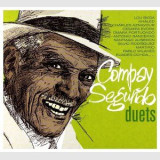
- A1: Saludo A Chango (Feat. Khaled)
- A2: Fidelidad (Feat. Silvio Rodríguez)
- A3: Lágrimas Negras (Feat. Cesária Evora)
- B1: Chan Chan (Feat. Eliades Ochoa)
- B2: Viejos Sones De Santiago (Feat. Dúo Evocación)
- B3: Virgen Del Pino (Feat. Santiago Auserón)
- B4: La Juma De Ayer (Feat. Pío Leyva)
- C1: Frutas Del Caney (Feat. Felix Valoy)
- C2: Morir De Amor (Feat. Charles Aznavour)
- C3: Linda Graciela (Feat. Basilio Repilado)
- C4: Macusa (Feat. Pablo Milanés)
- D1: La Pluma (Feat. Omara Portuondo)
- D2: Juliancito Tu Novia Te Botó (Feat. Martirio, Raimundo
- Amador)
- D3: Beautiful Maria Of My Soul (Bella Maria De Mi Alma)
- D4: Tente En Pie (Feat. Los Compadres)
Compay Segundo war der Godfather der kubanischen Musik. Im Alter von 88 Jahren erlangte er internationalen Erfolg und war der größte Künstler des Buena Vista Social Club-Phänomens.
Compays Musik ist in der Lage, einem ein Lächeln ins Gesicht zu zaubern, und einige seiner Lieder ("Chan Chan", "Sarandonga", "Yo vengo aquí") gehören zu den Klassikern des Son Cubano, des Genres, das er in der ganzen Welt verbreitet hat. Auch einige seiner Coverversionen klassischer kubanischer Lieder wie "Guantanamera", "La Negra Tomasa" oder "Lágrimas negras" gehören zu den besten der lateinamerikanischen Musik. Wir feiern sein Werk mit Vinyl-Veröffentlichungen im Jahr 2023, "Duets", "Las flores de la vida" und "Calle salud"
The visionary French musician stays true, in this third compendium too, to his path of planetary asceticism. A new treasure chest of secrets reveals to us the same spirituality of total experimentation, by balancing the universe and the inner soul. In Taste The Fullness Of Life Ariel builds his symphonic pillars toward the cosmos, eternal architectures that always smell of Indian fragrances. The music always communicates a state of full grace, spreading balms of bliss. An unprecedented whispered narrating voice, evident especially in Spiritual Chanson D'Esprit, is embellished with textures of harmonic bells, tropical flutes, spacey harmoniums and drones of mystical light. In the recordings of Going Inward, also made on the occasion of a Tantric workshop, Kalma oscillates between tribal electronic dances, metalic almost industrial rhythms, but then always falls back in a comfort zone made of desert carpets of synths and baths of sound (gong/bells). Harmonica Galactica crowns interestellar dreams with unscrupulous drum-machine gears and pulsing saxes, superb use of VCS3 with arabesque and Schulzian overtones, and suave touches of fingerpicking guitar with freak vibes typical of psych-folk.
Repress!
In the mid-1970s, a force of nature swept across the continental United States, cutting across all strata of race and class, rooting in our minds, our homes, our culture. It wasn’t The Exorcist, Goodbye Yellow Brick Road, or even bell-bottoms, but instead a book called The Secret Life of Plants. The work of occultist/former OSS agent Peter Tompkins and former CIA agent/dowsing enthusiast Christopher Bird, the books shot up the bestseller charts and spread like kudzu across the landscape, becoming a phenomenon. Seemingly overnight, the indoor plant business was in full bloom and photosynthetic eukaryotes of every genus were hanging off walls, lording over bookshelves, and basking on sunny window ledges. The science behind Secret Life was specious: plants can hear our prayers, they’re lie detectors, they’re telepathic, able to predict natural disasters and receive signals from distant galaxies. But that didn’t stop millions from buying and nurturing their new plants.
Perhaps the craziest claim of the book was that plants also dug music. And whether you purchased a snake plant, asparagus fern, peace lily, or what have you from Mother Earth on Melrose Avenue in Los Angeles (or bought a Simmons mattress from Sears), you also took home Plantasia, an album recorded especially for them. Subtitled “warm earth music for plants…and the people that love them,” it was full of bucolic, charming, stoner-friendly, decidedly unscientific tunes enacted on the new-fangled device called the Moog. Plants date back from the dawn of time, but apparently they loved the Moog, never mind that the synthesizer had been on the market for just a few years. Most of all, the plants loved the ditties made by composer Mort Garson.
Few characters in early electronic music can be both fearless pioneers and cheesy trend-chasers, but Garson embraced both extremes, and has been unheralded as a result. When one writer rhetorically asked: “How was Garson’s music so ubiquitous while the man remained so under the radar?” the answer was simple. Well before Brian Eno did it, Garson was making discreet music, both the man and his music as inconspicuous as a Chlorophytumcomosum. Julliard-educated and active as a session player in the post-war era, Garson wrote lounge hits, scored plush arrangements for Doris Day, and garlanded weeping countrypolitan strings around Glen Campbell’s “By the Time I Get to Phoenix.” He could render the Beatles and Simon & Garfunkel alike into easy listening and also dreamed up his own ditties. “An idear” as Garson himself would drawl it out. “I live with it, I walk it, I sing it.”
But as his daughter Day Darmet recalls: “When my dad found the synthesizer, he realized he didn’t want to do pop music anymore.” Garson encountered Robert Moog and his new device at the Audio Engineering Society’s West Coast convention in 1967 and immediately began tinkering with the device. With the Moog, those idears could be transformed. “He constantly had a song he was humming,” Darmet says. “At the table he was constantly tapping.” Which is to say that Mort pulled his melodies out of thin air, just like any household plant would.
The Plantae kingdom grew to its height by 1976, from DC Comics’ mossy superhero Swamp Thing to Stevie Wonder’s own herbal meditation, Journey Through the Secret Life of Plants. Nefarious manifestations of human-plant interaction also abounded, be it the grotesque pods in Invasion of the Body Snatchers or the pothead paranoia of the US Government spraying Mexican marijuana fields with the herbicide paraquat (which led to the rise in homegrown pot by the 1980s). And then there’s the warm, leafy embrace of Plantasia itself.
“My mom had a lot of plants,” Darmet says. “She didn’t believe in organized religion, she believed the earth was the best thing in the whole world. Whatever created us was incredible.” And she also knew when her husband had a good song, shouting from another room when she heard him humming a good idear. Novel as it might seem, Plantasia is simply full of good tunes.
Garson may have given the album away to new plant and bed owners, but a decade later a new generation could hear his music in another surreptitious way. Millions of kids bought The Legend of Zelda for their Nintendo Entertainment System back in 1986 and one distinct 8-bit tune bears more than a passing resemblance to album highlight “Concerto for Philodendron and Pothos.” Garson was never properly credited for it, but he nevertheless subliminally slipped into a new generations’ head, helping kids and plants alike grow.
Hearing Plantasia in the 21st century, it seems less an ode to our photosynthesizing friends by Garson and more an homage to his wife, the one with the green thumb that made everything flower around him. “My dad would be totally pleased to know that people are really interested in this music that had no popularity at the time,” Darmet says of Plantasia’snew renaissance. “He would be fascinated by the fact that people are finally understanding and appreciating this part of his musical career that he got no admiration for back then.” Garson seems to be everywhere again, even if he’s not really noticed, just like a houseplant.
Artist and multi-instrumentalist Flaer looks to the landscape to explore pastoral melancholy on debut release, Preludes.
Ensconced in his family home in rural Leicestershire in the early months of 2020, painter and musician Realf Heygate (b. 1994) picked up his childhood cello for the first time in several years and began to play. Setting himself parameters to only record onto 4-track tape with acoustic instruments – cello, piano and acoustic guitar – he assembled a suite of instrumental compositions that form the basis of Preludes, his debut album as Flaer and the inaugural release on Odda Recordings.
Channelling the tension and unease between the pastoral idyll of the English countryside and the darkness which lurks beneath the surface, the mini-album draws inspiration from the analogue aesthetic of 1970s folk horror films, weaving field recordings of birdsong, church bells and the natural environment into chimerical melodies that reflect on Heygate’s childhood experiences of rural England.
“It was really important not to isolate the sound from its environment,” he explains, describing the compositional and recording process as “site-specific”. Developed over a series of intuitive musical enquiries, the mini-album’s uncanny quality emerges from combining raw demo takes with overdubs of almost orchestral grandeur.
Heygate points to the final track as indicative of the work as a whole: “‘Follow’ really is the mantra for the release and embodies the practical approach I was taking to music making: not to force the music but see where it takes you.”
As a painter, Heygate’s practice takes artefacts through sequences of reproduction that embrace the fluctuating materiality of the copy. Since obtaining a degree in Fine Art from Central Saint Martins in 2017, he has exhibited solo at Peter von Kant and Springseason galleries in London, and has participated in group shows at Saatchi Gallery, Cob Gallery and Senesi Contemporanea.
Describing his artistic practice as one of self-erasure, music instead provides Heygate with a more personal and autobiographical outlet. Where the two worlds combine is on Preludes’ striking artwork, which features paintings of 13th century stone carvings from the font of the church in the town where he grew up.
Speaking to a time where people were connected to the land in a more profound way, each symbol is assigned to a track on the album, which Heygate likens to giving them a title.
“To add that one juxtaposition might open a whole new interpretation or language that might be hard to find otherwise,” he explains.“Over time it might reveal itself to you, which is why I'm excited about it being released. To throw them out there and see what comes of it.”
- A1: Puccini Tosca “Vissi D’arte”
- A2: Bizet Carmen Habanera. “L'amour Est Un Oiseau Rebelle”
- A3: Puccini Madama Butterfly “Un Bel Dì Vedremo”
- A4: Verdi Rigoletto “Gualtier Maldè!” – “Caro Nome”
- A5: Puccini Turandot “Signore, Ascolta!” (Bonus Track Only On Picture Disc Lp)
- A6: Catalani La Wally “Ebben? Ne Andrò Lontana”
- B1: Bellini Tosca “Casta Diva”
- B2: Verdi La Traviata“Ah, Fors'è Lui Che I'anima” –“Follie! Follie! Delirio Vano È Questo!”
- B3: Puccini La Bohème “Sì. Mi Chiamano Mimì”
- B4: Donizetti Anna Bolena “Coppia Iniqua, L'estrema Vendetta”
- B5: Puccini Gianni Schicchi “O Mio Babbino Caro”
- B6: Maria Callas Soprano
Maria Callas is credited with changing the history of opera. Known as La Divina, she continues to fascinate as a supreme artist, but also as a woman and an icon of style. Her interpretations were as compelling for their dramatic truth as for their musical integrity. Her voice, with its extraordinary range, was as distinctive as her infallible sense for a phrase. A magnetic presence, she brought operatic heroines to vivid life, magically shaping and colouring her tone, and making insightful use of the text of the libretto.
- Rare and Unreleased New Orleans Funk 1968
Tuff City’s Funky Delicacies imprint has issued the 7th volume in its New Orleans Funk series. This edition has a side of vocal tracks and a side of instrumental ones. These tracks have been hard to find and many were CD only bonus tracks on earlier editions of the series now out of print.
Noted guitarist Little Buck Sinegal opens the record with “Little Boy Blue.” This was first issued in 1969 on the Seven B label. Little Buck (as he was credited on the original record) passed in 2019 after a lengthy career dating back to the late 50’s as a session man for Slim Harpo & Lazy Lester. He also was a touring member of various Zydeco legends like Clifton Chenier, Rockin’ Dopsie and Buckwheat Zydeco. Drummer Chuck Conway leads the next track with the Amars, “Get On Up.” Cover feature Deacon John Moore still lives today. “You Don’t Know (How To Turn Me On)” was a 1970 B-side on the Bell label. Brotherhood issued “Suckey Suckey Feeling” as a 2-sided single in 1974. At some point the track was renamed “Sooky Feeling” and we have Part 2 here. Singer and Pianist Tommy Ridgley’s track “Fly In My Pie” was originally issued on our sister imprint Soul-Tay-Shus on The Best of International City compilation as well as a 7” on that imprint in 1968. Lonnie Jones recorded several singles for Jenmark in the early ‘70’s including the B-side “You Got To Do Better” originally released in 1972. Sam Henry of Sam and the Soul Machine closes out the side with “Loving You.” This track was originally a CD-only bonus track on our Po’k Bones and Rice compilation of that group we issued on Funky Delicacies in 2002.
Kicking off the instrumental second side is a recently located master by Anthony Butler and the Invaders covering the Otis Redding classic “Hard To Handle.” A bit of organ Funk here. Larry Jones jams out the “Funky Jaws.” The exact year is unknown, but the J.B.’s label that issued the original record put their releases out primarily from 1974-1976. Tyrone Chestnut’s B-side of 1969’s “The Bump” is called “Bumping.” Hook and Sling piano legend Eddie Bo has two appearances. The first is the second part of the “Getting To The Middle” single that came out on Bo-Sound in 1970. Louisiana Purchase have “Accept What You Expect” before they moved from New Orleans to Detroit. The Scram Band that backed vocalist Mary Jane Hooper on her “Don’t Change Nothin’” single are here in an instrumental version of that song. The album closes with a 5-minute combined version of Eddie Bo’s “If It’s Good To You (It’s Good For You)” single, issued in 1969 on Scram.
Overall, this album contains 14 previously hard-to-find tracks that would take hundreds if not thousands of dollars to track down the original singles on the used market. These tracks have been recently remastered, including tracks that were issued as CD bonus tracks on earlier volumes.
Death metal is the great undead of subgenres: rising, again and again, to take revenge on the living with maximum violence. Servants of the zombie code and masters of old school brutality, Germany’s ENDSEEKER have made their intent to kill again more than apparent over the last nine years. Formed in Hamburg in 2014, the quintet have swiftly built a reputation as one of European death metal’s most dynamic wrecking crews. From the aspirational evisceration of first full-length Flesh Hammer Prophecy, to Metal Blade debut The Harvest in 2019, and the widely acclaimed Mount Carcass two years later, Endseeker have cooked up such a formidable formula that their rise to glory seems almost inevitable. But like everyone else, they were stopped in their tracks by the Covid pandemic and its aftermath. As that global horrorshow fades in the rear-view, Endseeker are poised to return with their most crushing and charismatic album to date: Global Worming Death metal is a serious business and Global Worming is Endseeker’s most focused and sophisticated offering to date. Nonetheless, there is always room in the underground sewers for a brain-eating monster or two, and fans of zombie-centric death metal will be more than satisfied with the new album’s brilliant, bloody contents. Consumed in its belligerent entirety, Global Worming soon emits the acrid stench of a future classic. Endseeker have stayed true to their deathly roots, while also writing some of the most imaginative songs in their history. Supremely catchy but as brutal and ugly as the arcane gods demand, Global Worming promises to burrow under the world’s skin with maximum force.