Today, Anjimile Chithambo, better known as Anjimile, announces his new album, The King, out September 8th, his first full-length since 2020’s breakthrough Giver Taker. To herald the announcement, he shares lead single, ‘The King’, accompanied by a visualiser by Daniela Yohannes, whose striking painting takes centre stage on the album cover.
Highlighting the artistic shift from Giver Taker to now, ‘The King’ opens with a lofty, melodic choir, an intro that belies the song’s motives. Suddenly, sinister arpeggios interrupt the reverie, and the voices grow darkly serious. Deeply steeped in the confusion, grief, and rage of being Black in America, ‘The King’ pushes back against the tired adage, “what doesn’t kill you makes you stronger,” hissing, “What don ’t kill you almost killed you// What don’t fill you//pains you// drains you.”
“If Giver Taker was an album of prayers, The King is an album of curses.” In his second album, Anjimile continues exploring what it means to be a Black trans person in America. The brutally honest reflection of 2020’s deadly summer is less reminiscent of the pink cloud of early sobriety and more rooted in the reality of seeing brutality with clear eyes. Drawing from influences ranging from religion, Phillip Glass, and lived experiences, the album is a grand step forward for Anjimile. Nearly every sound you hear on The King comes from two instruments: an acoustic guitar and Anjimile’s own voice. Other than a few beautiful contributions from Justine
Bowe, Brad Allen Williams, Sam Gendel, and James Krivchenia (Big Thief), the album is the result of a year in LA working intimately with Grammy and Juno winner Shawn Everett.
Suche:big break
The Madlib Invazion Music Library Series Entry #3: Drummer and Producer J-Zone offers his take on The Ultimate Beats, Breaks and Funk. This is the next up in a series of music library releases, with future volumes produced by DJ Muggs, Karriem Riggins and more. The Madlib Invazion Music Library Series was created by Madlib and Egon to give their creative friends a chance to stretch out and indulge in whatever type of music they wanted. This music was created for easy, one-stop clearance in film and television synchronization usage and for sampling. You can also enjoy these albums in the way that many do with the best of the best vintage library catalogs – listen, ponder, repeat.
Today, Anjimile Chithambo, better known as Anjimile, announces his new album, The King, out September 8th, his first full-length since 2020’s breakthrough Giver Taker. To herald the announcement, he shares lead single, ‘The King’, accompanied by a visualiser by Daniela Yohannes, whose striking painting takes centre stage on the album cover.
Highlighting the artistic shift from Giver Taker to now, ‘The King’ opens with a lofty, melodic choir, an intro that belies the song’s motives. Suddenly, sinister arpeggios interrupt the reverie, and the voices grow darkly serious. Deeply steeped in the confusion, grief, and rage of being Black in America, ‘The King’ pushes back against the tired adage, “what doesn’t kill you makes you stronger,” hissing, “What don ’t kill you almost killed you// What don’t fill you//pains you// drains you.”
“If Giver Taker was an album of prayers, The King is an album of curses.” In his second album, Anjimile continues exploring what it means to be a Black trans person in America. The brutally honest reflection of 2020’s deadly summer is less reminiscent of the pink cloud of early sobriety and more rooted in the reality of seeing brutality with clear eyes. Drawing from influences ranging from religion, Phillip Glass, and lived experiences, the album is a grand step forward for Anjimile. Nearly every sound you hear on The King comes from two instruments: an acoustic guitar and Anjimile’s own voice. Other than a few beautiful contributions from Justine
Bowe, Brad Allen Williams, Sam Gendel, and James Krivchenia (Big Thief), the album is the result of a year in LA working intimately with Grammy and Juno winner Shawn Everett.
After releasing a breakout bedroom pop EP Catflap and a dream-jangle LP Telltale Signs that brought international embrace, Sobs now assemble a front- to- back indiepop behemoth - Air Guitar - after a much anticipated three-year wait.
A thirty-minute trip for the post-Internet consumer, Air Guitar calibrates inventive pop hooks for the indie rock lover, instantly accessible yet intricately arranged.
The album draws a line through the history of pop stylistics from 80s new wave ("Last Resort") and 90s power-pop ("Burn Book") to 00s sk8er punk and radio pop ("Air Guitar"). Further informed by the cosmopolitan, culturally astute ethos of PC Music - Sobs connects the uptempo of Shibuya's Advantage Lucy ("Lucked Out"), heart-on-sleeve indie rock of Bettie Serveert and Big Star ("World Implode"), with the eclecticism of New York's Darla Records ("Friday Night") to define the pulse of indiepop then and now.
- 1: Hello
- 2: A Love From Outer Space
- 3: Crack Up
- 4: Timewind
- 5: What's All This Then?
- 6: Snow Joke
- 7: Off Into Space
- 8: And I Say
- 9: Yeti
- 10: Conundrum
- 11: Honeysuckleswallow
- 12: Long Body
- 13: In A Circle
- 14: Fast Ka
- 15: Miles Apart
- 16: Pop
- 17: Mars
- 18: Spook
- 19: Sugarwings
- 20: Back Home
- 21: Down
- 22: Supervixens
- 23: Insect Love
- 24: Sorry
- 25: Catch My Drift
- 26: Challenge
A.R. Kive collates the three most astonishing works from that most miraculous of duos - A.R. Kane - comprising the ‘Up Home’ EP from 1988 that signified the band’s dawning realisation of their own powers and possibilities, their legendary debut LP ‘sixty nine’ (1988) and its kaleidoscopic, prophetic double-LP follow up ‘i’ (1989).
In founder-member Rudy Tambala’s new remastering, the music on these pivotal transmissions from the birth of dream pop, have been reinvigorated and re-infused with a new power, a new depth and intimacy, a new height and immensity. Vivid, timeless and yet always timely whenever they’re recalled, these records still force any listener to realise that despite the habits of retrospective myth-making and the
safe neutering effects of ‘genre’, thirty years have in no way dimmed how resistant and dissident to critical habits of categorisation A.R. Kane always were. Never quite ‘avant-pop’ or ‘shoegaze’ or ‘post-rock’ or any of those sobriquets designed to file and categorise, A.R. Kive is a reminder that those genres had to be coined, had to be invented precisely to contain the astonishing sound of A.R. Kane, because
previous formulations couldn’t come close to their sui generis sound and suggestiveness. This is music that pointed towards futures which a whole generation of artists and sonic explorers would map out. Now beautifully repackaged, remastered and fleshed out with extensive sleeve notes and accompanying materials, ‘A.R. Kive’ reveals that 35 years on it’s still a struggle to defuse the revolutionary and inspirational possibility of A.R. Kane’s music.
A.R. Kane were formed in 1986 by Rudy Tambala and Alex Ayuli, two second-generation immigrants who grew up together in Stratford, East London. From the off the pair were outsiders in the culturally mixed (cockney/Irish/West Indian/Asian) milieu of the East End, with Alex and Rudy’s folks first generation immigrants from Nigeria and Malawi, respectively. The two of them quickly developed and fostered an innate and near-telepathic mutual understanding forged in musical, literary and artistic exploration. Like a lot of second-generation immigrants, they were ferocious autodidacts in all kinds of areas, especially around music and literature. Diving deep into the music of afro-futurist luminaries such as Sun Ra, Miles Davis, Lee Perry and
Hendrix, as well as devouring the explorations of lysergic noise and feedback from contemporaries like Sonic Youth and Butthole Surfers, they also thoroughly immersed themselves in the alternate literary realities of sci-fi and ancient history (the fascination with the arcane that gave the band their name), all to feed their voracious cultural thirsts and intellectual curiosity.
It was seeing the Cocteau Twins performing on Channel 4 show the Tube that spurred A.R. Kane into being - “They had no drummer. They used tapes and technology and Liz Fraser looked completely otherworldly with those big eyes. And the noise coming out of Robin’s guitar! That was the ‘Fuck! We could do that! We could express ourselves like that!’ moment”, recalls Tambala - and through a mix of
confidence, chutzpah, ad hoc almost-mythical live shows and sheer innocent will the duo debuted with the astonishing ‘When You’re Sad’ single for One Little Indian in 1986. Immediately dubbed a ‘black Jesus & Mary Chain’ by a press unsure of WHERE to put a black band clearly immersed in feedback and noise, what was immediately apparent for listeners was just how much more was going on here - a
tapping of dub’s stealth and guile, a resonant umbilicus back to fusion and jazz, the music less a conjuration of past highs than a re-summoning of lost spirits.
The run of singles and EPs that followed picked up increasingly rapt reviews in the press, but it was the ‘Up Home EP’ released in 1988 on their new home, Rough Trade that really suggested something immense was about to break. Simon Reynolds noted the EP was: Their most concentrated slab of iridescent awesomeness and a true pinnacle of an era that abounded with astounding landmarks of guitar-reinvention, A.R. Kane at their most elixir-like.
If anything, the remastered ‘Up Home’ that forms the first part of ‘A.R. Kive’ is even more dazzling, even more startling than it was when it first emerged, and listening now you again wonder not just about how many bands christened ‘shoegaze’ tried to emulate it, but how all of them fell so far short of its lambent, pellucid wonder. This remains intrinsically experimental music but with none of the frowning orthodoxy those words imply. A.R. Kane, thanks to that second generation auto-didacticism were always supremely aware about the interstices of music and magic, but at the same time gloriously free in the way they explored that connection within their own sound, fascinated always with the creation of ‘perfect mistakes’ and the possibilities inherent in informed play.
‘sixty nine’ the group’s debut LP that emerged in 1988 had
critics and listeners struggling to fit language around A.R. Kane’s sound. As a title it was telling - the year of ‘Bitches Brew’, the year of ‘In A Silent Way’, the erotic möbius between two lovers - and as originally coined by the band themselves, ‘dream pop’ (before it became a free-floating signifier of vague import) was entirely apposite for the music A.R. Kane were making. Crafted in a dark small basement studio in which Tambala recalls the duo had “complete freedom - We wanted to go as far out as we could, and in doing so we discovered the point where it stops being music”. There was an irresistibly dreamy, somnambulant, sensual and almost surreal flow to ‘sixty nine’s sound, but also real darkness/dankness, the ruptures of the primordial and the reverberations of the subconscious, within the grooves of remarkable songs like ‘Dizzy’ and ‘Crazy Blue’. Alex’s plangent vocals floated and surged amidst exquisite peals of refracted feedback but crucially there was BASS here, lugubrious and funky and full of dread, sonic pleasure and sonic disturbance crushed together to make music with a center so deep it felt subcutaneous, music constructed from both the accidental and the deliberate, generous enough to dance with both serendipity and chaos. ‘sixty nine’ remains - especially in this remastered iteration - ravishing, revolutionary.
The final part of this ‘A.R. Kive’ contains 1989’s astonishing double-LP ‘i’ which followed up on ‘sixty nine’s promise and saw the duo fully unleash their experimental pop sensibilities over 26 tracks, plunging the A.R. Kane sound into a dazzlingly kaleidoscopic vision of pop experiment and play. Suffused with new digital technologies and combining searingly sweet and danceable pop with perhaps the duo’s strangest and boundary-pushing compositions, the album did exactly what a great double-set should do - indulge the artists sprawling pursuit of their own imaginations but always with a concision and an ear for those moments where pop both transcends and toys with the listeners expectations. Jason Ankeny has noted that “In retrospect, ‘i’ now seems like a crystal ball prophesying virtually every major musical development of the 1990s; from the shimmering techno of ‘A Love from Outer Space’ to the liquid dub of ‘What’s All This Then?’, from the alien drone-pop of ‘Conundrum’ to the sinister shoegazer miasma of ‘Supervixens’ — it’s all here, an underground road map for countless bands to follow.” Perhaps the most overwhelmingly all-encompassing transmission from A.R. Kane, ‘i’ bookended a three year period in which the duo had made some of the most prophetic and revelatory music of the entire decade.
After ‘i’ the duo’s output became more sporadic with Tambala and Ayuli moving in different directions both geographically and musically, with only 1994’s ‘New Clear Child’ a crystalline re-fraction of future and past echoes of jazz, folk and soul, before the duo went their separate ways. Since then, A.R. Kane’s music has endured, not thanks to the usual sepia’d false memories that seem to maintain interest in so much of the musical past, but because those who hear A.R. Kane music and are changed irrevocably, have to share that universe which A.R. Kane opened up, with anyone else who will listen. Far more than other lauded documents of the late 80s it still sounds astonishingly fresh, astonishingly livid and vivid and necessary and NOW.
After 25 years of living his dream as one of hip hop’s most respected producers, Hi-Tek is digging back into his roots with a brand new trio of instrumental vinyl LPs in 2023. “Beatbox Studios (1995 MPC 60II)” is the first of the series, each featuring a selection of restored and remastered beats, carefully chosen from an archive of DAT tapes. These LPs manage to both provide a window into Tek’s development and to shine light on the work of an already enormously-talented musician whose beats would’ve sounded right at home on classic releases from the mid-1990s.
Having learned to make beats off of borrowed equipment as a teenager, the aspiring DJ/producer born as Tony Cottrell achieved a break of sorts when he was hired in 1995 to manage one of the rooms at Beatbox Studios, a sprawling complex in the Clifton neighborhood in Cincinnati. It became the go-to-spot in town for emerging talent, giving him a chance to learn about the intricacies of recording and to sharpen his communication skills with artists to maximize their performance The gig also gave Tek plenty of down time to practice on and to master the studio’s Akai MPC 60II while making his own music. It was around this time he began to collaborate with the top rap talent in Cincinnati, and he started regularly visiting New York City to plant seeds for new relationships in the industry.
Though his work eventually evolved far beyond the styles present on “Beatbox Studios,” here you’ll find many signature elements of that era’s contemporary New York sound: some snappy drums reminiscent of A Tribe Called Quest or Easy Mo Bee, plenty of horn stabs a la Pete Rock or Lord Finesse, and the kind of dark pianos and filtered bass lines that producers like the Beatminerz were steadily employing. These were his biggest influences at the time, and that was the sound of 1995. As it turns out, that classic sound remains in demand today, and while Hi-Tek was not a well-known name in hip hop circles at that time, the calibre of beats on “Beatbox Studios” prove that he was a talent to be reckoned with, even then.
- A1: I Told Them Feat Gza
- A2: Normal
- A3: On Form
- A4: Sittin On Top Of The World By Burna Boy & 21 Savage
- A5: Tested, Approved & Trusted
- A6: Virgil
- A7: Cheat On Me Feat Dave
- B1: Big 7
- B2: Dey Play
- B3: City Boys
- B4: Jewels Feat Rza
- B5: If I'm Lying
- B6: Thanks Feat J. Cole
- B7: Talibans Ii By Burna Boy & Byron Messia
On the 25th August, Burna Boy will release his brand-new album ‘I Told Them…’. It will be available to stream everywhere as well as on CD & Vinyl. The Pre-order will go live alongside the album announce on the 28th July. ‘I Told Them…’ features Burna’s newest hit singles ‘Sittin’ On Top Of The World (feat. 21 Savage)’, ‘Talibans II’ & ‘Big 7’ as well as a whole host of album features.
Burna Boy was born Damini Ogulu in Port Harcourt, Rivers State, Nigeria, in 1991 and began making music at just ten years old. As a teenager he honed his craft on Nigeria’s southern coast, delving into dancehall, reggae and Afrobeat’s. In the early 2010s Burna Boy emerged as one of Nigeria’s fastest-rising stars, combining influences from his Nigerian heritage with hook-filled pop stylings to create unforgettable tracks. His 2012 single ‘Like to Party’ broke into the global mainstream and paved the way for his full-length debut L.I.F.E, a year later.
Over the next five years, Burna Boy released two more albums and collaborated with a long list of high-profile artists including J Hus, Skales, Fall Out Boy and Lily Allen. African Giant was released in 2019 followed by his fifth album Twice as Tall in 2020 (which featured collabs with Chris Martin and Youssou N'Dour), both charted in several countries across the globe andgarnered worldwide acclamation, with the latter winning a Grammy Award for ‘Best Global Music Album’. Breaking cultural boundaries, he became the first Nigerian to headline a show at New York’s Madison Square Garden, he released his sixth album, Love, Damini, last year (featuring collabs with the likes of Ed Sheeran and Khalid). It deservedly became the highest-charting Nigerian album in history and currently holds the record for the only African artist to earn a no. 1 on iTunes in 16 countries worldwide.
Madben's superb Troisième Sens album is remixed again, as new mixes from Josh Wink and AVNU join previous offerings from Alinka and Avision on this standout EP.
Kicking off this fantastic package is Ukraine-born but Berlin-based Alinka. She is now right at the cutting edge of the scene after big releases on the likes of Rekids and Live at Robert Johnson. She is a regular at iconic spots like Berghain/Panorama Bar, Circoloco and Smart Bar and flips 'Addicted' into a heavy house cut with thumping drums and lithe baselines. Acid sprays about over warmer synths to make for a real peak-time weapon. Next up is Josh Wink, a legendary electronic artist who heads up the Ovum label and has consistently crafted some of house and techno's biggest tracks. He flips '1AM At A Rave' into seven-plus minutes of scintillating electronic deepness with trippy leads and real synth intensity building to an explosive peak.
NYC DJ and producer Avision has released EPs such as ‘Innocence’ on this label while also getting support for his new school techno from Adam Beyer and Chris Liebing. His remix of 'Circuit Breaker' is a chunky and textural affair with seriously weighty drums. Stark synths rise up through the mix next to bubbling acid to make for a heart-of-the-dance-floor classic. Scottish artist AVNU is another label regular who dropped his ‘Tough To Love But Worth The Effort’ album here last year. He flips '1AM At A Rave' into a dark and atmospheric cut with flashes of strobe-lit synth and zippy leads that rip up the crunchy electro-tinged drums.
This is a vital package of varied reworks that bring plenty of new direction to the superb source material.
After his woozy dark disco EP debut on NEIN records, Clouzer returns with LMNTL, a fine collection boasting 4 massive tracks tailored for the “big room” stage. Listening to Clouzer’s cosmic textures, layered abstractions and futuristic soundscapes on LMNTL feels like connecting to an extraterrestrial world.
The Berlin-based musician blends electro, broken beats and dirty bass lines, creating immersive and hypnotic environments for people to dwell in. The EP also features a beautiful remix by Sestrica, one of the most vibrant and unique female live acts on the Breakbeat scene.
black LP[27,69 €]
King Krule, Interpol, Alex G, Orion Sun, Snail Mail, Toro Y Moi, Unknown Mortal Orchestra. “Transparent Yellow” Indie Store Colour. (LPC1) available while stocks last. For Lutalo, creating music is an act of hope in and of itself. Throughout their meticulously crafted folk, rock, and soul, on which they sing and play all the instruments, the Twin Cities-raised, Vermont-based musician embeds golden lines of poetry that inspire curiosity about the world and empathy for everyone searching for a way through it. After releasing their 2022 debut EP, Once Now, Then Again, Lutalo emerged as a rising talent in the indie world, catching the attention of Fleet Foxes’ Robin Pecknold and Big Thief’s Adrianne Lenker, who invited the young musician on tour. Following a vinyl release with that breakthrough project, they are releasing its companion EP, AGAIN, on August 25 via Winspear. On the ambitious AGAIN, a collection of kinetic indie rock tracks, Lutalo makes bold critiques of systemic oppression, capitalism, and the digital attention economy. Though these topics are heady, their writing always sits at an accessible place of personal introspection. Like on the arresting single “Push Back Baby,” whose fuzzy electric guitar lines twist and unfurl in intricate patterns, Lutalo paints a complex portrait of our current reality that’s “rooted in the greed or narcissism of capitalists,” they explain. “I’m analyzing those systems and patterns, and also asking, ‘Can we continue to not perpetuate this?’ Because it’s hurt a lot of people historically. I’m just asking people to question it.” Through their music, but also through their lifestyle that’s alternative to America’s economic and political systems, Lutalo asks listeners to imagine new possibilities. “I want to help people question the way they’re living,” they say, “so we can create a better reality for us to exist in together.”
yellow LP[27,69 €]
King Krule, Interpol, Alex G, Orion Sun, Snail Mail, Toro Y Moi, Unknown Mortal Orchestra. “Transparent Yellow” Indie Store Colour. (LPC1) available while stocks last. For Lutalo, creating music is an act of hope in and of itself. Throughout their meticulously crafted folk, rock, and soul, on which they sing and play all the instruments, the Twin Cities-raised, Vermont-based musician embeds golden lines of poetry that inspire curiosity about the world and empathy for everyone searching for a way through it. After releasing their 2022 debut EP, Once Now, Then Again, Lutalo emerged as a rising talent in the indie world, catching the attention of Fleet Foxes’ Robin Pecknold and Big Thief’s Adrianne Lenker, who invited the young musician on tour. Following a vinyl release with that breakthrough project, they are releasing its companion EP, AGAIN, on August 25 via Winspear. On the ambitious AGAIN, a collection of kinetic indie rock tracks, Lutalo makes bold critiques of systemic oppression, capitalism, and the digital attention economy. Though these topics are heady, their writing always sits at an accessible place of personal introspection. Like on the arresting single “Push Back Baby,” whose fuzzy electric guitar lines twist and unfurl in intricate patterns, Lutalo paints a complex portrait of our current reality that’s “rooted in the greed or narcissism of capitalists,” they explain. “I’m analyzing those systems and patterns, and also asking, ‘Can we continue to not perpetuate this?’ Because it’s hurt a lot of people historically. I’m just asking people to question it.” Through their music, but also through their lifestyle that’s alternative to America’s economic and political systems, Lutalo asks listeners to imagine new possibilities. “I want to help people question the way they’re living,” they say, “so we can create a better reality for us to exist in together.”
- A1: I Mean You
- A2: Evidence
- A3: (When It's) Darkness On The Delta
- B1: Oska T
- B2: Played Twice
- B3: Four In One
- B4: Epistrophy
Thelonious Monk could walk from his flat to New York’s famous Philharmonic Hall on the corner of 64th Street and Broadway when he made his very first appearance there with his Big Band in December 1963. And the other musicians could get there on the underground: Phil Woods, Steve Lacy, Thad Jones – all of them were members of Monk’s closest circle of collaborators.
It is no wonder then that the well-known themes were highly agreeable and harmonious. "I Mean You", "Four In One" and "Epistrophy" resounded through the auditorium, the audience was thrilled, Thelonious laughed and danced and a short while later fans could listen to parts of the concert on a recording released by Columbia Records. In a break for a smoke, Monk sat himself down at the piano and played "Darkness On The Delta" – nocturnal atmosphere pure.
Does it bear the patina of times long past? Absolutely not! Thelonious Monk is as red-hot as he ever was.
Rare Jazz-Funk album from 1978 by Headhunters founder.
Featuring an all-star line-up including Herbie Hancock.
Originally released in 1978 on Tobisha EMI Japan.
First vinyl reissue outside of Japan released in collab w/Totown Records. Comes with double side insert.
Paul Jackson (born in Oakland, California in 1947) needs little introduction. Paul began playing bass at the age of nine and was considered by many of his teachers to be a musical prodigy. Jackson was known as a “Musician’s Musician” and shaped a sound that launched a new direction in contemporary music: the so-called ‘Pulse Playing’, a trademark sound of close-meshed funk grooves combined with sensational rhythms. With this innovative approach, he influenced entire generations of jazz and funk musicians to come. Paul’s compositions were sampled by big acts from the likes of Prince, TLC, Mobb Deep and NWA…just to name a few.
Paul Jackson was a founding member of the Headhunters under Herbie Hancock (THE group responsible for their ground-breaking fusion and jazz-funk compositions that took the world by storm in the 70’s). The solid union between Hancock and Jackson has been especially evident in the many international tours they have made together…not to mention that he participated on most of the Headhunters albums and Herbie’s solo albums.
Paul has also worked as a producer and as a studio/live musician alongside acts such as Santana, Sonny Rollins and The Pointer Sisters. He was a frequent guest performer at renowned international festivals such as the Montreux and Newport events. Jackson’s composing has not gone without recognition and was nominated for Grammy Awards in 1974, 1975 and 1976. Like other highly talented, creatively motivated engineers of music, Paul has expanded his career to other mediums such as playing on blockbuster movie soundtracks such as “Death wish” and “Dirty Harry”.
Paul Jackson also wrote five solo albums worth listening to – including the monster of an album that is known as “Black Octopus” which is considered to be a kind of lost Headhunters album.
His debut album “Black Octopus” saw the light of day in 1978 and is a total piece of art filled with abstract sticky funky grooves, floating electric piano playing, strong thumping bass lines, raw heavy drums and amazing vocal acrobatics (Jackson himself takes vocals in 3 out of 5 songs, and his soulful singing voice strikes an emotional chord that does not go unnoticed).
On “Black Octopus” you’ll also find some of the best all-star musicians from the likes of Alphonse Mouzon (Roy Ayers, Betty Davis, Azar Lawrence)…and last but not least fellow Headhunters Bennie Maupin and Herbie Hancock himself.
With “Black Octopus” Paul Jackson wrote the book on how a jazz-funk-fusion album should sound like. The fact that the album was only distributed in Japan at the time (Jackson resided in Tokyo since the late 70’s, where he passed away in 2021) continues to increase its reputation as an album that is VERY hard to find. This is a must-have gem…not only for fans of jazz, funk and rare grooves, but also for DJs and collectors around the globe.
Les Imprimés treat us to a tough as nails 7" pulling two stand out tracks from their forthcoming album in a classic Plug & Ballad pairing. The A side "Falling Away'' starts with a crushing drum break that Martens layers with lush piano runs, sitar, and guitar riffs. The lyrics almost contradict the tone of the track making it a bittersweet affair as he sings about love falling apart - "One day at a time girl you waste my life".On the B side "Still Here" Martens professes his resilience through life's twists and turns over a thundering track that puts a new spin on the B side ballad genre. Martens blends his poetry with his excellent usage of space making this yet another tune from Les Imprimés that is easy to love but hard to categorize.
A truly enigmatic character from the golden era of Jamaican roots music, Icho Candy is an artist that has, to me, always been shrouded in mystery. A devout rastafarian born with a gift for prophetic songwriting, Candy always writes in a way that is true to himself and his deep seated beliefs, regardless of the external pressures he endures as a veteran artist, an incredible feet for an independent artist with a career that spans fifty years.
First recording for the great Joe Gibbs and Jack Ruby in the late seventies, Icho’s big break in the industry came with the hit record “Captain Selassie”, a track that is widely considered to be one of the greatest rastafari anthems in dancehall. During this time Icho also recorded for labels such as Jah Life, Rockers International, Tesfa, Jah Shaka and many more. Like so many of the great artists in the eighties Icho recorded and toured in America for an extended period alongside Sugar Minott, Nicodemus, Nitty Gritty, King Kong before returning to Jamaica to record two amazing albums for the late Jah Shaka.
The A side of this latest seven inch gives us the classic writing style of Icho Candy. Pairing his lyrical depth with an early 70’s Phil Pratt style production. An eerie horns line meets the clean sharp, older school backing vocals provided by The Mighty Viceroys to create something magical, the type of record we thought we may have already heard on some scratchy 45 deep in a soundmans crate.
Yakka once again returns to the label on B side duties, providing another Tubby inspired voyage into dusty fx units and quick draw fades. The bassline increases, the vocal decreases but the vibe never ceases.
Welcome home Icho Candy
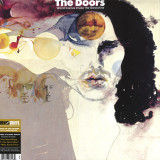
- A1: Break On Through
- A2: Strange Days
- A3: Shaman's Blues
- A4: Love Street
- A5: Peace Frog/Blue Sunday
- A6: The Wasp (Texas Radio & The Big Beat) (Texas Radio & The Big Beat)
- A7: End Of The Night
- B1: Love Her Madly
- B2: Spanish Caravan
- B3: Ship Of Fools
- B4: The Spy
- B5: The End
- C1: Take It As It Comes
- C2: Running Blue
- C3: La Woman
- C4: Five To One
- C5: Who Scared You
- C6: (You Need Meat) Don't Go No Further (You Need Meat)
- D1: Rdiers On The Storm
- D2: Maggie Mcgill
- D3: Horse Latitudes
- D4: When The Music's Over
Attarazat Addahabia & Faradjallah's album came to us as quite a mystery. Our friends from Radio Martiko got access to the studio archive of the Boussiphone label and a reel labeled “Faradjallah” was among the items they had found there. After listening to the selection of reels they borrowed, Radio Martiko felt it was not a fit for their label and helped us licensing it from Mr. Boussiphone instead. We knew nothing about the band. We just had the reel with the music but very little information. What we knew was that the music was incredible and very unique. Gnawa sounds were combined with funky electronic guitars, very dense layers of percussions and female backing vocals more reminiscent of musical styles further south than Morocco. We started asking around whether anyone knew the band with no immediate success until we asked Tony Day, a musician from Morocco who helped us during our search for Fadoul’s family. His sharp memory came through once again, remembering all the names of the Attarazat Addahabia band members and even how to contact the bands singer and leader Abdelakabir Faradjallah. After visiting him at his home in Casablanca with our Moroccan colleague Sabrina multiple times, he shared his personal story. His father arrived in Casablanca from Aqqa at the age of six and his mother came from Essaouira. Abdelakabir was born in the neighbourhood of Benjdia in 1942. Abdelakabir Faradjallah studied fine arts in Casablanca, graduating in 1962. He also played soccer in the second team of "Jeunesse Societe One". His brother-in-law Ibrahim Sadr worked for one of the biggest football teams of the time in Morocco called "Moroco Sportive Union", which allowed him to travel to France occasionally. While Ibrahim was never part of the band he brought along a few instruments from trips.
Yet the majority of the instruments they could not afford to buy were build by Faradjallah and Abderrazak, Faradjallah's brother who passed away early. For instance they had built a Spanish guitar and a drum made of wood barrel and sheepskin by themselves.During the 1950s Faradjallah was booked as a singer for surprise parties with friends. He started to write his first songs including "L’gnawi" in 1967 and wanted to make people discover Gnawa culture, or maybe rather his take on the culture to be more exact. Faradjallah recalls his first interaction with the genre in the streets of the Dern neighbourhood, where he used to go to elementary school. Gnawa is one of the essential musical genres of Morocco. It combines ritual poetry with traditional dances and music linked with a spiritual foundation. Musically a lot of influences originated from West Africa as well as Sudan. Gnawa is usually played by a selection of specific instruments such as the qaraqab (large iron castanets centrally associated with the music), the hajhouj (a three string lute), guembri loudaâ (a three stringed bass instrument) and the tbel (large drums). People would put shells on their clothes and instruments and use incense at their parties. "Sidi darbo lalla - lala derbo khadem..." came from Gnawa verses Faradjallah used to sing when he was 14. The lyrics tackle a global (im)balance of power and the question of social status in this course. The band Attarazat Addahabia was formed in 1968. The original line-up included 14 members, all from the same family. They played their first small concerts here and there starting in 1969. Later in 1973 they performed bigger shows for instance at the Municipal Theatre followed by the "Al Massira Show" at Velodrome Stadium in downtown Casablanca. Their first album "Al Hadaoui" (the one you are listening to) was recorded at Boussiphone studios in 1972 and was never released before. Nobody seems to remember the exact reason why Boussiphone ended up deciding not to put the album out. The album's title track also served as the basis for Fadoul's "Maktoub Lah", who frequented the same circles as the band for some time.
Their shows sometimes could go as long as 12 hours, starting at 5pm in the afternoon, with an occasional break here and there. In the 1980s the band took a brief break. Faradjallah recalled the reason for that break like this: "Zaki, the bands drummer, had fallen in love with a young girl from Mohammedia. Soon after, he fell very ill. The group members were convinced that the girl had given him ‘s'hor’ (a kind of local Moroccan version of "black magic"). For four years, the whole group stopped playing. It was unthinkable to find another drummer to replace Zaki, even temporarily." So they waited four years for Zaki to "get back on his feet" before going back on stage. Apart from very few gigs here and there Faradjallah stopped playing music in the mid 1990s. Some members from the younger generations formed a new band and still play frequently to this day. Faradjallah runs a television repair shop coupled offerings beverages and snacks in the Belevedere /Ains Sbaa district of Casablanca. While Faradjallah was primarily a musician, he would work for the local cinema and paint their posters for new movies by hand and he designed all artworks and cover posters of the band.
And this eventually led to him participating actively in our first exhibition dealing with Habibi Funk’s work in Dubai 2018. He helped us by creating calligraphic complementations on large photo prints for that show.
- Gumbo’! 4 Tha Folks, Hold On
- Wayans Bros
- Roscoe’!
- Fk U Mean/ Hold Me Dwn
- Bussin’ (Cold)
- Pink & Green, White & Gold
- Back’!
- Doin Tew Much. (In My Mama Name)
- 4: Sho’7
- Living Proof (Family)
- Scurrrrd
- Smile (Wit Yo Gold)
- Call Tha Bro (Tapped In)
- Bravo’!
- Voicemails Uptown
- Big Ole
- Lng Hair Dnt Care
- Play On’! Inshallah
Pink Siifu’s latest release, GUMBO!, is another sprawling Afrocentric vision from one of the boldest voices in contemporary rap. Following up on 2020’s NEGRO, the album’s songs are as rich and varied as its titular stew. Siifu’s boundless style makes for an unpredictable but rewarding ride across the album’s 18 tracks, as he explores the diverse sounds of his influences and breaks new ground with a unique class of co-stars.
Siifu, born Livingston Matthews and raised between Alabama and Cincinnati, has already notched a conspicuous list of collaborations in his burgeoning career, from legendary producer the Alchemist to Australian electronic group the Avalanches. Siifu also embodies various inspirations through a range of alter-egos, often producing under the moniker “iiye,” or as half of the duo B. Cool-Aid with Ahwlee, both of which appear on GUMBO!.
The variety of guest features and production on GUMBO! only elevates Siifu’s ability to push the boundaries of genre and song structure. “Voicemails Uptown” (produced by Soulection’s Monte Booker) is the second of two back-to-back posse cuts, sporting five plus vocalists each. “Lng hair dnt care,” the album’s first single, was produced by Ted Kamal, who first garnered attention for his outside-the-box edits of contemporary rap staples. And while several of the album’s tracks are well within his bag, the jazzy, drumless loop on “Fk U Mean/Hold Me Dwn” could’ve been a cut off of his collab album with Virginia rapper Fly Anakin, FlySiifu’s.
Though rife with standout tracks, GUMBO! is greater than the sum of its parts. Siifu’s ambitious range and impressive pool of features create an otherworldly listening experience. Overall, it reflects an intense desire for self-expression and creative growth, one which he shares with many of his influences. Like Outkast, Sun Ra, Baraka, or Bad Brains, his unique soundscapes re-imagine a genre without restrictions, breaking new ground in search of artistic and personal freedom.
- A1: I Wanna Dance With Somebody (Who Loves Me) (Who Loves Me)
- A2: Just The Lonely Talking Again
- A3: Love Will Save The Day
- A4: Didn't We Almost Have It All
- A5: So Emotional
- B1: Where You Are
- B2: Love Is A Contact Sport
- B3: You're Still My Man
- B4: For The Love Of You
- B5: Where Do Broken Hearts Go
- B6: I Know Him So Well
Whitney did more than turn Whitney Houston into a pioneering sensation known around the world by her first name. Originally released in June 1987, the singer's blockbuster sophomore record became the first album by a female artist to debut at No. 1 on the Billboard 200 chart — a position it claimed for a total of 11 weeks en route to selling more than 10 million copies in the U.S. The Diamond platinum effort also contains four No. 1 Hot 100 hits that, when combined with the three chart toppers from her 1985 debut, gave her seven consecutive No. 1 singles — an accomplishment that no other artist has accomplished. Commercially and creatively, Whitney stands on hallowed ground — especially now that the record plays with a sound that puts into perspective just how extraordinary, engaging, and vital Houston's music remains.
Mastered from the original master tapes and pressed on MoFi SuperVinyl at RTI, Mobile Fidelity's 180g 33RPM SuperVinyl LP of Whitney invites listeners to experience the Rock & Roll Hall of Fame inductee's pivotal album in audiophile quality for the very first time. Free of the dynamic limitations and tonal flatness prevalent on prior vinyl and CD pressings, it lets the music breathe and reveals the copious detail, nuance, and texture within the immaculately produced songs. MoFi's SuperVinyl profile offers further advantages in the forms of a nearly inaudible noise floor, dead-quiet surfaces, and superb groove definition.
In addition to featuring extreme clarity and immediacy, this numbered-edition reissue does wonders for the attribute that inspired more than 20 million people around the globe to add Whitney to their record collections: that inimitable voice. Houston's trademark mezzo-soprano — an acrobatic instrument equally capable of taking off on fantastic flights and unwinding for hushed meditations — benefits from the fantastic airiness and transparency afforded by this meticulously restored edition. Whitney has never sounded or looked better. The crossover landmark deserves nothing less.
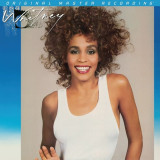
Issued just two years after Houston's breakthrough debut, Whitney immediately signalled the genre-defying singer's intent to continue to push ahead and expand her palette. Shot by photographer Richard Avedon, the album cover depicts an iconic image of Houston — captured with a gleaming smile, bright eyes, teased-out afro, toned arms, and a right hand that appears to wave a friendly hello — whose active, athletic profile stands in contrast to the extremely formal sit-down shot of her that graces her '85 record. The change is telling: Whitney overflows with unfettered joy, rhythmic vibes, and deep-seated emotions that forever endeared her to the hearts and minds of countless listeners — and which set the standard for the wave after wave of divas that followed in her footsteps.
It's no coincidence that the first track on Whitney is the declarative "I Wanna Dance with Somebody (Who Loves Me)." Like Michael Jackson's "Billie Jean" and Madonna's "Material Girl," the feel-good smash is one of the quintessential '80s gems — a lithe, melodic, celebratory release of pent-up energy and loneliness that glides across club floors, shouts to the rooftops, and shrugs off any concerns about vulnerability or embarrassment. Houston's swooping voice moves in sync with the sleek beats and dipping-and-diving synths. She practically takes her fellow musicians by their hand and leads them in a blissful dance that nobody would dare sidestep. Focusing on Houston's singing — a task made challenging only because of the impossible-to-ignore hooks and grooves — showcases the virtuosic facets of not only her register but her control, discipline, smoothness, and warmth.
That she replicates those feats for the entirety of the nearly 53-minute-long album makes Whitney that much more special. Houston reaches back and channels her childhood gospel training on the R&B-flared "So Emotional"; effortlessly slips into Quiet Storm mode on the duet with her mother, gospel great Cissy Houston, on "I Know Him So Well"; flirts with smooth jazz and collaborates with tenor saxophonist Kenny G on the lush "Just the Lonely Talking Again"; conjures dreamscapes and shadow-boxes with supple funk on a romantic cover of the Isley Brothers' "For the Love of You"; and, for the majestic power ballad "Didn't We Almost Have It All," displays the sky-scraping reach of her vocals amid a grand arrangement made even bigger by Houston's sweeping performance and triumphant finish.
Houston's once-in-a-generation talents weren't lost on the adoring public, radio deejays, or industry experts. In addition to harbouring four No. 1 hits and receiving nominations for four Grammy Awards, Whitney generated another Top 10 success in the guise of the Afro-Cuban-leaning "Love Will Save the Day." The album also netted Houston four American Music Awards; two Billboard Music Awards; back-to-back People's Choice Awards; a Soul Train Award; and various other accolades. It all makes the crux of the Washington Post's July '87 review of the album appear prophetic: "Her voice sounds stronger still and the songs are varied but so consistent she could garner 10 Top 10s out of a field of 11."
That claim still holds true. A brilliant fusion of pop, R&B, smooth jazz, and soul, Whitney is a showstopper – and one of the key reasons Houston is the most-awarded female artist of all time.