quête:black truffle
- A1: Donde Esta The Donner Party?
- A2: How Many Contracts Do I Have, Linda?
- A3: Cannibal Cowgirl
- A4: How Many Fur Coats Do I Have, Edith?
- A5: Archetypal Unitized Seminar
- A6: How Many Head 'O Cattle Do I Have, Sally?
- A7: Gold Gush Epilogue
- B1: You Pay Rent On Your Brain
- B2: I Feel Like A Martian
- B3: Japanese Disease
- B4: I'm Hungry
Unreleased album from 1981, a collaborative project by David Behrman, Paul DeMarinis, Fern Friedman, Terri Hanlon and Anne Klingensmith recorded at Mills College in 1981.
Previously known only to cognoscenti through an obscure self-released three-track 7”, this is the first publication of the complete album, an outrageous confection that mixes art-song and theatrical monologue with live electronics. Starting life as a performance art piece described by the artists as ‘Western Performance Noir’, the record centres on a series of texts written by Friedman and Hanlon in which female narrators comically embody a series of iconic roles (The Recording Artist, The Former Movie Star, and The Rancher). Other lyrical themes include recurring references to the notorious cannibal pioneers, the Donner Party, an ironic take on Japanophilia, and the luscious “Archetypal Unitized Seminar,” a satirical poke at self-help culture, whose lyrics are rendered in Indian raga style to the accompaniment of electronic glissandi and toy noisemakers. Delivered by Friedman, Hanlon, Klingensmith and special guest Maggi Payne in forms ranging from spoken monologue to Country & Western waltz, the texts are accompanied by instrumental and electronic contributions by Behrman and DeMarinis. Musically, She’s More Wild is truly unique, demonstrating these two pioneers of live-electronic performance adapting their signature processes to something approaching a ‘pop’ format: we hear the gliding, frequency-sensitive electronics familiar from Behrman’s classic On the Other Ocean and the mutant hacked Speak n’ Spell heard on DeMarinis’ Songs Without Throats propelled by drum machines and twisted into song forms. Perhaps comparable only to the David Rosenboom and Jacqueline Humbert’s contemporaneous Daytime Viewing in its interweaving of performance art tactics, high-tech electronics and pop sensibilities, She’s More Wild is an essential document, both immediately gratifying and ultimately thought provoking.
Nantes-based Australian drummer and percussionist Will Guthrie returns to Black Truffle with Nist-Nah. Like his previous solo record on the label, the abrasive hip-hop concrète of People Pleaser 'BT027', Nist-Nah finds Guthrie branching out in a new direction, this time in a suite of six percussion pieces primarily using the metallaphones, hand drums and gongs of the Gamelan ensembles of Indonesia.
The music presented here is grounded in Guthrie’s travels in Indonesia and study of various forms of Gamelan music, from the stately suspended temporality of the courtly Javanese Gamelan Sekatan, to the delirious, thuggish repetition that accompanies the Javanese trance ritual Jathilan, to the shimmering acoustic glitch of contemporary Balinese composer Dewa Alit and his Gamelan Salukat.
However, far from an exercise in exoticism, Nist-Nah develops out of Guthrie’s extensive work with metal percussion in recent years (as heard, for example, on his 2015 LP for 'IDEAL', Sacrée Obsession), where gongs, singing bowls and cymbals are used to build up walls of hovering tones and sizzling details.
Though Guthrie is broadening his palette to explore Gamelan instrumentation and pay tribute to his love of this sophisticated yet elemental percussion music, the pieces presented here are equally informed by Guthrie’s interests in free jazz, electro-acoustic music and diverse experimental music practices, exploring long tones, extended techniques, and non-metered pulse.
'Nist-Nah' presents a variety of approaches across its six pieces, from the crisp, precise rhythmic complexity of the opening title track to the droning textures of ‘Catlike’ and ‘Elders’.
On the epic closing ‘Kebogiro Glendeng’, Guthrie offers an extended, layered rendition of a Javanese piece belonging to a repertoire primarily used for warmups, beginner’s groups and children first learning Gamelan, elegantly gesturing to his own amateur status while using the piece’s insistently repeated melody as an extended exploration of the hypnotic effects of repetition, falling in and out of time with himself to create woozy, narcotic effects until the piece eventually dissolves into a wavering fog.
Black Truffle is pleased to present Realejo, the first vinyl release from Brazilian sound artist and composer Manuel Pessoa de Lima. Having composed works for diverse contexts including cinema, contemporary dance, theatre and television, Lima’s live appearances often take the form of self-reflexive lecture performances that combine electro-acoustic sound, red light, video and spoken text, moving unpredictably from the hilarious to the distressing.
Realejo consists of two side-long pieces of highly idiosyncratic electro-acoustic collage, beginning with recordings Lima made of himself playing the organ in the Schloss Solitude Chapel in Stuttgart. Exploring the peculiarities of the instrument’s mechanics, Lima made hours of recordings with the organ stops half-way open, moving from haunting gliding tones to oddly tuned fair-ground melodies reminiscent of the record’s namesake realejo, a hand-cranked organ traditionally found in Brazil as the musical accompaniment to the work of fortune-telling parrots.
To these organ sounds, Lima added recordings of a security guard made in São Paulo: ‘Just before coming to Stuttgart, I started making field recordings of a security guard in São Paulo. It's something pretty common in residential areas: they sit in a chair with a whistle, and use that to signal when people arrive, leave or pass by in the street. This particular security guard, Miguel Viana, works on the same street my parents live, and where I had my childhood, and he has worked there since I was a small child. He has watched the street at night, from 8PM to 6AM, every single day, except Sundays, for over 30 years’.
The poignant sounds of the security guard’s whistles punctuate Lima’s electro-acoustic environment, which also includes raw digital synthesis, recordings of his friends’ infant child, audio lifted from Youtube, and, on the LP’s second side, elements taken from an earlier work, ‘36 English to Portuguese Lessons’. Finely chiselled from dozens of hours of source material into a detail-rich, mercurial structure, Realejo is alternately jarring and seductive, introducing listeners to a young composer with a powerfully individual voice.
Black Truffle invite you to an evening of drunken revelry in the Batcave! After a chance meeting at a local supermarket in Poughkeepsie, New York, Joe McPhee and Graham Lambkin have performed together as a duo extensively in recent years, in addition to their joint work excavating some of the wildest tapes from McPhee’s archive for Lambkin’s now defunct Kye label. Live in the Batcave documents an evening the two friends spent together in the company of Joe’s brother Charlie and Lambkin’s son Oliver in November 2017 at Charlie’s house in Poughkeepsie. The LP captures seven increasingly drunken snapshots of the four shooting the breeze, playing flutes and whistles, drumming on anything at hand, and playing records.
Edited together in Lambkin’s distinctive style of lo-fi domestic tape collage, the multiple simultaneous cassette recordings of the shenanigans abruptly cut in and out and fall out of sync, creating disorientating, woozy echoes. Mics are bumped, stories are told, drinks are poured, text messages arrive, and AACM-esque flute jams are interrupted by violent bursts of laughter and wet-mouthed sound poetry. All the while, classic soul records play, initially in the background, but coming increasingly to the fore until the record culminates in a strangely moving free-associative singalong. Presented in a gatefold sleeve with extensive photographic documentation and liner notes from Joe McPhee, Live in the Batcave is a truly unique document that exists somewhere between free jazz, audio verité, performance art, and everyday life. File next to your copy of Das Kümmerling Trio. ‘Our music was born from the sounds of jazz, funk, soul, noise … sounds with no other reason so exist, except because they did, sounds which occurred like putting one step in front of the other to see if the way was clear to take the next step. The plan was, there is no plan, just start at the beginning, end at the end and party like it’s 1999’ – Joe McPhee
lack Truffle present In Real Life, the latest in a flurry of releases from Berlin-based guitarist and composer Julia Reidy. Having drawn acclaim for solo performances on 12-string acoustic guitar that bridge microtonality, ‘American primitive’ stylings and classic minimalism, Reidy’s recent releases have utilised an increasingly broad sonic palette, fleshing out guitar-based composition with electronics, field recordings, and – most strikingly – heavily auto-tuned vocals. On In Real Life, Reidy pushes one step further, crafting an epic LP-length suite that moves from abstracted song to lush electronics and explorations in contemporary musique concrète. Beginning with a passage of eerie electronics and creaking percussive interjections, Reidy’s heavily auto-tuned voice quickly takes centre stage. Surrounded by explosions of electric guitar and synthesised arpeggios, the auto-tuned voice delivers a melancholic ode, bringing together poetic images to reflect on the instability of experience and mutability of identity in a contemporary world saturated by digital technology. This concern with the unsettled relationship between the physical and digital is reflected musically by the constantly shifts in emphasis between Reidy’s physically demanding guitar-picking and the various forms of synthesis deployed. Similarly, the dynamic imagery of cutting, shattering, and ‘racing streams’ present in Reidy’s lyrics also serves to characterise the structure of In Real Life, which ceaselessly shifts between distinct episodes. The song-based opening, long sequences of frenetic 12-string guitar shadowed and eventually overtaken by synth tones, passages of delicate chiming harmonics, electro-acoustic cut-ups – each flows seamlessly into the next, often recurring throughout the record’s duration, which lingers over interstitial moments between these episodes.
Mixed and mastered by Joe Talia at Good Mixture, Tokyo. Vinyl cut at 45rpm for maximum fidelity by Rashad Becker at D&M, Berlin. Artwork by Suze Whaites. LP desgn by Lasse Marhaug.
Keiji Haino,Jim O'rourke,Oren Ambarchi
In the past only geniuses were capable of staging the perfect...
- A1: In The Past Only Geniuses Were Capable Of Staging The Perfect Crime (Also Known As A Revolution) Today Anybody Can Accomplish Their Aims With The Push Of The Button Part 1
- B1: Decorously Decorously Decorously Decorously Decorously Decorously Decorously Decorously Decorously Decorously To Make Something Beautiful And Then To Smash It Decorously
- C1: Head-On Collision If It Still Has Bones It Shall Move Forward (Which Is Different To Progress)
- D1: In The Past Only Geniuses Were Capable Of Staging The Perfect Crime (Also Known As A Revolution) Today Anybody Can Accomplish Their Aims With The Push Of The Button Part 2
For its 50th release, Black Truffle presents the 9th album from one of the label’s core ensembles, the power trio of Keiji Haino, Jim O’Rourke and Oren Ambarchi. Drawn from a November 2015 performance at Tokyo’s now-defunct SuperDeluxe, the record’s opening piece drops us immediately into the maelstrom, abruptly cutting into an extended episode of Ambarchi’s pummelling drums, O’Rourke’s fuzzed-out 6 string bass and Haino’s roaring guitar and electronics. Eventually settling into a hypnotic bass and drum groove over which Haino unleashes some almost Ray Russell-eque skittering atonal screech, these opening 13 minutes act as a potent reminder of the trio’s power. Alongside showcasing the steady development of a unique language for the guitar-bass-drums power trio, the group’s succession of releases over the last decade has demonstrated a constant experimentation with new instruments, which continues here with O’Rourke use of Hammond organ (played at the same time as his roaming, sometimes knotty basslines). On the album’s second piece, the organ plays a key role, furnishing a harmonically rich shimmer over O’Rourke’s angular 6 string bass chords, Haino’s distant, chirping electronics and Ambarchi’s crisp cymbal work; arriving somewhere halfway between Albert Marcoeur and Terje Rypdal, this piece is undoubtedly a highlight in the trio’s catalogue so far. Sides two and three are given over to slow-burning, multi-part epics that range from spacious reflection to furious tumult. Where the trio’s previous 2LP set (This Dazzling, Genuine “Difference” Now Where Shall It Go?, 2017) was primarily instrumental in focus, here we find Haino’s voice taking the spotlight on the expansive third side, intoning, wailing and exhorting in Japanese and English over a backdrop that moves from hushed bass and organ atmospherics to rolling toms and cymbal crashes before arriving at an ecstatic finale of searing guitar, tumbling drums and reverb-saturated bass. The fourth side returns to the hypnotic grooves of the opening piece, fixing on an relentless riff and riding it into oblivion under Haino’s roaming psychedelic soloing and jagged chordal slashes.
Black Truffle is pleased to announce the release of this genuine head-scratcher, the first collaboration between DJ/mixtape-compiler Kayo Makino and underground legend Tori Kudo. Originally created to be played between acts at the launch of Eiko Ishibashi’s acclaimed The Dreams My Bones Dream and then reworked and refined for LP release, the two side-long pieces are sonic environments constructed by Makino for Kudo’s piano to inhabit, or, as the LP’s credits suggest, a cinéma pour l’oreille in which Kudo’s piano plays the starring role. Beginning with a soothing field recording of crickets dramatically punctuated by smashing glass, the first side finds Kudo playing his way repeatedly through one of Satie’s 1897 Pièces froides. Best known to many listeners for his role as leader of the ecstatically shambolic rock unit Maher Shalal Hash Baz, Kudo’s performance of Satie’s whimsical yet haunting melody is alternately halting and fluid, delighting in the hesitations of unstudied technique and the subtle variations between repeated attempts. While the combination of Kudo’s piano and the background of crickets initially suggests a documentary approach to recording – as if the we are simply hearing incidental sounds creeping through an open window – things take an unexpected turn a few minutes in when Kudo’s piano is suddenly doubled. Layering two separate attempts at the same piece of top of each other, Makino’s unorthodox mixing blurs Satie’s original into a fog of stumbling echoes that becomes increasingly dreamlike as the chirping crickets are overtaken by pattering rain, German dialogue and traffic sounds. The second side begins in a similarly inscrutable vein, with snatches of birds and film music providing a gentle backdrop for Kudo’s improvisational variations on a chord progression that, as his performance builds over its twenty-minute duration, somehow begins to suggest the sadly swaggering grandeur of Mick Taylor-era Rolling Stones. Makino accompanies and eventually overwhelms Kudo’s piano with a bizarre layer of digitally processed voice and drums, stretched out into a disorienting haze before suddenly retreating to leave Kudo’s piano accompanied only by a barking dog. Seemingly unrelated to anything else being produced in the world of contemporary music, this is a striking collaboration between two unique musical personalities that bridges the mundane and the surreal, opening up a dream-space both haunted and hospitable.
Black Truffle is honoured to announce the first ever vinyl reissue of David Rosenboom’s legendary Brainwave Music, originally released on A.R.C. Records in 1975 and here expanded to a double LP with the addition of over 40 minutes of contemporaneous material. Pioneer of live electronics, innovator in music education, collaborator with artists as diverse as Jon Hassell, Jacqueline Humbert, Terry Riley and Anthony Braxton, Rosenboom is renowned for his ground-breaking experiments with the use of brain biofeedback to control live electronic systems.
Each of the three pieces that make up the original Brainwave Music LP integrates biofeedback with musical technology in different ways. In the side-long opening piece “Portable Gold and Philosophers’ Stones”, four performers have electrodes and monitoring devices attached to their bodies to receive information about brainwaves, temperature, and galvanic skin response. This information is analysed and fed into a complex set of frequency dividers and filters, manned by Rosenboom, but essentially played by each of the performers through their psychophysiological responses to the situation. The result is a slowly unfolding web of filtered electronic tones over a tanpura-esque fundamental, possessing the unhurried, stately grandeur of an electronic raga. In “Chilean Drought”, three different variations of a text about a drought in Chile, each read by a different voice in a different style, are associated with the Beta, Alpha, and Theta brainwave bands. Alongside an insistent piano accompaniment, we hear a constantly shifting combination of the three vocal recordings controlled by the relative preponderance of each of the brainwave bands in the soloist whose brainwaves are being monitored. “Piano Etude I (Alpha)”, the earliest piece included here, is based on research into the link between Alpha brain wave production and the execution of repetitive motor tasks. As Rosenboom plays a very rapid, incessantly repeated pattern in both hands – deliberately designed to be difficult to execute without being in an alert, non-thinking state similar to that associated with strong Alpha brainwave production – two filters controlled by monitoring his brainwaves process the piano sound, moving gradually higher in frequency as the average Alpha amplitude increases, resulting in a hypnotic, constantly shifting blur of repeated notes reflected through the shimmering, watery lights of the filters. For this reissue, the original LP is supplemented with an additional LP containing an unreleased 1977 live recording of Rosenboom’s “On Being Invisible”, in which the composer himself performs on an array of electronics that are fed information from his brainwaves. Stretching out over 40 minutes, the piece begins in similar territory to “Portable Gold and Philosophers’ Stones” but eventually becomes far wilder, building up to pointillistic bleeps and dense layers of electronic fizz that unexpectedly cut to near-silence. As Rosenboom explains, the piece creates a situation in which the ‘performer’s active imaginative listening became one of the ways to play their instrument, as well as an active agent in how self-organizing musical forms might emerge.’ Enriched with archival images and new notes from the composer, this expanded reissue of Brainwave Music is essential listening for anyone interested in the history of live electronic music and alive to the possibilities it might still contain.
- A1: If God Were Alive (& He Is) You Could Reach Him By Telephone
- A2: R4T
- A3: Et Tu, Klaatu
- B1: Eenie Meenie Chillie Beenie
- B2: Novena
- B3: Mind Power
- B4: Yellow Yankee
- C1: Want You
- C2: Vocal Variety
- C3: Kokole
- C4: Cincinnati 1830-1850
- D1: Edison's Piano
- D2: The Lecture Of Comrade Stalin At The Extraordinary 8Th Plenary Congress
Paul DeMarinis is a key figure in the history of electronic music since the 1970s. Collaborator with the likes of Robert Ashley, David Behrman, and David Tudor, DeMarinis is a pioneer in the development of gallery sound installation and digital music technologies. Black Truffle is thrilled to announce the release of a double-LP collection, selected in collaboration with the artist, focussing on DeMarinis's exploration of synthesized voice and the digital analysis and manipulation of speech sounds. Drawing together tracks dispersed on compilations along with a number of pieces previously unheard in any form, Songs Without Throats offers a revelatory look into DeMarinis's alternately accessible and uncompromising production between 1978 and 1995. Opening with a mesmerizing piece from 1978 pairing the voice and tamboura playing of Anne Klingensmith with strings of letters spat out by a Speak n' Spell to the accompaniment of the randomised melodic patterns of DeMarinis's homebuilt electronic instrument 'The Pygmy Gamelan', the record then dispenses with the live human voice in favour of its recorded and synthetic doubles. We follow DeMarinis's restless probing of the possibilities of new technologies, from the hacked Speak n' Spell (which gives us the austere 'Et Tu, Klaatu' 1979, another duet with Klingensmith, this time on bowed psaltery, in which the toy's synthetic voice is stretched into an alien song) through to the use of digital audio samples manipulated with home computer technology in the early 1990s (including a remarkable dream-like collage piece that weaves a rare recording of Stalin's voice and bird-like electronic twittering derived from its formant-glides into a rich tapestry of samples reflective of the dictator's musical life). In between we get a rich sampling of DeMarinis's signature work with speech melodies - usually unnoticed melodic inflections that lie within speech patterns - which he analyses and translates into synthesized musical accompaniment. These pieces draw on a wide variety of textual and vocal sources, which range from the hilarious to the menacing ('Cincinatti (1830-1850)' sets a detailed description of butchering techniques, for example) and an equally broad range of musical conceptions, combining elements as seemingly unlikely as Beethoven's Opus 31 pianos sonatas and the sounds of 80s synth pop. The results are an extraordinary combination of the alien and the familiar. As DeMarinis himself characterises his work with vocal synthesis, this is 'a kind of signal that simultaneously carried and obscured meaning and ideation, even as it created a sound world totally alien in esthetic'. Presented in a deluxe gatefold sleeve with archival images and liner notes by Paul DeMarinis. Design by Stephen O'Malley. Mastered and cut by Rashad Becker at D&M, Berlin
- A1: Ohne Titel
- A2: Ländliches Kouzert
- A3: Vier Brüder Auf Der Bank
- A4: Blaue Dominante, Öl Auf Kupfer
- A5: Susanna Im Bade
- A6: Marktfrau Mit Gemüse
- B1: Halbakt Im Gegenlicht
- B2: Aargauische Kleinlandschaft
- B3: Van Der Rande, Massstäblich
- B4: Goffersberg Mit Traktor
- B5: Selbstbildnis Mit Frau Und Söhnen
- B6: Ohne Titel
Black Truffle is excited to announce the release of the first-ever vinyl reissue of Ruedi Häusermann's Galerie Randolph, a masterpiece of solo multi-tracking originally released on CD by Unit Records in 1995. Born in 1948 and residing in the medieval Swiss town of Lenzburg, and virtually unknown outside of the German-speaking world, Häusermann is a multi-instrumentalist and enormously prolific composer who works primarily in the medium of absurdist music-theatre. A virtuoso wind player and free improviser who also composes for traditional classical instrumentation, his work is characterised by subtly surreal humour and the unlikely combination of extended technique and simple, at times almost child-like, melodic ideas. Named after his rehearsal room in Lenzburg, Galerie Randolph uses an enormous array of instruments to craft a work of singular compositional vision. Each of the twelve pieces begins from the same two elements: a woozy, sliding scatter of tones played on a home-made contraption stretching two guitar strings between the top of Häusermann's alto saxophone and an amplified cup, and a series of uneasy block chords sounded on accordion and reeds. On each piece these two elements (whose pitch gradually raises throughout the record) are complemented by entirely different material, all of it played by Häusermann. Ranging from layered flutes to one-finger piano melodies to unintelligible vocals to musique concrete interjections to free jazz saxophone explosions, these additional layers combine with the endlessly returning idée fixe of the foundational elements to create a truly dream-like listening experience, a gently deranged realm in which we lose all sense of linear time. Calling up the most unlikely combinations of possible predecessors - Erik Satie, Gerry Mulligan, and Helmut Lachenmann perhaps -Galerie Randolph ultimately defies comparison. Almost unknown except to a select group of cognoscenti such as Jim O'Rourke, yet destined to become a cult classic, Galerie Randolph is an instance of that most rare thing: music the likes of which you have never heard before.
Presented in a deluxe gatefold sleeve with gorgeous archival images by the composer. Design by Stephen O'Malley. Mastered and cut by Rashad Becker at D&M, Berlin
Key selling points: - Black Truffle is excited to announce the release of the first-ever vinyl reissue of Ruedi Häusermann's Galerie Randolph, a masterpiece of solo multi-tracking originally released in 1995, the album utilises an enormous array of instruments to craft a work of singular compositional vision.
- Calling up the most unlikely combinations of possible predecessors - Erik Satie, Gerry Mulligan, and Helmut Lachenmann perhaps -Galerie Randolph ultimately defies comparison.
- Each of the twelve pieces begins from the same two elements: a woozy, sliding scatter of tones and a series of uneasy block chords sounded on accordion and reeds. On each piece these two elements are complemented by entirely different material, ranging from layered flutes to one-finger piano melodies to unintelligible vocals to musique concrete interjections to free jazz saxophone explosions, these additional layers combine with the endlessly returning idée fixe of the foundational elements to create a truly dream-like listening experience, a gently deranged realm in which we lose all sense of linear time.
- Almost unknown except to a select group of cognoscenti such as Jim O'Rourke, yet destined to become a cult classic, Galerie Randolph is an instance of that most rare thing: music the likes of which you have never heard before.
- Galerie Randolph is presented in a deluxe gatefold sleeve with gorgeous archival images by the composer with design by Stephen O'Malley. Mastered and cut by Rashad Becker at D&M, Berlin
Black Truffle is honoured to present the first reissue of a true underground masterpiece, Massimo Toniutti's Il Museo Selvatico (The Wild Museum), originally self-released on LP in 1991. Like his better-known brother Giancarlo (whose classic 1985 Broken Flag LP La Mutazione was reissued by Black Truffle in 2015), Massimo Toniutti was active in the vibrant underground industrial/noise scene of the 1980s, contributing to releases on legendary labels such as Broken Flag and RRR and self-releasing a series of cassettes between 1984 and 1988. Existing in a private world apart from the noise and dark industrial tropes of many of his contemporaries, Toniutti's Il Museo Selvatico is an entirely singular work of domestic electro-acoustic exploration. Made up primarily of what Toniutti calls 'small and rare noises' or sonic 'knick-knacks' recorded between 1987 and 1990, the five pieces that make up the original LP usher us into a crepuscular space populated by mysterious traces of everyday life. Toniutti weaves a loose net of distant clanks, dull thuds, metallic resonance and skittering percussive sounds, allowing the sounds to breathe against a backdrop of near-silent atmosphere. Although the haunted ambience recalls the work of contemporaries like Organum, Toniutti generally steers clear of long tones and drones, preferring to arrange brief, sometimes staccato sonic objects into patters of repeating figures and isolated events whose overall compositional shape remains somehow ungraspable. Although glimpses of recognisable location recordings and instrumental sounds can occasionally be made out, for most of the record the sources of the sounds we hear remain teasingly mysterious, an abstracted memory of everyday actions and atmospheres. l Museo Selvatico is accompanied here by an additional LP of material recorded at the same time, composed especially for this reissue into two side-long suites that inhabit the same haunted space as the original LP while occasionally making use of more maximal compositional strategies. Black Truffle is pleased to return this overlooked masterwork to the world. Essential listening for fans of Organum, Nurse With Wound, Christoph Heemann, and the tradition of outsider musique concrète. Lovingly presented as a double LP in a lavish gatefold with printed inner sleeves featuring archival images and notes. Remastered and cut at D&M, Berlin
Limited Edition of 500 handnumbered Box Set including 4LPs (180g), 1 CD, Download Coupon and a high quality 120 page booklet. NOTE: BOX IS SHRINK-WRAPPED BUT WILL BE OPENED FOR SHIPPING TO AVOID SEAM-SPLIT.
Black Truffle Together With Bernhard Rietbrock And Zhdk Are Honoured To Reissue This Stunning Boxset Celebrating Alvin Lucier's 85th Birthday Celebrations Which Took Place In Zurich, 2013.
Alvin Lucier Is One Of Most Important Figures In More Than A Half Century Of Avant-garde And Experimental Sound Practice. He Has No Equivalent. He Is Among America's Most Important Composers - A Towering Pillar Of Intellect, Creativity, And Beauty Realized Through Sound. His Singular And Unparalleled Body Of Work, Focused Around Acoustic Phenomena And Auditory Perception, Which Included, Among Many Others, The Groundbreaking Works Bird And Person Dyning, Music On A Long Thin Wire, And I Am Sitting In A Room, Each Quietly Shifting The Understanding Of What Music Could Be - Deceptively Discrete Gestures, Laying Their Mark On History And The Expectations Of Nearly Everything To Come, While Radically Expanding The Field. It Is Such A Life, Defined By Such Striking Accomplishment, Which This Release Celebrates Across The Four Lps, Cd, And Book Which Make Up The Lavish Illuminated By The Moon Release.
Recorded In October Of 2016 At The Alvin Lucier 85th Birthday Festival At The Zurich University Of The Arts, The Box Gathers A Remarkable Range Of Performances Of Works From Lucier's Life In Music, From The Iconic To The Lesser Known. It Begins With Wonderful Stagings Of I Am In A Sitting Room And Music For Solo Performer Performed By The Composer, Before Presenting The Work Charles Curtis Performed By The Cellist For Whom It Was Composed, And Double Rainbow, A Recent Work, Performed By The Incredible Joan La Barbara. Over The Course Of The Set's Many Discs, We Encounter Works Ranging From Nothing Is Real (strawberry Fields Forever), Braid, Two Circles, Hanover, Step, Slide And Sustain, And One Arm Bandits, Performed By Oren Ambarchi, Stephen O'malley, And Gary Schmalzl, With Further Contributions By Charles Curtis And Many Others Involved In The Celebrations Of Lucier's Life And Work. The Collection, By Offering An Expanse Of Material Otherwise Unavailable In The Composer's Discography, Opens A Rare Window Into The Breadth And Range Of Territory Which He Has Approached, As Well As Into The Unique Humor Which Has Quietly Bubbled Through His Entire Career. It Is A Singular Recording Event, The Likes Of Which Are Unlikely To Be Repeated.
A Worthy Tribute To One Of The Last Century's Most Important Composers, Offering Insight, Recognition, And Critical Investigation, Long Overdue And Lovingly Produced. Including An Extensive, Lavish 120 Page Book, With Numerous Unseen Images. Pressed On 180 Gram Vinyl, This Limited Edition Of 500 Individually Numbered Copies Is Unquestionably One Of The Most Beautiful And Important Releases Of 2018.
Key Selling Points: - Limited Edition Of 500 Handnumbered Units From Legendary Electronic Music Pioneer Alvin Lucier
- Lavish Box Set Including 4lps, 1 Cd, And A High Quality 120 Page Booklet.
- 180g Vinyl
- Incl. Download Coupon To Redeem All Tracks
- Over 190 Minutes Playtime
- Remarkable Collection Of Performances Of Works From Lucier's Life In Music, From The Iconic To The Lesser Known.
- Mastered & Cut By Helmut Erler At Dubplates & Mastering, Berlin.
Two Words is the debut release from the duo of Canadian sound artist crys cole and Australian songwriter Francis Plagne. Building on a series of experimental live performances in which the pair toyed with possible common languages for their seemingly unrelated approaches to music, the LP's two sides present a single piece that brings together abstract texture and slow-motion song in a sonic space where genre cedes to the logic of dreams.
The piece begins with a long, nearly static sequence built primarily from rubbed surfaces, using movement in the stereo field and changing mic placements to create a unified but unstable sonic environment that mimics wind, water, and breath, opening an impossible space between nature and artifice. This artificial outdoors ultimately makes room for Plagne's electric organ, which sounds a series of melancholic chords to accompany a wandering Wyatt-esque keyboard line as cole's intimate contact mic textures sizzle and pop in the foreground.
From here the piece makes a surprise detour into song, as the majority of the second side finds Plagne intoning a series of obtuse two word phrases (from a text by Berlin-based poet Marty Hiatt) to an austere organ accompaniment. Working closely with engineer and producer Joe Talia, cole and Plagne extend the studio-as-an-instrument tradition of Teo Macero and This Heat, introducing subtle yet unexpected production shifts that lead the listener from the initial austerity of the organ and voice to an oneiric space of asynchronised vocal doubles, creaking textures, and distant whistling, ultimately arriving at something like an imagined meeting of Organum and Arthur Russell.
Packaged in a suitably mysterious sleeve featuring a lush work by Australian painter Anne Wallace on the front and text by Hiatt on the back, Two Words is both comforting and strange, a disorienting blend of seemingly discrepant elements.
Face Time is the second release from the trio of Oren Ambarchi, Kassel Jaeger, and James Rushford, following on from their 2016 debut Pale Calling. Recorded at the GRM studios in Paris in June 2017, the record immediately returns to the idiosyncratic sound-world of the trio's first release, a simmering stew of electronic smears, pitched-down animal moans, and mysteriously emotive microtonal organ chords. But before long the record takes an unexpected turn, as sounds that initially enter as occasional percussive pitter-patter build to a halting rhythm. Equally reminiscent of Basic Channel-style dub techno and the sound of a microphone loose in a pocket, these stumbling rhythmic figures provide the framework for the remainder of the record's two sides, occasionally receding into the background to allow squelching electronics, chiming bells, distorted autoharp, inchoate grunts and the sound of a Cristal Baschet to take centre stage, but each time returning with the inevitability of a an idée fixe.
Eschewing any clear sense of form, the two side-long pieces move seamlessly through episodes with the organic flow of improvisation, embracing the happy accidents of events conjoined by chance and lingering on liminal moments. Gradually washing out into a cavernous roar, the record's final moments are suddenly enlivened by shimmering metallic percussion and a sequence of woozy synth chords, combining with the muted rhythms and a distant thunderstorm to become a sort of oneiric tribute to the work of Wally Badarou. Bringing together three of contemporary experimental music's most individual voices, Face Time is an essential slice of outsider electro-acoustics. Cover design by Stephen O'Malley. Mastered and cut by Rashad Becker at D&M, Berlin.
Tint is the first new solo recording from Joe Talia in over a decade. Australian-born but now based in Tokyo, Talia is known to many listeners as a drummer (frequently collaborating both live and in the studio with artists such as Oren Ambarchi and Jim O'Rourke) and as a recording and mixing engineer responsible for dozens of releases across the fields of contemporary experimental music, wayward pop, and jazz. Alongside James Rushford, he is also responsible for one of the most legendary releases in the Kye records catalogue, the creaking electronic morass of Manhunter (2013).
Lovingly crafted over many months in his tiny Tokyo studio, Tint is an album-length electroacoustic suite that brings together Talia's expertise as percussionist, studio engineer, and performer on analogue electronic instruments (primarily modular synth and Revox tape machine). Ranging from minimalist austerity to kosmische lushness, Tint refreshingly refuses the dark and moody sonic palette of much contemporary electroacoustic music in favour of an airy, at times almost weightless sound-world of gliding tones, skittering percussion, and burbling field recordings. Drawing inspiration from Jean-Claude Eloy's epic concrète love letter to Tokyo, Gaku-No-Michi, Talia makes extensive use of his own recordings of his new home, but removes any sense of audio verite, abstracting them into transparent glosses of outdoor ambience or unidentifiable chimes and creaks. Flowing seamlessly between distinct episodes, Tint is compositionally controlled while retaining a sense of played spontaneity, eventually building to a maelstrom of analogue synth zaps and tape manipulated percussion that reflects Talia's deep engagement with the relentless yet constantly shifting dynamics of free jazz.
Black Truffle is pleased to make Oren Ambarchi's Grapes from The Estate available once more on vinyl. Originally released on CD on Touch in 2004 and reissued on Southern Lord as a limited double LP in 2006 during Ambarchi's tenure as a member of Sunn O))), Grapes from the Estate was a landmark release for Ambarchi, seeing him expand his sonic palette beyond the clipped, bass-heavy electric guitar tones he was known for at that point. Incorporating subtle layers of strings, keyboards, percussion over a bedrock of his signature guitar tones, in retrospect this album can be seen as the beginning of a broadening and evolution in Ambarchi's work that would lead to his acclaimed, densely layered epics for Editions Mego, Quixotism (2014) and Hubris (2016). Beginning with the shuddering pure tones of opener 'Corkscrew', which looks back to previous guitar-only releases such as Suspension (2001), the album's next two pieces show a progressive broadening of the instrumental palette and a corresponding move away from textural abstraction and sustained tones towards more traditional notions of musicality. This reached its high point on the album's third piece, the fifteen-minute long 'Remedios The Beauty', where guitars, both acoustic and electric, strings, piano, and bells build from a murmur to an interlockinging web of repeating melodic patterns over gently swinging brushed snare and cymbals. The epic closer, 'Stars Aligned, Webs Spun', returns us to a space populated only by the electric guitar, but unlike everything Ambarchi had produced up until this point in his career, the piece has a liquid, psychedelic edge that looks forward to the shimmering harmonics of his more recent work. As Brendan Walls wrote at the time of the original release, this is 'another outpouring of personal, intimate and enduring music from Oren Ambarchi'. Presented in a stunning gatefold sleeve featuring the original artwork and design by Jon Wozencroft. Redesigned by Stephen O'Malley Remastered and cut by Rashad Becker at D&M, Berlin.
Black Truffle is thrilled to announce the first ever vinyl reissue of legendary performance and sound artist John Duncan's forgotten gem Klaar, originally released by Extreme in 1991 and partly created in collaboration with Andrew McKenzie (The Hafler Trio). Duncan is perhaps most well known for his notorious early performances pieces, which explored violence, self-denial, and the establishment of extreme psychological and physical states in both artist and audience. Alongside these transgressive experiments, Duncan began to create audio works primarily using short wave radio. Where some of Duncan's earlier recordings are composed of magnificently sculpted but abrasive walls of noise, Klaar, recorded while Duncan was living in Amsterdam, occupies a more meditative territory.
Opening with 'Delta', which layers long tones seemingly sourced from slowed down voices over a distant, watery field recording, the remainder of the first side is occupied with the epic title piece, which arranges shortwave radio abstraction, vocal experiments, and field recordings (street sounds, fireworks, monastic chants) into an episodic cinema for the ear. The second side is dominated by the long, brooding 'The Immense Room', where layers of shortwave interference and field recordings are gradually built up into a pulsing, wavering bed of sound infused with a subtly disturbing sense of psychological unrest. This rises to the surface near the end of the piece as sexual moans and ominous rumbles crisscross the stereo image before being abruptly brought to a halt.
A singular work of electroacoustic composition, Klaar is both compositionally sophisticated and infused with a sense of mystery and a vital reality often lacking in more academic experimental music; it sits proudly alongside contemporaneous recordings by Duncan's friends and collaborators Jim O'Rourke and Christoph Heemann and is a must for anyone interested in their work.
- Francis Plagne
2024 Repress
Hotel Record is the second release from the duo/couple of crys cole and Oren Ambarchi, following on from Sonja Henies Vei 31 (Planam, 2014). Where their debut recording presented a disquieting portrait of the erotic dimension of romantic intimacy, the follow-up continues to explore the pair's simultaneously musical and romantic relationship in a more subtle fashion, presenting four long-form pieces that touch on the variety of forms the life of this couple takes: as a musical duo, as a pair of travelers to exotic locations, as opponents in a game of cards...
Each of the double LP's four sides presents a distinct sound-world, yet each manages to attain the same suspended, half-sleeping feeling, outlining a space where improbable combinations of the electronic and the acoustic, of extreme closeness and amorphous distance, occur with the gentle insistence of a dream.
The opening Call Myself calmly unfolds a fabric of long tones from electronic organ and guitar, combining the sliding, aleatoric effects of classic David Behrman with a more hands-on feel. Over the top of this slowly shifting tonal bed, cole's voice mutters unintelligibly into a Buchla synth, teasing the listener by suggesting a meaning that remains always out of the ear's reach. Francis Debacle (Uno) builds on the foundations of a heavily amplified session of the titular card game, overlaying vocal murmurs and exhalations and mysterious room-sounds to create an impossible aural environment. On Burrata, a palette of vintage 1980s digital synthesizer sounds combined with guitars create an irregular texture of lush chords and bubbling melodic details, into which cole's voice processed by a vocoder, is interwoven, reading fragments of romantic correspondence. Finally, on Pad Phet Gob, field recordings made in Thailand become an ambiguously acoustic/electronic rainforest, eventually giving way to a mysterious, wavering electronic tone-field punctuated by sibilant, popping mouth-sounds.
Carving out an intimate and human sonic space across a diverse array of compositional approaches, sound sources, fidelities and textures, Hotel Record is the latest dispatch from the continuing explorations of a unique duo. Ambarchi and cole reimagine electro-acoustic music, not simply as 'abstract' sound, but as a diary, a love poem, a dream.
Deluxe gatefold sleeve with photography by crys cole and LP design via Stephen O'Malley
Mastered and cut by Rashad Becker at D&M, Berlin February 2017
Black Truffle is honored to present a new issue of Annea Lockwood's classic 1970 tape piece Tiger Balm, unavailable on vinyl for over thirty years, accompanied by two exquisite unreleased works for percussion and voice.
Created while Lockwood was living in the UK, the side-long Tiger Balm is a singular work within the cannon of tape music. Inspired by research into the ritual function of music, the piece explores the possibility of evoking ancient communal memories through sound. Breaking entirely with the dynamic language of the musique concrète tradition, Lockwood uses a select palette of mainly unprocessed sonic elements chosen for their mysterious and erotic characteristics (a purring cat, a heartbeat, gongs, slowed down jaw harp, a tiger, a woman's breath, a plane passing overhead), presenting at most two sounds at once. As one sound flows organically into the next, their shared characteristics are highlighted, opening a space of dream logic and mysterious associations between nature and culture, the ancient and the modern.
The B-side presents two pieces for percussion recorded here for the first time. Amazonia Dreaming (1987), performed by Dominic Donato, uses unaccompanied snare drum and voice to evoke the nocturnal soundscape of the Amazon rainforest. Unorthodox techniques and materials (marbles, chopsticks, a plastic jar lid) transform the snare into a resonant field of sensual textures.
Immersion (1998), performed by Donato and Frank Cassara, is a slow-moving exploration of gentle beating tones, performed on marimba, tam tams and gong. Like the other two works presented on this LP, it provides captivating proof of Lockwood's belief in the complexity that deep listening can reveal within seemingly simple sounds.
Francis Plagne
Presented in a stunning deluxe gatefold sleeve with archival pics and liner notes by Annea Lockwood including the score to Amazonia Dreaming.
LP design via Stephen O'Malley
Mastered and cut by Rashad Becker at D&M, Berlin February 2017
Black Truffle is thrilled to announce Reverse Tree, the new LP from the acclaimed duo of Eyvind Kang and Jessika Kenney, two musicians who have established themselves as powerful voices working at a unique intersection of contemporary composition, improvisation, and Asian traditional music forms. Either individually or as a pair, they have worked in contexts ranging from performances of traditional Persian and Javanese music to collaborations with Sunn O))), but their work together as a duo (documented on The face of the earth and Aestuarium, both released on Ideological Organ/Editions Mego) most clearly represents the central concerns of their diverse practices: a music of the inner life of sound, demanding ritualistic focus and promising heightened sensations.
On Reverse Tree, the duo expand their work together into the realm of the chamber ensemble, presenting two side-long works that feature Kenney's voice and Kang's viola alongside a multitude of other instrumentalists. Kang's Thoughts on Being Exiled to the Frontier, for Lord Wei, inspired by a text by the Tang dynasty poet Hsueh T'ao, features an all-star international ensemble: Kang, Kenney, maverick Israeli conductor Ilan Volkov on violin, Icelandic cellist Hildur Guðnadóttir, and guitarists Oren Ambarchi and Stephen O'Malley. The piece is primarily composed of irregular patterns of pizzicato notes and guitar harmonics, gently falling in and out of sync and providing a subtly unstable support for Kenney's voice, which sings long, wavering tones, at times reminiscent of Michiko Hirayama's classic performances of Scelsi. Drawing on 20th century instrumental techniques, alternate tuning systems, non-western music and the experience of nature (the irregular rhythms of the piece calling to mind nothing so much as drops of rain), the piece opens a space both serene and subtly uneasy.
Kenney's 'Elm features Kenney and vocalist Nova Ruth (of Filastine & Twin Sista) alongside an ensemble of strings and Seattle's Gamelan Pacifica, performing on Javanese instruments tuned to the slendro scale. An uncanny timbre created by bowing the keys of the Gamelan's instruments, supported by bowed harmonics from the strings, is heard consistently throughout the piece. After a long introductory section in which this harmonic cloud slowly descends from shimmering high notes to rumbling bass, the vocalists enter, singing a slow and stately setting of a 19th century Surakarta poem (attributed to Mangkunegara the IV). The melody is sung as a rich and wavering heterophony, with the ensemble sometimes rising up to support individual notes. The poem deals with the idea of a form of knowledge achieved through deeds, as a practice and state of the heart. This is music in slow motion, in which, in Kenney's words,
Black Truffle is pleased to present Speak To Me, the sixth full-length release from 3/4HadBeenEliminated, the Italian trio of Stefano Pilia, Claudio Rocchetti and Valerio Tricoli. Based on source material recorded in Bologna and Berlin over the course of several years, the album is made up of two side-long pieces meticulously constructed in post-production by Tricoli in his singularly dense and unpredictable style. Although their live performances have always been entirely improvised, in their recorded work the group focuses on using improvised recordings as source material for compositions built up through layering, editing and analogue manipulation, extending the practices of Teo Macero, Faust and This Heat. Melancholic instrumental ruminations sit alongside cracked electronics, concrete sounds and Tricoli's whispered vocals, drawn together into dense assemblages animated by gradual transformations and sudden jump cuts.
Beginning from the abstractions of their self-titled debut release in 2004, the group embarked on a trajectory that saw them move toward near-song structures, Tricoli's voice becoming a dominant element amid an increasingly dense and layered production style. On Speak To Me, however, the listener feels confronted by the ghost of music, sonic memories echoing across a psychedelic expanse. Evacuated of any clear structure, the music becomes a reverb-saturated morass, from which crystalline details momentarily emerge: shimmering echoed guitar, bowed double bass, tactile hand percussion, skittering electronics. Suffused with a darkly pensive atmosphere, Speak To Me is an elegant summation of the distinctive blend of electroacoustic techniques, instrumental improvisation and contemporary psychedelia pioneered by 3/4HadBeenEliminated over the last decade.
This release blows the trio's instrumental palette wide open for a single continuous piece.
Begun as a one-off collaboration in 2009, the trio of Keiji Haino, Jim O'Rourke and Oren Ambarchi has now become a solid working group, refining its craft through a series of annual concerts at Tokyo's legendary SuperDeluxe. Much of their recorded work has focused on their intense, ritualistic take on the rock power trio of electric guitar, bass and drums, with last year's 'now while it's still warm let us pour in all the mystery' (BT09) containing a series of instant compositions of stunning power and concision that demonstrated how familiar and attuned to one another the three have become.
Presenting the entire first set of the trio's March 2013 concert at SuperDeluxe (the second set will follow on Black Truffle later this year), 'only wanting to melt beautifully away is it a lack of contentment that stirs affection for those things said to be as of yet unseen', their fifth release, blows the instrumental palette wide open for a single continuous piece focused on acoustic strings, synth, flute and percussion. Featuring one of Haino's most delicate and moving recorded vocal performances, the opening section of the record takes the form of a spare duet between O'Rourke's 12-string acoustic guitar and Haino's kantele (a Finnish variant of the dulcimer), behind which Ambarchi provides a hovering backdrop of wine glass tones. While on previous releases the listener has often sensed that Haino was firmly in the driver's seat, here O'Rourke takes centre stage with an acoustic guitar performance that takes the lyricism of John Abercrombie or Ralph Towner and refracts it through the free improvisation tradition of his mentors Derek Bailey and Henry Kaiser. The atmosphere of meditative, abstracted song is reminiscent of some of Haino's greatest recordings, such as the legendary 'Live In The First Year Of The Heisei' volumes recorded with Kan Mikami.
After the great success of the 9 volumes, FullTime Production returns with a new vinyl in the "FullTime Factory" series!
Four gems from our catalogue by Rainbow Team, Michael Baker, Say When! and MA.GI.C. remixed by our artists Da Lukas, Massimo Berardi, Souls
Groove and Black Truffle, who revolutionise big hits through their musical experience with current sounds disco, nu-disco and funk! This vinyl can't miss into the collection!
blickwinkel welcomes composer and multi-instrumentalist Francis Plagne to the label with a reissue of Asleep in a beached boat, an album that was initially released on his own Mould/Mouse Museum label in 2021 on cassette. The album was mostly given away to friends but now gets a wider release through a limited vinyl and digital edition.
Gentle melodies set an airy atmosphere and are intertwined with tensive dialogs between rhythms and textures coming from a wide array of acoustic and electronic instruments. Stylistically somewhere in between his Rural Objects (Black Truffle) and Udge (Horn of Plenty), on the eleven tracks on this album we hear Plagne in his most playful way to date.
Francis Plagne is a musician from Melbourne, Australia whose work swings between songwriting and a variety of other approaches, including group improvisation, instrumental abstraction, and domestic musique concrète. He performed live regularly since 2005 and has released recordings on labels such as Black Truffle, Horn of Plenty, Kye Records, Penultimate Press and his own Mould/Mouse Museum micro-label. In addition to performing his own work either solo or with a band, he has performed and recorded in improvised and other arrangements with Tetuzi Akiyama, Oren Ambarchi, Andrew Chalk, Crys Cole, James Rushford, and Joe Talia, among others.
Stereogum: »Here’s a cool new musical project that feels both out-there and extremely mundane. In 2022, the great Colorado experimentalist M. Sage teamed up with Lieven Martens (Dolphins into the Future) under the name Sage Martens. Their album, »Riding Fences«, was an ambient classical exercise designed to explore the idea of ›Western‹ music. They’re back this year with another conceptual offering (...)«
»Chamber Music for Lawn Mowers« is the second album by Sage Martens. This time, Matthew Sage (RVNG, Fuubutsushi) and Lieven Martens (Edições CN, Dolphins into the Future) sing the lawn.
Did you know a clean-cut lawn is a desire we inherited from the British?
Yes, the British dumped this pleasure into our collective consciousness. Those humorless Victorians who enjoyed having their black pudding on the lawn. They came to this uninspired impression while mis-looking at Italian paintings. Yes indeed, while gazing at these paintings they mistook green lanes for green lawns. Thus it became hip. Every stuffed truffle commanded his gardener to cut the grass.
As a result, this Victorian lust for sterile gardens with pretty green lawns nudged our world into water spillage and pesticide clouds. This new priority produced exhaust clouds and prudish monocultural landscapes. Just by looking at Italian paintings.
As with most of Western history, the practice was exported to America and then turbocharged. By shearing clear the prolific brush of pastures, prairies, forests and glens, biodiversity becomes an aesthetic casualty with long-suffering ecological ripples. An inherited practice narrows the bandwidth of experience.
And so, the childhood habit of humming along in key to the drone of a gas-powered mower while trimming a suburban lawn extrapolates into something expanded — an unanswered question about the harmonics of landscape practices.
M. Sage: Bb clarinet, alto saxophone, sine wave, lawn mowing, processing L. Martens: computer, analog synthesis, digital processing With W. Van Gils: lawn mowing
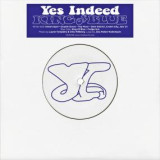
King Of Blue by Yes Indeed sees Laurie Tompkins and Otto Wilberg take their eclectic stance on cosmic jazz and electronics to further uncharted and dreamlike territory, encompassing a unique logic of what is harmoniously absurdist.
King of Blue by Yes Indeed sees members Laurie Tompkins and Otto Willberg further dive into their melismatic take on cosmic jazz and new electronics, by way of their highly eclectic and at times nonsensically sensical modus operandi. Their work is defined by an eloquent flurry of ideas, spheres, and signifiers, creating a musical universe of surprising longevity and depth. Treating musical convention with gentle disdain, Yes Indeed take on a variety of genres and moods and switch them around into a beautifully melismatic and dreamlike state of being. King Of Blue is a mini- album of fragmented beauty and warmth. It puts the illogical center stage and gives space to abruptly miniaturist musical ideas, allowing them to take on a meaning bigger than one would expect. It is cosmic music for modern times. A brazen descent into the execution of a fundamentally diversified musical stance.
'Yes Indeed' are Laurie Tompkins & Otto Willberg. Live, they play keys, bouncy bass and sing over tactile, emotive samples. Their music is epic and also somehow wrong, with space for delicacy, straight-up joy and soaring licks. Since 2022’s ‘Rotten Luck’ - their first proper album, on Bison - YI have played across the UK and Europe. Solo, Laurie co-ran the Slip label and has put out CDs on Entr’acte, 33-33 and Hyperdelia. Otto is a roaming bassist in groups like Historically Fucked and Abstract Concrete and his LP of “wildly singular, wickedly trippy and sensual set of fusion jams” (Boomkat) was recently out on Black Truffle.
Funkyjaws Music is back with more music to make your jaw go funky, this time in the form of a second volume of its Let's Dance series. It features a quartet of esteemed tune makers starting with Frank Booker's 'Yes No Maybe' which is a horn laced and loose-limbed delight, while go-slow master Eddie C brings his classy touch to the funky licks of 'Love Dancing Theme.' There are plenty of cosmic synth waves to Black Truffle's 'Dancing Through The Night' while the LTJ Xperience close down with a super laid back and summery vibe on 'Sunny Groove.'
After her stunning collaborations with Vincent Royer (for Mode Records), Jim O"Rourke and Christoph Heemann (both for Oren Ambarchi"s Black Truffle Records) Brunhild Ferrari returns to the scene with this new solo album. Extérieur-jour is comprised of two previously unreleased compositions, one being the title track the album is named after and the other "Le Piano Englouti (version original)." Extérieur-jour translates to "Outside Day," and indicates an instruction for a film scene, a piece of cinéma pour l"oreille, a movie for the ears. It was recorded at Luc Ferrari"s Atelier Post Billig in January and February 2014. "Le Piano Englouti" ("The Sunken Piano"), another electroacoustic composition which was realized over a period of fourteen years between 1996 and 2010, also brings forth cinematic elements with sound sources recorded in places as diverse as a Greek island by the noisy Agean Sea, a Pachinko place and a quiet island in Japan. It comes across as a meditation on the loss and reappearance of memory and silence. The graphics for the album sleeve were created by the late Wolfgang Meyer Tormin, artist and composer and also father of Brunhild Ferrari. The album was mastered for vinyl from the original source by Jim O"Rourke.
'Scapegoat' is the new album by TRIOLA, the project led by the prolific Tokyo-based composer & experimental string musician Atsuko Hatano, featuring the Japanese violinist Anzu Suhara.
Conceived as a strings project, with Hatano on viola and Suhara on violin, TRIOLA involves a rotating ensemble of guest musicians, including the likes of Chicago-born musician, composer & producer Jim O'Rourke (Drag City, Sonic Youth, Steamroom), the composer & musician Eiko Ishibashi (Drag City, Black Truffle), Australian composer Joe Talia (Touch, Room40, Feeding Tube Records), Yamaguchi-born drummer Tatsuhisa Yamamoto (releases on Black Truffle, Longform Editions, SUPERPANG, performances with Keiji Haino, Oren Ambarchi & Phew +++), Sendai-based vocalist & musician Koji Shibuya (Maher Shalal Hash Baz, Yumbo) & many more.
New Music Fix BBC Radio 6 8th August.
Corey Fuller and Tomoyoshi Date are the Illuha duo but for this new Tobira album they link with percussionist Tatsuhisa Yamamoto. He is a skilled drummer who has worked alone on Black Truffle but has also collaborated with Jim O'Rourke, Eiko Ishibashi, Keiji Haino, Phew and Oren Ambarchi among others. This new record focusses on electro-acoustic sounds that are run through with all manner of precise sonic details and are carried by Yamamoto's unique playing style and singular sense of groove which were recorded over two sessions. That playing style finds him playing very lightly with closely mic'ed drums so plenty of softness is captured and then interwoven with layers of Rhodes, piano, distant synths and metallic murmurations.
- 01: Teo Olter - How Am I Doing? Where Am I Going?
- 02: Wiktoria Jakubowska - Sold
- 03: Miłosz Pękala - Game #3
- 04: Wojtek Warmijak - Realness
- 05: Macio Moretti - I Run On Sugar And Internet
- 06: Tymoteusz Papior - Truffles Attack
- 07: Wojtek Sobura - Fudge
- 08: Zbigniew Robert &Quot;Inferno&Quot; Promiński - Opus I
Coloured Vinyl Vinyl[34,87 €]
Vinyl is available in two versions - classic black or various color limited "Indie Shop Edition".
Both versions have 180g record and printed inner sleeve.
The idea for "PORTRETY" was simple - to invite esteemed drummers to record a song that will be signed with their name. There was no musical framework - they could invite guests or record everything themselves - no need to necessarily use drums. This is how the first PORTRAITS in 2019 were created, and now we present their next installment.
" 'Part two' seems to suggest a series, so just as with the bad joke from four years ago, I'll lead with the short, age old adage: "10 musicians and a drummer". Admittedly, it is rudimentary and unfunny, however, it is significant: It's easy to forget an instrumentalist's other specialities, but here, the drummers don't let themselves to be forgotten.
This series - the brainchild of Marcin "Groh" Grośkiewicz - is composed of up-close portraits. A task which not only shifts accents, but also changes the lives of those normally considered the unsung heroes of the background. One of the tracks from "Portraits" was picked for an advertising campaign for a well known smartphone producer, others topped industry charts and inspired new bands where drums were in the spotlight.
Part two brings us eight drummers who are among the most multifaceted musicians on the Polish music scene. What are they doing here? Teo Olter tells a complex story, asking in the very title, where he is going? Wiktoria Jakubowska, known for backing big stars, shines through with her own composition. Miłosz Pękala - an interpreter of avant-garde composers and an academic lecturer - thoroughly entertains. Famous from Immortal Onion, Wojtek Warmijak energetically explores high tempos, while Wojtek Sobura - those slower, patiently sculpting a club beat with sonoristic* abstraction. Macio Moretti surprises, as expected, stylistically moving towards his hero: Zappa. Tymoteusz Papior impresses, effortlessly juggling accents and chopping time signatures. And Inferno, despite being associated with the group Behemoth, shows he can do it… drum-less. Some invite other musicians, but they always remain - as their studies or professional experience taught them to be - the musician with the widest set (be it drums or skills) on the team.
So, how does the second part of the series compliment the first? It further completes the gallery of collector's cards with Polish Percussion's superheroes and heroines. Each a different personality and an individual set of features. But does it satisfy? Strikingly.
Enough, I won't drum it into you."
Vinyl is available in two versions - classic black or various color limited "Indie Shop Edition".
Both versions have 180g record and printed inner sleeve.
The idea for "PORTRETY" was simple - to invite esteemed drummers to record a song that will be signed with their name. There was no musical framework - they could invite guests or record everything themselves - no need to necessarily use drums. This is how the first PORTRAITS in 2019 were created, and now we present their next installment.
" 'Part two' seems to suggest a series, so just as with the bad joke from four years ago, I'll lead with the short, age old adage: "10 musicians and a drummer". Admittedly, it is rudimentary and unfunny, however, it is significant: It's easy to forget an instrumentalist's other specialities, but here, the drummers don't let themselves to be forgotten.
This series - the brainchild of Marcin "Groh" Grośkiewicz - is composed of up-close portraits. A task which not only shifts accents, but also changes the lives of those normally considered the unsung heroes of the background. One of the tracks from "Portraits" was picked for an advertising campaign for a well known smartphone producer, others topped industry charts and inspired new bands where drums were in the spotlight.
Part two brings us eight drummers who are among the most multifaceted musicians on the Polish music scene. What are they doing here? Teo Olter tells a complex story, asking in the very title, where he is going? Wiktoria Jakubowska, known for backing big stars, shines through with her own composition. Miłosz Pękala - an interpreter of avant-garde composers and an academic lecturer - thoroughly entertains. Famous from Immortal Onion, Wojtek Warmijak energetically explores high tempos, while Wojtek Sobura - those slower, patiently sculpting a club beat with sonoristic* abstraction. Macio Moretti surprises, as expected, stylistically moving towards his hero: Zappa. Tymoteusz Papior impresses, effortlessly juggling accents and chopping time signatures. And Inferno, despite being associated with the group Behemoth, shows he can do it… drum-less. Some invite other musicians, but they always remain - as their studies or professional experience taught them to be - the musician with the widest set (be it drums or skills) on the team.
So, how does the second part of the series compliment the first? It further completes the gallery of collector's cards with Polish Percussion's superheroes and heroines. Each a different personality and an individual set of features. But does it satisfy? Strikingly.
Enough, I won't drum it into you."
Tape
Collaboration by Italian composer Giovanni Di Domenico (Die Schachtel, Superpang) & Japanese drummer Tatsuhisa Yamamoto (Black Truffle, Superpang).
Recorded at Hoshi To Niji studio, Kobuchizawa, Japan
& studio W and The Nest Cellar, Brussels, Belgium in 2021
Cello on A Murder by Emmanuel Cremer
Vanish is Julia Reidy’s yearning, fat debut for Editions Mego. Since 2019, Julia’s bubbling 12-string guitar work - sighing streams of crystal plucks drawn closer or echoing on - has moored a tactile, ever-lusher sound. On ‘Guitar’, the Australian, Berlin-based musician melts down sharp synths; electric fuzz and flex; uncanny found sounds; and autotuned voice and harmonica in a heady, overpowering potion.
Reidy’s music sweeps you up. It’s restless, always travelling on. Lonesome tones into machine chorales into hesitant hum. The LP’s side-long cuts sway between scenes but are always rooted: Julia’s guitar and vocal lines seem mapped to the natural ebb and flow of breath and thought, they lull you as they push through vast and secret spaces.
Vanish completes a trio of releases begun with last year’s ‘brace, brace’ (Slip) and ‘In Real Life’ (Black Truffle). The delicious unease, the anxious burning of the preceding volumes has settled, becoming more wide-eyed and resolute. For all its poise, the album’s sense of build - electric licks rasping into glistening synths, punctured by distant kicks - feels freshest. When 'Oh Boy'’s smudged whistle comes, it has fought its way out of the thickets, and hits like heartbreak.
It was chance that brought about the release of One/Three, Dabrye's debut album. Early demos were tucked on the B side of a cassette Tadd Mullinix passed to Sam Valenti in 2000 while working at the Dubplate Pressure record shop in Ann Arbor. Mullinix had spent the late '90s producing jungle, techno, house, hip-hop and more using the All Sound Tracker software as a primary instrument. Each style pulled from a similar sound palette as Mullinix used limitations to define the contours of di-erent musical personalities. Dabrye was his hip-hop wildstyle, a captivating collage of sparse instrumentals inspired by the laid back vibes of midwestern hip-hop and east coast boom bap, the futuristic funk of Umma-era Jay Dee, and the calculated subtlety of Detroit dance music. Released in 2001 as the first in an intended trilogy, One/Three announced Dabrye's arrival with an unavoidable contribution to Detroit hip-hop. Ghostly International is reissuing the album in 2017 for the first time, including a long overdue vinyl edition.
On its release One/Three was the rare album that appealed to both fans of Slum Village's smooth yet rugged hip-hop and enthusiasts of the distinct American IDM released by labels like Schematic. Over the following decade, the inadvertent demo submission turned into a body of work that placed Dabrye alongside innovators such as Prefuse 73 amid the cannon of a new generation of producers. Today, One/Three remains a concise and intriguing study in instrumental hip-hop that helps join the dots between J Dilla and Flying Lotus.
One/Three is a record that says much with little. There are no obvious hip-hop tropes. Instead Mullinix captures the ingenious minimalism of '90s hip-hop instrumentals to build tracks both supple and hard, joyous and melancholy, full of sharply angled rhythms and warm rubbery basslines: 'The Lish' throws a sickly sweet saxophone against digitally fragmented melodies, 'How Many Times (with this)' draws you in with an irresistible, clipped guitar groove, the rhythmic stutter of 'Smoking The Edge' makes your head spin with pleasure. Playing with his inspirations, Mullinix injects omitted downbeats for imagined rhymes and repurposes the intricacy of ragga jungle for breakdowns.
But what really defines One/Three is the rhythmic sensibility and metric modulation of Detroit's school of hip-hop production, which Mullinix was a fervent student of. The beats feel like they're constantly escaping a rigid tempo grid even though they are, in fact, pretty tight. A lot of it is nuance,' Mullinix explains. I've been known to say that I'm not impressed by spectacle. I think that nuance is what really captivates people.'
If you like your beats with a dash of class, do not miss this. An essential purchase of the highest order.' -BBC
- First time all tracks from the original 2001 release appear on vinyl.
- Remastered by Daddy Kev
- Standard weight black vinyl is inserted in to 3.5mm matte finish vinyl jacket.
- Download card includes free download of the Payback EP