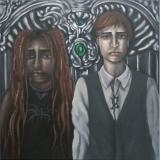
"Ensomheden Vi Deler" ("The Loneliness We Share") is the result of a dialogue between the collages and the music of øjeRum, initiated by IIKKI, between December 2024 and July 2025.
øjeRum is Copenhagen based musician and collage artist Paw Grabowski.
With his collages, the distinctive feature of øjeRum's works is their ability to combine different historical and artistic periods, such as ancient sculpture, medieval frescoes, classical painting and photography, and to make them interact with one another. øjeRum is also renowned for his work as a musician, where he stands out for his surreal, mysterious and poetic universe. His music and art are closely linked. These two sides of the artist's work are constantly intertwined.
In his øjeRum guise, he plucks and strums his treated acoustic instruments, sounding at times like church bells, at times like angelic harp, at time like drones, and suspends the listener in the magic of his melodies. With a deep back-catalogue of releases since 2014 - spanning labels such as eilean rec., Room40, Line, Opal Tapes and many more - he continues exploring his minimal, textural and deeply personal style of ambient music.
The collage and music project "Ensomheden Vi Deler" ("The Loneliness We Share") is an exploration of loneliness, closeness and distance. A meditation on the fragile architectures and hidden shapes of human connection. This is his second release on IIKKI.
Fine Art Book, Ltd. to 500 copies:
Hand numbered & hand stamped / first edition and only edition (no re-print) / hardcover book (15 cm x 21 cm) on Wibalin Natural Cotton White / 80 pages, 35 collages printed on Freelife Vellum 120g/m2 / Swiss Binding / Coloured edges with neon green pantone / Neon Green pantone on front and back cover (logo, slot and circle) / Sticker on front cover.
Поиск:bô vel
Все
- A1: The Velvet Note Lounge (Skit)
- A2: Hollow Tips
- A3: Cut Throat Game
- A4: Playas Need Love (Feat. Rocci)
- A5: True Playas
- A6: I'm Not Yo Daddy
- A7: Boulevard Nights (Feat. Jason Joshua & Rocci)
- A8: Playing The Fool (Skit)
- A9: Money Don't Stop For You (Feat. Rocci)
- B1: Shake Junt Hoes
- B2: Pushin On Some Paper
- B3: Chain Swangin (Feat. Mikey The Magician)
- B4: Scrapin Tha Corner
- B5: Never Listen
- B6: Don't Lose Hope
- B7: Cadillac Burnin (Feat. Rocci)
- B8: Goodbye & Goodnight (Skit)
Vinyl[24,33 €]
Ramirez returns with THA PLAYA$ MANUAL II, the long-awaited sequel to his cult classic that helped solidify his place as one of underground rap’s most distinctive voices. Steeped in Southern-fried funk, Bay Area swagger, and Memphis-style menace, this new chapter finds Ramirez sharper, smoother, and more seasoned—delivering game like a streetwise sage with a gold grill grin.
Where the original Playa$ Manual was gritty and raw, THA PLAYA$ MANUAL II sounds like a player who's leveled up. The beats knock harder, the flows glide slicker, and the game is deeper. Ramirez weaves tales of betrayal, come-ups, late-night drives, and cold-hearted reality with the same charismatic cool that made him a standout in the $uicideboy$-adjacent G59 movement—but this time with a more refined, cinematic approach.
From trunk-rattling bangers to syrupy smooth cuts that soundtrack late-night escapades, THA PLAYA$ MANUAL II feels like a ride through Ramirez’s world with tinted windows up and the bass on max. It’s a record for the hustlers, the heartbreakers, the loners, and the legends in the making.
This is more than a sequel—it’s a statement: the playa’s still active, and the manual’s been updated.
- 1: Go Out And Get 'Em, Boy!
- 1: 2You Should Always Keep In Touch With Your Friends
- 1: 3Everyone Thinks He Looks Daft
- 1: 4A Million Miles
- 1: 5My Favourite Dress
- 1: 6Anyone Can Make A Mistake
- 1: 7Nobody's Twisting Your Arm
- 1: 8Davni Chasy
- 1: 9Give My Love To Kevin
- 1: 0Kennedy
- 1: What Have I Said Now?
- 2: 1Bewitched
- 2: Take Me!
- 2: 3Brassneck
- 2: 4Crawl
- 2: 5Dalliance
- 2: 6Dare
- 2: 7Suck
- 2: 8Blonde
- 2: 9Corduroy
- 3: 1Heather
- 3: 2Blue Eyes
- 3: Come Play With Me
- 3: 4Flying Saucer
- 3: 5Click Click
- 3: 6Spangle
- 3: 7Convertible
- 3: 8Montreal
- 3: 9Kansas
- 3: 10Interstate 5
- 3: 11I'm From Further North Than You
- 4: 1Perfect Blue
- 4: 2Don't Take Me Home Until I'm Drunk
- 4: 3Boo Boo
- 4: Deer Caught In The Headlights
- 4: 5Two Bridges
- 4: 6Rachel
- 4: 7I Am Not Going To Fall In Love With You
- 4: 8Science Fiction
- 4: 9Hot Wheels
Vierfaches Vinyl (Frosted White Vinyl Colour) - oder CD-Box-Set, kuratiert von David Gedge, um vier kompromisslose Jahrzehnte The Wedding Present zu feiern. Nachdem sich die Alternative-Rock-Band The Lost Pandas aus Leeds Anfang der 1980er Jahre aufgelöst hatte, beschlossen Sänger/Gitarrist David Gedge und Bassist Keith Gregory, eine neue Gruppe zu gründen. 1985, inspiriert von Pop-Radio, Punk-Frechheit, The Velvet Underground und Davids ehemaligen Schulkameraden The Chameleons, gründeten sie The Wedding Present. Diese Band war - und ist bis heute - in jeder Hinsicht kompromisslos und unerschütterlich authentisch, und so wurde Gedge, ohne es zu beabsichtigen, zu einer legendären Figur der alternativen Musik. Er ist einer der wichtigsten Architekten und Begründer des alternativen Gitarrenrocks und der Mastermind hinter einem der reichhaltigsten, eingängigsten und beständigsten Kataloge der Popgeschichte. Vier Jahrzehnte später, mit 13 Studioalben, 20 Compilation-Alben und einer ganzen Reihe von Singles, EPs, Live-Alben und Radio-Sessions - und weiteren in Aussicht - ist "The Wedding Presen 40" eine feiernde Reflexion dieser komplexen und faszinierenden Band. Erhältlich als vier Vinyl- oder vier CD-Box-Sets, handelt es sich hierbei nicht um eine gewöhnliche Sammlung der ,beliebtesten" Songs, sondern um eine chronologische, akustische Reise durch Albumtracks, Singles und B-Seiten. Das atemberaubende Artwork wurde von Jonathan Hitchen zusammengestellt, der viele der Original-Plattencover der Band entworfen hat, und es gibt ausführliche Begleittexte von David Gedge selbst sowie dem renommierten Musikjournalisten Mark Beaumont NME, Guardian, Independent. Gedge's Kommentare bieten einen einzigartigen Einblick in die Arbeitsweise der Band und einen spannenden Track-für-Track-Leitfaden zur Jubiläums-Compilation. Inklusive 32-seitigem Hardcover-Buch mit ausführlichen Begleittexten von Mark Beaumont sowie Kommentaren zu jedem einzelnen Titel von David Gedge.
[b] 1.2YOU SHOULD ALWAYS KEEP IN TOUCH WITH YOUR FRIENDS [PEEL SESSION VERSION]
[e] 1.5MY FAVOURITE DRESS [LP VERSION]
[i] 1.9GIVE MY LOVE TO KEVIN [ACOUSTIC VERSION]
[n] 2.3BRASSNECK [SINGLE VERSION]
[t] 2.9CORDUROY [LP VERSION]
[z] 3.6SPANGLE [LP VERSION]
[xd] 3.10INTERSTATE 5 [LP VERSION]
[xj] 4.5TWO BRIDGES [LP VERSION]
[xl] 4.7I AM NOT GOING TO FALL IN LOVE WITH YOU [LP VERSION]
[xm] 4.8SCIENCE FICTION [LP VERSION]
Annahstasia kündigt ihr Debütalbum „Tether“ an, das am 13. Juni über drink sum wtr erscheint. Gleichzeitig mit der Ankündigung veröffentlicht sie die neue Single „Villain“.
Annahstasia sagt über die neue Single: „Wir alle bestehen sowohl aus Schatten als auch aus Licht. Aus irgendeinem Blickwinkel sind wir alle der Bösewicht der Geschichte gewesen, wir versuchen alle unser Bestes und verhandeln ums Überleben.“ Die Single wird von einem atemberaubenden Musikvideo begleitet, bei dem Adam Davis Regie führte und in dem die schwarze Rodeo-Community in Tulsa, Oklahoma zu sehen ist.
„Meine Karriere war eine Lektion in Geduld“, sagt Annahstasia, die ihre musikalische Sprache zwischen den Flammen der Intimität und Unabhängigkeit über verschiedene Leben, Orte und Wiederholungen hinweg kultiviert hat, verlorene und gewonnene Lieben, Erwartungen, die sich entzogen und neu geschaffen wurden. Die Nähe der aufstrebenden Troubadourin zur Liebe für und von anderen, in der Gesellschaft im Allgemeinen und tief in sich selbst, leitet den Geist ihrer gefühlvollen, poetischen Folk-Songkunst. Die Liebe ist die elementare Konstante neben ihrer unverwechselbaren Stimme, die die Musik der Singer-Songwriterin seit ihren ersten autodidaktischen Aufnahmen prägt, als die damals 17-jährige Annahstasia Enuke entdeckt und in die Zwänge einer Industrie gedrängt wurde, die ihre größten Stärken beinahe erstickt hätte. Künstlerische Widerstandsfähigkeit, Dankbarkeit und Hingabe haben „Tether“ hervorgebracht, Annahstasias Debütalbum, das auf dem kunstorientierten Indie-Label drink sum wtr erscheint. „Tether“ ist eine Sammlung von strahlenden Torch Songs, orchestralen und astralen Hymnen, die sich wie gelebt anfühlen und aus der menschlichen Erfahrung und dem Spektrum der Liebe stammen. Annahstasia hat die Stücke von „Tether“ langsam und mit tiefer Absicht zusammengesetzt; sie hat diese Lieder mit auf Reisen genommen, sie für Freunde und Fremde gesungen und sie im Laufe der Zeit zusammen mit ihren persönlichen Offenbarungen weiterentwickelt. „Der Song ist geschrieben, und dann muss ich mit ihm leben und sehen, ob ich wirklich glaube, was ich sage“, erklärt sie. Sie brachte ihr Material zu den Sessions in den berühmten Valentine Studios in Los Angeles mit und wurde dabei von den Produzenten Jason Lader (ANOHNI and the Johnsons, Frank Ocean, Lana Del Rey), Andrew Lappin (Cassandra Jenkins, L'Rain, Luna Li), Aaron Liao (Liv.e, Moses Sumney, Raveena) und einer Reihe versierter Musiker unterstützt, darunter die Gäste Aja Monet und Obongjayar. Die Aufnahmen erfolgten instinktiv, nur in Live-Takes, um das Gefühl des Raums und die Gemeinschaft der Musik einzufangen. Das Sequencing war ebenso essenziell; sie kam zu einem Fluss mit wechselnden Energien und ergreifenden Bögen. Die Instrumentierung schwillt an, mal zurückhaltend, mal üppig, und durch jedes Arrangement klingt Annahstasias Stimme wahrhaftig, offenherzig und frei. Lyrisch umarmt Annahstasia die Nuancen der Poesie und lädt die Zuhörer ein, sich auf die bedeutungsvollen Worte einzulassen, ob sie nun über Romantik oder soziale Konstrukte sinnieren.
“A once-in-a-generation vocalist writing haunting love songs” – NME
“Annahstasia’s grace and wisdom promises to leave a lasting impression this year and beyond.” – Clash
“Her flawless voice draws you into a world of feeling, whilst her beautiful, naturalistic songwriting spellbinds you into staying.” – Wonderland
- Asshole
- Baby
- Caddy
- Daley
- Effortless Feat. Evidence
- Furthermore
- Grateful
- Heavy Lifting Feat. Haphduzn
- Instrument
- Jester
- Kilowatts Feat. Kurious
- Locusts
- Mash Feat. Mike The Martyr, Musab, And Muja Messiah
- Neptune
- Phidiophobia
- Past
- Quicksand
- Really
- Sean
- Trying
- Used To
- Velour
- Westbound
- Xxx
- Yearning Feat. Yoni Wolf Of Why?
- Zorro Feat. Zoodeville
Cassette[20,59 €]
Auf Jestures, dem weitläufigen neuen Album von Atmosphere, taucht Slug tief in die Komplexität des Lebens ein und konfrontiert uns mit den unerwarteten Reibungspunkten des häuslichen Alltags und der Stabilität im mittleren Lebensalter. Längst hat er den Glauben hinter sich gelassen, dass große Kunst großen Schmerz erfordert, und stellt die Vorstellung in Frage, dass Kreativität aus Traumata entstehen muss. Stattdessen erkundet ihr fünftes Album der 2020er Jahre eine andere Art von Spannung - eine, die in Reflexion, Verantwortung und den stillen Offenbarungen des Alltags verwurzelt ist. Das Ergebnis ist ein Album, das persönliche Entwicklung einfängt, ohne die Vergangenheit zu romantisieren oder die Zukunft zu fürchten. Das Format des Albums ist ebenso ambitioniert wie seine Themen: 26 Songs, die jeweils mit einem anderen Buchstaben des Alphabets beginnen und in der Reihenfolge von A bis Z angeordnet sind. Selbst die Gastbeiträge folgen diesem Muster - Evidence ist auf ,Effortless" zu hören, Kurious auf ,Kilowatts" und Musab, Muja Messiah und Mike the Martyr alle auf ,Mash". Die Trackliste mag zwar umfangreich erscheinen, doch viele dieser Songs sind überraschend kurz - oft nur ein oder zwei Strophen - und vermitteln ihre Kernaussagen mit chirurgischer Präzision. Der Effekt ist ein kuratiertes, fließendes Mosaik, das einen vollständigen emotionalen und kreativen Bogen spannt, ohne sich in die Länge zu ziehen. Jestures ist mehr als eine Retrospektive, es ist eine Meditation über Bewegung und Bedeutung - darüber, wie die Zeit uns prägt und wie selbst Alltägliches transformativ sein kann. Slug verbindet Vergangenheit und Gegenwart mit Leichtigkeit und verweist auf ikonische Atmosphere-Sounds, während er sich mit sich entwickelnden Beziehungen, Erinnerungen und Selbstbewusstsein auseinandersetzt. Ants reichhaltige Produktion bietet den perfekten Hintergrund und wechselt zwischen Electro-Glitch, düsteren Drones und verspieltem Twang. Im Kern ist Jestures eine Geschichte des Fortschritts, die auf eine Zukunft hinarbeitet, die von Widerstandsfähigkeit und kreativer Klarheit geprägt ist.
- Asshole
- Baby
- Caddy
- Daley
- Effortless Feat. Evidence
- Furthermore
- Grateful
- Heavy Lifting Feat. Haphduzn
- Instrument
- Jester
- Kilowatts Feat. Kurious
- Locusts
- Mash Feat. Mike The Martyr, Musab, And Muja Messiah
- Neptune
- Phidiophobia
- Past
- Quicksand
- Really
- Sean
- Trying
- Used To
- Velour
- Westbound
- Xxx
- Yearning Feat. Yoni Wolf Of Why?
- Zorro Feat. Zoodeville
Vinyl[32,35 €]
Auf Jestures, dem weitläufigen neuen Album von Atmosphere, taucht Slug tief in die Komplexität des Lebens ein und konfrontiert uns mit den unerwarteten Reibungspunkten des häuslichen Alltags und der Stabilität im mittleren Lebensalter. Längst hat er den Glauben hinter sich gelassen, dass große Kunst großen Schmerz erfordert, und stellt die Vorstellung in Frage, dass Kreativität aus Traumata entstehen muss. Stattdessen erkundet ihr fünftes Album der 2020er Jahre eine andere Art von Spannung - eine, die in Reflexion, Verantwortung und den stillen Offenbarungen des Alltags verwurzelt ist. Das Ergebnis ist ein Album, das persönliche Entwicklung einfängt, ohne die Vergangenheit zu romantisieren oder die Zukunft zu fürchten. Das Format des Albums ist ebenso ambitioniert wie seine Themen: 26 Songs, die jeweils mit einem anderen Buchstaben des Alphabets beginnen und in der Reihenfolge von A bis Z angeordnet sind. Selbst die Gastbeiträge folgen diesem Muster - Evidence ist auf ,Effortless" zu hören, Kurious auf ,Kilowatts" und Musab, Muja Messiah und Mike the Martyr alle auf ,Mash". Die Trackliste mag zwar umfangreich erscheinen, doch viele dieser Songs sind überraschend kurz - oft nur ein oder zwei Strophen - und vermitteln ihre Kernaussagen mit chirurgischer Präzision. Der Effekt ist ein kuratiertes, fließendes Mosaik, das einen vollständigen emotionalen und kreativen Bogen spannt, ohne sich in die Länge zu ziehen. Jestures ist mehr als eine Retrospektive, es ist eine Meditation über Bewegung und Bedeutung - darüber, wie die Zeit uns prägt und wie selbst Alltägliches transformativ sein kann. Slug verbindet Vergangenheit und Gegenwart mit Leichtigkeit und verweist auf ikonische Atmosphere-Sounds, während er sich mit sich entwickelnden Beziehungen, Erinnerungen und Selbstbewusstsein auseinandersetzt. Ants reichhaltige Produktion bietet den perfekten Hintergrund und wechselt zwischen Electro-Glitch, düsteren Drones und verspieltem Twang. Im Kern ist Jestures eine Geschichte des Fortschritts, die auf eine Zukunft hinarbeitet, die von Widerstandsfähigkeit und kreativer Klarheit geprägt ist.
When João released “Quem é Quem” in 1973, he had already been in the music industry for over 20 years, gaining national and international recognition. Nevertheless, the album marked the beginning of a new phase in his career: the surprising multi-instrumentalist included lyrics in his songs for the first time. It is one of his most important albums, which now returns to shelves on 180-gram vinyl as part of the “Classics on Vinyl” collection from Polysom.
The album was produced by Milton Miranda and Marcos Valle, with arrangements by João Donato, Maestro Gaya, Lan Guest, Laércio de Freitas, and Dory Caymmi. It features 12 tracks, the vast majority of which are authored by him, with collaborators such as Geraldo Carneiro, Lysias Ênio, Paulo Cesar Pinheiro, Caetano Veloso, and João Carlos Pádua. The only exception is the song “Cala Boca Menino” by Dorival Caymmi.
Müne isn’t just a label—it’s a sonic language carved somewhere between the imagined and the real. Born from the fusion of the Japanese words 夢 (yume, “dream”) and 音 (oto, “sound”), Müne exists as a liminal space where emotion, memory, and sound design blur into something that feels. Less about genre, more about atmosphere. Less formula, more intuition.
The debut release capture that vision into four tracks shaped by hardware grit, dusty grooves, and moods that shift between tension and warmth.
A-side
Jose Daguerre sets the tone with Barbaria, a hypnotic loop-based workout with gritty low-end, dry drums, and a subtly evolving structure. It’s meditative, but with weight. Electro Reunión leans into stripped-down electro mechanics—tight sequencing, foggy FX, and a lingering sense of space. With Patricio Felip collab on the keyboard, both tracks feel tactile, intentional, and refreshingly unpolished.
B-side
Dani Labb brings Resfr0m, a broken-beat track that feels like it’s breathing—loose and raw, wrapped in textures that drift between dreamy and distorted. Finally, Veloz y Raptor by Juan Proeliis & Cohema closes this first release with a bouncy, dark cut full of kinetic energy, tape color, and playful detail.
MÜNE 001 is a declaration of intent: warm, human, and left-of-center. Built for deep listening and late-night systems.
- A1: Malavoi - Te Traigo Guajira
- A2: Los Caraibes - Donde
- A3: Tropicana - Amor En Chachacha
- A4: Ryco Jazz - Wachi Wara
- A5: Eugene Balthazar - Dap Pignan
- A6: Roger Jaffort - Oye Mi Consejo
- A7: Les Kings - Oriza
- B1: Les Supers Jaguars - Tatalibaba
- B2: Super Combo De Pointe A Pitre - Serrana
- B3: L'ensemble Abricot - Se Quedo Boogaloo
- B4: Henri Guedon - Bilonga
- B5: Les Aiglons - Pensando En Ti
- B6: Los Martiniquenos - Caterate
In Guadeloupe, many people think that jazz and ka music are like a ring and a finger. To some extent, the same could be said about so called Latin music and the music played in the French West Indies.
Both aesthetics were born in the Caribbean and bear so many connections that they can easily be considered cousins. In constant dialogue, there are lots of examples of their fruitful alliance and have been for a while. The English country dance that used to be practiced in European lounges came to be called kadrille in Martinique and contradanza in Cuba. They both featured additional percussion instruments inherited from the transatlantic deportation. Drawing from shared feelings about the same traumatized identity – later to be creolized – it would be hard not to assume that they were meant to inspire each other. The golden age of the orchestras that graced the Pigalle nights during the interwar period further proves the point. As soon as the 1930s, Havana-born Don Barreto naturally mixed danzón and biguine music in a combo based at Melody's Bar. In the following decade, Félix Valvert, a conductor who was born and raised in Basse-Terre in Guadelupe, also worked wonders in Montparnasse with La Coupole, which was an orchestra made up of eclectic musicians. Afro- Caribbean performers of various origins were often hired on rhythm and brass sections in jazz bands, which used to enliven the typical French balls of the capital. In the 1930s and onwards, Rico’s Creole Band was one of them.
Martinican violinist-clarinettist Ernest Léardée, who would become the king of biguine music as well as the main figure of French Uncle Ben's TV commercials (a dark stigma of post-colonial stereotypes), had musicians from the whole Caribbean sphere play at his Bal Blomet – and they all enchanted "ces Zazous-là" (according the words of Léardée's biguine-calypso piece). In les Antilles (French for French West Indies), music history started to speed up in the 1950s, when trade expanded and radio stations grew bigger. The Guadelupean and Martiniquais youth tuned in their old galena radio sets to South American and Caribbean music. As for the women traders, les pacotilleuses, they bought and sold goods across different islands (the "passing of items through various hands" was thought to be most pleasurable) and brought back countless sounds in their luggage. Such was the case of Madame Balthazar, who once returned from Puerto Rico with the first 45rpm and 33rpm to ever enter Martinique.
Out of this adventure was created the famous Martinican label La Maison des Merengues, a music business she opened and undertook with her husband and which proved to be a major landmark. At the end of the 1950s, in Puerto Rico, Marius Cultier competed in the Piano International Contest playing a version of Monk's Round 'Midnight. He won the first prize and this distinction foreshadowed everything that was to come. Cultier, the heretic Monk of jazz, was quickly praised for writing superb melodies, always tinged with a twist that conferred a unique sound to his music. It didn't take long for the gifted self-taught musician to get to play with Los Cubanos, making a name for himself thanks to his impressive maestria on merengues.
The rest is history. Besides, in the late 1950s, Frantz Charles-Denis, born into the upper middle class in Saint-Pierre and better known by his first name Francisco, went back home after working at La Cabane Cubaine – a club located rue Fontaine where he had caught the Latin fever. Francisco's music was therefore heavily marked by his Cuban cousins' influence, which gave the combos he led a specific style and also led to renewal. Things were swinging hard in La Savane, located in the main square in Fort-de-France. He set up the Shango club close by and tested out the biguine lélé there, a new music formula spiced up with Latin rhythms. Soon afterwards, fate had him fly to Puerto Rico and Venezuela.
As for percussionist Henri Guédon (percussions were only a part of his many talents), he was born in Fort-de-France in May 22nd 1944, the day marking the celebration of the abolition of slavery. As an old man, he could remember that in " his father's Teppaz, a lot of hectic 6/8 music was constantly playing...". In the opening lines of his Lettre à Dizzy, a small illustrated collection of writings published by Del Arco, he highlighted the huge impact that cubop had on him as a teenage boy, around 1960. He eventually turned out to be the lider maximo in La Contesta, a big band steeped in Latin jazz. He was also the one who originated the word zouk to describe music which brought the sound of the New York barrio to Paris. It was the culmination of a journey that started in Sainte-Marie: "a mythical place for bélé, the equivalent of Cuban guaguancó". In the early 1960s, the tertiary economy developed to the detriment of agriculture. Yet rural life was where roots music emerged in Martinique and in Guadeloupe.
Record companies played a major part in the process of Latin versions sweeping across the islands – before reaching everywhere else. Producer Célini, boss of the great Aux Ondes label, and Marcel Mavounzy, both the head of Émeraude records - a firm which was founded in 1953 - as well as the brother of famous saxophonist Robert Mavounzy, were big names to bear in mind. Although there were many of them - all of whom are featured on this record - Henri Debs was definitely the major figure in the recording adventure. He proved to be so influential that he even got compared to Berry Gordy. In the mid 1950s, when he acquired his first Teppaz, he worked on his first compositions: a bolero and a chachacha. Then, he became the one man who made people discover Caribbean music, from calypso to merengue. He was among the first ones to rush out to San Juan, Puerto Rico, to buy records and distribute them through a store run by one of his brothers in Fort-de-France. He had members of the Fania All Star come and perform there, which he was madly proud about. He was also the first one to pay attention to Haitian music, such as compas direct and various other rhythms which would soon flood the market. As a result, many of the combos hitting his legendary studio would end up boosted by widespread "Afro-Latin" rhythms. However, he never denied his identity: gwo ka drums were given a major role, although they were instruments which had long been banned from the "official" music spheres. The present selection bears witness to such a creative swarming. Here are fourteen tracks of untimely yet unprecedented cross-fertilization: all types of music rooted in the Creole archipelago have found their way, whatsoever, to the tracklisting. Whether originating from the city or being more rural, they all go back to what Edouard Glissant, in an interview about the place of West Indian music in the Afro-American scope, called "the trace of singing, the one which got erased by slavery." "It is so in jazz, but also in reggae, calypso, biguine, salsa... This trace also manifests through the drums, whether Guadelupean, Dominican, Jamaican or Cuban... None of them being quite the same. They all point to the idea of a trace, seeking it out and connecting to each other through it. This is the hallmark of the African diaspora: its ability to create something new, in relation to itself, out of a trace. It may be the memory of a rhythm, the crafting of a drum, a means of expression which doesn't resort to an old language but to the modalities of it." The opening track features one of the emblematic orchestras of this aesthetic identity, criscrossing many music types from the archipelago. The 1974 Ray Barretto guajira – Ray Barretto was a major New York drummer influenced by Charlie Parker and Chano Pozzo – is magnificently performed by Malavoi, a legendary Fayolais group (i.e from Fort-de-France). Additionally, the compilation ends on a piece by Los Martiniqueños de Francisco. It symbolically closes the circle as it is a genuine potomitan of Martinique culture which also functions as a tireless campaigner for Afro-Caribbean music. Practicing the danmyé rounds (a kind of capoeiria) to the rhythm of the bèlè drum, it delivers a terrific Caterete, a kind of champeta of Afro- Colombian obedience which was originally composed by Colombian Fabián Ramón Veloz Fernández for the group Wgenda Kenya. The icing on the cake is Brazilian Marku Ribas, who found refuge in Martinique in the early 1970s, bringing his singing to the last trance-inducing track. These two "versions" convey the whole tone of a selection composed of rarities and classics of the tropicalized genre, swarming with tonic accents and convoluted rhythms. It is the sort of cocktail that the West Indians never failed to spice up with their own ingredients. For instance, the Los Caraïbes cover of Dónde, a famous Cuban theme composed by producer Ernesto Duarte Brito, has a typical violin and features renowned Martinique singer Joby Valente and his piquant voice.
The track used to be – or so we think – their only existing 45rpm. The meaningful Amor en chachachá by L'Ensemble Tropicana, a band which included Haitian musicians among whom was composer and leader Michel Desgrotte, also recalls how Latin music was pervasive in the tropics in the mid-1960s. They were the ones keeping people dancing at Le Cocoteraie in Guadelupe and La Bananeraie in Martinique. Around the same time, another "foreign" band, Congolese Freddy Mars N'Kounkou's Ryco Jazz, achieved some success on both islands by covering Latin jazz classics – such as their adaptation of Wachi Wara, a "soul sauce" by Dizzy Gillespie and Chano Pozo whose interweaving of strings and percussions can have anyone hit the dancefloor. How can you resist Dap Pinian indeed, a powerful guaguancó by Eugene Balthazar, performed by the Tropicana Orchestra and published by the Martinique-founded La Maison des Merengues? It also acts as a symbol of the maelstrom at work. Going by the name Paco et L'orchestre Cachunga, Roger Jaffory used to play guaguancó too: his Fania-inspired Oye mi consejo is one example of his style. Baila!!!!! Dancing was also one of the Kings' focus points. Oriza is a Puerto Rican bomba and a "classic" originally composed by Nuevayorquino trumpeter Ernie Agosto, which reserves major space for brasses, giving it a special sheen.
Emerging from the New York barrios crucible was also La Perfecta, a Martinique group originating from Trinidad, whose name directly references the totemic Eddie Palmieri figure as well as his own band, also called La Perfecta. Here they borrow Toumbadora from Colombian producer and composer Efraín Lancheros and interpret it by emphasizing percussions, which set fire to the track even more than the wind instruments. The same goes for Martinique's Super Jaguars, who use Tatalibaba – a composition by Cuban guitarist Florencio "Picolo" Santana which was made famous by Celia Cruz & La Sonora Matencera – as a pretext for sending their cadences into a frenzy. In a more typically salsa vein, the Super Combo, a famous Guadelupean orchestra from Pointe-Noire that was formed around the Desplan family and had Roger Plonquitte and Elie Bianay on board, adapt Serana, a theme by Roberto Angleró Pepín, a Puerto Rican composer, singer and musician also known for his song Soy Boricua. Here again, their vision comes close to surpassing the original. In the 1970s, L'Ensemble Abricot provided a handful of tracks of different syles, hence reaching the pinnacle of the art of achieving variety and giving pleasure. They played boleros, biguines, compas direct, guaguancó and even a good old boogaloo - the type they wanted to keep close to their hearts for ever, "pour toujours", as they sang along together in one of their songs. Léon Bertide's Martinican ensemble excelled at the boogaloo which had been composed by Puerto Rican saxophonist Hector Santos for the legendary El Gran Combo.
Three years later, in 1972, Henri Guédon, with the help of Paul Rosine on the vibraphone, tackled the Bilongo made famous by Eddie Palmieri. Such a classic!!!!! And so were the Aiglons, the band from Guadelupe: choosing to execute Pensando en tí, a composition by Dominican Aniceto Batista, on a cooler tempo than the original, they noticeably used a wonderfully (un)tuned keyboard in place of the accordion. On the high-value collectible single – the first one released by Les Aiglons under the Duli Disc label – there is a sticker classifying the track under the generic name "Afro". Now that is what we call a symbol. Jacques Denis
Introducing the Evil B-Side Twins — A New Era from Yazzus & DJ TOOL
Two of the most unpredictable forces in the underground are colliding at full velocity: YAZZUS and DJ TOOL are proud to launch Evil Twin Rekords — a label and collaborative project born from the wildest corners of their shared sonic imaginations.
Under the moniker The Evil B-Side Twins, the duo are setting out to warp time and space through a blazing fusion of trance, gnarly breaks, and techno rhythms. Their sound? Think hyper-speed rave transmissions beamed in from another galaxy — distorted basslines, and acidic euphoria intersecting 90’s psychedelic textures as they soundtrack a playful, alien-friendly universe. It’s high-energy, no-rules, evil as hell club music with a space-age edge. And their debut EP Relentless Spirit delivers just that.
Four rave-ready ‘in your face’ anthems, breaking the boundaries of modern electronic music. A collision of catchy grooves, iconic motifs from the old school trance world and mental melodies that you won’t forget easily.
Evil Twin Rekords isn’t just a label. It’s a wormhole into a sound that’s too futuristic, too feral, and too fun to fit into anyone’s algorithm. Expect inter-dimensional anthems, and records that feel like they’ve been smuggled from the B-side of a black hole.
This is rave culture turned inside out — full-throttle, unapologetically weird, and always one step ahead. From the UK to Scandinavia let the band expand your horizon and welcome you to the Evil Era. Listen without prejudice.
The artwork is a specially commissioned portrait of the twins, hand painted by friend and collaborator Ryo Koike, known for his eerie, whimsical fantastical style. Throughout his visual ident, he provides an imaginative window into the twins’ cosmos and beyond.
- A1: It Meant Nothing
- A2: Try To Forget You
- A3: Shut Up And Sit Down
- A4: Please Don't Leave Me On The Highway
- A5: I Can't Change
- A6: Jet Lag
- A7: I Just Can't Take It
- A8: Too Tough
- A9: Walk Of Shame
- B1: Regret
- B2: I Wanna Be With You Tonight
- B3: Peril-Ized
- B4: One Way Street
- B5: I Don't Care What She Thinks Of Me
- B6: Empty Hole
- B7: Out Of Focus
- B8: Permission Too Bored
- B9: Blow Up
**ON LTD SPLATTER VINYL** First time available on vinyl! With bonus tracks and unreleased material! The Sultans formed in 2000 and were John Reis / Slasher and Tony DiPrima and at times also Andy Stamets / Black Flame (Rocket From The Crypt’s ND) and Dean Reis / Black Velvet (Mannequin Piss, Spider Fever, The Heartaches, Los Dug Dugs). Shipwrecked was the bands second album and was released only on CD in 2004.
It was hailed as a “power-pop meets ’70s punk classic” by Virtual Underground Press and “…a masterpiece of the form...essential” by the Cleveland Call And Post. This reissue is a labor of lust with maximum attention to detail in resurrecting these masters from their deteriorated, analog state. The result is a louder, thicker and even more bristling slab of triumphant rock ’n’ roll. Everything on this reissue cuts deeper and breaks the digital glass into razor sharp shards and then shits on the 1s and 0s. Treble Magazine says. “It is the perfect soundtrack to your post-breakup life: fourteen songs about heartache, shame, trying to move on, regrets and just plain old hate. (And by the by, hate has never sounded as good as this)”. Added to the original are four bonus tracks, one being a cover of The Dils “Blow Up” and another the never released “Out Of Focus”. Shipwrecked was the last record at Drag Racist (Hot Snakes, RFTC, etc) before it shuddered its doors for good.
- Hinomaru Factory - Chinese Boy
- Hinomaru Factory - Mercy Of Doom
- Hinomaru Factory - Modern Romance
- Dea - Draw The Curve
- Dea - Pretty Smile
- Vinyl Kaitai Koujou - Arigato Sensei
- Vinyl Kaitai Koujou - Katadore
- Vinyl Kaitai Koujou - Puraneri No Kopī
- Excentrique Noiz - Still In My Heart
- Excentrique Noiz - Dark Crystal Day
- Inpull Caco - Rakuda
- Inpull Caco - Cable Dance
- Tomoko Higuchi - Feel Me Up
- Tomoko Higuchi - Futari Demo Ima
- Gekko Imonkyaku - Sakyū Nite
- Gekko Imonkyaku - Aozora
- Juma - Object Glass
- Juma - Velvet Noise
- Juma - Clockwork Circus
- The Flag - Through The Heavenly Eyes
1[39,45 €]
After the success of the first volume, “Nihon No Wave 2” continues to unearth the hidden history of Japan’s underground electronic scene from the ’80s. This second installment digs even deeper into the archives, showcasing more rare tracks from obscure artists who operated on the fringes of Japan’s independent music world.
Like its predecessor, “Nihon No Wave 2” captures the raw energy and experimental spirit of the "Nippon-wave" era—where lo-fi synths, minimal rhythms, and post-punk aesthetics converged into a uniquely Japanese take on global sounds. Many of these recordings, originally released on cassette compilations or small-run vinyl with no international reach, have remained virtually unknown outside Japan.
Back on their own imprint for the first time since 2017, Gauss returns with Latent Space EP--three tracks of smoldering electro and dub-infused techno. The title track opens with a fresh take on the duo's signature sound: weighty low-end, kinetic rhythms, and slowly shifting pads that add both introspection and scale. Subtle yet immersive, it echoes earlier explorations while carving out a more refined and spacious terrain. Backprop shifts gears into floor-focused territory--percussive and punchy, with explosive chord stabs and tight drum programming. It's raw, relentless, and engineered for full-body impact. Closing the EP is Z-1, a tense electro workout driven by syncopated drums and morphing melodic sequences. Its constantly evolving structure gives the sense of forward motion without ever breaking its glide--a hypnotic, high-velocity closer in true Gauss form.
- In Kommer Gösta
- Du Är Min Ende Vän
- Missan Spinner
- Subjekt Och Predikat
- Dyngan Rinner I Takt
- Om Ni Tycker Jag Undviker Er
- Ingenting I Din Hjärna
- Stanna Där Ni Är
- Naturen
- Scoutvisan
- Jag Vill Va I Fred
- En Liten Stuga
- Lille Pelle
- Godda' Gösta
- Min Hund
- Blomman
- Mor Anka
- Men Va Fanken
- Henning I Sin Presenning
- Hedersmannen
- All Makt Åt Folke
- Den Sista Veckan
- Får Jag Spy I Ditt Paraply?
- Reinkarnerad Exakt Som Förut
Reissue of Philemon Arthur and the Dung's debut album, originally released in 1972. Comes with a bonus 12" where Philemon Arthur play a Bob Hund track, and Bob Hund play Philemon Arthur. Two still anonymous youngsters from Skåne, in the far south of Sweden are making music that divide music Sweden in two halves with their bold vocals, experimental lyrics and fantastic songs. Either you love them or the opposite. Clearly there are influences from early rock bands as Velvet Underground and Rolling Stones and others. But they make something completely of their own out of it with accordion, guitar, biscuit jars, granny's radiator and some other stuff. 1972 they were awarded a Swedish Grammis. Of course there was no one to receive it. The Grammy awards were shut down for 15 years after that.
Black Vinyl LP with insert (including the story behind the album and lyrics with English translation)
After their first LP, in 1987, Pedro gathered his usual band, Carlos Sousa on keyboard, Bulimundo on drums, Nuno Santos and Zézé on lead and rhythm guitars, Augusto Rasta on bass, Daló on sax and finally Dalú on percussions, for yet another project, one that carried both their names: Jacinta Sanches - Pedro Ramos. Eight days, no more, that’s all Pedro Ramos and Jacinta Sanches needed inside the Estúdios Musicorde. The process was natural, as with all their music, memories recollected and arranged by Pedro on café napkins, rehearsed and perfected at home with Jacinta. Together they imagined music where Cape Verdean saudade could dance together with Kingston’s skank, two island hearts beating inside European concrete.
His name is Pedro Correia Ramos Varela, born in Praia, Santiago, Cabo Verde on April 6th 1954; her name is Jacinta Lopes Veiga Varela, born in Cidade Velha, Santiago, Cabo Verde on January 22nd 1959. The two met in Praia, where a few exchanged words turned into long evening conversations; conversations into friendship; friendship into love; and love into six wonderful children. After the independence of Cabo Verde, they got married in 1978 and moved to Portugal, where Pedro started working as a welder for Lisnave and playing the guitar in a band in Ramada. Trading shipyard sparks by day for the after-hours pulse of Cova da Moura, his love for music proved harder than steel. And in 1982, after seeing Bob Marley and Peter Tosh in Rotterdam, he opened his own Dancing Bar just below their house, a pioneering space for the promotion of reggae music in Portugal.
Their Dancing Bar kept its doors open from 1982 to 1994, seeing the release of two albums and more singles. To this day, Pedro and Jacinta are still making music, one the inspiration of the other. They define themselves as simple people, living happy without prejudice, friends with the world.
- 1: Airport Scene 03:8
- 2: Blackbird 05:15
- 3: Dropouts 02:56
- 4: Free Form Future 02:30
- 5: Higher Path 0:3
- 6: Kill All Indies 04:35
- 7: Naked West 05:14
- 8: Oleo Skull 04:11
- 9: The Cat 05:48
Brazilian Psychedelic Rock Artist Firefriend via Cardinal Fuzz and Little Cloud Records announce a first time vinyl pressing for the classic - “999 to 666 ts Street” Prepare to take the long way through the void — Brazilian sonic architects Firefriend present the searing “999 to 666 TS Street”, a full-length LP that bends time, bleeds color, and dives deeper into the cracked corridors of psychedelic rock. With roots tangled deep in the underground of São Paulo and their eyes forever fixed on the cosmic unknown, Firefriend has carved out a space uniquely their own — a distorted dreamscape where shoegaze meets fuzz, noise folds into melody, and every track is a doorway. “999 to 666 TS Street” is a concept record that navigates a haunted psychogeography: an address etched between realities, where spiritual unrest collides with dystopian daydreams.
A Journey Through Sound and Shadow Drenched in fuzzed-out guitars, whispered vocals, analog synths, and pulsing rhythms, this LP sees the trio — Yury Hermuche (guitar/vocals), Julia Grassetti (bass/vocals), and Cacau Bandeira (drums) — begin to forge the fearless vision they seek. From the opening surge to the final fractured lullaby, “999 to 666 TS Street” is both a destination and a transmission: a call to the wanderers, the outsiders, and the seekers. But Firefriend's mission isn’t just sonic — it’s political.
As proudly left-wing artists with an internationalist vision, the band channels the disillusionment and resistance of a generation watching the world teeter. Their music radiates both critique and hope, connecting the dystopia of late capitalism with a dream of liberation. Whether playing São Paulo basements or European festivals, Firefriend brings an urgent message beneath the haze: solidarity is louder than silence. "This album is a street you can't find on any map — it's the place your mind goes when you turn the lights off," says frontman Yury Hermuche. "It's noise, beauty, and a little bit of danger." "We wanted to build a record that feels like a fever dream on vinyl," adds bassist Julia Grassetti. "Something physical, something that glows in the dark." About Firefriend Known for their hypnotic live shows and cult international following, Firefriend has shared stages with underground legends and graced the grooves of multiple celebrated independent releases.
They’ve become essential listening for fans of Spacemen 3, The Brian Jonestown Massacre, and The Velvet Underground — yet remain wholly, defiantly themselves. “999 to 666 TS Street” marks the start and is another milestone in their prolific catalog, pushing the limits of psychedelic rock while remaining anchored in the beautifully bleak emotionalism that defines their sound. Beneath the distortion lies a worldview — anti-authoritarian, borderless, and defiantly alive.
- Bright Light Boulevard – Blueshift
- Revue
- Keep On Keepin' On – Blueshift Revue
- I Saw The Devil – Blueshift Revue
- Supernova Smile – Twin Star Collective
- Lightyears – Twin Star Collective
- Baby Driver – Twin Star Collective
- Side B
- Me, Myself And An Open Road –
- Velvet Bandwagon
- Even Though You Want To – Velvet Bandwagon
- Rusty Gold – Velvet Bandwagon
- Stay Awake – Pilgrim Peterson
- Another Day – Pilgrim Peterson
- Haunted – Pilgrim Peterson
- Lost In Lane – Duke Miles
- Bend In The Road – Duke Miles
- Bound For Home – Duke Miles
- Lollipop Stomp – Ross Stack
- Purgatory Shuffle – Ross Stack
- Glitter And Moonlight – Ross Stack
- (Ross Stack)
- Long Haul To Solitude
- Stardust Whisper
- Driftin' On
- Void Echo
- Ghost In The Radio
- 85: Th Street
- Two Trucks Short Of A Convoy
- Dustbrook Blues
- Gumball Groove
Close The App, Make The Ting is a collection of ideas shared by Elijah that began in July 2021, as the Covid 19 lockdowns were ending in the UK. They started as simple notes questioning what the music and creative scenes would look like after being shut down for 18 months shared regularly on Instagram, then developed into a multimedia project that spanned visual installations, an album with grime MC Jammz, a club night and a lecture series that toured the world.
Close The App, Make The Ting: Transformative Prompts for the Modern Artist brings together the best of the ideas and the projects they inspired. This book is for anyone producing or thinking of producing creative work, that needs something outside of ‘advice’, these are evergreen artistic prompts that will inspire new ways of approaching being an artist in the 2020s.
The book is 25cm x 25 cm, and the 144 pages are printed on premium heavyweight paper.
- I'm | Getting Sick
- Evicted | 05 24
- We've | Made It This Far
- Undercurrent
- King | Of Swords
- Omw
- Happy | Is Hard
- Tired
- Keep | Driving
- I'll | Be Here 03 56
Vines, the solo project of New York-based multi-instrumentalist and composer Cassie Wieland, offers a window into her inner world through expansive swaths of sound. She pieces together a celestial mix of synths, percussion, strings, and vocoded voice, making music that is at once deeply personal and cinematic in scope. This diaristic approach first took shape with her 2023 EP Birthday Party, and is crystallized on her debut LP, I’ll be here. With the sweeping and vulnerable I’ll be here, Vines arrives fully formed as an artist who crafts deeply resonant and open music–the kind that invites listeners in to listen, reflect, and share in the journey of learning through living.
“It was through making music that I was able to meet myself,” Wieland said. “Anything I’m going through or feeling is something that somebody else out there can relate to, and that’s really special to me.”
I’ll be here is both a culmination of years spent creating gossamer soundscapes and an opening to a new journey for Wieland as an artist. The album grew out of her years as a composer and songwriter, and builds on the language she developed on Birthday Party, which transformed the tumultuous feelings of the passing of time into minimalist meditations. It was just a start, though–a prologue, a development of the kind of language and ideas she wanted to express. With I’ll be here, she digs deeper and writes music that feels more sprawling, further solidifying her singular voice.
Wieland’s musical composition process is similar to journaling, lending itself to the music’s honesty. When she writes, she makes room for all the ideas she has; in these sessions, there are no wrong ideas, and she allows the music to be attuned to the experiences she’s having at the time. With I’ll be here, Wieland zeroes in on themes of anxiety, loneliness, navigating human connection, and having to grow up from a young age, ultimately coming to a place of acceptance. And though it began as a journal written in solitude, her collaborators shape the music with her.
Working with friends, in fact, was a crucial part of bringing the record to life. “Everything that was supposed to happen came together so easily because of the people involved,” Wieland said. I’ll be here was co-produced and recorded with Wieland’s longtime collaborator Mike Tierney, a four time Grammy-nominated engineer who has worked with artists across the contemporary classical and experimental scene like minimalist pioneer Steve Reich, LA’s preeminent classical ensemble Wild Up, and various bands on Bang on a Can’s Cantaloupe Music label. Percussionist and composer Adam Holmes and violinist Adrianne Munden-Dixon are two other longtime collaborators who are frequent fixtures of her live show. Holmes plays synths, drums, and banjo; in live settings, his kit is loaded with elements of the songs that are then triggered by MIDI, making the music an interactive, evolving experience. The album’s gentle, filamented edges are colored by Munden-Dixon, whose poignant string melodies elevate Wieland’s introspective compositions, as well as cellist Helen Newby, saxophonists Julian Velasco and Jordan Lulloff, and bassist Pat Swoboda.
Wieland takes an economic approach to writing music, building the swirling and immersive landscapes of Vines through short melodies, lyrics, and phrases. As each element layers and interweaves, they grow into sprawling webs of ghostly sound. Prior to Vines, Wieland composed pieces for other people to play using a minimalist’s sensibility, writing slowly unfolding melodies for instruments like violin and saxophone. In recent years, she sharpened her solo style across a variety of singles and covers which have garnered significant attention on social media for their emotional resonance (“being loved isn't the same as being understood” in particular went massively viral on TikTok in 2024). Birthday Party, her debut as Vines, brought her writing to a much more intimate space, centering on her vocoded voice cloaked in feathery reverb. A series of recent singles, meanwhile, including “I am my home,” showcase the way that Wieland’s music is born from the story of her innermost feelings, extending far beyond just the self.
Though Wieland’s music often deals with dark themes, it unfolds with tender melancholy, the kind that feels like a warm embrace. On “Evicted,” Wieland wonders if she’s getting sick or moving on, if she’s lost or found. Her vocals expand with each lyrical repetition, as the instrumentals slowly encircle and the music’s rhythm grows and bursts into a heart-wrenching, yet radiant wave reminiscent of post-rock bands like Explosions in the Sky. “Tired” follows a similar trajectory, building from a looping, melancholy rhythm and floating lyrics into a solemn resignation. Elsewhere, Wieland takes a more ruminative approach: “Omw” begins with twinkling piano and melancholy strings that gradually transform into an undulating mass. It is a song born out of the warm feeling of reminiscence, the slight return of hope that comes with nostalgia.
With any searching journey, there is also a point of understanding. The title track closes the album with the freedom of acceptance. A marching drum beats steadily beneath Wieland’s open vocals, moving forward, ever onward as it flies into the ether. In Wieland’s delicately textured music, there is room to come into yourself, and learn to love whomever that is. I’ll be here is a special space that can be all your own, one in which to feel what needs to be felt. “This is music for your story,” Wieland said. “I want you to use it how you need it.”