Following the release of the first volume of Music 4 Tesla last April, Kaba and Hyas (ex-residents of Le Sucre & Rinse FM) continue their musical exploration between rap and UKG/electronic music, going even further on volume 2.
While the influences already present on the first album are still present: UK Garage, Acid House, Ghetto House and 2step, Kaba and Hyas experiment with new sounds. Incisive flow is joined by more sung, almost r&b vocals (10 Machines, Facts, Coup du sort), new textures with crunchy sounds (Mood 4 A Classic), and sampling (Lick It).
The 7 tracks that make up "Music 4 Tesla Vol.2", including a featuring with Detroit trio HiTech (the latest signing to Omar-S's label), are a blend of pervasive house influences and bouncy basslines borrowed from the sounds of funk. Over the course of 20 minutes, they depict a captivating gradation of festive ambiences, proving once again that the marriage of rap and house is definitely made to last.
After a first festival tour, including a notable appearance at Grünt in September, the Kaba x Hyas duo will be in concert at Point Éphémère on December 16, 2023.
Suche:borrowed
Announcing the new cassette release from London based solo artist, Bubble People.
Both sides of this tape were recorded in continuous takes over the course of a few days. A mixing session was performed shortly afterwards, in order to preserve the moment that was captured here.
Jasper Sdougos performs using a DSI Prophet 12 and an array of borrowed, vintage drum machines, his melancholic vocals echoing through cascades of drones and synthesis.
Bubble People is a live AV electronica act based in London, UK. Jasper Sdougos performs alongside visual artist Mamoru Watanabe.
50 turquoise cassettes pressed exclusively by Squeeze Trip Records (JP).
This audio was written especially for cassette format.
Includes 2 continuous live recordings, timed to 22.5 minutes in length, for sides A and B.
Clear Vinyl
On Rock Island, their second LP, Palm produces evidence of a distinct musical language, developed over time, in isolation, and out of necessity. On the island, melodies are struck on what might be shells or spines. Rhythms are scratched out, swept over, scratched again. Individual instruments, and sometimes entire sections, skip and stutter. There is the sense of a music box with wonky tension or a warped transmission in which all the noise is taken for signal.
Like other groups so acclaimed for their compulsive live show, Palm has been burdened by the constant comparison between their recorded material and their touring set. On Rock Island, they render this tired discussion moot, using the album form to present that which could never be completely live, reserving for performance that which could never be completely reproduced.
Despite appearing behind the instruments typical of rock music, Palm trades in sounds of their own making. On these songs, one of the guitars and the drum kit are used as MIDI triggers, producing an index that can be combed through later and replaced with new information. The percussion is sometimes augmented so as to suggest a multiplication of limbs. The strings are manipulated to choke, crack, and hum like other instruments, or other bodies, might.
Working again with engineer Matt Labozza, the band spent the better part of a month in a rented farmhouse in Upstate New York. With the benefits of time and space, Palm recorded the various elements piecemeal, only rarely playing together in groups larger than two or three. While some members tracked, others holed up in the next room, experimenting with quantization, beat replacement, and other methods borrowed from electronic music. Even accounting for the many labors that brought them to be, these materials seem produced by an organic logic. Their complex friction forms a habit of thought, scores a network of grooves on the floor of the mind.
This is music with dimensionality. Sonic objects are deployed, developed, and dissected in various states of mutation. The listener flits about between the field and the lab. The tone is warm in a way only the sun could make, the pace as forceful and as variable as a gale. Whether one locates Rock Island in a sea or in a refinished attic (as in Greg Burak's album cover), whether one escapes to there or is banished, its psychic environs are charted clearly enough. Only at this remove from the mainland can we sense the conditions necessary for such a strange species of sound.
This project should have been born in 2005. Indeed, hardock striker had just released his single control (with lyrics borrowed from Ian Curtis) and he recorded at the same time a cover of his favorite group Joy Division by imagining this track interpreted by new order and mixed by shep pettibone. Caught in a whirlwind of releases and dedicated exclusively to all artists signed at the time, this project was left aside. More than 15 years later, delighted to see a whole generation of producers greatly inspired by new wave and italo disco, he finally decides to release it realizing that the production hasn't aged a bit. As a bonus, it comes up with 2 monstruous remixes by the brilliant Spanish producer who is exploding everything at the moment, the future great Parissior.
The new recordings from The Dengie Hundred unfurl on Tain Records after a busy year releasing a solo tape on Sagome and a collaborative LP and tape with Japan Blues on Demdike Stare's DDS imprint.
Lammas Land is an album which meditates on the Walthamstow Marshes, an ever-changing watery landscape, rich with history and wildlife. The Dengie Hundred writes:
"I am sitting at my table overlooking the marshes listening to Lammas Land in November 2023, watching crows fight a never-ending aerial battle with the gulls. In summer, you can see bats from here every evening, fluttering around the windows as the light begins to fade, but today it is colder so there is smoke rising from the boats on the River Lea and the dog walkers are wrapped up tight against the wind.
Most of Lammas Land was made sitting right here, playing guitar and recording the sounds passing by. I would hang a microphone out of the window to capture the ‘putput’ boat which delivers provisions, or the trains that rattle along the tracks that cut across the marshes and up to Stanstead, carrying passengers to the airport and away.
I wonder what tourists make of the marshes as they cross them, the landscape opening up for a moment between the urban sprawl of the East End and the rampant development of Tottenham. They offer a jarring pause of green and sky. I feel very lucky to be living in that pause, a resident, for now…
The album contains a whole year of found sounds recorded from the window and while out walking. It is full of bird song and radio sounds, singing, life.
Many others have been inspired by this space, this pause. The author Esther Kinsky who wrote River, published by Fitzcarraldo Editions, captures this area so perfectly. I borrowed the two track names for this album from her book. I hope she doesn’t mind.
Also, the photographer Paul Fuller whose work reflects the atmosphere I feel here precisely. On hearing the music he wanted to collaborate on the Lammas Land project, He spent a year filming the marsh through the seasons. Some of his images are included with the vinyl release, and there is an accompanying film close to completion. I am so pleased this project is continuing in new forms.
The vinyl also contains a piece of writing, ‘Sound Fishing’, by Gemma Blackshaw, an author, art historian and curator who in a twist of fate also found herself spending time on the marshes, but that is her story, for another day."
The Dengie Hundred
Lammas Land
LP, with essay insert + five photographic prints
Cat No: TAIN02
Price: £14.49
Due next week
A: A hand full of ever thickening twilight
(Sample clips 1 / 2 / 3)
B: A string of pearls pulling
the night away
(Sample clips 1 / 2 / 3)
- A1: Wipe′Out″ Intro
- A2: Hakapik Murder
- A3: Messij
- A4: Canada
- A5: Tenation
- B1: Doh-T
- B2: Trancevaal
- B3: Surgeon
- B4: Cairodrome
- C1: Body In Motion
- C2: Cardinal Dancer
- C3: Cold Comfort
- C4: Kinkong
- D1: Operatique
- D2: Plasticity
- D3: Messij Extended
- D4: Argon
- D5: Phloem
- D6: Xenon
- D7: Xylem
- E1: Wipeout Intro (Μ-Ziq Remix)
- E2: Doh-T (Wordcolour Remix)
- E3: Xylem (Brainwaltzera Remix)
- E4: Canada (James Shinra Remix)
- E7: Cairodrome (Surgeons Girl Remix)
- E8: Messij (Datassette Remix)
- E5: Messij (Kode9 Remix)
- E6: Trancevaal (Simo Cell Remix)
Back in the 1990s video games were still largely seen as nerdy: fun, sure, but basically a guilty pleasure that you’d soon grow out of. The release in 1995 of wipE'out'', a lightning-fast, razor-sharp, futuristic racing game that helped to launch the PlayStation in Europe and North America, changed all that. This was a game that looked and sounded both adult and cool, the kind of game you would put on display in your living room, rather than hide away under your bed. Key to this was the fact that wipE'out'' borrowed unashamedly from the clubbing experience and electronic music, in a way that put it at the heart of progressive mid 90s culture. It soon became a phenomenon.
wipE'out'' looked sensational, with Sheffield agency The Designers Republic - known for their work with Warp - creating the visuals, packaging and manual for the game, drawing heavily on the bright colours and excitable geometric shapes of the rave and club flyers of the early 90s.
wipE'out'' also sounded like a new rave dream. The European version of the game included music from The Chemical Brothers, Leftfield and Orbital, the kind of fashionable game syncs that were almost unheard of at the time. Equally striking was the game’s original music, which came from Welsh musician Tim Wright, aka CoLD SToRAGE, by this point already a veteran in the video games world, having worked on the music for Amiga titles such as Lemmings and Shadow of the Beast 2. His music for wipE'out'' was, if anything, even more extreme than the big-name syncs, mixing the accelerated beats of drum & bass with the pure synth rush of trance to make music that sounded as breathlessly exciting as playing the game felt.
These tracks were burned into the brains of millions of gamers; the soundtrack to a generation of late-night anti-gravity racing, as the sun gingerly rose beyond the curtains. But they haven’t, perhaps, quite got the respect they deserve, something that this release will address. In 2023, video game music is finally getting its dues; here, remastered and repackaged –and also remixed by cutting edge producers such as Kode9, μ-Ziq, Brainwaltzera, Simo Cell, Wordcolour, James Shinra, Surgeons Girl and Dattassette– are some of the most important, thrilling, innovative and most fun songs ever committed to game release.
Blackfoxy is a jazz-funk group originating from Villeneuve La Garenne in the Parisian region. The group was formed in 2011 at the initiative of Kalid Bazi and Klaus Blasquiz (the singer of the legendary group Magma with Christian Vander, Jannick Top, etc.). They are notably known for the hits "Talk About Peace" (featuring Nina Attal, MB14, and Princess Erika), dedicated to the victims of the Bataclan attacks in 2015, as well as their performance on France 4 with 50 drummers on the Michael Jackson song "Don"t Stop" & "Til You Get Enough" One of their most notable features is their ability to innovate by skillfully and uniquely incorporating elements from "Blaxploitation" film music and African, Cuban, and Caribbean musical traditions into their funk, characterized by a high-quality brass section and arrangements borrowed from both 70s and 80s Funk. Blackfoxy"s music also stands out due to the complementarity of its two singers, Klaus Blasquiz (baritone and tenor, he sings over 5 octaves!) and Sista Wyndyz. Lastly, since the attacks of 2015, Blackfoxy has been involved in the movement (sponsored, among others, by Manu Katché) to promote the values of peace through music in popular neighborhoods and rural areas in France and elsewhere.
In 2022, Fixed Rhythms released Marcela Dias Sindaco’s “Rio de Janeiro 3025 EP”. Now the label is proud to welcome her back for a brand new 10 track sequel entitled “Cidade Fantasma”. Vintage synths borrowed from her father, her icy but inviting spoken Portuguese lyrics, her characteristically straight to the point and funky yet mysterious electro…it’s all woven together in this brilliant exhibit of an artist who hears dance music in a singular way and who masterfully delivers her vision to the listener. All you need are your ears. The moment of understanding is instantaneous when you listen.
Mark Cameron delivers rough-around-the-edges blues the way it was meant to be played. From the boogie-based opener, "Doctor in theHouse," to the haunting closing cut, "Borrowed Time," this album
is a perfect reflection of the live sound of Mark Cameron and his band. A fun, funky and very original approach to the Blues!
- A1: Real B*Tches Don't Die!
- A2: H-Town
- A3: Me First
- A4: Gemini+
- A5: Turnin' Heads (Ft Big K.r.i.t.)
- A6: Money Angels (Ft Jazz Cartier)
- A7: Dog (Ft Devin The Dude)
- B1: White Caprice (Ft Gangsta Boo)
- B2: Make A Wish
- B3: Thank You!
- B4: Past Life (Ft Phoelix & Themind)
- B5: Drunk Words, Sober Thoughts
- B6: Borrowed Time
Limitierte Auflage Neon Violet Vinyl! Kari Faux ist nicht zu bremsen. Die aus Arkansas stammende Künstlerin kehrt mit ihrem dritten Album REAL B*TCHES DON'T DIE! zurück, einer 12-Track-Ode an ihre Südstaaten-Wurzeln. Die LP verwebt Karis knackige Produktion mit ihrem lässigen und herrischen Flow, gleitet mit Leichtigkeit durch ihre Dirty South-Wurzeln und verweist auf Outkast und UGK als Einflüsse, während die Femcee ihre Macht behauptet. Die Rapperin und Singer-Songwriterin hält den regionalen Vibe mit ihrer unverschämt dominanten Energie im Herzen ihres neuesten Werks authentisch. Karis Exzentrik wurde auf ihrem 2020 erschienenen Album Lowkey Superstar hervorgehoben, auf dem sie die Hörer mit ihrem verführerischen, aus Arkansas stammenden Akzent und ihren schwungvollen Arrangements faszinierte. Auf REAL B*TCHES DON'T DIE! hat sich Karis einzigartiger Blick auf die Welt und ihre Vision nur noch erweitert, was die Künstlerin auf die Verfeinerung ihres Handwerks zurückführt. "Lowkey Superstar felt very Southern - it was me getting super-immersed back into southern rap and gospel music," sagt sie und fährt fort "Since I've been in this space for over two years now, it's like, Let me keep refining this and making it better." In der gegenwärtigen Hip-Hop-Landschaft stehen weibliche Rapperinnen unangefochten an der Spitze. Methodisch in ihrer Herangehensweise an die Musik - und selbstbewusst in ihrem Ansatz, authentisch zu leben - fühlt sich Kari in der wachsenden Wiederauferstehung von Frauen im Rap zu Hause. Auf REAL B*TCHES DON'T DIE! erinnert Kari Faux die Hörer an eine unbestreitbare Wahrheit: Der Süden hat etwas zu sagen.
The only album to soundtrack both late-'70s Minneapolis lounges and a Travis Scott x Dior fashion show. Recorded in a host of living rooms with only a Fender Rhodes piano, a Donca Matic Mini Pops drum machine, and Senrick's wide-eyed, 20-year-old voice, the 1977 LP disappeared into the wild and joined the Wendigo in Minnesota lore. A provocative mix of marina soul, easy listening, and loner folk, Dreamin' is a sanguine sliver of the American private mind garden. Harsh winters coupled with a relative lack of interest amongst siblings allowed Chuck Senrick years of unfettered access to the family piano in their Farmington, Minnesota, home. Learning both by ear and by instruction, Senrick began gigging professionally at age 15, joining John Zimmer and the CR4 for a weekly rundown of Allman Brothers, Blind Faith, and Cream covers at the Sea Girt Inn in Lake Orchard. Tapping into James Taylor's pop-chart achievements in songwriting and enunciation, Senrick composed the bulk of the songs featured on Dreamin' before graduating from Farmington High School. At 20, Senrick migrated 30 miles north to the Twin Cities to pursue music full-time. Using borrowed equipment and borrowed living rooms, a string of informal recording sessions generated the quarter-inch tape for Dreamin'. "I didn't know how to do it," Senrick says about producing an album. "I just knew it could be done." Constructed with vocals, Fender Rhodes, and an assortment of rhythm presets on his Donca Matic Mini Pops drum machine, a mere 200 copies of the private-press masterpiece were stamped and sleeved and sold hand-to-hand at performances. Chuck's wife Lesli illustrated the album cover_a pen-to-paper portrait of her husband against the backdrop of the Minneapolis Skyline, she and their newborn son situated on a nearby knoll. Any plans for a re-press were quashed when producer Bruce W. Hansen lost the reels during a messy divorce. "I was a kid with big ideas and not much hope to do anything but play," Senrick said of the Dreamin' era. "It still amazes me that people are interested in it."
On Rock Island, their second LP, Palm produces evidence of a distinct musical language, developed over time, in isolation, and out of necessity. On the island, melodies are struck on what might be shells or spines. Rhythms are scratched out, swept over, scratched again. Individual instruments, and sometimes entire sections, skip and stutter. There is the sense of a music box with wonky tension or a warped transmission in which all the noise is taken for signal.
Like other groups so acclaimed for their compulsive live show, Palm has been burdened by the constant comparison between their recorded material and their touring set. On Rock Island, they render this tired discussion moot, using the album form to present that which could never be completely live, reserving for performance that which could never be completely reproduced.
Despite appearing behind the instruments typical of rock music, Palm trades in sounds of their own making. On these songs, one of the guitars and the drum kit are used as MIDI triggers, producing an index that can be combed through later and replaced with new information. The percussion is sometimes augmented so as to suggest a multiplication of limbs. The strings are manipulated to choke, crack, and hum like other instruments, or other bodies, might.
Working again with engineer Matt Labozza, the band spent the better part of a month in a rented farmhouse in Upstate New York. With the benefits of time and space, Palm recorded the various elements piecemeal, only rarely playing together in groups larger than two or three. While some members tracked, others holed up in the next room, experimenting with quantization, beat replacement, and other methods borrowed from electronic music. Even accounting for the many labors that brought them to be, these materials seem produced by an organic logic. Their complex friction forms a habit of thought, scores a network of grooves on the floor of the mind.
This is music with dimensionality. Sonic objects are deployed, developed, and dissected in various states of mutation. The listener flits about between the field and the lab. The tone is warm in a way only the sun could make, the pace as forceful and as variable as a gale. Whether one locates Rock Island in a sea or in a refinished attic (as in Greg Burak's album cover), whether one escapes to there or is banished, its psychic environs are charted clearly enough. Only at this remove from the mainland can we sense the conditions necessary for such a strange species of sound.
Ils Veulent Nous Tuer is Bérurier Noir's 3rd maxi 45tours, the title of which is borrowed from the slogan of a banner unfurled by the mutineers from the roof of Fresnes prison. It was an apt title for the group, too, since at the time of its release, the political and police authorities decided to destabilise them by associating them with the Black War activists and arresting many of the Bérus' entourage.
It's a dark album, with hard-hitting lyrics rooted in the social reality of the time (1988) and tackling subjects as diverse as the problems of access to food for the precarious (On A Faim !), prison repression (Sur Les Toits), the excesses of marginal youth (Mineurs En Danger) and the omnipresence of the military and police in our daily lives (Et Hop !). The album compo
--
The band's name alone evokes the epic of alternative rock: rebellious and committed.
Born by mistake on a February evening in 1983, Bérurier Noir soon found themselves the driving force behind a vast "Mouv'ment d'la Jeunesse", determined to take control of their lives in the face of a society that was ultra-conservative at the time. Times have hardly changed.
From their first self-produced records distributed by hand to the creation of self-managed labels, from concerts in squats and wild appearances at demonstrations, on the street or in the metro to endless tours, from interviews given to fanzines and free radio stations to unclassifiable appearances in the mainstream media, Bérurier Noir waged the most exciting war of independence in the history of French rock, with just a microphone, a guitar, a drum machine, a few red noses and patched-up theatre masks.
François, Loran and their 'Troupeau d'Rock' gave the last finger to this turbulent, irredeemable raia, committing hara-kiri at the height of their glory, during three final concerts in the heart of Paris in November 1989.
Forty years after its birth, Bérurier Noir's work continues to resonate, whether at demonstrations or free parties, fuelling the hopes of all those who wish to turn this world upside down and build a truly libertarian society based on solidarity and brotherhood.
For those who missed this unprecedented adventure, the Archives de la Zone Mondiale label is bringing you 8 recordings by Bérurier Noir in the form of limited-edition reissues on highly original colour vinyl ("crown" finish), distributed throughout the year.
After 25 years of living his dream as one of hip hop’s most respected producers, Hi-Tek is digging back into his roots with a brand new trio of instrumental vinyl LPs in 2023. “Beatbox Studios (1995 MPC 60II)” is the first of the series, each featuring a selection of restored and remastered beats, carefully chosen from an archive of DAT tapes. These LPs manage to both provide a window into Tek’s development and to shine light on the work of an already enormously-talented musician whose beats would’ve sounded right at home on classic releases from the mid-1990s.
Having learned to make beats off of borrowed equipment as a teenager, the aspiring DJ/producer born as Tony Cottrell achieved a break of sorts when he was hired in 1995 to manage one of the rooms at Beatbox Studios, a sprawling complex in the Clifton neighborhood in Cincinnati. It became the go-to-spot in town for emerging talent, giving him a chance to learn about the intricacies of recording and to sharpen his communication skills with artists to maximize their performance The gig also gave Tek plenty of down time to practice on and to master the studio’s Akai MPC 60II while making his own music. It was around this time he began to collaborate with the top rap talent in Cincinnati, and he started regularly visiting New York City to plant seeds for new relationships in the industry.
Though his work eventually evolved far beyond the styles present on “Beatbox Studios,” here you’ll find many signature elements of that era’s contemporary New York sound: some snappy drums reminiscent of A Tribe Called Quest or Easy Mo Bee, plenty of horn stabs a la Pete Rock or Lord Finesse, and the kind of dark pianos and filtered bass lines that producers like the Beatminerz were steadily employing. These were his biggest influences at the time, and that was the sound of 1995. As it turns out, that classic sound remains in demand today, and while Hi-Tek was not a well-known name in hip hop circles at that time, the calibre of beats on “Beatbox Studios” prove that he was a talent to be reckoned with, even then.
Eight years after its original release in 2015, and sold out upon release, Umor Rex finally presents a vinyl repress of Sirens, by Kara-Lis Coverdale and LXV. This new edition is limited to 500 copies and comes with revised artwork.
Inspired by the link between seduction and violence, Sirens comprises a series of timbrally vast anamorphic pieces that poise the voice as a newly imagined tool of multiplicity. Processes of sample manipulation, signal processing, routing, and source design inform instrumental writing and performance in feedback until intertwined, flickering between states of conflict and consonance. Apparitions of the schizophrenic voice are at one moment fractured and cold and at the next full of warmth and vivaciousness, embodying velvet rituals of romanticism in the digital age.
Ultimately, Sirens is music for ambitious dreamers: surreal sound portraits sound like the warmth of the world laid over an ice cold virtual altar. LXV’s vocal truncations and fleshy sound palettes depict the archivation of the breath and aural fantasies of the flesh which Coverdale sets amongst a vast and unconfined landscape of deeper and unknown force. Harmonically active and dynamic orchestrations underpin post-sacred tonalities while brooding pipe organs, sphinx flutes, and hailstorms of metallic percussion characterize uniquely disjointed discussions between disparate compositional ontologies. At times violent and at others serenely peaceful and seductive, these pieces, at their most powerful moments illuminate a felt space between cybernetic energy and the body.
Composed and recorded by Kara-Lis Coverdale and David Sutton. Mastered by John Tejada. Cover photograph by Cody Cobb. Layout by Daniel Castrejón.
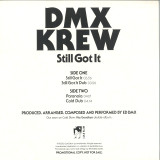
The Rephlex alumni and Rinse.fm resident DMX Krew channels Prince’s spirit in this new electro-pop maxi on Cold Blow.
Picking up his electro-pop and synth-funk hat from where it was laid on 2022’s Party Life LP, Ed DMX is switching gears and picking up the pace with four dance-inducing tracks. Another one of the brilliant releases that we’ve become to expect from the consistently hot Cold Blow! The titular track “Still Got It” is a brand new production with vocal and dub versions of driving bassline and Linn fills, exclaiming “I still got the music in me, and it sets me free!” amidst heartbreak. Teardrops on the dancefloor, anyone?
On the flip side, we are treated with an archive gem from the Rephlex era! The Telex-like pacey vocoder synth pop “Paranoia” was recorded around the time of “We Are DMX” album in 1999, and what a treat it is!
The closing track is the only previously released one. A dub version of “Cold Love” borrowed from the Japan-exclusive, CD-only 2005 album “Kiss Goodbye” which Cold Blow has announced to be reissued soon!
The Tallest Man On Earth - the project of Swedish musician Kristian Matsson - presents Too Late For Edelweiss, an album of new covers out ANTI. With Too Late For Edelweiss, Matsson weaves together a sparse collection of home recordings made in Sweden and North Carolina, captured fresh off a 39-date run with the adrenaline of tour rattling through his veins. The songs on Too Late For Edelweiss have been with Matsson since he started playing music as The Tallest Man on Earth in 2006. In those early years, Matsson used to perform "Lost Highway" by Hank Williams before he had enough songs to flesh out a full set. In July 2022, Matsson released a cover of Swedish super star Håkan Hellström"s "För sent för Edelweiss," a precious song that has been The Tallest Man"s walk-on music before every performance for over a decade and what inspired the title of this covers album. Since then, in the lead-up to this announcement, he has quietly released other selections, including Lucinda Williams" "Metal Firecracker," Yo La Tengo"s "Tears Are In Your Eyes" and now "Lost Highway." Mattson explains, "When I was a teenager I borrowed a Hank Williams album at the local library, and "Lost Highway" has been haunting me ever since. Many vocal sound checks throughout my career have heard Hank"s advice." As much as Too Late For Edelweiss feels like a scrapbook, an intimate memento with the ghosts of The Tallest Man"s earlier, sparser sound hovering at the edges, it"s also just the artifact of a moment - a flash of joy, of feeling recharged, of feeling good. These are the songs that happened to be in Matsson"s head at the time he sat down to record It came together so simply and easily - and in that way, it"s the purest distillation of making music - and being a fan of it, charting the connective tissue of a songwriter"s life.
Attarazat Addahabia & Faradjallah's album came to us as quite a mystery. Our friends from Radio Martiko got access to the studio archive of the Boussiphone label and a reel labeled “Faradjallah” was among the items they had found there. After listening to the selection of reels they borrowed, Radio Martiko felt it was not a fit for their label and helped us licensing it from Mr. Boussiphone instead. We knew nothing about the band. We just had the reel with the music but very little information. What we knew was that the music was incredible and very unique. Gnawa sounds were combined with funky electronic guitars, very dense layers of percussions and female backing vocals more reminiscent of musical styles further south than Morocco. We started asking around whether anyone knew the band with no immediate success until we asked Tony Day, a musician from Morocco who helped us during our search for Fadoul’s family. His sharp memory came through once again, remembering all the names of the Attarazat Addahabia band members and even how to contact the bands singer and leader Abdelakabir Faradjallah. After visiting him at his home in Casablanca with our Moroccan colleague Sabrina multiple times, he shared his personal story. His father arrived in Casablanca from Aqqa at the age of six and his mother came from Essaouira. Abdelakabir was born in the neighbourhood of Benjdia in 1942. Abdelakabir Faradjallah studied fine arts in Casablanca, graduating in 1962. He also played soccer in the second team of "Jeunesse Societe One". His brother-in-law Ibrahim Sadr worked for one of the biggest football teams of the time in Morocco called "Moroco Sportive Union", which allowed him to travel to France occasionally. While Ibrahim was never part of the band he brought along a few instruments from trips.
Yet the majority of the instruments they could not afford to buy were build by Faradjallah and Abderrazak, Faradjallah's brother who passed away early. For instance they had built a Spanish guitar and a drum made of wood barrel and sheepskin by themselves.During the 1950s Faradjallah was booked as a singer for surprise parties with friends. He started to write his first songs including "L’gnawi" in 1967 and wanted to make people discover Gnawa culture, or maybe rather his take on the culture to be more exact. Faradjallah recalls his first interaction with the genre in the streets of the Dern neighbourhood, where he used to go to elementary school. Gnawa is one of the essential musical genres of Morocco. It combines ritual poetry with traditional dances and music linked with a spiritual foundation. Musically a lot of influences originated from West Africa as well as Sudan. Gnawa is usually played by a selection of specific instruments such as the qaraqab (large iron castanets centrally associated with the music), the hajhouj (a three string lute), guembri loudaâ (a three stringed bass instrument) and the tbel (large drums). People would put shells on their clothes and instruments and use incense at their parties. "Sidi darbo lalla - lala derbo khadem..." came from Gnawa verses Faradjallah used to sing when he was 14. The lyrics tackle a global (im)balance of power and the question of social status in this course. The band Attarazat Addahabia was formed in 1968. The original line-up included 14 members, all from the same family. They played their first small concerts here and there starting in 1969. Later in 1973 they performed bigger shows for instance at the Municipal Theatre followed by the "Al Massira Show" at Velodrome Stadium in downtown Casablanca. Their first album "Al Hadaoui" (the one you are listening to) was recorded at Boussiphone studios in 1972 and was never released before. Nobody seems to remember the exact reason why Boussiphone ended up deciding not to put the album out. The album's title track also served as the basis for Fadoul's "Maktoub Lah", who frequented the same circles as the band for some time.
Their shows sometimes could go as long as 12 hours, starting at 5pm in the afternoon, with an occasional break here and there. In the 1980s the band took a brief break. Faradjallah recalled the reason for that break like this: "Zaki, the bands drummer, had fallen in love with a young girl from Mohammedia. Soon after, he fell very ill. The group members were convinced that the girl had given him ‘s'hor’ (a kind of local Moroccan version of "black magic"). For four years, the whole group stopped playing. It was unthinkable to find another drummer to replace Zaki, even temporarily." So they waited four years for Zaki to "get back on his feet" before going back on stage. Apart from very few gigs here and there Faradjallah stopped playing music in the mid 1990s. Some members from the younger generations formed a new band and still play frequently to this day. Faradjallah runs a television repair shop coupled offerings beverages and snacks in the Belevedere /Ains Sbaa district of Casablanca. While Faradjallah was primarily a musician, he would work for the local cinema and paint their posters for new movies by hand and he designed all artworks and cover posters of the band.
And this eventually led to him participating actively in our first exhibition dealing with Habibi Funk’s work in Dubai 2018. He helped us by creating calligraphic complementations on large photo prints for that show.
REPRESS
Codek is the brainchild of Jean-Marie Salaun who grew up in Paris influenced by the folklore of the inner city. In 1978 he joined art rock group SpionS alongside Gregory Davidow and recorded two singles. Diving into the Paris post punk scene he met Claude Arto and designed the artwork for Claude's single on Celluloid Kwai Systeme / Betty Boop.' Robin Scott (M Pop Music') had produced the SpionS first single and wanted to collaborate further. With Claude, Jean-Marie wrote Me Me Me', intended for a choir, for M. Then SpionS split and Robin was off to Switzerland to record an album to follow-up his hit single. That left Jean-Marie alone in London, where he began working as Codek, a play on the brand name Kodak The Me Me Me' single was released by MCA Records in 1980. Back in Paris, now with some studio experience, Celluloid Records hired Jean-Marie to produce records for Artefact and Les Orphelins. Over the next 2 years he began working on ideas for the next Codek single Closer / Tam Tam'
Closer' started its life as an electric baseline played by Jean-Marie. Claude Arto sequenced the floating synthesizers. Laurent Grangier and Frédéric Lapierre of reggae band Immigration Act played the horns. The lyrics Hard to say. Easy to do. We don't need to say what we do' were a statement on creation as narration expressed Jean-Marie's ennui, I'm tired with it.' Tam Tam' was inspired by Burundi drummers playing on the plaza in front of Beaubourg where the song was recorded. Jean-Marie enlisted one of the drummers from the circle, Georges Atta Dikalo, to lay down percussion for the song. The female singers were from the French Caribbean and added falsetto tribal chants. JM was part of the the African night scene in Paris, remixing Xalam's Kanu' and Touré Kunda's Salaly Muhamed.' Claude achieved complex rhythmic patterns using a modular synthesizer and heavy processing. Jean-Marie recorded himself beating his chest for the thump noises. The recording of Tam Tam' and Closer' spanned over two years. They started on 16-track in Studio d'Auteuil, where JM blew the woofers, before resuming in Studio Centre Georges Pompidou with an added 8-track recorder. Jean-Marie was producing other bands, and a lot of this was recorded on "borrowed" studio time. The single was released in 1981 on West African Music, a tiny label from the Ivory Coast, and was re-released a year later by Island Records in the UK (where the B-side was re-named Tim Toum'). Both tracks were staples in the DJ sets of Beppe Loda and Daniele Baldelli, finding a spiritual home in the Cosmic scene of Italy.
Both songs have been remastered for vinyl by George Horn at Fantasy Studios in Berkeley. The jacket is an exact replica of the 1981 edition with artwork by Angela Boy, inspired by primitive electronics and African paintings. Each copy includes an doubles-sided insert with photos and liner notes by Jean-Marie Salaun.
On The Deep and the Dirty, Eric Johanson is a roots-rock innovator and
modern-day guitar hero who uses blues as a springboard for an edgier,
broader sound
The Louisiana native teams up with Producer Jesse Dayton (Rob Zombie,
Supersuckers) and a taut power trio, firing twin barrels of sharp songwriting and
fiery fretwork along the way. The album arrives on the heels of four solo records
that all reached the Top 10 on the Billboard blues chart. Johanson fills The Deep
and the Dirty with revelatory anthems about embracing the modern moment and
the raw, honest sounds of a band performing together live. Offering everything
from roadhouse roots-rock to dark, bluesy Americana, it's a diverse album glued
together by a musician who's never been afraid of the grey area between
traditional genres.