'In de verte, dit uitzicht’ is Abel Ghekiere's second album. It is a celebration of beauty and sudden bursts of euphoria and melancholy, hidden in the distinctive soft and fragile sound of Ghekiere's music. Much more personal than on his debut record, he calls out to the world.
Working with voice samples and field recordings, voice and improvisation take centre stage. Sounds from outside are subtly interwoven with instruments, while conversations and memories act as a thread running through the compositions. The music flows into the room, bringing with it remembered places and voices.
The music was recorded very nomadically, in different places, with different people. Most of the parts were written and played by Abel Ghekiere himself but with guest contributions from Vitja Pauwels, Nicolas Rombauts, Leo Adamov, & Jan de Vroede, among others, the record breaks open into a soft sound palette.
Search:break it
Life is full of splendid yet fleeting moments – as is this album. Filled with songs of ever- changing bliss, it offers a modern take on Rephlexish-Warpy IDM and Electronica, embedded in that irresistible Electro groove from the land of milk and honey. Put your feet up – it’s time for a break from work.
First time on vinyl! Selected tracks from the 2018 digital release, newly compiled and remastered – plus three completely new tunes from the same era!
WOLFDRIFTA makes it a hat trick of releases of his own Wolves That Drift imprint via the ‘Cybertron Utopia’ EP.
The EP’s influences are transatlantic in nature, fusing core elements of Drexicyan Detroit electro with Sheffield bleep, breakbeat and early techno. The release features three original cuts and a wigged out, brain tickling remix from Fabric resident Anna Wall.
The EP kicks off with the title track ‘Cybertron Utopia’, a track characterised by it’s subtle deepness, driven by breaks and emotive pads. Closing out the A-side Anna Wall provides her take on the track adding the aforementioned wigged out-ness.
The flip opens with ‘Leave Luck To Heaven’ which harkens back to the early (and some one say golden) years of UK club music, dilated pupils at the ready for this subtle banger… ‘Stray Dog In Tokyo’ wraps up an impressive third release for the burgeoning imprint.
Music possesses an incredible ability to transform raw emotion into an expansive array of expression. Nackley knows this ideation well. Having spent years working behind the scenes as an agent, Bordello’s latest discovery now steps fully into the spotlight with Anger Management, channeling the turbulence of transition into sound.
Cathartic and charged compositions are at the heart of this four-track release. Acid-dipped keys are both delicate and direct in the driving highs of Return of the Gecko, a track pulsing with raw energy. The crueler side of the music industry isn’t so much parodied here as it is dismissed entirely—Nackley lets the music do the talking. Sublime Desolation is pure dancefloor dynamite, where synth sirens detonate and explosive rhythm commands movement.
Been A Long Time arrives dripping in attitude. Breaks and a juddering bassline face off with a hustling 303 hook, harmonies weaving through deep sonic textures. A renewed confidence courses through the release as Nackley explores a range of styles, closing with the synth romance of Heartbreaker—an addictive blend of keyboards, guitar strings, and enveloping vocals are the emotive ingredients of this tear-streaked work of 1980s-inspired joy.
And joy is exactly what Anger Management delivers—a healing triumph and a bold debut declaration from a rising talent.
- 1: Dance
- 220: Th Century
- 3: Survival (New Version)
- 4: Deprived
- 5: Killer On The Streets
- 6: Bitch
- 7: Defective Breakdown
- 8: Conscription
- 9: Casualty
- 10: We Don't Care
- 11: Live In Pain
- 12: Head On Collision
- 13: Metal Walls
- 14: Thoughts
Sunburst Yellow/Red Vinyl[28,15 €]
Introducing the vinyl reissue of "Defective Breakdown" by The Defects, a cornerstone album in the history of Irish punk. Originally released in 1982, this album captures the raw energy and rebellious spirit of Belfast’s punk scene during a turbulent period. Known for their uncompromising lyrics and driving rhythms, The Defects became anthems for youth discontent and anti-establishment sentiments. Fronted by the powerful vocals of Buck Defect, with infectious guitar work from Geoff "Duke" Gilmore, the band brought a visceral sound that resonated with audiences far beyond Northern Ireland. Tracks like "Survival" and "Brutality" showcase their fast-paced, no-holds-barred approach to punk, combining aggressive instrumentals with direct, hard-hitting lyrics. This vinyl edition brings "Defective Breakdown" back to life with enhanced clarity and depth, giving both long-time fans and new listeners the chance to experience The Defects’ iconic sound as it was meant to be heard.
- A1: Do U Fm
- A2: Novelist Sad Face
- A3: Green Box
- A4: Dusty
- A5: The Linda Song
- A6: Dm Bf
- B1: I Tried
- B2: Melodies Like Mark
- B3: Wildcat
- B4: How U Remind Me
- B5: Pocky
- B6: Bon Tempiii
- B7: Pt Basement
- B8: Alberqurque Ii
- B9: Mary's
Yellow Coloured Vinyl[29,37 €]
Kneading dough is tricky – you should know how it’s supposed to feel. If you try too hard you could make it worse. It’s a beautiful practice – creation with a gentle touch, to work at something so it can be left alone. “If it’s too drawn out it’s awful. It’s easy to give too much.” Dance in the mirror. Contemplate your veiny hands. Who do they remind you of?
You begin by mixing flour and water. “What happens when your people die? Why’d they move the rock to the other side of Ulster Park?” Eliza Niemi asks two seemingly unrelated questions in a rising melody with guitar accompaniment, like fingers playing spider up to the nape of your neck. Gentle pressure. Strands of gluten form to bind the mix. A new question lingers in the binding. When she admits “but I don’t know how to tell if I’m feeling it or not,” that question surfaces through the text. It is reiterated throughout the album. When I’m working with dough I think the same thing to myself.
On Progress Bakery, her second album as a solo artist, Eliza knows to leave some questions alone – to let juxtaposition and tension be the proof. It doesn’t have to be hard. The feelings and revelations they provoke rise in the heat. The smell is sweet. Crispy on the outside and soft all the way through. She playfully slip-slides through words and sounds and images, delighting in surprise, skimming ideas like stones cast across clear water, touching down briefly with uncommon grace.
The question provoked between those opening lines resurfaces in the strands between songs – “Do U FM” is fully formed and beautifully layered, while “Novelist Sad Face” is a short, acapella rendering of gentle curiosity. What is holding these ideas together? Some songs demand more, seem to carry a whole load – eventually the skipping stone will halt to sink and resume its idle duty – while others drift in and out of focus, the way thoughts and dreams become interwoven before the mind is sunk into true sleep.
Music and words don’t always have to interact. Where she decides to keep them apart gives a new contour to where and how she puts them together. The kind of thing you’re supposed to take for granted with songs and their singers comes alive in Eliza’s hands – the little miracle of mixing, kneading, stretching, and stopping.
So often on Progress Bakery, Eliza teases out truth and meaning by asking questions. “Do I wanna be crying?” “Do you want me good or do you want me bad?” “Do I need an eye test?” “I’m writing songs in my head while you’re going over stuff with me — is that cruel??” In “Pocky” Eliza ends with a question that feels to me like the actual biography, succinct and revealing:
I don’t wanna be made to see
I just wanna ask “what’s that?”
Grace that ought to be rare, but in its care and precision is offered humbly, with great generosity, and without announcing itself. Eliza’s simple, miraculous music is given further form and shape by a group of collaborators – invaluable guest musicians Jeremy Ray, Evan Cartwright, Steven McPhail, Kenny Boothby, Ed Squires, Carolina Chauffe, Dorothea Paas, Louie Short, and Avalon Tassonyi. Together with Louie Short, who recorded, mixed, and produced the album along with Jeremy Ray and Lukas Cheung, Eliza has cultivated a richness in sound and texture that prods and provokes the ticklish ear. Barely audible guitar tinkering, a brief lo-fi field recording of trumpets, the harmonic clicking of a looped synthesizer, a flourish of reeds, a child’s conversation, each uncanny sound perfectly placed, rippling out under a soft breeze.
Lay in bed alone at night and ask aloud to the stillness,
“What were you doing at the Albuquerque Airport?
What were you doing there??”
And hear your question answered by a dream of swelling, undulating cellos. Try to grasp at the melody and structure. It’s not an answer (if there could be one), but it moves deeper, closer to the weird layer of fleeting moments and disconnected images, barely perceptible at its core. Wait for the dream reel to click into place.
Eliza took me for a ride in Nicole (her beloved Dodge Grand Caravan) and told me she’d been thinking of the album as an embodiment of transition – and I think every transition, known or unknown, carries the weight of new meaning, skittering off the surface tension of life as you know it, creating ripples, sometimes bouncing off and sometimes breaking through. There is a trick you can use to tell if a dough is glutinous enough. You’re supposed to stretch it out as thin as you can without breaking it and hold it up to the light. If you can see through, even if it renders the world murky and uncertain, you should leave it alone. I love this trick. It’s one that Eliza seems to know intuitively: work gently and ask questions and don’t always expect answers, and when you can, take a glimpse at something new, and then leave.
Kneading dough is tricky – you should know how it’s supposed to feel. If you try too hard you could make it worse. It’s a beautiful practice – creation with a gentle touch, to work at something so it can be left alone. “If it’s too drawn out it’s awful. It’s easy to give too much.” Dance in the mirror. Contemplate your veiny hands. Who do they remind you of?
You begin by mixing flour and water. “What happens when your people die? Why’d they move the rock to the other side of Ulster Park?” Eliza Niemi asks two seemingly unrelated questions in a rising melody with guitar accompaniment, like fingers playing spider up to the nape of your neck. Gentle pressure. Strands of gluten form to bind the mix. A new question lingers in the binding. When she admits “but I don’t know how to tell if I’m feeling it or not,” that question surfaces through the text. It is reiterated throughout the album. When I’m working with dough I think the same thing to myself.
On Progress Bakery, her second album as a solo artist, Eliza knows to leave some questions alone – to let juxtaposition and tension be the proof. It doesn’t have to be hard. The feelings and revelations they provoke rise in the heat. The smell is sweet. Crispy on the outside and soft all the way through. She playfully slip-slides through words and sounds and images, delighting in surprise, skimming ideas like stones cast across clear water, touching down briefly with uncommon grace.
The question provoked between those opening lines resurfaces in the strands between songs – “Do U FM” is fully formed and beautifully layered, while “Novelist Sad Face” is a short, acapella rendering of gentle curiosity. What is holding these ideas together? Some songs demand more, seem to carry a whole load – eventually the skipping stone will halt to sink and resume its idle duty – while others drift in and out of focus, the way thoughts and dreams become interwoven before the mind is sunk into true sleep.
Music and words don’t always have to interact. Where she decides to keep them apart gives a new contour to where and how she puts them together. The kind of thing you’re supposed to take for granted with songs and their singers comes alive in Eliza’s hands – the little miracle of mixing, kneading, stretching, and stopping.
So often on Progress Bakery, Eliza teases out truth and meaning by asking questions. “Do I wanna be crying?” “Do you want me good or do you want me bad?” “Do I need an eye test?” “I’m writing songs in my head while you’re going over stuff with me — is that cruel??” In “Pocky” Eliza ends with a question that feels to me like the actual biography, succinct and revealing:
I don’t wanna be made to see
I just wanna ask “what’s that?”
Grace that ought to be rare, but in its care and precision is offered humbly, with great generosity, and without announcing itself. Eliza’s simple, miraculous music is given further form and shape by a group of collaborators – invaluable guest musicians Jeremy Ray, Evan Cartwright, Steven McPhail, Kenny Boothby, Ed Squires, Carolina Chauffe, Dorothea Paas, Louie Short, and Avalon Tassonyi. Together with Louie Short, who recorded, mixed, and produced the album along with Jeremy Ray and Lukas Cheung, Eliza has cultivated a richness in sound and texture that prods and provokes the ticklish ear. Barely audible guitar tinkering, a brief lo-fi field recording of trumpets, the harmonic clicking of a looped synthesizer, a flourish of reeds, a child’s conversation, each uncanny sound perfectly placed, rippling out under a soft breeze.
Lay in bed alone at night and ask aloud to the stillness,
“What were you doing at the Albuquerque Airport?
What were you doing there??”
And hear your question answered by a dream of swelling, undulating cellos. Try to grasp at the melody and structure. It’s not an answer (if there could be one), but it moves deeper, closer to the weird layer of fleeting moments and disconnected images, barely perceptible at its core. Wait for the dream reel to click into place.
Eliza took me for a ride in Nicole (her beloved Dodge Grand Caravan) and told me she’d been thinking of the album as an embodiment of transition – and I think every transition, known or unknown, carries the weight of new meaning, skittering off the surface tension of life as you know it, creating ripples, sometimes bouncing off and sometimes breaking through. There is a trick you can use to tell if a dough is glutinous enough. You’re supposed to stretch it out as thin as you can without breaking it and hold it up to the light. If you can see through, even if it renders the world murky and uncertain, you should leave it alone. I love this trick. It’s one that Eliza seems to know intuitively: work gently and ask questions and don’t always expect answers, and when you can, take a glimpse at something new, and then leave.
It’s always fun to let our audience peer through the party peephole with some hot behind-the-scenes info. For months, Black Light Smoke’s Control EP has supplied several of label head Tiga’s secret DJ weapons. In fact, he’s been sneaking out constantly after 9pm to play it out anywhere they’ll have him. And it’s little wonder to those who wonder why, as the Chicago-born producer’s top-flight mix of EBM, electro and Benadryl-soaked vocals has all the right people dancing.
Leadoff track "New York Is Dead” eulogizes the famous Big Apple Dance Party Scene in a way that will confuse the many who have embraced the city’s thriving “Groove With the Avengers” day rave series in Times Square. But the nihilism-liking doesn’t stop there, with the Friday-Til-I-Die attitude of “Black Hole at the Disco,” the pleather-dreaded post-cyberpunk of “Last Song Before Sunrise”, and the oxygen-deprived acid of “Break Your Back” culminating in the 11:45am-peak-time industrial trance of closer “Mind Control.”
Because we want this to be available to as many inhabitants of the blasted apocalyptic landscape we have pencilled in for 2034 or so, we have decided to make this release available both digitally and on vinyl. So whether you’ve managed to jack in illegally to a Spotify Wind Farm or you’re relegated to the hand-cranked misery of a Victrola while living in a barn or something, we’ve got you covered!
- A1: Special
- A2: B.a.b.e
- A3: Fantasy
- A4: Not Hell, Not Heaven
- A5: Tonight (I’m Afraid)
- B1: Fleshed Out
- B2: Let You Down
- B3: Cellophane
- B4: Suffer The Fool (How High Are You?)
- B5: Haunted
- B6: Are We All Angel
Olive Green Vinyl[28,15 €]
Scowl is a band that sounds exactly like their name implies. Venomous, fierce, antagonistic. A sneer not to be crossed. Over the last five years, the Santa Cruz, California, band has firmly planted their flag in the hardcore scene with their vicious sound and ripping live show, sharing stages around the world with Circle Jerks, Touché Amoré, and Limp Bizkit, and filling slots at prominent festivals like Coachella, Sick New World, and Reading and Leeds. But with their new album, Are We All Angels (Dead Oceans), Scowl is aiming to funnel all that aggression through a more expansive version of themselves. Much of Are We All Angels grapples with Scowl’s newfound place in the hardcore scene, a community which has both embraced the band and made them something of a lightning rod over the past few years. Standout single “Not Hell, Not Heaven” outright rejects the narratives cast onto them by outsiders. “It’s about feeling victimized and being a victim, but not wanting to identify with being a victim,” explains vocalist Kat Moss. “It’s trying to find grace in the fact that I have my power. I live in my reality. You have to deal with whatever you're dealing with, and it ain’t working for me.” The band breaks from a sense of disassociation to seek deeper connections on “Fantasy.” “It’s incredibly challenging to try to balance my love for the scene while also feeling, in some spaces, extremely alienated and hated,” Moss says. “‘Fantasy’ is about feeling like I don't know how to connect with these people anymore, because I have shelled myself away so hard.” The album ends in a philosophical place on the closing, titular track, “Are We All Angels,” asking questions like, “Is this all there is?” and ultimately putting it on the listener to decide. “It’s about the personal struggle between good and evil. It doesn’t matter how ‘good’ or ‘bad’ you are, there are systems that will try to rewrite your narrative no matter what you actually do,” explains Moss, noting that punctuation on “Are We All Angels” has been deliberately omitted in an attempt to leave the statement open-ended. Are We All Angels is the highly anticipated follow-up to Scowl’s debut, 2021’s How Flowers Grow, a 16-minute primal scream over punishing riffs. But amidst the pounding chaos, it was the record’s sonic outlier, a cleaner interlude called “Seeds to Sow,” that, true to its name, planted the seed for what was to come for the band. “It kind of laid out this destiny for us, and I feel like now we’re fulfilling that,” says drummer Cole Gilbert. The band continued to expand their sound on 2023’s widely acclaimed Psychic Dance Routine EP, incorporating more pop hooks and favoring gentler singing over heavy screaming, paving the way for what would come next. Scowl’s growth got a huge boost from producer Will Yip (Turnstile, Title Fight, Code Orange, Balance and Composure), who broadened the band’s scope. “Will would say, ‘Everything you have here is correct, but it’s in the wrong place,’” says Gilbert. Moss adds: “Will really helped restructure a lot of the material. Some songs he tore apart to make more space for the really good hooks and choruses.” But even through this more eclectic approach, Scowl loses none of their edge, and still manages to convey the anger and frustration that lies underneath. They are deeply committed to carrying the ethos of punk and its sense of community. “Hardcore and punk have sculpted how we operate, what we want to do as a band, and how we participate,” says guitarist Malachi Greene. “At our core, we are a punk and a hardcore band, regardless of how the song shifts and changes.
Every so often an album of such deceptive genius, of such aesthetic clarity, comes across our desk and transfixes us. Thought Leadership's III Of Pentacles is one such work of art. It's an instant classic and glides into the pantheon of timeless guitar-soul totems. Originally out on cassette only, we present the first ever vinyl issue. It's a hideously limited pressing of 300 for the world, so don't sleep on this.
Thought Leadership has already garnered big support from such tastemakers as Ruf Dug, Jason Boardman, Nathan Gregory Wilkins, J Walk, Evan Woodward, Justin Robertson and Heavenly's Jeff Barrett. The first time we heard III Of Pentacles, we nearly wept at the thought that something so beautiful, so bursting with real hope, could even exist in this brutal world. To quote the Quietus, "imagine if Stockport was situated somewhere along the Pacific Coast Highway rather than the M60, and you’ll have some idea of the coordinates to the post-industrial, sunburnt dream space opened up here."
So, who is Thought Leadership? What do we know about them? They reside in Stockport and are obsessed with ethereal guitar records. That’s about it. That and these X ideas shared with you, the listener.
Captured on a multitrack recorder in a terraced house in Stockport, this is as DIY as it gets. Glaringly obvious is a love for classic Factory and early 4AD. Perhaps it is the proximity to the River Mersey where the ideas arrived, and there being but three miles between where this and the Durutti Column’s classic “LC” was recorded, as the two operate across a familiar aural plain. Be it geographic or otherwise, limited by a true economy of means, namely guitar, pedals and drum machine, the fruit borne from these humble tools has been indelibly shaped by the perma-gloom that hangs low over the Manchester and Stockport environs.
Ushered in on 808 kicks, “I” opens the record as a beautiful Sketch for Stockport; a chiming maj7 chord dripping in chorus and delay sets us on our way. The Vini Reilly comparisons are unavoidable. “II” is all John McGeoch, with its trippy goth-psyche arpeggiated pattern cascading across the stereo image. Do those drums swing? But goths don’t swing?! They do here. We’re treated to a bit of crunch on the lead guitar part and some really lush reverb. We even step forth into shoegaze territory, albeit briefly, for the middle eight. “III”, a firm Be With favourite, continues the dreamy psyche leanings of the previous track, with an even bigger melody this time. We’re hearing The Teardrop Explodes on quaaludes here. A proto-dream pop cut soaked in melancholy. But watch out! The coda finds Johnny Marr has gotten into the ‘ludes and gatecrashed the final bars with some incredibly ignorant B minor pentatonic noodling.
“IV” ditches the drum machine for the first in a suite of three beatless electric guitar duets. The first of these semi-improvised rubato ideas is a striking departure from the earlier playful pieces, coming over emo and moody. Greyscale sulking for Stratocaster. Sign us up. “V” contains some really lyrical phrasing; a gorgeous conversation between two guitars. Real Stopfordian Primitive; meditative, crude, rain-soaked. We cycle through the same feels, then end on an alluring chord that breaks the pattern. Sometimes thoughts are like this. “VI” creeps in all plaintive, then a huge reverberating descending guitar line comes tumbling in like something off those classic Dif Juz 12”s. There’s some Maurice Deebank in there too, for sure, and the coda nods to early Meat Puppets.
“VII” rounds out the A Side, and succinctly presents a summary of all ideas explored thus far on our journey. The drum machine is back, this time with some wispy delay, before both guitars enter together playing interlocking lines. As we start, we end, with the delayed 808 guiding us out.
Opening Side B, “VIII” sees us embark on the other side of our journey as we slow down and space out. The drum machine is here, but the guitars are different now. Think Sensations Fix or Göttsching at his most peeled out. Drones, ambient drifts of broken chords and distorted lead lines all swirl round the mix. Side B is one for headphones for sure. “IX” is almost too exquisite for words. A New Age Mixolydian voyage through the cosmos. If you’re unmoved by the end you’ve probably got no pulse. We were left blunted ineffable by this one, such is the smudged elegance radiating from this idea. All hail the Thought Leader.
“X” is a full circle moment, and a fitting end. If you’ve not already elsewhere across the platter, you will be getting heavy Robin Guthrie vibes from this piece. Like the rest of Side B, this improvised jam sticks within a framework of related chords but the celestial energies channelled might invite us to wander “outside”, especially when the Tubescreamer is engaged.
RIYL Durutti Coulmn, Cocteau Twins, Dif Juz, Sensations Fix, Spike and adjacent guitar musicks – but, ultimately, this is just its own thing; such is the strength of ideas presented. "It’s good music to chill out to." (??)
Be With is honoured to present the first ever vinyl release of III Of Pentacles, carefully remastered by Be With's engineer Simon Francisco to ensure it sounds better than ever after its initial tape release. Cicely Balston's expert skills have made sure nothing is lost in the cut whilst the records have been pressed to the highest possible standard at Record Industry, in Holland. The original tape cover artwork, so crucial to Thought Leadership's striking visual aesthetic, has been rejigged for vinyl issue here at Be With. Its stark presentation befits the music contained within. They inform us that they shuffled their tarot deck to ask what the album should be called and the card you see on the cover popped out. The III Of Pentacles tarot card represents teamwork, shared vision and the ability to achieve goals through collaboration. We like to think Thought Leadership and Be With have nailed this one.
Donato Basile AKA DJ Plant Texture always wants his music to tell a story, and with his debut EP on Tresor Records, entitled Life, he’s now trying to tell the biggest story there is. According to the artist, “Life is about the fear of growing up”; both the anxiety itself and acknowledging and moving past it.
This narrative seems to have struck a chord with those who have heard the track, “People want to reflect themselves in the music; something personal. Lots of people have been in touch after hearing it; I guess they feel something melancholic in it. Personally, I imagine the track is like the life of a person; going from being born through childhood and youth and onwards, so perhaps they hear this?”
Having used an MPC since the early 2000s, Basile feels an intuitive connection to the hardware he uses, and so the creative process is very spontaneous: “I know where everything is so the music is made immediately. I make everything in the first ten minutes; after that if it’s not right then I just abandon it and start something else.” This immediacy, and familiarity with his equipment is apparent on the A-side, where Basile’s previous life as a drummer comes to the fore and tracks like Cycles and Ripetivo display his native understanding of groove but also how to stir things up - the three A-side tracks find classic techno rhythms seemingly falling apart only to snap back into place even stronger. The B-side finds Donato exploring more of his melodic side with WTT and the aforementioned title track showing Plant Texture’s love of breakbeat and classic techno.
The three digital bonus tracks continue this exploration of melody and syncopated beats - The EXP Days echos the wistful feeling of Life, as Basile meditates on the times spent at EXP, his record shop in Bari, which functioned as a meeting place for electronic producers in the area.
- Waco Kool Aid
- Hand Me Down Love
- Girl From Plaquemine
- Bayou La Batre
- Almost Forever
- Felt My Heart Breaking
- Shotgun Religion
- Man On The Marquee
- Just In Case
- Another House
- It'll Come Back To Me
- Fog Rolls In
Andrew Duhon has a knack for telling the kind of stories that clearly cost the writer something to tell- the kind of honesty that feels noble and never half hearted. When a song written by a stranger heals you, even in the smallest way, that's a connection beyond entertainment, and that is the journey Andrew Duhon sets out on from his home in Louisiana. His songs are about recognizing our story as much as they are about telling his, and his coast to coast pursuits have given him a clearer view of the American Landscape than most are privy to. Still, after years of voyaging off to every corner of the country, a new sensation arises with each return home to New Orleans. From that familiar return comes The Parish Record, a snapshot of life venturing from and returning to one of America's purest cultural vignettes, and the beauty, conflict, and stories that come with it. The Parish Record was recorded at Dockside Studios in Maurice, LA, where deep in Cajun country sits a wood-panel barn engulfed in oak and cypress trees along the slow butterscotch bayou pace of the Vermillion River. In this isolated hub of Acadiana, Andrew Duhon embarked with his trio of most trusted musicians - Myles Weeks (James Hunter Six, Eric Lindell) on Bass, Jim Kolacek (Feufollet) on Drums, and Daniel Walker (Heart, Ann Wilson, Amy Ray) on Keys - to harness of the sound and feeling of their surroundings. "I wanted this record to feel like home. It wasn't time to get out of town or try out something new on this one. It was about believing in the songs from where the songs came from," Duhon says.
- 1: Adagio
- 2: Ta Vimata
- 3: Omorfo Mou
- 4: Baby Brazil Feat. Las Palabras
- 5: Can I Say
- 6: 80 Days
- 7: Too Poor
- 8: Corfu
- 9: Caravan
Almost as soon as Σtella Chronopoulou began writing Adagio, her fifth album as Σtella, she knew the time had finally come to sing in Greek, her native tongue. It would be a first. She started the record almost by accident in 2019, during an 11-hour boat ride to the island of Anafi. Σtella had recently gone through a patch of personal turmoil and needed a break from home. On the ferry, she pulled out her cell phone as the boat clipped through the Mediterranean and began with a simple melody, steadily piecing together a rough instrumental. As psychedelic keyboards twinkled and swayed above staccato drums, the track suggested some deep exhalation, as if Σtella were letting go of long-unnecessary baggage. For a spell, she set the instrumental aside. She wasn’t ready yet, or in a rush. Σtella, after all, grew up in a slow place. During her youth in a relatively rural suburb of Athens, Greece, she and her friends played unfettered in empty streets, not worried about cars or permission, and living felt easy. But in the last decade life has steadily become busier for Σtella, now based in the heart of Athens. She has become one of modern Greece’s most popular musical exports, with three sophisticated, playful pop albums rendered with international élan. After her Sub Pop debut, Up and Away, in 2022, she catapulted beyond three million monthly Spotify listeners. That success was a blessing, but Σtella sometimes found herself pining for the slower pace of her youth. That longing is the thread that loosely binds together her fifth album, the entrancing Adagio. Borrowing its name from the term for music that’s meant to be played slowly, Adagio is a pop record that feels like a very warm blanket, its nylon-string guitars and featherlight percussion swaddling its listeners for three minutes at a time. Written and recorded over the span of five years, with a consortium of international collaborators including !!!’s Rafael Cohen and British songwriter Gabriel Stebbing, Adagio is a 27-minute meditation on love and desire, rest and time. Though the bulk of it is sung in English, Σtella delivers her first two songs in Greek here—“Omorfo Mou,” the one that began on the boat, and a cover of a 1969 cult classic of the Greek New Wave, Litsa Sakelariou’s “Ta Vimata.” It is a sign of the self-assurance that radiates throughout these tender and smitten little tunes. Start to finish, Σtella sounds more at ease and comfortable than she’s ever been on Adagio. These fetching songs will not slow her career or grant her that title track’s wish. But, for half an hour, Adagio adds a measure of warmth to the world, with time loosening its grip even if it doesn’t slow down.● Athens, Greece-based Σtella’s new album Adagio is a pop record that feels like a very warm blanket, its nylon-string guitars and featherlight percussion swaddling its listeners for three minutes at a time.● Features Rafael Cohen and British songwriter Gabriel Stebbing.• Σtella’s breakout hit “Charmed” from her 2022 album Up and Away has nearly 100 million streams, and was recently featured in the hit Max show Industry.• On Spotify, Σtella has 3.4 million followers, 66k monthly listeners.
We are beyond excited to release new remixes of an absolute classic tune by none other than Aural Float, the legendary collaboration between Pascal FEOS, Gabriel Le Mar and Alex Azary. Originally released on their debut album „Introspectives“ on the mighty Elektrolux records back in 1995, „South Of The Clouds Pt.2“ quickly became the standout track of the longplayer and an absoute fan favorite as it encapsuled the very essence of the no nonsense hypnotic sound of Frankfurt at the time. On the A-Side, label head honcho Gregor Tresher presents an epic 11-minute journey that pays homage to the timeless original while updating it for the modern day dancefloor. Through layers and layers of subtle percussion lines, Gregor´s remix builds up over time, with bold breakdowns that gives the distinctive melody line time to breathe, only to eventually culminate in bringing the massive beat back to take things to the next sonic level. On the flip, our good friends Extrawelt deliver another outstanding production once again, that has their signature sound written all over it. The boys respectfully incorporate the original melody line, while perfecting their remix by adding their unmistakeable trademark sound and sophisticated beat structures. Aural Float, we salute you and are forever grateful for this seminal piece of music, that easily stood the test of time and will continue to do so for generations to come.
- A1: A Carrion Harvest
- A2: Beyond The Veil (Of The Grey Mare)
- A3: Genesis Chamber
- A4: Deviant Spine
- A5: Engines Of War
- A6: The Finality Of Perpetuation
- B1: Crawling Over Corpses
- B2: In The Dread Of The Night
- B3: Drought Of Mercy
- B4: Psychosister
- B5: Ravage Of Empires
Petrol Green Vinyl[28,28 €]
Black Vinyl
“Sometimes They Come Back” is not just the title of a horror movie based on a macabre tale by Stephen King, it is also a summary of what happened to UK death etal veterans BENEDICTION, yet you might ke to add a “better than ever before”. While never officially disbanded, 2020’s Scriptures, the group’s eighth studio album achieved what is usually not an easy feat. It connected well with classics like Transcend the Rubicon (1993) and its immediate and memorable songwriting, the heavy-as-a-brick Grind Bastard (1998), and also saw legendary vocalist Dave Ingram return with his merciless roar and knack for morbid, twisted lyrics. After two albums with Dave Hunt on vocals, Scriptures was BENEDICTION’s first record in over a decade impressing with aggressive up-tempo attacks like ‘Iterations of I’ and ‘Rabid Carnality’ or the neck-breaking mid-tempo barrage of ‘Stormcrow’, songs that became live staples alongside ‘evergreens’ such as ‘I Bow to None’, ‘Magnificat’, ‘Subconscious Terror’ or ‘Vision in the Shroud’ in no time. With Scriptures, BENEDICTION even almost cracked Germany’s top ten by entering at a phenomenal #11 of the Official German Charts showing that the death metal veterans founded 1989 in Birmingham, England, offered an extremely well received sonic catharsis when due to the pandemic, people were locked down and pissed off.
When the shroud of Covid-19 lifted, the quintet finally could start to promote the album onstage with numerous festival gigs including Summer Breeze (DE), Copenhell (DK), Mystic Festival (PL), UK Deathfest, Alcatraz (BE), Party.San (DE), Obscene Extreme (CZ), Eindhoven Metal Meeting (NL) and Rock Hard (DE) to name but a few, played triumphant shows in South and Middle America as well as in their home country and all over Europe.
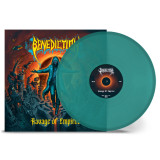
Kicking in the door without further warning, fast paced opener ‘A Carrion Harvest’ that mounts in a vicious Slayer-style break, starts with Ingram growling ‘Brace for impact, go!’ giving an unmistakable hint at what to expect during the following 47 minutes and 11 songs. With tremolo riffs and hammering grooves in spades, tracks like ‘Engines of War’, ‘Genesis Chamber’, ‘Crawling over Corpses’, ‘In the Dread of the Night’, and ‘Psychosister’ show a remarkable consistency and Scott Atkins, who produced the record at Grindstone Studio once again, ensures with a crisp and massive sound that the aforementioned impact leaves no bone unshattered. Garnered with artwork by Wolven Claws Artist, Ravage Of Empires continues BENEDICTION’s flawless discography on Premier League level and promises to become one of 2025’s undisputable old school death metal highlights!
With their brilliant new record in tow, founding members and guitarists Darren Brookes and Peter Rew, longtime vocalist Dave Ingram, drummer Giovanni Durst, and Nik Sampson (bass) will travel far and wide once more. Already confirmed are the Tales of the Triple Death Tour with Jungle Rot and Master kicking off on album release date as well as confirmed appearances at Wacken Open Air and Maryland Deathfest. More to be announced soon!
- A1: A Carrion Harvest
- A2: Beyond The Veil (Of The Grey Mare)
- A3: Genesis Chamber
- A4: Deviant Spine
- A5: Engines Of War
- A6: The Finality Of Perpetuation
- B1: Crawling Over Corpses
- B2: In The Dread Of The Night
- B3: Drought Of Mercy
- B4: Psychosister
- B5: Ravage Of Empires
Black Vinyl[22,48 €]
Petrol Green Vinyl
“Sometimes They Come Back” is not just the title of a horror movie based on a macabre tale by Stephen King, it is also a summary of what happened to UK death etal veterans BENEDICTION, yet you might ke to add a “better than ever before”. While never officially disbanded, 2020’s Scriptures, the group’s eighth studio album achieved what is usually not an easy feat. It connected well with classics like Transcend the Rubicon (1993) and its immediate and memorable songwriting, the heavy-as-a-brick Grind Bastard (1998), and also saw legendary vocalist Dave Ingram return with his merciless roar and knack for morbid, twisted lyrics. After two albums with Dave Hunt on vocals, Scriptures was BENEDICTION’s first record in over a decade impressing with aggressive up-tempo attacks like ‘Iterations of I’ and ‘Rabid Carnality’ or the neck-breaking mid-tempo barrage of ‘Stormcrow’, songs that became live staples alongside ‘evergreens’ such as ‘I Bow to None’, ‘Magnificat’, ‘Subconscious Terror’ or ‘Vision in the Shroud’ in no time. With Scriptures, BENEDICTION even almost cracked Germany’s top ten by entering at a phenomenal #11 of the Official German Charts showing that the death metal veterans founded 1989 in Birmingham, England, offered an extremely well received sonic catharsis when due to the pandemic, people were locked down and pissed off.
When the shroud of Covid-19 lifted, the quintet finally could start to promote the album onstage with numerous festival gigs including Summer Breeze (DE), Copenhell (DK), Mystic Festival (PL), UK Deathfest, Alcatraz (BE), Party.San (DE), Obscene Extreme (CZ), Eindhoven Metal Meeting (NL) and Rock Hard (DE) to name but a few, played triumphant shows in South and Middle America as well as in their home country and all over Europe.
Kicking in the door without further warning, fast paced opener ‘A Carrion Harvest’ that mounts in a vicious Slayer-style break, starts with Ingram growling ‘Brace for impact, go!’ giving an unmistakable hint at what to expect during the following 47 minutes and 11 songs. With tremolo riffs and hammering grooves in spades, tracks like ‘Engines of War’, ‘Genesis Chamber’, ‘Crawling over Corpses’, ‘In the Dread of the Night’, and ‘Psychosister’ show a remarkable consistency and Scott Atkins, who produced the record at Grindstone Studio once again, ensures with a crisp and massive sound that the aforementioned impact leaves no bone unshattered. Garnered with artwork by Wolven Claws Artist, Ravage Of Empires continues BENEDICTION’s flawless discography on Premier League level and promises to become one of 2025’s undisputable old school death metal highlights!
With their brilliant new record in tow, founding members and guitarists Darren Brookes and Peter Rew, longtime vocalist Dave Ingram, drummer Giovanni Durst, and Nik Sampson (bass) will travel far and wide once more. Already confirmed are the Tales of the Triple Death Tour with Jungle Rot and Master kicking off on album release date as well as confirmed appearances at Wacken Open Air and Maryland Deathfest. More to be announced soon!
- 1: Beautiful People (Feat. )
- 2: South Of The Border (Feat. )
- 3: Cross Me (Feat. Chance The Rapper &Pnb Rock)
- 4: Take Me Back To London (Feat. )
- 5: Best Part Of Me (Feat. )
- 6: I Don’t Care (Feat. )
- 7: Antisocial (Feat. )
- 8: Remember The Name (Feat. )
- 9: Feels (Feat. )
- 10: Put It All On Me (Feat. )
- 11: Nothing On You (Feat. )
- 12: I Don’t Want Your Money (Feat. )
- 13: 1000 Nights (Feat. )
- 14: Way To Break My Heart (Feat. )
- 15: Blow (With )
Scientist's name will be found on many dub releases in peoples record collections.His connection to King Tubby's studio is inseparable and many say when the dub end of Reggae music had fallen on quieter times it was Scientist with his often stripped back style and at other times, wild off the wall remixes that breathed life back into the dub cannon.
Scientist (born Overton Brownie,1960, Jamaica) was in many ways King Tubby's apprentice. Having helped his own father out repairing televisions and such like, he would help Tubby on winding transformer coils, that the amps of the day all needed. His interest in recording grew as he watched the many sessions taking place at Tubby's Dromilly Avenue Studio, learning the ropes as the musicians came and went. His first break happened when King Jammy (then Prince Jammy) was too tired to work on a session booked for producer Errol 'Don' Mais. Scientist engineered the session to every one’s bewilderment and great satisfaction.
His first hit would be a mix of Barrington Levy's 'Collie Weed' and his reputation built on the many versions he cut at Tubby's where he would become the engineer of choice. His pared down mixing style suited the new Dancehall reggae sound that came at the tail end of the 1970's and rolled into the 1980's. Such was his stature that albums were now sold with his name on their jacket, 'Scientist Vs Prince Jammy, 'Scientist meets The Space Invaders' to name but two.
His time at King Tubby's was followed as chief engineer working for the Hookim Brothers at the mighty Channel 1 Studio's and on many of top producer Henry 'Junjo' Lawes tracks, that were hit after hit at the time.
We have compiled some tuff tracks from the late 70's / early 80's just before everything went digital. Some great dub versions to some killer tracks that rocked the dancehalls around this golden time.The mighty Tristan Palmer whose killer cuts 'BadBoys','Stop Spreading Rumours','Eveready' and 'The Greatest Lover’ alongside Michael Palmer's debut release 'Mr Landlord' and Robert Trench's 'Mr Babylon'. The songs stand back-to-back with Tony Tuff's timeless 'Never Trouble Trouble' and the biblical Rod Taylor's 'The Lord is My Light'. Sammy Dread's 'Wah Dah Wah' and the always respectful Dennis Brown's 'Time and Place' all benefited a touch of magic from The Scientist and his laboratory of effects.
Hope you enjoy the set.....