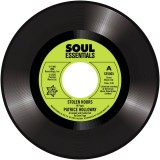
- A1: Joe Simon - Theme From Cleopatra Jones
- A2: Dee Edwards - Why Can't There Be Love
- A3: Alonzo Smith - Love Machine
- A4: King Floyd - Hard To Handle
- A5: Tobi Lark - Challenge My Love
- A6: Millie Jackson - All The Way Lover
- B1: Nancy Holloway - Hurt So Bad
- B2: Darondo - Didn't I
- B3: Dorothy Moore - Don't Let Go
- B4: Brenda George - What You See Is What You're Gonna Get
- B5: Betty Padgett - Sugar Daddy (Part 1)
- B6: George Soule - Talkin' About Love
Buscar:brenda
You could think of the collection of tracks here as a library record of sorts, and each track inhabits its own universe. Tropical fits various moods and situations, and it could soundtrack any number of activities at home or on a dancefloor - whether real, imaginary, or hallucinated. Strangely enough, it sounds like it could have been constructed from obscure Italian library breaks, when instead every instrument has been played and panned, several times over, across magnetic tape.
The genesis of many of these tracks began when CV Vision moved to Berlin in 2014. His flat had a small chamber where he could fit a drum set, so he treated the walls with foam, and in true DIY style, dived headfirst into recording these tracks. It was the natural next step on an audio adventure that first began when CV Vision picked up the guitar in his teens, and a couple years later started recording with friends in his home town of Bayreuth. Fast forward ten years and here is his debut - a culmination of practising chops and learning instruments, mastering recording techniques and fine-tuning the CV Vision sound.
It’s a sound that condenses elements of acid rock, psych soul, library funk and new wave oddities into a movie soundtrack for your mind. It’s a journey from ‘60s west coast LSD-drenched excursions to ‘80s synth and post-punk mutations. Tropical is a plunge into another time, another music you can simply swim around in and explore.
Side A opens up with Tropical Tune In, which rides in on a clave and a warm wind, blowing a distinctly herbal aroma and recalling exotica dons like Les Baxter and Martin Denny. Following on with the aural equivalent of a sea breeze through your mind, Spaziergang am Meer blows away the cobwebs and conjures some nice library moments like Stringtronics or F eelings . Next, Ba_c_k(Lava) bounces out of a cold wave post-punk melting pot and crashes through the speakers like a blazed Zebedee, with some sweet eastern synths for added flavour, before the rolling bass licks of Der Böse Schamane take us into another dimension, landing somewhere between a psych rock freak out and a Black Ark dub session. Mr Maze channels the arpeggiators of synth outsiders like Mort Garson and Bruce Haack, creating a glorious interlock of robotic electronics and freakbeat vocals. The side comes to a close with the guitars of Der Strand (außer Rand und Band) letting loose like syrupy springs, and setting a languid mood like the bedroom scene in Bedazzled (1967 version). Side B kicks off with Parallel Universum, which comes through like a woozy krautrock workout, all ducking synths with big chord shifts to create an epic deranged beehive of a soundtrack. Im Land der Ameisen evokes the spirit if not the sound of White Rabbit, when logic and proportion have fallen sloppy dead, before waking up and wandering through the side alleys of Marrakech with the West Coast Pop Art Ensemble and the Electric Prunes, as Ritual (No. 4) blares out the speakers of passing tuk tuks. Ein Wasserfall plumbs the deep synth depths, like Raymond Scott in scuba gear, modular rack strapped to his back delivering oxygen as he swims between connector cables and seaweed forests through a watery underworld. Banana King sounds like a lost soundtrack to Donkey Kong or Mario Cart, if the cart radio was tuned into a synth
documentary hosted by James Pants, while Das Kloster am Berg takes the baton from Brenda Ray and her Naffi cohorts, all dubbed-out niceness and post punk swagger. The LP closes out with Tropical Drop Out, a dreamscape rather than a wake up call, coaxing you deeper into the trek across the desert of your mind.
And that’s Tropical in its essence: capsules from another time, snapshots of another sound, messages from another mind - all in the service of inducing the visions in your head.
written by Max Cole
After the heaviest of years, it should be time to take a little weight off with the playful sounds of The Person. Mapping its own Bermuda Triangle between dub-pop, sugary synthwave and Balearic boogie, ‘Tide Life’ transports Compass Point to Soggy Bottom, providing maximum fun, sun and bitmap escapism.
The eagle-eared may recognise The Person from the aspirational Italo-rockers Steaming Jeans, whose chalet-ready romp on Bordello A Parigi scored a Winter Olympic gold back in early 2020. Now left to her own devices, Minna Wight swaps the slopes for a jet ski and takes a Wave Race from Summer Bay to Monkey Island across 11 cuts of vintage oddball pop.
Whether she’s borrowing Brenda’s Beach Balls for the dubby daydream of ‘Snail Cafe’ and ‘The Place’, serving lost library cues to SNES club scenes on ‘Barry R Reef’ and ‘Elastic Shoes’ or spinning high school slow jams into synth soul ballads like ‘Nice Feeling’, Minna disguises serious musicianship behind a naive aesthetic. Disarmed by charm, we’re powerless to resist her tidal pull.
Patrick Ryder
Black vinyl editions of four 'Elephant' era singles ('Seven Nation Army', 'I Just Don't Know What To Do With Myself, The Hardest Button to Button' and There's No Home For You Here). Featuring badass non-album b-sides, 3 of which are covers of songs from some of Detroits turn-of-the-millenium best and brightest (Brendan Benson, Jason Falkner, Dan Miller (Blanche), Soledad Brothers), and one of which is a live White Stripes medley of "I Fought Piranhas" and "Let's Build a Home," recorded at New York's legendary Electric Lady Studios. Most of these tracks have been remastered from the original analog sources, and the artwork on all the singles has been improved upon by the Third Man Creative Hive. "There's No Home For You Here", which was originally coupled with a generic company sleeve, now has stunning new artwork. It looks electrifying! On top of looking good, these sleeves are soft as a baby, printed with an aqueous coating, so they feel like a cross between rubber and lambskin. It's nice.
Black vinyl editions of four ‘Elephant’ era singles. The four singles ("Seven Nation Army," "I Just Don't Know What To Do With Myself," The Hardest Button to Button," and "There's No Home For You Here") feature badass non-album b-sides, 3 of which are covers of songs from some of Detroit's turn-of-the-millenium best and brightest (Brendan Benson, Jason Falkner, Dan Miller (Blanche), Soledad Brothers), and one of which is a live White Stripes medley of "I Fought Piranhas" and "Let's Build a Home," recorded at New York's legendary Electric Lady Studios.
Most of these tracks have been remastered from the original analog sources, and the artwork on all the singles has been improved upon by the Third Man Creative Hive. "There's No Home For You Here", which was originally coupled with a generic company sleeve, now has stunning new artwork. It looks electrifying! On top of looking good, these sleeves are soft as a baby, printed with an aqueous coating, so they feel like a cross between rubber and lambskin. It's nice.
This is the original Arcade Fire demo EP recorded in August 2003 in a barn in Maine, featuring an earlier line up of the band (Win Butler, Régine Chassagne, Dane Mills, Brendan Reed and Myles Broscoe). It was produced by Richard Reed Parry, Win and Régine, and was originally only available at live shows. The EP features an early version of fan favourite 'No Cars Go'. Marketing. Online/social media activity. Poster campaign and database mailout.
It’s a family affair on the second Growing Bin 7”, as Peter & Patrick Jahn enjoy some father and son boogie with a smooth split release. A sunblushed moocher served two ways, this disc is designed for horizontal dancing…
Rooting around the cupboards in his family home outside Nuremberg, Patrick Jahn unearthed a dusty box of cassettes, saved for posterity but eventually forgotten. Somewhere between ‘True Blue’ and ‘Brothers In Arms’ was a faded C60 full of unreleased demos by his father Peter, recorded in the mid to late 80s. Back then Jahn Sr owned a pub club called Schrank (Cupboard to the Anglophones), with an upstairs office he used as a music studio. In amongst naïve synthesiser experiments and carefree noodling was a Balearic boogie bomb, all strolling synth bass, clipped funk guitar and seaside melancholy – like Brenda Ray on a Wim Wenders soundtrack.
Too impressed to keep it a secret, Patrick played the cut to Carsten “Erobique” Meyer, when he was over there jamming, and Hamburg’s premier funk freak suggested this might be of interest to his likeminded hometown freak Basso. Instantly in love, the Growing Bin boss suggested Patrick provide his own version for the flipside, and so it was, reborn with percussive sway, moonlit keys and beefy bass tones for the next generation. Here’s to the Jahn family, father and son but brothers in calms…
Patrick Ryder
Thembisa’s Hot Soul Singers were formed in 1975 by promoter and producer Sam “Jiza Jiza” Mthembu. In the early years the trio was called the Thembisa Happy Queens and consisted of sisters Ntombifuthi and Nombuso Mabaso and Lindiwe Ndlovu. The trio would start out playing Jive, Zulu Disco and other popular sounds of the 70s . In 1979 they became the Hot Soul Singers and would begin a career in the emerging Disco scene which their group name was now more fitting for.
Their first single under the new name was a tribute to their producer Sam, and their first album “Together” would come 2 years later in 1981. It contained their Lamont Dozier rip off from a year earlier, and biggest hit to date “ Give Me My Love Back” which was playing in jukeboxes across the country. At this time the Hot Soul Singers were also gaining popularity due to their demand as an opening act for American groups. Sam’s ongoing pursuit to be a successful promoter also helped to ensure they were always in the headlines and playing shows. It would be in 1983 that the group would temporarily step away from a major label and go onto record their first Maxi single with the independent Raintree Records new Lyncell Imprint.
Like most places in the world the early 80s was a fast changing time in music for South Africa. Although the Maxi had a disco standard for years in other parts of the world it had only recently been popularized in South Africa. Thanks to the Brenda and the Big Dudes smash, Weekend Special, the maxi took over as the preferred format for pop music, replacing the cheaper but time restricting 7” single. Singles were being pushed to the limits in the early 80’s with running times of 4+ minutes a sides by some labels. The Maxi allowed for groups to extend their grooves onto a full side and later album art containing smiling musicians infant of cheesy backdrops became the norm. Synthesizers had been used in pop music for years already but the DX7 wouldn’t land in the country for another year. Drum machines were being used but had yet to fully replace live drummers like would happen in the years to come. The recording of this new single would require a full band resulting in it being one of the gems of the crossover period before the complete midi takeover. Durban’s Graham Handley was recording some of the best upcoming Disco sounds for labels like Heads Music and groups like Kabasa and Masike Mohapi and was tasked as engineer. Other known musicians in the session would be Jimmy Mgwandi from the group Image, who’s signature bass playing can be heard on both songs. A young Daniel Phakoe aka “sox” was also present and took care of the male parts of the vocal line. Both musicians have writing credits along with lead singer Nombuso. Other possibilities of musicians would be Thami Mduli aka Professor Rhythm who had been with the group since their early days as well as a young Chicco who was best friends with Jimmy at the time.
The single, which was packaged in a customized but simple company disco sleeve, went on to do quite well. Less than a year later they would feature on a track with Sunset which would lead to them singing with Sounds of Soweto records label. The group would enjoy the growing fame when tragedy struck in 1984. On their way to a show in Mpumalanga they were involved in a car accident which took the life of Nombuso and left her husband Sam with a leg injury he limps with to this day. Upon recovering Sam would organize a tribute concert at Soweto’s Jabulani Amphitheatre. Even though the tragedy left the group broken and without a member the band went back to work to record their second full length album. They worked with Mac Mathunjwa who had written Nombuso’s favourite song “Going Crazy”. This album would be released with two different names and covers. One took the former singer’s favourite song as the album name and used a photo consisting of all three girls where the other released under the name “ A Tribute” and would only have the remaining members on the cover.
Although the tragedy never halted the group, moving forward the trio of singers would see a few members change. Lindiwe would leave to join Freeway and then become Linda “Babe” Majika so by the time they were ready to record in1986, now with Teal records, the only original member was Ntombifuthi. She would also shortly leave the group and provide backing vocals to other artists including her old band mate Linda. The Hot Soul Singers would be kept alive by Jiza Jiza and go on to record 5 more albums before calling it quits in 1990 after a successful 15 year career. Today the only core member left is Sam Mthembu who still lives in Thembisa and is occasionally promoting live events. Even though he did produce a handful of artists back in the 70s, his most significant additions to the music industry were the Hot Soul Singers and his event promotions, which is what he is best known for and will most likely be the legacy of his career.
- A1: Love Is All We Have Left
- A2: Lights Of Home
- A3: You're The Best Thing About Me
- A4: Get Out Of Your Own Way
- A5: American Soul
- B1: Summer Of Love
- B2: Red Flag Day
- B3: The Showman (Little More Better)
- B4: The Little Things That Give You Away
- C1: Landlady
- C2: The Blackout
- C3: Love Is Bigger Than Anything In Its Way
- C4: 13 (There Is A Light)
- D1: Ordinary Love (Extraordinary Mix)
- D2: Book Of Your Heart
- D3: Lights Of Home (St Peter's String Version)
Deluxe Box Set[41,60 €]
Double cyan blue vinyl in a gatefold sleeve. Two printed inner sleeves and a six panel oversized booklet. Download card enclosed. The vinyl includes the Deluxe track listing - 17 tracks in total.
U2 return with their hotly anticipated new studio album 'Songs of Experience'. The Island Records priority release completes a stellar year for the Dublin band, following their return to stadiums with the critically acclaimed, sold out 'The Joshua Tree Tour 2017' playing to 2.4 million fans in just 51 shows across Europe and North and South America, as well as the successful 30th Anniversary re-issue of 'The Joshua Tree'.
Recorded in Dublin, New York and Los Angeles, Songs of Experience was completed earlier this year with its subject matter influenced by Brendan Kennelly's* advice to Bono, to ...write as if you're dead'. The result is a collection of songs in the form of intimate letters to places and people close to the singer's heart: family, friends, fans and indeed himself.
Songs Of Experience is the companion release to 2014's 'Songs Of Innocence', the two titles drawing inspiration from a collection of poems, Songs of Innocence and Experience, by the 18th century English mystic and poet William Blake.
Produced by Jacknife Lee and Ryan Tedder, with Steve Lillywhite, Andy Barlow and Jolyon Thomas, the album features a cover image by Anton Corbijn of band-members' teenage children Eli Hewson and Sian Evans.
'The Blackout' and 'You're The Best Thing About Me' were the first songs to be made available from the album. 'You're The Best Thing About Me' is the band's first UK Top 20 airplay record in a decade and has also been remixed by Norwegian superstar DJ and producer Kygo.
*Brendan Kennelly - Irish poet, novelist and Professor Emeritus at Trinity College, Dublin.
- A1: Thore Pfeiffer - Urquell
- A2: Max Würden - Diminish
- A3: Yui Onodera - Cromo 4
- A4: Joachim Spieth - Meteor
- B1: T Raumschmiere - Notre-Dame
- B2: Klimek - All The Little Horses
- B3: Morgen Wurde Feat Maria Estrella - Lässt Los
- B4: Markus Guentner - Clade
- C1: Thomas Fehlmann - Liebesperlen
- C2: Gen Pop - Iron Woman
- C3: Klimek - Requiem For A Butterfly
- C4: Leandro Fresco - Brenda
- D1: Max Würden / Pepo Galan - Stay
- D2: Leandro Fresco / Thore Pfeiffer - Neo
- D3: Thore Pfeiffer - Alles Bleibt Anders
- D4: Andrew Thomas - Song 9
- D5: Andrew Thomas - Sleep Fall
20 years of Pop Ambient. Already? One didn’t notice. It’s an anniversary which comes quietly. An anniversary with quiet tones.
In the spirit of the special restraint of pop-elegance, it has no reason to drawn attention to itself with a big „Tam-Tam“. Or better: „Bum-Bum“. The bass drum stays outside. Nevertheless, in fast-paced, overstimulated times of moving forward, it’s a joyful occasion to look back.
What strikes most by putting or listening to 20 years of pop ambient in a row is the central theme that holds together the dense aesthetic concept like the pearls of a necklace.
Floral beauty for digital naturalists. Music like flowers, that don’t wilt. Timeless. Ageless. But with all of the conceptual unity and resolution, Pop Ambient would not be Kompakt without the break, the friction, the expansion of musical boundaries in between tradition and innovation, in between conspiracy and the openness of the discourse.
Aestheticism, escapism, acting in the spirit of „nevertheless“. Swans drifting by, clouds pass over, everything is floating and: „Boredom is a stylistic device“ (Andy Warhol).
Pop Ambient Music is medicine against illnesses, that you don’t even suffer from. It’s giving everything, demanding nothing.
Musical lotus leafs, off which the virtual wastewater of our time is rolling like the reality is dripping off the matrix.
In this sense, we’re happy about the pop-ambient anniversary greetings from new and old companions like Thore Pfeiffer, Max Würden, Yui Onodera, Jörg Burger, Thomas Fehlmann, Morgen Wurde, Leandro Fresco aswell as contributions from T.Raumschmiere, Andrew Thomas and, after a long break, from friends from early days like Joachim Spieth, Markus Guentner und Klimek.
Pop Ambient 2020 is released digital, as CD and of course as a chic double vinyl. Also included in the package: The whole distinctive cover-series as an art book of 44 pages. And for all of the old and young fans and collectors there is the Pop Ambient 2001 in a overhauled original version out on vinyl for the very first time.
Breath in. Breath out. Thank you.
Wolfgang Voigt, September 2019.
20 Jahre Pop Ambient. Schon? Hat man gar nicht gemerkt. Ein Jubiläum auf leisen Sohlen. Ein Jubiläum der leisen Töne. Und ganz im Sinne pop-eleganter Zurückhaltung, kein Grund, großes Tam-Tam zu machen. Oder besser gesagt: Bum-Bum. Denn die Bassdrum bleibt ja draußen. Dennoch freudiger Anlass genug, in reizüberfluteten, schnelllebigen Zeiten auf dem Weg nach vorne einen Blick zurück zu werfen. Wenn man 20 Jahre Pop Ambient Platten hintereinander legt / hört, sticht einem zunächst der sprichwörtliche rote Faden ins Auge und ins Ohr. Der Faden, der das dichte, ästhetische Konzept zusammenhält wie die Glieder einer Perlenkette. Florale Schönheit für digitale Naturalisten. Musik wie Blumen, die nicht welken. Zeitlos. Alterslos. Aber Pop Ambient wäre nicht Kompakt, wenn nicht bei aller konzeptionellen Ge- und Entschlossenheit, auch der Bruch, die Reibung, das Ausweiten musikalischer Genregrenzen zwischen Tradition und Innovation, zwischen Konspiration und Diskursoffenheit, inkludiert wäre. Ästhetizismus, Trotzdemismus, Eskapismus. Schwäne treiben, Wolken ziehen, alles fließt – und: »Langeweile ist ein Stilmittel« (Andy Warhol).
Pop Ambient Musik ist Medizin gegen Krankheiten, die man gar nicht hat. Gibt alles und verlangt nichts. Musikalische Lotusblätter, an denen das virtuelle Schmutzwasser der Zeit abperlt, wie die Realität an der Matrix.
In diesem Sinne freuen wir uns über pop-ambiente Jubiläumsgrüße von neuen und alten Weggefährten wie Thore Pfeiffer, Max Würden, Yui Onodera, Jörg Burger, Thomas Fehlmann, Morgen Wurde, Leandro Fresco sowie Beiträge von T.Raumschmiere, Andrew Thomas und nach langer Pause, von Freunden aus frühen Tagen wie Joachim Spieth, Markus Guentner und Klimek.
Pop Ambient 2020 erscheint Digital, als CD und natürlich als schickes Doppelvinyl. Mit im Paket: Die gesamte unverwechselbaren Cover-Serie als 20-seitiges Kunstbuch. Und für alle neuen und alten Fans und Sammler, erscheint zeitgleich Pop Ambient 2001 erstmalig auch auf Vinyl, in generalüberholter Originalversion. Das Ganze gibt es zudem im schicken Jubiläumsschuber in limitierter Auflage und farbigem Vinyl, exklusiv erhältlich nur auf kompakt.fm …
Einatmen. Ausatmen. Danke.
Wolfgang Voigt, September 2019
Out September 6th on Dischord Records, Anthropocosmic Nest is the second full-length by Washington, D.C.’s The Messthetics, who are Anthony Pirog, Joe Lally, and Brendan Canty.
Formed in 2016 the Messthetics are Anthony Pirog, Joe Lally, and Brendan Canty. Pirog is a jazz and experimental guitarist based in Washington, D.C. One half of the duo Janel & Anthony, he also performs regularly with Low Ways Quartet and James Brandon Lewis. Canty and Lally were the rhythm section of the band Fugazi from its inception in 1987 to its period of hiatus in 2002.
Since then, Canty has remained active as a documen- tary filmmaker, producer, and composer, and released a music as a member of the band Deathfix. Lally has re- leased three solo albums and toured extensively with a frequently-rotating cast of musicians.
Recorded at the band’s practice space throughout 2019, it’s an album that more perfectly captures the trio’s current live dynamic, complete with improvisational tangents, playful experimentation, and cathartic sprawl.
When The Messthetics recorded their debut album in 2017, the trio had only done a handful of shows and had yet to fully find its footing on stage. In a way, those compositions were a template for the band that Pirog, Lally, and Canty hoped would come into being through subsequent work on the road.
Since then, The Messthetics have played upwards of 200 shows across the US, Europe and Asia. Their dialog as a performing unit has necessarily focused and intensified. As a result, Anthropocosmic Nest offers a more var- ied vision of the band. It’s the loudest the trio has ever been and also the quietest.
Remastered 6 song mini LP originally produced in the
mid-80s *very in-demand with funk record collectors and
DJs worldwide. Featuring 6 upbeat synth-driven, boogie
funk dance tracks *first officially licensed vinyl reissue*
Colours of the Rainbow contains the best 6 tracks from two rare South African LPs by recording artist Bibi
the Kid Msomi: 4 tracks from the 1985 album Searching, and 2 tracks from the 1986 LP What Kind of Love
is This?
South African funk music from the 80s has recently gained recognition as some of the best funk
productions in the world; yet so many titles remain virtually unknown outside of South Africa, especially
due to the scarcity of the original pressings (due in part to the destruction of any music perceived as
subversive by South African government censors at the time).
The level of musicianship on these recordings is simply world-class. Even Paul Simon was trying to work
with Bibi Msomi while recording his Graceland album in South Africa (read more about it in this exclusive
interview).
Combining American and South African funk influences, these 6 upbeat dance tracks feature popular
synths and drum machines of the day. The subversive lyrics and infectious grooves on these recordings
address the political turmoil during the peak Apartheid years in a way that was just subtle enough to slip
under the radar of stringent government music censors. Deep messages of freedom and universal
brotherhood are backed by some of South Africa's greatest musical talent, including:
Mac Mathunjwa (Street Kids, Neville Nash), Sello Mphatsoane (Bayete), The Hot Soul Singers, Cisco the
Champ Mokoena, Blackie Sibisi (Step Ahead, Brenda & The Big Dudes), Alistair Coakley (Hotline, Stimela),
Ladysmith Black Mambazo, Jantshi Mayo (Sipho Mabuse), Peter Mokoena (Pure Magic), Solly Ledwaba
(Juluka), Joey Mabe (Mahlathini and the Mahotella Queens), Deborah Fraser (Brenda Fassie), Zamo
Mbutho, Banzi Kubheka (Banjo, CJB), Cyril Mnculwane (CJB), and Stimela vocalists: Marilyn Nokwe, Tu
Nokwe, Hlengiwe Maphumulo, Beaulah Hashe.
Meticulously re-mastered with love for maximum impact on the dancefloor; we hope you enjoy the
songs contained on this spiritual boogie masterpiece.
collecting orders for repress
The Messthetics are an instrumental trio featuring Brendan Canty (drums), Joe Lally (bass), and Anthony Pirog (guitar). Brendan Canty and Joe Lally were the rhythm section of the band Fugazi from its inception in 1987 to its period of hiatus in 2002.
This is the first band they've had together since then. Anthony Pirog is a jazz and experimental guitarist based in Washington, D.C. One half of the duo Janel & Anthony, he has emerged as a primary figure in the city's out-music community.
The trio's debut includes nine songs recorded at Canty's practice space throughout 2017, live and mostly without overdubs. It's a snapshot of a band dedicated to the live ideal, where structure begets improvisation.
Brendan Canty: drums
Joe Lally: bass
Anthony Pirog: guitar
Black Truffle is pleased to make Oren Ambarchi's Grapes from The Estate available once more on vinyl. Originally released on CD on Touch in 2004 and reissued on Southern Lord as a limited double LP in 2006 during Ambarchi's tenure as a member of Sunn O))), Grapes from the Estate was a landmark release for Ambarchi, seeing him expand his sonic palette beyond the clipped, bass-heavy electric guitar tones he was known for at that point. Incorporating subtle layers of strings, keyboards, percussion over a bedrock of his signature guitar tones, in retrospect this album can be seen as the beginning of a broadening and evolution in Ambarchi's work that would lead to his acclaimed, densely layered epics for Editions Mego, Quixotism (2014) and Hubris (2016). Beginning with the shuddering pure tones of opener 'Corkscrew', which looks back to previous guitar-only releases such as Suspension (2001), the album's next two pieces show a progressive broadening of the instrumental palette and a corresponding move away from textural abstraction and sustained tones towards more traditional notions of musicality. This reached its high point on the album's third piece, the fifteen-minute long 'Remedios The Beauty', where guitars, both acoustic and electric, strings, piano, and bells build from a murmur to an interlockinging web of repeating melodic patterns over gently swinging brushed snare and cymbals. The epic closer, 'Stars Aligned, Webs Spun', returns us to a space populated only by the electric guitar, but unlike everything Ambarchi had produced up until this point in his career, the piece has a liquid, psychedelic edge that looks forward to the shimmering harmonics of his more recent work. As Brendan Walls wrote at the time of the original release, this is 'another outpouring of personal, intimate and enduring music from Oren Ambarchi'. Presented in a stunning gatefold sleeve featuring the original artwork and design by Jon Wozencroft. Redesigned by Stephen O'Malley Remastered and cut by Rashad Becker at D&M, Berlin.
Described by Clash Music as one of America's best songwriters', Brendan Benson has consistently unfurled unparalleled melodies and lyrics in his acclaimed career. Over twenty years in, he's still wowing folks and Half a Boy, Half a Man' is a powerful dollop of power chords wrapped into a tale of split personalities. Backed with an astute cover of Jules Shear's Big Kid Face' from his 1989 album The Third Party' in which Benson helps shine a light on this oft-overlooked but seminal songwriter.
Best known as half of the songwriting team at the heart of the Raconteurs (along with Jack White) Brendan Benson's career has never slowed across six solo albums, two Raconteurs full-lengths, countless collaborations and placements and a seat as one of the most respected and reliable writer, performers, producer, engineer and musical jack-of-all-trades.
Blood Debts' is the compulsive debut album from Years Of Denial, the alter-face of London-based French musician/producer and DJ, Jerome Tcherneyan.
Though his formulative Marseille youth was spent exploring the darkest corners of post-punk, New Wave, not to mention Public Enemy and the inspirational Mille Plateaux and Basic Channel labels, Tcherneyan, already an extremely capable drummer, quickly extended his sonic palate toward and beyond the bass-heavy electronic isolationism, insistent beats and drone experimentation that's still very much prevalent in his work today.
One should not either pass over his integral contribution to the much-lauded, though stolidly underground "ghost-rock" unit, Piano Magic, which engineered sublime collaborations with Brendan Perry (Dead Can Dance), Simon Raymonde (Cocteau Twins/This Mortal Coil) and Alan Sparhawk (Low). Tcherneyan, always prolific, can also lay claim to impressive collusions with Bonjo Iyabinghi Noah (African Head Charge), Damo Suzuki (Can), 70's psych folk legend, Mark Fry to name but a few.
In 2005, Jerome founded and promoted the infamous 'Flesh' parties; guests including Andy Stott /Claro Intelecto/Edit-Select/James Ruskin/Kirk Degiorgio/Mark Broom/Oliver Ho/Sigha/Steve Bicknell and many more. These nights served as an invaluable education in Techno and Dubmixology; marathon sets played deep into the sunrise.
Skip forward a decade and the DJ bug is even deeper embedded, with Tcherneyan sharing the booth with, amongst many others, Orphx/Phase Fatale/Joefarr and London Modular Alliance.
Tcherneyan's muse and foil on 'Blood Debts,' his first for Oliver Ho's splendid and already essential new Death & Leisure imprint, is Maya Petrovna, an entrancing London-based vocalist, film composer and performance/physical theatre artist, whose voice perfectly evokes Billie Holliday, Diamanda Galas and all stations between.
There's a black neon heart at the centre of 'Blood Debts,' a fetishtic ritual of contorted flesh and altered states; a feverish, infectious paradox of primitivism and modernity. Years of Denial is the ghost in the machine.
The Filthy Six are back with a cover of Michael Jackson's 1983 mega hit 'Wanna Be Startin' Somethin'. Available from January 22nd on 7' vinyl (& digital download).
Already something a floor filler for a handful of DJs lucky enough to have a copy. It is expected to become the funk floor-filler over Christmas and the New Year, as well as a regular feature on Craig Charles Funk 'n' Soul Show.
Wanna Be Startin' Somethin' is the bands' first single from their third album for Acid Jazz, More Filth' which will be released in February next year.
Wanna Be Startin' Somethin' comes accompanied with jazz-soul instrumental, 'Iguana Strut', which also features on the album.
Limited to 500 units, pressed on black vinyl and delivered in an Acid Jazz house bag.
(feat Brendan Reilly - radio edit)
Prolific electronica polymath Emika found acclaim once again this year with new studio album 'DREI', an opus that picked up Ibiza Spotlight's 'Album Of The Week' accolade and was called a fascinating album' by Rolling Stone. With six new remixes on this EP, further life has been breathed into her latest LP - with stunning results.
UK techno legends The Black Dog provide a foreboding rework of Battles, all brooding pads, electro glitchery and stomping breakbeats.
Kamikaze Space Programme's version is more dramatic still, returning the favour after Emika appeared on his own 'Choke' recently.
CNCPT (Brenda, Natch Records) kicks off the remixes of What's The Cure with an industrious slab of dubbed-out, reverb-heavy techno, doing away with Emika's vocals entirely and instead making use of her sound design expertise with subtle finesse.
Mysterious German Clone and Bunker affiliates The Exaltics tap into their electro roots on their rework with a thick, rubbery bassline working its way under a simple, atmospheric arrangement that allows Emika's honeyed delivery to take centre stage.
Borai (Tasteful Nudes) teams up with Emika herself to provide a stripped-back, heavily-swung, stomping take on the track, boiling it down to its melodic and textural essence.
Eomac rounds off the package with his stunning string-laden instrumental interpretation.
Bell Gardens combines the musical visions of Kenneth James Gibson (formerly of Furry Things, now recording as
*Bell Gardens' origins began arguably as more of an experiment than the duo's current 'experimental' projects - McBride's drone- and string-laden ambient symphonies, and Gibson's ventures in dub and minimalist techno - as they sought to manifest their mutual reverence for folk, psychedelia and chamber pop in a traditional band structure without cannibalising any particular past genre. Bell Gardens' sound is less reliant on effects and studio trickery than the pairs' independent guises, laying bare as it does vocals and live instruments with emotional sincerity, and presenting songs imbued with an almost pastoral or gospel simplicity and timelessness.
Slow Dawns for Lost Conclusions was again recorded mostly at home studios, but additionally the band made use of a friend's desert cabin in Wonder Valley, California, and it seems this willingness to retreat from the city has lent an expansiveness to the tracks, in particular the spacious, ceremonial 'Silent Prayer' (written in a snowbound mountain cabin in Idyllwild, C.A.) and the crepuscular 'She's Stuck in an Endless Loop of Her Decline' (mapped out under the stars in the desert).
While the addition of strings (contributed by Lauren Chipman of The Rentals and The Section Quartet) and trumpet (Stewart Cole of Edward Sharpe and The Magnetic Zeros) provides a double rainbow of tonal textures throughout, the nine tracks of Slow Dawns for Lost Conclusions are united by an understated elegance belying the newly expanded, communal effort in the studio: each instrument earns its place, nothing is overwrought or conspicuous. Moreover, it is McBride and Gibson's artistry in building stirring soundscapes from the barest of materials in their other guises that lends such assurance and sophistication to these arrangements.
The band is a result of the complimentary cross-pollination of Gibson and McBride's musical tastes - borne from a late-night conversation between the two that grew wings - and it is the universality of the sentiments and their restrained, reflective approach to writing and recording that allows the music to simultaneously straddle the past and the present. The music avoids pastiche, its pedal steel, sleigh bells and harmonies giving a nod to the ghosts of musical genres past, but never overriding or distracting from the emotional content of the sum of its parts.
The album ends with the glorious 'Take Us Away' - one of the first demos Gibson gave McBride when he was on tour with Stars of the Lid - neatly bringing their work to date full circle and exemplifying the band's mindfulness of their own serendipitous beginnings: the dawning of an auspicious, unique musical force.
Bell Gardens - Take Us Away -
Harmonies alert!! Actually, this is rather lovely. Slow-tempo, just the right side of 'twee' and packed full of strings, as if Air and Midlake had been taking balloon trips over the mid-West and sprinkling good-vibes dust across the land. From L.A. and subconsciously plugged into the '60s dream-pop scene, taking in a little bit of Mercury Rev and Brendan Perry en route, stopping off at Pearls Before Swine and Big Star's house for inspiration, before getting stoned with '70s era Brian Eno and Harold Budd.