With their new album 'Rhapsody, the extraordinary vocalists fedayo Gatling, Dennis Bailey, and George Marage are able to fully explore the entire range of music that influenced them. The follow-up to their acclaimed 2021 release 'Look Up!', the record is a dive into a lesser-known but hugely important era in the evolution of gospel music.
Starting in the mid-1960s, local gospel groups and singers began incorporating elements of popular soul and funk styles and in 2006, Chicago-based reissue label Numero Group released Good God! A Gospel Funk Hymnal. HGT's longtime friend and mentor Eli.
"Paperboy Reed" approached the group with the idea of digging through the Numero catalog and recording some of the gospel funk material, reinterpreted in their own way from the high-energy, old-school soul of "God's Been Good to Me" to the hip-hop-inflected "Get Involved."
The Harlem Gospel Travelers story began when Gatling and Marage met while studying under Reed's tutelage. The group put out their debut LP, 'He's On Time', to rave reviews in 2019, earning them high profile fans like Elton John and landing them festival slots everywhere from Pilgrimage to Telluride Jazz. Originally a quartet, they brought in Bailey and reconfigured as a trio prior to recording Look Up!, their first album of all original material.
At a moment when the world is reconsidering the concepts of genre and category and who's allowed to participate in which traditions, HGT are squarely on the cultural pulse.
"We always found it difficult to stay in this one lane of what people think gospel is supposed to be," says Gatling. "This record allowed us to hear people that were innovators in their own time, pushing how gospel music sounded, and now we've created this project that is message-wise gospel, but the feeling and the sound can be whatever you want it to be."
Search:bro records inc
Dream in Dream Cornelius Vinyl Release Sales Sheet BIO Cornelius is the brainchild of Japanese multi-instrumentalist Keigo Oyamada; the genre-defying producer and multi-instrumentalist. Last year Cornelius released the highly anticipated seventh studio album, 'Dream in Dream’ via Like Ltd, which marks the first full-length album since the critically acclaimed 'Mellow Waves' in 2017. What can only be described as breezy and sun-drenched ambiance, 'Dream in Dream' seamlessly merges elements of avant-garde jazz, soulful R&B, and psychedelic acoustic electronics, resulting in a genre-blending masterpiece that pushes the boundaries of musical innovation.
With his breakthrough album Fantasma, Cornelius gained international recognition for his cut and paste style reminiscent of American counterparts Beck and The Beastie Boys and was released internationally by Matador Records.
Being called a "modern day Brian Wilson" for his orchestral-style arrangements and production techniques, Cornelius subsequently became one of the most sought after producer/remixers in the world, working with a wide range of artists including Blur, Beck, Bloc Party, MGMT, and James Brown. 'Dream in Dream,' Cornelius expands his sonic universe, incorporating angular guitars and lush synthesizer interplay that dance around syncopated drums throughout the album.
"Bright and poppy while inviting an air of contemplation, this track takes notes from ‘00s indie rock, alt-pop, and a touch of electro to form a solid comeback.
Dream in Dream Cornelius Vinyl Release Sales Sheet BIO Cornelius is the brainchild of Japanese multi-instrumentalist Keigo Oyamada; the genre-defying producer and multi-instrumentalist. Last year Cornelius released the highly anticipated seventh studio album, 'Dream in Dream’ via Like Ltd, which marks the first full-length album since the critically acclaimed 'Mellow Waves' in 2017. What can only be described as breezy and sun-drenched ambiance, 'Dream in Dream' seamlessly merges elements of avant-garde jazz, soulful R&B, and psychedelic acoustic electronics, resulting in a genre-blending masterpiece that pushes the boundaries of musical innovation.
With his breakthrough album Fantasma, Cornelius gained international recognition for his cut and paste style reminiscent of American counterparts Beck and The Beastie Boys and was released internationally by Matador Records.
Being called a "modern day Brian Wilson" for his orchestral-style arrangements and production techniques, Cornelius subsequently became one of the most sought after producer/remixers in the world, working with a wide range of artists including Blur, Beck, Bloc Party, MGMT, and James Brown. 'Dream in Dream,' Cornelius expands his sonic universe, incorporating angular guitars and lush synthesizer interplay that dance around syncopated drums throughout the album.
"Bright and poppy while inviting an air of contemplation, this track takes notes from ‘00s indie rock, alt-pop, and a touch of electro to form a solid comeback.
Limited pressing of 300 LPs ! 180gm VINYL LPS w/ INSERT & DOWNLOAD FILE UNDER : GARAGE ROCK / PUB ROCK "I wanted to make a very NOW album, our past was fantastic at the time but it was exactly that.the past. We've learned a lot since then and with the combination of influences and personal tastes we've concocted a combination of Raw Power guitar grunt, a touch of The Cars' pop sensibilities and Bad Seeds brood." Dave Butterworth Veteran rockers The Double Agents return with their third album New Motion a powerful new recording evoking directness and immediacy and marking their first release of new material in nearly two decades. The Double Agents' initial incarnation circa 2000 saw the fiercely independent quintet rise from humble stages to becoming one of Melbourne's most revered pub rock bands. They twice toured Europe and eventually shared the stage with iconic luminaries Dead Moon, Mudhoney, The Dirtbombs, Celibate Rifles, The White Stripes and The Black Keys before an amicable hiatus in 2008. New Motion is a modern Australian rock record and marks a departure from their garage rock roots, as best exemplified in their self released 2023 anthology compilation Best Bits. So Far spanning their first three releases. The familiar twin vocals remain, Kim and Dave summoning that deep Dead Moon energy, as does Ryan Tandy's singular lead guitar playing and the rock solid backbeat of Myles Gallagher, but the band's scope seems to have widened on this record, with the inclusion of longtime cohort Mick Stylianou (Saint Jude) adding style and harmonic punch on bass guitar and backing vocals. ..The New Motion sessions were tracked to analog tape by Finn Keane at Head Gap and Julian McKenzie at Newmarket with vocal post production by Dave Larkin (Dallas Crane), mixing by Callum Barter (Courtney Barnett, Kurt Vile), mastering by Mikey Young. Dave Butterworth also produced the album.
- A1: Bloom (Feat. Esther Durin & Elsie)
- A2: Warning (Feat. Cimone)
- A3: Changes (Feat. Askel & Elere And Javeon)
- B1: Take Me Under
- B2: Crunchy Nutter
- B3: Music To Smash Your Head Against The Wall To
- C1: Dusty 45
- C2: Dubbin Out (Feat. Sweetie Irie)
- C3: Stacatto
- D1: Minimalizm
- D2: Summer Breezin' (Feat. Paige Eliza)
- D3: Little Giggler (Feat. Elsie)
Prepare for take-off as your favourite multidimensional sound supplier, Unglued, unveils his long-awaited second album, "What on Earth". Set to launch you into the stratosphere with 14 fresh meteoric cuts, the Brighton-based producer continues to prove himself as one of the most innovative in the game. Expect a killer line-up of collaborations alongside Pola & Bryson, Lens, SOLAH, Urbandawn, Sweetie Irie, Waeys, Duskee, Paige Eliza and heaps more.Get ready to embark on an auditory adventure like no other - "What on Earth" by Unglued is set to be his biggest release to date, and it's guaranteed to be out of this world.
Since his unforgettable entrance onto the drum & bass circuit with his infamous remix of High Contrast's "If We Ever", Unglued has quickly become known for having one of the most distinct and versatile production styles in modern dance music. His debut album "Interplanetary Radio" was home to anthems such as "South By West", "Total XTC" and "Way Back When (feat. Esther Durin)", and since then Unglued has unleashed a slew of radioactive rumblers such as "If You Like That" with Whiney, Lens & Doktor, "Show Me The Light (feat. Kathy Brown)", and "Warning" alongside Pola & Bryson. Championed by leading industry tastemakers such as Gilles Peterson, Charlie Tee, Sherelle, Annie Mac, and more, Unglued's flawless musical output has led to him lighting up stages at some of the biggest shows and festivals across the globe, including Glastonbury, Boomtown, Hospitality On The Beach, Rampage, and Let It Roll to name a few. Not to mention sell-out tours across USA, Australia and New Zealand! "What On Earth" will be available in digital and vinyl formats from your nearest planet on 26th July
- A1: Ora Di Punta (Ruscigan)
- A2: Sin Palabras (Ruscigan)
- A3: Sole Rosso (Ruscigan)
- A4: Il Giorno Dopo (Ruscigan)
- A5: Festa Al Quartiere (Ruscigan)
- A6: Ansiedad (Ruscigan)
- A7: Chemin De Fer (Selmoco)
- B1: Itinerario B. (Ruscigan)
- B2: Semplice E Bella (Ruscigan)
- B3: Fuoco Freddo (Ruscigan)
- B4: Parentesi (Ruscigan)
- B5: Corner (Ruscigan)
- B6: Verso Sud-Ovest (Ruscigan)
- B7: Spag E Spig (Selmoco)
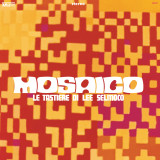
Francesco Anselmo, also known as Lee Selmoco, Dorsey Dodd, Alex Brown, Arsenio Bracco or Tommy Ruff, is an Italian keyboardist that covered the role of of artistic director for Vedette Records, historical Italian imprint founded by director and violinist Armando Sciascia, and also recorded for its notorious Phase 6 Super Stereo, its sub-label focused on instrumental records and production music.
"Mosaico (Le Tastiere Di Lee Selmoco)" is an incredible display of his creative and composing skills, featuring 14 tracks of what could be classified as "happy music", with killer electric organ and rhythms alternating with fuzzy guitars and spacey / psychedelic hints thrown in for good measures, written alongside Guido Baggiani, alias Ruscigan. We are very happy to start a series of reissues from the Vedette Records catalog with the first ever reissue of this title after 50 years from its original release, and since the original pressing did not feature the correct track listing, it is reissued here for the first time in its correct version!
Since its founding back in 2014, Blume has carved a unique place in cultural landscape, issuing free-standing works, spanning the historical and contemporary, that represent singular gestures of creativity within the field of experimental sound. Joining their broad efforts in building networks of context and understanding that already includes the works by Werner Durand, Sarah Hennies, Bruce Nauman, John Butcher, Jocy de Oliveira, Mary Jane Leach, Valentina Magaletti, Alvin Curran, Julius Eastman, Alvin Lucier, and shortly after returning with the first ever vinyl release to attend to James Tenney’s legendary “Postal Pieces”, the label is now offering a brand new, ambitious work by the American composer Ben Vida, entitled “Vocal Trio”, conceived, performed, and recorded in Bremen, Germany, during the Spring of 2022. A truly stunning work of compositional conceptualism, combining the ideas of systems based synthesis with real-time vocal collaboration - issued in a highly limited vinyl edition of 200 copies mastered by Stephan Mathieu, featuring specially commissioned liner notes by Bradford Bailey and a leporello insert offering the piece visual score - it’s a landmark in contemporary experimental practice and arguably the most forward-thinking and exciting piece by one of the most exciting American artists working today.
Ben Vida first emerged during the mid 1990s within a loose constellation of experimental musicians, centred around a performance series of improvised workshops at the Myopic Bookstore in Chicago, alongside Jim O'Rourke, Kevin Drumm, Chad Taylor, and the other future members of Town and Country - Jim Dorling, Joshua Abrams, and Liz Payne - the band within which he would gain widespread recognition over the following years. Like many other members of that scene, Vida remains a restless product of a fleeting context - Chicago during the 1990s and early 2000s - continuously undermining concrete notions of idiom and signifier within a practice that witnessed him rendering bristling abstractions within Pillow, glacial melodies with Town and Country, the art-rock mayhem of Bird Show Band, and the angular, driving indie rock of Joan of Arc, before becoming immersed in a practice of systems based synthesis, beginning in the 2010s, that guided much of his first decade of output as a solo performer and composer.
As early as 2013, he began to incorporate acoustic sound sources - specifically the human voice - into his work. It was this shift, evolving and refining itself over the last decade, that underscores radically the leap in his practice represented by “Vocal Trio”, a work that encounters Vida composing for the human voice with the ideas that allow for synthesis - transferring the underlying concepts and structures of both subtractive and additive synthesis to the acoustic realm - without using a synthesiser.
During the Spring of 2022 Vida was in Bremen, Germany, collaborating on a dance piece with the choreographer Fay Driscoll, when the production fell into delays. Finding himself with time on his hands, a space at his disposal, and the company of two dancers - Amy Gernux and Lotte Rudhart - who were also singers, the idea for the piece - to utilising the larynx as audio paths (multi-harmonic or harmonically pure) while conceptualising each person’s mouth as a filter to sculpt the timbre and resonance of a given tone - began to take shape in his mind. Considering how typographical scores might be developed into a non-linguistic social framework, Vida drafted a single page of text - what became the score for “Vocal Trio” - accompanied by a set of harmonic suggestion and loose parameters, seeking a core meaning from each word's phonic make-up by each of the three singers (Vida, Gernux and Rudhart) singing as slowly as possible.
At the core of the pulsing vocal drones - intoxicating, harmonically rich long-tones - that make up the duration abstraction of “Vocal Trio”, is Vida’s regard for music as a social space. It is an experiment that seeks liberation through the act of collective music making, by challenging the terms through which the act of composing is perceived and then relinquishing control. The piece’s rehearsals were simply the three performers hanging out, allowing their knowing each other and natural dynamics to contribute to its form as the score, before recording during a single afternoon at the end of a number of days sharing company and space.
Creatively visionary and groundbreaking on numerous terms, as well as being intoxicatingly beautiful and remarkably listenable, Ben Vida’s “Vocal Trio” represents a striking step forward for one of the most ambitious and outstanding sonic artists working in the United States today. Issued by Blume in a highly limited vinyl edition of 200 copies mastered by Stephan Mathieu, featuring specially commissioned liner notes by Bradford Bailey and a leporello insert offering the piece visual score, this is hands down one of the most important contemporary records we’re likely to encounter in 2024.
This led to her immediate recognition as a banjo pioneer and to her win in 1991 of the Banjo Player of the Year award from the International Bluegrass Music Association (the first female to win an Instrumentalist of the Year award). For the 2024 reissue, the original 8- track, 1" multitrack tapes were transferred at a resolution of 192kHz/36- bit, and remixed and mastered by Matt Coles at
Compass Sound Studio in Nashville.
The album was produced in 1989 by acoustic music icon and frequent Jerry Garcia cohort David Grisman (architect of "Dawg Music," the jazz- influenced breakout fringe of the bluegrass genre) and recorded with a cast of all- star musicians at Dawg Studio in Marin, CA. Players on the sessions included Alison Krauss (fiddle), David Grisman (mandolin), Mike Marshall (guitar, fiddle, mandolin), Matt Eakle (flute), Joe Craven (percussion) and Jim Kerwin (bass).
The album's 12 tunes were all written by Alison and include the first recorded versions of some of her most well- known compositions, including "Mambo Banjo," "Leaving Cottondale," and "Weetabix."
REMIXED AND REMASTERED from 192kHz/36-bit transfers of the original multitrack tapes. LP – features LIMITED EDITION BLACK & WHITE SWIRL + album download code with 3 never- before- released bonus tracks Includes a 4- COLOR BOOKLET with liner notes from Alison Brown, Dave Dennison, and Mike Marshall, plus ARCHIVAL PHOTOS and SESSION DOCUMENTS
Emerald vinyl LP is for Indies only. Cassette is also for indies only. San Francisco Bay Area-based metal desconstructionists’ latest is both inspired by the loss of a bandmate and the legacy of Oakland A’s legend Vida Blue. Time is a slippery fish. Loss has inspired Mamaleek’s latest full-length album, titled Vida Blue. This marks the San Francisco Bay Area metal deconstructionists’ eighth album and their third as a full lineup. Tragedy struck in March of 2023 when the band lost a longtime friend and member, keyboardist Eric Livingston, leaving the group, which began as a duo of two brothers and later expanded to a five-piece, now with only four members. Despite this profound loss, Mamaleek persevered, performing as a quartet at various festivals, including the 2023 edition of Tilburg. The band returned to the studio to create new material that appropriately reflects their journey through loss and honors their fallen comrade. The resulting album draws inspiration from the legacy of Oakland A’s baseball legend Vida Blue, whose former team coincidentally announced its relocation to Las Vegas that same year. The band members themselves describe this poignant chapter in their own words: “Time is a slippery fish. Maybe only someone like Vida could grasp it. Although he’s left time behind, his image and that lefty heat remain in the memories of many. Eventually they’ll be forgotten, and hopefully replaced with even more exultant ones. This musical recording is a reflection on loss and its acceptance. We explore several examples for each song, including the loss of pride, of money, of glory, of country, of sanity, of a favorite sports team, of significant others, and, every day, one’s self. It also explores various associated moods fear, panic, reverence, stoicism, and steadfastness—to arrive at a resolution: Loss is only a test, the glue that holds and erodes each memory, the connection that binds and loosens us all, pitch by pitch, inning by inning. This is your celebration.” Vida Blue is a person, moment, and memory, together the crystallization of apocalypse: “unveiling,” “disclosure.”
- Waldgeist
- Face-Off At Mammoth Mountain
- Wily Stage 1 & Boss (Mega Man)
- Iron Whale (Shovel Knight)
- Ultramarine
- Quick Man Stage (Mega Man 2)
- Wily Stage 1 (Mega Man 2)
- Full Circle
- Needle Man Stage (Mega Man 3)
- Wily Medley (Mega Man 3)
- Mission (Pulstar)
- Ronin
- The Amazing Ryu (Ninja Gaiden)
- The Parasprinter (Ninja Gaiden 2)
- Stage 4-2 & Stage 1-1 (Ninja Gaiden 3)
- Terra Incognita
- Art Thou The Holy One (Panzer Dragoon Saga)
- Atolm Dragon (Panzer Dragoon Saga)
- Quiet & Falling (Celeste)
- Apricot Dreams
- Ultimate Medley (Gimmick!)
- Echoes
Pressed on heavy-weight 3xLP 180g curaçao vinyl GIANTS is an ambitious video game concept album, meticulously crafted over six years by Tokyo-based record label Brave Wave Productions under the direction of Mohammed Taher. The colossal 98-minute album showcases the talents of legendary composers known for their iconic work on series like Mega Man, Ninja Gaiden, Panzer Dragoon, Sonic the Hedgehog, Final Fantasy, among others. The album is a rich tapestry of new, gameinspired compositions from these celebrated artists, paired with innovative remixes from their classic catalogue as reimagined by their contemporaries. A highlight of the album is its emphasis on collaboration, exemplified by original tracks like Ultramarine_the first collaborative effort from Mega Man 2's Takashi Tateishi with Mega Man 3's Harumi Fujita and Sonic Mania's Tee Lopes. Another standout track, Ronin, marks a historic reunion for the Ninja Gaiden composer trio_Keiji Yamagishi, Ryuichi Nitta, and Kaori Nakabai_collaborating for the first time since their work on the NES Ninja Gaiden titles. The collaborative spirit extends to the remixes as well, such as Final Fantasy series composer Yoshitaka Suzuki's cinematic reimagining of Mega Man 2's Wily Stage, featuring Bayonetta co-composer Takahiro Izutani on acoustic guitars and producing, as well as Celeste composer Lena Raine's tranquil rendition of Panzer Dragoon Saga's Art Thou the Holy One, crafted in harmony with original composer Saori Kobayashi. GIANTS transcends traditional boundaries, featuring a diverse array of genres and styles brought to life by over two dozen talented musicians, making it a celebratory anthology of game music's rich history and evolution, led by Brave Wave's in-house rock band Super Strikers and a legion of legendary game composers.
Since surfacing into the Scandinavian synth-pop scene 16 years ago, Nicklas Stenemo and Christian Hutchinson Berg aka KITE have steadily grown from local icons to a global phenomenon, yet until now they've never released a full-length studio album. VII breaks the ice, collecting 14 of the duo's deepest and most dynamic anthems into a stormy saga of immersive, apocalyptic emotion. Sourced from a series of six 7-inch singles released over the past half-decade, the collection persuasively showcases KITE's distinctly cinematic strain of Swedish darkwave in all its glory and desolation. Stenemo and Berg had both logged time in other bands before joining forces in the mid-aughts, although their unique chemistry became apparent immediately. After forming in Malmö, Sweden, they soon relocated to Stockholm, further refining their fusion of brooding synths, booming rhythm, and vocal theatrics over a string of celebrated, numbered EPs (named I through VI). Despite their rising profile, KITE then and now have largely refrained from publicity, allowing their music to speak for itself - which it clearly has, as KITE's live performances have become the stuff of legend, prompting frequent festival invitations, international tours, and limited engagements on prestigious stages (recently at the Royal Swedish Opera, and Dalhalla, the former limestone quarry turned open air amphitheater, to name a few). VII offers a compendium of KITE's potent recent discography, including collaborations with Blanck Mass, Anna von Hausswolff, and Henric de la Cour. From yearning dystopian pop ("Hand Out The Drugs," "Bowie `95"), to widescreen existential balladry ("Tranas Stenslanda," "Glassy Eyes"), and sleek New Romantica ("Remember Me," "Teenage Bliss"), KITE's wavelength is one of soaring heights and abysmal depths, anguish and ecstasy, pouring one's burning, battered heart into the here and now. Their years of visceral commitment and artistic integrity have been hard fought and hard won; it bleeds between the words and melodies in one holy moment after another: "I switch my ways / To seize the day / To face my life / Not fade to gray."
Meghan Parnell (vocals) and Dave Barnes (guitar) are the founding
members of Bywater Call, a powerhouse seven-piece Southern soul,
roots rock band from Toronto, Canada
The band is completed by Bruce McCarthy on drums, Mike Meusel on Bass,
newest member, John Kervin on Keys, Stephen Dyte on Trumpet and Julian Nalli
on Tenor Sax. Bywater Call has received multiple Independent Blues and
Maple Blues Award nominations including Entertainer, Electric Act and Best
Female Vocalist for the 2024 Awards Season. They have toured extensively in
Europe where shows have been praised by Dutch, German and UK media, with
references to Meghan as one of the best female voices in blues and roots today.
In August 2023, the band participated in Joe Bonamassa's thirdKeeping the Blues
Alive at Sea Mediterranean Cruise alongside headliners Blackberry Smoke and
Christone "Kingfish" Ingram, and were invited to perform at the All-Star Jam on
the mainstage with Bonamassa himself. Guitarist Dave Barnes was also asked to
join legendary blues artist Jimmy Vivino (Conan O'Brien's Basic Cable Band) on
stage. On October 24, 2023, Bywater performed a live stream performance for the
famed German TV show and festival Rockpalast. The band's music is an
exploration of life's highs and lows. From intimate ballads that lay bare the
complexities of human emotion to electrifying anthems that demand to be played
at full volume, their catalogue is a journey through the human experience,
incorporating influences from the likes of The Band, The Wood Brothers, Tedeschi
Trucks Band, Otis Redding, Little Feat, Sly and the Family Stone, among others.
Video Link:
Marking sixty years of Bossa Nova, and twenty years since Marcos Valle’s first release for Far Out Recordings, what better time to bring back this era-defining classic from the Brazilian master composer?
Throughout his astounding six-decade career, infiltrating pop, bossa nova, samba, delicate psychedelia, jazz and funk, Marcos Valle has consistently shown a dogged determination to transcend the traditions and structures of bossa nova, whilst never veering away from the movement’s inherent, fundamental spirit. To some extent, his epithet ‘the original Rio beach boy’ is a handy one: it reflects the origin and character of his often sun-soaked sound, but expounding his importance in the lineage of Brazilian music, he is more discerningly known as ‘the renaissance man of Brazilian pop’. He is indeed one the very greatest and most important composers, arrangers, writers and performers in Brazil.
Up until Nova Bossa Nova, Marcos Valle hadn’t released an album for well over a decade. After 1983, he resented the way the music industry had changed with commercialisation and new demands curtailing his creative freedom. This was until 1994 when Marcos met Far Out boss Joe Davis and they recorded a track for Far Out’s first Friends From Rio album. This new collaborative partnership resulted in a new solo album, which commenced recording in 1996.
Nova Bossa Nova brought Marcos bouncing back into the 90s, slotting nicely in place alongside the acid jazz movement as well as a voracious new demand for Brazilian music on dancefloors from London to Tokyo. It was witnessing the London club scene’s growing appetite for Brazilian music, as well as a lack of new sounds coming out of Brazil at the time, that a young Joe Davis put in a proposal to record a new album with one of his musical idols. Joe wanted to facilitate an album which would combine the latest technologies and production techniques, with live to analogue tape recording: a Marcos Valle album tailor-made for London’s clubs. Always open to modern influences and possibilities, Marcos agreed to the project, and Joe and his production partner Roc Hunter flew to Rio in ‘96. The record wasn’t released until ’98, as the original ½ inch tapes were stolen from Far Out’s London studio, meaning parts of the album had to be re-recorded.
Nova Bossa Nova was unveiled at the peak of the of the Brazilian movement, the record would also prove to be something of a revolution, inspiring a new generation of artists like Bebel Gilberto, Sabrina Malheiros, Da Lata and Bossacucanova, who continued to fuse Brazilian influences with modern electronic sounds.
Marking its first decade of activity, Blume returns with the first ever vinyl reissue of the seminal “New Music for Electronic and Recorded Media”, from 1977, the third and final instalment in a suite of releases that includes James Tenney’s “Postal Pieces” and Ben Vida’s “Vocal Trio”. Unquestionably among the most important collections of experimental music to emerge during the 20th Century, “New Music for Electronic and Recorded Media” is the original feminist presentation in its context, releasing the work of Johanna M. Beyer, Annea Lockwood, Pauline Oliveros, Laurie Spiegel, Megan Roberts, Ruth Anderson, and Laurie Anderson under its collective banner. Includes newly commissioned liner notes by Jennifer Lucy Allen and Bradford Bailey.
Since its founding back in 2014, Blume has carved a unique place in cultural landscape, issuing free standing works, spanning the historical and contemporary, that represent singular gestures of creativity within the field of experimental sound. Joining their broad efforts in building networks of context and understanding that already includes the efforts of efforts of Werner Durand, Sarah Hennies, Bruce Nauman, John Butcher, Jocy de Oliveira, Mary Jane Leach, Valentina Magaletti, Alvin Curran, Julius Eastman, Alvin Lucier, and others, Blume delivers their third release in their first suite of releases for 2024, the fist ever vinyl reissue of the seminal “New Music for Electronic and Recorded Media” compilation, originally issued by Thomas Buckner's 1750 Arch Records in 1977. Out of print for decades on vinyl and arguably the most important feminist statement in the history of experimental music, illuminating the work of Johanna M. Beyer, Annea Lockwood, Pauline Oliveros, Laurie Spiegel, Megan Robert, Ruth Anderson, and Laurie Anderson - in a number of cases representing their recording debuts - during a crucial moment in the history of experimental music. Blume’s brand new edition - complete with newly commissioned liner notes by Jennifer Lucy Allen and Bradford Bailey, as well as reproducing Charles Amirkhanian’s original accompanying text - radically shifts perceptions of the past and present day with its truly revolutionary sounds.
Issued by Thomas Buckner's 1750 Arch Records in 1977, and out of print nearly the entire time since, “New Music for Electronic and Recorded Media” can be understood within two simple frameworks. On one hand, it is an astounding document of the landscape of experimental music toward the end of the 1970s. On the other, it is a historically significant feminist statement, being the first collection of experimental music entirely dedicated to female composers, a number of whom were grossly under-celebrated at the time, but have since gone on to be regarded as among the most important composers of their generation.
The eight pieces gathered by “New Music for Electronic and Recorded Media” - Johanna M. Beyer’s “Music of the Spheres”, Annea Lockwood’s “World Rhythms”, Pauline Oliveros’ “Bye Bye Butterfly”, Laurie Spiegel’s “Appalachian Grove I”, Megan Roberts’ “I Could Sit Here All Day”, Ruth Anderson’s “Points”, and Laurie Anderson’s “New York Social Life” and “Time To Go (For Diego)” - might be regarded as the first cohesive vision of alternate proximity or expression of experimental music to what has always been a frustratingly male dominated environment, and to the tropes, temperaments, and sensibilities that have been historically perceived to define it. It is an expanded vision of truth. While the presence of feminine sensibilities and temperaments in experimental music, however they may present themselves, were anything but new in 1977, “New Music for Electronic and Recorded Media” was the first opportunity, beyond the temporal limitations of live performance, to view them collectively, rather than as individualised expressions within a larger body of similar gestures (as was the case of Oliveros’ inclusion in Odyssey’s 1967 “New Sounds In Electronic Music” and “Extended Voices” compilations) where they might be confused for something else; to regard and celebrate a radical notion of feminine sonority for its unique characteristics and through its interrelations.
While its historical significance and groundbreaking nature can not be debated in its totality, nearly half a century on “New Music for Electronic and Recorded Media” remains compelling in both its musicality and the palpable sense of its lasting influence. Every composition across the album’s two sides is not only engrossing and deeply compelling - feeling as fresh and relevant as the day it was laid to tape - but clearly tangible in their lasting influence. Viewed in context, the album’s eight works feel like breath of fresh air when compared to much of what came before, and laid the groundwork for much of what was to come, introducing a new, often more holistic temperament and more sensitive and inclusive sensibility into the landscape of experimental music.
Particularly in the case of Annea Lockwood, Pauline Oliveros, Laurie Spiegel, Ruth Anderson, and Laurie Anderson, it's hard to throw ourselves back in time and imagine a moment when these composers rested in a fairly marginalised corner of the creative landscape. Blume’s brand new edition of “New Music for Electronic and Recorded Media” - complete with newly commissioned liner notes by Jennifer Lucy Allen and Bradford Bailey, as well as reproducing Charles Amirkhanian’s original accompanying text - brings us back to this confounding moment and points us toward a crucial moment of change set forth by these incredible composers and their sounds. Absolutely seminal and not to be missed.
To experience Justin R. Cruz Gallego's pulverizing Sub Pop debut is to get burned down to ashes and burst forth, born anew. Grim Iconic...(Sadistic Mantra), the Tacoma-based artist's second album, is driven by opposing forces: noisy abstractions and tightly structured beats, anguish and dissolution at the outside world and empowerment within, apathy and catharsis. Grim Iconic...(Sadistic Mantra) weds scouring electronics to hooky songs and Gallego's powerful drumming in a way that feels visceral and new. It's his most personal statement to date, at once playful and intent, driven and combustible, total fucking chaos mixed into glints of broken-glass beauty. Born in Tucson, Arizona, Gallego experienced culture shock as a child after relocating to the frigid climes of the Pacific Northwest. He found solace in the Seattle punk scene centered around Iron Lung Records and has since remained a fixture in the underground community. "I see this record as first and foremost a musical statement," Gallego says. "I grew up in punk and DIY subcultures, but before that I had Latin music playing in the background through my childhood and every phase of adolescence. It was surprisingly natural to incorporate. I realized I wanted to go deeper into these rhythms. I wanted to make a record that felt as experimental as much as it felt from the perspective of a Latino. When I got a glimmer of that possibility, it felt exciting." Lead single "Dogear" is a face-melting party starter that sounds like someone forced Talking Heads and Rudimentary Peni to share a practice space. "I wanted a song that felt playful in the way it attempted to be dissonant without taking itself too seriously," Gallego says. "Cholla Beat" is even more ambitious, an anthemic mix of WAR and Wire led by unruly synthesizers spiraling down a labyrinth of production. Gallego's influences for the album are vast, ranging from British documentary filmmaker Adam Curtis to electric Miles Davis to audio miscreants like Demdike Stare and Oneohtrix Point Never. But it's Gallego's assured sonic vision that resounds the loudest. And, while J.R.C.G. is a solo project, conceived and executed primarily in Gallego's home studio, he found strength in opening the project to others, starting with Seth Manchester as co-producer. Manchester's penchant for bone-rattling frequencies, as seen in his production work with The Body, Battles, and Mdou Moctar, made him a natural fit for Gallego. Together, they retained the intimacy of Gallego's home recordings while taking advantage of the hi-fi stylings of his Machines With Magnets Studio in Rhode Island. The closing song, "World i," offers a glimpse into the live experience of Grim Iconic...(Sadistic Mantra), with upwards of seven band members blasting off. The album features a fascinating mix of supporting players, many of whom cycle through J.R.C.G.'s live lineup: Morgan Henderson (The Blood Brothers, Fleet Foxes), Jason Clackley (Dreamdecay, The Exquisites), Jon Scheid (Dreamdecay, U Sco), Erica Miller (Casual Hex, Big Bite), Veronica Dye (Terminator) Phil Cleary (U Sco), and Alex Gaziano (Dreamdecay, Kidcrash, Science Amplification). Taken as a whole, G.I.S.M. is a whirlwind of sound, pummeling, and cleansing. It's a sweaty, thrilling aural adventure and, like a great basement show, it'll leave you breathless, exhausted, and wanting to repeat it all over again. As any good mantra should.
Comes with insert and download coupon.
Imagine a Latin remake of Back to the Future. The mad scientist is Arsenio Rodriguez (the godfather of salsa) and the young student who travels through time with him is Eblis Alvarez (Meridian Brothers). This album can only be described as the perfect soundtrack for that movie that never was.
After the massive buzz generated by his first solo album, Mentallogenic, Alex Figueira got back in the studio to work in a more collective fashion this time, carefully assembling the second album of his largest project to date, Conjunto Papa Upa; a team of 6 musicians, spanning 3 generations of some of the best talent in the Latin and avant-garde scenes.
In an era where tropical music is dominated by purely electronic and rhythmically uniform sounds, the ten songs encompassed in “Fruta Madura” (“Ripe Fruit”) wander through the most diverse tempos, rhythms, and motifs effortlessly. A real breath of fresh air that gracefully incorporates soul, funk, jazz, psychedelia, and electronics into a solid tropical, irresistibly polyrhythmic foundation, without ever succumbing to the many genre clichés.
The distinctive production and catchy songwriting of Figueira shine in a very distinctive light on this second full-length. Living up to his reputation (Miles Cleret, founder of Soundway Records, called him “one of the scene's truly authentic and eccentric producers”), he takes the opportunity to show he’s not afraid to keep walking his own path.
Taking the band for a wild ride through the traditions of Africa, America, and the Caribbean; contrasting them with a ridiculously wide plethora of vintage, contemporary, and futuristic sounds, and pivoting on the exuberant musicality displayed by his musicians; the result leaves no doubt: this album is destined to be considered a future classic of the exciting tropical psychedelic music of the 21st century.
Addressing the most diverse themes in this new collection of songs, things take on a much more mature tone, as the title clearly suggests.
The opening track “El segundo es más sabroso” (“The second one is tastier”) sets the tone in the most assertive way imaginable, with the band boldly declaring, through multiple metaphorical references (laid upon a crazy mix of Dominican merengue, Detroit techno, classic and free jazz, dub, and electro), that the bar will be set higher with this second album.
The remaining compositions touch upon the most diverse subjects, with a fair dose of humor, sarcasm, and postmodern “magic realism”. “El Algoritmo” (The Algorithm) is a parranda-cumbia hybrid (for lack of a specific term) about the omnipresence of technology in our lives. The sophisticated Latin soul of the titling track “Fruta Madura” makes a case for the beauty of the maturity process. Some key philosophical teachings of Marcus Aurelius (the role of causality, the impositions of “the logos” and the importance of self-control) get a twisted cumbia treatment on “Reos del Deseo” (Prisoners of Desire). “No le pongas Coca-Cola” (“Don’t put Coca Cola in it”) shows us the most satirical side of the band, accusing those who mix Coca Cola with Rum of committing "sacrilege", on a powerful base of Dem Bow (the grandfather of Reggaeton), intertwined with touches of soul, salsa, and Cuban comparsa.
"Háblame Claro" (“Talk to me clearly”) is a story of heartbreak that evokes in its first part the spirit of the erotic salsa of the 80s (a subgenre deeply despised by purists), and after an unexpected samba interlude, leads to the hardest salsa of the 70s (a subgenre adored by purists), to end up in the surprising form of pure Afro-Cuban ceremonial music.
“Tu mamá tenía razón” ("Your Mom Was Right") is an attempt to exalt the spirit of the Latin American soap opera in the key of “acid bachata”, to recount a real-life case, witnessed by the band on countless occasions: the partying woman who arrives at the show accompanied by her bitter husband, who obviously does not like to dance. A very cheeky song to talk about the very serious and pertinent topic of female empowerment.
“La misma vaina” (“The same thing”) with its indescribable blend of bantú, candomblé, and Mozambique rhythms with abstract synthesizers, is an ode to adventure in favor of the aversion to taking risks and seeking predictability.
“Amigas picadas” (“Salty friends”) is another humorous song recounting another real-life case witnessed by the band on countless occasions: a love encounter sabotaged by the girlfriend's friends, who all happen to fancy the same guy. A jazzy take on the ancient Dominican rhythm of pambiche (grandfather of merengue), with generous psychedelic touches, resembling the classy late 60s releases of Guadeloupe's legendary producer / label owner Henri Debs.
“Vinimos a hablar” (“We came to talk”) takes sarcasm to the highest level, to ridicule the absurdity (also experienced by the band firsthand) seen in live music venues where people pay a ticket to go and have conversations that could be carried out much better on any bar, where no band is playing. The music alternates between a delicate melody with loose, sparse percussion and a full-on, pumping Angolan semba, with a techno kick drum included; bringing things to an apotheotic grooving finale, where the peculiar swing of Venezuelan calypso from the Callao region is thrown on top of all the precedent elements; closing the album in the most uplifting, “end of the carnival parade” feel.
The artwork is a delicate and impactful oil painting by Colombian artist Kevin Simón Mancera, who has collaborated many times with the label before (“Maracas, tambourines and other hellish things” tape and the Lola’s Dice LP).
What the experts are saying:
“Alex (Figueira) dove into this work with a brutal cohesion between lyrics and synths. Timbre poetry, sound poetry (you name it). And that, superimposed on his always impeccable percussive base, confirms the title of “avant-garde visionary of our beautiful Latin music”".
EBLIS ALVAREZ (MERIDIAN BROTHERS)
“Papa Upa's infectious quirkiness is a balm against boredom. A mature album, but without an expiration date”.
GLADYS PALMERA
“Here there is a lot of strength, drum, cadence and psychedelia, lost dance rhythms, united in an intercontinental Latin/African/and Caribbean journey, a unique winning combination that we could consider the new “Ritmo Figueira”.
DISCODELIC
Conjunto Papa Upa are:
Alex Figueira - Timbales, percussion, vocals.
Gerardo Rosales - Congas, percussion, vocals.
Ramón Mendeville - Bongos, percussion, vocals.
Randy Winterdal - Bass.
Andrew Moreno - Guitar.
Nico Chientarolli - Organ, piano, synths.
All songs written by Alex Figueira.
Arranged and performed by Conjunto Papa Upa.
Recorded, produced, mixed and mastered by Alex Figueira at Heat Too Hot, Amsterdam.
- A1: Music Of The Earth
- A2: Let’s Sing A Song Of Love
- A3: When I Found You
- B1: Haven’t You Heard (12” Version)
- B2: Givin’ It Up Is Givin’ Up With Dj Rogers
- C1: Forget Me Nots (12” Version)
- C2: Look Up! (Long Version)
- C3: Where There Is Love
- D1: Never Gonna Give You Up (Won’t Let You Be) (Long Version)
- D2: Number One (12” Version)
- E1: All We Need
- E2: Remind Me (Lp Version)
- E3: Settle For My Love
- F1: Feels So Real (Won’t Let Go) (12” Version)
- F2: To Each His Own
Black Vinyl[27,52 €]
Strut present the first definitive retrospective of an icon of 1970s and ‘80s soul, jazz and disco, Patrice Rushen, covering her peerless 6-year career with Elektra / Asylum from 1978 to 1984. Joining Elektra after three albums with jazz label Prestige, Patrice had shown prodigious talent at an early age and had first broken through after winning a competition to perform at the Monterrey Jazz Festival of 1972. By the time of the recordings on this collection, she had become a prolific and in-demand session musician and arranger on the West coast, appearing on over 80 recordings for other artists. She joined the Elektra / Asylum roster in 1978 as they launched a pop / jazz division alongside visionaries like Donald Byrd and Grover Washington, Jr. “The idea was to create music that was good for commercial radio / R&B,” Patrice explains. “We were all making sophisticated dance music, essentially.”
Drawing on some of the leading musicians in L.A. like saxophonist Gerald Albright, drummer “Ndugu” Chancler and bassman Freddie Washington and keeping an open minded approach from her training in classical, jazz and soundtrack scores, Patrice’s music was a different, more intricate proposition to many of the soul artists of the time. “L.A. musicians were not so locked into tradition,” she continues. “None of us were accustomed to limitation and the record label left us to take our own direction.”
Early classics like ‘Music Of The Earth’ and ‘Let’s Sing A Song Of Love’ were among Patrice’s first as a lead vocalist before her ‘Pizzazz’ album landed in 1979, featuring the unique disco of ‘Haven’t You Heard’ and one of her greatest ballads, ‘Settle For My Love’. “Although ballads make you feel more vulnerable as an artist because they are often personal, I think listeners relate to that sincerity,” she reflects. By now, Patrice’s records were supremely arranged and produced as her confidence as an all-round writer, producer, arranger and performer grew. Slick dancefloor anthem ‘Never Gonna Give You Up’ and the ‘Posh’ album in 1980 led to her landmark album ‘Straight From The Heart’ two years later. Receiving little support from her label, Patrice and her production team personally funded a promo campaign for the first single from it, ‘Forget Me Nots’. It went on to peak at no. 23 on the Billboard Hot 100 and the album was later Grammy-nominated, while the track became a timeless anthem and popular sample, inspiring Will Smith’s theme for the film ‘Men In Black’ and George Michael’s ‘Fastlove’.
Patrice’s final album for Elektra, ‘Now’ kept the bar high with sparse, synth-led songs including ‘Feel So Real’ and ‘To Each His Own’. It concluded a golden era creatively for Patrice which remains revered by soul and disco aficionados the world over.
‘Remind Me’ features all of Patrice Rushen’s chart singles, 12” versions and popular sample sources on one album for the first time. Formats included a 3LP set and 1CD fully remastered by The Carvery from the original tapes. Both formats include an exclusive new interview with Patrice Rushen and rare photos.
• First definitive Patrice Rushen compilation released on vinyl since the ‘80s
• Includes all of her chart hits, DJ favourites and sample sources
• Official release featuring full interview with Patrice Rushen about her career and music • Features rare photos from her personal collection + some of the photographers she has worked with during her career
• Fully remastered by The Carvery from the original ¼” tapes
• Start of full Patrice Rushen reissue programme from her Elektra era
Experimental black metal from Brooklyn featuring members of Pyrrhon, Krallice, Sigur Rós, The Glen Branca Ensemble, Steve Reich. Recorded by Colin Marston (Dysrhythmia, Krallice, Liturgy). Follow-up to the bands well received 2022 debut Aveilut. The Promise Of Rain, the sophomore album of the experimental black metal band Scarcity, is an embodiment of the hard-to-believe truth that burdens are easier to bear when distributed, a realization Brendon Randall-Myers (conductor of the Glenn Branca Ensemble) grappled with extensively while writing this record. This is a sweat-drenched album about dispersion, about spreading, about the collective relieving of burdens through shared experience: one doesn’t have to go through everything alone. When Scarcity’s debut album Aveilut was written in early 2020, Randall-Myers and vocalist Doug Moore (Pyrrhon, Weeping Sores, Glorious Depravity, and Seputus) never expected to be able to play their songs live. The cathartic experience of playing something that came from a place of isolation out to people in a live setting is the root of the intensity in The Promise Of Rain. The Promise Of Rain begins where the craziest climaxes of Aveilut end, and is the first Scarcity record to include Tristan Kasten-Krause (Sigur Ros, Steve Reich, LEYA) on bass, Dylan Dilella (Pyrrhon) on guitar and Lev Weinstein (Krallice) on drums. Rather than building density with the quasi-orchestral layering on Aveilut, Scarcity challenged themselves to document what five people in a room could do, recording most of The Promise Of Rain in one or two takes, capturing the physical effort and urgency of a live performance. Scarcity forges a completely fresh sound in The Promise Of Rain with their alarming guitar work and melodic arpeggiating, shedding dead skin and breaking ground with sheer vulnerability. The lyrics for The Promise Of Rain were inspired by a trip Moore took to the high deserts of southern Utah in 2023. “To thrive in the desert is an act of abnegation—” he observes, “you do right by the land and receive its gifts, or it does away with you.” The necessity of adaptation is as evident in the desert as it is to the landscape of the human experience. The transformation of ideas and beliefs, the grief of losing relationships that had to end, and the fear involved in forming new ones under the grip of mental illness is conjured over and over again on this panoramic album.
Repress!
Far Out Recordings Proudly Presents The 1975 Self-titled Debut Album From Brazilian Vocalist And Bossa Nova Luminary Emilio Santiago. Nicknamed 'the Nat King Cole Of Brazil', Santiago Was A Master Bossa Balladeer And A Top-class Crooner. But He Is Known Equally For His Brazilian Funk, Soul And Boogie Classics. One Of His Best Know Is Album Opener 'bananeira', A Party-starting Version Of The Song Originally Written By Joao Donato And Gilberto Gil. 'brother' Is A Smooth-grooving Killer With Great Horn Arrangements And A Huge Backing Choir, While 'la Mulata' Is A Soulful, Swinging Salsa Stepper.
Originally Released On The Cid Label, The Album Showcases The Full Range Of Emilio's Talents, While Paying Homage To Some Of Brazil's Greatest Composers, Including Jorge Ben, Marcos And Sergio Valle And Ivan Lins Among Others.
The Credits On The Album Are A 'who's Who' Of Brazil's Greats, With João Donato On Keys, Wilson Das Neves, Ivan 'mamão' Conti And Paulinho On Drums, Durval Ferreira, Carlos Roberto Rocha And Helio Delmiro On Guitar, Ariovaldo, Orlandivo, And Chacal On Percussion, Danilo Caymmi On Flute, A Brass Section Featuring Victor Assis Brasil, Edson Maciel And Jesse Sadoc, And Backing Vocals From Jaime And Nair, Lúcia Lins, Jurema And Marcio Lott.