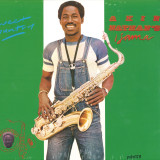
First time repressed since 1982, Akin Nathan was a seasoned session saxophonist who featured on several albums but was chiefly known for his tenure with Sonny Okosuns' Ozziddi during the group's most productive period in the 70s & 80s.
Nathan's Ijama 1982 solo outing Sweet Country, includes drummer Geoffrey Omadehbo, guitarist Brother Didi Lead, bass guitarist Yakubu Daniel, keyboard player Johnny Woode, trumpet Big John Oaikhena & piano Brother Francky Ntoh Song.
Featured cuts are K'ale San Wa, Congratulation & Free Namibia.
Played by dearly beloved luminaries such as Tone Nimble, Ge-ology, Sadar Bahar & Charlie Dark.
Search:bro sa
McCombs is one of the most highly regarded bassists/guitarists working today, known for his pioneering band Tortoise, his bass playing in Chicago"s Eleventh Dream Day, and his innovative instrumental group Brokeback. He has released albums with guitarist David Daniell, and collaborated with the likes of Tom Zé to Yo La Tengo, Stereolab to Daniel Lanois. In addition to being the touring bassist for The Sea and Cake, McCombs has somehow found time to form a new trio Black Duck with guitarist Bill MacKay, and percussionist Charles Rumback. Douglas McCombs" VMAKMcCombs" debut solo album is a mix of improvisation, textural explorations and recurring melodic themes. Taking after Brokeback"s classic Morse Code in the Modern Age: Across the Americas, "Two To Coolness" is a piece that McCombs refined through a series of improvised performances and features Calexico drummer John Convertino, as well as singer/guitarist/synth player Sam Prekop (also of The Sea and Cake). "Green Crown"s Step" was largely improvised working through melodies and patterns. The stately "To Whose Falls Shallows" reshapes three key themes that Tortoise and Brokeback fans will find to be signature McCombs, buoyed by fellow Brokeback member James Elkington (Tweedy), who also engineered and mixed the album. On the album, McCombs plays with spare instrumentation and primarily plays electric and acoustic guitars as well as the Bass VI, drawing out textures that stretch the scope of his instruments. McCombs" work is pastoral and expansive, his playing is refined and nuanced, and his melodies often bely his admiration for Ennio Morricone as his guitar imbues endlessly sprawling fields of the midwest with the same sense of magic. It is a true pleasure to hear him perform in such an intimate way. This is an absolute essential for followers of McCombs and newcomers alike, as the album lays bare his influence on each of his groups as well as firmly stakes McCombs as a force all his own.
Two hidden gems from the P&P vaults courtesy of a scarcely known talent from Georgia, Florence Miller get an official reissue 'I'm Just A Lonely Girl' and 'The Groove I'm In'. With only two releases to her name, both of which came on Peter Brown’s P&P Records, ‘The Groove I'm In’ released around 1975 got the attention of the Northern and Modern Soul scenes in the mid ‘90s becoming a real star of the show. Since then, it’s maintained consistent demand on the second-hand market with originals selling for over £200.
As with most of Peter Brown's artists, they briefly emerged on the sparsely distributed P&P label, for a brief stab at stardom only to disappear when Peter's attentions moved on to the next releases. Consequently, very little is known about the multi-talented and sadly ignored Florence Miller following her two releases on the Harlem label. Clearly though, the music speaks for itself with the quality of the P&P catalogue and this Florence Miller slice of magic shining through to this day.
Brother Deges zweites Album "How to Kill a Horse" wurde nachts in einem leeren Lagerhaus aufgenommen (während er tagsüber in einem Obdachlosenheim für Männer arbeitete) und ist ein Meisterwerk, das von Scheunenbrennern über antike Delta-Meditationen bis hin zu babylonischen Schrottplatz-Jams reicht, die die Schattenseiten dessen erforschen, was es heißt, ein Mann in der modernen Welt zu sein. Zu den Einflüssen zählen: Ernest Hemingway, Joseph Conrad, Ry Cooder, Norman Mailer, Henry Miller, Sonic Youth, Black Sabbath, Blind Willie Johnson, Einstürzende Neubauten, Jackson Pollock und Don Quijote. Wie Hemingways stärkste Werke dringt "How to Kill a Horse" tief in das Gefängnis-Rodeo des menschlichen Herzens ein, konfrontiert die dunklere, fehlerhafte Seite des Selbst, während es mit voller Aggressivität in den existenziellen Hochofen der modernen Weltgerät steuert und mit den Rollen der Männer als Versorger, Beschützer, Partner, Liebhaber, Krieger, Friedenstruppen, was auch immer ringt. "How to Kill a Horse" ist ein gewaltiger Schuss vor den Bug aller Riff-Heads, Songwriter und Americana-Enthusiasten auf der ganzen Welt. Es ist ein Game-Changer, der das ganze Durcheinander der Roots-Musik aus den Vinyl-Mülltonnen ins 21. Jahrhundert befördert.
A captivating work of impressionistic memories, observations and intimate confessions, Ebony wrote her debut self-titled solo album while coming into prominence as an in-demand portrait photographer within New Zealand’s contemporary literature and independent music scenes. The release comes five years after her alt-country band, Eb & Sparrow, amicably parted ways in 2018.
Recorded on vintage analog studio gear and mastered to tape, EBONY LAMB finds Runga and Nielson placing Ebony’s distinct, fragile-but-firm voice within a cinematic confluence of jazz, folk, psychedelia, alt-country and ambient pop. Written over the last five years while coming to terms with the realities of a changing world, themes of gratitude, loss, acceptance and aspiration run through the album like a river, especially in the nocturnal groove of ‘My Daughter My Sister My Son’ and ‘Brother Get Me Home’.
From the album’s opening notes, Ebony expresses herself in non-judgmental terms, singing with a raw tenderness that draws listeners into her reflections on friendship (‘Drive Me Around’), the complexity and contradictions of success (‘Successful Feelings’), and connections in seemingly hopeless moments (‘Come, Put A Record On’). Yet while her songs can feel like she’s sitting just across from you, Runga and Nielson’s production imbues them with an expansive sensibility. Spare, vivid and moving,
EBONY LAMB is an album that captures a defining artistic leap from a talented artist coming into her own. Singing to herself and the listener, she implores us to continue reaching forward without losing sight of what we have and the elements of our lives that truly matter.
The rising Tamil-Swiss artist Priya Ragu is set to release her long-awaited debut album ‘SANTHOSAM’ on October 20th.
‘SANTHOSAM’ (the Tamil word for ‘happiness’) is a standout dynamic album which takes her raguwavy sound – simmering R&B, masterful pop hooks, earthy soulful vocals, dance beats, and the warm tabla rhythms, and spiralling melodics of Tamil music – to even more adventurous heights. Defined by Priya’s contagiously positive spirit, it pulsates with gorgeously varied musical textures and urgent political themes. Once again crafted in collaboration with her brother and producer Japhna Gold, it’s an album that originates from Priya’s quest for self-discovery.
‘SANTHOSAM’ opens with ‘Ammama’s Note’, which features a voice recording in which Priya’s grandmothers is questioning why she isn’t married. Like many young South Asian women, Priya felt like she wanted to achieve much more before she settled down, regardless of other people’s preconceptions of what direction her life should take. That ability to write one’s own destiny continues the euphoric ‘School Me Like That’, set to a rumbling tambla beat and breezy synths. More universal issues are explored in the blazing anger of ‘Black Goose’, which was written in the wake of the murder of George Floyd and the Black Lives Matter protests, and ‘Let Me Breathe (Reprise)’, a spiritual call for freedom, emancipation, and peace.
Elsewhere, the record brims with highlight-after-highlight, taking in everything from the dancefloor disco energy of ‘One Way Ticket’ to ‘Power’ which features a rousing string arrangement that was written by Indian composer Bala and recorded with an orchestra in Budapest. It closes with ‘Mani Osai’, a song which continues a yearly family tradition in which Priya, Japhna and their father write a song together. Never intended to be a Priya Ragu track, it nonetheless felt like the perfect way to close the album – especially as the concluding “santhosam” chant conveys the meaning of the word with life-affirming zest.
Teichmann + Söhne’s »Flows« is not so much the result of a collaborative process as it is a process in itself. Over the course of nine pieces, the Gebrüder Teichmann—Andi and Hannes—and their father Uli repeatedly find common ground between the very different musical styles, sound aesthetics, and subcultural codes they have internalised throughout their lives. The source material out of which the album evolved was culled from several recordings of rehearsal sessions in preparation for the trio’s concerts that took place between the years 2012 and 2022. The three added only a few overdubs to those recordings but edited them rigorously to both preserve and transform the spirit of their unlikely collaboration. The combination of Uli’s background as a versatile jazz artist and multi-instrumentalist with his sons’ penchant for dub techniques, modular synthesis, and live sampling as well as their interest in electronic dance music take on ever-different shapes. »Flows,« released on the occasion of Uli’s 80th birthday, is as joyful, lively and free-spirited as its makers.
It took the three musicians decades to get together to jam. Uli and Lu, the mother of Andi and Hannes, ran the legendary Jazzclub Kneiting between 1978 and 1983 while he also made a name for himself as a musician who, besides jazz, is knowledgeable in a plethora of music styles from all over the world and has an instrument collection to match. Naturally, Andi and Hannes rebelled against this versatility by opting for simplicity. Already as pre-teens, they formed a punk band and once they got a whiff of the burgeoning techno scene, strayed even further from their father’s path. They eventually moved from their native Regensburg to Berlin where they made a name for themselves with a slew of releases on seminal labels like Disko B or Kompakt before starting to more regularly collaborate with musicians from the realms of Contemporary Music, Improv, and Sound Art. Even after Uli had finally contributed some saxophone licks to the brother’s 2011 »They Made Us Do It« LP, it indeed needed someone else to make them do it, i.e. finally get together to reconcile their musical differences in a creative way.
Finding out that the three had never performed together, Yoichi Osaki from Berlin’s iconic Miss Hecker venue, a focal point of the city’s so-called Echtzeitmusik (real-time music) and Improv scene, scheduled them to play their first concert on April 1, 2012. Even though the date was chosen deliberately, things got serious very quickly and this first joint concert proved to be the first of many. It also laid the foundation for »Flows« since the three would start recording their rehearsals. Revisiting the roughly 90 recordings, some of which clock in at a full hour, after ten years of playing with each other then started what Hannes describes as a »form-finding process.« It was a holistic one and involved all three of them, extending also to their choice of cover artwork, a piece created by Lu, who died in 2016 and to whom the album is dedicated. For the collage, she had used photos of the place where it all began, Regensburg, and the river that flows through it, the Danube. This made the piece, coincidentally created around the time Teichmann + Söhne started playing their first concerts together, correlate perfectly with the working process of the three musicians on a visual level.
Similarly, Teichmann + Söhne can be thought of as a human-musical collage. It is a meeting of three different musicians who all have in common that they have occupied alternative spaces and perfected a variety of musical styles and subcultural codes throughout their lives. When those flow into each other, this necessarily creates something that is as unique as the nine tracks collected on this album. While it is mostly Uli who takes the lead on pieces like the appropriately titled »Im Zwischen« (»In the Inbetween«), the brothers respond by live sampling his playing, thus serving as a creative interface between acoustic sounds and electronic responses. This in turn provides a framework in which Uli can improvise on a variety of acoustic instruments like the saxophone and the clarinet as well as a mandolin and glockenspiel or even percussion. This indeed makes their music flow—across different generations, between different musical ideas and genres, into previously uncharted territory.
- A1: Fadoul - Bsslama Hbibti
- A2: Bob Destiny - Wang Dang
- A3: Attarazat Addahabia - Unknown
- A4: Jalil Bennis Et Les Golden Hands - Mirza
- B1: Sharhabeel Ahmed - El Bomba
- B2: Belbao - Casablanca Shuffle 7.Mallek Mohamed - Rouhi Ya
- B3: Hafida
- B4: Freh Kodja - La Coladera
- C1: Kamal Keila - Al Asafir
- C2: Ahmed Malek - Tape 19.11
- C3: Hamid El Shaeri - Ayonha
- C4: Ahmed Malek - Bossa
- D1: Samir & Abboud - Games
- D2: Al Massrieen - Sah
- D3: Gharbi Sadok & Georges Garzia - Lala Tibki
- D4: Dalton - Soul Brother
'I heard about Seif Abu Bakr and The Scorpions maybe 3-4 years ago. Their album 'Jazz, Jazz Jazz' ended up on my radar because of an eBay auction with the bids eventually rising daily up to a staggering 1000$. The music is a unique combination of incredible horn arrangements powerfully performed, a vigorous drummer contributing a funky backbone and Seif's vocals uniting those elements. The results range from instrumental tracks awaking memories of 1970s crime thriller soundtracks to more Sudanese-rooted tracks, a lot of them modernized versions traditional rhythms of the diverse regions of Sudan and even an excursion into Colgolese Soukouss.
I went for my second trip to Sudan in December 2018 and after doing some research on the first trip my local colleagues Larissa and Yassir had managed to reach Amir, The Scorpions band leader and he was happy to meet. We got together with him in a Cafe right at the Nile in Omdurman. It was a happy occasion for everyone. He told us stories about him meeting Jimmy Cliff and Lewis Armstrong when they visited Sudan and how he and his band mates from The Scorpions played extensively in Kuwait, both in club residencies as well as for television. Amir brought tons of incredible photos illustrating not only the bands history but the vivid cultural live in the many music clubs in Khartoum of the 1970s. During this decade up until 1983 the capital was home to a huge number of clubs, bards and concert halls. This scene started to perish after president Nimeiry's turn away from his socialist policies, that he was widely associated with in the first decade of his rule, towards the implementation of Sharia law in 1983. During the first decade of his rule he had actively supported various artists of the Jazz scene, taking some of them on trips throughout Africa. The 1989 coup of Bashir and his generals then caused the final blow to a once thriving scene. Both of these political events within 6 years lead to significant drawbacks for the Sudanese jazz scene resulting into hardly no gig opportunities left and parties and concerts being critically observed. A number of musicians faced prosecution, most of the time for their political views; some left Sudan for good. Music never completely vanished from public life and even the regime kept selected artists close, but for a majority of those bands affiliated to the jazz scene life and making ends became a lot harder. The Scorpions dissolved as a group around the same time.
The re-release was produced with a clean copy of the vinyl version as a source. The original reel tape of the album stayed with Saif Abu Bakr along with another reel with other recordings that were never released. Unfortunately it was lost when Saif Abu Bakr had to flee to Kuwait temporarily during the second gulf war when Iraq raided Kuwait. Vinyl version comes with extensive booklets with photos, interviews, liner notes. The vinyl version also has a DLL code.
- A1: The Sugarhill Gang - Rapper's Delight
- A2: Joe Bataan - Rap-O Clap-O
- A3: Funky 4 + 1 - That's The Joint (Remix)
- A4: Afrika Bambaataa X Zulu Nation & Cosmic Force - Zulu Na
- B1: Grandmaster Flash & The Furious Five - The Message
- B2: Super-Wolf - Super-Wolf Can Do It
- B3: Spoonie Gee - Spoonin' Rap
- B4: Cold Crush Brothers - Basketball Throwdown
- B5: Fab 5 Freddy - Down By Law
- C1: Boogie Down Productions - 9Mm Goes Bang
- C2: Jungle Brothers - Straight Out The Jungle
- C3: Digital Underground Feat 2Pac - Same Song
- C4: Monie Love Feat True Image - It's A Shame (My Sister)
- C5: Grand Puba - I Like It (I Wanna Be Where You Are)
- D1: The Pharcyde - Runnin
- D2: Capone-N-Noreaga - Invincible
- D3: D I.t.c. Feat. Ag., Big L & O.c. - Thick
- D4: Dj Honda Feat Mos Def - Travellin' Man
- D5: Rza - Grits
- E1: Percee P - Raw Heat (45 Version)
- E2: Guilty Simpson Feat Spacek - Smoking
- E3: Brooklyn Academy - Black Out
- E4: Dizzee Rascal - Fix Up, Look Sharp
- E5: Chinese Man Feat Kendra Morris & Dillon Cooper - Liar
- F3: Brand Nubian - Slow Down
- F4: Bozoo Bajou Feat Oh No - Back Up
- F5: Greyboy Feat Main Flow & Elgin Park - Uknowmylife
- F1: Beat Assailant - Hard Twelve (The Ante)
- F2: Lanu Feat Kero One - It's Time
Prolific producer Stu Bangas is back with a new collection of hard-hitting collaborations on Death Wish (Part II), the much anticipated sequel to the 2021 original. The project finds the Boston beatsmith rocking with some of his favorite emcees of all time as well as familiar names who always seem to bring their best work to his instrumentals.
For Stu, it’s an honor to work with the likes of Ras Kass and Psycho Les (of the Beatnuts). He made the connections while creating the phenomenal Empires LP with Eric Bobo (of Cypress Hill), and it led to the bangers you hear on Death Wish (Part II). The track with Ras, “Sus,” is an equally hilarious and hardcore takedown of weak-willed phonies, while Psycho Les teams with Celph Titled for the gangster-but-lighthearted “Y’all Clowns.”
“I grew up on all the Beatnuts albums, my whole group of friends loved them,” Stu says. “And Soul on Ice by Ras Kass? That’s a certified classic for any hip-hop head.”
Joe Sutkowski (Dirt Buyer)'s new album is a documentation of making it to the other side. Sutkowski grew up in New Jersey, and although he lives in Brooklyn now, he remains " an emo kid at heart ," garnering inspiration from bands like My Chemical Romance and Muse, the latter of whose theatrical, dramatic performances inspired the band's own vocal-forward, soaring takes. Initially working together as a duo while Sutkowski and Ruben Radlauer (Model/Actriz) were at school in Berklee, the band's self-titled 2019 debut album was recorded on an IPhone in their practice room on just drums and guitar, and the quietly striking, nuanced stylings earned them accolades far beyond the " fake record label " the two made up to originally release their music. The band's new album, Dirt Buyer II , was recorded in February 2020, and represents a foray into heavier material that marks a deeper shift for the band. Now working as a trio, Sutkowski is flanked by Tristan Allen on bass and Mike Costa on drums, a fellow Berklee grad who cut his teeth playing in bands across Boston including past collaborations with Sutkowski. Half-recorded while the band was on tour with Surf Curse, the record finds Sutkowski reaching out for places, people and beliefs to ground him. Throughout the album he attempts to wrap his head around the idea of fate and how you can brush up against other people and then leave them behind. The songs themselves play with this concept of light and dark intertwined. Oscillating between urgency and cathartic release and more stripped-back elegies, Sutkowski faces the reality that while the people he'd rather forget can still live on through music, he is able to move on at the same time. Half-recorded in his mother and uncle's upstate house where he turned the living room into a studio, he contemplates the beauty and disaster around him - all refracted through visceral visual imagery of how the physical earth meets the unknown to converge in something greater than ourselves. " This is all a living chronicle of all I want to do, which is feel good and be happy ," he admits. " I'm a completely different person now - a better version of myself ." Processing the past, Sutkowksi has emerged with newfound belief, fully intact and with a new path forward to the future.
- A1: 1985
- A2: Thrasher’s Abbatoir
- A3: Cadaver Pouch Conveyor System
- A4: A Congealed Clot Of Blood
- A5: The Master Butcher's Apron
- B1: Noncompliance To Astm F899-12 Standard
- B2: The Granulating Dark Satanic Mills
- B3: Unfit For Human Consumption
- C1: 316L Grade Surgical Steel
- C2: Captive Bolt Pistol
- C3: Mount Of Execution
- D1: A Wraith In The Apparatus
- D2: Intensive Battery Brooding
- D3: Zochrot
- D4: Livestock Marketplace
- D5: 1985 (Reprise)
Nun sind sie mit verändertem Line-up (für Ken Owen kam Daniel Wilding; Amott wollte an der Reunion nicht teilnehmen) wieder da
und präsentieren mit „Surgical Steel“ ihr neues Album, das den Sound der früheren Alben perfekt zusammenfasst. Sämtliche
Schaffensphasen der Band werden erstklassig berücksichtigt, entsprechend bedient und dürften jeden Fan zufriedenstellen.
Emerging from the heart of Brussels, the captivating five-piece Azmari is set to release "Maëlström" on October 20. For Maelström, the follow up to their acclaimed debut album Sam?'? (with raving reviews in Uncut, Songlines, Uk Vibe and Electronic Sound), the group has delved into uncharted musical territories creating a mesmerizing "azmarian" identity and melding intricate jazz textures with intoxicating oriental influences, otherworldly ethio grooves, enigmatic dark funk, and the pulsating beats of dub music,
For the creation of "Maëlström," Azmari embarked on an intensive one-week recording journey. During this time, they meticulously honed the sound of their instruments, blending the nostalgic notes of old-school clavinet keyboards with cutting-edge synth sounds, resulting in a distinct and alluring atmosphere. Enriching their traditional instruments with balanced pedal effects and special amplification, the band added new flavours to their sound.
Founded in the vibrant musical haven of Brussels in 2015, Azmari have been crafting a truly unique tapestry of musical exploration. Azmari defies conventional labels to weave a narrative of sonic innovation and artistic liberation. Influences range from an eclectic array of artists, including Okay Temiz, Heliocentrics, Whitefield Brothers, Surprise Chef, Antibalas and Sons of Kemet.
From the band: "For the third part of our musical journey, we dug into a deeper creative process. We literally immersed ourselves in deep waters during a unique two-week aquatic residency. The tracks on this album are thus directly imbued with distinctive underwater frequencies, the sounds of abyssal creatures, and the beauty of the seabed. Convinced by this creative experience, and guided by captain (and producer) Frederik Segers, we brought this album back to the surface and reveal a resolutely scaly, sandy, and deep soundscape."
„Malicious Intent“: Das eigene Ding- die eigene Stärke
Die Inspiration, die die Band nach wie vor von Bands wie LAMB OF GOD, CROWBAR und HATEBREED bezieht, ist auch bei „Malicious Intent“ spürbar und eben in Sachen Sound auch mit diesen am ehesten vergleichbar, dennoch kann man hier wirklich behaupten, dass MALEVOLENCE immer schon Künstler darin waren, aus all den Einflüssen ihr Ding zu bauen und weiter eigene Stärke zu entwickeln.
Jetzt als Reprint im Gold Vinyl erhältlich.
It’s been a hot moment, so we can’t wait to finally announce the next EP on our Awkwardly label, “a hack is a foul“ by dadan karambolo.
Safe to say he’s been on our radar for a while, so we’re mighty excited to welcome the Wroclaw-based producer on AWK005. After a strong debut release on his co-owned SPLOT imprint, an equally solid LP on Regime Brigade as well as contributions to various compilations, dadan is back with his signature moody, bass-bin shaking sound.
Hitting the sweet spot somewhere between dubstep, grime, breaks and ambient techno, these 4 tracks provide a somber yet seductive quality that invite the listener to get lost in a hazy amalgamation of stylistic elements. Rest assured, this combination of low end and rhythm heavy explorations contains the right formula to cause some damage on the dance floor.
DJ picks ups and plays by: DJ Voices, EMA, Ehua, Kassian, HAAi, Ila Brugal, Jaye Ward, Mani Festo, mi-el, Nala Brown, Om Unit, Peder Mannerfelt, Pinch, Stenny, Sybil, Tom Ravenscroft, Toumba et al.
Classic black vinyl plus bonus 7"-single with two exclusive tracks! Babydoll is the fifth Rat Columns album and, following 2021's Pacific Kiss, the second to be released on Tough Love. The recordings took place in Perth, Western Australia, partially by engineer Jason Hayles in a 1960's office building that formerly housed the secretarial pool of a successful mattress company, and partially by DW in an industrial unit, and feature the ensemble cast of Taylah McLean, Chris Grunwaldt, Scott Payne, Richard Ingham, Cohen Bourgault and, of course, DW himself. It was then mixed and mastered in Melbourne by Mikey Young and Joseph Carra, respectively. Babydoll seems to mark a return to a murkier, dirgier Rat Columns format. Distortion is fetishized again and many small amplifiers were tortured in the album's production. Tempos have drifted down and the lyrical concerns move ever inward, in an inverse bloom. The mood is dour, introspective, circular, the songs long, and short attention spans are neglected. 'Cerulean Blue' churns through a crystalline memoryscape, homaging low-brow grunge auto-fiction and a partial history of mid-period rave. 'Life In The Jungle' is a fever dream of imperialist wartime fantasy projection. 'Heavenly Assault' attempts a crushing density amid visions of transcendent devotion. 'Virtual Sweden' takes us ever northwards into the frosted tip of Scandinavian détente. 'Babydoll', like 'Cerulean Blue', homages a primarily imagined low-cosmopolitan world of alt-lit digi-poets, bedroom fantasists, underwater prisons for gorgeous, gorgeous girls. 'Bees Make Honey' lets more sophisticated music machines into the conversation, and marks the first use of vocal tuning software on a Rat Columns album, albeit in an avant-amateurist fashion. 'Jane, I Live For You' enters the space-ballad race, dreaming of synthetic folk-rockers, leaning on sampler keybeds in the half-light. 'December' is yet another tribute to fallen Stars, mansions on the hill, winter skin in cashmere sweaters, truth in education, love, faith, (im)purity. In all these respects, it is a classic Rat Columns record. Because all Rat Columns records are classic records.
- 01: Hail Caesar (Feat. Gilles Tandy & Jean Felzine)
- 02: Get Out Into The Pigs
- 03: Isn`t That What Jimi Said (Feat. Jean Felzine & Jo Wedin)
- 04: When I Whisper In Your Ear (Feat. Mareva Galanter)
- 05: Jane Loves The Highway (Feat. Gilles Tandy & Jo Wedin)
- 06: Requiem
- 07: Cult Of Personality
- 08: Broken By The Song
- 09: Waiting For Sorrow (Feat. Jacqueline Taïeb)
- 10: Get Out Into Yourself
- 11: Knew That One Day (Feat. Jean Felzine & Jo Wedin)
11 track Studio from Caesar Spencer released by New Radio Records


