Rian Treanor will release his anticipated debut album 'ATAXIA' on Planet Mu this March. The striking full-length follows singles for The Death Of Rave and Warp's Arcola imprint as well as live sets at Boilerroom x Genelec, Nyege Nyege festival, tours in India and various high profile EU shows.
The title 'ATAXIA' means 'the loss of full control of bodily movements' and relates to Rian's music which is 'intended to make people's bodies move in unpredictable ways.' He adds 'the angles in the letters, the phonetics seem to mirror the geometry and idiosyncratic patterns in the music.' Rian explains that components of the tracks were made by generating a series of irregular events and re-structuring them, or by destabilising a pattern that is constant.
When asked how the album compares with his previous releases, he says 'My earlier EPs share a similar interest in angular and asymmetrical rhythms that are designed for club sound systems,' adding 'they were more improvised, focusing on sequencing and pattern modulation, using standard drum sounds and synthesiser patches. ATAXIA is more focused and stricter, it's more co-ordinated in terms of the track selection and the rhythmic structures. I spent more time refining the synthesis and sound design, pushing it further than the previous releases.' He expresses an interest in exploring opposites in his music: 'fluidity and syncopation,' 'systematic and unpredictability,' 'reduction and extremity,' 'irregular symmetry,' 'easy listening and brutal'.
There's clear a conceptual backdrop, but the music itself is not overthought. There's an immediate joy to much of the album - check out ATAXIA_D3 with its wonderful cut-ups and modulations of the phrase 'people don't understand people.'
The roots of Rian's playful sound are directly linked to his love of the music he grew up with. Coming from Sheffield, you can hear elements of industrial, synth-pop, bleep, extreme computer music and speed garage at play. From Cabaret Voltaire to Warp and beyond; the sound of his city has been, and is, an integral part of his musical development and is still a direct influence.
Last year, he noted in an interview that "I'm not a computer programmer, I'm not an articulate person in that kind of way. I'm a visual artist." Now he elaborates 'I meant more that I'm a visual thinker.' Drawing and visual art have been a fundamental part of his life 'since I was a child. I got really into graffiti as a teenager and around the same time I got into mixing and these both developed together.' You can sense the mind of a visual artist at work in his music which is also reflected in the artwork he created for this project.
As well as his visual art, installations and multichannel sound works he is involved in numerous collaborations such as with composer Nakul Krishnamurthy exploring the common ground between Indian classical music and electronic music and his work with improv saxophonist Karl D'Silva, plus his time studying with Lupo at Dubplates and Mastering in Berlin (who taught him the 'importance of reduction') have all helped shape and push his sound into other unique and adventurous zones. Treanor is developing on different levels and in different forms all at the same time, re-imagining the intersection of club culture, experimental art and computer music, presenting an insightful and compelling musical world of fractured and interlocking components.
Cerca:brutal music
I was thrilled when Joe Goddard asked if he could make an EP for the label and were even more thrilled when I heard it. The fact that he roped in the legendary Kool Keith to appear on one track just kept on bringing the thrills.
Here are some lovely words from Joe about this release - 'It's an honour to release some music for this label. I feel that due to the ravages of unrestrained and brutal capitalism, people across the world are finding life particularly difficult right now- both economically and emotionally. Capitalism is an insidious and elusive enemy and many people are currently turning to intolerance and hatred instead of recognising that at these times what we really should attempt to do is love and respect each other as much as possible. Therefore I support Keith's efforts wholeheartedly, and on a personal level I couldn't think of a nicer or more talented person to release an EP with.'
AF Trax's message is very simple. The far right ultimately wish for the destruction of our way of life and indeed the lives of many of the people we love. The message is love. The message is solidarity. The message is No Pasaran - They shall not pass. It is a call to stand together, it is a call to stand up, it is a call to ACT. Individually we may be powerless, but together we are strong.
If you're not outraged, you're not paying attention!
Third LP of Cabaret Contemporain, French band (featuring Fabrizio Rat on keys) who use acoustic instruments (piano, guitar, bass, drums, contrabass) to produce a « hand-crafted » club music infused with techno. Inspired by Jeff Mills, Robert Hood or Drexciya, the five members already had a career on classical scene; their idea is not to replay classical techno tunes but to create a new path for the electronic music. 2 tracks featuring with the label boss, Arnaud Rebotini.
« Ballaro », which opens Cabaret Contemporain's third album, begins with light percussions, which seem to turn on themselves, while being conveyed by reverberations close to dub. After a few minutes of convolutions, the piece gets out of hand, transporting the listener into a rich form of pulsating trance, irrigated by a soaring melody and punctuated by persistent piano tones. « La selva »; more subdued, has the same energy, the track ending in an even more powerful way, a kind of paroxysm.
Finally, the strangest and most minimal « Cactus », features a singular groove, which evokes the most brutal house from Chicago, or the sometimes obsessive techno from Detroit. Just like other tracks such as « Transistor » or « TGV », fuelled by sweat and trance, Séquence Collective bears all the intensity of a techno cut for clubs' dancefloors. The only difference being that their music is not played with synths, drum machines or software, but with acoustic instruments. Dual curriculum The band is composed of five musicians and a sound engineer: Fabrizio Rat on piano, Giani Caserotto on guitar, Julien Loutelier on drums, Ronan Courty and Simon Drappier on double bass and of course Pierre Favrez on console. They are all in their thirties and met at the prestigious Paris Conservatoire in the late 2000s. However, all the musicians in the band have a double curriculum and navigate freely between the institutional realm and the underground or pop music scenes. Through classical or contemporary music, jazz and improvisation, rock and experimentation, they share a common passion for the original and futuristic techno of the 1990s, that of Jeff Mills, Robert Hood or Drexciya, which they have decided to reinvent and further in their own way. Not as a simple stylistic exercise practiced by virtuoso musicians, but rather as a new path for modern music, and for their generation. « The original idea » they say, « was to make club music by hand, like craftsmen. Like in the early days of jazz, our band managed to transform itself into a kind of dancing machine. Our music is therefore functional because it is danceable, but also mental and abstract, while offering several layers of listening. You can dance and play, have a purely physical and sensory connection to the music. But you can also immerse yourself in its listening, perceive refined harmonies or more complex rhythmic superpositions »
If the tones of Cabaret Contemporain are truly unique it is because each member of the band has developed a very personal approach through the use ''prepared'' instruments. The strings of their piano, guitar or double bass may recall strange machines with literally incredible sounds, obtained using objects such as chopsticks, clothes pegs, foil, hangers, a tiny pie mould or many other utensils from a DIY store. A collective energy
Cabaret Contemporain is first and foremost a live band that has been performing in venues and festivals since its inception in 2012 (Nuits Sonores, Siestes Electroniques, L'Aéronef, Le Trabendo, Philharmonie de Paris, Gaîté Lyrique, Rewire, Dancity, Barcelona Accio Musical...), both at traditional jazz and contemporary music venues, and more often at electro music hubs. When facing the audience, the band, which plays each of its sets in one go, without a break, shows an intense physical presence, which competes with the musical power of DJs who share the stage with them. Their performance, full of tension and repetition, which requires maximum concentration and a state close to trance from the musicians, is sometimes, according to them, « a mental journey and a mystic experience ». A dimension that brings to mind the historical techno culture and its dancers who, communicating on the dancefloor, were carried until the early hours of the morning by the power of the beat. An album inspired by the stage Since their beginnings, their compositions on record have drawn their energy directly from the practice of their concerts, whether referring to Terry Riley (2014) or Moondog (2015), an EP and an album dedicated to the repertoire of the two American artists, the original compositions of Cabaret Contemporain (2016) and Satellite EP (2017), as well as this new album. Séquence collective can be listened to as a condensed transcription of their inventions and their live experiments. The tracks, more than half of which were improvised during sessions held in the former Vogue studios near Paris, were recorded in live conditions, « like an old school rock band » they say. As usual, they invited a new musician to join them in the studio. After collaborating with Étienne Jaumet or Château-Flight, Arnaud Rebotini, César winner for best film music, added a welcome synth touch on two tracks (Pro- One, Prophet 600), which boosted the group's formidable collective energy. The album ends with « October Glide », again performed with Rebotini, a lyrical and lively track, built on a powerful and slow progression of timbres and percussions, which would ideally find its place at the core of a techno party « peak time »
Label boss Perc returns to Perc Trax for his first full release since his career defining "Bitter Music" LP in May 2017, an album which featured the infamous "Look What Your Love Has Done To Me", one of the most played techno tracks of the year and Perc Trax's best selling track to date.
Conceived as a response to the endless stream of rip-off's, rehashes and re-edits that track spawned "Three Tracks To Send To Your Ghost Producer" strips back the vocals and melodic elements that characterised Bitter Music to present a raw, rolling, heavily percussive sound. Kick, toms and hi-hat rhythms play off each other whilst interlocking with the solid kicks that propel each track forwards.
From the spitting acid stabs of "Toxic NRG" to the brutal drop in "Driller" the three tracks are overflowing with the kind of in-yerface attitude that marks out the best of Perc's productions. Together they form an EP which once again highlights him as one of the UK's most forward thinking techno practitioners.
After their highly acclaimed debut album »Decadent yet Depraved«, Berlin and LA-based producers Belief Defect invited a variety of artists to join their »Remixed« project. The following 12' EP is a first four-track release of this project. The original tracks of the album are only an approximate starting point for »Remixed«. In contrast to »Decadent yet Depraved«, largely conceived in song structures, this EP is about transferring the pieces back into abstract space, and each remixer does it in his very own way. Alessandro Cortini's one-take live recording is a lesson in classical ambient music. Telefon Tel Aviv's remix is timelessly modern and extremely delicate sound design. Rather opposite concepts are coming from Surachai's brutal pattern design and Kangding Ray's expressive and analogously saturated repetitions for the dance floor.
Bremen finds two luminaries of the Swedish punk underground, Jonas Tiljander (Brainbombs) and Lanchy Orre (Totalitär, Brainbombs, Teenage Graves, etc), coming together to explore the dark side of kraut and progressive rock, early electronic and drone music, whilst also invoking the fathomlessly bleak interior landscapes conjured by Nico/Cale on The Marble Index and Desertshore.
'Following a trio of sprawling, planet-gargling double-LPs, 2013's self-titled LP on Skrammel, and Second Launch (2015) and Eclipsed (2017) on Blackest Ever Black, Bremen - J. Tiljander and Lanchy, previously best known for their contributions to Brainbombs' long rapsheet of genius-and- brutality, but latterly exponents of a rarefied cosmic melancholy - return with Enter Silence, their most concise, and powerful, album to date. Once again the Uppsala multi-instrumentalists combine elements of trogged-out psychedelic rock with a deadly serious Arctic minimalism and weeping modal improvisations that owe more to the outer limits of jazz and burnt-out free music from Japan. It's connoisseur's space music, grown-up and grievously honed; outwardly inclined towards the epic but studded with details that reward attention and introspection. There's always been a strong undercurrent of sadness animating Bremen's work, and that existential burden is present and correct on Enter Silence, culminating in the all-out cosmic anguish of 'Palladium'. Even 'The Middle Section', whose ragged chords are nothing if not the sound of optimism and defiance, sounds like it's navigating some kind of unsayable trauma. But this band has always allowed plenty of room for bonehead slash-and-burn as well: see here especially the Stoogeian/39 Clocks-ish rock'n'roll of 'Aimless Cruising' and the pulpy quasi-cinematic tension of 'Sinister', or the brilliant 'Too Cold For Your Eyes', a blast of voidal motorik that sounds like a cranked-up Clean. It's a cold, cold world out there'
User Experience welcomes young German and living meme, Nils Viktor Voss, or Corroid as the world will know him from now on. Corroid sent me a track a while back for mastering... an absolute face melter. I asked him via the medium of dance if he had any more tracks. Now I cannot get rid of him, he sends stuff all the time, if it's not music it's memes. The only way I am able to deactivate the meme machine is to try and divert his attention elsewhere. So, find him on facebook, meme him until he is unable to function. Thank you.
Joining Corroid on this record are two fucking amazing artists who I admire a great deal; Myler and Jasmine Azarian who both execute their remixes with precise brutality. As for the track names I considered translating for the ignorant English (myself included) then I heard Corroid's flatmate say: "YOU CANNOT TRANSLATE THEM, THIS IS TRUE ART". Well that's bollocks but tbh I don't have time for translations.
Jan Bertil Svensson: co-founder of the legendary Börft Records, member of arch techno-primitivists Frak, the man responsible for Villa Abo and all-round underground don active in the field of machine music since 1987!
Whilst Jan's output will always conjure comparisons to Techno with a capital T, he has (and continues to) plough a singular and peculiar path in the realm of electronic music. For the Glasgow-based Full Dose, he presents his first ever solo 12' under the name of J.B.S: a four tracker of sluggish, minimal funk that bears the hallmarks of his most classic work as Villa Abo, and adds dashes of the brutal grit that his Studio SS project is infamous for. If there's any sort of recurring theme in Svensson's work, it's playfulness and humour, a particular Scandinavian form of sonic banter that cuts right through the po-faced, black-clad heteronomy of much of today's electronic landscape. The music on this record, with it's odd blend of stripped-back synth pop and brutish dungeon funk evokes exactly that: a body of work that doesn't even seem capable of taking itself too seriously, yet evades anything resembling a recognisable piss take. After all, nobody said that humour and credibility in music had to be mutually exclusive, and J.B.S is a master at weaving the two together at will.
In a world where dance music is often subjected to ludicrous conceptual analysis, sometimes the combined effect of hot circuitry, sincerity, vivaciousness and an anomalous attitude are the only thing for it. But then again, this is not just dance music either...
This triple pronged battle weapon from Cowboy Rhythmbox takes is inspiration from a wealth of disparate elements, the brutal drum machine swagger of early Chicago house, the murky world of 1980's video arcades, the bleeps of Sheffield, arcane home computing documentaries recorded to VHS, public access TV, yes there really is something here for everyone.
Terminal Madness:
A quirky track about the paranoia surrounding artificial intelligence, inspired by early Dance Mania releases and broken pocket calculators amongst other things.
Beware, you'll begin to think that computers have minds of their own!!!
Hands Inside The Car:
Proof that there is joy in repetition, a wonderfully eccentric number with a deadpan vocal hook that wraps itself around a killer combination of sub bass, freestyle beats and deranged reversed elements.
Vodonik:
A stark, glacial rave beast, very much a reaction against Cowboy Rhythmbox's usual maximal approach. This is stripped-down-to-the-bone body music that will work in the most cavernous of rave palaces or the most intimate seedy basement club.
Few producers can capture atmospheres and moods like Heinrich Dressel. The Minimal Rome boss left jaws on the floor with his first appearance on Bordello A Parigi, The House of the Rising Synth demonstrating the breadth of this Italian musician's sound. Now Dressel returns, this time with a full eight tracks for Lost in the Woodland. In this analogue forest anything is possible. From the whimsical resonance of the title piece, a sonic pathway through a verdant soundscape is laid. Gentle melodies caress and embrace before the road bends into shadows filled with dramatic twists and unseen dangers. Romantic moments are juxtaposed by triumphal chords and daring drums signalling immediate panic or outright victory. This is a woodland of divergent emotions, one where sounds give way to feelings and where Heinrich Dressel is the piper leading his followers through what can only be described as an unforgettable journey.
Rhythmic Brutalism' is the title of this release, available as a two CD set or two separate LPs, the title is also a very apt description of the music itself. Romanian-born Alexandra Atnif was fascinated by the harsh, grey concrete beauty and minimally repetitive force of the brutalist post-war architecture of her homeland, and this fascination has given rise to the music here. Vol. 1 is an EM Records edition, compiled from an earlier self-released double CD featuring recordings from 2014-15. Vol. 2 consists of previously unreleased recordings from 2015 to 2017. Using elemental, inexpensive technology, Atnif' s music is heavy and harsh, stripped down to distressed skeletal frameworks, rhythmic noise, rusting metal and weathered concrete, a distorted DIY realization of her beautifully brutal vision. With a background in European modernist/avant-garde music, Atnif has been influenced by early rhythmic industrial music such as Throbbing Gristle, Esplendor Geometrico and Muslimgauze, as well as later practitioners of rhythm and noise including Pan Sonic, Autechre, Winterkälte, Prurient and Scorn. Across the relatively brief span of years contained within these two volumes, we hear the rhythmic structures begin to fracture and fray, and the outlines darken and become more obscure, with Antif's sensibility evident throughout.
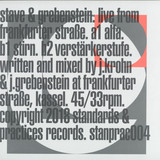
The first release on Standards & Practices since the widely acclaimed remixes of Talker's 'Battle Standards' EP (by Surgeon / Regis / Broken English Club) from late last year, 'Live From Frankfurter Strasse' represents the first recorded collaborative effort from Jonathan Krohn (Stave, also 1/2 of Talker) and Jan Grebenstein (Downwards, Horo).
Culled from recording sessions following several successful improvised live performances in San Francisco, Los Angeles, & Berlin, 'Live From Frankfurter Strasse' is 3 tracks of seismically powerful, industrial dub music that represents a new direction for the pair and is unquestionably some of their strongest material to date.
The twitchy, pared-to-the-bone opener 'Alfa' is at once vast and frighteningly claustrophobic, recalling the brutal, clinical precision of Mika Vainio & Ilpo Vaisanen's output, with a brilliantly tricky arrangement that continually pulls the rug out from under the listener - it's vertigo-inducing twists and turns are simultaneously disorienting and endlessly hypnotic. On the flip, the brooding, scorched-earth 'Stirn' & 'Verstarkerstufe' work at a much slower tempo, uncurling like a plume of smoke with a spacious, cerebral quality that occasionally brings to mind early Gescom.
The first release on Standards & Practices since the widely acclaimed remixes of Talker's 'Battle Standards' EP (by Surgeon / Regis / Broken English Club) from late last year, 'Live From Frankfurter Strasse' represents the first recorded collaborative effort from Jonathan Krohn (Stave, also 1/2 of Talker) and Jan Grebenstein (Downwards, Horo).
Culled from recording sessions following several successful improvised live performances in San Francisco, Los Angeles, & Berlin, 'Live From Frankfurter Strasse' is 3 tracks of seismically powerful, industrial dub music that represents a new direction for the pair and is unquestionably some of their strongest material to date.
The twitchy, pared-to-the-bone opener 'Alfa' is at once vast and frighteningly claustrophobic, recalling the brutal, clinical precision of Mika Vainio & Ilpo Vaisanen's output, with a brilliantly tricky arrangement that continually pulls the rug out from under the listener - it's vertigo-inducing twists and turns are simultaneously disorienting and endlessly hypnotic. On the flip, the brooding, scorched-earth 'Stirn' & 'Verstarkerstufe' work at a much slower tempo, uncurling like a plume of smoke with a spacious, cerebral quality that occasionally brings to mind early Gescom.
- 01: Adrift
- 02: Become Real
- 03: Cipher
- 04: Lithic
- 05: Isolation Waves
- 06: Vanta
- 07: Across Time
- 08: Hymnal
- 09: Blood Rain
- 10: Prima
- 11: Fragility
- 12: Bodied
- 13: The Circle Is Complete
Planet Mu are excited to announce Ital Tek's 'Bodied', the follow up to his acclaimed 2016 album 'Hollowed'. Stepping in a different direction from that album, It's as if Hollowed's detailed world has been fleshed out and filled with the spectre of human voices.
As on his last album, the sounds on 'Bodied' are highly designed, but this time barely a whisper of dance music remains. Instead it's built around acoustic elements and ghostly choral arrangements, refracted and transformed into atmospheric, alien forms which are given the time to settle and transform. Rhythm is used only as a tool to give his world a sense of dark, mechanical momentum.
Alan explains; "After completing 'Hollowed' I had over a year away from writing any of my own material. I was working, composing music for a video game and a number of different projects. I needed to find a way back in and I rediscovered the joy of music being a release as opposed to a job. I was getting up really early and sketching out lots of ideas very fast, squeezing in quick bursts of writing at the beginning or end of long studio day spent working on other musical projects."
"It was important for me to define the world that the album was going to inhabit before taking it any further, so I put a much greater focus into the sound design and palette than I had before. I wanted to make the music sound very physical, geometric, and monolithic, as if it inhabited a physical space."
"On 'Bodied' the music focuses on the interplay between the minuscule and the vast, beauty and brutalism. With this album I was much more concerned with dynamics and the discipline of holding tension; the use of space and silence to provide a counterpoint to the intensity."
"Most importantly, I was keen for there to be a human acoustic foundation, so I did a lot of live recording of cello, violin, harp and guitar - anything I could get my hands on. I was certain that I wanted there to be a greater vocal presence - nothing lyrical or at the forefront but to give it an underlying organic quality - to impart some humanity into the music."
As Ital Tek moves further from his roots, he's creating new sounds and spaces in which his music can exist. It's up to the listener to decide what kind of world 'Bodied' evokes, but it's certainly one that's beautiful and rewarding to spend time in.
When looking for music to be released on Magazine, our guideline has always been energy. The key question remains the same: Does the artist have something important to say Does it have a sense of urgency Alex played us these tracks while visiting the Magazine studio in Cologne earlier this year and we were consumed by unadulterated rage. This is anything but a conceptual release, Alex has not released this kind of music before. A side of Alex manifests itself through these techno tracks, that most might not have known before. Brutal yet beautiful, furious yet fragile. A Berlin native who shaped his sense for techno by striving through his hometown and its infamous raves, Alex is now one of the prominent protagonists of that scene - not only when regularly playing at Berghain. The EP harnesses this experience perfectly, fully preserving the energy of the creation process by recording directly to tape. Most productions may have suffered from this primitive method of locking sound into position, but not these tracks from a techno master.
When Ann Arbor's Tadd Mullinix began exploring hip-hop under the name Dabrye 20 years ago, he soon honed in on a startling vision of what the genre could be: ingenious, refined, daring. This vision came to life across two albums for Ghostly International — 2001's One/Three and its 2006 follow-up Two/Three— with each record further positioning the quiet Michigan producer as one of his generation's best, equally comfortable creating minimalist instrumental meditations or sharp rap salvos. In the late 2000s, following critical acclaim and accolades from both peers and inspirations (including the late Jay Dee with whom Mullinix collaborated before his untimely passing), Mullinix put the Dabrye moniker on ice and dedicated himself to other genres and ideas. All the while the influence of his work on a new generation of electronic musicians continued to make itself felt in subtle but meaningful ways.
All this changes in 2017 as Dabrye makes his long-awaited return with Three/Three, a razor-sharp rap album that brings to completion a prophetic trilogy. Mullinix's incisive productions provide the backdrop for equally acute rhymes that run the gamut from intergenerational observations and being your best self to back alley deals and having fun in the ride. Guests include indie rap legend DOOM, whose previous collaboration with Dabrye remains a point of reference for many, Wu Tang storyteller Ghostface Killah, L.A word fanatic Jonwayne, and Long Island's rugged surrealist Roc Marciano. Most importantly Three/Three is, much like its predecessor, an unfettered celebration of Detroit-area talent with Guilty Simpson, Phat Kat, Kadence, Quelle Chris, Danny Brown, Shigeto, Clear Soul Forces and more all lending their touch to Dabrye's return.
The blend of American and British dance music, hip-hop sampling, and Jamaican sound clash energy that underpinned Two/Three remains a quiet, guiding principle. At the same time Mullinix rejoices in a refreshed perspective, having had time to incubate ideas and find clarity in the distance between albums and the evolution of scenes.The beats are looser and less angular, more embracing of repetition. Organic techniques inspired by soul and jazz round off some of the harsher sonics. The resulting broad palette of tracks reflects both this evolution and the range of the Dabrye persona: relaxed headnod ("Tunnel Vision"), nervous, slow-motion electro ("The Appetite"), glacial motifs ("Emancipated"), jazzy, cut-up funk ("Sunset"), minimal brutalism ("Electrocutor"), intricate layering ("Culture Shuffle").
Three/Three marks the return of an innovator after close to a decade of silence. Despite what the title might imply, the album isn't the end of the story but rather the completion of a creative arc. Expect more Dabrye in the near future. The game is far from over.
- Final installment of the /Three series, started in 2001
- Guests include Ghostface Killah, Jonwayne, Doom, Danny Brown, Shigeto, and more.
- Media support from: The Wire, FACT Magazine, The Detroit Free Press, Pitchfork, XLR8R
- Past collabs with Jay Dee (J Dilla), MF DOOM, Beans & more
- Vinyl is housed in a matte jacket with black hot foil and includes 24-page zine designed by Michael Cina.
Whether or not techno music is destructive and to what degree is fair concern to have, but there's no denying that it can call upon our primal instinct of surrendering to rhythms together with everyone around the proverbial camp fire. Sure, the camps of today are the clubs, and the fires are strobes, but that doesn't change the essence of rituals that we continue practicing. The release stays close to 130 BPM and offers efficient tools for the dancefloor: Airy, for one, represents a syncopated narrative of wonder and magical realism, whereas in the
hands of Gotshell it becomes less contemplative, shifting to a more direct perspective.
Backed by cascading kicks XI takes a dive into atonal realm, and KUJIN —the most brutal number of EP—offers a densely packed treble range running above the hammering 3/3 kicks. With Hydra, it's a trip laden with wondrous soundscapes, shamanic percussion and
sensations of unexplored grounds emanating from the bassline, after which the closer Trioptic provides a rebellious theme fitting for times of unrest and resistance.
- A1: Discovery
- A2: Floating World
- A3: The Fire
- A4: Life By The Sea
- B1: Harmony
- B2: Shanghai Gesture
- B3: Leave Her To Heaven
- B4: Light
- C1: Music For Someone
- C2: Calcutta
- C3: Nightshift
- C4: The Astronaut
- C5: Spectators Of Life
- D1: Life By The Sea (Peel Session)
- D2: Discovery (Peel Session)
- D3: Shanghai Gesture (Peel Session)
- D4: Harmony (Peel Session)
Factory Benelux presents a new vinyl edition of Swimming, the debut album by Belgian new wave group The Names, originally issued in June 1982, and now issued in a limited edition of 300 copies on clear vinyl.
Between 1979 and 1982 The Names recorded a string of excellent records for Factory, Factory Benelux and Les Disques du Crepuscule, all helmed by legendary producer Martin Hannett. Recorded at Strawberry Studios in Manchester, Swimming has come to be regarded as a European cold wave classic, combining strong songwriting from Michel Sordinia and poised, tasteful delivery by guitarist Marc Deprez and keyboards player Christophe Den Tandt.
"Exhibits many of the fine qualities of early 80s avant-rock: icy brutalism, spectral reverb, tormented vocals, techno-tribal rumbles" (Uncut, 12/2000); "Swimming retains a gorgeously shrouded, sepulchral mood" (Mojo, 12/2011); "Intelligent and imaginative" (The Face, 7/1982)
Bonus tracks include the popular singles Calcutta, Nightshift, Spectators of Life and The Astronaut, as well as the band's John Peel session from February 1982 - the first ever recorded by a Belgian band. The gatefold sleeve features original artwork and poster design by Benoit Hennebert, and photographs by Marc Portee.
On The 50th Anniversary Of The Band's Inception At An Event In Harlem, Ny To Commemorate Malcolm X's Birthday On 19 May 1968, Influential Spoken Word Artists, Poets And Commentators The Last Poets Are Set To Make A Glorious And Relevant Return With Their First Album In Over 20 Years, 'understand What Black Is'.
Produced By Ben Lamdin (nostaglia 77) And Brighton Legend Prince Fatty, Whose Speciality Is Traditional Reggae And Dub Production's, 'understand What Black Is' Is A Ten-track Album Which Speaks Of A Revolutionary Struggle Defined By Both Race And Identity, That Has Never Sounded More Relevant. Released On Studio Rockers, There Will Also Be An Accompanying Single Featuring Remixes Of The Title Track "understand What Black Is" By Mala (south London Collective Digital Mystikz) And Uk Dance Music Innovators Dego And Kaidi.
Since The Initial Line-up Of Dahveed Nelson, Gylan Kain And Felipe Luciano Formed In East Harlem's Marcus Garvey Park, The Last Poets Have Produced Under Various Guises Over The Subsequent Years. However, It Was Their Seminal Output, Namely 1970's 'the Last Poets' Under Both Umar Bin Hassan And Abiodun Oyewole That Secured Their Legacy, Becoming One Of The Most Important Influences In Early Hip Hop.
Throughout The Last 20 Years, The Band Have Remained Largely On Hiatus. But Their Influence Could Still Be Felt With Their Tracks Being Sampled By The Notorious B.i.g, Nwa, A Tribe Called Quest, Dr.dre And Snoop Dogg. Umar Has Recorded Various Solo Albums And Featured On Common And Kanye West's Grammy Nominated 'the Corner'. Abiodun Appeared On The Red Hot Organization's Album, Stolen Moments Which Was Named "album Of The Year" By Time. He Also Conducts Weekly Open House Poetry Readings, Where He Constructively Critiques Upcoming Poets, Helping To Nurture Them. He Has Also Conducted Classes At Columbia University, Where He Teaches Creative Writing.
The Inauguration Of Donald Trump As Us President In 2016 Inspired Hassan And Oyewole To Resurrect The Group To Create A Brand New Record, Modern And Edgy, And Deeply Relevant And Reflective Of Our Times.
Tracks On 'understand What Black Is' Include 'how Many Bullets', Which Bridles With Defiance As Oyewole Works Through A Litany Of Injustices Suffered By Black People In The Us: " You've Tried
To Blow My Brains Out With Bigotry, Chopped Off My Wings, So I Couldn't Fly Free, And Dared Me To Be Me, Took My Drum, Broke My Hands, Yanked My Roots Right Up Out Of The Land, And Riddled My Soul With Jesus" 'what I Want To See' Describes A Utopia - A Refuge From Hurt And Those Who'd Make "our Vision Blurred, And Our Faith Obscure", Whilst The Title Track 'understand What Black Is' Aims To Transcend Ethnicity: "understand What Black Is....it's The Source From Which All Things Come...black Is A Hero, Not A Villain."
The Album Even Takes Reference From Prince's 2003 Album Of Instrumentals, 'news', Which Hassan Drew Comparisons From With His Own Childhood Experiences: "that Poem Took Me About A Year To Write....i Just Kept Writing And Writing But Not Getting Too Far And Then I Heard That Album And The Musicianship Was Amazing. I Was Left Wondering If It Was Jazz, Classical, Rock Or Maybe Something New But All Those Images That I Write About Came To Me From Listening To That Album. I Loved Prince In That Movie Purple Rain Because My Father Was A Talented Musician But He Was Into Brutalising Mama At Times And In The Movie There's A Jerome And My Name Is Jerome, So It Was Like He Was Telling My Life Story As Well."
The Album Acts As A Body Of Work Between Individual Members Each Speaking Of Their Own Personal Journeys, But Feeding Into The Much Larger Narrative Of Struggle And Oppression, Alongside A Fervent Hunger For Social Change. These Are Struggles And Tests Of Personal Resolve That Have Directly Shaped And Moulded The Bands' Unique Sound Over The Course Of An Impressive 50 Years, And Their Powerful And Influential Commentary Remains As Relevant As Ever.
After a period of hibernation, aperture records awakens with a bang and a compelling program in the pipeline.
Following their first album released on aperture at the tail end of 2015 'no.3.obliate', the Italian duo T.e.s.o. bring us their second full-length album 'costruzione 04'.
As the title suggests, the album centres around an underlying theme of construction, inspired by radical architecture, brutalism and collages from Superstudio. The concept and title evolved from the nature of the album and the process of building up tracks from a number of separate samples, much like the singular elemental materials used to assemble a structure.
Alongside their music production, the duo have previously created a multimedia installation that investigated the geometric studies of Le Corbusier in parallel to the musical production of Erik Saite and Matteo Castiglioni continues to create impressive audiovisual installations such as the recent 'Freddo Flusso' and 'neon(i)', as well as a collaboration with Danilo Randazzo. T.e.s.o also continue to perform absorbing live sets of their own inimitable range of musical perspective and vision.
Intense, visual and structured, 'costruzione 04' again showcases T.e.s.o.'s complex, obscure and dominant beats and their oblique and sometimes challenging style.