
nicht am Lager
Bestelle jetzt und wir bestellen den Artikel für dich beim Lieferanten.
10,55 €
Last In: vor 3 Jahren
Bestelle jetzt und wir bestellen den Artikel für dich beim Lieferanten.

Japan's guitar hero Takeshi Terauchi reworks traditional songs and lets everything go wild with his magnificent and frenzied guitar sound. Enter the electrifying world of Eleki!
Gatefold 180g heavy vinyl LP, reverse board print. Comes with extensive liner notes by Japanese pop culture writer Julien Seveon (Cinexploitation)
All tracks licensed by King Record Co., Ltd., Tokyo, Japan.
Mastering and lacquer cut by Jukka Sarapää at Timmion Cutting Lab, Helsinki, Finland.
Artwork by Nker
The aftermath of World War II gave rise to a global phenomenon that saw new generations of young people rise up determined to forge new paths from their elders – culturally, politically, and musically. Japan was no exception and the recent past made the local youth angrier, hungrier and even more determined to fully experience something different from their parents. The country caught on to the early rock & roll craze almost in tandem as it was happening in the States. Teenager Chiemi Eri singing "Rock Around The Clock" and Kazuya Kosaka with "Heartbreak Hotel" were among the first to make what would soon be called Rokabiri accessible to a large audience. Teacher and parent associations showed concern regarding this new music when teenagers started missing school to attend afternoon shows – one of which most notably being the Nichigeki Western Carnival where all the top names of Rokabiri played to sold out audiences. But by the end of the 1950s, the youth of Japan had moved on to something else entirely: Eleki.
The 50s and 60s were a time of rapid change that saw trends come and go. Japan, like all other industrial countries, saw its youth move from one musical sensation to the next. And in the early 60s, there was one band in particular that created a distinct new flavor: The Ventures. Leaving behind vocals and focusing strictly on the impact of the sound of the electric guitar, The Ventures drove kids crazy all over the world. Other bands followed, most notably The Shadows, but in Japan, no other instrumental rock band managed to leave such an impact. The sound of The Ventures helped boost guitar sales in Japan and soon hundreds of cover bands were popping up all over the country. The Eleki Bumu (electric boom) was now in full effect with Takeshi Terauchi emerging as its first and greatest guitar hero.
Terauchi was born January 1939 in the prefecture of Tochigi, north of Tokyo. His mother taught music and played the shamisen – a traditional Japanese stringed instrument – while his father ran, among other things, an electronics shop. Their respective professions were to be decisive in the path that Terauchi would later take. Serendipitously, at the age of five, Takeshi was given his first instrument – a guitar. His destiny sealed, he quickly began experimenting with different tools from his father's shop to give his instrument a stronger sound. The technological approach came from his father, the technique from his mother. Terauchi's signature playing style owes a lot to his mother's instrument of choice, as he attacks the notes on his guitar as one plucks the strings of a shamisen.
This exceptional compilation you are holding in your hands explores some of the best works by Takeshi Terauchi, recorded between 1966 and 1974, where the guitar hero looks inwards to Japan for inspiration. A meeting between traditional folk songs and the unique way Terauchi and his band play: the content is explosive, inspired, and highly addictive! The 60s and 70s were undoubtedly Terauchi's finest hours, and in the late 60s, one Japanese critic said that Terauchi was not only the best guitarist in Japan, but also in the world. You can now find out why.
Bestelle jetzt und wir bestellen den Artikel für dich beim Lieferanten.

Freestyle puts out another reissue 12" in their drive to unearth rare and classic UK funk, soul & boogie records - this time a much needed pressing of the late Candy McKenzie's heavy boogie-funk cover of Patrice Rushen's classic Remind Me. Produced by Candy's late cousin, and seasoned session bass player, John McKenzie (and licensed from the family estate) this was originally released in 1983 - and comes with an excellent dubbed-out 'Different Style' instrumental version on the flip.
-----------------------
Candy McKenzie (1953-2003) was a North West London-based vocalist from a Guyanese family heavily steeped in musicianship . She began learning the piano at a young age, picking up vocal harmony from her father, a jazz bass player. Her brothers Bunny & Binky, were also celebrated bassists. Candy would marry young in 1970 at the age of 17, though just one year later her brother Binky (who played with the likes of Cream, Alexis Korner & John Mclaughlin in the late 60s) tragically killed her mother and father, along with Candy's husband in an attack at the family home to which Candy was present. Candy was also injured but escaped with her life.
In the years that followed the tragedy Candy, regularly accompanied by her brother Bunny, would find reggae vocal session work - often at the Chalk Farm Studios frequented by many key producers & acts. She found her way onto Aswad's first album and Keith Hudson's legendary Flesh Of My Skin Blood Of My Blood LP - and a little while later on a couple of sessions with Bob Marley for Island, under the supervision of Lee Perry.
The latter two parties took a keen interest in Candy, with Island wisking her away to Jamaica in 1977 to record an album at the legendary Black Ark. Her vocals found their way onto The Congos seminal Heart of the Congos LP, but the album she recorded with Perry was shelved - with just the Black Art holy grail 12" Disco Fits / Breakfast in Bed finding it's way to release at the time.
Back in London, Candy spent the early to mid 80s recording various lovers and funk/soul 12"s, including this fantastic cover of Patrice Rushen's Remind Me, produced by her cousin John. She went on to record singles for labels like Elite & Cooltempo throughout the '80s and early '90s, and appeared as backing vocalist with the likes of Leonard Cohen, Whitney Houston, Elton John and Diana Ross. She passed away in 2003, with her one and only album recorded at the Black Ark finally seeing release on Trojan in 2011.
Candy's cousin John McKenzie got his starts in the music industry in the mid 70s as part of prog group Man and communal festival rockers Global Village Trucking Co., as well as playing with the likes of Annette Peacock and Steve Hillage. His father Mike McKenzie was also a key Carribbean jazz figure in the UK throughout the early 1950s, through to the '60s and '70s. John would become a heavily in-demand session musician - playing with everyone from the Eurhythmics to Bob Dylan - while also finding time to produce this record, alongside a couple of excellent 12"s with Mel Gaynor as Finesse, between 1982 and '83. He would regularly tour the world as a live musician for a huge array of headline acts, appearing on multiple chart hits, and in his later years was a member of the excellent group Ibibio Sound Machine. He lost his battle with cancer in 2020.
This reissue is dedicated to the memory of both John & Candy McKenzie.
Bestelle jetzt und wir bestellen den Artikel für dich beim Lieferanten.

At the beginning of the eighties reggae music became increasingly in tune with what was happening in Kingston’s dance halls… probably more so than at any time since the sound system operators had started to make their own shuffle and boogie recordings in the late fifties. The international audience and the critics were too busy looking for a new Bob Marley to appreciate what was happening downtown and failed to acknowledge that this was a return to the real, raw roots of the music. Brash, confident, young record producers who were totally in tune with the youth audience stepped forward and seized the moment…
Oswald ‘Ossie’ Thomas began his apprenticeship in the music business at the age of
fourteen and served his time as a record salesman for Bunny ‘Striker’ Lee and Winston ‘Niney The Observer’ Holness before moving on to Miss Sonia Pottinger’s Tip Top Records.
“I ended up working in three record stores on Orange Street from 1976 to 1981… Yeah man! Me deh ‘pon me bicycle till I buy my motorcycle! Them days records were coming out left, right and centre… every day!” Ossie Thomas.
It was during his time with Miss Pottinger that Ossie began to produce records for
himself and in 1979 Ossie and Phillip Morgan began the Black Solidarity label based deep in the Kingston ghetto on Delamere Avenue. Phillip initially inspired Ossie to start the label and soon Triston Palma, Phillip Frazer and “a youth named Gary Robertson” joined in although Gary later left for Canada.
The Soul Syndicate rehearsed in the Delamere Avenue area and Tony Chin gave Ossie a cut of a rhythm that he used for Triston Palma’s ‘A Class Girl’… the label’s inaugural release. The record was a sizeable success and paved the way for hit after hit after hit on Black Solidarity. Ossie worked with just about everybody who was anybody during this critical period of the music’s development including vocalists Robert Ffrench, Little John, Sugar Minott, Frankie Paul and most notably Triston Palma.
For this release we have compiled some of the version sides to those releases. Dub still being an integral part of the Reggae Sound System Sound. So sit back and listen to what Black Solidarity, one of the most important and often overlooked labels were bringing to the dance, dubwise, back in those heady 1980’s times.
With grateful thanks to: Paul Coote, Nick Hodgson & Hasse Huss
erscheint voraussichtlich am 24.02.2023

‘Cracker Island’ is the eight studio album from Gorillaz, an energetic, upbeat, genre-expansive collection of 10 tracks featuring yet another stellar line-up of artist collaborators: Thundercat, Tame Impala, Bad Bunny, Stevie Nicks, Adeleye Omotayo, Bootie Brown and Beck. Recorded in London and LA earlier this year, it is produced by Gorillaz, Remi Kabaka jr. and eight-time Grammy Award-winning producer / multi-instrumentalist / songwriter extraordinaire Greg Kurstin. Title track ‘Cracker Island’ kickstarted the new campaign this Summer hitting the charts across the globe with a top 10 video racking up 10M views in 10 days. The virtual band exploded onto TikTok gaining over 2.1 m followers in the space of a few months where they continue to innovate, taking virtual characters where no character has been before…
Bestelle jetzt und wir bestellen den Artikel für dich beim Lieferanten.

Derrick Morgan ia one of the greats of Jamaican music, he is the undisputed King of Ska.
But his recording career dod not stop in 1967 when the sound of Ska slowed down into Rocksteady.
Nor did it stop in 1968 when Rocksteady evolved into the early sound of Reggae.
The set you have here was first released in 1974 when Reggae was King,the album carried the name 'In the Mood'..but also had the working title 'This is Derrick Morgan'.
A title in the world of Reggae carrying the moniker would normally be used to introduce new singer and be his showcase album.
In this case in could be used to reintroduce the singer Derrick Morgan to the new Reggae sound.
But we feel someone of Derrick's calibre needs no introduction as his voice works on any rhythms put his way.
So sit back and enjoy one of the greats of Jamaican music showing the world with the help of producer Bunny Lee that he can roll with the Reggae sound....respect...
Bestelle jetzt und wir bestellen den Artikel für dich beim Lieferanten.

Studio One was founded by Clement "Coxsone" Dodd1 in 1954, and the first recordings were cut in 1963 on Brentford Road in Kingston.12 Amongst its earliest records were "Easy Snappin" by Theophilus Beckford, backed by Clue J & His Blues Blasters, and "This Man is Back" by trombonist Don Drummond. Dodd had previously issued music on a series of other labels, including World Disc, and had run Sir Coxsone the Downbeat, one of the largest and most reputable sound systems in the Kingston ghettos.
In the early 1960s, the house band providing backing for the vocalists were the Skatalites[3] (1964–65), whose members (including Roland Alphonso, Don Drummond, Tommy McCook, Jackie Mittoo, Lester Sterling and Lloyd Brevett) were recruited from the Kingston jazz scene by Dodd. The Skatalites split up in 1965 after Drummond was jailed for murder, and Dodd formed new house band the Soul Brothers (1965–66), later named the Soul Vendors (1967) and Sound Dimension (1967-). From 1965 to 1968 they played 9 a.m. to 5 p.m., 5 days a week, 12 rhythms a day (about 60 rhythms a week) with Jackie Mittoo as music director, Brian Atkinson (1965–1968) on bass, Hux Brown on guitar, Harry Haughton (guitar), Joe Isaacs on drums (1966–1968), Denzel Laing on percussion, and on horns (some initially and some throughout): Roland Alphonso, Dennis 'Ska' Campbell, Bobby Ellis, Lester Sterling, among others on horns during the era of Rock Steady. Headley Bennett, Ernest Ranglin, Vin Gordon and Leroy Sibbles were included among a fluid line-up, to record tracks directed by Jackie Mittoo at Studio One from 1966-1968.
During the night hours at Studio One from 1965-1968, singers like Bob Marley, Burning Spear, The Heptones, The Ethiopians, Ken Boothe, Rita Marley, Marcia Griffiths, Judy Mowatt, Alton Ellis, Delroy Wilson, Bunny Wailer[4] and Johnny Nash, among others, would put on headphones to sing lyrics to original tracks recorded by the Soul Brothers earlier each day. These seminal recordings included "Real Rock" (by Sound Dimension), "Heavy Rock", "Jamaica Underground", "Wakie Wakie", "Lemon Tree", "Hot Shot", "I'm Still In Love With You", "Dancing Mood", and "Creation Rebel".
Jackie Mittoo, Joe Isaacs, and Brian Atkinson left Studio One in 1968, recorded drums and bass for Desmond Dekker's and Toots' biggest hits at other Kingston studios, then moved to Canada. Hux Brown stayed in Jamaica to record on the soundtrack The Harder They Come, The Harder They Fall, and toured in Nigeria with Toots and the Maytals and Fela Kuti. The Soul Brothers (a.k.a. Sound Dimension) formed the basis of reggae music in the late 1960s, being versioned and re-versioned time after time over decades by musicians like Shaggy, Sean Paul, Snoop Lion, The Clash, String Cheese Incident, UB40, Sublime, and countless other Billboard originals and remakes trying to emulate their original Rock Steady sound at Coxsone's Studio One.
The label and studio were closed when Dodd relocated to New York City in the 1980s.
erscheint voraussichtlich am 17.02.2023

Studio One was founded by Clement "Coxsone" Dodd1 in 1954, and the first recordings were cut in 1963 on Brentford Road in Kingston.[1][2] Amongst its earliest records were "Easy Snappin" by Theophilus Beckford, backed by Clue J & His Blues Blasters, and "This Man is Back" by trombonist Don Drummond. Dodd had previously issued music on a series of other labels, including World Disc, and had run Sir Coxsone the Downbeat, one
of the largest and most reputable sound systems in the Kingston ghettos.
In the early 1960s, the house band providing backing for the vocalists were the Skatalites[3] (1964–65), whose members (including Roland Alphonso, Don Drummond, Tommy McCook, Jackie Mittoo, Lester Sterling and Lloyd Brevett) were recruited from the Kingston jazz scene by Dodd. The Skatalites split up in 1965 after Drummond was jailed for murder, and Dodd formed new house band the Soul Brothers (1965–66), later named the Soul Vendors (1967) and Sound Dimension (1967-). From 1965 to 1968 they played 9 a.m. to 5 p.m., 5 days a week, 12 rhythms a day (about 60 rhythms a week) with Jackie Mittoo as music director, Brian Atkinson (1965–1968) on bass, Hux Brown on guitar, Harry Haughton (guitar), Joe Isaacs on drums (1966–1968), Denzel Laing on percussion, and on horns (some initially and some throughout): Roland Alphonso, Dennis 'Ska' Campbell, Bobby Ellis, Lester Sterling, among others on horns during the era of Rock Steady. Headley Bennett, Ernest Ranglin, Vin Gordon and Leroy Sibbles were included among a fluid line-up, to record tracks directed by Jackie Mittoo at Studio One from 1966-1968.
During the night hours at Studio One from 1965-1968, singers like Bob Marley, Burning Spear, The Heptones, The Ethiopians, Ken Boothe, Rita Marley, Marcia Griffiths, Judy Mowatt, Alton Ellis, Delroy Wilson, Bunny Wailer[4] and Johnny Nash, among others, would put on headphones to sing lyrics to original tracks recorded by the Soul Brothers earlier each day. These seminal recordings included "Real Rock" (by Sound Dimension), "Heavy Rock", "Jamaica Underground", "Wakie Wakie", "Lemon Tree", "Hot Shot", "I'm Still In Love With You", "Dancing Mood", and "Creation Rebel".
Jackie Mittoo, Joe Isaacs, and Brian Atkinson left Studio One in 1968, recorded drums and bass for Desmond Dekker's and Toots' biggest hits at other Kingston studios, then moved to Canada. Hux Brown stayed in Jamaica to record on the soundtrack The Harder They Come, The Harder They Fall, and toured in Nigeria with Toots and the Maytals and Fela Kuti. The Soul Brothers (a.k.a. Sound Dimension) formed the basis of reggae music in the late 1960s, being versioned and re-versioned time after time over decades by musicians like Shaggy, Sean Paul, Snoop Lion, The Clash, String Cheese Incident, UB40, Sublime, and countless other Billboard originals and remakes trying to emulate their original Rock Steady sound at Coxsone's Studio One.
erscheint voraussichtlich am 10.02.2023

• Bunny Lee was the first to actually use reggae in the title of a record with ‘It’s Reggae Time’ Striker’s propensity for creating hit records during this period was unmatched and he was awarded the prestigious “title of Jamaican Producer Of The Year in 1969, 1970, 1971 & 1972” the years covered by this new Boss Reggae focused compilation.
• Striker’s complete mastery of the new reggae rhythms and “versioning them over” are showcased on this release with the emphasis placed on the outstanding contribution of the cream of Kingston’s session musicians
erscheint voraussichtlich am 27.01.2023

Mysticisms keeps the Dubplate series moving, welcoming one of the seminal Dub producers of all time in Scientist. His unique studio techniques and understanding of rhythm are exalted and present on Step It Up, an enlightening example of his genius and matched with a widescreen remix by label associate DJN4, aka DJ Normal 4, teaming up with fellow Dusseldorf producer AKI AKI, to offer a dreamland breaks-steppers anthem.
The fact that Hopeton Overton Brown aka Scientist is one of the true pioneers of Dub music is undisputed. His productions, first as an apprentice at Studio One, then breaking through whilst teamed at King Tubby's studio, led to Channel One and a series of seminal Dub masterpieces throughout the 1980s, mixing engineer Henry 'Junjo' Lawes' productions with the Roots Radics, alongside vocalists Barrington Levy, Jonny Osbourne and Jah Thomas.
Step It Up precedes, taken from the period of seminal Tubby's work with Bunny Lee and in this instance, with Barry Brown classic vocals and Lee's house band, The Aggravators, backing. As often with Reggae's history, much is disputed, however, this unmistakable Scientist production showcases Brown's high pass filters in effect, the trademark riding 4/4, utilising the 4 track mixing desk to create a joyous bounce.
Working on the license from the outset, Tim Schumacher aka DJN4, waited in the wings to dive in the desk for a modern-day remix. Partnering with up-and-coming producer Aki Vierboom (Phaserboys / Candomble), the Digi-Dance MixX is bass-quaking histrionics, a steppers meets rave culture overdose that will be heard from festivals to dancehalls, a righteous dub-breaks riddim y'all.
Step the Mystery
Bestelle jetzt und wir bestellen den Artikel für dich beim Lieferanten.

Red Vinyl
Adrian Borland and Graham Bailey might be better known as members of legendary post-punk group The Sound, but the two were childhood friends and had been playing together even earlier in The Outsiders, and continued their deep musical rapport as a duo, creating these intense and engaging songs as Second Layer at the same time as their higher profile band output.
Combining their early recordings, including the 1979 Flesh As Property EP and 1980 State Of Emergency EP, Courts Or Wars takes its title from the first song that served as the pair’s introduction to listeners. Right from the beginning you are enveloped in what The Quietus described as, “a monochrome worldview morbidly obsessed with the dehumanizing effect of war, nuclear weapon annihilation, and the fracturing and negation of the self within an increasingly distorted and technologically mediated society.” Where The Sound fit snugly next to Echo And The Bunnymen, Second Layer had far more in common with the pulsing menace of Suicide.
Borland’s familiar vocals and sense of melody hold a connection to his other songwriting, but within these songs he takes far more risks in his guitar work to suit the subject matter. What really drives everything is Bailey’s propulsive bedrock, formed by his homemade pre-drum machine rhythm generators, creating an innovative mechanical approach that somehow inserts a jittery neurotic touch that merges perfectly with his electronic layers driven by the wasp synth, various unique effects boxes or tape loops. Adding in Bailey’s own distinctive bass playing, the results feel personal and experimental, pointed and harsh, while also bracingly accessible and covered in dark manic energy.
Over forty years later, these recordings feel shockingly appropriate. In painting a bleak reality and frightening future, there is real desperate beauty here.
erscheint voraussichtlich am 20.01.2023

John Holt has one of the finest and most versatile voices to come out of Jamaica.Whether fronting the great vocal group 'The Paragons' which he joined around 1965,singing many of their greatest hits including'Tide is High','On the Beach','Wear You to the Ball' to name but a few or his extensive solo career.A career that saw him covering every musical style from Pop,Lovers,Soul and his much overlooked Roots period.
John Holt (b.1947,Kingston,Jamaica) was a child prodigy he began his career being a regular voice on talent contests run by Vera Johns across the Jamaican Island.He cut his first single in 1963 for Leslie Kong's Beverly's label,'I Cried a Tear/Forever I'll Stay' and sang many duets with various singers of the day including 'Rum Bumper' with Aton Ellis.
In 1965 to 1970 as stated above was John Holts Paragon years in a period which he also ran solo with hits such as 'Fancy Make Up','A Love I Can Feel' and 'Lets Build Our Dreams'.
For this release we are looking at his extremely productive period working with Bunny'Striker'Lee.This reissue of John Holts classic1976 album 'Before The Next Tear Drop' is an album filled with classic after classic sung by Mr.Holt effortlessly.....
Hope you enjoy visiting these tracks....
Bestelle jetzt und wir bestellen den Artikel für dich beim Lieferanten.

Brixton in South London has to be the place whee legends in Reggae & Dub meet up for a collaboration. The result is this 8 track all-analogue mixed Dubwise adventure that features the UK’s hardest Roots Reggae bass player & drummer (Mafia & Fluxy) playing the UK’s deepest dubs (Vibronics).
This fascinating and intricate LP merges old stool Jamaican reggae musicianship with the swirling euphoria found in contemporary dub music.
Vibronics is one of the most established names in UK Dub/Reggae music. From their base, in the Dub Cupboard Studio in Leicester, their music has achieved millions of views on YouTube, millions of Spotify streams and many tens of thousands of vinyl record sales. Vibronics have collaborated with reggae legends Michael prophet, Macka B, Iration Steppas, Soom T, Aba-Shanti and so many more.
Mafia & Fluxy are the UK’s foremost Reggae rhythm section and were initially inspired by Sly And Robbie, consisting of brothers Mafia (Bass) and Fluxy (drums). Legends of the stage and the studio, they record regularly in the UK & Jamaica, building rhythm tracks for Bunny Lee, Blacker Dread, King Jammy, Exterminator and Jah Shaka. They continue to work with the cream of the crop in terms of Reggae, having recently backed Luciano & Eek-A-Mouse on their world tours.
Bestelle jetzt und wir bestellen den Artikel für dich beim Lieferanten.

Neuauflage des Albumklassikers von 1980, aufgenommen im Channel One Studio und abgemischt in King Tubbys Studio von Scientist. Der Produzent Henry 'Junjo' Lawes engagierte folgende Musiker: Bass: Errol 'Flabba' Holt, Drums: Santa Davis, Sly Dunbar, Style Scott, Guitar: Sowell, Bingy Bunny, Melodica: Jimmy Becker, Organ/Piano: Ansel Collins, Steely, Gladstone Anderson, Percussion: Bongo Herman, Sky Juice, Sticky Thompson, Saxophone: Headley Bennett, Trombone: Val Bennett, Trumpet: Bobby Ellis
Bestelle jetzt und wir bestellen den Artikel für dich beim Lieferanten.

In 1997, after a lengthy hiatus, Echo & The Bunnymen returned to the fore with 'Evergreen', revealing the brighter side of the band, and standing up with any of their earlier work.The self-produced album was recorded at The Doghouse in Henley-On-Thames with additional strings, horns and vocal arrangements recorded at Abbey Road.
The album saw the band rightfully return to the UK album charts at #8, with 3 singles ('Nothing Lasts Forever', 'I Want to Be There When You Come' and 'Don't Let It Get You Down') entering the UK top 50. 'Nothing Lasts Forever' (with backing vocals and tambourine by Liam Gallagher) has grown to become one of the band's most enduring and well-loved songs - a UK Top 10 and a fan favourite to this day.
To celebrate its 25 year anniversary, London Records releases 'Evergreen' on vinyl for the very first time, with a limited first pressing in solid white vinyl. There is also a new remastered and expanded 2 CD edition, taking in studio b-sides, live and acoustic sessions and previously unreleased versions across 33 tracks.
erscheint voraussichtlich am 09.12.2022

Original cat# GREWCD314 - Recorded in 1981 for Time 1 Productions (Jah Screw) this is one of the 'strictly dub' albums and gets a re-mastered LP vinyl re-release! It's the follow-up to 'Dangerous Dub' and again The Roots Radics (Drums: Lincoln "Style" Scott, Bass: Erroll "Flabba" Holt, Piano: Gladstone "Gladdie" Anderson, Keyboards: Wycliff "Steely" Johnson, Rhythm Guitar: Eric "Bingy Bunny" Lamont, Percussion: Barnabus & Noel "Scully" Sims) at their very best and King Tubbys studio sound and mix. Additional mix by Soldgie and Paul "Jah Screw" Love, tracks laid at Channel One - Killer!
Original Cat# GREL314 / Das Original Album "Dangerous Dub" wurde 1981 veröffentlicht und gehört definitiv zu den "Must Have" Alben des Dub. Nun gibt es eine Fortsetzung dieses Klassikers. "More Dangerous Dub" enthält nicht weniger als 14 unveröffentlichte Tracks der Roots Radics, aufgenommen mit King Tubby in den Channel Studios.
Bestelle jetzt und wir bestellen den Artikel für dich beim Lieferanten.

180 gram vinyl LP of Freddie's 1979 album with extensive sleeve notes
Produced by: Winston 'Niney The Observer' Holness
Recorded, Voiced & Mixed at: Channel One ecording Studio, 29 Maxfield
Avenue, Kingston 13
Engineers: Anthony 'Crucial Bunny'/'Bunny Tom Tom' Graham & Lancelot
'Maxie' McKenzie
Musicians:
Drums: Max 'Feelgood' Edwards & Leroy 'Horse Mouth' Wallace
Bass Guitar: George 'Fully' Fullwood
Lead Guitar: Earl 'Chinna' Smith
Lead Guitar & Rhythm Guitar: Albert Valentine 'Tony' Chin & Eric 'Bingy
Bunny' Lamont
Keyboards: Jamaba Johnson & Keith Sterling
Tenor Saxophone: Enroy 'Hot Train' Grant
Trumpet: Arnold 'Willie' Brackenridge & Donald Vidan-Greaves
Percussion: Herman 'Bongo Herman' Davis & 'Brooksy'
Advertising in Black Echoes and Record Collector
erscheint voraussichtlich am 25.11.2022

Rastafarianism came to prominence in the late 1960's/ 1970's and had a huge influence on the musical culture in Jamaica. The sentiments of the songs reflected the struggles of life, as reggae music always did but now with an added spiritual/conscious element to the lyrics. By the mid 1970's most, if not all the top flight singers were following the doctrine and growing their har to dreadlocks.
Everything was truly 'Dread'.
At the heart of this musical explosion was again Bunny 'Striker' Lee a man who was always at the heart of the action and many times in his career ahead of the musical game. As Bunny Lee's stable of singers were at this time nearly all Rasta's and with the worldwide acceptance of Bob Marley, in especially the foreign territories, this musical style was the way forward for reggae music in the mid 1970's. The visual focal point of this new turn in reggae music would be a call to all things 'Dread'. Add to the mix Bunny Lee's close working relationship with studio wizard King Tubby, again not a Rasta himself, but someone who could sonically bring what was needed to the table and enable the whole musical chemistry to fall into place.
Heavy rhythms were created to match the heavy and serious lyrics and 'Versions Galore' as they say were coming out fast and furious.
We have compiled a set of conscious tunes that not only match the 'Dread' criteria, but also are just great tunes. The great Jacob Miller's 'Zion Gates', Cornell Campbells 'Two Faced Rasta', Horace Andy's 'It's Gonna Be Dread' alongside Linval Thompson's 'Never Conquer Jah'. Two timeless cuts from the 'The Abyssinians' get a fresh outing by two great singers, firstly Don Carlos' cut to 'Satta Massaganna' and the prince of reggae himself, Dennis Brown works 'Declaration of Rights' in fine style. Johnny Clarke's 'Man like Me' and 'Dem Say Rasta' still sound as fresh today as when they were first laid down and Wayne Jarrett's 'Live On Jah' and Frankie Jones 'Satta and Praise Jah' add to this great selection. All great 'Dread' tunes that were cut or voiced at King Tubby's giving them that extra shine.
So if you are Rasta or not this is a great set of tunes to make you move and also like all of the best things in life, make you think.........
Track 14 WICKED BABYLON - LINVAL THOMPSON
Bestelle jetzt und wir bestellen den Artikel für dich beim Lieferanten.
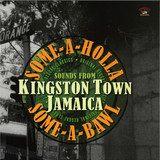
Orange Street, Kingston, Jamaica the epicentre of the Reggae world.
Where all the record shops, studios, pressing plants were based.
The new cut 45’s would be taken to the shops after a testing on various Sound Systems around the people and passed to the record shop proprietors to sell.
Bunny Lee as a former record plugger and now a leading producer knew what the people wanted and a great ear for a hit tune.
This collection carries some of the stand out tracks from this period, when music was finding a new beat as Rocksteady rolled into the late 60’s early 70’s Reggae Sound.
The Ravers ‘Mati and Fulli’ telling the story that the ‘Rent too High’ to The Twinkle Brothers ‘Miss Laba Laba’ …you see and blind you must hear and deaf…clean up your own backyard before talking about others.
All stories of daily life and love songs told over a cracking rhythm played by finest musicians on the island.
So yes ‘Some A Holla Some A Bawl’ as Max Romeo would say but it can’t be denied that all the tunes on this selection are of a fine pedigree….
So sit back and Enjoy the Ride…………..
Bestelle jetzt und wir bestellen den Artikel für dich beim Lieferanten.

Charbel Haber is Lebanese musician, performer, visual artist and composer from Beirut. His work has seen him collaborate with artists from a wide range of disciplines - film, video art, visual art, theatre, dance - both in Lebanon and abroad.
As a solo artist and as a member of post-punk band Scrambled Eggs, he has composed music for directors Khalil Joreige and Joana Hadjithomas, Ghassan Salhab, Mohamad Malas, video artists Lamia Joreige and Akram Zaatari, Maqamat dance company and playwrights Rabih Mroueh and Lina Saneh, to name but a few. His prolific and collaborative career includes free improv group Johnny Kafta Anti-Vegetarian Orchestra, psychedelic Arabic music ensembles Malayeen and Orchestra Omar, cold wave band The Bunny Tylers and minimal ambient duo Good Luck In Death. He is the founder of Those Kids Must Choke and co-founder of Johnny Kafta's Kids Menu - two experimental record labels - and he has recorded and collaborated with notable artists from the fields of free rock and improv such as Oiseaux-Tempête, Radwan Moumneh, Tarek Atoui, Jean Francois Pauvros, The Ex, Michael Zerang, Mats Gustafson, Eddie Prevost, Xavier Charles and Tony Buck.
And once again, here I am telling you to go look for the truth and its beauty in the words of dead poets, in the little tales of ravaged cities, in aborted dreams, in the melancholy of the ruins of tomorrow, in meaningless plastic totems, in the enigmatic end of restless fools.
I'll be here long after you all disappear.
These are the first and last sentences from Charbel Haber's latest offering, A Common Misunderstanding of the Speed of Light: a multi-media musing on the chronic and the chronological, the subversive nature of time. This combination of a record and book observes the slow passing of life and the illusion of retrogradation in his every day. Simply by documenting - via image, text and tune - Haber assigns value to everything that is cast in amber by this project. There's an acceptance and appreciation of the destitution he witnesses, it is an homage given in overlapping forms.
ACMOTSOL has two parts. The book, hardcover in an embossed orange, features photographs and texts taken from Haber's personal digital diary spanning from 2020 to the start of 2022. Broken into six chapters - named for the six tracks on the record - the entries are an artist's log of sorts during a peculiar period of global hyper stagnation and navigating the aftermath of the Beirut explosions. The 96 pages highlight Haber's interest in decay, negative space and the temporality of the human condition. Instead of presenting the images and texts as they were originally paired online, they're reordered and recontextualized in the book. New connections are formed, as tenuous and fleeting as the content they surround. The images interrupt the texts in many instances, forcing pauses and inviting distraction.
At the center of the book is a sudden burst of orange pages, with stylized pluckings of the text framing a QR-code that grants access to the record. With the brilliant orange covers and matching innards, pregnant with the music at the core, it's almost as if these central pages act as a way to turn the book inside out. There, the book's purpose is altered, fixated on a mirror image of itself. It forms a self-completing arc for the project, a loop.
ACMOTSO's second half is that mirrored album. Six tracks totalling just under 52 minutes. The music could be a continuation of his solo albums Of Palm Trees and Decompositions (2016) and It Ended Up Being a Good Day Mr. Allende (2012), an exploration into the expansiveness of seemingly simple loops of a lilting guitar. Careful electronic effects add dimensions or reground the listener. There's a swelling of sound, the illusion of the push of space before it retracts back into itself or fades into the distance. Much like the images and texts the music complements, the songs challenge the purity of cycles. Endings are beginnings, beginnings are endings or is everything just the middle? Haber is quietly and elegantly grappling with the troublesome act of place-making. In music, in words and in visual storytelling.
ACMOTSOL is a work that can be calming or disorienting, depending on what is requested of it. Similar to the way loops and cycles can signify both meditation and mania. The tendrils of Haber's past - his home of Beirut, fictional and real characters encountered, authors read, films watched, composers listened, walks taken - knit themselves together for a presentation of our immediate present. An evidence of a happening. A considered project of time.
All photographs, texts and music by Charbel Haber. Album mixed by Radwan Ghazi Moumneh. Design by Maziyar Pahlevan. Printed by Albe De Coker in Belgium.
This dual-part project will be released on XX XXX 2022 on 'Other People.'
Description by Nereya Otieno.
erscheint voraussichtlich am 11.11.2022
