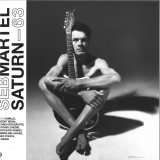
If the name Seb Martel is still unknown to you, the guitarist appears on the credits of classic albums from Tony Allen, Femi Kuti, Morcheeba or Blackalicious. Saturn 63, his new album on InFiné is dedicated to the exploration of the electric guitar in all its nuances. This new opus made from a selection of 9 guitars from the Musée de la Musique (a branch of the Philharmonie de Paris), and only enriched with the voices of his close collaborators (Camille, Sabrina Bellaouel...), unfolds on fourteen tracks a musical fresco faithful to the historical and geographical heritage of his instrument. The album includes fascinating reworks of Carl Perkins, Benjamin Britten, Chavela Vargas or Vincent Segal in addition to his own compositions. However, adopting a dogmatic approach, and dressing his compositions with sounds and effects collected during the recordings, Martel offers an abstract and experimental edge to Saturm 63, which transports the listener into an out of time experience. Two famous names of the French Chanson, -M- and Mathieu Boogaerts joined Martel to close the album with the snapshot of a speechless improvised session.
Cerca:camille
- 1: One Last Time (Feat Blick Bassy)
- 2: Happy (Feat Camille)
- 3: Super Rich Kids (Feat Malik Djoudi)
- 4: Chandelier (Feat Sandra Nkaké)
- 5: Malamente (Feat Camélia Jordana)
- 6: Don't Stop The Music (Feat Camille)
- 7: Royals (Feat Malik Djoudi)
- 8: Bad Guy (Feat Blick Bassy)
- 9: Dance Monkey (Feat Camélia Jordana)
- 10: Video Games (Feat Sandra Nkaké)
With their ability to move seamlessly from the triangle to the donkey jaw, cymbals to Chinese gong, vibraphone to wind machine, percussionists are undoubtedly the most atypical members of the classical orchestra. Paul Changarnier, Nicolas Cousin and Alexandre Esperet are a case in point. Having set their sights on the marimba - Latin American xylophone, cousin of the African balafon - they decided to use it as the main vehicle for their artistic dreams. With the label No Format, they embarked on a project which would see them taking on pop hits of the kind that are produced in mega studios on the other side of the Atlantic and dazzle with a thousand lights and special effects. But they wanted to do it without leaving France or their beloved instruments. They wanted to make pop without machines, guitars, bass or synths. They ended up finding a hitherto unknown instrumental formula that belongs to them and them only, one conceived as the perfect fit for the voices from the well-known French artists that were called upon to interpret the songs. Camille, with her extraordinary energy, makes Rihanna"s "Don"t Stop the Music" waltz in a new organic mode; Blick Bassy redecorates Ariana Grande"s "One Last Time" in the colours of Bassa; Malik Djoudi envelopes Frank Ocean"s "Super Rich Kids" with a subtle ethereal texture; Camélia Jordana made her mark on this bonanza of reinvention by slowing down the tempo of "Dance Monkey"; The voice of Sandra Nkaké, imbued Lana del Rey"s "Video Games" with a solemn and sublime mystery. Like an old love that"s rediscovered with new eyes, an air that comes back from far away but could have been born today, somehow familiar but never seen before. Déjà vu but never heard until now. Déjà Vu: the name of this magnificent, unprecedented experience, this unidentifiable flying platter.
Hot on the heels of 2021's stellar release of The French Connection's "Speechless" LP, Balance head honcho and legendary producer and DJ Chez Damier teams up again with Camille and Adeen Records for another trip around the the world with Lima, Peru's Surco's Groove, "The Lima Project." This beautiful release titled "What Is Love?" delivers hard hitting versions of the track in the original, dub, instrumental, and an acapella with stellar remixes from Snad and German producer Damien Rausch. Be it France or Peru, Balance and Adeen knows how to take you on a musical journey. We can't wait to see where they go next!
Adeen Records comes with its series of funk, soul, dsco and jazz only edits label called The Bird. And it's first releases comes from label head Camille and Spanish graffiti artist and dj Cad73, and edited by DJ Boring. These two 7" gems came from each selectors childhood memories from living in Detroit and Barcelona respectively. While Camille draws such tunes as "Stop Bajon and Carino" from influences Detroit, Cad73 pulls "Shakedown and The Vulture" from early radio and parties growing up around Baecelona. Already a staple series amongst Adeen's catalog, This "The Bird" series may be the label we've been craving.
Generation '22: Chanson mit Seele
Wenn andere Jubiläen begehen, dann schwelgen sie in Erinnerungen. Le Pop ist anders:
Unsere Nummer 10 schaut nach vorn. Sie ist jünger, femininer und souliger als ihre
Vorgänger. Und stellt 16 neue Namen vor, die zuvor auf keiner anderen Ausgabe zu finden
waren. Die neuen Stars heißen Emma Peters, Iliona, UssaR, P.R2B, Ariane Roy und
Clou. Viele dieser Namen stehen am Anfang ihrer Karriere, haben bisher erst eine EP, ein
Album oder ein paar Singles draußen und doch ist spürbar, dass diese neue Generation das
Nouvelle Chanson prägen wird. Nicht alle sind Newcomer, aber Künstlerinnen und Künstler
wie KCIDY, Voyou, Malik Djoudi und Laura Cahen haben in den letzten 4 Jahren (so lange
ist Le Pop 9 schon draußen) eine so fulminante Entwicklung gemacht, dass wir sie diesmal
unbedingt vorstellen wollten. Dazu gesellen sich Schauspielerinnen wie Edwige, Elisa Erka
und Suzanne Lindon, die sich zum ersten Mal als Sängerinnen präsentieren. Ganz
besonders erwähnenswert: Camélia Jordana – einerseits als Musikerin in der Charts-Welt
etabliert, anderseits César-prämierte Schauspielerin, trägt sie in dieser illustren Runde sicher
den glamourösesten Namen.
Doch was macht sie aus, diese neue Generation? Zuerst einmal das Offensichtlichste: Nur
vier der hier vorgestellten Stimmen sind männlich. Das Chanson wird weiblicher und
orientiert sich damit an den Erfahrungen der letzten 20 Jahre. Denn meistens waren es die
Frauen der aktuellen Szene, die sich in der Breite auch im Ausland durchgesetzt haben (man
denke nur an Zaz, Coeur de pirate und Angèle). Le Pop 10 ist nicht nur femininer, die neue
Generation ist auch viel stärker durch die Präsenz von HipHop und R'n'B geprägt. Ein
richtiges Crossover findet zwar nicht statt, dafür merkt man, dass das heutige Chanson
grooviger geworden ist, soul-lastiger auch und punktuell tatsächlich Rap-Anklänge mitliefert.
Besonders deutlich wird das bei P.R2B, die gelegentlich in den Sprechgesang wechselt, bei
Emma Peters, die sogar ein ganzes Album mit Coverversionen von französischen Rap- und
R'n'B-Hits veröffentlichte, bevor sie eigene Songs aufnahm und bei UssaR, der als
Bühnenmusiker auch Rapper wie Kery James und Youssoupha begleitet. Vielleicht nicht
ganz so deutlich, aber wunderschön und subtil binden Iliona aus Belgien (was für eine
Entdeckung!) und Ariane Roy aus Kanada Soul-Elemente in ihre Musik mit ein. Selbst bei
Uptempo-Nummern wie "Le confort" von Voyou ist ein Hauch Motown zu spüren.
Selbstverständlich fehlt auch diesmal nicht der Einfluss von britischem Pop und Americana.
Die Band Palatine etwa ist gitarrenlastig, bringt Folk-Elemente mit und verbindet dies sehr
elegant mit Chanson-Tradition. Bei Laura Cahan finden wir Einflüsse der Cocteau Twins,
Kate Bush aber auch Anklänge an Camille oder Keren Ann. Eine erstaunliche Entwicklung
legte KCIDY hin, die nach einer längeren Phase des Experimentierens mit Elektro und Wave
auf einmal einen mit Vocal-Harmonien, Kraut- und 70ies-Elementen veredelten Gitarrenpop
aus dem Hut zaubert, der nur theoretisch aus der Zeit zu fallen scheint und sich doch ganz
harmonisch in den Gesamtklang der Compilation einfügt.
Und dann ist da auch noch Edwige, eine belgische Schauspielerin, der es nicht mehr
genügte gelegentlich auf Theaterbühnen zu singen. Sie hat ein traumhaftes, in dezenten
Gitarrenarrangements ausgekleidetes Debüt-Album aufgenommen, das im Herbst 2022
erscheinen soll. Ihren Song "Corps & Ame" hat sie uns vorab exklusiv für diese Compilation
überlassen. Den Tipp, uns mit Edwige zu beschäftigen, bekamen wir übrigens von Albin de
la Simone (seit Le Pop 2 immer wieder vorgestellt), der auch schon ein Duett mit ihr
aufgenommen hat.
Mit De La Simone, seit seiner Arbeit für Carla Bruni und das Durchbruch-Album von Pomme
(Le Pop 9) einer der meist gebuchten Produzenten der Szene, sprachen wir anlässlich
seines Konzerts bei der Kölner Reihe "Le Pop La Série" über junge Künstlerinnen wie Iliona,
Clou, Emma Peters und über deren Karrierewege. Dabei machte er uns auch auf Ariane
Roy aufmerksam. Wie sie sind viele der hier vorgestellten Namen Labelmates oder Protegés
etablierter Künstler.
Das sind nicht immer zufällige Beziehungen. In Frankreich erntet das neue Chanson zudem
immer mehr die Früchte des Casting-Show-Booms der letzten 15 Jahre. Hier bekommen
viele Teilnehmer irgendwann die Chance mit renommierten Musikern zusammenzuarbeiten.
Carla de Coignac zum Beispiel flog zwar noch vor dem Finale bei "Nouvelle Star" (2017)
aus dem Wettbewerb, trotzdem nahm Louane (die bei der Konkurrenz-Sendung "L'école des
stars" entdeckt wurde) fünf Songs in ihr Repertoire auf, die die Aussortierte für sie
geschrieben hatte. Teilnehmerin der gleichen Show war auch Camélia Jordana, allerdings
schon 2009. Jordana scheiterte damals im Halbfinale, bekam aber beim Major Sony einen
Vertrag. An ihrem Debüt-Album arbeitete sie mit Jean Felzine (Mustang, auf Le Pop 8
vorgestellt), BabX (Le Pop 8), "L" (Le Pop 7) und Mathieu Boogaerts (seit Le Pop 1 dabei)
zusammen. Inzwischen ist Jordana in der Musik- und Filmwelt etablierter Star und Celebrity.
Wir lernten sie abseits glamouröser Welten bei einer "sièste acoustique" kennen, einem
speziellen Konzertformat in Paris, bei dem das Publikum tatsächlich Siesta hält. Dort trat sie
mit Le Pop-Künstlern wie Armelle Pioline (Holden), BabX und Siesta-Gastgeber Bastien
Lallemant auf. An diesem Beispiel sieht man einmal mehr, wie durchlässig die französische
Szene geworden ist. Jordana ist heute ihre eigene Songwriterin – bei dem hier vorgestellten
Song, dem wunderbar groovenden "Jusqu'au bout des cils" stammen Musik und Text aus
ihrer Feder.
Der Mainstream zeigt sich immer wieder offen für Impulse von Indie-Acts, Kooperationen
zwischen diesen scheinbar gegensätzlichen Szenen sind inzwischen nahezu
selbstverständlich und verschaffen dem Underground zusätzliche Unabhängigkeit.
Le Pop 10 zeigt die Vielfalt dieser Welt auf authentische Weise und formt daraus eine
kohärente Einheit. Wie immer hat auch diese neue Ausgabe keinen Anspruch auf
Vollständigkeit. Wir lassen bewusst Künstler außen vor, die manche Fachleute hier erwarten
würden, die aber nicht "unsere Tasse Tee" sind. Im Vergleich zu ihren Anfängen ist die
Szene heute dynamischer und diverser. In den 50er und 60er Jahren haben Jazz und Brazil
ihre Einflüsse im Chanson der Gegenwart hinterlassen. Zu Beginn der Le-Pop-Reihe waren
es Indie, Electro und Reggae. Heute sind darüber hinaus die Einflüsse von HipHop und R'n'B
zu spüren. Das neue Chanson ist in Bewegung und wird es sicher auch in Zukunft bleiben
For their next reissue, Parisian crew Discomatin picked one of the rarest and sought-after releases of the French Boogie scene, Lot'Vie / Y'a Du Blues by Marché Noir. The original 12" from 1984 gets a proper remastering and delivers its powerful mixture of Boogie, Jazz-Funk and West Indies influences. Two amazing titles finally reissued with a loud sound!
"Lot'Vie" is a perfect blend of powerful funky rhythms with tons of percussion, second to none slap bass and dope synths leads. With its infectious chorus ("son a bip bip!"), the track seems to irresistibly make you move your feet. Sung in creole, the track speaks about everyone going their own way, knowing that past, present and future are only one.
"Y'a Du Blues (Tant Pis, C'est La Vie)" is based on a monstrous boogie bassline. the song talks about melancholy and hope, but with joy. In these troubled times, lyrics surely get a special meaning: whatever happens, keep smiling because after all "c'est la vie" ("that's life").
Marché Noir brought together friends and family around keyboardist Max Marolany living in the south of France, with the band starting in the second part of the seventies. Excited by the new funky sound coming from the USA, they wanted to create Marché Noir to compose and sing their own French songs. With a full range of references, from Zouk to Soul, from Disco to Funk, Reggae and Pop, their first goal was to have fun! The band was playing in clubs and festivals around Marseille, Nice, Aix-en-Provence and Fréjus. With this local fame, they ended up doing the first parts of Touré Kunda and french rockstar Johny Halliday. Without a doubt, their live shows were a truly funky experience.
Thanks to Discomatin, the EP is now available to the real connoisseurs with an exclusive insert that contains lyrics, again with fantastic illustrations from French artist Camille de Cussac.
- A1: Opening - 03 24
- A2: Call Center - 02 22
- A3: End Love - 00 58
- A4: Sister - 01 39
- A5: Mdma - 01 33
- A6: Paris 13Th - 01 52
- A7: Mother - 01 27
- A8: Arrival - 01 43
- B1: Nora - 02 05
- B2: Humiliation - 1 34
- B3: One Month Later - 02 37
- B4: Camille & Emilie - 01 39
- B5: Emilie Dance - 01 54
- B6: Looks - 01 10
- B7: Porno - 2 40
- B8: Nora & Amber - 2 56
Sixteen musical vignettes of electrifying emotion at the crossroads of ambient, modern synthesizer productions and organic orchestral music experimentation, which tint French director Jacques Audiard's new feature film with the illuminated glow of a whole new generation.
Textextext - (add your write up)
When Jacques Audiard contacted him, Rone was just a few weeks away from receiving the Cesar award for best film score for his very first soundtrack "Night Ride", the highest honor in French film for a composer.
Throughout his career, the French director has been able to surprise his audience by playing on the codes of "genre films", while remaining faithful to the aesthetics of "art film". His cinema is both profound and entertaining, sophisticated and accessible, dark and dreamlike.
"Jacques' cinema is physical, sensual, modern", Rone says about the director, "when he asked me to do the music for Paris, 13th District , I immediately accepted, without seeing any images or reading the script. He is simply one of the greatest contemporary filmmakers."
His new feature film deals with youth in general and their sexuality in particular in a way no one may have done before. The story is based on four young characters and their existential questionings, whose destinies intertwined against the backdrop of the Parisian "Olympiades" high rises in the 13th arrondissement.
But time was already running out, as the film was set to be nominated for *Cannes' Palm D'or* at the rescheduled edition of the festival in July 2021. Between the releases of "Rone & Friends" and his remixes for Agnes Obel, Go Go Penguin and Jehnny Beth (who also plays a role in the film), the producer decided to lock himself away in in his brand-new Isola Studio in Cancale, French Brittany. He also invested in a large screen on which he projected loops of the film and started manipulating his gear. "I had Miles Davis in mind and the way he composed "Ascenseur pour l'échafaud" by improvising with his band while watching excerpts from the film."
After a first conclusive test on three scenes of the film which allowed Rone to showcase the skills he had developed in composition in various musical fields, a relationship of trust developed between the musician and the director, which resulted in over 45 minutes of Rone's music used for the final cut.
"There was a lot of music to be made in a short time, but the talks with Jacques were very stimulating. He had a fairly precise idea of what he wanted, while at the same time, I think, having the desire to be surprised, or even a little shaken up."
If the black and white aesthetic recalls the great hours of the "Nouvelle Vague", Rone´s music gives a new layer to the film which fits resolutely with 2020's zeitgeist.
This second soundtrack by Rone is a sonic urban adventure in itself. As it is used in the film, colouring in the lives of Audiard's protagonists, it will have the same impact on us, the listeners, in our own everyday lives.
“I’m reeling, I’m restless,” sing Deep Throat Choir from the heart of their second album. That restlessness manifests in a set of tremendously abundant, original songs from the east London female and non-binary vocal collective, founded by Landshapes member Luisa Gerstein.
Released via Bella Union, ‘In Order to Know You’ is a multi-layered assertion of freshly expansive range, driven by two core virtues: a sense of strength in unity and an open embrace of its singers’ personal experiences, shared through collective, supportive vocal expression.
After 2017’s largely covers-based debut album, ‘Be OK’, the choir recognised the call to evolve. “Having been singing together for five-plus years, and having released an album of mostly covers, it felt like the logical next step to make our own music together,” says Gerstein. “This album is the alchemy of all the specific voices and players that make up the choir, and a collaborative process of writing and sharing music and ideas. Sonically, I wanted to move beyond just voices and percussion, to see what richness could be brought with acoustic instruments and electronics, and to transition from a choir that
does covers to a band with loads of vocalists.”
‘In Order to Know You’ heads towards its climax without seeming to touch the ground, from the title track’s devotional exhalation to the stealthy, smoky shimmer of ‘Unstitching’. Its lyrics drawn from a poem by Emma Cleave, the sublime ‘Field of Not Knowing’ closes the album in a vivid tapestry of folkgothic images (moon beams and pipistrelles) and serene-to-soaring arrangements, revelling in possibility: “It’s the place where I begin,” sing the choir.
For Deep Throat Choir, the result is both an exquisite culmination of journeys taken so far and a lustrous, exquisite springboard for further adventures. Their travels began in 2013, when the collective took shape from a desire to strip music back to the basic elements of raw female voices and drums, united in a fashion that both honours and transmogrifies personal expression.
A small group of four or five singers steadily expanded, with Zara Toppin’s drums providing a propulsive energy. Cathartic live shows and collaborations followed, ranging from team-ups with Peggy Sue, Stealing Sheep, Horse Meat Disco and Matthew E White, to performances at Green Man, Wilderness, the Southbank Centre’s WOW festival, London’s Scala and beyond. ‘Be OK’ provided a gutsy showcase for the band’s close, collective strengths, bolstered by weekly gatherings at a church in east London to blow
the roof off. A fruitful collaboration with techno-pop duo Simian Mobile Disco on the 2018 album ‘Murmurations’ followed: a testament to the choir’s alchemical abilities.
In divided times, the power of music is undeniable. When that music is ferociously original and defiantly uplifting, the impact is even greater. Formed in Paris, December 2014, by Dublin-born singer/guitarist Gary Kelly and Parisian guitarist Steven Andre, MOLYBARON have swiftly become one of the most talked-about bands in the modern metal scene. With a sound that encompasses everything from state-of-the-art tech-grooves and anthemic metal to multi-layered atmospherics and giant, muscular hard rock riffs beyond, the band’s eccentric flair always sets them apart from the rest. From the infectious aggression and giant hooks of opener “Animals”, to the thunderous denouement of crushing closer “Ordinary Madness”, The Mutiny once again affirms MOLYBARON’s idiosyncratic identity and irresistible charms. As Metal Hammer UK put it: “Diverse and satisfying, The Mutiny is a banger!” The album was also declared Album of the Month in Rock Hard magazine. Kelly’s songwriting has hit new heights of ingenuity, and the ensemble performances of comrades Steven Andre (guitar), Sebastien de Saint-Angel (bass) and Camille Greneron (drums) are never less than precise, potent and bursting with personality. Right now, these fearless artisans are in a field of one, evoking the visionary fervour of bands like System Of A Down, Muse, Pain Of Salvation and Rush, while never sounding remotely like any of them. The Mutiny will be re-released by InsideOut Music/ Sony Music Entertainment and is available as 180g black Vinyl + 2page Insert, Ltd. CD Digipak and Digital Album.
- A1: Max Cilla - La Flute Des Mornes
- A2: Kallaloo - Star Child
- A3: Ophelia - Red Light Lady
- A4: The Revolution Of St Vincent - The Little You Say
- A5: Wganda Kenya - El Testamento
- B1: Richard Duroseau & Son Orchestre - Compas Jupiter
- B2: Max & Henri - Mizik A Ka Kafe
- B3: The Beginning Of The End - Come Down
- B4: Afrosound - Caliventura
- B5: Super Combo - Rosita Femme Chaud
- C1: Camille Soprane - Si Ou Dit Ca Ce Ca
- C2: Henry Guedon - Bomba Des Musiciens
- C3: Simon Jurad & Freres Dejean - Mawa
- C4: Wganda Kenya - Pim Pom
- C5: Max Cilla - Crepuscule Tropical
- D1: Gordon Henderson - More Power
- D2: Shleu Shleu - Alouette
- D3: Les Aiglons - Musiciens De Grande Classe
- D4: Skah-Shah - Racine Core
- D5: Afrosound - Salome
An invitation to multi-cultural musics reunited around the Carribean Islands. From Haïti to the Bahamas, passing by the French West Indies this journey explores traditional rythms from Soca, Calypso or Biguine. Musicians as Gordon Henderson, Max Cilla or the band Skah Shah knew how to use Soul, Funk and Disco influences to create a unique groove with multiple faces.
To be released in LP and CD on 02/04/21 by Les Disques du Festival Permanent, Pagans, Murailles Music.
Artwork and illustration by Camille Lavaud
Constructed like an invented tarot deck, De Mòrt Viva explores the idea of a contemporary paganism in ten jubilant, humorous and spiritual odes.
The Auvergne Occitan imposes itself at the spittoon, deploying its metaphorical and polysemic network, with the particular candor of a newly acquired language.
The melody is born from the word, the poem gives birth to the song, in a form that could recall from afar and without erudition, the trobar, the art of the troubadours.
In this game-album each piece describes a possible situation, with its typical emotions and stakes, its often reversible systems of forces whose meaning escapes Manichean thinking.
Drawing from the ageless figures of the Carnival, these ten arcane songs will perhaps bring to our consciences what to think differently about contemporary concerns.
Always hybrid and exploratory, Sourdure's music reveals itself here under a new face. Exoskeleton or chemical revelator, the electronics are camouflaged in the roughness of the song as if to disturb its contours. Carried away by an armada of percussions and wind instruments, the voice naturally takes its strong place, whispering, savoring the langue d'oc like a macerated wine.
On his latest opus, 2121, Michigan composer and multi-instrumentalist, The Lasso, creates a thermonuclear rocket ship glide of astral funk: a floating house party that exists at that eternal crossroads, suspended in timeless animation, the axis mundi where past, present, and future all get down. Its genesis traces back to the dozens of instrumental demos that The Lasso created throughout 2019 and early 2020, vulcanizing his singular twists on psychedelic rap with delirious mutations of vintage Ohio and Minneapolis funk. A long-brewing collaboration with New Mexico-based vocalist A. Billi Free, coupled with his introduction to the vocalist Rachele Eve, allowed for their voices to buoy his interstellar thump. Over the course of the summer of 2020, Lasso gathered various features from old and new collaborators to fill out the core vocalists, including Fat Tony, Hemlock Ernst (Sam Herring of Future Islands), Ill Camille, Namir Blade, and Nelson Bandela. In the fall of that year, The Lasso met up with The Saxsquatch and cellist Jordan Hamilton for the fait accompli: layering lush orchestrations to capture the haunted reverberations of a renowned 100-year old Michigan theatre. 2121 exists in its own galaxy, its own planetary tilt, its own sense of time. A record that asks whether the future is merely the place where the loop starts again, but this time a little more aged. As the centuries progress -- from 1921 to 2021 to 2121, with each repetition, we can hear the tape warble deepen and the hi-end lose its definition. What is it about this moment now that will shape our future ten decades hence? Life revolves in cycles, so you might as well maximize the upswing. If music is our collective vessel to track where and who we are and what we hope to lean towards in this next passage through history, the only sane answer is to turn 2121 up as loud as possible, until we all disappear into the shadows.
With his new solo album Djourou, Malian composer Ballake Sissoko
connects with artists from distant horizons.
“Djourou is the cord that connects me to other people,” says Ballake Sissoko with characteristic simplicity. It is a magnificent distillation of that same art: the art of being yourself and being with others. It combines pieces in which Ballake converses, all alone, with his kora, and others in which he takes palpable pleasure in dialoguing with musicians whose contributions come across like declarations of love.
Ballake links with the singer Camille, the band Feu!Chatterton, famous French MC Oxmo Puccino, the clarinetist Patrick Messina, the singer Piers Faccini, Salif Ke ta’s sacred voice, the gifted kora-player Sona Jobarteh, alongside cellist and longtime musical partner, Vincent Segal.
Ballake is an improviser and prodigy who is still reinventing himself and who takes his art to explore other worlds. Djourou presents the Malian kora player’s music in all its multi-faceted forms: intimate and universal, singular and plural, solo or in conversation.
Ballake Sissoko on the Cover of Songlines in February 2021
The sublime songs comprising Los Angeles-based musician Ana Roxanne's second release, Because Of A Flower, germinated gradually across five years, inspired by interwoven notions of gender identity, beauty, and cruelty. She describes her process as beginning with “a drone element and a mood,” then intuiting melody, syllables, and lyrics incrementally, like sacred shapes materializing from mist.
The experience of identifying as intersex informs the album on levels both sonic and thematic, from spoken word texts borrowed from tonal harmony textbooks to cinematic dialogue samples and castrati aria allusions. It's an appropriately interstitial vision of ambient songcraft, a chemistry of wisps and whispers, sanctuary and sorrow, conjured through a fragile balance of voice, bass, space, and texture.
Despite a background studying at the prestigious Mills College in Oakland, Roxanne's music rarely feels conceptual, instead radiating an immediate and emotive aura, rooted in the present tense of her personal journey. She speaks of the flower in the title as a body, singular and sunlit, as many petals as thorns, an enigma beholden only to itself. But whether taken as surface or subtext, Because is a transfixing document of a rare artist in the spring of their ascension.
resh imprint Caldeira open their account with the first vinyl retrospective of Swiss composer Louis Crelier, whose FM sorcery and LinnDrum drama takes the listener away to an imaginary Africa.
Standing proud amid the sound waves, Caldeira emerges with a singular mission; to bring us music with hidden depth. Whether it’s a reissue or retrospective, archival or original, each release reflects the Michelin-grade tastebuds of label founder Camille Bertin AKA Plastic Bamboo.
Operating out of the shadow of Les Puces, the Saint-Ouen digger, DJ and producer has turned those in the know onto a wealth of zouk, boogie, proto-house and Balearic bombs over the past couple of years, but it seems he’s saved something truly special for this first release.
Rich with FM synthesis, infectious rhythms and evocative motifs, Rester Partir transports us to a fantasised Africa, found onstage at a Lausanne Theatre in 1985. Scoring a story about a 19th Century French missionary’s trip to Timbuktu, Swiss composer Louis Crelier created his own sonic landscape, capturing the exoticism and otherness of an imaginary Mali. Though the hypnotic rhythms and cascading mallets conjure images of the continent, the queasy keys, dubby idents and synthetic sonatas suggest something more interplanetary - picture James T. Kirk and Spock beaming down into the ochre dust of a ruined city.
Aided and abetted by a selection of ambient interludes, jazzy diversions and polyrhythmic excerpts from Crelier’s film work, as well as the exceptionally Balearic Deep In The Dale from TV series Alpine Academy, the largely unreleased compositions on Rester Partir finally break the fourth wall to find the wider audience they deserve.
Words by Patrick Ryder
- A1: Sign O' Times (Cd1 Sign O' Times Remastered)
- A2: Play In The Sunshine
- A3: Housequake
- A4: The Ballad Of Dorothy Parker
- A5: It
- A6: Starfish & Coffee
- A7: Slow Love
- A8: Hot Thing
- A9: Forever In My Life
- B1: U Got The Look (Cd2 Sign O' Times Remastered)
- B2: If I Was Your Girlfriend
- B3: Strange Relationship
- B4: I Could Never Take The Place Of Your Man
- B5: The Cross
- B6: It's Gonna Be A Beautiful Night
- B7: Adore
- C1: Sign O' The Times (Cd3 Single Mixes & Edits Remastered - Edit)
- C2: La, La, La, He, He, Hee (Edit)
- C3: La, La, La, He, He, Hee (High Explosive) (High Explosive)
- C4: If I Was Your Girlfriend (Edit)
- C5: Shockadelica
- C6: Shockadelica
- C7: U Got The Look (Long Look) (Long Look)
- C8: Housequake (Edit)
- C13: Hot Thing (Dub Version)
- C9: Housequake
- C10: I Could Never Take The Place Of Your Man (Fade)
- C11: Hot Thing (Edit)
- C12: Hot Thing (Extended Remix)
Overflowing with musical ideas and topical lyrics that sound just as relevant today as they did when they were initially released, Prince’s iconic double album Sign O’ The Times captured the artist in a period of complete reinvention. The final 16-track album included just some of the countless songs Prince recorded in the prolific period of 1985-1987, which saw the dissolution of his band The Revolution, the construction of his innovative recording complex, Paisley Park, and the creation (and ultimate abandonment) of the albums Dream Factory, Camille, and Crystal Ball.
This September 25, The Prince Estate, in partnership with Warner Records/Rhino UK, will reissue Sign O’ The Times. This 4LP Deluxe Edition will feature the classic album remastered for the very first time by Prince’s original mastering engineer Bernie Grundman, along with single mixes and edits released in the period the album was released.
- A1: L'aventurier (Feat Helena Noguerra & Louis Ronan Choisy)
- A2: Putain Putain (Feat Camille)
- A3: Marcia Balla (Feat Adrienne Pauly)
- A4: Sandy Sandy (Feat Soko)
- A5: Ou Veux-Tu Qu'je R'garde (Feat Emily Loizeau)
- A6: Two People In A Room (Feat Cocoon)
- A7: Dereglee (Feat Melanie Pain)
- A8: Oublions L'amerique (Feat Nadeah Miranda)
- B1: Voila Les Anges (Feat Coeur De Pirate)
- B2: Week-End A Rome (Feat Vanessa Paradis)
- B3: Mala Vida (Feat Olivia Ruiz)
- B4: Anne Cherchait L'amour (Feat Julien Dore)
- B5: Ophelie (Feat Yelle)
- B6: Amoureux Solitaires (Feat Hugh Coltman)
- B7: So Young But So Cold (Feat Charlie Winston)
- B8: Je Suis Deja Parti (Feat Coralie Clement)
The 80s owed everything to the punk revolution ... and betrayed it time and again.
ln 76-77, the incredible explosion of English-speaking bands focused the energies of a whole generation of Western youth - rebels ready to pick up a guitar and use it like a weapon. Yet more than punk music itself, it was the creative burst it triggered that radically shaped 80s pop and heralded an unending stream of inspired performers.
Although we often speak of the British and American golden age of post-punk from 78 to 84, with artists that included Talking Heads, Joy Division, PIL and Devo, France (together with Switzerland and Belgium) joined the movement too. Today, on a new album, the group Nouvelle Vague have paid tribute to this sumptuous "Frenchy" period clothed in the nihilism of punk, along with bitterness fuelled by the economic crisis and, paradoxically, the bewitching spirit of pop.
lts title, Couleurs sur Paris (Colours on Paris) is based on both a famous postcard collection and Oberkampf's 1981 punk anthem, and reflects the period, which oscillated between elation and despair. Written by artists sometimes known as "the modern young people" and including faux naïf electropop nursery rhymes by Elli & Jacno ("Anne cherchait l'amour", 1979), Lio ("Amoureux solitaires" , 1980)
and Etienne Daho ("Week-end à Rome", 1984), along with Lili Drop ("Sur ma mob", 1979) and Taxi Girl ("Je suis déjà parti", 1986), the songs clearly express the hopes and disappointments of the day.
The sense of melancholy suggested by the disenchanted lyrics of "Déréglée" - performed in 1977 by Marie-France, an icon of Paris nightlife - is even more noticeable on the 1981 hit by The Civils, who cynically sang, "Tonight, they're dying in Chad, but l'm buying my dream Walkman" before taking it to the chorus: "The economic crisis is fantastic, decadence is the right feel".
The punk shockwave con also be felt in the music of bands who radically shaped French culture and song. Like Rouen, with Les Dogs ("Sandy, Sandy", 1982), every provincial town and city in France began to produce bands at the end of the 70s and the start of the 80s. Wunderbach's 1983 punk pamphlet "Oublions l'Amérique" was a foretaste of what is now called alternative punk, a genre that won acclaim in 1988 with Mano Negra's "Mala Vida". Indochine, French pop legends for the last thirty years, also encouraged the trend in the summer of 1983 with "L'aventurier", after a first single brimming with the spirit of rebellion, "Dizzidence Politik".
Rita Mitsouko, the duo that emerged from the underground Parisian punk scene of the late 70s, rocketed to stardom in 1984 with "Marcia Baïla". Equally baroque, TC Matic - the first band fronted by Belgian singer Arno - released an ironic, political underground hit in 1983: "Putain, putain". Other artists fuelled a post-punk movement that explored the romanticism of machines and the darkness of new wave, including the cult, much-neglected duo from Nancy, Kas Product ("So Young but so Cold", 1982) and Switzerland's Stephan Eicher, whose "Two People ln A Room" (1985) followed on from "Eisbaer", a hit in a more underground style written with Grauzone in 1981. However, the genre's most influential practitioners were certainly Noir Désir. From their first single in 1987 ("Où veux-tu qu' je r'garde?"), they won mainstream success with their unique fusion of 80s gloom and power rock. Beyond from the meteoric success of Bordeaux's Gamine ("Voilà les anges", 1988) and the subversive spirit of Jad Wio ("Ophélie", 1989), French post-punk reached its climax with the success of Noir Désir, Rita Mitsouko, Stephan Eicher and Manu Chao, whose albums reigned supreme in the 90s French charts. From the underground scene to gold records: the eternal story of pop.
- A1: Tromboranga - Chachacha Chatuchak
- A2: Alex Wilson - Ain't Nobody
- A3: Antoine Tato Garcia - La Rumba Me Va (Jeff The Fish Rework)
- B1: Camille - As
- B2: Camarao Orkestra - Afroben
- B3: Fabiano Chagas - Frevus
- C1: Juan Pablo Torres - All Rhythem Ahead
- C2: The Santiago Acevedo Ensemble - El Gato Del Raval
- C3: Mayomi - Conga Con Rumba
- D1: Ec3 - Manteca
- D2: Born74 - Alla Voy
- D3: La Calenda Beat - Es Mas Lindo
- D4: Jizue - Habana
Following on from the release of 'Modern Jazz Dance Classics, Volume One' in 2019, which was popular on the jazz underground, the Staubgold's MJDC sub label returns with another compilation comprising mainly of contemporary artists carefully selected by DJ Jeff The Fish, this time on a Latin trip for 'Sol Vibrations: Latin Dance Movements'.
There are carefully selected tracks from all over the world to make a great set and selection, including three acts based in Catalonia (Tromboranga, The Santiago Acevedo Ensemble and Antoine 'Tato' Garcia), some from the US (Camille, EC3), the UK (Alex Wilson, Born 74), France (Mayomi, Camarao Orkestra), Japan (Jizue), Brazil (Fabio Chagas), Cuba (Jean Pablo Torres) and Uruguay (La Calenda Beat).
For some time now in the continual hunt for new DJ material to play in the jazz scene, the Modern Jazz Dance Classics label (a division of Staubgold) has been coming across great tracks by current artists that are often only available on digital or CD format. The brainchild of French based DJ Jeff The Fish and Markus Detmer at the Staubgold record label in Germany, MJDC aims to provide DJs with this new music on vinyl and inject new sounds into the jazz dance scene.
Recorded at Le Bal, Paris 4 May 2018. Mix & mastered by Stephan Mathieu, Schwebung November 2019. Vinyl cut at Schnittstelle, Berlin December 2019. Cover photo by Elodie Lesourd, Charleroi 2017.
Dedicated to Iancu Dumitrescu. Thank you to the audience & staff at Le Bal, Gisèle Vienne, Emilie Lauriola, Stephan Mathieu, Elodie Lesourd, Lia Pradal & Camille Tallent.
Produced within the context of 'The Guidebook of Church Burners' publication release, this performance was recorded at visual arts institution LE BAL in Paris, May 4th 2018. Published by Païen in a limited edition, the book explores and transforms into an abstract narration the multiple facets of black metal iconography and history. Emerging from a dialogue between sound and image, the otherworldly piece created for that evening by Stephen O'Malley is a result of this collaboration. – Emilie Lauriola.
Adeen Records with another spectacular release. This time, they're offering up a double lp re-release of remixed classics of the imperial Lee "Scratch" Perry 1997dub techno infused album "TECHNOMAJIKAL. With stellar remixes from Camille and DJ Boring giving it an updated futuristic sound while keeping it still techno at heart.
Produced by Jenn Wasner of Wye Oak. LP is on coloured coke bottle green vinyl + inclues download code and 12x12' lyric sheet/ liner note insert.
Madeline will be on tour throughout the UK and Europe this Autumn.
'Building from understated beauty to dense guitar theatrics. It reminds me of Chicago circa '93 as remembered in a dream — a little bit of Liz Phair 'Exile In Guyville' - rendered in soft-focus with the graceful confidence of a young master. ' STEREOGUM
In January of 2018, five months after the release of her debut album Night Night at the First Landing, Madeline Kenney traveled from Oakland, California to the woods outside of Durham, North Carolina to record her sophomore album with a new collaborator, Wye Oak's Jenn Wasner.
The choice was a conscious decision to explore new methodology in writing, recording, production and even genre. Perfect Shapes sees Kenney leaping headfirst into fresh and adventurous territory, largely eschewing conventional rock structures in favor of theme and melody. Its ten songs are full of surprises big and small - from vibrant synth lines to taut bass figures and subtly modulated vocals - that instead of feeling fussed over, reveal Kenney's penchant for elegant and abstract composition.
Kenney's 2017 debut, Night Night at the First Landing, was a guitar-centric rock album, produced by friend and collaborator Chaz Bear of Toro Y Moi, Perfect Shapes leans on the foundational pieces of Night Night - fuzzed-out guitar tones, coy wordplay and Kenney's notably strong voice - but with an unconventional approach that allows them to bloom, reincarnated. Perfect Shapes marks Wasner's first foray into producing another artist's work and is permeated by the pair's collaborative spirit. Both Wasner and Kenney play multiple instruments on the record, and engineered the session alongside Kenney's touring percussionist, Camille Lewis.
An eagerness to explore and experiment is apparent from start to finish, as Kenney and Wasner weave endless sonic curve balls into the arrangements. From the delightfully warped percussion on opening track 'Overhead' to the burbling synths on the R&B-tinted 'The Flavor of the Fruit Tree' and the left-field trumpet solo in 'Your Art,' these rich and inventive ideas echo Yo La Tengo's everything-but-the-kitchen-sink mentality, as well as the surging soundscapes of Tame Impala and Wye Oak at their most impressionistic. Lead single "Cut Me Off" is a surprise of its own - the most pop-forward song Kenney has written yet. 'Bad Idea,' finds her balancing fragility as foil; later, 'I Went Home' manages to evoke both frustration and affection in a single breath.
The complex and open-ended questions that lay at the core of Perfect Shapes mark Kenney's arrival into a hard-hitting reflective space: How do you love another when it hurts to do so What is the physical limit to which one can carry the emotions of others How does a modern female artist reckon with the expectations demanded of her femininity Yet for all the notes of doubt and fear that Kenney raises, she delivers each song with confidence and poise, grounded by the pointedly laid and surging soundscape.
Kenney has always had a penchant for curiosity and experimentation. Raised in the Pacific Northwest, she began studying classical piano and dance in kindergarten, and grew to believe her future lay in modern dance choreography. Not one to be tied to a singular pursuit, however, Kenney took a hard left in college, studying Interpersonal Neurobiology and supporting herself with a career in baking. Music remained a constant however, and after moving to the Bay Area in 2013, Kenney quickly found footing in the supportive arts community in Oakland. There, she met and began collaborating with Chaz Bear (Toro Y Moi), which led to the production of her Signals EP and later her debut album, Night Night at the First Landing. Both releases were received with great critical acclaim, and saw Kenney exploring the sounds within her self-proclaimed twang-haze genre, defined by cathartic fuzz breakdowns and lyrical sensitivity.