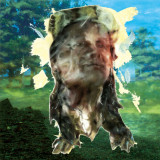
During a month living with the Wampís in the Amazon Rainforest, Aboutface and the Wampís community collaboratively captured field recordings, music instrumentation and traditional Wampis Nampets – ancient songs sung from the perspective of animals living in their rainforest environment.
These recordings then informed 4 improvised performances to articulate the story of the 4 Nampet songs from within each animal's habitat, to depict nature and culture as inseparable, and to propose that humanity is not exclusive to humans but a multinaturalist characteristic available to all living organisms.
This is the first project of its kind in Wampís history and contains sound recordings of biodiversity that no longer exist due to deforestation.
Indigenous-managed Amazonian rainforests sequester around 340 million tonnes of CO₂ each year—equivalent to the UK’s annual fossil fuel emissions. In stark contrast, non-Indigenous-controlled forests have become sources of carbon emissions, therefore accelerating our global climate crises. Among the vital custodians of these precious ecosystems are the Wampís people, who protect 1.3 m ha of precious rainforest territory currently being decimated by mining for gold. This devastating practice is currently decimating Wampís territory, destroying their river habitats, leaving toxic methylmercury pollution that strips all biodiversity, contaminates the food chain, and causes widespread harm.
100% of all sales revenues from this release will directly go to the Wampís to protect their rainforest territory, to fund Wampís-led eco-initiatives against illegal mining, alongside ways to preserve Wampís cultural heritage– embedded in their songs, art and crafts, central to their conservation of their territory called The Iña Wampisti Nunke: A system of life that encompasses reciprocal relationships between humans, plants, animals, and spirits, central to the harmony of all its multi-dimensional ecology– which they term Tarimat Pujut.
For more project information, a short essay is provided alongside a nonstop-listening version of the album as part of the free Bandcamp download with every LP.
Credits
Nampet songs
Kutir, Wancha and Pinchichi by Elizabeth Huampankit Najamtai.
Manchi by Fernando Ijisam Tsakim.
Acoustic Percussion by Wampís band Guayabita
Fernando Ijisam Tsakim, Edilberto Ijisam Tello, Larry Tello Huampankit, Jose Luis Cahuata Pipa, Tedy Tello Cahuata, Heyner Tello Cahuata, Eli Artista Antonio, Never Tello Huampankit
Violin by Taro.
Peruvian bamboo quena, classical flute, acoustic guitar, electronics, composition and arrangement by Aboutface.
Original portrait painting of Fernando Ijisam Tsakim by Nyran Loomcal.
All other artworks, analogue photography and design by Aboutface.
Rainforest field recordings identified and collected by The Wampís of Guayabal and Aboutface.
Buscar:carbon community
- 1
Moody cacophonies, sonic dispatches from Japan, crystalline breakbeats that are more environment than rhythm: Jake Muir’s enmixed, described by Muir as a “(re)mixtape,” is a mind-bending deep dive into the enmossed archive. Besides reflecting the history of the label, Muir’s mix is a production in its own right. A Los Angeles native based in Berlin, Muir is a DJ and field recordist who “sees mixes as a vehicle to explore narratives outside of the album format.”
In Bathhouse Blues (2023), where Muir sampled various sources to explore gay cruising culture and sensuality, his more expansive, conceptual approach to the form is illuminated. Mixes are not just a linear succession of tracks with transitions—they’re excavations that also result in the creation of new audio artifacts. Inspired by the psychedelic impulses of illbient, Muir uses DJ and sound engineering techniques to melt down genre distinctions and create alien atmospheres.
From the enmossed community, Muir pulls from artists like bad lsd trips, Angelo Harmsworth, Nick Klein, Tetsuya Nakayama, and Patrick Gallagher to coalesce a super-compendium of the global sonic underground, all viewed through his own unique lens. Muir takes major liberties with processing and effects automation to carve new worlds from the soil of these preexisting works. Some of the tracks and material on enmixed are heavily edited, emphasizing specific harmonics or bass frequencies, and some portions contain three or four layers, putting artists in direct conversation with each other.
This heady approach—using the tools of both mixtape and remix—results in a super textual and dense palimpsest of the enmossed catalog. “Because mixes are more open- source,” Muir says, “it’s easier to express some ideas since there is more material to pull from.”
- Rob Goyanes
Silver foil printed j-cards on heavyweight iridescent ('Lapis Lazuli') recycled paper Duplicated at a carbon-neutral facility
- A1: First Overture (Spiritual Atom) (4:59)
- A2: Annotation (4:04)
- A3: Carbonb 12 (5:05)
- B1: Unorthodox Elements (3:35)
- B2: Anamenesis (Part 1) (3:30)
- B3: The Abyss Of Doubt (3:35)
- B4: Mutation (5:03)
- C1: Fist Interlude (Absence Of Measure) (4:40)
- C2: Permutation (4:39)
- C3: Kundalini (4:48)
- D1: Anamnesis (Part 2) (4:05)
- D2: Blue I (4:01)
- D3: Second Interlude (The Choosing) (6:26)
By now, the story of how Jlin went from working in a steel factory in Gary, Indiana to being one of the most widely appreciated electronic musicians is well known. 'Black Origami' was one of the most reviewed and lauded albums last year. Seriously prolific and seriously hard-working, she has toured constantly since its May 2017 release and despite being involved in a wide range of projects, still manages to find a balance and 'do some personal healing and growing.'
Here we are over a year later with 'Autobiography,' the score for her collaboration with renowned British choreographer Wayne McGregor arranged by Unsound. This isn't technically her third album (that's due to arrive in 2019 or 2020), but the soundtrack stands up on its own with all the emotional peaks and troughs of a well-sequenced longplayer.
For Jlin, making music for dance is the fulfillment of one of her lifelong dreams - and remarkably, Company Wayne McGregor's performance was the first show she'd ever seen. She describes the process of working with Wayne: 'We first met face to face in October 2016 in a downtown Chicago hotel, talking for about a solid two hours. Immediately, I saw Wayne was very friendly and energetic. He's brilliant, witty, and knows exactly what he wants; an absolute gem to work with. Before I even started composing for Autobiography, Wayne told me so gently that he trusts me completely with my direction of creating the score. That was the best feeling in the world. I would wake up at two in the morning and work until six in the evening until I completed all the pieces. We were both very happy with the outcome. Creating the score for an impeccable piece of work such as Autobiography changed my life as an artist.'
'Autobiography' is a highlight in an evolving and growing career. During the last year, Jlin has also become an in-demand remixer, securing her place among a roster of music heavyweights. Unsurprisingly, given her positive and outgoing nature, she also developed friendships with the artists she has remixed such as Björk, Max Richter and Ben Frost.
Jlin will be touring with Company Wayne McGregor performing 'Autobiography' this year in addition to completing a commission for the Kronos Quartet titled 'Little Black Book.' She still approaches every performance 'with the same attitude of doing my best to execute a good show, no more, no less. Doing my best is what's most important to me.' She also still lives in Gary, Indiana, which keeps her grounded. She notes with her typical humility, 'The local community is a little more knowledgeable of me now. But I don't mind my community taking its time.'
- 1


