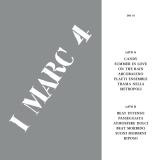
Releasing Italian soundtrack gems on 7" has become a mission for Four Flies! This time the label went back to Franco Prosperi's 1972 film Un uomo dalla pelle dura (known in English as either The Boxer or Ripped-Off) and hand-picked two tracks that were included not in the (now uber-rare) original OST album released on Pegaso/RCA, but in the (even rarer) library album Meedley (sic) released by Carlo Pes a couple of years later, where, needless to say, he was accompanied by his legendary quartet I Marc 4, whose recognizable sound permeates both tunes on this 7".
Side A contains "The Riff", a stupendous acoustic-guitar-and-drums break that was later sampled by DJ-producer Nicola Conte for his debut album Jet Sounds (2000). In contrast, side B veers into fancy poolside cocktail party territory with "Bossa Party", a relaxing, bossa nova-infused jazz tune woven by Carlo Pes' electric guitar lines and Antonello Vannucchi's piano phrasing.
It's a limited edition so don't sleep on it!
Search:carlo pes
- 1
The last of the collaborative LPs Miles Davis recorded with Gil Evans for Columbia, Quiet Nights is easily the most controversial. Following the success of Sketches Of Spain, Davis and Evans aimed to further the Latin explorations, this time pointing to Brazil, as heard on the adaptation of Antonio Carlos Jobim’s ‘Corcovado’ and Joao Gilberto’s ‘Aos Pés Da Cruz,’ with its stellar Ron Carter bass accompaniment, though some were surprised by the brevity of the proceedings, including Miles himself. Nevertheless, those who get to know the album will appreciate its intricacies, the product of the pair’s unique creative chemistry.
In summer 1958, João Gilberto -an unknown 28 year-old Brazilian guitarist and singer from Bahia- made his recording debut as a singer with two songs "Chega de Saudade" and "Bim Bom." With a new rhythmic feeling, batida, and rich harmonies he laid the basis of the modern Brazilian samba, now known as Bossa Nova. Underpinned by his insouciantly swinging guitar, Joãos seductive, vibratoless vocals caressed both ear and soul in a mesmerizing, highly addictive combination, refreshing and modern. Chega de Saudade was a hit, launching Gilbertos career and the bossa nova craze. Soon, singers and guitarists were trying to imitate him and composers were all on a Desafinado (the second Gilbertos hit) and Chega de Saudade kick. The longawaited renewal of the Brazilian samba was now a fact. Antonio Carlos Jobim said: Gilberto appeared as a light, as a big star in the firmament, in the heavens. He became a focus, because he was pulling the guitar in one way and singing the other way, which created a third thing that was profound. Yes, the guy who brought the Bossa Nova beat to the world was João Gilberto.
Born in Juazeiro, Bahia, Brazil on June 10, 1931 (and 87 years .old at this writing), singer/song writer Joao Gilberto is a living legend of bossa nova. While Antonio Carlos Jobim set the standard for the creation of bossa nova in the mid-’50s (with songs like “The Girl from Ipanema” and “Desafinado”), it was Gilberto who brilliantly reimagined (and, arguably, defined) the genre. The first bossa nova song, titled “Bim-Bom”, was written as Gilberto watched passing
laundresses on the banks of the Sao Francisco River balance loads of clothes on their heads. In 1956 he went to Rio de Janeiro and struck up old acquaintances, most significantly Antonio Carlos Jobim, who was by then working as a composer, producer and arranger with Odeon Records. Jobim was impressed with Gilberto’s new style of guitar playing, and set about finding a suitable song to pitch the style to Odeon management. In 1959 Gilberto presented his first LP, Chega de Saudade. The title song turned into a hit, launching Gilberto’s career and the bossa nova craze. Besides a number of Jobim compositions, the album featured older sambas and popular songs from the 1940s and 1950s, all performed in Gilberto’s distinctive style. This album was followed by two more in 1960 and 1961, by which time the singer featured new songs by a younger generation of performer/composers such as Carlos Lyra and Roberto Menescal.
By 1962, bossa nova had been embraced by North American jazz musicians such as Herbie Mann, Charlie Byrd, and Stan Getz, who invited Gilberto and Jobim to collaborate on what became one of the best-selling jazz albums of all time, Getz/Gilberto. Chega de Saudade was issued in the United States as The Warm World of Jo o Gilberto.
The Girl With The Gun for the first time on Ltd 7" Vinyl
Another dream come true! The first 7" ever to contain the three grooviest and most danceable tracks from the legendary soundtrack to La ragazza con la pistola, Mario Monicelli's 1968 cult film depicting the mod subculture of 60s Swinging London and starring Monica Vitti in one of her most iconic roles. (In the mid-90s two of the tracks were compiled in the seminal compilation Easy Tempo Vol. 2.)
Starting the party is Girl With The Gun, a mod-generation classic featuring a psych-funk rhythm section and an exotic-sounding theme played by a sitar. Next on Side A we find the danceable lushness of Shake Balera, a shake number clearly influenced by the London moods portrayed a couple of years earlier by Michelangelo Antonioni in Blow Up, with Antonello Vannucchi on Hammond and Carlo Pes on guitar (the piece was later covered by Calibro35 in their first album). Last but not least, on the flip is the super intriguing Rapimento in Sicilia, which opens with a spy-movie vibe before switching to a hectic dance of sitar, electric bass and wild percussion.
All tracks were written by Peppino De Luca and performed by his trusted and recurring musicians, the legendary super-group of Italian session players I Marc 4, who bring in their signature psycho-beat sound.
Highly recommended for diggers and DJs.
- A1: Avant Garde - Pesadillas
- A2: Vandana - Cambios En El Tiempo
- A3: Syntoma - No Me Puedo Controlar
- A4: Artefacto - Mundo Sin Viento
- A5: Cou Cou Bazar - Cou Cou Bazar
- B1: Volti - Corazon
- B2: Nahtabisk - La Dama De Probeta
- B3: Escuadron Del Ritmo - Las Cucarachas
- B4: Decada 2 - Alfabeto (Cold Version)
- B5: Silueta Palida - El Paso Del Tiempo (Version Remezclada)
A fresh re-press of an Italo Disco club classic: My Mine - Hypnotic Tango. My Mine were the trio of Stefano Micheli (vocals, keyboards), Carlo Malatesta (vocals, keyboards), and Danilo Rosati (drums, keyboards) formed in 1982. Utilizing new electronic instruments like the now legendary Roland TB-303, Danilo improvised a simple but effective synthesizer bass line and passed it through the Roland Echo until something magical came out.
“Hypnotic Tango” was released on Progress Record in 1983 and became an international hit across Europe and US dance clubs in New York, Detroit and Chicago, capturing the imagination of House and Techno producers. In 1987 legendary DJ Frankie Knuckles remixed “Hypnotic Tango” at Seagrape Studios in Chicago, with assistance from studio engineers Tommy White and Brett Wilcotts. Originally released on Danica Records as the “Powerhouse Mix” named after Knuckles' club the Power House, the mix has added vocals by Frankie.
This reissue also includes the “Hypnotic Mix” released in 1990 on Rams Horn Records. All songs are remastered for vinyl by George Horn at Fantasy Studios in Berkeley. The vinyl comes housed in a jacket with original artwork and includes an insert with photos and liner notes by Stefano Micheli.
Limited Edition Vinyl LP – 1971 album cover, thick tip-on sleeve, 700 copies only
Finally putting an end to a long wait for library music lovers, Four Flies Records is proud to present the first reissue of Piero Umiliani's Paesaggi – a record that, despite remaining for many years pretty obscure compared to other titles in the maestro's discography, is now regarded by collectors and experts as the gold standard in Italian library music.
Originally released in two versions with different sleeves, the first on Liuto Records in 1971 and the second on Ciak Record in 1980, the album features tracks composed by the maestro himself (under his alias Zalla) and performed by the legendary super-group of Italian session players I Marc 4, this time with Angelo Baroncini instead of Carlo Pes on guitars (which probably explains the name being spelled with a 'k' instead of a 'c' on the album cover).
The Italian word paesaggi means "landscapes", and that is exactly what the music in the album has been designed to evoke – a journey of moods and emotions, through exotic and pastoral scenery, with loungey sounds that caress your ears like the song of an enchanted nightingale. Mysterious yet captivating soundscapes transport you to a faraway and peaceful place, possibly somewhere in rural Asia. While listening to the record, you'll feel as if you are sitting under a pavilion, right in the middle of a tea plantation, enjoying a freshly brewed green tea and watching the calm sunset.
In addition, Paesaggi is paradigmatic of Italian library music and its genre-defying nature. By using a multitude of instruments, such as flute, vibraphone, harpsichord, sitar, gong and others, it brings together a variety of arrangements, styles, and genres spanning from bossa nova to jazz, easy listening to psychedelic, Latin, exotica, and many more.
Under Umiliani's brilliant direction, the pianos and keyboard instruments of Antonello Vannucchi, the guitars of Angelo Baroncini, the bass of Maurizio Majorana, and the drums of Roberto Podio dance together and – enriched by other instruments played by top session musicians like Bruno Battisti D'Amario (sitar), Franco De Gemini (harmonica), or Franco Chiari (vibraphone) – create the sound that makes Paesaggi so unique.
With the honour of reissuing this masterpiece so many decades since its release comes a responsibility to do full justice to one of the greatest Italian composers of the 20th century and his now celebrated legacy. Four Flies have done their best to put out a record that replicates as closely as possible the value of the original as a cultural artefact, providing Italian library connoisseurs and novices alike with an exquisite sonic, and tactile, experience.
- A1: Devadip Carlos Santana & Turiya Alive Coltrane - Illuminations
- A2: Brilliantes Del Vuelo - I Know That (When The Springtime Comes) (When The Springtime Comes)
- A3: Nazia Hassan - Khushi
- A4: Kelly Doyle - Drm
- B1: Sanullim - Don't Go
- B2: Maxwell Udoh - I Like It (Don't Stop) (Don't Stop)
- B3: David Marez - Ensename
- B4: Gerald Lee - Can You Feel The Love (Reprise)
- C1: Justine & The Victorian Punks - Still You
- C2: George Yanagi & Nadja Band - Track 10
- C3: Pesnyar - Zacharovannaya Moya
- D1: Khruangbin - Summer Madness (Exclusive Cover Version)
- D2: Paloma San Basilio - Contigo
- D3: Roha Band - Yetikimt Abeba
- D4: Tierney Malone & Geoffrey Muller - Transmission For Jehn Gnossienne No 1 (Exclusive Spoken Word Piece)
Hot on the heels of ‘Mordechai’, the critically acclaimed third album from US psych-rockers Khruangbin, the Texas trio are set to become the latest act to present their own LateNightTales in the popular, long-running musician-curated album series.
Having first come to prominence in 2013 when producer and D.J. Bonobo included Khruangbin’s ‘A Calf Born in Winter’ in his own collection of songs for the series, the little known Houston trio had yet to release an album, but have since gone on to become international superstars forming their own exotic, individual sound. “The LateNightTales series is such a special thing to be a part of because we wouldn’t have made it if it wasn’t for Bonobo’s LateNightTales, because that’s how we got into the LNT family – and got a break.”
avorite Recordings proudly presents Natureza, first album of Joao Selva. The story of Natureza is made of the meeting between two passionate artists who are Jonathan "Matuto" Da Silva and Bruno "Patchworks" Hovart.Born and raised in Ipanema and son of a pastor, Jonathan Da Silva grew up in a community of ex-prisoners and converted artists. He made his first guitar notes before his 10th birthday, under the watchful eye of Wanda Sa (muse of the bossa nova), and influenced by a father who in addition to his work, was also a true music lover with a collection, where black music, rock and classical meet. From the age of 18, Jonathan began a life of entertainer, traveling the world to offer shows for disadvantaged children and intensively practicing the Brazilian traditional music arts (Capoeira Angola, Maracatu, Samba de Roda, Coco de Roda...). It was later in France and in Lyon that he put down his instruments. There he formed the trio Forro de Rebeca in 2008, touring the all country and winning many praise in media. The trio recently joined forces with American producer Maga Bo on the project Sociedade Recreativa, whose album was released in 2016 on The Jarring Effects label.Bruno Hovart is a recognized producer, multi-instrumentalist, and remixer. After passing through Angers, Birmingham and London, he's based in Lyon since 2001. Bassist and guitarist for various bands, he switched to production in the mid-90s. Passionate about music and tireless creator, Bruno has practiced in almost every imaginable style, when it comes to groove music, collecting many aliases and projects for more than 10 years: Patchworks, Voilaaa, Uptown Funk Empire, Mr President, Taggy Matcher, Mr. Day, Hawa, John Milk, Lightnin 3, The Dynamics or Metropolitan Jazz Affair ... Nothing resists and escapes his talent and production skills. Thus, when he discovered and met Jonathan and his music, Bruno saw an immediate opportunity to broaden the spectrum of his discography a little more, by looking at Brazil. Beyond its traditional heritage, Brazil has always been a land of extremely varied music, influenced by the international scene. Soul, Jazz and American Pop did inspire many local stars such as Chico Buarque, Carlos Jobim, Gilberto Gil, Tom Zé, or Erasmo Carlos. Both fervent lovers of this movement and these names, it's with the idea to pay them a faithful tribute, that Jonathan and Bruno began the Joao Selva adventure. Together they gave birth to Natureza and embark us for a trip into the heart of the Tropicalist Pop influences of Jorge Ben and Caetano Veloso, the intoxicating Funk of Tim Maia, and the social poetry of Vinicius de Moraes.
- 1