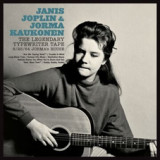
The legendary 1964 rehearsal collaboration receives its first official issue Restoration and Mastering by Grammy®-winning engineer Michael Graves Packaging contains rare photos plus liner notes from Jorma Kaukonen Jorma Kaukonen (later of Jefferson Airplane and Hot Tuna) met a singer named Janis Joplin at a hootenanny in San Jose, California, in the fall of 1962. Over the following years, Janis would call on Jorma to accompany her at gigs. As they continued to play together, the Bay Area was changing musically and developing into the legendary San Francisco scene to which both Janis and Jorma would be integral. During a rehearsal for a show in North Beach, Jorma started his reel-to-reel machine to capture what they were working on. For decades, this recording was the stuff of legend, with inferior, multi-generational transfers making their way through select collector’s circles. Now, for the very first time, it is available officially, with the blessing and cooperation of both the Janis Joplin Estate and Jorma Kaukonen. The Legendary Typewriter Tape: 6/25/64 Jorma’s House contains this legendary recording, featuring Restoration and Mastering from acclaimed, Grammy®-winner Michael Graves. The tracks include Joplin on vocals, Kaukonen on guitar, and Jorma’s wife Margareta typing away intermittently in the background. This may have just been a rehearsal, but it is so much more. Featuring Joplin originals, as well as blues classics, The Legendary Typewriter Tape is an intimate glimpse into two major artists at the beginnings of what would become highly influential careers. As Jorma says in his liner notes: “This is indeed a window into a simpler time when the music truly was everything.” Available on CD and Digital December 2, 2022, the release will also be available on vinyl exclusively for Record Store Day Black Friday, November 25, 2022 Enjoy being a fly on the wall and revel in the magic of The Legendary Typewriter Tape.
Buscar:chan
- A1: Hanif Reads Toni (Feat. Hanif)
- A2: Sun, I Rise (Feat. Angélica Garcia)
- A3: Mezzanine Tippin' (Feat. Teller Bank$, Alfred.)
- A4: Run, Run, Run
- A5: Live! From The Kitchen Table (Feat. Ghais Guevara)
- B1: Tyler, Forever
- B2: Dedicated To Tar Feather (Feat. Anjimile)
- B3: The Story So Far (Interlude)
- B4: The Story So Far (Feat. Seline Haze)
- B5: Beloved! Paradise! Jazz!? (Feat. Ms. Jaylin Brown)
Recycled Col. LP
McKinley Dixon calls the late Toni Morrison the greatest rapper of all time; and the way he tackles topics like survival, violence, and religion within the expansive landscape of the Black experience, evokes her novels. It is from the title of Morrison‘s Beloved trilogy where he finds the title of his new album with City Slang Records: Beloved! Paradise! Jazz!? Musically his household was defined by “artists whose first name was Mary,” including Mary J. Blige and gospel duo Mary Mary. Discovering Outkast was formative for Dixon, deepening his love for hip-hop while he also grew curious about the more theatrical rock of groups of the day, bands like My Chemical Romance and Panic! At The Disco that his Maryland friends introduced him to. “Those groups also helped me with my sense of longing, since their music reflected a sense of longing,” he says. Eventually he channelled these competing influences into a debut EP he released in 2013. With time, his music became his primary means of self-expression, whether discussing Blackness or his own relationship with healing. Across his next releases, his style evolved and his confidence grew, especially when it came to live instrumentation. His 2021 debut album For My Mama and Anyone Who Look Like Her was a game changer, as Dixon set his sights on heartache and grief. “I was making these really dense and chaotic songs, stuffing whatever thought I had into five and a half minutes,” Dixon says of that project. Beloved! Paradise! Jazz?! is an attempt at channeling different impulses. Sometimes rough and other times delicate, this record is a journey into is a journey into the psyche of McKinley Dixon, with all of the of the attendant peaks and valleys.
Producer & musician Handshaking continues the legacy of Finnish electronic music with the upcoming album ‘There was a chance’, due for release on May 19th of 2023.
Handshaking is a familiar name in the Helsinki underground scene and has become known for surprise-filled and versatile DJ gigs and energetic live performances.
Handshaking’s 2020 debut LP Garden Clogs was a long-awaited work for the electronic and dance music audience. The limited 200 vinyl edition sold out during the release weekend. Image Magazine said the “Handshaking’s debut album is of the highest quality in terms of production value, which competes with peers like Yaeji, Peggy Gou and Jaakko Eino Kalevi”.
Handshaking releases via PME Records, which is the biggest independent label in Finland, representing artists like ALMA, Babel and AHO. Founded in 2012, the label has almost 30 artists in its roster with a wide variety of genres.
Ygrok brings a long-awaited fourth release to its catalog. René Audiard's Sakhalin' takes things a step away from traditional club music.
The A side, Vox Out' opens with the skeleton of a rhythm. Scattered tom drums and barely detectable whirs, fading and reeling in the background. When the distorted voices begin their story behind a hissing, grinding off-shaker, you know this will not be your traditional club track. A story develops. The barest hint of a shuffling beat, a subtle reminder of Soren's previous work, pins down the journey into the darkest psychic territory. The title track Sakhalin steps even further into darkness. Crackling electrics and disjointed atmospheres change at a glacial pace over a submerged hydraulic beat. Sakhalin Audiard experimental territory.
First time reissue of mega rare 1972 psych-folk album from Venezuela.
180g LP.
One of the most obscure records ever released in Venezuela that was originally distributed in tiny quantities as a promo-only album.
A magic blend of protest songwriting, with a strong environmentalist statement, and folky pop with psych ingredients —such as the use of sitar sounds— recorded by the collective of artists “Una Luz”, and “El Zigui” who was once described as the local Bob Dylan.
The late ‘60s was a short period of time, long enough to turn the world upside down.
Music, paying attention to the ancient Greeks who said that changes in society are also reflected in it, also undergoes violent transformations in its structure. The turbulent joy of rock and roll and twist gives way to the meditative sounds of the waves of the sea contained in surf to finally welcome music of soft and delicate harmonies with songs full of references in their lyrics to the state of society and their relationships with the environment.
On the other hand, in Venezuela, although the expansive wave of May 68 had not reached it, a certain degree of dissatisfaction began to be perceived, especially through the music of a singer-songwriter from the countryside of Venezuela known as Ali Primera, El Cantor del Pueblo. Thanks to a scholarship from the German government, he studied for a few years in that country, and it was there that he recorded his first album, with songs whose lyrics reflect the essence of authors such as Bob Dylan and Atahualpa Yupanqui. And Ali Primera becomes one of the greatest influences of our artist: El Zigui.
Guillermo Sánchez Corao —known as El Zigui for some strange reason— was born in the Venezuelan city of Maracay, capital of the State of Aragua, on January 13, 1948. From a very young age he began to study guitar playing and, already in his teens, we can find him as part of the duo El Zigui & Franklin together with Franklin Laudelino Mejías, another young man with a great musical pedigree.
It is during his bohemian phase as a troubadour, in the surroundings of the Ateneo de Caracas, when his music caught the attention of producer Mario Tepedino, the most important youth music producer at the time. Mario takes him to his TV show “2001 Juvenil”. With the incorporation of other musicians such as Rubén "Micho" Correa —who would later become a great arranger and record producer— he created the group El Zigui y Una Luz, which would later be joined by musicians such as Carlos "Nene" Quintero and Alfredo Padilla, members of the amazing Grupo Pan. Later on, another outstanding singer would also join Una Luz: Guillermo Carrasco.
With this formation they made it into a recording studio in 1972 where they managed to record, in just 30 hours, a long-playing album of which only 60 copies were pressed and has therefore gained cult status among collectors. As expected, the strong content of the lyrics was not supported by the media, making the promotion of the album impossible to accomplish. However, it was with the help of Mario Tepedino that they made it to television, with appearances on “2001 Juvenil” and “Antesala Lunar”, a show that was especially produced for the broadcast of the arrival of man on the Moon.
That was probably one of the main reasons for El Zigui to move to Canada and then France until 1978 when he returns to Venezuela. He would then join bands like Xabañón, Fogón and De Vuelta al Futuro, a 12-member super group. The former members of Una Luz had become well known musicians in the country, especially Guillermo Carrasco who was one of the greatest ballad artists in the ‘80s and targeted by the biggest record companies at the time. El Zigui died in a traffic accident on June 22, 1999. If he had lived through these crazy times... where would he have gone?
Jeffrey Silverstein returns in 2023 with his second full-length release:
Western Sky Music - Based in Portland, Silverstein channels the natural beauty of his adopted Pacific Northwest into guitar-driven explorations of inner landscapes silverstein is joined by Barry Walker Jr. on steel (North Americans + Rose City and), Dana Buoy (Akron/Family) on drums, as well as guest appearances from William Tyler and Karima Walker. Robert Earl Thomas from Widowspeak shared quick note on the album: 'I've really been enjoying Western Sky Music, especially No Rain' and '(Theme From) Western Sky Music.' The back to back pairing of arthy slow core and blissed out tremolo meditations takes me to such a warm lace. It's a great Sunday record' Cosmic country with a gentle sweetness, reminiscent of Beachwood Sparks and silver Jews at their twangiest" - NPR Music
ummer west coast tour. March UK tour.
Appeared on Best-of lists: Aquarium Drunkard, New Commute, Raven Sings the lues, and more.
Jeffrey Silverstein returns in 2023 with his second full-length release:
Western Sky Music - Based in Portland, Silverstein channels the natural beauty of his adopted Pacific Northwest into guitar-driven explorations of inner landscapes silverstein is joined by Barry Walker Jr. on steel (North Americans + Rose City and), Dana Buoy (Akron/Family) on drums, as well as guest appearances from William Tyler and Karima Walker. Robert Earl Thomas from Widowspeak shared quick note on the album: 'I've really been enjoying Western Sky Music, especially No Rain' and '(Theme From) Western Sky Music.' The back to back pairing of arthy slow core and blissed out tremolo meditations takes me to such a warm lace. It's a great Sunday record' Cosmic country with a gentle sweetness, reminiscent of Beachwood Sparks and silver Jews at their twangiest" - NPR Music
ummer west coast tour. March UK tour.
Appeared on Best-of lists: Aquarium Drunkard, New Commute, Raven Sings the lues, and more.
- 1: Secretly Bad 03:08
- 2: I Like To Pretend 0:53
- 3: Rude Body 02:57
- 4: If I Ask Her 02:18
- 5: Stripey Horsey 03
- 6: Lean 03:2
- 7: I Have A Lot To Say 03:09
- 8: Born To Care 03:00
- 9: Done With The Day 03:30
- 10: Lighter Better 03:12
- 11: Wakey Wakey 01:57
PURPLE VINYL[22,65 €]
In a world of endless, bottomless content, to find something that stands out from the crowd is a rare thing. But it’s something that 7ebra manage without breaking a sweat. Based in Malmö, twin sisters Inez and Ella Johansson deal in sparkling indie-rock that’s pretty without being soft, sweet without losing its edge and catchy without being cheap. With Inez on guitar and vocals and Ella on keys, organ and Mellotron, their minimal set-up makes a virtue of simplicity – with a sliver of guitar fuzz, and organ lines snaking around stark, striking vocals, augmented by shivering harmonies, they don’t need a lot to make music that’s colourful, kaleidoscopic, and effortlessly original.
7ebra debuted in 2022 with the double-single “I Have A Lot To Say”/ “If I Ask Her”, two helpings of psych-tinged, street-smart rock and roll, and the music scene around them wasn’t slow to notice. They opened for the Future Islands and the Dandy Warhols, were picked out by Apple Music’s Matt Wilkinson as a Hidden Gem of 2022 and were booked for prestigious showcases SXSW and Eurosonic. With a packed schedule of shows across Europe and the UK already planned for 2023, their world looks set to get a lot bigger – something that their debut album Bird Hour makes certain. The record is a warm, elegant introduction to the sound 7ebra have crafted. The songs are full of personality and character, but also retain a little bit of enigma, a sense of keeping something secret to themselves. To unwrap that elusiveness is a daunting task, but one the listener can’t resist leaping into.
Ella and Inez’s parents played in bands as they were growing up, so picking up music was a natural thing for them. The origins of 7ebra start with Inez whiling away the hours playing guitar in her bedroom. “I learned by playing covers by myself in my room”, she says. “Ella didn’t do that as much, but we sometimes played and sang together, country songs”. Eventually she would start writing her own. Ella wasn’t involved originally (“we did play together a few times”, she says, “and it just went to shit laughs. We fought a lot”), and Inez was originally reluctant: “I was a bit unsure whether I wanted to be in a band with my sister. Because you get clumped together all the time, when you’re twins”. But Ella was keen to join, and eventually persuaded Inez to let her join for a show. It went – so well that producer Tore Johansson (The Cardigans, Franz Ferdinand), saw it and asked if they’d like to record with him. That changed things, says Ella: “It made us think there might be something in this music”. As a duo, 7ebra were in flight. “In the end, it’s kind of a nice thing too being sisters in a band”, Inez says. “It doesn’t bother me anymore. It just made sense to play together”.
On the album that they eventually came up with, the talent that caught Johansson’s eye is immediately obvious. Opener “Secretly Bad” has a way of walking along your nerves, an eerie echo of a hymn in Inez’s vocal backed by a swirl of woozy blend of guitars and organ. That’s followed up by “I Like To Pretend”, an easily charming song that has a sleepy brightness about it, like morning sunlight breaking through a window. They take a couple of different genres for a whirl on Bird Hour – they’re tense and snappy on “If I Ask Her”, breezy and cocky on “Lighter Better”, and there’s even a couple of droplets of blues and folk in the mix, in the raw intensity of the emotions in the slower songs, the vulnerability and aching of songs like “Lean” and “Stripey Horsey”. The record has a way of sweeping you along in its mood and tones, fuelled in part by the band’s use of repetition, sometimes fast and fevered, sometimes crawling and hypnotic. The duo’s musical input blends perfectly, with Inez’s guitar and vocals forming the core, and Ella drawing in the detail with keys, organ, and harmonies, to really bring out the vivid nature of the songs. Indie rock that’s melodic and sweet, but with enough shadow mixed in to make it really compelling.
On Bird Hour, what strikes you first about 7ebra’s sound is how fully formed it is, how much they’ve carved out their own sonic territory, perfected by trial and error in the studio with Johansson. “Tore wanted us to try everything possible”, says Ella. “We had moments where things weren’t working. But that was necessary in order to find the good stuff”. 7ebra’s signature might be found in the deft way they deal with emotion – unafraid of being open, but a little too clever to make things too clear cut: “You can’t take yourself that seriously. It’s too emotional to take it seriously, to start hating yourself. But at the same time, it is quite serious”, says Ella. Another trademark is the simplicity – a 7ebra song has just enough to make it work, and nothing more. “I think it was important for me that our voices were at the centre of the songs”, says Inez, “that all the little melodies have their place, and don’t get overwhelmed. With lyrics, I sometimes come up with something, and just feel ‘there’s no need to add more to this’. Sometimes a line works by itself. You don’t have to add a bunch of lyrics”. Finally, the album’s themes are ones that will resonate with most people that have set foot on this planet. “I guess it’s about trying to understand yourself, in relation to others. Just life. ‘Why am I not good at this, why is this thing happening to me, why is this thing so hard, why am I so stupid?’”, laughs Ella.
7ebra haven’t been around for very long – but a handful of songs and their fizzing live shows have stirred up the biggest buzz in Scandinavian music in quite a while. Their debut album justifies it all. It showcases the magic they’re capable of conjuring up, and hints at even more to come in the future. But from where they are right now, they’ve made something very special. Bird Hour takes all that promise and turns it into something concrete, in the form of one of the year’s best rock debuts.
Bound To Rise is the quietly impressive debut album from Yorkshireman Chris Brain. His songs have a gentleness and ethereality, enhanced by his softly husky, smoky vocals coupled with delicate finger-picked guitar patterns based around his alternate tunings.
The self-composed songs draw on the pastoral and the traditional, heavily centred in natural imagery featuring both as itself and as allegory. A misty ambiguity, suggestions of layered meaning and hints of multiple interpretations permeate the lyrics. And darker moods throw long shadows across this landscape.
A pre-dawn longing for the sun in title track ‘Bound To Rise’ seems to obliquely evoke springtime, primitive beliefs and lifting mood. ‘Bird Count’ is another daybreak song hinting at other, more intimate, preoccupations, “calling out your name / never to be tame”.
‘Chance To See’ celebrates the emotional significance of a relationship, and it’s easy to interpret ‘Golden Eagle’ as its flipside partner, “but you can’t choose her, she chooses you” – or maybe it’s simply a song about birdwatching. ‘Flying On Time’ continues with rare sightings paired with impressions of human air travel and distance, “she’s due tonight / just for one night / to visit our skies”.
Non-specific doubt and uncertainty edgily patrol ‘If I Could’, whilst the cheerfully pattering guitar motif of ‘Peace And Quiet’ belies an inner melancholy, and ‘Rare Find’ charmingly bookends Mary Jane Walker’s plangent violin and Simeon Walker’s subtle piano.
‘Sunday Morn’ “lays the week to rest” amongst other things but, despite the laid-back vibe, all is not sunny and “melancholy calls to greet us once more”. Brain’s songs are intriguing shifts of light and shade, and the details improve with each listen.
Coming full circle thematically, the joyous simplicity of expression in ‘Sun Song’ makes it close kin to the mighty Bright Phoebus, “the sun was born and she’s beautiful / the sun was born from the ground”. It’s an optimistic ending to an emotionally ambiguous album.
Influenced by, among others, Nick Drake, John Martyn and Joni Mitchell, it’s not hard to see where Chris Brain is coming from. More interesting is where he’s going to. Bound To Rise makes a very promising start.
In a world of endless, bottomless content, to find something that stands out from the crowd is a rare thing. But it’s something that 7ebra manage without breaking a sweat. Based in Malmö, twin sisters Inez and Ella Johansson deal in sparkling indie-rock that’s pretty without being soft, sweet without losing its edge and catchy without being cheap. With Inez on guitar and vocals and Ella on keys, organ and Mellotron, their minimal set-up makes a virtue of simplicity – with a sliver of guitar fuzz, and organ lines snaking around stark, striking vocals, augmented by shivering harmonies, they don’t need a lot to make music that’s colourful, kaleidoscopic, and effortlessly original.
7ebra debuted in 2022 with the double-single “I Have A Lot To Say”/ “If I Ask Her”, two helpings of psych-tinged, street-smart rock and roll, and the music scene around them wasn’t slow to notice. They opened for the Future Islands and the Dandy Warhols, were picked out by Apple Music’s Matt Wilkinson as a Hidden Gem of 2022 and were booked for prestigious showcases SXSW and Eurosonic. With a packed schedule of shows across Europe and the UK already planned for 2023, their world looks set to get a lot bigger – something that their debut album Bird Hour makes certain. The record is a warm, elegant introduction to the sound 7ebra have crafted. The songs are full of personality and character, but also retain a little bit of enigma, a sense of keeping something secret to themselves. To unwrap that elusiveness is a daunting task, but one the listener can’t resist leaping into.
Ella and Inez’s parents played in bands as they were growing up, so picking up music was a natural thing for them. The origins of 7ebra start with Inez whiling away the hours playing guitar in her bedroom. “I learned by playing covers by myself in my room”, she says. “Ella didn’t do that as much, but we sometimes played and sang together, country songs”. Eventually she would start writing her own. Ella wasn’t involved originally (“we did play together a few times”, she says, “and it just went to shit laughs. We fought a lot”), and Inez was originally reluctant: “I was a bit unsure whether I wanted to be in a band with my sister. Because you get clumped together all the time, when you’re twins”. But Ella was keen to join, and eventually persuaded Inez to let her join for a show. It went – so well that producer Tore Johansson (The Cardigans, Franz Ferdinand), saw it and asked if they’d like to record with him. That changed things, says Ella: “It made us think there might be something in this music”. As a duo, 7ebra were in flight. “In the end, it’s kind of a nice thing too being sisters in a band”, Inez says. “It doesn’t bother me anymore. It just made sense to play together”.
On the album that they eventually came up with, the talent that caught Johansson’s eye is immediately obvious. Opener “Secretly Bad” has a way of walking along your nerves, an eerie echo of a hymn in Inez’s vocal backed by a swirl of woozy blend of guitars and organ. That’s followed up by “I Like To Pretend”, an easily charming song that has a sleepy brightness about it, like morning sunlight breaking through a window. They take a couple of different genres for a whirl on Bird Hour – they’re tense and snappy on “If I Ask Her”, breezy and cocky on “Lighter Better”, and there’s even a couple of droplets of blues and folk in the mix, in the raw intensity of the emotions in the slower songs, the vulnerability and aching of songs like “Lean” and “Stripey Horsey”. The record has a way of sweeping you along in its mood and tones, fuelled in part by the band’s use of repetition, sometimes fast and fevered, sometimes crawling and hypnotic. The duo’s musical input blends perfectly, with Inez’s guitar and vocals forming the core, and Ella drawing in the detail with keys, organ, and harmonies, to really bring out the vivid nature of the songs. Indie rock that’s melodic and sweet, but with enough shadow mixed in to make it really compelling.
On Bird Hour, what strikes you first about 7ebra’s sound is how fully formed it is, how much they’ve carved out their own sonic territory, perfected by trial and error in the studio with Johansson. “Tore wanted us to try everything possible”, says Ella. “We had moments where things weren’t working. But that was necessary in order to find the good stuff”. 7ebra’s signature might be found in the deft way they deal with emotion – unafraid of being open, but a little too clever to make things too clear cut: “You can’t take yourself that seriously. It’s too emotional to take it seriously, to start hating yourself. But at the same time, it is quite serious”, says Ella. Another trademark is the simplicity – a 7ebra song has just enough to make it work, and nothing more. “I think it was important for me that our voices were at the centre of the songs”, says Inez, “that all the little melodies have their place, and don’t get overwhelmed. With lyrics, I sometimes come up with something, and just feel ‘there’s no need to add more to this’. Sometimes a line works by itself. You don’t have to add a bunch of lyrics”. Finally, the album’s themes are ones that will resonate with most people that have set foot on this planet. “I guess it’s about trying to understand yourself, in relation to others. Just life. ‘Why am I not good at this, why is this thing happening to me, why is this thing so hard, why am I so stupid?’”, laughs Ella.
7ebra haven’t been around for very long – but a handful of songs and their fizzing live shows have stirred up the biggest buzz in Scandinavian music in quite a while. Their debut album justifies it all. It showcases the magic they’re capable of conjuring up, and hints at even more to come in the future. But from where they are right now, they’ve made something very special. Bird Hour takes all that promise and turns it into something concrete, in the form of one of the year’s best rock debuts.
- A1: Everybody Wants To Rule The World
- A2: Shout
- A3: I Love You But I'm Lost
- A4: Mad World
- B1: Sowing The Seeds Of Love
- B2: Advice For The Young At Heart
- B3: Head Over Heels
- B4: Woman In Chains (With Oleta Adams)
- C1: Change
- C2: Stay
- C3: Pale Shelter
- C4: Mothers Talk
- D1: Break It Down Again
- D2: I Believe
- D3: Raoul & The Kings Of Spain
- D4: Closest Thing To Heaven
Erik K Skodvin's alter persona “Svarte Greiner” re-appears with another chapter in his “zen music for disturbed souls” series, channeling both spiritual distress and meditation in a live recording from the bunkers of a bombed out brewery.
The first piece, entitled “Devolving Trust” is recorded live in the bunkers of Schneider Brewery in Berlin, 2018. Erik explains : “I was invited to use the vast old cellars located underneath the site for a performance / installation. Wet and hollow with a dark past and long reverb, it was a perfect location to channel a cello and electro-acoustic improvisation in the spirit of my two long-form, meditative albums Black Tie & Moss Garden. As a 30 minute piece, it was left looping in the room for hours after it ended as an echo of the performance, allowing people to walk around and soak up the sounds and empty hallways alone.
I am usually not into the idea of releasing a live recording, as there are so many factors that are lost in the translation from being present and listening to it in another space. The eyes, ears and body can often see beyond small mistakes once a live performance unfolds in front of you. The details are usually lost in translating it to a pure recording. I made an exception for this as I feel it translates the live feeling in a way I like. Very personal and full of small mistakes it creates its own life. Also, as an improvisation, I am very happy with it, and have been listening to it on and off since a few years. With this in mind I decided I want it to be another document in my ongoing series of longform, atmospheric pieces following the aforementioned two albums.
The second track simply called “Devolve” is mostly constructed out of fragments from the performance as a sort of minimal, reversed echo, further tunnelling into the unknown. These pieces has given me calmness, reflection and escape from the madness escalating outside of our doors. I hope it can do the same for you”.
Under the production moniker of Material Things, 12th Isle co-founder Stewart Brown unveils a part debut album part compendium of musical collaborations spanning from 2015-2020. Some recordings began as long, one-take improvisations (How's Life, Peckham) spliced together and revisited years later. Others were based upon chance opportunities to record with musicians operating a long way from the parameters of 12th Isle.
Cult private-press loner folk guitarist Bob Theil, whose 1982 album So Far counts as one of the Scottish greats of the era, is at the heart of 'Westway'. Synth and guitar fragments recorded by the pair in Stewart's family home one summer form a low-key conclusion to the collection, whilst London based percussionist Pike Ogilvy brings an array of drum sounds and natural percussion to 'No Direction'. Regular 12th Isle affiliate Vague Imaginaires also features heavily, contributing synth work on Grenoble and his own extended digi bonus remix of 'How's Life'.
As a collection, the 8 tracks show a studious, concise vision and combine influences from minimalism, concrete and avant-garde jazz and techno yet also embrace friendship, experimentation and curiosity whilst capturing 5 years of the artists own personal life. Some of the tracks have been circulating in various versions for a number of years now, with DJ support from Bake, Ivan Smagghe, Optimo, Lena Willikens, Huntley & Palmers, Orpheu The Wizard and, of course, 12th Isle.
A lost Chantays album that's locked in and leaving a foamie! A Dawning Sun, largely recorded in '66, sees the originators of "Pipeline" riding another pearler of a platter! These 13 lost tracks come from the tape archive of Richard Delvy (Belairs, Challengers) and features the bands unique take on "Mr Moto," some new surf anthems and even a trio of vocal cuts for when you just hit out or the wave eats your lunch! It also features a killer instrumental cover of The Fortunes' "You've Got Your Troubles.
Lost for over 50 years, these sound waves are finally ready to ride!
*INSTOCK AND SHIPPING* The North-West’s legendary electro-prog-pop experimenalists a.P.A.t.T. are back with their first studio album in 6 years. a.P.A.t.T. are an English ensemble generally known for their avant-garde music and multimedia works. Redefining notions of failure and success with electronic art pop. Since their first release, (e.p.) in 2002 a.P.A.t.T. have released over 7 albums, numerous singles, 100’s of music films; received commissions from a Smörgåsbord of leading arts organisations, created a feature-length film and even starred in and composed for a BBC TV Sitcom. The last album Fun with Music (2016) saw the band more refined and focussed than ever… “Their most accessible work yet..in a freaky kinda way” said BBC’s Stuart Maconie. This album discusses the ‘I’ the ‘WE’ and the confusing notion of self. 6 years since the release of the last a.P.A.t.T. album and the world seems to have changed. “It’s different now” muses General MIDI when asked, “We were all doing something pretty similar in some respect. We changed. We struggled. We adapted. We grew. We felt more collective than ever…maybe?” ‘We’ is an adventurous collection of passing thoughts, barely laughable references, pop songs andsonic experiments. It’s a look at people. It’s a look within.
LTM presents a limited edition clear vinyl edition of Sorry For Laughing, the legendary first album by cult Scottish guitar group Josef K, recorded for Postcard Records but destined to become the great ‘lost album’ of the post-punk era.
This remastered edition of Sorry For Laughing replicates the original Robert Sharp artwork (a solarised portrait of the band atop Calton Hill, printed in silver pantone), with detailed sleeve notes on the inner bag, and the added bonus of a 12 track CD, The TV Art Demos, featuring all tracks from the band’s very first recording sessions in 1979.
Recorded at Castle Sound Studios (Edinburgh) in November 1980, Sorry For Laughing should have been issued as Postcard 81-1, but was shelved after the band and label boss Alan Horne decided the 12-song set sounded too polished. Perhaps two dozen white-label copies in unmade sleeves exist, and have sold for as much as £1,000 amongst collectors. Josef K issued their second stab at a debut album, The Only Fun In Town, in July 1981 – only to split after completing a promotional tour.
This remastered edition of Sorry For Laughing replicates the original Robert Sharp artwork (a solarised portrait of the band atop Calton Hill, printed in silver pantone), with detailed sleeve notes on the inner bag, and the added bonus of a 12 track CD, The TV Art Demos, featuring all tracks from the band’s very first recording sessions in 1979.
‘They were The Sound of Young Scotland, together with Orange Juice, whose guitars were also radiant and brittle, whose rhythms were also scrubbed and blunt, whose vocals were also proud and serious, but who sounded like another group entirely’ (Paul Morley); ‘In retrospect, their aborted attempt at a debut album feels much superior to what was finally released. The early versions of the songs sound superbly coiled and keen, the sublime poise of Endless Soul their truly timeless blaze of glory’ (Simon Reynolds)
Bonus CD (The TV Art Demos) 1. Chance Meeting (take #1) 2. Terry’s Show Lies 3. No Glory 4. Final Request 5. Art of Things 6. Romance (take #1) 7. Torn Mentor 8. Night Ritual 9. Heads Watch 10.
A long side from Win in his Hardfloor kick-changes psychedelic roughtness...
A Kvasir kind of same vibe thick fat kicker... (dare playing it at 45 : you will get an Enrbyoneer feeling)
Extra one is Pijlen and a lightspeed driver psychedelic 70's synths sound...
A1 here is the last you can listen, probably because it's a short tune (2min) and not a bad one... Ambient intro to place some XP in this already quiet XP record :)
ENJOY !
What a record! The outstanding Solar Plexus, the much-loved third album from Ian Carr and Nucleus, was first released on Vertigo in 1971. Inevitably, original copies are now very tricky to score and, like all the Nucleus records, it’s aged ridiculously well. This Be With re-issue, re-mastered from the original analogue tapes, shows off just why this deserves to be back in press.
Genius trumpeter and visionary composer Ian Carr was one of the most respected British musicians of his era. He was a true pioneer and saw the potential in fusing the worlds of jazz with rock, just as Miles Davis and The Tony Williams Lifetime did in the US. In late 1969, following the demise of the Rendell-Carr quintet, and tiring of British jazz, Carr assembled the legendary Nucleus. Regarding music as a continuous process, Nucleus refused to “recognise rigid boundaries” and worked on delivering what they saw as a “total musical experience”. We can get behind that.
Under bandleader Carr, Nucleus existed as a fluid line-up of inventive, skilled musicians. This constant evolution and revolution was all part of the continuous musical exploration and discovery that took jazz to new levels. And the music has kept relevant. To steal a line from a review of our re-issue of Roots, when it comes to anything Nucleus “it’s basically already hip-hop”.
We'll let Ian describe this one: "I wrote Solar Plexus' last year with the help of an Arts Council grant. It is based on two short themes which are stated at the beginning (Elements I & I1). The first theme is angular and has a slow, crab-like movement: the second theme is direct, simple and diatonic. CHANGING TIME and SPIRIT LEVEL explore the first theme and BEDROCK DEADLOCK and TORSO explore the second one. SNAKEHIPS DREAM tries to fuse both themes. (The title is a reference to the famous dancer 'Snakehips' Johnson)."
Solar Plexus features the same lineup as Elastic Rock and We'll Talk About It Later, but they're augmented by six guests, three of which play brass. Carr himself had almost full control of the writing and it does feel very different to the previous albums. It's more of a jazz record loosely based on a rock foundation rather than jazz fusion jamming.
The haunting synth-and-bass soundscape "Elements I and II" opens the album in dramatic, experimental fashion. It gives way to the bright, funky feel-good jazz of "Changing Times". An elegant onslaught of horns, courtesy of guests Kenny Wheeler and Harry Beckett, ride a solid groove for the duration. How the brass refrains have eluded samplers is beyond us. The melancholic "Bedrock Deadlock" features the brooding majesty of Jenkins' oboe and Clyne's mournful, skittering double bass. Wah wah guitar, drums and funky percussion then take over before the horns ride us out over frenetic beats. The dark, angular "Spirit Level" is a real highlight, by turns harmonic and beautiful then dissonant and wayward. Wonky jazz with no apparent structure or melodic bones. Regardless, it represents a great showcase for each virtuoso performer.
The breezy soul of "Torso" feels like a breath of fresh air, skipping along in the uptempo style with guitar, horns, drums and bass. A track which truly sounds scintillating, featuring sax solos, fantastic propulsive interplay from all the group around the halfway stage before Marshall gets his chance to really shine in closing out with a polyrhythmic drum solo. Final track "Snakehips' Dream" stretches cooly out over 15 minutes to round out a spellbinding album. An epic, suave groove, it's a relaxing piece with warm electric keys, laconic guitar and languorous horns. Truly sophisticated soulful jazz. An absolute masterclass. We could easily listen to this all day long.
This Be With edition of Solar Plexus has been re-mastered from the original Vertigo master tapes, Simon Francis’ mastering working together with Cicely Balston's cut at AIR Studios to weave their usual magic with these wonderful recordings. The stunning gatefold sleeve has been restored to complete this sensational package.
The distinctive rolling grooves, growling basslines and blasting horns of Snakehips Etcetera combined to present Nucleus's most energetic record. First released on Vertigo in 1975, original copies of Snakehips Etcetera are now very tricky to score. Like all the Nucleus records, it’s aged ridiculously well and this Be With re-issue, re-mastered from the original analogue tapes, shows off just why this deserves to be back in press.
Genius trumpeter and visionary composer Ian Carr was one of the most respected British musicians of his era. He was a true pioneer and saw the potential in fusing the worlds of jazz with rock, just as Miles Davis and The Tony Williams Lifetime did in the US. In late 1969, following the demise of the Rendell-Carr quintet, and tiring of British jazz, Carr assembled the legendary Nucleus. Regarding music as a continuous process, Nucleus refused to “recognise rigid boundaries” and worked on delivering what they saw as a “total musical experience”. We can get behind that.
Under bandleader Carr, Nucleus existed as a fluid line-up of inventive, skilled musicians. This constant evolution and revolution was all part of the continuous musical exploration and discovery that took jazz to new levels. And the music has kept relevant. To steal a line from a review of our re-issue of Roots, when it comes to anything Nucleus “it’s basically already hip-hop”
With all restraint out the window, 1975's pimped-up Snakehips Etcetera is the outrageous - in both cover art and sound - follow-up to the brooding Under The Sun. It's perhaps not one for the jazz purists! It finds Nucleus pared down to a core group of six, with Carr, Bob Bertles (sax), Ken Shaw (guitar), Geoff Castle (keys), Roger Sutton (bass) and Roger Sellers (drums) comprising the collective. Snakehips Etcetera reflects a period where the compositions start to become a little more direct and less-cerebral in comparison to some of Nucleus' previous releases. And why would we begrudge them some fun? This one rocks, swings and funks with no little soul. And more than a little jazzy sleaze. Clearly, they were having a good time.
The album has a real live, jamming feel to it, no surprise given the extent to which they were touring at the time. The band is tight and grooving throughout, none more so than on Bob Bertles's effervescent opener, "Rat’s Bag". So darn funky it stings, it's an infectious gem full of punchy clean lines over a killer bassline from Sutton. The thick, driving jazz-rock of "Alive And Kicking" is exactly that. It has a very improvisational feel, but an inspired one at that and features a wailing guitar solo from Ken Shaw that simply slays. The funky "Rachel’s Tune" is amazing, bringing you back to Canterbury days with its fuzzed-out organ solos to close out Side A.
Opening up Side B, the cool psychedelic title track unfolds slowly and sensually over its ten-plus minutes. A stoned soul stew of sorts, each member of the crew gets their chance to shine over Sellers's steady drums. The melodic funk fusion of "Pussyfoot" pairs Carr with Bertles on ace solo flute for a bright, springy melody. This one really gleams over shuffling drums. Changing the pace to close out this memorable set, the particularly cool "Heyday" is a reflective, sober tune which reinforces the sumptuous Nucleus palette, the acoustic guitar and bass high in the mix to make the neck snap, the horns elegantly blasting to help you swoon.
This Be With edition of Snakehips Etcetera has been re-mastered from the original Vertigo master tapes, Simon Francis’ mastering working together with Cicely Balston's cut at AIR Studios to weave their usual magic with these wonderful recordings. The striking, lascivious sleeve has been restored in all its seductive/ridiculous beauty.


