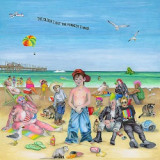
The War On Drugs, “one of the premier live bands of their generation” (Pitchfork), announce Live Drugs Again, via Super High Quality Records and Transgressive / Canvasback. Recorded on tour between February 2022 through December 2023 in America, UK, Europe and Australia, Live Drugs Again follows 2020’s Live Drugs and represents The War On Drugs at their ragged, righteous best.
Bandleader Adam Granduciel comments, “Live Drugs Again chronicles the evolution of these songs from the studio to stages all over the world; documenting our continued growth as a live band. This series ensures that these versions, and some of our favorite moments on stage, will live on.”
As Consequence so accurately hailed, “it’s hard to imagine a musical experience that’s more enveloping and uplifting.” This is hearing a band at its peak.
Cerca:chronic
Mark Barrott’s 2024 album, 'Everything Changes, Nothing Ends', is a profound and deeply personal exploration of life, love, and loss. Released on Anjunadeep Reflections, this album is a follow-up to his critically acclaimed 2023 release, Jōhatsu (蒸発). Unlike his previous works, this album chronicles a more intimate and emotional journey, reflecting the life Mark had with his late wife, and the harrowing experience of her illness and eventual passing. It stands as both a tribute to her memory and a reflection on the profound impact she had on his life and music. Mark has been a constant innovator throughout his nearly four-decade-long career. He’s best known to some as Future Loop Foundation, the alias under which he created ambient drum and bass in the mid-90s. Others know him for his ‘Sketches From an Island’ series, released under his own name, which played a significant role in the revival of the Balearic music scene. He’s also the founder of International Feel, a label that was instrumental in the bespoke vinyl movement of the 2010s and played a role in bringing DJ Harvey back into the spotlight. Barrott’s work has always pushed the boundaries of genre, and 'Everything Changes, Nothing Ends' is no exception. However, this album is perhaps his most personal and emotionally charged work to date. The album’s creation was born out of tragedy. Barrott began writing music for the album during the eleven weeks of his wife’s illness, using it as a form of therapy to cope with the overwhelming grief and loneliness that followed her passing on January 25, 2023. “I actually started writing music most nights throughout this process—it was therapy to mitigate the loneliness of coming back to a cold, dark winter home after spending the day with her at the hospital,” Barrott explains. What began as a way to process his emotions evolved into a project that would ultimately become 'Everything Changes, Nothing Ends'. The album traverses genres, blending orchestral, ambient, and jazz elements to create a rich and varied soundscape. Each track on the album serves as an audio diary, capturing specific moments from the eleven weeks of his wife’s illness. The music oscillates between intense emotional peaks and more soothing, delicate moods, reflecting the rollercoaster of emotions that come with facing such a profound loss. Ultimately, this album is about acceptance and gratitude for what was, not grief for what could have been. It addresses the fundamental issue that confronts all human beings: life and death. ‘Everything Changes, Nothing Ends’ is out on 29th November on Reflections.
- 1: Peach Blossom Paradise
- 2: Demon Cicadas In The Night
- 3: The Cold Curve
- 4: Saying Yes To Everything
- 5: Lighthouse
- 6: Revisionist Mystery
- 7: The Meander
- 8: The Wheel Of Persuasion
- 9: Another Tomorrow
- 10: Common Exotic
Prairiewolf make easy listening music for an age of fracture. They almost do it in spite of themselves. No one can seriously question the head music bona fides of the members of this Colorado-based trio.
Guitarist Stefan Beck has already assembled a formidable discography of jewel-toned guitar zone-outs under his Golden Brown moniker. And keyboardist and guitarist Jeremy Erwin and bassist Tyler Wilcox have both made their reputations as chroniclers of the vast world of out-music. Erwin helms the indispensable Heat Warps blog, a performance-by-performance archive of Miles Davis’s labyrinthine electric period. And Wilcox has been covering the ragged edges of psychedelia and experimental rock at Aquarium Drunkard and other publications, not to mention his own virtual basement for heads, the great bootleg blog Doom and Gloom from the Tomb.
These guys come by it honestly. And yet, given their backgrounds, Prairiewolf’s self-titled debut last spring was remarkably free of face-melters, brown acid blowouts, and ascendant spiritual jazz odysseys. Instead, they dropped a record of beautiful, elegant, low-key cosmic groovers that sounded like the piped-in background music to a resort hotel on Jupiter. It was an unlikely psychedelia, brocaded with mid-twentieth century sonic threading from the hi-fi era: vintage synthesizers, smears of spaghetti western, luxe tropical details, the faint schmaltz of space age pop. Imagine something like a Harmonia residency in the airport lounge. And yet somehow it all worked brilliantly. Prairiewolf became last summer’s cool-down standard. After a year woodshedding around Colorado’s Front Range region, the Prairiewolf boys have fired up their trusty Korg SR-120 drum machine for another outstanding collection of suborbital exotica. The appropriately titled Deep Time operates in its own chronology, unspooling at its unhurried pace. All its incongruous period and stylistic references—the new age pulses, Hawaiian steel, shaggy hippie rambles, lysergic guitar spirals, and orchestral synthesizer flourishes—float atop the album’s own singular temporality. Deep Time makes its own time.
From the moment Beck folds his slide guitar, origami-like, into a sound resembling the call of gulls on the tranquil album opener, “Peach Blossom Paradise,” there is a sense of departure from everyday life. The shimmering “Lighthouse” has a similar sunbaked nonchalance, like an afternoon passed day-drinking in a seaside bar. That they named their lush, kaleidoscopic downtempo track “The Meander” pretty much says it all. The ranging, propulsive “Saying Yes to Everything” seems like a nod in the direction of Rose City Band’s brand of wookie krautrock. And the motorik noir of “Demon Cicadas in the Night” also goes hard. Beck and Erwin’s intertwined guitar jam on the eerie album standout “The Cold Curve” evolves into something that sounds like primitive computer music. A genteel bassline from Wilcox on another album highlight, “Revisionist Mystery,” sets the stage for a loopy space jazz turn from guest clarinettist Matt Loewen of Rayonism. The title of post-rock cowboy tune “Another Tomorrow” might refer to the alternative future that so many critics heard in the music of Prairiewolf’s first album. Or it might simply refer to the persistence of time, however deep. Either way,
I’m thankful for the way Prairiewolf make each of their tunes a little oasis or sanctuary, each subsisting according to its own crystalline little logic for a few minutes. It is no simple task to filter out the omnipresent anger and anxiety of everyday life these days. But Prairiewolf are out here making it seem easy.
Brent S. Sirota
- A1: Keep Right On
- A2: Chronic Tonic
- A3: Hot Tamale
- A4: Pocket Rocket
- B1: Near-Earth Objects
- B2: Othership
- B3: Mind's Eye
- B4: Possibilities
Stalwarts of the London music scene The Boom Yeh are at the forefront of redefining British Jazz-Funk with the release of their new album Near-Earth Objects. Featuring a host of musicians that have worked with Jamiroquai, The Brand New Heavies, Incognito, Alice Russell and Leroy Hutson.
Keep Right On
A blistering syncopated jazz-funk assault reminiscent of The Brecker Brother and Tower Of Power. Featuring solos from trombone player Tom White and sax player/horn arranger Ian Bailey, followed by a virtuosic drum solo courtesy of Alessio Barelli.
Chronic Tonic
A smooth jazz-funker with hip-hop undertones, echoing early Prince with a boogie funk outro in the vein of George Duke, propelled by bass player Matteo Grassi.
Hot Tamale
If Jimi Hendrix was stuck in a Mexican traffic jam, it would probably sound like this. An abrasive funk-rock stomper featuring a heavy duty guitar solo from band leader Jon Speedy.
Pocket Rocket
Deep pocket funk in tribute to George Clinton's Parliament-Funkadelic with be-bop infused horn riffs. Featuring solos by Paul Silver on baritone sax and guest keyboard player Carl Hudson on Oberheim synth.
Near-Earth Objects
High energy jazz-fusion exploring the universe of Herbie Hancock and The headhunters with an afrobeat inspired horn outro. Featuring guest keyboard Carl Hudson on Fender Rhodes and synth.
Othership
Bombastic big band jazz-funk with a rare groove flavoured mid section. Composed by band leader/guitarist Jon Speedy as a nod to his father Dave Speedy - a jazz trumpet player and big band leader.
Mind's Eye
Laid back Ibiza chill out mixtape vibes meets Donald Byrd and the Mizell Brothers. Featuring blissful Fender Rhodes and synth by guest keyboard player Carl Hudson.
Possibilities
A slow burner in the spirit of Roy Hargrove's RH Factor and early neo-soul with a gospel flavoured outro.
'Mei Semones' sweetly evocative blend of jazz, bossa nova and math-y indie rock is notonly a way for her to find solace in her favorite genres, but is an intuitive means ofcatharsis. "Blending everything that I like together and trying to make something new -that's what feels most natural to me," says the 23-year-old Brooklyn-based singer-songwriter and guitarist. "It's what feels most true to who I am as an artist." Plinking guitar tones and asymmetrical time signatures exemplify her forays intoangular indie rock more now than ever before, especially on her debut Bayonet Recordssingle "Wakare no Kotoba"_its wide-interval arpeggios in odd meters being some ofthe most technically difficult guitar work Mei has ever implemented in her songwriting.Translated to "parting words'' in English, the self-described "anti-love song" serves as afarewell to a toxic friendship, complete with orchestral swells and crashing guitars. Originally from Ann Arbor, Michigan, Semones began playing music at a young age,starting out on piano at age four before moving to electric guitar at age eleven. Afterplaying jazz guitar in high school, she went on to study guitar performance with a jazzfocus at Berklee College of Music. College is where she met her current bandmates,including string players Noah Leong and Claudius Agrippa, whose respective viola andviolin add softness and multidimensionality to Mei's intricate guitar work. After releasinga slew of singles and an EP in 2022, coinciding with her move to New York City, Mei andher band have since gone on to collaborate with post-bossa balladeer John Roseboroand embark on their first-ever tour with the melodic rock outfit Raavi. Semones chronicles infatuation, devotion, and vulnerability in her songs, complete withsweeping strings, virtuosic guitar-playing and heartfelt lyrics sung in both English andJapanese, that have all become part of her sonic trademark: ornately catchy, genre-fusing compositions serving as the backdrop to tender lyrics touching on theuniversalities of human emotion.
- Yoake
- Kodoku
- Tsukino
- Muchuu
- Hfoas
'Mei Semones' sweetly evocative blend of jazz, bossa nova and math-y indie rock is not only a way for her to find solace in her favorite genres, but is an intuitive means of catharsis. "Blending everything that I like together and trying to make something new - that's what feels most natural to me," says the 23-year-old Brooklyn-based singersongwriter and guitarist. "It's what feels most true to who I am as an artist." `Tsukino', Mei's debut, self-released EP, is being released physically for the first time ever on Bayonet Records! The EP will be released by itself on CD & Tape formats, and will be included in a vinyl pressing on the B-side of Semones' landmark EP, `Kebutomushi'! Plinking guitar tones and asymmetrical time signatures exemplify Semones' forays into angular indie rock more now than ever before. Originally from Ann Arbor, Michigan, Semones began playing music at a young age, starting out on piano at age four before moving to electric guitar at age eleven. After playing jazz guitar in high school, she went on to study guitar performance with a jazz focus at Berklee College of Music. College is where she met her current bandmates, including string players Noah Leong and Claudius Agrippa, whose respective viola and violin add softness and multidimensionality to Mei's intricate guitar work. After releasing a slew of singles and an EP in 2022, coinciding with her move to New York City, Mei and her band have since gone on to collaborate with post-bossa balladeer John Roseboro and embark on their first-ever tour with the melodic rock outfit Raavi. Semones chronicles infatuation, devotion, and vulnerability in her songs, complete with sweeping strings, virtuosic guitar-playing and heartfelt lyrics sung in both English and Japanese, that have all become part of her sonic trademark: ornately catchy, genrefusing compositions serving as the backdrop to tender lyrics touching on the universalities of human emotion.
- Baby I'm Your Man
- It's So Easy
- Power
- The Hole I See
- Feedback
- A&E
- Flick Of The Wrist
- Turn On The Radio
- Sweetheart
- Politicians
- SE23:
- Karen's God Plan
Crankers of amp, torturers of fuzzbox and denizens of small-hours salvation, Thee Alcoholics dished out a rancorous and righteous debut in their decent `Feedback' - one that filtered gnarled riffage and motorik malevolence through a uniquely debauched prism in pursuit of some extremely ill-advised audial dystopia. Thee Alcoholics may have started life as the home-birthed brainchild of Rhys Llewellyn (Hey Colossus/Acidliner/Drmcnt) yet an evolution since has proven the ultimate form of this beastly creation to be the live arena. In assembling cohorts to turn these visceral jams into something to shake rafters and rattle pint-glasses, new frontiers of ornery intensity have made themselves manifest, and such is the form of the monstrous Bear Bites Horse Sessions, a live-in-the-studio document recorded with Wayne Adams at Bear Bites Horse studio in Haggerston, London, chronicling a band breathing life into a Stoogian paradigm, and doing so apparently whilst barely breaking a sweat. Taking essential elixirs of in-the-red mania, hypnotic repetition and deathless swagger, these twelve jams walk a crooked path that neighbours the nihilistic vortex of Loop, the saturnine lurch of The Fall and the deadpan derangement of The Heads but remains possessed of a maverick charisma and mischief all its own. Lovers of lysergic heaviosity and the sound of a Marshall 4x12 violently spluttering its last will find much to satisfy here, but moreover Bear Bites Horse Sessions is a testimony to sonic punishment as a gateway to new horizons, audial excess as a path to wisdom, and answers, right or wrong, being found in the bottom of a glass.
"We could go so far as to say that it is the human condition to be grotesque, since the human animal is the one that does not fit in, the freak of nature who has no place in the natural order and is capable of re-combining nature's products into hideous new forms." So reckoned Mark Fisher in 'The Weird And The Eerie', which chronicled the means by which the uncanny can enter the everyday. Mwg Drwg, the second album from South Wales psychic seers Obey Cobra, is an album that dwells in exactly this kind of headspace, where the otherworldly meets the kitchen sink. Always a band who've sought out new dimensions to explore via their trademark warped post-punk, electronic and industrial influences, Obey Cobra have crafted surreal new shapes here. Taking influences as diverse as Diane Arbus, David Lynch and Sonic Youth, they balance out heaviosity and grace on the likes of the majestically discordant 'Ten Of Wands' Elsewhere, on the title track, the band sculpt a Jesus Lizard-esque rhythmic pulse, eerie vocal abstraction and the crepuscular downtempo atmosphere of Massive Attack's Mezzanine into a uniquely haunting dreamscape. Mwg Drwg is where the weird and eerie are amplified to intimidating proportions It's where grotesquely and beauty happily cohabit. It's an aural exorcism of William Friedkin proportions that demands your immediate attention.
- A1: Ollie Lishman - Scarymode
- A2: 6 Sense - Planetary Defence System
- A3: Grace Dahl - Don't Stop
- B1: Antigone - The Battle
- B2: Alec Dienaar - Make My Body Move
- B3: Bad Boombox - Alba
- C1: Isaiah - Tool W
- C2: David Moleon - Span
- C3: Dj Swisherman - Kie
- D1: Hertz Collision - Catalyst
- D2: Flits - Baklava
- D3: Lacchesi - Babock Faceplant
- E1: Disguised - Blurred Vibrations
- E2: Regent - Interpolation
- E3: Ferdinger - Dry Ice
- F1: The Chronics - Pump
- F2: Obscure Shape - Maze
- F3: Zisko - Lost In The Night
Making a return to his Chronicle alias for the first time since 2001, Tim Cant brings his unique blend of laid back atmospherics to the Spatial family for the first time with Time and Space on Curvature. Sit back, relax, or dance Chronicle has you covered for either with this welcome return to the scene.
A1 Geosynchronous
Getting straight to business with an intro of thick Hot Pants breaks, Geosynchronous sees Chronicle bring his unique take on atmospherics to Curvature in welcome style. An early breakdown with synths and subtle melodies is followed by a dreamy layer of two step amens and 808 basslines, completing a collage of beats as the increasingly memorable melodies slowly weave their story throughout the track.
A2 Life On Earth
A dream like, reflective affair is up next with Life On Earth Chronicle returning to the late 90s vibe of the moniker with a plethora of classic FX, vocal samples and long constant synthwork cascading above. Utilising a simple but effective core melody, danceable two step breaks and layers of detail that would fit in any retrospective set from the Progression Sessions era to the modern renaissance, this is one to savour.
B1 Future Fragments
A real treat for fans of synthy, sci fi tinged atmospheric goodness from eras gone by as Chronicle transports you to 99 Shepherds Bush Empire you had to be there now you can be with a track that encapsulates the era perfectly. Drizzling the mix with frequent echoing effects and washes of spacey synths and pads over an earworm melody not to mention the crisp rolling breaks this is a versatile and enduring track youll keep going
back to.
B2 Nostradamus
Closing out the EP, we have Nostradamus which opens lightly with hi hats and airy padwork before finely edited old school breakwork injects energy to the mix.
The breaks build with additional elements creating a very danceable and rhythmic loop, punctuated by a catchy melody. One sample proclaims The Future Is Power - if its in the hands of producers like Chronicle, effortlessly channeling the past with a modern twist, we know
we are in good hands.
Words by Chris Hayes Spatial Red Mist
Camelot, the legendary seat of King Arthur's court in Early Middle Ages Britain, was probably not a real place. A corruption of the name of a real Romano-Briton city, the word "Camelot" accumulated symbolic, mythic resonances over centuries, until achieving its present usage as a near-synonym of "utopia." In the mid-20th century alone, Camelot inspired an explosion of representations and appropriations, among them the violent, affectless Arthurian court of Robert Bresson's 1974 film Lancelot du Lac and the absurdist iteration of Monty Python's 1975 Holy Grail, both of which feature armored knights erupting into fountains of blood; the mystical Welsh world of novelist John Cowper Powys's profoundly weird 1951 novel Porius, with its Roman cults, wizards and witches, and wanton giants; and the nationalist nostalgia of President John F. Kennedy's White House. Unsurprisingly there are fewer Camelots in more recent memory. Camelot, Canadian songwriter Jennifer Castle's extraordinary, moving 2024 chronicle of the artist in early middle age, charts a realer, more rooted, and more metaphorical place than the fabled Camelot of the Early Middle Ages (or its myriad depictions), but it too is a space more psychic than physical. In Castle's Camelot, the fantastic interpenetrates the mundane, and the Grail, if there is one, distills everyday experience into art and art into faith, subliming terrestrial concerns into sublime celestial prayers to Mother Nature, and to the unfolding process of perfecting imperfection in one's own nature. Co-produced by Jennifer and longtime collaborator Jeff McMurrich, her seventh record is at once her most monumental and unguarded to date, demonstrating a mastery of rendering her verse and melodies alike with crisply poignant economy. For all their pointedly plainspoken lyrical detail and exhilarating full-band musical flourishes, these songs sound inevitable, eternal as morning devotions. "Back in Camelot," she sings on the lilting, vulnerable title track, "I really learned a lot / circles in the crops and / sky-high geometry." The album opens with a candid admission of sleeping "in the unfinished basement," an embarrassing joke that comes true. But the dreamer is redeemed by dreaming, setting sail in her airborne bed above "sirens and desert deities." If she questions her own agency_whether she is "wishing stones were standing" or just "pissing in the wind"_it does not diminish the ineffable existential jolt of such signs and wonders. This abiding tension between belief and doubt, magic and pragmatism, self and other, sacred and profane, and even, arguably, paganism and monotheism, suffuses these ten songs, which limn an interior landscape shot through with sunstriped shadows of "multi-felt dimensions" both mystical and quotidian. The epic scale and transport of "Camelot," with its swooning strings, gives way dramatically to "Some Friends," an acoustic-guitar-and-vocals meditation in miniature on Janus-faced friends and the lunar and solar temperatures of their promises_"bright and beaming verses" versus hot curses_which recalls her minimalist last album, 2020's achingly intimate Monarch Season. (In a symmetrical sequencing gesture, the penultimate track, the incantatory "Earthsong," bookends the central six with a similarly spare solo performance and coiled chord progression, this time an ambiguous appeal to _ a wounded lover? a wounded saint? our wounded planet?) Those whom "Trust" accuses of treacherous oaths spit through "gilded and golden tooth"_cynics, critics, hypocrites, gurus, scientists, doctors, lovers, government, the so-called entertainment industry_sow uncertainty that can infect the artist, as in "Louis": "What's that dance / and can it be done? What's that song / and can it be sung?" Answering affirmatively are "Lucky #8," an irrepressible ode to dancing as a bulwark against the "tidal pools of pain" and the "theory of collapse," and "Full Moon in Leo," which finds the narrator dancing around the house with a broom, wearing nothing but her underwear and "big hair." But the central question remains: who can we trust, and at what cost faith, in art or angels or otherwise? Castle's confidence in her collaborators is the cornerstone of Camelot. Carl Didur (piano and keys), Evan Cartwright (drums and percussion), and steadfast sideman Mike Smith (bass) comprise a rhythm section of exquisite delicacy and depth. This fundamental trio anchors the airiness of regular backing vocalists Victoria Cheong and Isla Craig and frames the guitars of Castle, McMurrich, and Paul Mortimer (and on "Lucky #8," special guest Cass McCombs). Reprising his decennial role on Castle's beloved 2014 Pink City, Owen Pallett arranged the strings for Estonia's FAMES Skopje Studio Orchestra. On the ravishing country-soul ballad "Blowing Kisses"_Pallett's crowning achievement here, which can be heard in its entirety in the penultimate episode of the third season of FX's The Bear_Jennifer contemplates time and presence, love and prayer_and how songwriting and poetry both manifest and limit all four dimensions: "No words to fumble with / I'm not a beggar to language any longer." Such rare moments of speechlessness_"I'm so fucking honoured," she bluntly proclaims_suggest a state "only a god could come up with." (If Camelot affirms Castle as one of the great song-poets of her generation, she is not immune to the despairing linguistic beggary that plagues all writers.) Camelot evinces a thoroughgoing faith not only in the natural world_including human bodies, which can, miraculously, dance and swim and bleed and embrace and birth_but also in our interpretations of and interventions in it: the "charts and diagrams" of "Lucky #8," a daydreamt billboard on Fairfax Ave. in LA in "Full Moon in Leo," the bloody invocations of the organ-stained "Mary Miracle," and all manner of water worship, rivers in particular. (Notably, Jennifer has worked as a farmer and a doula.) The album ends with "Fractal Canyon"'s repeated, exalted insistence that she's "not alone here." But where is here? The word "utopia" itself constitutes a pun, indicating in its ambiguous first syllable both the Greek "eutopia," or "good-place"_the facet most remembered today_and "outopia," or "no-place," a negative, impossible geography of the mind. Utopia, like its metonym Camelot, is imaginary. Or as fellow Canadian songwriter Neil Young once sang, "Everyone knows this is nowhere." "Can you see how I'd be tempted," Castle asks out of nowhere, held in the mystery, "to pretend I'm not alone and let the memory bend?"
based songwriter Henrik Appel returns with third album Shadows. Ranging from freewheeling garage rock to intimate moments, and adding touches of jazz, Shadows is inspired by the likes of Bob Dylan’s Blond on Blonde and The Fall’s Hex Enduction Hour and another step of his continued evolution as a songwriter and artist.
For as long as he’s been a solo artist, Henrik Appel has been in a constant state of evolution. His first album, 2018’s Burning Bodies, was a meticulous construction project, one that came togeth-er over a five-year period and that saw him chronicle, with searing honesty, the slow death of a relationship, with its nine songs written according to a stringent set of self-imposed rules, intend-ed to keep the songwriting minimalist and bare-bones in nature.
His 2021 follow-up, Humanity, represented a remarkable progression of its own. It was born out of a break-up of a different kind, this time with his former bandmates in Stockholm outfit Lion’s Den; piecing together aspects of the vision he’d had in mind for the band’s never-realised second al-bum, he built from them his own sophomore LP, one that took the classic feel of Burning Bodies and imbued it with adventurous new influences, as he began to carve out a genuinely singular sound.
Now, three years on from Humanity, Appel has made another ambitious left turn. Neither of his first two albums were made in complete isolation; on both, he enlisted the production services of Stockholm underground legend Martin ‘Konie’ Ehrencrona, and also collaborated on his lyrics with his partner, Emma Lind. Now, on this thrilling reinvention of a third record, Appel has turned away from perfectionism, placing chief importance instead on making a raw, human record.
Long-time friends and collaborators, musician Daniel Avery, alongside photographer Keffer are proud to present Techno is Boring, a new book that collects a decade of work chronicling club culture in visceral form.
Techno is Boring also includes short written essays and notes from Avery and fellow DJ, writer and collaborator John Loveless, who also provides an introduction, appearing alongside guest contributions from friends and allies.
The book is 24.5cm x 17cm, and the 148 pages are printed on premium heavyweight paper with Swiss binding.
. For Fans Of: The Weather Station, Weyes Blood, Adrianne Lenker, Phoebe Bridgers, Joan Shelley, Lana Del Rey, Cass McCombs, Angel Olsen & Neil Young. Camelot, the legendary seat of King Arthur’s court in Early Middle Ages Britain, was probably not a real place. A corruption of the name of a real Romano-Briton city, the word “Camelot” accumulated symbolic, mythic resonances over centuries, until achieving its present usage as a near-synonym of “utopia.” In the mid-20th century alone, Camelot inspired an explosion of representations and appropriations, among them the violent, affectless Arthurian court of Robert Bresson’s 1974 film Lancelot du Lac and the absurdist iteration of Monty Python’s 1975 Holy Grail, both of which feature armoured knights erupting into fountains of blood; the mystical Welsh world of novelist John Cowper Powys’s profoundly weird 1951 novel Porius, with its Roman cults, wizards and witches, and wanton giants; and the nationalist nostalgia of President John F. Kennedy’s White House. Unsurprisingly there are fewer Camelots in more recent memory. Camelot, Canadian songwriter Jennifer Castle’s extraordinary, moving 2024 chronicle of the artist in early middle age, charts a realer, more rooted, and more metaphorical place than the fabled Camelot of the Early Middle Ages (or its myriad depictions), but it too is a space more psychic than physical. In Castle’s Camelot, the fantastic interpenetrates the mundane, and the Grail, if there is one, distills everyday experience into art and art into faith, subliming terrestrial concerns into sublime celestial prayers to Mother Nature, and to the unfolding process of perfecting imperfection in one’s own nature. Co-produced by Jennifer and longtime collaborator Jeff McMurrich, her seventh record is at once her most monumental and unguarded to date, demonstrating a mastery of rendering her verse and melodies alike with crisply poignant economy. For all their pointedly plainspoken lyrical detail and exhilarating full-band musical flourishes, these songs sound inevitable, eternal as morning devotions. “Back in Camelot,” she sings on the lilting, vulnerable title track, “I really learned a lot / circles in the crops and / sky-high geometry.” The album opens with a candid admission of sleeping “in the unfinished basement,” an embarrassing joke that comes true. But the dreamer is redeemed by dreaming, setting sail in her airborne bed above “sirens and desert deities.” If she questions her own agency whether she is “wishing stones were standing” or just “pissing in the wind” it does not diminish the ineffable existential jolt of such signs and wonders. This abiding tension between belief and doubt, magic and pragmatism, self and other, sacred and profane, and even, arguably, paganism and monotheism, suffuses these ten songs, which limn an interior landscape shot through with sunstriped shadows of “multi-felt dimensions” both mystical and quotidian. The epic scale and transport of “Camelot,” with its swooning strings, gives way dramatically to “Some Friends,” an acoustic-guitar-and-vocals meditation in miniature on Janus-faced friends and the lunar and solar temperatures of their promises—“bright and beaming verses” versus hot curses which recalls her minimalist last album, 2020’s achingly intimate Monarch Season. (In a symmetrical sequencing gesture, the penultimate track, the incantatory “Earthsong,” bookends the central six with a similarly spare solo performance and coiled chord progression, this time an ambiguous appeal to … a wounded lover? a wounded saint? our wounded planet?). Those whom “Trust” accuses of treacherous oaths spit through “gilded and golden tooth” cynics, critics, hypocrites, gurus, scientists, doctors, lovers, government, the so-called entertainment industry sow uncertainty that can infect the artist, as in “Louis”: “What’s that dance / and can it be done? What’s that song / and can it be sung?” Answering affirmatively are “Lucky #8,” an irrepressible ode to dancing as a bulwark against the “tidal pools of pain” and the “theory of collapse,” and “Full Moon in Leo,” which finds the narrator dancing around the house with a broom, wearing nothing but her underwear and “big hair.” But the central question remains: who can we trust, and at what cost faith, in art or angels or otherwise? Castle’s confidence in her collaborators is the cornerstone of Camelot. Carl Didur (piano and keys), Evan Cartwright (drums and percussion), and steadfast sideman Mike Smith (bass) comprise a rhythm section of exquisite delicacy and depth. This fundamental trio anchors the airiness of regular backing vocalists Victoria Cheong and Isla Craig and frames the guitars of Castle, McMurrich, and Paul Mortimer (and on “Lucky #8,” special guest Cass McCombs). Reprising his decennial role on Castle’s beloved 2014 Pink City, Owen Pallett arranged the strings for Estonia’s FAMES Skopje Studio Orchestra. On the ravishing country-soul ballad “Blowing Kisses” Pallett’s crowning achievement here, which can be heard in its entirety in the penultimate episode of the third season of FX’s The Bear Jennifer contemplates time and presence, love and prayer and how songwriting and poetry both manifest and limit all four dimensions: “No words to fumble with / I’m not a beggar to language any longer.” Such rare moments of speechlessness “I’m so fucking honoured,” she bluntly proclaims suggest a state “only a god could come up with.” (If Camelot affirms Castle as one of the great song-poets of her generation, she is not immune to the despairing linguistic beggary that plagues all writers.) Camelot evinces a thoroughgoing faith not only in the natural world including human bodies, which can, miraculously, dance and swim and bleed and embrace and birth but also in our interpretations of and interventions in it: the “charts and diagrams” of “Lucky #8,” a daydreamt billboard on Fairfax Ave. in LA in “Full Moon in Leo,” the bloody invocations of the organ-stained “Mary Miracle,” and all manner of water worship, rivers in particular. (Notably, Jennifer has worked as a farmer and a doula.) The album ends with “Fractal Canyon”s repeated, exalted insistence that she’s “not alone here.” But where is here? The word “utopia” itself constitutes a pun, indicating in its ambiguous first syllable both the Greek “eutopia,” or “good-place” the facet most remembered today and “outopia,” or “no-place,” a negative, impossible geography of the mind. Utopia, like its metonym Camelot, is imaginary
Moon White Vinyl. All her life, Emma Hardyman has wrestled with contradictions. After all, she was practically rendered a living, breathing contradiction the moment she was born into her half-Peruvian, half-white working-class Mormon family. In young adulthood, Hardyman became increasingly disillusioned with Mormonism's righteous black-and-white thinking, as well as its exclusionary elitism, and decided to leave the church. But she also acknowledged that the institution's all-or-nothing philosophy had become a part of her, resulting in a considerable test of grace and unlearning. As the singer-songwriter behind Little Moon, the Tiny Desk Contest-winning, Utah-based avant-folk project, Hardyman uses music as an outlet to illuminate contradictions of all kinds. Following the release of her 2020 debut LP Unphased, Hardyman set out to write a romantic album about her newlywed husband Nathan (who also sings and plays guitar in Little Moon), but the universe had other plans. After Nathan's mother tragically passed away, Hardyman recalibrated her vision and started work on a love-as-grief, grief-as-love album titled Dear Divine. The record serves as a mirror for the darkest parts of ourselves, allowing us to examine our ego_not to dismantle it, but to better understand how we love, process adversity and move through the world. Centering the classical music, folk, video game soundtracks and Tabernacle Choir hymns she grew up with, as well as ephemeral snapshots of personal significance, Dear Divine is an abundant tapestry of Hardyman's life. As enlivening melodies radiate from a string trio, you can envision the classical music that thrums from her parents' radio 24/7, as Hardyman sings in an otherworldly coo, you can imagine her younger self swooning over the tranquil records of Vashti Bunyan and Joan Baez, and as arpeggiated synths twinkle, you can visualize the enchanting kingdom of Hyrule from The Legend of Zelda: Ocarina of Time that she still adores. Songs like "now" and "messy love" embrace the gloriously jumbled stew of life, with the former chronicling Hardyman's arduous quest for love and trust and the latter patiently navigating the ways romantic partners can mirror each other's shortcomings. As Dear Divine attests, Emma Hardyman may not have it all figured out, but that's kind of the point. Through grief, faith crises and all-encompassing love, she's found the most wisdom in life's maddeningly consistent inconsistencies, as well as the subtle ways one can cultivate a feeling of home. Dear Divine doesn't take a red pen to life, it brings an open heart, an open mind and achingly beautiful, opulently weird folk songs.
Anna McClellan's childhood summers were spent in front of the TV, cementing a love of narrative that would later reveal itself through songwriting. By seventeen, Anna was performing original songs in her hometown of Omaha, Nebraska. Her debut album, Fire Flames, garnered attention and earned her an opening slot on a Frankie Cosmos tour, setting the stage for her subsequently adored albums, 2018's Yes and No and / saw first light, released in late 2020. Now, with her forthcoming fourth album Electric Bouquet, out October 25, 2024 via Father/Daughter Records, McClellan crafts a musical journey that unfolds like one of her cherished television series. Each track is an episode, chronicling the past four years of her life - navigating a career change, a cross-country move, and relationships gone sour. Electric Bouquet is a narrative tour de force showcasing McClellan's remarkable ability to transform life's myriad of messy experiences into captivating musical stories. While writing the album, Anna attended trade school, apprenticing to become an electrician to escape the service industry grind and secure a foundational career alongside music. Eager to break free from Omaha, she decided to take her newfound electrical skills to pursue a career in the film industry in Los Angeles, CA where she's now based. Recorded in multiple sessions in Baltimore, MD and Omaha and co-produced with long-time collaborator Ryan McKeever and Another Recording Company Studios engineer Adam Roberts, Electric Bouquet shifts seamlessly between piano-driven melodies and guitar-anchored anthems, each song a miniature universe slowly opening unto itself.
Charlie Parker had a complicated relationship with his hometown of Kansas City, MO owing both to its history of racial segregation and to his strong ties to his family and friends there. This new set of rare recordings dating from 1941–1951 — most of them never having been heard before and some never even having been known to exist — chronicle Bird’s evolution from a blossoming soloist with the Jay McShann Band into a brilliant improviser who dominated the jazz landscape for decades to come. In addition to two unreleased 78s with the McShann band, this set offers two sets of private recordings (at the home of Bird’s friend Phil Baxter and at Vic Damon’s studio) made with local musicians and a very relaxed-sounding Parker who has the room to really stretch out and show us the shape of jazz that was to come in his wake.
Produced by Wild Rivers and Gabe Wax (Soccer Mommy, Adrienne Lenker), "Better Now" consists of eight tracks that complement the recent album Never Better, as the group dives deeper into the complicated, confusing and unknown realities of life in their twenties, and the personal growth they’ve found through it all. Of the new project, Wild Rivers shares: “Better Now" is our companion record, and the other side to "Never Better".
On the first record, the songs contain raw, absolute and instinctual feelings. In many ways, Better Now is the afterglow of this. We’re reflecting and understanding that relationships change over time. Complicated situations can be just that, complicated. Feelings can remain unresolved. If the first record is bright and bold, this one is the softer gradients in between; the sunrises and the sunsets. Both projects make up the full spectrum of who we are.
"Better Now" is just the moodier, misunderstood one. Musically the records really are twins. We wrote all of the songs at the same time. Finishing Better Now, we really felt that it was the close of a massive musical and personal chapter. It’s bittersweet but so meaningful to be able to chronicle our lives between these projects. Ultimately, we are optimistic; ‘better now,’ after the ups and downs of the relationships and turbulence of our twenties. Hopefully we’re wiser for it.”