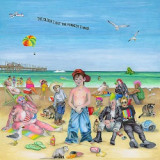
Charbel Haber is Lebanese musician, performer, visual artist and composer from Beirut. His work has seen him collaborate with artists from a wide range of disciplines - film, video art, visual art, theatre, dance - both in Lebanon and abroad.
As a solo artist and as a member of post-punk band Scrambled Eggs, he has composed music for directors Khalil Joreige and Joana Hadjithomas, Ghassan Salhab, Mohamad Malas, video artists Lamia Joreige and Akram Zaatari, Maqamat dance company and playwrights Rabih Mroueh and Lina Saneh, to name but a few. His prolific and collaborative career includes free improv group Johnny Kafta Anti-Vegetarian Orchestra, psychedelic Arabic music ensembles Malayeen and Orchestra Omar, cold wave band The Bunny Tylers and minimal ambient duo Good Luck In Death. He is the founder of Those Kids Must Choke and co-founder of Johnny Kafta's Kids Menu - two experimental record labels - and he has recorded and collaborated with notable artists from the fields of free rock and improv such as Oiseaux-Tempête, Radwan Moumneh, Tarek Atoui, Jean Francois Pauvros, The Ex, Michael Zerang, Mats Gustafson, Eddie Prevost, Xavier Charles and Tony Buck.
And once again, here I am telling you to go look for the truth and its beauty in the words of dead poets, in the little tales of ravaged cities, in aborted dreams, in the melancholy of the ruins of tomorrow, in meaningless plastic totems, in the enigmatic end of restless fools.
I'll be here long after you all disappear.
These are the first and last sentences from Charbel Haber's latest offering, A Common Misunderstanding of the Speed of Light: a multi-media musing on the chronic and the chronological, the subversive nature of time. This combination of a record and book observes the slow passing of life and the illusion of retrogradation in his every day. Simply by documenting - via image, text and tune - Haber assigns value to everything that is cast in amber by this project. There's an acceptance and appreciation of the destitution he witnesses, it is an homage given in overlapping forms.
ACMOTSOL has two parts. The book, hardcover in an embossed orange, features photographs and texts taken from Haber's personal digital diary spanning from 2020 to the start of 2022. Broken into six chapters - named for the six tracks on the record - the entries are an artist's log of sorts during a peculiar period of global hyper stagnation and navigating the aftermath of the Beirut explosions. The 96 pages highlight Haber's interest in decay, negative space and the temporality of the human condition. Instead of presenting the images and texts as they were originally paired online, they're reordered and recontextualized in the book. New connections are formed, as tenuous and fleeting as the content they surround. The images interrupt the texts in many instances, forcing pauses and inviting distraction.
At the center of the book is a sudden burst of orange pages, with stylized pluckings of the text framing a QR-code that grants access to the record. With the brilliant orange covers and matching innards, pregnant with the music at the core, it's almost as if these central pages act as a way to turn the book inside out. There, the book's purpose is altered, fixated on a mirror image of itself. It forms a self-completing arc for the project, a loop.
ACMOTSO's second half is that mirrored album. Six tracks totalling just under 52 minutes. The music could be a continuation of his solo albums Of Palm Trees and Decompositions (2016) and It Ended Up Being a Good Day Mr. Allende (2012), an exploration into the expansiveness of seemingly simple loops of a lilting guitar. Careful electronic effects add dimensions or reground the listener. There's a swelling of sound, the illusion of the push of space before it retracts back into itself or fades into the distance. Much like the images and texts the music complements, the songs challenge the purity of cycles. Endings are beginnings, beginnings are endings or is everything just the middle? Haber is quietly and elegantly grappling with the troublesome act of place-making. In music, in words and in visual storytelling.
ACMOTSOL is a work that can be calming or disorienting, depending on what is requested of it. Similar to the way loops and cycles can signify both meditation and mania. The tendrils of Haber's past - his home of Beirut, fictional and real characters encountered, authors read, films watched, composers listened, walks taken - knit themselves together for a presentation of our immediate present. An evidence of a happening. A considered project of time.
All photographs, texts and music by Charbel Haber. Album mixed by Radwan Ghazi Moumneh. Design by Maziyar Pahlevan. Printed by Albe De Coker in Belgium.
This dual-part project will be released on XX XXX 2022 on 'Other People.'
Description by Nereya Otieno.
Cerca:chronic
Black Vinyl[30,67 €]
The sun sets over the ranch, a can of beer cracks, and an acoustic guitar
wrangles the day's thoughts and memories into a semblance of orderDuring moments like these, California-born and Nashville-based singer
and songwriter Emily Nenni chronicles her life through delicate songcraft
rife with honky-tonk spirit and spiked with just the right amount of soul
In possession of a deep understanding of music stoked by a lifelong passion and
sharp chops shaped by endless sets in smoky bars and sizzling doublewides, she
asserts herself as the consummate country storyteller on her full- length debut
album, On The Ranch.
RADIO MOSCOW'S most loved second studio album
Radio Moscow does for Blue Cheer what the Black Keys do for 21st century
blues: stomps it. " Raoul Hernandez / AUSTIN CHRONICLE (2010).
As three souls plunge down from the heavens, death and destruction can be felt hanging in the air like a foul stench. Red clouds swirl around a black sun that never sets and an erratic clock ticks off-tempo, moving faster and slower before rewinding and starting anew.
“Let me paint you a picture…” vocalist Mikey Arthur sings, welcoming listeners with a dramatic opening scene. It takes a skillful guide to navigate the darkest depths of hell. And, as The Gloom In The Corner depict in their second full-length album Trinity, death is merely the beginning of the series of chilling adventures
Purposefully aligning their song count with unlucky number thirteen – a reoccurring symbol in the ever-unfolding Gloom Cinematic Universe or GCU – it comes as little surprise to longtime fans that each of the Australian quartet’s enticing tracks intertwine to form an interlocking tale; this time centered around the appropriately labeled unholy trinity.
Comprised of previously deceased characters Rachel Barker, Ethan Hardy, and Clara Carne, the group’s bloody battle is woven throughout the album as the anti-heroes determinedly claw their way back to Earth from the Rabbit Hole dimension, slashing, shooting, and extinguishing anyone who dares to oppose their quest. Yet, for the Girl of Glass, Ronin, and Queen of Misanthropy, there is clearly more to the story than what can be contained within a single package.
Projecting a wide and complex web of lore, plot twists, and tongue and cheek humor, frontman Mikey Arthur, guitarist Matt Stevens, bassist Paul Musolino, and drummer Nic Haberle, have been producing highly detailed concept releases since their formation. And, consistently filling in more missing pieces of the puzzle with every body of work, the band equate each new record to a fresh season of The Umbrella Academy dropping on the streaming service of your choice. Because, just as a great TV series captivates viewers with its music and storytelling, the quartet’s work provides a complete experience designed to allow fans to check in with their favorite characters, all the while enjoying a cinematic new soundtrack.
For those just joining the GCU, as well as those looking for a quick refresh, 2016 debut album Fear Me introduced listeners to main protagonists Julian “Jay” Hardy, a Section 13 agent consumed by anger over his girlfriend Rachel’s death, and Jay’s gloom (later known as Sherlock Adaliah Bones), a demonic entity who at times takes over Jay’s body as a host vessel. 2017 EP Homecoming tells the tale of Jay’s brother Ethan, a war veteran suffering from PTSD, who upon discovering his brother’s struggle, kills himself as part of a Dante-style rescue mission to bring Rachel back to life. In 2019 EP Flesh and Bones, we’re introduced to Clara Carne, a past witness to one of Jay and Sherlock’s crimes, who instead of taking revenge, began a twisted love story with Sherlock, only to be murdered by his forced hand. And 2020’s Ultima Pluvia EP where we finally learn of Sherlock’s past as an ancient warlord under the tyrannical King Baphicho, and see Sherlock and Jay’s deaths ushered in by Section 13 opponent and New Order leader Elias DeGraver and his gloom Atticus Encey.
After 2016’s Fear Me, the band admit that their original intention was to jump straight into the events of Trinity before pivoting to create Homecoming, Flesh and Bones, and Ultima Pluvia. However, upon reflection, primary storywriter Mikey Arthur believes that pushing the timeline back actually provided greater opportunity for the group to properly flesh out the songs and plotlines for their sophomore studio record.
Indeed, while Trinity re-introduces the three central “heroes” of this new arc, it’s important to understand that while familiar, the characters are not carbon copies of who they were earlier in the story. And neither is the band who brought them to life.
Fully embracing the weird and whacky has never been a struggle for The Gloom In The Corner. Rather, it’s together with this attitude that the group come away with special moments such as the fascinating old and new dynamic between neighboring tracks “Red Clouds” – a song whose initial version predates the formation of The Gloom In The Corner as an official band – and “Gravity” in which a demo intended for future material was adjusted to fit the sonic drop.
Mirroring this evolution in the band’s musical approach, a sense of growth can also be seen projected in the characters and story that the quartet chronicle across the thirteen tracks.
Classifying their individual sound as an intricate form of “cinema or theater-core” due to the depth and breadth of their musical approach, features, samples, symphonic elements, and conceptual nature, The Gloom In The Corner continue to prove that they’re more than just a simple concept band.
In fact, similar to character theme music in movies and video games, the group seamlessly play off their diverse sonic story in a variety of ways. Continuing to breathe new life into older staples from their catalog, the quartet reworked their infamous “Oxymøron” breakdown from Fear Me into an impactful moment in Trinity’s “Nor Hell A Fury” and sprinkled audio easter eggs of this sort all throughout their new music for fans to discover.
Listeners are also brought further into the world of the GCU with the help of what The Gloom In The Corner call their “casting process.” Like picking actors for a musical, the band meticulously selected eleven different vocal features and several additional voice actors to bring the album and characters to life. Described as a 50/50 split between notable talents such as Ryo Kinoshita (Crystal Lake), Joe Badolato (Fit For An Autopsy), and Lauren Babic (Red Handed Denial), as well as talented friends and family like Elijah Witt (Cane Hill) and Mikey’s sister Amelia Duffield, each featured artist brought their own touch and realistic spark to the characters they portrayed.
For in the end, as much as Trinity and it’s cast live within the confines of their own supernatural worlds, themes such as falling out of love (Gatekeeper), battling depression (Obliteration Imminent), and standing behind women’s empowerment (Nor Hell A Fury), are ones that many can relate to or understand. And, while most individuals may avoid drowning their woes by way of transforming into full-on egotistical murderers like the Queen and King of Misanthropy and the gang, The Gloom In The Corner have illustrated that time and time again, life’s a little more fun when you can crack a smile. Taking a page from the trinity’s playbook: try to avoid the end of the world. But if you can’t…at least spend it with a killer soundtrack.
The Older I Get, the Funnier I Was, which follows Thomas’ brilliant 2020 HBO special The Golden One and his Can't Believe You're Happy Here EP released earlier this year, surveys a range of emotion and offers a broad sonic palette, moving between pop punk, electro, and the obvious influence of the singer-songwriters he grew up listening to in early childhood. It conjures the ennui of Bright Eyes alongside the barefaced storytelling of John Prine, the overstuffed lists of Fred Thomas with the lackadaisical humor of Colleen Green, among many others.
Thomas attributes the dexterity of the record to Duterte, who recorded and engineered most of it in addition to serving up plenty of encouragement when Thomas got down on the process. “As a comic, I used to test out new songs during sets to see if the funny bits were hitting, but since I wrote this in isolation I ended up writing lyrics and worrying less about making jokes,” Thomas says. That said, the album’s plenty funny. Stand-out and lead single “Rigamarole” opens with a Thomas-voiced infomercial that recalls his oft-cited lookalike Jim Carrey as the Grinch, before launching into a buoyant pop song about being depressed.
Whitmer Thomas will admit that when he traveled home to small town Gulf Shores, Alabama to record his HBO stand-up special, The Golden One, he expected to be greeted as a returning hero, a conquering king, or at minimum, a guy with a moderately successful career as an entertainer in Los Angeles. “I expected a big welcome home, open arms, but when I went back I realized: nobody fucking knows me. Nobody remembers me,” Thomas says. “In the years I’d been performing that show, I’d been romanticizing my childhood in this mythologized place, but the visit made me see that I’m not really from there anymore.”
The sense of alienation compounded when Thomas recognized how few people in town remembered his mom, to whom The Golden One is dedicated and largely about. Thomas grew up watching her perform with her twin sister at the legendary Flora-Bama Lounge, where he set the special, and still counts her as one of his musical influences. His new album, The Older I Get, the Funnier I Was, isn’t overtly about his mom, her presence is deeply felt throughout. While in Gulf Shores, Thomas discovered dozens of her old recordings, all of which had been wrecked by Katrina, but upon returning to LA, Thomas paid “a fancy place in Hollywood” to fix the tapes and hired Melina Duterte (Jay Som, Bachelor, Routine) to mix them. The two struck up a collaborative friendship, and Thomas had the sound of his mom’s voice back. “I was listening to songs she recorded when she was about my age, just these heartfelt, sweet Americana songs,” he says. “I decided then that I wanted to lose the Ian Curtis voice I always sing with; I wanted to do what came naturally, because my mom always sounded like herself, even when she was singing some cheesy reggae song about, like, Jamaica.”
Thus he went into The Older I Get, the Funnier I Was knowing it was time to retire his darkwave persona, and leaning into his natural, chirpier voice, which he says sounds “like a 12-year-old’s.” It makes sense: much of the album chronicles what Thomas calls “being a kid and feeling like you have no control and overcompensating by being annoying.” “So much of the album is about witnessing drug and alcohol addiction as a kid and seeing what it does to people, but also realizing that there's nothing you can do about it,” Thomas says. It’s familiar territory (see: “Partied to Death”) but the methodology is different this time around; true to its title, The Older I Get, the Funnier I Was isn’t always looking for laughs. Thomas might’ve left his hometown behind, but his kid self is still tagging along, a Peter Pan shadow he can’t untether himself from. The first line he sings on The Older I Get, the Funnier I Was is: “There should be a room at every party where you can just sit and watch a movie.” Find a 12-year-old who wouldn’t say the same.
“Final Departure” is the debut album by J-Shadow, a widescreen vision expanding out on an event horizon before us. Built using influences from London’s rich electronic, pirate radio and black music lineages (jungle, grime, hip-hop, electronica etc), the album twists and turns, lifting listeners up towards a more ethereal plane. “I see beauty in the complexity of life from the cosmic scale to the quantum,” he explains. “From all that we can observe, this world stands as a uniquely multifarious sphere in which we just happen to exist.” “I love to take ideas and attempt to conceptualise them into an audible expedition,” he explains. “I find that music serves as an extraordinary medium to project my perception of the universe.” “Sometimes I will reach for certain influences and deconstruct them into an amalgamation of conscious experiences that reflect my vision of how I see the world.”
The 'Privacy Angels' dwell in a liminal zone, a folk magical world sprawling within some remote nodes of the digital universe. An a-chronic plane of contradictions in which the spiritual and the machinic exist in a contrast that, instead of leading to mutual annihilation or subjugation, produces weird forms of life and uncanny forms of beauty. Like flowers sprouting from glitching fluxes of data transmissions, in the corrupted memory of a heavenly landscape. It is the vision of Italian (though London-based) musician and multidisciplinary artist Nicola Tirabasso, channeled through his usual musical avatar VISIO, a dimension he came in contact with while retreating in his native Sibillini Mountains in Marche, central Italy. A type of forced hermitage dictated by the global pandemic and whose idyllic premises were constantly unbalanced and contaminated by the constant presence of the digital world. But again, it is by means of this contrast that art is born. While channeling the magic, the fables and even the superstitions the locals have imbued the region with, Tirabasso developed them into audial spirits of electronic abstraction. A juxtaposition of mystic retreat and information-age alienation that, for some brief, ineffable and baffling moments, seemed to make him able to hear the angels. The album itself is a collection of digitally broken folk songs and logarithmic chants of praise. Acoustic instruments are broken down, replicated and re-materialization, while computer-generated ghosts and synthetic tones are allowed to exist and resonate in ancient spaces. Most of the actual recordings have been in fact made at desecrated XVI church in a town near Montappone, not far from the birth place of XX century painter Osvaldo Licini, whose influence echoes all throughout the region. Licini’s idiosyncratic mix of primitivism, futurism and orphic realism similarly echoes all throughout the record, with VISIO even paying tribute to his painting ‘Angelo Ribelle’ in titling one of the tracks. Collaborations made in person and through file-swaps have traversed the album’s conception and enrich its palette by presenting different versions of reality. Haunter co-founder Daniele Guerrini (Heith) co-produced every track with Tirabasso and gave a fundamental contribution to the album’s final form. Elsewhere, City and Kenichi Iwasa evoke their own privacy angels and let them dance with VISIO’s. Be it, in the depths of the earth or in the dissolution of a digital cloud, it is just as possible to (un)know the divine. Genre: Electronic / Experimental Listen: Track list: 1. Moonchild 2. Extasi Exile 3. Youth Grows Forever 4. Untitled X 5. Blessed Mystery 6. Years Of Silence 7. angelo ribelle
- A1: Tenison Stephens - Don&Apos;T Rip Me Off!
- A2: Leontine Dupree - Standing On His Word
- A3: Frankie Staton - Love One Another (Feat Speckled Rainbow)
- A4: Joe Washington &Amp; Wash - Blueberry Hill
- B1: Reno &Amp; The Chosen 3 - Soul Bagg
- B2: Don Patterson Trio - Paddy Wagon
- B3: Bill Cole - Bring It On Back To Me
- B4: Unknown Organist - Untitled
- B5: Roy Long - Mercy Mercy Mercy
- C1: Mckinley Edmonds - Hard Times
- C2: Marva Josie - I&Apos;M Satisfied
- C3: Shirley Wahls - Tell The Truth
- C4: The Echomen - Talk Is Cheap
- C5: Unknown - Damn You Sheriff Black
- D1: Rick Bowen - Snake In The Grass
- D2: 101 Gold Street Band - You Came A Long Way From St Louis
- D3: Bobbi Lane - Black And White
- D4: Dave Stockwell - I Can&Apos;T Get Enough
- D5: Delores Eiler - He Won&Apos;T Love You
** SISTER FUNK, SOUL-JAZZ and BLUE-EYED-SOUL - OBSCURE RARE GROOVES ALL THE WAY THRU! **
- the double vinyl LP comes with a full album download code
- deluxe double-gatefold LP with detailed liner notes & unseen photographs
- ALL songs appear on LP & digital for the very first-time
- sales notes by Joel Ricci (aka Lucky Brown)
When Tramp Records was founded, there really were very few ways in which the music lover could discover new music besides the traditional methods of digging, good luck, and inheritance. First there were torrent sites such as Napster and Limewire where generous collectors might digitize and upload portions of their accessions, and sometimes you could find entire radio show broadcasts of live vinyl curation made by real Disc Jockeys out there, a lot of the Deep Funk I heard for the first time in around 1999 I found this way via Disc Jockeys on radio shows from the UK, tunes were faded and mixed together and of course veiled with that unmistakable Mp3 'whoosh'. And unless you have been living as an off-grid hermit for the past 20 years, you know the rest of the story.
But though our world has changed, and even though everyone from our grandparents to our 5-year old nieces are curating their own internet playlists, I submit that the role of DJ has become even more vital, not less. We as a culture have always relied on our Disc Jockeys to introduce us to sounds that speak to their souls, to control the vibe and most importantly put forth the narrative that speaks to society as a whole. DJs are our tribal storytellers, and the music they bring us are the stories. And when a DJ like Tobias Kirmayer is telling us that story clearly and with conviction, it speaks to our souls as well.
"Countdown to...SOUL" is a compilation series that, much like Tramp Records' other critically-acclaimed comps such as Movements, Feeling Nice, and the Praise Poems Series' examines a unique facet of the Golden Era of Soul, Funk, Jazz and R&B. Perhaps, in this case the dawning of the Soul era, "proto-soul", "primitive soul", or even "pre-soul" if you will. When they were recorded, many of these tunes were still firmly ensconced in the Black Radical Jazz tradition, but there was a change in the air, something happening in the coming years that would revolutionize popular music forever. In fact, Soul had already taken over the world by the time many of these tunes were released on 45, but for various reasons, the artists and their music occupied the fringes of the idiom and therefore remained obscure. Countdown to...SOUL chronicles that beginning, that buildup, those heady moments before the lid blew off and American Black music would explode across the planet, while scouring the outskirts and tide pools for specimens that were emanating in their own respective neighborhoods and communities, so often overlooked by the American pop music machine.
Side A features barrier-breaking pioneer Frankie Staton and her message of "Love One Another" to the world that is as fresh and vital today as it was when it first came out in the late seventies. In that spirit, Tenison Stevens' appeal "Don't Rip Me Off" reminds us to treat each other as brothers and sisters.
Side B meets us at the altar of the formidable Hammond Organ with an Unknown and uncredited Organist found languishing on a one-of-a-kind unreleased acetate and moving on to explore the nexus of Soul, Bebop, and R&B with Don Patterson's "Paddy Wagon".
Side C satisfies our hunger for the blaring horn sections, big beat drums, wailing Hammonds, pleading vocals and gritty guitars of authentic Soul music (both brown and blue-eyed) with Marva Josie, Shirley Wahls and The Echomen, among others, but then takes a hard left turn into undoubtedly uncharted territory with the hybrid folk/country/soul story of Sherrif Black and poor Sally who, though she is tragically met with a terrible fate, thanks to the careful and conscientious mastering of our German engineers, the song itself remains alive and is a genuine addition to the canon.
For the remaining side, I'm gonna just let you discover this music on its own terms, as you won't find these tunes anywhere else, not on Napster, not even on Limewire, or anywhere else. I want to personally thank you for putting your trust in the DJ and for continuing to listen, study, appreciate, and share the work and mission of Tramp Records.
-Joel Ricci (May 2022)
Channeling his background in classical music, SUUNS' Ben Shemie combines string fractals, manipulated vocals, and synth-powered chaos to bridge the universes of past, present, and future. Over the course of ten tracks, Shemie chronicles a wandering soul tangled in its own dark orbit, searching for meaning in a world of stardust and astral mirages. Breathing life into Shemie's orchestral maneuvers was the Molinari String Quartet, one of Canada's most celebrated contemporary ensembles. Recording the album's ten tracks in two single-takes, the urgency and dynamism of these compositions can be heard as much felt. The listener can sense the stuttering pulse of Shemie, flanked by five amplifiers and wading in electronic bedlam, as the Molinari Quartet switchbacks measures of strings and chimes. Sometimes, the only way to make sense of the world is to travel to its absolute end. While Shemie's image of a faraway universe is equal parts inspiring and chaotic, he assures the listener _ everything and everyone is exactly as it should.
Explosive, unpredictable, and persistently candid throughout, I Owe You
Nothing is a lesson in introspection and identity -The Denton, Texasbased Record Setter are unflinchingly inventive with every new release,
creating intricate compositions which balance their fierce spirit and
delicate emotions
Frenzied and impassioned vocals soar over thunderous guitars, ferocious
percussion, and bone-shaking basslines, comprising fervent songs that oscillate
between raw powerful screamo and affective post- rock melodies. Through
introspective lyricism and turbulent sonic soundscapes, Record Setter chronicle
the lifelong journey of coming to terms with yourself, your anxieties, and your
mistakes, ultimately rewarded by a sense of empowered independence.
- A1: Pepe Velasquez Y Su Arpa Paraguaya - Santo Domingo
- A2: Pedro Salcedo Y Su Orquesta - La Pollera Colora
- A3: Pedro Laza Y Sus Pelayeros - La Compatible
- A4: Los Alegres Diablos - La Magdalena
- A5: Juan Pina Y Sus Muchachos - Zapatico Viejo
- A6: Pello Torres Y Sus Diablos Del Ritmo - El Lunatico
- A7: Los Satlites - Pa La Playa
- B1: Julio Erazo Y Su Conjunto - El Indio Chimila
- B2: Ariza Y Su Combo - Ariza En Descarga
- B3: Pedro Jairo Garces Y Su Guitarra Estereofonica - Fajardos Charanga
- B4: Los Claves - El Dulcerito
- B5: Los Super Star De Colombia - El Toro Pusnaix
- B6: Peregoyo Y Su Combo Vacana - Salsa Pa Ti
- B7: La Carnaval Swing - Descarga Colombiana
- C1: El Sexteto Miramar - Cumbia De Serenata
- C2: Tono Y Su Combo - Con El Tambor
- C3: Los Corraleros De Majagual - Amaneci Tomando
- C4: Juancho Vargas Al Organo - La Murga Panamea
- C5: El Super Combo Los Diamantes - Salsa Sabrosa
- C6: Csar Pompeyo Y Su Sonora - Marcela
- D1: La Integracion - Wah Wah
- D2: Dimension Caribe De Pedro Conde - Atruku Truku Ta
- D3: Michi Y Sus Bravos - Corazon De Arana Negra
- D4: The Latin Brothers - La Noche
- D5: Wganda Kenya - El 77
- D6: Afrosound - Zaire Pop
Third volume in our series of Afro-Latin sounds from the golden period of the seminal Discos Fuentes label in Colombia. An outstanding selection of 26 hard-to find-tracks, many reissued for the first time, covering a wide array of Afro-rooted genres, with an stronger focus on the music's folkloric origins than in previous volumes, comprising recordings by the likes of Michi Sarmiento, Wganda Kenya, The Latin Brothers, Los Corraleros De Majagual, Peregoyo_ It's been a few years, but Vampisoul is back with the next installment of Colombian tropical bangers from the deep vaults of Discos Fuentes. The term Afrosound denotes an always exciting, sometimes surprising soundtrack chronicling the embrace, development, dissemination, and commercialization of the country's rich Afro-Coastal musical heritage over more than four decades. It is the proud sound of African-rooted culture translated, transformed, and transmitted through the commercial enterprise of Discos Fuentes, and this third collection offers an even more diverse and chronologically wide-ranging array of tracks than the previous two volumes, with an even stronger focus on the music's folkloric origins. The unifying factor this time is the same: African roots or influences and the period of experimentation, self-expression, upheaval, rebellion, and rebirth in the industry, nurtured by the label and its stable of musicians, song-writers, producers, and engineers. Although this volume does not list Fruko Y Sus Tesos in the track-by-track credits, the presence of Julio Ernesto Estrada Rincón can be felt throughout, with the first half setting the stage for his artistic birth, schooling and eventual emergence at the label, and the second half featuring bands that he was an integral part of or had a hand in creating, producing, and composing for. And with that said, we dedicate this collection to Fruko: long may he reign as The King of Afrosound. This incredible stream of black gold adorned and enriched the public airways of Cali, Buenaventura, Cartagena, Baranquilla, to become a symbol of pride and part of Colombia's collective identity. It includes an extended booklet with notes by compiler Pablo Yglesias aka DJ Bongohead.
Here’s artist Max Kuhn on hearing the new Ralph White recordings for the first time: “I was driving a familiar round trip across the high desert when I first put it on. It immediately spoke to me. In the lyrics there's a familiar geography for me, a familiar emotional landscape for all of us. And maybe it was driving an almost 40 year old truck on sun baked & cracked asphalt in July, but it's like you can hear his songs coming apart- the cadence, the rhymes stumbling & defying expectations, consistency but they just keep moving. You have no choice but to go with it. Probably a good lesson for how to live in this era we're in, cracking up but keeping it all running somehow, trying to make something pretty with the time.” Recorded in Austin, Texas in March of 2020, just days before the city and the rest of the world shut down, Ralph White spent two days with producer, Jerry David DeCicca (Will Beeley, Ed Askew) and recording engineer, Don Cento, capturing a raw and wild set of performances. Ralph, having recently converted his van into a mobile living and touring quarters equipped with a wood-burning stove, left Austin, the city where he was born 70 years ago, and retreated to an Arizona commune where he began building a new house in the desert hills to escape the virus and insanity of daily living. Ralph takes us on a journey through his myriad of travels: from Dock Boggs to Syd Barrett to William Faulkner to Stella Chiweshe to Blind Uncle Gaspard…scratching banjo, rasping train whistle hollers, rolling kalimba, rousing accordion, taut shimmers of guitar, caustic fiddle and lyrics - that could have been hidden amongst the dusty inner groove of a lost Harry Smith 78 - weaving in and out of streams of consciousness, time and place. In addition to his solo work, White has recorded or performed with a diverse group of folk and avant-garde musicians: Thurston Moore of Sonic Youth, Jandek, Jack Rose, Eugene Chadbourne, Michelle Shocked, Sir Richard Bishop, and Michael Hurley. “This is what Ralph White really sounds like. It’s what time passing really sounds like. It’s what a look really feels like. This record is someone touching you all over!” --Bill Callahan “Striking, electrifying acoustic music from an underappreciated legend of the American Southwest. Here, tight song structures meet open, unadorned instrumentation: guitar, banjo, kalimba, accordion, fiddle, and White's elastic voice, unspooling pitches and syllables. White draws listeners in on his terms. Lyrics wind and twist and pull back: "Motel 6, Motel 6, Altoona, Altoona; missing you, missing you so, great big hole in my--..." Brave, beautiful, a high point in White's long career. And this is just Volume 1!” - Eli Winter. "What Ralph White puts on albums and onstage is so mind-boggling and vast, it forces those of us in the description business down a treacherous path." --Darcie Stevens, Austin Chronicle. “White was a member of well-loved punk bluegrass outfit Bad Livers, but his solo work is possessed of a much more lonesome spark, exaggerating the implied drone at the heart of the music of Dock Boggs and The Stanley Brothers…White plays wooden six-string banjo, violin, button accordion and kalimba and his voice has a high, eerie quality to it…extremely psychedelic.” --David Keenan, The Wire Tracklisting: 1. Gun Barrel Polka 2. Misinformation Shuffle 3. El Golfo 4. Something About Dreaming 5. Rye Straw 6. The Stovepipe Blues 7. No Stranger 8. Morning Sickness 9. Lord Franklin
- A1: The 6 Million Dollar Sandwich
- A2: Glen’s Goo
- A3: A Chronicle Of Early Failures Pt One
- A4: A Chronicle Of Early Failures Pt Two
- A5: Taco Me Manque
- B1: Aegina Airlines
- B2: When I See Scissors I Cannot Help But Think Of You
- B3: Girth Rides A (Horse)
- B4: La Ballade D’alain Georges
- B5: Beatrice Pt Two
- B6: The Struggle
First vinyl issue of the sole The Dead Texan album originally released in 2004. Gatefold Sleeve.
“Stars Of The Lid’s Adam Wiltzie presents a collection of drone compositions that he considered too aggressive for his parent band—which means they range somewhere between a whisper and a shout. The sense of cathedral-like reverence is balanced with extreme intimacy.” — 8.2 Pitchfork
“This is quite possibly the best music available for slowly drifting into dreamland. Equal parts intrigue and sedative, The Dead Texan is an elegantly hypnotic album that manages to freeze time in addition to passing it.” —Tinymixtapes
“The Dead Texan remains a remarkably subtle and tranquil work. Disarmingly lovely...” —Textura
Another sweeping album from STARS OF THE LID/A WINGED VICTORY FOR THE SULLEN and AIX EM KLEMM member ADAM WILTZIE, this time under his DEAD TEXAN moniker.
Eleven mini-symphonies of nocturnal psychedelia and reverie-inducing soundcraft, propelled with piano, strings, and Wiltzie's surreal smear of guitars.
- 1: Radiant Boys
- 2: Steam
- 3: 1 2 I Love You
- 4: Grooving In Green
- 5: Crow Baby
- 6: The Undertow
- 7: Strange Head
- 8: Slow Drip Lizard
- 9: Walk Into The Sun
- 10: Deep
- 11: Kill The Delight
- 12: Big Soul Kiss
- 13: Lights Go Out
- 14: Love Hit
- 15: Don't Take It Lightly
- 16: Electric Shades
- 17: The Face Of The Dragonfly
- 18: Snake Dance
- 19: Deep
- 20: High Times
- 21: Close To The Heart
- 22: South Country
- 23: Avalanche Of Love
THE MARCH VIOLETS came out of Leeds in the early 80"s, label-mates of Sisters of Mercy. Releasing six singles, they were a constant presence in the UK indie charts, hitting the top two spots with Snakedance, Deep and Walk Into The Sun. They never got around to recording an album - their only "80"s long-players, Natural History in the UK and Electric Shades in the USA, were compilations. Eventually they signed to a major label and were groomed for a USA breakthrough, performing in the 1987 Some Kind of Wonderful movie. However they were asked to make too many compromises and split up. Their early eighties career was thankfully well-documented by the BBC, who broadcast six sessions between 1982-86 - three for John Peel, and one each with Kid Jensen, Janice Long and Richard Skinner. Chronicling their development with lead singers Simon Denbigh, Rosie Garland and Cleo Murray and backed by bassist Lawrence Elliot and guitarist Tom Ashton, these sessions include nine unreleased songs and alternative versions of their indie hits. Here is the unheard history of The March Violets.
Noodles Groove chronicle has releases going back to the 90's and is recongised as one of UK garage music most influential producers, his recent works is a collaboration with follower producer Dubchild. The duo also work under the alias"nu agenda"creating their own style of hybrid house, and have support from various stations such as Rinse fm, 1xtra, SWU, NTS, Mode, Worldwide radio and Reprezent. Lets now get to "selector selection vol.1" out on DPR recordings label owned by Noodles Groove chronicles we have three tracks "helikopter" "your turn" "my thing" all individual but weighty. The volume series is all about what you may have missed or slighty over looked.Talior made so you'll never miss a good track and it's been selected for your listening pleasure.
Say ZuZu is an Americana rock band from New Hampshire - Originally
formed in 1991,Say ZuZu recorded and released nine full-length albums
before disbanding in 2003 and reuniting in 2019
The band's first release on Strolling Bones Records is Here Again: A Retrospective
(1994-2002) and includes highlights from the group's five studio albums recorded
during its touring heyday. A new studio record from the band is scheduled for
release in October 2022 on Strolling Bones Records. 'For those who haven't met
our music before, these are highlights from five records released between
1994-2002. The songs focus on the large internal lives of people in small mill
towns like ours. This record also chronicles a decade of growth from a fiercely
independent, self-produced New Hampshire band that flew under the radar during
the heyday of the 1990s alt- country movement. The title of the record, "Here
Again", is inspired by a song from our 1994 self-titled record. We've always sought
to write songs that hold up, personal songs that are durable and can stand on
their own in a variety of arrangements. "Here Again" is one of those songs. It's
also a fitting title for a record that's an opening salvo from a recently reunited
band with its first new studio record forthcoming in Fall of '22.' Here Again is set
for release on February 25, 2022 via Strolling Bones Records.
- 1: Dehydrated
- 2: The Process Of Suffocation
- 3: Suspended Animation
- 4: The Trauma
- 5: Chronic Infection
- 6: Out Of The Body
- 7: Echoes Of Death
- 8: Deify Thy Master
- 9: Proliferous Souls
- 10: Reduced To Ashes
- 1: City Of The Living Dead/Antropomorphia
- 2: Parricide
- 3: Echoes Of Death
- 4: Subordinate To The Domination
- 5: Commandments
- 6: Out Of The Body
- 7: Chemotherapy
- 8: Cycle Of Existence
- 9: Suspended Animation
- 10: The Trauma
- 11: Subordinate To The Domination
- 12: Cycle Of Existence
- 13: Extreme Unction
- 14: Chemotherapy
- 15: Bacterial Surgery Systematic
- 16: Consuming Impulse (Demo)
The Best Old School Death Metal album from the Netherlands gets a well-deserved re-issue! Crushing, aggressive, abrasive, pounding, bone crunching... In an age when blast speed drums were still mostly used by grindcore acts (and some pioneers such as Morbid Angel) and now classic bands such as Cannibal Corpse, Suffocation, Deicide were still tiny demo acts, Dutch masters Pestilence released one of the best old school Dutch death metal classics ever to be unleashed upon mankind, the album that made a huge impact upon its release. “Consuming Impulse” is one intense album. one could say this album is definitely up there with classic death metal albums such as Death’s “Leprosy”, Obituary’s “Slowly We Rot”, and Morbid Angel’s “Altars of Madness”. With “Consuming Impulse”, Pestilence created their greatest, most complete album, successfully marrying the primitive brutality of their previous effort ‘Maleus Maleficarum’ with the technicality of their later releases. Whereas their debut album “Malleus Maleficarum” had some hints of thrash metal, this was gone on “Consuming Impulse” although the up tempo beat was still of course very much present. The production was heavy yet remarkably transparent. The riffs of Patrick Mameli on “Consuming Impulse” are simply mind-blowing. Even though quite simple at times they still prove extremely deadly. Try the main riffs in the verses of ‘Process of Suffocation’ and ‘The Trauma’ for starters. Speed monsters like ‘Dehydrated’ and ‘Reduced To Ashes’ were simple compositions but the intensity of this material just oozes out of your speakers. The presence of these straight forward raging death metal tracks was perfect to balance the dynamics and variety of the album. Songs such as ‘Chronic Infection’ and the classic ‘Out Of The Body’ incorporated some great interacting differentiating guitars and much more diversity in pace and riffing.
- 1: The Secrecies Of Horror
- 2: Bitterness
- 3: Twisted Truth
- 4: Darkening
- 5: Lost Souls
- 6: Blood
- 7: Land Of Tears
- 8: Free Us From Temptation
- 9: Prophetic Revelations
- 10: Impure
- 11: Testimony
- 12: Soulless
- 13: Presence Of The Dead
- 14: Mindwarp
- 15: Stigmatized
- 16: In Sorrow
- 1: Dehydrated
- 2: Chemo Therapy
- 3: Presence Of The Dead
- 4: The Process Of Suffocation
- 5: Lost Souls
- 6: Twisted Truth
- 7: Testimony
- 8: Chronic Infection
- 9: Stigmatized
- 10: Out Of The Body
- 11: Darkening
- 12: Presence Of The Dead
- 13: Prophetic Revelations
- 14: Suspended Animation
- 15: The Secrecies Of Horror
- 16: The Trauma
- 17: Land Of Tears
An iconic landmark album within Death Metal. “Testinomy of the Ancients” gets the well-deserved reissue! Two years after releasing one of the best death metal albums ever to surface from The Netherlands, Pestilence hit jackpot again with their 1991 album “Testimony Of The Ancients”. The biggest differences with their previous effort “Consuming Impulse” are simple: The production is more clean, short intermezzos between all the songs, the average pace is lower and Patrick Mameli has taken over lead vocals. Pestilence has had a well-deserved place in the first wave death metal elite, mentioned in one breath with the likes of Death, Sepultura, Cynic, Atheist and the likes. Rightly so, because their progression up untill this album is comparable to, say, Carcass. With every album they developed their sound so no release sounds alike but still stays Pestilence undeniably. Their previous album “Consuming Impulse” was unprecedented in brutality and morbidness. ‘Testimony of the Ancients” is less relentless, but it makes up for that with an onimous dose of morbid melodies, great lyrics and an all out Lovecraftian atmosphere. The highlight of this album is definately the guitars. Patrick Mameli and Patrick Uterwijk are a great tandem, combining melodic (twin) soloing with screeches and crashes of tremolo filled chaos. Take for example the song “Land Of Tears”. The guitar solo starts out very emotional, almost ballad like and then switches into high gear, so that all listeners who were dreaming away immediately abbandon all hope for solution of the saddening first guitar part. Noteworthy also are the supportive keyboard samples, never obnoxious, always morbid. Other album highlights are the title track (with truly frightening and insane lyrics), ‘Twisted Truth’ with its catchy dynamics, ‘Profetic Revelations’ (excellent chorus) and basically the whole album is perfect. Special attention to the final track (the album sticks together with samples, which are all great by the way) ‘Stigmatized’. This is death metal perfection, combining Slayer, Death and even Iron Maiden to create a masterpiece of metal.
Deluxe 180gram vinyl edition comes in a foil-embossed and die-cut cardstock jacket with printed inner sleeve and additional 12x12 art cards featuring the collages of Maciek Szczerbowski. All the art interacts with the die-cut jacket framing. Edition of 300. Rooted in a distinct and immediately identifiable sound_with the cello of Rebecca Foon (Saltland, Set Fire To Flames, Thee Silver Mt Zion) and the marimba of ex-Godspeed You! Black Emperor percussionist Bruce Cawdron at its core_Esmerine has long embroidered emotive chamber works using threads of post-classical, post-rock, Minimalism, neo-Baroque, jazz, pop and a wide array of folk traditions. Multi-instrumentalist Brian Sanderson, who joined the group in 2012, has furthered Esmerine's melodic and ethnomusicological sensibility ever since, expanding the ensemble's palette as its third core member with guitars, ngoni, ekonting, hulusi, brass horns of all sorts, and more. Since 2003, six stately and filmic instrumental albums have inscribed compositional landscapes through epigrammatic miniatures, longform multi-movement chronicles, and all manner of evocative musical prosody between. Marked by an inimitably turbid yet tempered pastoralism, alternately lit by dappled dawn and disquieted dusk, Esmerine's musical narratives balance asceticism and romanticism, melancholy and hope, stillness and wanderlust. Esmerine now shares Everything Was Forever Until It Was No More, its seventh full-length album and first in five years. The band surprise-dropped the full album digitally on 06 May 2022, with the CD and Deluxe 180gram LP editions hitting stores on official release date 26 August 2022. Following an acclaimed run of mid-career records on Constellation through the 2010s_the last three of which have all been finalists or winners of Juno Awards for Instrumental Album of the Year and/or Album Packaging of the Year_Esmerine began working on new music at decade's end. Under the auspices of a grant from the Canada Council for the Arts, and a summer 2019 residency at Le Château de Monthelon (an artist commune in France where the band has cherished long-standing spiritual, creative, and personal connections), compositional seeds were planted_and then pandemic rooted everyone in place. In between lockdown waves, at the respective rural Québec homesteads of Cawdron and Foon, longtime co-producer Jace Lasek (The Bernard Lakes) began capturing the band in various stripped-down configurations with spartan remote equipment. More fulsome arrangement and overdub sessions at Foon's converted barn during the summer of 2021 brought the album to full fruition_where a notable increase in the use of acoustic piano also poured forth, with just about every band member having a go. The record also signals the definitive integration of bassist Philippe Charbonneau_having joined Esmerine as a touring member pre-pandemic, he plays throughout the album on upright and electric bass, with turns on piano and synth, as well as sound design contributions via tape echo and other processing. Everything Was Forever Until It Was No More grapples with the existential tensions between atmosphere and airlessness, seclusion and claustrophobia, forbearance and coalescence. In many ways it is one of Esmerine's most restrained records. Only a few passages are driven by full percussion. There is palpably less Sturm and Drang or overt crescendos compared to its recent predecessors. The new album roils with a different sort of dynamic intensity, where instrumental densities ebb and flow within an overtonal centre, melding into each other with gauzy timbral warmth, sometimes tracing fleeting tendrils outwards, but always rotating around a saturnine gravitational force. Everything Was Forever Until It Was No More is like a dark forest lit by a closely-orbiting opalescent planet; it could be the alternate score to Von Trier's Melancholia or Cormac McCarthy's The Road.
Japanese born Shoko Igarashi's debut album Simple Sentences is a record that, not unlike a piece of luggage checking in from city to city, has managed to absorb vital influences from each place it has landed. Shoko grew up in rural Japan, she studied in the US and is currently
living in the most quintessential European city, Brussels.
Shining in its diversity, Simple Sentences carries elements from each one of those stops in her life.
The influences from Far East are more than evident and funnily enough, even unconscious, which makes them integrate in a beguiling childish and naive way that adds even more to the originality of the sound. Take for Example the lead track ’AppleBanana’ - Echoes of Chiemi Manabe, Hosono and even overtones of Akiko Yano are all seamlessly there. 'Sand Dungeon' is a little gem reminiscent of Yellow Magic Orchestra at the heights of their powers and the aptly titled 'Anime Song' could be an unreleased track from Testpattern’s infamous and sought after LP. 'Lovely Song' in its electronic pastoral vibe could have been produced by Seigen Ono, but is entirely the work of Shoko's expansive creative world.
'CASH OK' harks back to New York’s 90’s Jazz Street scene, paying tribute to her Brooklyn live gigs, and album closer 'Tsuki No Yama' goes back to her roots with a meditative folk sound quite different from the rounded pop edges that the rest of her album carries.
Simple Sentences is like its title implies: straightforward in its brilliance and simplicity, yet carefully measured with a maturity that almost makes us wonder - how did Shoko manage to absorb all these influences and bring them together into a vibrant sound collage which ultimately is fresh and timeless.