Vathres is the new project by Swedish-based keyboardist and composer Alex Zethson, who usually
performs with acts such as Angles 9, Fire! Orchestra Goran Kajfeš Tropiques, Sven Wunder and
Mariam the Believer, in addition to his own ensembles and solo projects. Record consists of three
extended pieces of cinematic, minimalist post-rock featuring a large ensemble and appearances by
guitar-wizard Reine Fiske (Dungen), keyboardist Tomas Hallonsten, former Meshuggah-bassist
Gustaf Hielm and Cult of Luna-drummer Christian Augustin, among others. LP comes in a Tip-On
sleeve with artwork by Michell Zethson.
Buscar:cinematic orchestra
KID FRANCESCOLI, leader of the French Riviera Touch is back with the stellar album SUNSET BLUE out Sept 22nd 2023.
After a first sold-out world tour (over 200 concerts in Europe, USA, Asia...), and successful hits such as Nopalitos, Blow Up or Moon (now certified diamond, with more than 200 millions streams), the Marseille-based producer, crooner and multi-instrumentalist, Mathieu Hocine, is eager to share his most accomplished LP ever. This fine collection of soulful songs honor his Mediterranean roots, with elegant and pop melodies. His most recent success and the creation of his first original soundtrack with AZURO, installed him as one of the best French songwriters of his generation, with a unique signature sound.
"I live in Marseille, I spent my childhood in Corsica, I have Algerian origins, my first vacations with friends were in Barcelona, vacations with my first girlfriend in Roma,... Then, I had the chance to perform in Morocco, Greece, Turkey and Egypt: each time I spent time in the Mediterranean region, the people I met there made me feel like I was part of the same country. This shared multiculturalism is really comforting, it has its own poetry and strength, bringing uniqueness and empathy to the people. It is essential for me. I love my city: it’s the perfect place to feel good with sun, sea, family, friendships, love... It gets me emotional, bringing tears with a smile".
With his new musical gem, Mathieu Hocine unveils 11 elegant tunes of his finest craft: sunbathed French Touch (Run Run, 1986), romantic chillwave (Corsica), uplifting synthpop (You Are Everywhere, Like Magic), electronic-soul (Casino Soul), cinematic disco (Solaris), cosmic R&B (Sweet and Sour, Take Time), … Everything is in this record.
For the first time ever, Kid Francescoli paid tribute to his mixed origins with his collaboration with world-renowned lute and mandolin player Hakim Hamadouche (Rachid Taha, Patti Smith, Brian Eno, Tricky...), whom added Algerian patterns to the introspectives songs Drift in Blue and The Morning After.
"My ambition is to create pictures in people's heads with music, to transport them instantly into a movie"
SUNSET BLUE is an instant-crush album: crystal-clear, strong, personal but universal at the same time.
It's an ecstatic soundtrack for this moment when time is suspended, the golden hour when everything seems possible. It feels like Love is in the air, you're living your best life and you're at the right place at the right time. This album embodies this magic moment where we would like to last forever… Like an epiphany, Kid Francescoli's new album is a moment of pure pleasure, a soothing way to escape reality.
"I see myself as a melodist.I would like my music to feel like velvet. There's something cinematic, classy about it, and yet comforting. It's very simple, popular and synonym of love and passion"
His friend French 79 co-produced the album, while the american rapper Bamby H2O brought his NYC swag (on Sweet & Sour), Stan Neff (Polo & Pan, Kungs, Christine and the Queens...) took care of the mix and Alex Gopher (Daft Punk, The Blaze, Bon Entendeur...) added a final touch of magic when mastering. Nicolas Despis (known for his work with Etienne Daho, Hoshi, Juliette Armanet... and many famous French rappers) later joined this dream-team to craft custom-made artworks. SUNSET BLUE is a deeply personal quest, a human adventure for Mathieu Hocine (whom explores his maghrebian origins, his feminine side, his subconscious space, ...). It's a male's work, but don't get it wrong, this LP would be nothing without women’s touch : Julietta (on Run Run and Take Time), Sarah Gaugler from Turbo Goth (on You Are Everywhere and Like Magic), and iOni (on Drift in Blue).
“Music has this magical power to broaden your vision of the world. It's fascinating because, like dreams, it's the kind of irrational things science can't explain and that makes life exciting."
Planets aligned perfectly on this project and thanks to this five-star cast of collaborators, Kid Francescoli achieved his personal holy grail : he orchestrated a great 21st century pop-music album.SUNSET BLUE is a new turning point between organic and electronic, both a mediterranean travel and a Californian dream, a bridge between Ennio Morriconne and modern electronic music.
Also, while it might be called SUNSET BLUE in honor of the sea and the Portuguese / Brazilian concept called “saudade”, but it is a really optimistic album, whose true colors would rather be "yellow-orange-red" in nod to the sun.
Created in the midst of the world tour, SUNSET BLUE is a direct result of the lives’ energy and fans’ joyful vibes: going back in the studio after smiling, singing and dancing with people all around the world inevitably gave Kid Francescoli the desire to retranscribe this ecstatic feeling in music. This album is a sensitive experience, from sunrise to sunset, from first track to last one. It’s an exploration of an everlasting summer, reaching its climax in the very final seconds of the track Corsica, making us want to press play and dive into this jewel all over again.
A beautiful cosmic trip, whether you like to stay in bed cocooning, to travel far, far away or to dance ‘till dawn, to catch the first rays of light.
Make sure to catch Kid Francescoli on his next world tour to have a good time.
As one of the most triumphant and beguiling directorial debut features to emerge from the fruitful Polish New Wave, Andrzej Zulawski’s 1971 film Third Part Of The Night not only earned the thirty-year-old filmmaker a place next to other radical Polish directors such as Polanski, Skolimowski and Has, but also galvanised a creative bond with long running collaborator and composer Andrzej Korzyński, providing fans of foreign abstract/suspense cinema with a potent creative fusion to match those of Polanki/Komeda, Fellini/Rota and Argento/Goblin, amongst others.
Quite simply one of the heaviest psych rock film soundtracks of all time Andrzej Korzyński’s short and unreleased score matched the blueprint that adorned the drawing boards of conceptual French jazz orch rock composers like Jean-Claude Vannier, Francois De Roubaix and Alain Gourageur, creating a soundtrack that unknowingly begs comparison to Masahiko Satô’s Belladonna Of Sadness and Billy Green’s Stone. As one of the first progressive pop writers to come out of the vibrant (but carefully scrutinised) Polish beat scene with his bands Ricecar 64 and later Arp Life (and composing for national heroes such as Czeslaw Niemen, Niebiesko-Czarni and Test) Korzyński’s growing passion for conceptual rock and jazz music soon lead to instrumental composition and soundtrack scores.
His cinematic debuts scoring two consecutive transitional new wave films for Andrzej Wajda (in collaboration with the radical Polski pop groups Trubadurzy and Grupa ABC) also provided Korzyński with another significant cinematic muse in that of the stunning actress Malgorzata Braunek with whom they would both eventually achieve their finest performances under the direction of the ravenous first-timer Żuławski. Third Part Of The Night (1971) perhaps epitomises that triangular on-screen unison in its vibrant youth and feeds it through a hallucinogenic mangle finding astonishing beauty (within a repulsive synopsis) against a bleak and shattered backdrop and accompanied by progressive, psychedelic orchestral rock music – elements which would intensify for all three creatives with the next film, Diabel, which was banned by the Polish government the following year until 1988.
Third Part Of The Night also marks the public unison of Żuławski and Braunek whose later private romantic relationship is said to form the basis for another defining Żuławski/Korzyński defining endeavour with the 1981 film Possession exactly a decade later, encapsulating a period that bequeaths a previously unopened vault of some of the composers finest and most inspired sonic adventures.
- A1: The Cult Of Venus Aversa
- A2: One Foul Step From The Abyss
- A3: The Nun With The Astral Habit
- B1: Retreat Of The Sacred Heart
- B2: The Persecution Song
- B3: Deceiving Eyes
- C1: Lilith Immaculate
- C2: The Spawn Of Love And War
- C3: Harlot On A Pedestal
- D1: Forgive Me Father (I Have Sinned)
- D2: Beyond Eleventh Hour
- D3: Beast Of Extermination
The 2010 studio opus featuring 11 sonic nightmares from the UK's supreme exponents of blistering Metal darkness. presented on double gatefold vinyl. 'Darkly, Darkly, Venus Aversa' was the band's ninth studio album; a gothic
horror themed slay-ride of fervour and perversion. Set amidst the orchestral melodrama and lush, cinematic production, there sits stalwart a ravening beast of furious riffing, flesh ripping vocals and monstrous, unstoppable percussion.
Described by Cradle's infamous frontman Dani Filth as 'without doubt the fastest and most brutal album we've created to date.' Unafraid of ruffling a few feathers, the band have continually refused to bow
to convention or to conform to prevalent trends and fads. Yet despite this uncompromising stance, the band are still the most successful British heavy metal band since Iron Maiden, with legions of fans around the globe.
A long-in-the-works project of ours, here comes A Tribe Called Kotori's first foray into full-length territories, as the immensely talented Rampue takes us on a melancholy-riddled ride across his phantasmatic mindscapes. A true sound explorer, deftly steering his ship down the junction of electronica, abstract and balearic-infused prog house, the Berlin-based vibist has us transfixed and elevated throughout the twelve cuts that form the backbone to this lushly textured promenade in sound - at times understatedly euphoric, at others rivetingly exotic.
Of the creative process that lead to 'Bubblebath Trance', Rampue explains "It all started and ended in the same moment: my cherished feline companion, my laptop awash with an unintended bath, and alas, a dearth of backups. The resultant calamity, an echo of chaotic tranquility." Under the generous layer of irony lies some unaltered truth about Rampue's debut long-player for A Tribe Called Kotori: this sense of serenity that goes with stepping into this warm and bubbling primitive chaos of sorts infuses the listening experience far and wide. Distantly emulating the "euphonious strains" of iconic PS1 video games soundtracks from his youth days, the album has us surfing a constant paradox of emotions, wistful but not abandoning itself to sorrow, dynamic yet suspended in some sort of mind-expanding stasis. As if you were looking at the world beneath you in exploded view, conscious of all thing, slowly moving up the many layers of our atmosphere towards uncharted skies.
A paragon of Rampue's most poignant take on classic electronica tropes, 'Harmonie' blazes with a poetic fire that engulfs about everything in its wake. Just figure yourself riding a chocobo across the sand-covered expanse of North Corel (toasting to the FFVII nerds here) as this blasts out in the distance. From this trancey bubblebath emerge lots of musical shades and nuances, from the nicely dubbed-out, brass-heavy coastal jazz of 'Schattenschranz' to the choppy, trip-hop-adjacent future electronics of 'Inside', via the exuberantly joyous mess of faux-organic number 'Tripomatic' and cinematic charisma of 'Ich hasse Sonne' high-flying orchestrations.
Connecting the dots between that trance-indebted ebullience and further downtempo-friendly attraction, 'Verfahren' perhaps encompasses best what 'Bubblebath Trance' is about: gracefully walking the tightrope in-limbo nostalgia-soaked inner movements and a powerful outward thrust, burning to let the feelings ooze out from the shell that holds them.Clad in purely 90s-compatible breaksy motion, 'Salz' is another attempt to reconcile emotional and physical dissonance, like kneading all states - solid, liquid and vaporous - into an impossible mega-vibe of its own; malleable, strong and enveloping in equal measure. Borrowing from two-step and UK garage, 'Take Away' is a definite high in Rampue's master unfolding of musical twists and turns, summoning a Boarder Community-esque atmosphere and clashing it alongside floor-ready footwork motifs to fascinating effect.
An ode to his studio companion, 'Buchla Trip' finds Rampue's exploring his machinic friend's quirky yet soulful array of electronic potentialities - making it sound like a conversation you'd have with R2-D2 in the heart of a Sandcrawler, whereas 'Kajal' beams us up to a fragmented headspace, halfway altered PC-Pop and arps-loaded electronica on amphetamines. Effusive and transporting, the title-track 'Bubblebath Trance' could well figure as the album's no.1 medley in essence: a bountiful lucid dream of dancing forms, colours and sentiments to wrap your head around, confidently drifting from a liminal state of consciousness down the rapids of one's troubled inner workings.
Rounding off the package, the languid ambient finale of 'Die Leiden des hungrigen Fruehstuecks' rubber-stamps the feeling that 'Bubblebath Trance' belongs to that rare category of albums. The ones that mint their own alphabet aside from typical norms and expectations, teaching you the ropes of their new language as it unreels between your ears - real and unreal, elusive to any other meaning than the one your guts and brains will be inclined to give it to, in real time. A crystal-pure object if you will, that shall not reveal its secrets, even after a thousand listens and just as many wowing moments.
RIYL: Sigur Ros, Explosions in the Sky, Bark Psychosis, Caspian, Mogwai, This Will Destroy You. Exclusive vinyl colour (Opaque Mix Hellfire), limited to 1000 copies, and features a gatefold jacket, printed two-sided Euro sleeves, four art prints, and download code. Breaking from the strange monotony and abnormal norms that took hold during two years of pandemic life, Hammock returns with Love in the Void, an album that looks to the future, seizes the present, and unabashedly relishes the experiences and bonds that bring meaning to our days. Known for crafting orchestral works of stirring cinematic ambience, on Love in the Void the Nashville-based duo of Marc Byrd and Andrew Thompson bring guitar-forward, heart-pounding urgency to songs that shout through and shatter the static of complacency. Since forming as Hammock in 2003, Byrd and Thompson have released 14 critically-acclaimed albums and are renowned for their unique talent for bringing inexpressible emotion to life. The Covid-19 pandemic followed closely after one of Hammock’s career-defining works, the Mysterium, Universalis, and Silencia trilogy that chronicled the incomprehensible loss of Byrd’s 20-year old nephew. At their homes and apart, Byrd and Thompson then recorded Elsewhere, an album of shimmering ambience that channelled alienated longing and displacement into avenues that gave way to worlds and possibilities yet realized. Shaken awake and needing to break free of frustrations and longings, Love in the Void pulses with an unbridled spirit for action and experience and a burning desire for connection. Across songs that hammer home the keenly felt emotions of life’s highs and lows, Byrd and Thompson crest soaring crescendos awash in reverb and delve to keenly felt moments of quiet introspection, with unflinching lyrics on tracks like “Undoing” and “Denial of Endings’’ that weigh choices made and circumstances that can’t be changed. Lush and dramatic string orchestration from Matt Kidd (Slow Meadow) and emphatic drumming from Jake Finch heighten the stakes in play, and Christine Byrd’s (Lumenette) ethereal vocals leave mysteries lingering in the haze. Love in the Void is Hammock’s loudest album to date, embracing daring and vulnerability with palpable vitality at its core, and moving into an unknown future without fear.
From the trademark melancholy tone of Scandinavian Jazz, to cinematic synth textures and propulsive programmed drum machines, Danish quintet "Andorra" embodies the melting-pot spirit of jazz. Their sophomore album "Current", set to release March 23rd on April Records, brings a hard-hitting indie-rock-esque attitude to a sound which is bold, fresh, and full of twists. Jazz"s ability to evolve, grow, and remain relevant over the past century is arguably due to its capacity to transcend genre and classification. Andorra"s 2021 debut (conceived and recorded during covid) re-united five musicians who met at the Funen Music Conservatory in Denmark and work in a range of areas, from film music and orchestral, to large ensembles and chamber jazz. With their long-held desire to explore their creative potential together finally launched, "Currents" shows them diving deeper into their self described "modern vintage" sound. Distorted guitar riffs, modern effects processing, warm soaring trumpet melodies and deep grooves carry the listener through an exciting journey that pays homage to their roots whilst pushing confidently into the future. With a focus on lyrical melodies, the record features intricate compositions, open passages of ethereal texture, and virtuosic, interactive improvisations from all corners of the ensemble. Each member of the quintet is a highly active member of Denmark"s vibrant music scene; Mads La Cour is an award-winning horn player who runs his own band Almugi and plays in the DR Big Band; Morten Jorgensen plays with The White Album and Soren Huss; Nikolaj Bundvig has played for Alex Canasta and Blue Foundation; Simon Krebs has recorded with the likes of Tomasz Dabrowski; and Peter Kohlmetz Moller"s diverse back catalogue includes compositions for Den-mark Radio"s documentary department, and multiple theatre productions.
- A1: An Ocean Of Doom
- A2: Getting Settled
- A3: Crimson Leaves
- A4: Reconquest
- A5: The Dark Moorland
- A6: Election Day
- A7: Danger From Within
- A8: Hunger March
- B1: Eerie Horizon
- B2: Strong Walls
- B3: Sharp Frozen Teeth
- B4: Incoming Menace
- B5: Derelict Sand Castles
- C1: The Throne Room
- C2: Lurking Shadows
- C3: We Are Done For
- C4: Caustic Steam
- C5: The New Empire
- D1: Dark Experiments
- D2: The Goddess Of Destiny
- D3: They Are Billions!
- D4: Make It Out Alive
Feel the ground shake beneath your feet as swarms of infected march towards your colony! The soundtrack for They Are Billions was composed by Nicolas de Ferran, a prolific composer who already has about fifteen soundtracks to his credits and experience as a Music Editor on OSTs like A Plague Tale: Innoncence, Vampyr, and more.
Due the game's humble beginnings, the music was originally produced on a low budget, using only samples and virtuals instruments.
However, following the overwhelming success of the Early Access, the music was re-orchestrated and completely re-recorded with the National Slovak Symphony Orchestra in Bratislava. A 60-piece orchestra recorded the music for the game for an entire day in the concert hall of Slovak Radio, with sound engineer Peter Fuchs (known for Fable, Total War, Call of Duty and more).
With its cinematic epicness, stressful ambiences and inspiring melodies, this album is a must-have awaited by the whole community! "They Are Billions has been an incredible experience in my career and I'm very happy to be able to keep the music of this game alive with Microids Records" Nicolas de Ferran
In addition to his day job transforming pop music with his own records, as well as those of Gastr del Sol, Loose Fur and Sonic Youth over the past few decades, Jim O"Rourke has been contracted for several dozen film scores over the years as well. It makes sense - his abilities as an improviser, composer and producer allow him to interpret cinematic moments with a unique understanding for their construction and how they work. It doesn"t hurt that Jim"s a well-versed cineaste, a complete and total fan of watching films, which has given him a preternatural understanding of the role of music in movies. What doesn"t make sense is how Hands That Bind is the first film soundtrack of Jim"s to ever receive worldwide release! He"s worked with filmmakers of international repute, like Olivier Assayas, Allison Anders, Werner Herzog and Kôji Wakamatsu! He served as music consultant on Richard Linklater"s 2003 laff-fest, School of Rock! He"s played in ensembles of award-winning documentaries and films alike! Throw the guy an internationally-promoted soundtrack LP every more often, why doncha? It was left to the "suits" of Drag City Records to innovate, once again, by taking a leap on an O"Rourke work. Made for an indie film that"s been seen by festival audiences and not enough others, the soundtrack for Hands That Bind is a moody, atmospheric delight. Jim"s roots in composition via tape-editing have evolved into a sophisticated assembly of found-and-processed sounds that achieve highly musical, near-orchestral majesty as they hang in the very air of the drama that unfolds in Kyle Armstrong"s Hands That Bind. Described as a "slow-burn prairie gothic drama" set in the farmland of Canada"s Alberta province, and starring Paul Sparks, Susan Kent, Landon Liboiron, Nicholas Campbell, Will Oldham, and Bruce Dern, Hands That Bind is a spellbinding trip to the existential bone of rural working life in North America. As conflict rises over the hard-worked patches of land that provide a mere and mean existence, a desperate air settles in, as a series of mysterious, often supernatural occurrences rock the small community. O"Rourke"s vaporous, serpentine musical backdrops and atmospheres reflect the obsessions and distractions of the film"s principles; moods of all sorts seen or otherwise implied. Additionally, the music highlights cinematographer Mike McLaughlin"s closely observed accounting of the farmers" environment, as well as the striking widescreen images of the big sky country with unnerving flair. For fans of Jim"s ongoing steamroom series as well as collectors of soundtracks, Hands That Bind will provide hours of engrossing listening. And if you get a chance, see the movie projected in a movie house, please - farmers aren"t the only ones struggling these days!
- A1: Lost (1 32)
- A2: Listen Here (4 18)
- A3: Hide Your Heart Away (4 52)
- B1: Send Me An Angel (4 48)
- B2: Leader Of The Band (4 29)
- B3: Yeah (4 46)
- C1: Please Help Me If You Can (4 20)
- C2: Let’s Hope Nobody Finds Us (4 42)
- C3: New Morning (5 45)
- D1: Say I Love You (4 43)
- D2: See My Way (4 01)
- D3: One More Mystery (4 49)
Lewis Taylor's legendary magnum opus: The Lost Album. "Now you're talking. That's my favourite LT album. Unlike all of the others, there isn't anything about it that embarrasses me." Straight from the genius's mouth. What can we say about this? Well, it's the most requested record ever at Be With Towers. The Lost Album was the intended follow-up to his first album but Island rejected it for fear of "confusing" the marketplace and its conception of Lewis as a soul artist. Their loss. It's a breezy sunset masterpiece.
The genesis of this incredible record needs unpicking a bit. Lewis stopped promoting the first album after a year and went home to record a completely different record that was the most un-R&B album you could probably ever hear: "I pushed in such an extreme direction the other way with what eventually became The Lost Album. It was a knee-jerk reaction to a perceived ‘trapped in R&B’ feeling I was going through at the time. Some people around me were in favour of it and others weren’t. In the end I think I lost confidence in it and did Lewis II instead." We did at least get Lewis II, which is a remarkable album, and he kept Island happy...for a bit. Not long after, Lewis was dropped. And what was to become The Lost Album could've been...er...lost. Forever.
Thankfully, however, Lewis and longtime partner Sabina Smyth revisited those scrapped demo tracks in 2003. They decided to re-arrange, re-record and then self-release them. So it was that the brand new version of The Lost Album finally dropped in late 2004. It's sheer perfection, and we don't say that lightly. The Lost Album was a fully 50/50 collaboration between Lewis and Smyth. As well as production, Sabina did a lot more writing on it, from the melody to "Listen Here" to the chord sequence for "Let's Hope Nobody Finds Us." Thankfully, Sabina is credited this time around.
No, it's not straight up "soul music" in the vein of his previous work. Yet, in its perfectly formed suite of one dozen songs, The Lost Album is dripping in soul. It's so warm, so effervescent and so alive with possibilities. It features deep, fresh imprints on well-loved, accessible sounds. It's a proper 70s style double album. Just one listen and the musical influences on The Lost Album are fairly self-explanatory, as Lewis recently told us, but it's always nice to hear that, in case we were in any doubt, he was definitely channeling Love, Yes, Brian Wilson, CSN, Laura Nyro and, of course, Todd Rundgren. The influences don't end there: "I’m particularly fond of my bass playing on that album, there’s a lot of Chris Squire going on which is cool."
Deep orchestral opener "Lost" is a sublime, harp-laced, string drenched gem, a cinematic, melancholic Axelrod-esque mini-epic that simply beguiles. Written by Smyth, it evokes Donny Hathaway's celestial "I Love The Lord, He Heard My Cry" from Extensions Of A Man. The only problem is the brief 90 seconds running time. It segues into the classic Brian Wilson-meets-power-pop-rock splendour of "Listen Here" which, with its outstanding extended harp-licked beatless intro, sounds like the younger cousin to Boston's "More Than A Feeling". We then drift into the ringing guitars of classic 70s rock anthem "Hide Your Heart Away". It's Lewis's personal favourite, "especially the multi-tracked guitar solo – I was listening to Boston at the time, which was fun." A-ha!
A new version of the heart-stopping, shoulda-been-a-massive-pop-hit "Send Me An Angel" opens Side B before the arrival of, in Lewis's completely correct words, "the clear standout, "Leader of the Band"; the perfect distillation of everything that album was trying to achieve." Soaring, piano-led Rundgren-esque power pop that makes the hairs on the back of your next stand on end. Truly, otherworldly. This is pure pop for now (and then) people. The simple jangly brilliance meets experimental prog-rock of "Yeah" sounds like simultaneously like prime CSNY and late 90s Radiohead (if they'd had a slightly more accessible bent and could write better tunes).
Oh, you wish The Beach Boys had continued writing amazing songs beyond Holland? Well, allow us to point you in the direction of the downlifting stunner "Please Help Me If You Can" and the warm textures and brilliant atmospherics of goosebump-inducer "Let’s Hope Nobody Finds Us". Words can't really describe the sheer beauty of these songs. So we'll stop trying. Just listen. Listen, listen, listen. Closing out this remarkable side of music, the accidentally Balearic "New Morning" should be blasting out at every sunrise set in Ibiza, this summer and forevermore.
The final side opens with the vaguely Beatlesey "Say I Love You". It's just classic, soaring pop-rock songwriting and should strictly be canonical. It's that good. The sassy, Stonesy swagger of "See My Way" injects enough rock'n'roll attitude to compensate for the rest of record's peace-loving, AOR sun-dappled vibe whilst album closer, "One More Mystery", emerging out of the rubble of the previous track, comes on initially like a Baroque-Pop George Harrison before piling crunching drums and screeching guitar solos atop the dreamy harmonies til close.
When asked what it means to have these records available on vinyl for the first time, Lewis is in no doubt: "It’s great and it’s really nice to be able to offer fans a different listening experience. There’s a whole other dimension with vinyl that taps into that whole nostalgia thing, well for me anyway. Something about the physical aspect of pulling it out of the sleeve and putting it on, it does tend to make you feel like you’re more engaged."
Lewis was adamant that he wanted all new artwork for The Lost Album vinyl sleeve and his brief was just the sort of classic tropical-beach-at-sunset you’d want to see on the front of a record that sounds like this. On the finished sleeve, the beach at sunset is just where we start out, before heading up through the painterly clouds and heading out into the stars. And yes, the lettering is a definite subtle nod to all those in-between-period Beach Boys bootlegs we all love. Simon Francis's sensitive mastering combines with Cicely Balston's precise cut for Alchemy at AIR Studios so the album sounds appropriately outstanding. The immaculate Record Industry double LP pressing will ensure this previously lost masterpiece stays forever found.
- A1: Renaud Mayeur Dago Theme
- A2: The Nick Leonardo Orchestra Ghost City Blues
- A3: The Nick Leonardo Orchestra The 12 Bastards Of Lucifer
- A4: Jean-Marc Lederman Immaculate
- B1: Moaning Cities Easter
- B2: The Nick Leonardo Orchestra Hellhounds
- B3: Jean-Marc Lederman Man Behind The Curtain
- B4: Jean-Marc Lederman Blackout
- C1: Jack O'roonie Man Alone
- C2: Renaud Mayeur Murder One
- C3: Renaud Mayeur I Wish I Was With You
- C4: Renaud Mayeur Soulless
- C5: Jean Marc Lederman - Raw Deal
- D1: Ashtoreth Threnody V
Director's note : "My encounter with Wild Dee, the main actor in DOUBLEPLUSUNGOOD, was a determining factor in the making of this film. Not only are we strongly influenced by the same literary atmospheres - Among them American authors like Harry Crews, Iceberg Slim, N.Tosches and Belgian horror author Jean Ray - we also share the same cinematic tastes - low budget cinema be it French, Japanese or Spanish. Our main aim was to recreate the spirit, and play with and even subvert, the codes of Exploitation cinema. We also share the same taste for Rock & Roll, as our parallel musical backgrounds show. We were both singers in emblematic Belgian rock bands of the 80's and 90's - Wild Dee in The Wild Ones and me with Marine (79/81 - 3 singles with Les Disques du Crepuscule) and La Muerte (84/94 - 6 albums with Pias). The film's soundtrack, inspired by Francois de Roubaix, John Carpenter, Lalo Shiffrin, is like its second layer of dialogue: the original compositions of Renaud Mayeur (winner of the Magritte 2013 Belgian cinema awards for best soundtrack) and of J-M Lederman (Fat Gadget, TheThe, ... ), Moaning Cities, Ashtoreth, The Nick Leonardo Orchestra, The Manarays, Jack'O'Roonie. " A further thing that brings us together is something that has been with us since childhood and that we Belgians call: Belgitude...
- A1: Sleepwalking
- A2: Ashes Ft Rider Shafique
- A3: Freedom Of Speech Ft Prynce Mini
- A4: Skullz & Bonez Ft Gardna & Mādły
- A5: Cool & Deadly Ft Solo Banton
- A6: Dead! Ft Killa P & Jman
- B1: Weeper's Lament
- B2: In The Night Ft Charli Brix & Gardna
- B3: Tira Ft Nãnci Correia
- B4: Loving Cause Ft Catching Cairo
- B5: Living People Ft Joe Yorke
- B6: End (Operator)
“Solid foundations of polished drums and deep sub bass are coloured with moody, cinematic melodies and intricate effects” - begins to unearth the futuristic sounds of KREED.
Based in Bristol UK, his signature sound is commonly interpreted as contemporary sound system music, as first and foremost it fully delivers that essential low end needed to generate waves in the dance whilst making regular visits down some well trodden paths across a wide scope of genres. As we move forwards through KREED’s soundscape, we find that each track cleverly hooks you in with a combination of theatrical songwriting, dynamic arrangements, twisting melodies and naturally intricate production values. Imagine an orchestra playing Casio keyboards to a silent movie set in the Wild West but filmed in Bristol - or something like that. KREED dreams up a world for his music to exist in, with each track being complete with scenery, characters and a story to tell.
Brazilian soul, psych, bossa and jazz, reimagined from Berlin, via the Dead Sea, on Moriah Plaza’s dreamy first album for Batov Records.
Moriah Plaza co-founders Tamir Chen and Moosh Lahav first encountered and fell in love with the beautiful and hypnotic sounds of Brazilian bossa nova and samba as children in Tel Aviv in the nineties, via the many local bands and tribute groups that had sprung up since the first wave of bossa had hit swept across the world. Likewise
they developed a fascination with elevator muzak, film soundtracks, and even the hotel pianist performing day-by-day in the lobby of the Sheraton Moriah where Tamir’s mother worked, overlooking the Dead Sea.
Relocating years later to the vastly different environment of Berlin, capital of a country that enjoyed its own Brazilian moment, Tamir and Moosh’s shared passion for Brazilian music would encourage them to create their own songs inspired by the warm pulse of Brazil, albeit a world apart, through a vastly different lens.
Whilst the initial inspiration for Moriah Plaza can be traced back to Tel Aviv and the Dead Sea, the band itself was conceived by Tamir and Moosh in Solarium Studio, Berlin, from the broken fragments of their former shoegaze band, Soda Fabric, who had the honour of backing outsider legend Daniel Johnston. They would go on to write and record their debut album in close collaboration with two Brazilians and fellow Berlin residents,, poet and singer Cecília Erisman, and singer, songwriter, synth operator and Tropical Disco Club founder Flavia Annechini.
The album opens with “Desendereçada”. Dirty drum machine beats thud away under flutes and extraneous noises and a spoken word commentary. The oddness and allure of the intro is a perfect introduction to the world of Moriah Plaza.
The pace picks up on “Mais Amor”. A beautiful Brazilian soul jazz number with a sublime vocal from Flavia Annechini that will surely appeal to the global dancefloor jazz scene. “Te Peço” daws us in deeper with sweetest jazz vocal over an irresistible bassline and bossa drums that transforms halfway through into a modern soul rhythm crowned by flute and horns. A flute solo from Moosh Lahav leads us into the final uplifting refrain.
The Pharoah Sanders meets Ravi Shankar in Rio grooves of “Estelar”
have that fresh feeling that will certainly appeal to fans of modern favourites Rebecca Vasment and Ruby Rushton. Next up, the mysterious “Lagoon de Merim” is practically two songs in one, the first half an atmospheric string-topped number somewhere between Arthur Verocai and Cinematic Orchestra, before snappy drums beats and playful organ chords introduce a slow brassy samba that fills the whole sonic room.
“Teu Porto” is a must for all DJs, mixing calypso, highlife and house, lilting guitars and smooth vocals by Cecilia Erismann.. The deep samba house grooves of “Samba Moosh” close us out. The rich blend of sweet vocals, soaring flute and gritty synths carry us off into the sunset.
Moriah Plaza’s self-titled debut album is a major addition to the global soul and jazz scene. providing the perfect summer soundtrack for music lovers around the world.
The Ironsides have arrived. Changing Light is the first full-length effort from this masterful group of Bay Area musicians. It melds classic psych-soul sounds with sweeping orchestral arrangements - reminiscent of a cinematic soundtrack from a 60s European film. The Changing Light evokes strong imagery of an open road, a breathtaking view, and scenes of a vast landscape begging to be explored. Cruise up the coast, where sweeping orchestral arrangements rise and fall with the tide. As you head North, the countryside opens to an undeniable groove. Tremolo-soaked guitar tones grow on the vines, and timeless, soulful bass lines flow like wine. In higher altitudes, French horns and trumpets soar like eagles. A river below carries bellowing cello tones through a mountain pass into an expansive canyon. Down in the desert, fuzzed-out electric guitar cuts through the dry heat and leaves the listener thirsty for more. Plot a course, or just turn on the car and drive. Max recommends the latter. "The songs are inspired by landscapes - Each one could mean something to someone and create a completely different meaning for someone else." At the end of a long road, The Ironsides have found the perfect place to begin.
- A1: Akousmatikous (Feat. Soccer96)
- A2: Dimensional Collapse
- A3: Always On My Mind
- A4: Fireflies
- A5: Dimcola Reprise
- A6: Propaganda (Feat. Brijean)
- A7: Zee Complex
- A8: The Giddy Aquatic
- B1: Sugar Coating
- B2: Proof Is In The Pudding
- B3: Cathartic Interlude
- B4: Pushing Me
- B5: Gradients
- B6: Losing Steam
- B7: Zaza Flip
- B8: Exhaustion And The Open Mind
Die Singer-Songwriterin, Multiinstrumentalistin und Produzentin Lindsay Olsen aus der Bay Area ist der brillante Kopf hinter dem schrägen und magischen Projekt Salami Rose Joe Louis. Auf der Grundlage ihres Studiums der Planetenwissenschaften erschafft sie eine einzigartige Erfahrung: Sie erforscht Ideen von Multiversen und Klimawandel durch die Linse eines fiktiven postapokalyptischen Erdenbürgers mit Keyboard, einer Taschenlampe, einer Dose Cashews und einem hoffnungsvollen Optimismus. Durch die Verschmelzung von Einflüssen aus Jazz, Rock und Hiphop, wie bspw. Shuggie Otis, Captain Beefheart, Stereolab oder R. Stevie Moore, schafft sie eine einzigartige Mischung aus experimentellen Klängen aus der Galaxis mit jazzbeeinflusstem Gesang und Keyboard.
Das neue Album folgt auf kürzliche Kollaborationen mit Toro Y Moi oder Alice Phoebe Lou für ihr Strongboi-Projekt, auf einen Remix für die Brainfeeder-Labelbuddies von Hiatus Kaiyote und auf die Mitwirkung am Song „Scapegoat“ des mit einem GRAMMY ausgezeichneten Rappers Baby Keem. Olsen hatte außerdem die Ehre, mit Flying Lotus, The Cinematic Orchestra, Toro Y Moi, TuneYards, Clairo, MNDSGN, Homeshake, The Comet is Coming und Still Woozy zu touren. „Akousmatikous“ ist die erzählerische Fortsetzung von ihrem letzten Studio-Album: Nachdem das Metropolis-Raumschiff am Ende von „Zdenka 2080“ auf die Erde gestürzt ist, kommt es zu einem dimensionalen Kollaps. In der Folge verwandeln sich die Köpfe und Hände der Erdbewohner:innen in Bildschirme, womit das neue Album beginnt. Die Erdbewohner:innen stecken in einer nicht enden wollenden Video-Feedback-Schleife zwischen ihren Köpfen und Händen fest. Ein interdimensionales Wesen, Zeeanori, manipuliert diese Rückkopplungsschleife, weil es will, dass die Pflanzen die Erde zurückerobern und die Natur wieder blüht und gesund wird. Ein alter Freund und frühere Liebe des Monsters, Akousmatikous (von einem fernen Planeten), kommt auf die Erde, um es zu sprechen, weil er neugierig auf seine Motive und die komplizierte ethische Situation ist. Akousmatikous stimmt zu, dass die Natur schön sein und blühen wird, ist aber besorgt über das Schicksal der Erdbewohner:innen, die in unendlichen Rückkopplungsschleifen gefangen sind. Akousmatikous hofft auf eine Lösung, die für jedes Wesen und jede Entität von Vorteil sein kann, einen Weg zur Symbiose.
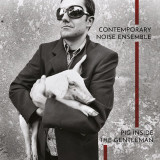
After a creative break of more than 10 years finally the comeback: In line with the long-awaited new album called "An Excellent Spiritual Serviceman" a limited colored vinyl reissue of the classic Contemporary Noise Ensemble debut record "Pig Inside The Genleman" from 2006.
"Jazz music without jazz, film music without movie but something splendid instead! Despite the band's name suggesting noisy music for the chosen ones, Contemporary Noise Ensemble appears to be a revelation for everyone. Beautiful, hard, romantic piano tunes in the dialogue with brass section. Simple and extraordinary emotional compositions leading to the climax which makes the flesh creeps while listening. Hair bristle on the heads of those who remember the musical past of the The Contemporary Noise Ensemble members..."
"The Contemporary Noise Ensemble impresses with maturity and class. There's elegance as well as punk energy. The compositions are unbelievably spacious but on the other hand all fulfilled with instruments - from the superb rhythm combo to the greatly equipped brass section. The roots of the most of The Contemporary Noise Ensemble musicians reach harder music, sometimes even heavy metal what bears excellent interest. The compositions are vigorous and expressive. The name of the band must be remembered because it undoubtedly is Polish export commodity."
"There’s no doubt that the Contemporary Noise Ensemble is one of the most fascinating musical projects from Poland which catches the attention of both pure jazz fans and people who are interested in experimental instrumental music in general. For fans of Cinematic Orchestra & jazz influenced film sounds."
Pressing Info: 180g translucent pink vinyl, limited to 250 copies, download card included. Five years on from their 2018 debut album 'Great Vowel Shift', Lviv, Ukraine-based krautrock outfit Sherpa The Tiger are now returning with their second album, 'Ithkuil, via Fuzz Club Records - with 100% of the profits from the release going to the band to help support them during the war. Where their previous work was centred around vintage synths, minimal ambient and neon-lit kraut-disco grooves, 'Ithkuil' sees Sherpa The Tiger explore more expansive and layered structures and compositions - incorporating intricate guitars, flute, arpeggiators and jazzy piano references, alongside an array of other elements that originate from a broad spectrum of past and present music genres. "This album bears the name of 'Ithkuil' for a reason", the band state: "Like the language we borrowed the title from, the sound of the record has a lot of levels, layers, and orchestral nuances. We consider this album and its pieces a single journey. Every track of the LP works as a mandatory stop for contemplation and reflection that happens on the route of the listener." Sherpa The Tiger began working on the new material in 2019 during their EU live shows in support of 'Great Vowel Shift' and chalk the more textured and cinematic results down to a more collaborative approach. "We wanted to rethink the Krautrock heritage explored on our last album and made a clear stylistic shift that was determined by a totally different approach to our music-making. The tunes on 'Great Vowel Shift' were cooked in a sort of live-looping mode with two musicians jamming. This time, with 'Ithkuil', the process of creation was shared among 4 musicians, and that approach had a great impact on the final result." Several years in the making and now released against a backdrop of war and invasion in their home country, 'Sherpa The Tiger' say that 'Ithkuil' acts as a snapshot of pre-war times: "Since the war caught us in the middle of planning the release as opposed to creating the music itself, the album can be perceived as a wistful reminder of the pre-war life that doesn't seem to be coming back. The life we actually experienced but lost any recollection of and which we are desperately trying to bring back through the music created by the other us now dwelling in an absolutely different reality."
"This is a melancholy, broody, moody and fun project to get lost in” – CLASH
★★★★★ “Few bands are brave enough to try something this ambitious, even fewer have the talent to pull it off” - UPSET
Accompanied by an awe-inspiring film that immerses viewers in 180 degrees of virtual reality, the brand new album finds the band reinvigorated once again, delivering a serene salvo of songs that defy the heavy weight of adulthood, faith and self-redemption through sounds unlike anything they have made before. Following their previous 2021 LP, The Million Masks of God - an acclaimed collection that cried for help as it explored a man’s encounter with the angel of death - The Valley of Vision puts forth a collective, cathartic expression of gratitude that is brought to life in both the songwriting of frontman Andy Hull, and the cinematic story directed by Isaac Deitz.
Writing for the record began with a chance occurrence in the summer of 2021. Hull was looking through his suitcase for his lyric notebook, but instead found a 1975 book of Puritan prayers called The Valley of Vision, which his mom had gifted to him the previous Christmas. The title became a mantra that helped inspire the idyllic yet otherworldly energy that permeates throughout the album and film. An evolution from its predominantly guitar-driven past, the band almost completely abandons the instruments it is used to, and instead plays with primitive yet powerful piano leads and shimmering atmospheres, backed by sub-synth frequencies of bassist Andy Prince and shapeshifting sounds of drummer Tim Very.
"
Standout track Disco currently sits at 88 million plays on Spotify. Surf Curse has over 8 million monthly listeners on Spofity. Departing from the overblown visceral sound of previous Surf Curse records, 2019’s Heaven Surrounds You is a bold step towards HIFI for the Los Angeles DIY scene veterans. The polished orchestral production and driving cinematic moments would feel at home in any of the cult films that inspired the album’s coming-of-age stories. Lyrically, the record finds the duo returning to themes of love, loss and mystery veiled beneath more symbolism and mysticism creating their most emotionally poignant record to date. One ingredient the band doesn’t change is the earworm guitar melodies and massive hooks that have always fueled their famously raucous live shows
The incongruous, yet glorious, creative partnership between Nancy Sinatra and Lee Hazlewood was well underway when the two singular artists reunited to record 1972’s Nancy & Lee Again, a follow-up to their bestselling duet debut, Nancy & Lee. Nancy, the eldest daughter of Frank Sinatra, had been working with the Oklahoma-born songwriter since 1965, when she topped the pop charts with “These Boots Are Made For Walkin’.” Over the next five years, the two artists forged a prolific relationship in the studio, with Hazlewood writing and producing many of Nancy’s solo hits. Soon, the duo found success with a series of duets, including “Sand,” “Summer Wine,” and “Some Velvet Morning” – all of which appeared on their highly-influential 1968 debut.
Not long after the critical acclaim and chart success of Nancy & Lee died down, however, Hazlewood unexpectedly relocated to Sweden, leaving his musical partner in the proverbial dust. America, meanwhile, was in the midst of a cultural shift, as the Vietnam War waged on. By the turn of the decade, the musical landscape had changed significantly. “Trivial music and not profound music became unimportant,” recalls Nancy, speaking to Hunter Lea. “It was a tough time.” And yet, despite the circumstances, the stars somehow aligned for the duo to record some of their most magnificent music together.
Returning to Los Angeles for the project, Hazlewood – who reprised his role as producer – chose to take a new direction with the duo’s sophomore album. Nancy recalls, “It was more dramatic; it was more fun to do, more challenging to do…. It was more grandiose.” For the lush, orchestral arrangements, they collaborated with Larry Muhoberac (an original member of Elvis Presley’s TCB band, whose early ‘70s credits also included Barbra Streisand, Neil Diamond, and Lalo Schifrin) and Clark Gassman, who had worked on Hazlewood’s 1970 LP, Cowboy in Sweden. Backing vocals from brothers John and Tom Bahler, who remain two of the most recorded singers in history, added additional texture to several songs.
The big sound that Nancy describes above is exemplified in the album’s cinematic opener, “Arkansas Coal (Suite).” Clocking in at nearly six minutes long, the dynamic overture tells the tale of an ill-fated coal miner (sung by Hazlewood), while Nancy adjusts her vocals to sing as both the miner’s daughter and his wife. Hazlewood’s knack for vivid, nuanced storytelling shines throughout Nancy & Lee Again, particularly in “Paris Summer,” which details the conflict that a married woman faces, as she engages in a passionate affair. Another highlight is the country-inspired hit, “Did You Ever,” which was released as the album’s lead single. After it landed at No.2 on the U.K. pop charts, the song served as an alternate title track in several countries, including LP pressings in the U.K., Germany, and Canada.
One of the most emotionally-charged moments on Nancy & Lee Again is a cover of Dolly Parton’s “Down From Dover.” The heartbreaking tune tells the tale of a pregnant teenager, who has been abandoned by her lover and her family and ultimately gives birth to a stillborn baby. While Parton’s 1970 version was sung from the teenager’s point of view, Hazlewood and Sinatra transformed the country song into a duet. Hazlewood, who offers the man’s side of the story, sings in a notably deeper octave than his signature baritone.
Another poignant selection is “Congratulations,” which describes a soldier coming home from Vietnam. “His face has grown old and his eyes have grown cold/And they tell you of where he has been/Congratulations, you sure made a man out of him,” Hazlewood sings, pointedly. Nancy, who performs as the vet’s wife, argues that the song had a deeper meaning for her duet partner. “Lee started out a hawk, he was an army guy, so he was all for the war in the beginning. We didn’t talk about it, but at some point, he changed radically. ‘Congratulations’ was almost like an apology from him. I don’t want to put words in his mouth, but it was as though he was saying ‘I’m really sorry.’”
The song “Friendship Train” could also be interpreted as an apology of sorts – this time to Nancy. “You’ve been hurt and I’ve been hurt/Now we’re living pain,” the tune opens. When Hazlewood moved to Sweden without telling his longtime musical partner, Sinatra was understandably upset. “I felt pretty betrayed. I mean, who does that? Who just up and disappears like that? I’ll never understand it,” she reveals. But the uplifting duet – a slice of ‘70s pop perfection – offers reaffirming words of love between friends. “Lee felt things very deeply and tended to express his feelings in song instead of in real life,” explains Nancy.
The 10-track album closes with the stripped-down “Got It Together.” Backed by an acoustic guitar, the song is equal parts playful and candid, as the duo has an impromptu, spoken-word conversation about their lives. “I wish that we’d quit getting so old,” laments Nancy, who later shares her wish to have children (she would do so in the next few years). Hazlewood, meanwhile, attempts to remedy his past wrongdoings – this time asking his partner, “Can I go back to Sweden?” With that, Nancy gives her blessing.
This definitive reissue of Nancy & Lee Again also includes two bonus tracks. Both are stylistic departures for the duo – but fit right in with the psychedelic pop of the era. The first one, “Think I’m Coming Down,” is a harmony-filled reflection on a toxic relationship. “I think that was one of [Lee’s] drug things. I don’t mean that he used drugs; I mean that he was trying to be part of that culture. Trying to be hip,” explains Nancy, who delivers an emotive vocal performance on the solo track. Also included is “Machine Gun Kelly,” penned by a staple of the 70s singer-songwriter movement, Danny Kortchmar (James Taylor, Carole King, Linda Ronstadt). Recorded several months after the release of the album, the song found Nancy reuniting with Billy Strange, who arranged many of her solo albums, as well as Nancy & Lee. Sinatra and Hazlewood first performed “Machine Gun Kelly” during their residency at Las Vegas’ Riviera Hotel in February 1972 (later released as a concert documentary on Swedish television). While the recording has long remained a career favorite of Nancy’s, it would be decades before it was officially released.
Nancy & Lee Again remains a creative high point in the careers of Sinatra and Hazlewood and, upon its release, garnered rave reviews from Billboard, Record World, and Cash Box, among others. Yet, Nancy & Lee Again never received the spotlight it so utterly deserved. “We didn’t have label support at all in those days,” recalls Nancy. “Without the strength of a label, records die. We were old. We were old-fashioned. We were just not what was happening. It’s a very ageist kind of business.” Nevertheless, she adds, “I think it’s a very good album. I think it’s timeless.” Now, after years of being a sought-after rarity, this gem in the Sinatra-Hazlewood canon can finally get its due.
Five decades later, Nancy’s legacy only continues to grow, as new generations discover her impressive catalog (which boasts nearly 20 studio albums – her duets with Hazlewood among them – and dozens of charting singles, including the theme song to the 1967 James Bond film, You Only Live Twice). In 2020, Sinatra was recognized by her peers when “These Boots Are Made For Walkin’” was inducted into the GRAMMY® Hall of Fame. That same year, Sinatra partnered with Light in the Attic for Nancy Sinatra: Start Walkin’ 1965-1976, a definitive survey of her most prolific period. LITA has also reissued Sinatra’s classic debut, Boots, and her iconic, 1968 album with Lee Hazlewood, Nancy & Lee. The label looks forward to celebrating Nancy over the coming years with a variety of special releases, exclusive merchandise, and more.