
5
In Stock
On Stock and ready to ship
10,88 €
On Stock and ready to ship

Francesco Sancricca aka Sancra is a new coming very productive Italian artist. Based in Rome he’s recently releasing his music on independent labels or on his imprint Ipso Facto while playing for local and international venues like, The Magick Bar, Coropuna or Starlane in London. Very emotional and complex when both producing and djing for this release he showcases his ability to blend dark and appealing sounds being never boring but always mental and uplifting like for the A1, a masterpiece ready to smash every dance floor with that endless bassline closing perfectly on the straight 4/4 beat with techno electro influences. The A2 powerful and more techno it’s a 90s echo of warehouse parties together with the malefic melody of the B1 while “closing” the ep with a more breaky B2.
Eternal Return is a must-have for fans of techno, electro, new wave driving music and anyone looking for a unique and innovative take on techno. With its mental sound and high-quality production, this EP is sure to become a classic in the world of electronic music.
Mastered in UK at The Fish Tank Studios pressed and distributed by Vinylfuture.
On Stock and ready to ship

Label head Blue Hour steps up for the next release with an impressive two tracker, offering a new exploration of sound from the Berlin based producer. First up on the A side ‘Dimensions’ reveals a dramatic and eery driving Techno track with an atmosphere akin to early British IDM releases but with a more dancefloor-focused approach. ‘Dimensions’ is punctuated by warped mechanical percussive fx, pummeling drums and relentless groove highlighted by a simple yet effective melodic line which boldly opens things up and cuts through the complex layering of sound as the track evolves. On the B side ‘Sun Dogz’ adopts a similar soundscape, however picks up the tempo with a more Trance orientated production inspired by darker Goa/Psy styles and modern Fast-Trance productions. Hypnotic acidic lines, spatial fx and tribal percussion guide the listener to the main event. A heavily reverbed metallic hook and unique piece of sound design which takes multiple twists and turns along the course of the track. The EP wraps up a year of multiple successful releases from the label, with next year marking 10 years since the labels inception - keep an eye on things to come.
On Stock and ready to ship

Visions Recordings is delighted to have Detroit's Julion D'Angelo and Chicago's SPECTER on the same record after years of trying to work together. These two Detroit masters of the deepness have released records on some of the best labels around, including Sound Signature, Tone Log, Freedom School , Tetrode , Sistrum and more.
These two tracks are original deep zmusic to dance to, but also to dive into and listen to all the details, the complex programming, and the search for unique sounds. It's special and that's why we love it and want to keep promoting it. Real music!
We fell in love with these tracks as soon as we heard them, and we hope you will too. Visions aims to maintain a high and varied standard, and once again we try to present you with quality and profoundness. enjoy the ride.
On Stock and ready to ship

For their fourth release of the year, Chat Noir Tools welcomes Hamburg based producer and DJ Rupert Marnie! Co-founder of The Press Group and part of Remoto record store, the german artist is one to watch among the new scene. In his High Tech Artisan EP we can feel his very distinctive touch: sci-fi influenced music with artificial voices from the future, vocal synths, psychedelic soundscapes and pads.
Rupert Marnie also adds complex drum programming and acid bass lines to create his very own groovy yet minimalistic sound crafted for a cyber and playful dance floor.
On Stock and ready to ship

The 1973 album “El Violento” was the fifth full-length salsa LP led by Julio Ernesto Estrada Rincón, aka Fruko, and the second credited to Fruko Y Sus Tesos. Though it did not contain hits like ‘A la memoria del muerto’ or ‘El Preso’, it’s a collector’s item today in places like the US, Europe and Japan, perhaps precisely because it is obscure yet full to the brim with unrelentingly hard and heavy salsa bangers that never let up from start to finish (hence the title, which translates as “The Violent One”). A mix of originals and interesting covers, the LP is “all killer and no filler”, purposely designed to set the dance floor ablaze. It features Fruko’s two main vocalists that took over from the first pair of Humberto “Huango” Muriel and “Píper Pimienta” Díaz, namely the beloved duo of Álvaro “Joe” Arroyo and Wilson “Saoko” Manyoma. Los Tesos were a talented “wild bunch” who listened to their fearless leader, with Fruko holding down the bottom end on electric bass, Hernán Gutiérrez in the piano chair, the Villegas brothers on hand percussion (Jesús tickling the bongos and Fernando slapping the congas), augmented by Rafael Benítez on timbales and an ace horn section of Freddy Ferrer and Gonzálo Gómez (trombones) and Jorge Gaviria and Salvador Pasos (trumpets). The super aggressive sound comes directly from the South Bronx playbook of Willie Colón. The snarling trombones and soaring trumpet are somewhat sweetened by a nice little Puerto Rican cuatro guitar solo. Sonically lightening the mood somewhat, ‘Nadando’ (‘Swimming’) is a bouncy tune in the ‘Mercy’ genre (basically a hybrid of pop, funky soul, cumbia and salsa, in the style of Nelson y Sus Estrellas), gleefully sung by Joe Arroyo. The beats are complex and ever changing, with a little bit of mozambique, conga, bomba, jala jala and of course salsa thrown in for good measure. The side closes out with a brilliant, uptempo salsa reworking of the venerable ranchera chestnut, ‘Tú, sólo tú’. Side two explodes with the frenetic descarga jam session ‘Salsa na’ ma’—which is exactly that: nothing more than the hottest “sauce” to make the dancers go crazy. Fruko’s tune is dedicated to the Latin community in New York that listens to salsa from everywhere and dances to it so fervently on the weekend. The relentless percussion propels the listener along at breakneck speed as if hurtling down the Bronx Expressway, demonstrating that Fruko y Sus Tesos have mastered the ‘violent’ form of urban salsa that was having its transnational moment in the early 1970s. While “El Violento” may not be as well known as some Fruko records, it certainly deserves a new look and should be assessed on its own merits as a very powerful, confident entry in the historical evolution of Colombian salsa dura.Sleeve
On Stock and ready to ship

Sept duos pour guitar acoustique et piano préparé is the second duo recording from Stephen O'Malley and Anthony Pateras. Their first together, Rêve Noir (2018), took an electro-acoustic scalpel to a 2011 duo concert for electric guitar and piano, using Revox and digital treatments to twist and smear gig documentation into ghostly echoes and fractured drones. Here, in contrast, the music is entirely acoustic and presented as it was performed, without overdubs. Both players’ choices of instruments are notable: this is O'Malley’s most extensive recording on steel string acoustic guitar (playing an instrument whose previous owners include Marissa Nadler and Glenn Jones) and Pateras return to the prepared piano, which he has rarely employed in recent years, after spending much of the first decade of the 21st century exploring its possibilities.
Recorded during O'Malley’s residency at La Becque on Lake Geneva in the summer of 2021, from the first moments of the opening ‘déjà revé’ the music immediately establishes the distinctive landscape of chiming tones and hovering clouds of resonance explored throughout its one-hour running time. Pateras’ preparations create tolling bell-like tones alive with complex overtones, alongside which O'Malley’s open strings and natural harmonics add a sparkling clarity. While Pateras’ music often uses a densely chromatic harmonic language, these duos are remarkable for their modal simplicity. However, the interaction between the pure intervals of O'Malley’s just-intoned strings and the unstable harmonies created by the piano preparations suspends the music in an oneiric state of hazy ambiguity. Without obvious reference to tempo or meter, the music floats in what the composer Ernstalbrecht Stiebler has called a ‘bottomless sound space’, the temporal placement of events determined by bodily rhythms and the performers’ own listening to (and enjoyment of) the sounds being made.
Heard one way, this music can seem striking in its consistency, almost environmental. Attending more carefully, the listener hears the pitch sets and tunings changing throughout the album’s length. Each piece has its own character, subtly distinguished from the others through mood, pacing, and timbre. On ‘déjà voulu’, for instance, O'Malley makes prominent use of slide, the woozy, bending pitches weaving through a series of lush arpeggiated chords from the piano. ‘Déjà senti’, on the other hand, is particularly spare, the gestures spaced out to the extent that they often float in isolation against the background of fading resonance. Much of ‘déjà su’ is built around a slowly pulsing single prepared piano tone, creating an almost ominous tension, whereas the sparkling guitar harmonics and arpeggios of the closing ‘déjà raconté’ have a gently triumphal air. While the music’s calm, rippling surface is immediately entrancing, these seven duos – in the tradition of the best improvised music – also reward close listening, which reveals sonic details and focuses the listener’s attention on how the music unfolds spontaneously from decision to decision, from gesture to gesture.
Recorded during a period when O'Malley and Pateras were grieving the loss of recently departed friends and collaborators, these seven duos possess a reflective, at times almost mournful quality. More importantly, though, they are imbued with other qualities that can arise from personal loss: a clarity that allows one to clear away the inessential, to begin again, to renew one’s faith in friendship and music.
On Stock and ready to ship

At times where technology inexorably infuses into humankind, Ammar808’s next adventures lays within the realms of Stambeli’s invisible creatures, an old genuine Tunisian tradition that has roots spreading out within the depths of the African continent.
Stambeli is a Tunisian musical therapeutic ritual that was implanted by afro-descendant communities. During the ceremonies, music, dance and chants are blended so as for some participants to reach the alternate state of trance while they are possessed by super natural entities. It is a syncretism between Islam and animist Yorisha religion’s voodoo beliefs, that has been disseminated during slave trade by Yoruba populations originating from current Benin’s gulf. Stambeli is a precious legacy the symbolizes the outstanding diversity and complexity of the North-African identity.
Using drum machines and analog synthesizers, he summons super natural creatures to visit our material world and taste human incarnations, form the audience’s collective experience. The album features vocals and gumbri from Bellassan Mihoub, who inherited his father’s knowledge and mastery, and currently embodies the avant-guarde of Stambeli’s revival. Two additional choristers round off the stage band, also playing the krekebs: these are pairs of large castagnet-like instruments oscillating in the limbo between binary and ternary rhythmic patterns. They breathe life and motion into this pagan communion, blessed by VJ Sia original visuals synchronized to the thundering music.
Super Stambeli is a contemporary interpretation of the Stambeli traditional repertoire, processed through a time-travel washing-machine, a parallel-dimension earthquake portal, that aims to echoes ancestral ceremonies through sub-harmonic speakers. It’s a dialogue between the wailing of the gombri, known to call for the spirits to descend into the bodies of the participants, but this time AMMAR808 directs them straight into the digital circuits of his clockwork-crafted machineries.
On Stock and ready to ship

2023 Reissue
After releasing Undefined, Kazufumi Kodama and Babe Roots, the 4th release from a Japanese experimental dub label newdubhall welcomes the ever-evolving pioneer of minimal dub and dub techno Deadbeat, a solo project of Scott Monteith hailing from Canada. Side A 'Things Fall Apart' will feature a beatless dub ambient which shares a perspective of free jazz and 'Adieu Chez Cherie,’ an absolute knockdown four on the floor dub techno on the flip side. Though simple, both sides are layered with complexity, let yourself experience the profundity of newdubhall with this masterpiece.
On Stock and ready to ship

Pellegrino & Zodyaco, with their new single 'Malìa', continue the aesthetic and sonic journey of the project led by the Neapolitan producer, with a mixture of Neapolitan disco-funk and fusion steeped in Latin flavour that already explored the innermost corners of the soul with 'Quimere'. This new work captures the frenzy and vibrant character of Naples, with its rarefied atmospheres and infectious groove that evoke the beating heart of the city and take us on a journey through the wonder of life in search of the Mediterranean essence.
The 'Malìa' is enchanting, it’s that mysterious force that hides deep inside, transforming itself into a vortex of emotions through the fusion of involving rhythms and reflections on inner battles, on the importance of finding the 'light' to overcome conflicts and difficulties that hinder the ability to choose, a dreamlike mirage that opens a window on human vulnerability, a hymn to authenticity, to self-acceptance.
The celebration of dance in the Caribbean Escapade version is also an exhortation to escape from everyday life; it takes us into a sonic imagery that plays with the Neapolitan musical tradition and the freshness of Caribbean and Latin sounds. This summer single becomes an ode to the vital energy of dance music: there is no more time for hesitation, one must let oneself be carried away by the enthralling embrace of 'Malìa', like a call to awareness and the search for authenticity in life. Malìa becomes the guiding thread, the mystery that urges us to go beyond the confines of everyday life, to explore and celebrate the complexity of existence.
On Stock and ready to ship

microCastle’s third offering of 2023 welcomes Ditian back to the label for his first artist EP. Splitting time between Buenos Aires, Berlin and Barcelona, the Argentinean artist has carved out a unique place in the electronic underground over the last half decade. With an immediately recognizable sonic signature, Ditian channels languages of varied musical landscapes, churning them into his own complex rollercoaster of intricate electronica. A sound that is equally at home on rebellious dance floors around the world or in the sweet spot of a late-night leftfield listening session. A short but meticulous discography reflects Ditian's choosy nature; with Exit Strategy, Innervisions and TAU serving as the primary landing spots for his musical output. Having remixed Ivory’s ‘Arpstairs’ for his microCastle debut last summer, a project which was followed by a contribution to Dixon and Ame’s Secret Weapons 15 collection to begin the year, Ditian now returns to the label with a four-track showcase entitled ‘Serpenta’.
The crushing title track crashes in and sets any preconceived ideas of Ditian’s music alight, forecasting jet force propulsions and wild signal bending synths. As somewhat of a departure from his previous experiments, Ditian’s clustered pungi mutations provide an enduring main theme, while a wonderfully warped break is sure to cast a paranoid spell over the dancefloor.
‘Venena’ follows in fine style and further hammers down Ditian’s elusive vision. Dizzying, rapid-fire sequences of rhythm, granular textures and heavily manipulated synths travel to the very edges, while maelstroms of drums and contorted basslines highlight a high-octane second act.
‘Inertia’ lands at the collection’s midway point and does so in remarkably twisted fashion, stepping decisively on the gas and steering into shadowy transgressions. Never one to shy away from darkness or pushing boundaries, Ditian’s metallic storyboarding rises and falls across act one, consciously withholding energy, as grooves pulse and effects orbit, creating tension that eventually gets resolved as clusters burst open and oscillate in kaleidoscopic fashion.
Ditian’s creative attitude reveals itself further on collection closer ‘Influenza’. Presenting some of his most club-adjacent rhythms yet, it’s a clever coax of billowing tones and scrappy melodica which get wrapped up in a concordant fog, eventually getting washed away; because after all, the oceanic drones are all the better when they’re magnified to full size.
Cover art: Mauricio Seidel
On Stock and ready to ship

As it celebrates its 50th anniversary, Bill Withers' Still Bill remains true to its title – and stands as the greatest male-fronted soul album not made by a singer named Marvin, Al, Sam, James, or Ray. Though the saying "keeping it real" did not exist in popular parlance when Withers released his sophomore effort on Sussex Records, no words better capture the music's approach, mindset, and value. Every facet of Still Bill radiates honesty, truth, and emotion.
These characteristics – along with Withers' strong singing, hybrid arrangements, and deceptively simple songwriting – have allowed the album to endure to the point where it sounds as fresh today as in 1972.
After rising into the Top 5 of the Billboard Album charts and attaining gold status within a year of release, Still Bill has long been evaluated not by sales – but according to its merit, spirit, and agelessness. Included by The Guardian on its "1,000 Albums to Hear Before You Die" list (2007) as well as in Tom Moon's 1,000 Recordings to Hear Before You Die book (2008), its contemporary standing as one of history's most venerated soul efforts eclipses the positive reception it enjoyed in the early ‘70s.
Still Bill walks the same hallowed ground as What's Going On, Call Me, Night Beat, and Genius + Soul = Jazz. Like those landmarks, Still Bill plays with a mix of consistency, effortlessness, and complexity that rewards repeat listening and transcends categorization.
In combining four of the era's predominant styles – Philly soul, sweaty funk, Southern-reared blues, acoustic-based folk – and melding them with standout production borrowed from both minimalist affairs and sophisticated singer-songwriter albums, Still Bill occupies a distinct universe.
Its rhythmic fare is equally laidback and invigorating; relaxing and rollicking; eloquent and muscular; soft and tough. Withers' calm, self-assured voice hovers above it all, doubling as a warm blanket that adds comfort and grace to lyrics steeped in maturity, perspective, and compassion.
Withers' balanced outlook on human desires, needs, and situations stem from his own existence as a former blue-collar employee who believed his time as a musician would soon end. That grounding forever separates Withers from other contemporary soul greats – and stamps Still Bill with a conversational nature and egoless approachability.
"I mean look, I'm really a factory worker," said Withers in 1972. "That's a real job." There's that word again: real. The songs on Still Bill are tethered to modesty and actuality, wedded to a belief in simplicity, and connected to universal truths that link us all – independent of our economic or social standing. No track better exemplifies those principles than "Lean on Me," a feel-good paean to brotherhood and community that hit No. 1 on the pop and R&B charts en route to becoming a mainstream staple.
Withers approaches the plainspoken insight on "Lonely Town, Lonely Street" and heartbreaking vulnerability of "I Don't Want You on My Mind" with similar sincerity and straightforwardness. His proclivity for authenticity extends to the record's other big hit: the sexual, funk-laden "Use Me," which reached No. 2 and reflects the singer's everyman persona. It's an identity couched in keeping it real, the very inclination that ultimately led Withers to retire in the mid-'80s rather than bend to industry pressures or risk credibility.
That commitment to truthfulness and realism helps make Still Bill feel as unaffected as the air we breathe. Looking back on "Lean on Me" years later, Withers said it seemed like "something that was there before I got here" – the kind of song that could be 100 or 10 years old, or one we encounter anew 10 years into the future. The same can be said for every note on Still Bill.
On Stock and ready to ship
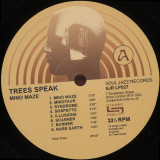
12" + 7" !
Mind Maze is, amazingly, Trees Speak’s fifth album to be released on Soul Jazz Records in the space of little over two years– an output matched only by the intensity of their music created during this short time.
The first pressing only of the album comes with a bonus seven-inch single containing two tracks that are not available on vinyl anywhere else.
As with all their previous releases, ‘Mind Maze’ is a mind-boggling tightrope walk across an array of musical influences that seamlessly create the unique present-day world of Trees Speak.
The band’s sound is characterized by a combination of German krautrock motoric-beat rhythms, angular New York post-punk attitude, 60s spy soundtracks, psych, rock, jazz, and 70s synthesizers and vocoders. There is also a cosmic spatial awareness to their sound; both personal inner space and galactic outer space, as well as a wilful pushing of sonic boundaries.
Trees Speak are a musical duo based in Tucson, Arizona, composed of Daniel Martin Diaz and Damian Diaz. Their music is heavily influenced by the cosmic magic of the natural desert landscapes of Arizona, creating a unique and captivating sound that is both experimental and innovative.
Here you will find the myriad sounds of 1970s German electronic music (everything from Can to Cluster, Popul Vuh to Tangerine Dream); 1980s New York post-punk and synthcore (from No Wave to Suicide); John Barry’s 1960s movies, John Carpenter’s 1970s horror. You will also hear the influences of French and Italian progressive rock (Magma, Goblin) as well as cosmic, new age and experimental space soundscapes …. an almost endless list of diverse influences that ebb and flow like an ocean of sound, in the process creating a truly unique soundscape that Trees Speak have made wholly their own.
The name Trees Speak reflects their interest in the concept of using future technologies to store information and data in trees and plants, with the idea that trees communicate collectively. This interest in nature and technology, combined with their passion for experimentation, has led Trees Speak to create a truly one-of-a-kind listening experience that is both unique and engaging.
If you ever wanted to hear Can, Neu!, Destroy All Monsters, Pere Ubu, electric eels, John Cage, Liquid Liquid, Tangerine Dream, Suicide, Laurie Spiegel, Art Ensemble of Chicago, John Barry, Mother Mallard’s Portable Masterpiece Company, Sun Ra, Stockhausen, John Carpenter, Electro-Acoustic and Musique Concrete and Mars in one band - then this is it! Trees Speak are a band that defies categorization and offer an eclectic listening experience, both exciting and memorable.
The two bonus tracks (‘Seraphim’ and ‘Orpheus’) included with the album give us a further window into the complex mind maze of the group - two stunning acoustic tracks that explore a distinct early 70s sound of Yes, Argent and other progressive rock accolytes.
On Stock and ready to ship

Sampled by Jay-Z and Dr Dre, Italian band Calibro 35 announces the release of the new album NOUVELLES AVENTURES. The album will be available abroad on limited edition Crystal Clear vinyl next June 30th via Record Kicks.
Italian cult cinematic combo Calibro 35 are back with their new studio album NOUVELLES AVENTURES. The new album will be available abroad on a limited edition Crystal Clear Gatefold LP on June 30th, distributed worldwide via Record Kicks. The crystal clear vinyl edition is a Record Kicks exclusive and is limited to 1000 copies, which makes it an instant collector's item.
After last year's Scacco Al Maestro, the 2 tribute-albums dedicated to "il maestro" Ennio Morricone, followed by the "Calibro 35 plays Morricone" tour and the releasing of the ost of TV drama series Blanca, Calibro 35 are back with NOUVELLES AVENTURES, a new studio album of original material. NOUVELLES AVENTURES was recorded in Naples at Auditorium Novecento, the former Phonotype Records, one of the most legendary and fascinating Italian recording studios. The new LP sees the group making full use of their knowledge and resources, refined and enriched over the years, back to making "Calibro's music": a unique mix of funk, progressive rock, alternative jazz and wide-spectrum cinematic music the public has known them for in fifteen years of career.
"After a couple of intense and stimulating years playing Morricone and writing music for the TV drama Blanca", Calibro 35 said, "we had a great desire to make new inspired music. To do so, we left home and we shut ourselves up in the splendid space-time capsule that is the Auditorium Novecento studio. The result is a series of musical voyages in which we concentrated all our artistic and human experiences. As in Verne's imaginary and extraordinary journeys, we explored distant places where we had never been before. We then happened to return to more familiar shores and discover them with new eyes without realizing it. We borrowed the title NOUVELLES AVENTURES from György Ligeti, precisely because after fifteen years of building ourselves, we are ready for new adventures".
NOUVELLES AVENTURES was anticipated by the first extract "EXTRAORDINAIRE", an almost 6-minute song that once again confirms the band's aptitude for the exploration of unpredictable sound territories: a music that, on one hand sounds liquid and abstract, while on the other, it cuts through the psychedelic mists, with a complex architecture.
Described by Rolling Stone as "the most fascinating, retro-maniac and genuine thing that has happened to Italy in the past few years", Milan-based Calibro 35 enjoy a worldwide reputation as one of the coolest independent bands around. Active since 2007, during their long career they were sampled by Dr. Dre on Compton ("One Shot One Kill" feat. Snoop Dogg), Jay Z ("Picasso Baby"), The Child of Lov & Damon Albarn ("One Day") and Demigodz ("The Summer Of Sam"). They played major venues and festivals all over Europe and as unique musicians they collaborated with, amongst others: PJ Harvey, Mike Patton, John Parish, Stewart Copeland and Rokia Traoré.
On Stock and ready to ship

Over three years after the release of his latest record, Belgian singer-songwriter Bram Vanparys finally returns with breathtaking new music. His songwriting has often drawn comparisons to the music of Bob Dylan and Neil Young, but the new record 'Silent Days' reveals that Vanparys has been on a journey into new musical territory.
After 'Wild Flowers' (2015), which he recorded in Los Angeles with Ray LaMontagne's former live band, Bram Vanparys kept his guitars locked away in their cases for months. Too many questions had been bothering him and soon he found himself struggling with his musical direction and his artistic integrity. Partly so because he felt that his almost archaic approach on songwriting was pushing him down a dead end street and partly because his interest in rich and complex arrangements started to grow stronger. In 2016 he bought an old trailer and went living in the countryside to work on his new sound. A harsh winter and a tragic breakup with his wife set the mood for a new set of songs and soon Vanparys started recording again.
'Silent Days' comprises both classic songwriting reminiscent of the old masters such as Leonard Cohen and Bob Dylan and on the other hand dark, complex arrangements that refer to late Talk Talk and even Radiohead. Guitars were played with kitchen knives and the heavily manipulated acoustic sounds reveal that Vanparys might have been listening to Kurt Vile. Bram's lyrics are deeply honest, touching, but never sentimental and his once so angelic voice now sounds hoarse and mature.
The Bony King of Nowhere is the pseudonym of Belgian singer-songwriter Bram Vanparys. He released his debut album 'Alas my love' to critical acclaim in 2009, which was followed by his second and most celebrated album 'Eleonore' in 2011. In the aftermath of 'Eleonore' he was asked to write the film score for the movie 'Les Géants', for which he was awarded by Les Magritte du Cinéma for best original soundtrack.
L
On Stock and ready to ship

A certified maestro of his time, king of Cool Jazz with a penchant for unusual time signatures, Dave Brubeck is as prolific as they come. For their third release, Major Keys lovingly remaster and reissue three of his key pieces as The Dave Brubeck Quartet including the instantly recognisable ‘Take Five’ on 180g vinyl in a Major Keys sleeve.
On the A side one of the most famous jazz pieces of all time. Released in 1959 as part of the Quartet’s Time Out LP, which become the first jazz album to sell more than a million copies with the ‘Take Five’ single also taking that that coveted spot whilst going on to become the best-selling jazz single of all time. Accolades aside, it’s an intricate, absorbing and elating piece of jazz history, with one of the most recognisable melodies ever to be written. Timeless genius written by the quartet’s saxophonist Paul Desmond and performed by Dave Brubeck, Paul, Joe Morello and Eugene Wright, reissued for a new generation of listeners.
The B side sees ever more experimentation from the quartet, with the time signatures Dave heard on the streets of Istanbul providing the inspiration that gave birth to the lead track from Time Out - ‘Blue Rondo a la Turk’. As cool and complex as they get, stirring up those meters like a slick Manhattan. Rounding off the package, American jazz singer Carmen McRae’s 1962 vocal version of ‘Take Five’ gives an extra dose of sophistication to proceedings. All in all, a must have for any discerning music lover.
On Stock and ready to ship

Josh Milan has been recording music professionally for over 30 years.He's played every role from artist to engineer in the studio.This project, Honeysweet, focuses on his production and musicianship.Utilizing only one musician on sax, Josh plays every instrument and sings every note on this project. His songs are packed with soulful dance floor grooves inspired by iconic, soulful groups like Brian Auger, Cymande, Pleasure, Africano, Santana and others.
"I wanted to do music that made me and my family feel good when I was growing up. It's the kind of music that families dance to at gatherings with a record player and no DJ”, says Josh. “Intros, Accents, Breakdowns, Bridges, and endings were all part of the music.” This music will transport Josh's audience to a place of musical freedom. This is music with, seemingly, no rules.
Josh Milan describes each track on the Honeysweet EP “Exodus” in his own words :
"Last Night Changed It All featuring Lawrence Clark on sax is the kind of groove that keeps its dance floor value while holding up the banner of true musicianship. This song was written after hearing a DJ set,where the DJ didn’t seem to be concern about staying within a musical box. He played all sorts of music in one set. I knew then that I’d branch out musically when recording.Rhodes, picked bass guitar, rhythm guitar and drum kit is all that's needed on this one.”
"Exodus the manipulation of major and minor chords in this groove make it complex and interesting. The listener is lead by the organ solo featured here. The song is a mental escape. A mental exodus complete with bongo section.”"Being Free is a message that captures the point of this entire project. Musical freedom and expression is where this project gets its
fuel. Horns, are included on this production. A true expression of soulful music. Being free should be all the time I'm your mind all the time.”
“Cranberries and Cream is my tribute to funk grooves as they were featured on records in 70’s. I’m a fan of that sound and I like to play by own funk grooves when I’m alone. This is one of the tracks on the ep I prefer to rock.”
“And So She Waits has eerie sounding pads in the background. They linger throughout the track. Popping in and out, as though they’re waiting for something. You will hear the change in mood once she is no longer waiting. The groove returns to it’s original state. Only she is no longer waiting, he is.”
“Crazy is me bringing the funk to dirty house music. Complete with house piano in the mix. The chords are unsettling. They are, in fact,Crazy. I though adding a horn arrangement to a house track like this would sound interesting and different.”Honeysweet “Exodus” out at all digital outlets and double pack vinyl set.
On Stock and ready to ship

Just mention 'Terrace' in a techno environment and soon someone else will shout "pioneer!" As Florence, Terrace and (half of) Acid Junkies, Brabant-based producer Stefan Robbers was at the flying centre of Dutch techno in the early 1990s.
Perks is Robbers' fifth EP for Delsin in a relatively short time. On the one hand, it contains his signature sound: melancholic melodies and complex drum patterns wrapped in outstanding production; on the other, Perks surprises on many fronts. For starters, the overall vibe is a lot more sombre, the chosen route much more experimental. Take 'Model A', a dreamy, 12 minute-long meandering epic that nods to the kraut-infused electronica of Tangerine Dream and Cluster but at the same time proudly carries the techno DNA. A fascinating return of a true pioneer.
On Stock and ready to ship

Recently created Guatemalan label Identidata is extremely proud to present Sacratávica, the very first collected survey of Joaquín Orellana’s compositions. With a career spanning over 50 years of activity across contemporary art, performance, theater and sound art, Orellana is a highly singular figure in Guatamalan culture. Often considered to be the sole avant-garde composer in the country, his work has a deeply interdisciplinary quality. Most of his music was created using an orchestra of his self-built instruments, also known as Útiles Sonoros. Sitting at the border of sculpture, sound installation and musical instrument, these Útiles Sonoros, which he’s been building and developing since the late ‘60s, are at the center of his artistic activity.
Aside the obvious formal aspect, his compositions also have a strong political message, while being deeply rooted in Guatemalan history, folklore and various identities, both indigenous and modern. Playful opener “Híbrido a presión” was one of the first of his compositions to be performed entirely using the Útiles Sonoros. However, due to its technical complexity the piece was seldom reproduced, except for a later staging that Orellana directed in Louisville, Kentucky. “Ramajes”(1984), initially titled “Evocación profunda y ramajes de una marimba” , tracks the many incarnations of the marimba across history, before reaching its final form as one of Orellana’s instruments by combining vibrational percussion with melody and poetry fragments.
The title track, ‘’Sacratávica’’, represents one of the most ambitious and emotionally charged pieces from the album. An expansive 22 minute composition mixing textures that mimick field recordings and multi-layered vocal melodies culminating in choral catharsis, ‘’Sacratávica’’ deals in baroque maximalism without ever feeling cluttered. For the casual listener, the track immediately stands out, not only because of the moving vocal layered harmonies, but also through its epic scale and strong sonic narrative. Dubbed “Las voces del Rio Negro”, the piece references the massacres that took place in Coban during a period where the army massacred numerous towns, throwing the bodies in the nearby Rio Negro (the Black River).
Final track, “Fantoidea”, a glistening, metallic ambient improvisation, was a reimagining of Disney’s Fantasia using Paul Dukas’s “The Sorcerer's Apprentice” as inspiration.
Despite his work being presented in numerous exhibitions and concerts in various prestigious museums and theaters across the world, very few quality recordings exist to date. The only previously available recordings so far or either of very poor quality or did not receive enough attention. This is why, although The compositions presented not being previously unheard, having them all together in a high quality audio object represents a key moment In Guatemalan and Latin American culture.
Recorded on August 31st 2016 during a historical concert attended by over 1000 people at the Centro Cultural Miguel Angel Asturias, designed by Efrain Recinos, one of Guatemala’s leading contemporary artist from the last century, the four pieces were performed by a selection of over 90 musicians (including 60 vocalists) who were already familiar with Orellana’s instruments, cherry-picked from the Guatemalan Conservatory.
For the people behind Identidata, it has been a long and arduous process to put together these pieces. Trying to offer a panoramic view of Orellana’s work, the curators have selected pieces ranging from different decades and artistic periods. Sacratávica is a portrait of a singular artist whose work speaks not only to his culture, but carries strong aesthetic sensibilities that resonate universally.
On Stock and ready to ship

American rapper from Oak Park, Sacramento, California. He started rapping in 2004 under the name Lil Tim. The artist eventually changed his stage name to Mozzy in 2012. Until 2015, he had received little
attention until the release of this album which Rolling Stone magazine ranked as the 22nd best rap album of 2015. The same year also saw Mozzy being recognized by Complex as having "the best run of 2015." And 2018 found him appearing on the “Black Panther” soundtrack which introduced him to a mainstream audience. He has evolved over the years to become one of the most influential voices in his era of West Coast hip-hop.
On Stock and ready to ship
