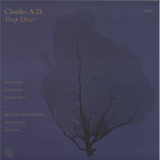
The sea has long been central to Japanese culture, symbolizing both sustenance and spiritual depth. Charles A.D.'s Deep Diver draws inspiration from this, channeling the ancient traditions of diving and fishing into his music. Historically, the sea has influenced everything from Shinto rituals to the livelihoods of coastal communities. In Deep Diver, this reverence flows through aquatic soundscapes, where rhythmic waves of 90s house and Detroit techno meet Japanese minimal production techniques, New Age and Pacific Jazz. Like the tides, the album ebbs and flows, creating a serene yet dynamic homage to the timeless connection between Japan and the sea.
The opening track 'Deep Diver' plunges into the depths, its abstract sound design capturing the sensation of deep-sea propulsion. Rhythmic bubbles pulse gently alongside slow-moving chords, creating an otherworldly atmosphere. The textures are lush yet restrained, setting a tranquil stage that pulls the listener into a submerged world. 'Underwater Ruins' builds on this aquatic theme, introducing rhythmic layers and bass-heavy notes reminiscent of mid-90s Japanese ambient techno. The smooth, melodic flow nods to pioneers like Mr.YT and Susumu Yokota, while subtly incorporating the Detroit techno influence through soulful, deep basslines.
The track feels like a fusion of ambient and techno, balancing serene tones with a rolling groove, emblematic of Japanese techno soul. As the album progresses into 'Bubble Ring', it becomes clear that Charles A.D. is a master of minimalism. The production is timeless, leaning
on analog techniques where echo-drenched chords and carefully layered soundscapes take on an addictive, hypnotic quality. The simplicity of the composition is deceptive, as each element carries weight, drawing the listener deeper into the rhythm and space between the notes.
'Merperson' is where organic rhythms truly come into play. Charles A.D. gently evolves the patterns, allowing each percussive hit to flow naturally into the next. Soothing melodies emerge from within the track’s structure, eventually reaching an emotional peak without ever feeling forced. The organic nature of the arrangement creates an effortless progression that feels deeply connected to the natural movement of water.Starting the second half with 'Deep Exploration', the theme of underwater excursions becomes even more pronounced. Light, steady drumming anchors the track, allowing the melodic layers
to develop gradually. It unfolds with a calm, measured pace, before ending softly, almost as if the sounds are drifting off into the oceanic depths. 'Diffuse Reflection' stands out as the most dub house-influenced on the album, with rolling rhythms and hypnotic elements reminiscent of Maurizio's deep, pulsing sound. Yet here, the production feels submerged, with aquatic effects swirling around the rhythmic core, blending dub house with a fluid, oceanic touch. 'Traitors' delves even deeper into dub-inspired territory. Deep, resonant bass hits combine with wooden drums, while static-like sounds evoke the image of a radio tuning through static to find clarity.
Chords shimmer briefly before fading back into the liquid depths, evoking the ebb and flow of the tide. The final track on Deep Diver 'Levitation', is a fitting conclusion, as the rhythms merge and overlap like waves gently lapping the shore. The minimalistic arrangement allows each element to blend effortlessly into the next, creating a sense of unity and closure. The sounds move with the gentle grace of water, ending the album in a way that feels both complete and
open-ended, like the infinite motion of the sea.
Search:con natural
"One of the most iconic groups of the late 20th century, Dire Straits established their timeless sound from the
moment they first appeared on the London gig circuit, in 1977. With faultless musicianship and memorable songs
that quickly connected with music lovers, it was clear the group would set their own path, proving that, even amid
the new-wave era, classic songwriting would never go out of fashion.
After three years of relentless hard work, touring, writing and recording their music, the group entered the 1980s
well on their way to becoming the biggest-selling band in the world. That year’s Making Movies album would also
make its presence felt on the silver screen, thanks to the inclusion of the UK No.8 single ‘Romeo And Juliet’ – later
used in films such as Empire Records, Hot Fuzz and I, Tonya – and live favourite ‘Tunnel Of Love’, which featured in
the 1982 Richard Gere film, An Officer and a Gentleman. Dire Straits’ frontman, Mark Knopfler, would later explain
to The Times how satisfying it was to write ‘Tunnel Of Love’: “It’s the moment when you know you’re really on to
something,” he said. “There’s a certain part of the song that I call the breakdown and when I got there I could feel
the drums, the piano, all the things that I wanted all the instruments to do. When you get to that state, there’s a
strange sense of one thing following another, of elements falling into place quite naturally.”
Paying extra attention to those elements, this half-speed master of Making Movies has been overseen by Miles
Showell at Abbey Road Studios, in London, resulting in a cut that has a superior high-frequency response (treble)
and very solid and stable stereo images. Pressed on 180g vinyl, it comes with alternative artwork that swaps the
red and the blue of the original album sleeve, plus a printed inner sleeve, a “Half-Speed Master”-branded obi-strip
and an Abbey Road certificate of authenticity.
"
Norwegian pianist Eyolf Dale’s lateral approach to composition is given full range on his beautiful new album. Featuring his trio with the Norwegian Radio Orchestra, conducted by Edition Records artist Japanese maestro Miho Hazama, The Space Between Two Notes is a nuanced investigation of sound and space.
Eyolf Dale, the renowned Norwegian pianist and composer, releases his latest album, The Space Between Two Notes, his 7th album released under Edition Records. This new album elegantly reimagines selections from Dale's celebrated trio albums, Beingand The Wayfarers, with rich orchestral arrangements featuring the Norwegian Radio Orchestra, conducted by fellow Edition artist, Miho Hazama.
The Space Between Two Notes explores a mesmerising blend of jazz and classical music, harmoniously integrating the intimatedynamics of a trio with the grandeur of an orchestra.
The album is an exploration of musical intervals—the nuanced spaces between notes—which shape the auditory landscapes of Dale’s compositions. This approach sets it apart from traditional jazztropes, which often emphasize vertical structures, like chords and melodies. Dale, however, crafts his music horizontally, focusing on the relationships and distances between sounds.
Eyolf Dale’s approach to music is profoundly influenced by his rich musical upbringing and an early fascination with the varied textures of sound: from the intricate works of Pat Methany to the vibrant tones of Norwegian jazz. This diverse background informs his unique musical language, which is not confined by genre but instead resides in the intriguing liminal space between established musical traditions.
The album features not only Dale's pianistic finesse but also the empathetic interplay of his trio, including Audun Kleive on drums,whose sensitive accompaniment ensures the music's purity of expression. As Eyolf points out "One of the most challenging aspects, in my opinion, of blending classical and jazz elements lies in the delicate balance of the drummer's cymbals.” Together,they achieve a unity of sound that transcends the sum of its parts, further enriched by the poised bass playing of Per Zanussi andthe orchestral collaboration. This synergy allows the music to unfold naturally, each note and silence carefully articulated to communicate more than mere melody.
Limited Edition Orange Coloured Vinyl.
- Two Start Right Away
- Two Smoke One Blunt
- Two Look Very Freid Alreadyired Already (Feat. S.fidelity)
- Two Get Two More (Feat. S.fidelity)
- Two Think About Rolling Another One
- Two Be Too High
- Two Rather Stay Together (Feat. Dj Illvibe (The Krauts))
- Two Start Laughing For No Apparent Reason
- Two Feel A Certain Way About Certain Things (Feat. Wandl)
- Two Be Ok
- Two Hope So (Feat. Fid Mella)
- Two Be Continued (Feat. Dexter)
- Two Keep Playing
Amsterdam's resident by choice, Torky Tork's Seed Tape Vol.1 is a reminiscences to his love for growing plants. Having created his own personal "music for plants" project, to keep flora and fauna entertained and triggering the blooming process.
Simultaneously to the album, Torky's own OK KUSH weed-strain will be introduced to the world. The lush & laid-back stimulating sounds and baselines are beneficial for the plants and the listeners cortex equally.
Torky's sound - even across various projects can be described with the broad spectrum of influences. The restless Berlin native has never stuck to one formula. His urge for ever new input is reflected by the constant change in the centre of his life - for some years now, he has been constantly traveling back and forth between his Berlin Bunker studio and Amsterdam, his home of choice. So the influence of weed has naturally been around him for a while, yet inspiring him to dive into the album TWO BE OK.
The illustrious line-up of musical guests on the album contains Germany’s most in-demand producers, the self-taught bedroom beatmaker FloFilz, Berlin’s bunker studio affiliate S. Fidelity, wine aficionado Dexter (also mastering engineer of the album), Wandl and more. This is the perfect soundtrack for watering your favourite plants while watching them grow.
Quinnisa Kinsella-Mulkerin recorded her first song at five years old with her parents, who comprise the adventurous Maine band, Big Blood. Ever since the age of five, she was writing songs, banging on chimes, strumming guitars, and clanging together whatever else she could find. Improvisation was natural, and she stuck to the approach. Quinn brings this innate sense of songwriting to The Wickies, a duo she formed with Aiden Arel a year ago at age 16, whose chill approach and fluid delivery belie true inventiveness in the underneath mechanics. Inspired by seventies folk icons like Stevie Nicks, Krautrock bands like Can, and modern indie-rockers like Alex G, The Wickies feel like an amalgamation of these decade-spanning sounds, but uniquely their own. Quinn’s voice croons like a seventies folk star, but it possesses a great and controlled tone. Her vocals feel like another instrument within the mix, building and growing each song to its fullest sound, leaving no detail within the mix unheard. Their use of echoing guitar lines recalls sixties psych, a springboard for their unique take. Quinn’s lush, free-flowing lyrics, created on the spot, complement Aiden's fleshed out backing instrumentation and over-dubbing. Quickly, the pair created more material than they ever needed, allowing them to mold their recordings into a self-titled debut album. Like a painter crafting the perfect exhibition of their finest work, Aiden and Quinn condensed their improvisations to all the best parts. Tracks like “Campfire Song” and “Skipping Pond,” exemplify the ethereal and lackadaisical atmosphere of their sound. “I keep finding these weird, obscure bands from the seventies that have one album and nothing else, which is awesome,” Quinn said, “I want my music to sound like somebody found it in a record store that no one has ever heard of and uploaded it to YouTube. I want it to sound a little strange.”
- A1: Mytron & Balam - Cabasa Loca (Poland/Argentina)
- A2: Caveman & The Machine - Grasslands Dance (Scotland/Germany)
- B1: Natural Numbers Feat U Brown - Wicked Can't Run (Us/Jamaica)
- B2: Thomass Jackson - Numeris Vienas (Argentina/Mexico)
- B3: Changa Boys Feat Ndiaxo Dal Jaam - Jaar Jaar Dub (Germany/Brasil/Senegal)
Following on from last years's "Mondo Organico" compilation, the latest Invisible Inc compilation EP "Mondo Ritmo" sets its sights firmly on rhythm and percussion.
Featuring a global array of artists hailing from Argentina to Senegal and everywhere in between, the influences and styles featured include latin, afro, dub, dancehall, experimental, acid and more.
Proven and tested dancefloor bombs are Mytron & Balam's opening track "Cabasa Loca" which label boss GK Machine has been spinning at his Wrong Party nights and elsewhere for the last 6 months or so...and the house/dancehall hybrid floor filler "Wicked Can't Run" by LA producer Tom Chasteen (Exist Dance/Dub Club) featuring legendary Jamaican DJ and toaster U Brown, and mixed by equally legendary producer/keyboardist David Harrow who first came to our attention through his regular keyboard contributions to all things On-U Sound related in the 1980s.
The rest of the tracks may not be peak time bangers but they are sure to please the more esoteric and adventurous dancefloors out there...it's an honour to have on board Calypso Records head honcho Thomass Jackson, Thomash (Voodoohop) and GATS (Suçuarana / Curuba) who together as Changa Boys bring in Senegalese drummer Ndiaxo dal Jaam, and last but not least a certain Machine with assistance on percussion from the mysterious Congo Caveman.
SWIMS returns with their third release since last summer’s romance with London’s Kit Records which spawned two beautiful albums by Romeo Poirier and Electric Capablanca.
Leaving behind the soothing natural landscapes of the previous releases, Finomehanika is an intricate 42-minute machinist journey combining the frayed melancholia of Vladislav Delay’s recently reissued Multila, with the strangely real-sounding yet otherworldly mechanics of Autechre in their Confield era. However, Finomehanika sounds thoroughly unique. It makes heavy use of the piano and field recordings for depth and ambience. The line between synthesized sound and manipulated recordings blur to a point where one becomes the other. The often subtle use of field recordings prevents us from drifting too far into the abstract, keeping us grounded in a fragmented, confusing but familiar environment.
Finomehanika is Robert’s first solo release in 20 years since 2000’s Albumski on Phthalo. The sleeve was designed by Michael Tan known for his previous work with artists such as Blanck Mass and Dopplereffekt. The album features on piano Robert’s brother Miro, better known for his releases as Qwerty. The brothers also recently collaborated on 2019 album Na Vrućem Krovu by Robert’s art-pop band Marinada.
Caroline Says' haunting new album, The Lucky One, is a poignant exploration of how the ghosts of past relationships linger, sometimes holding more sway over our hearts and minds than our current connections. We revisit these ghosts through evocative landscapes of our memories - hometown bars, road trips, and late-night swims. Through a series of fractured and persistent memories these songs capture the bittersweet realization that the past, though imperfect, can sometimes be a more comforting and meaningful companion than the present. Opening track, "The Lucky One," confronts death's role in shaping our memories head-on, as it ponders the way death freezes a person in time, forcing us to confront the complexities of grief and its lasting impact on our relationship with the one we lost. Other tracks delve into the complexities of relationships that naturally grow apart as life takes us in different directions. For example, "Faded and Golden" reflects on the bittersweet nature of reunions with old friends, where the idealized memories of youth can clash with the realities of the present. Then, "Actors" takes this a step further, acknowledging the influence of perception and desire in friendships, and the idea that in many ways "all friendships are imaginary friendships," as it confronts the disappointment of inauthentic connections, and the facades we sometimes put on in relationships. "Roses" began when Caroline was looking through her grandma's collection of commemorative Kentucky Derby glasses, each one etched with the name of a winner. The song delves into the story of "Sunday Silence," the horse that won the year Caroline was born. Researching the horse's journey from near-Triple Crown glory to retirement in Japan sparked a metaphor - a pressured being (the horse) desperately trying to please but ultimately disappointing. The owners eventually selling the horse becomes a relatable symbol of unmet expectations, and the sting of falling short despite our best efforts. Album closer, "Something Good," revisits Caroline's Alabama childhood. Lost on a recent trip to Birmingham, unable to find the familiar path to a riverside hangout, the experience becomes a powerful metaphor; we can't always retrace the paths in our memories, but those memories, however unreliable, continue to shape us. In the end, The Lucky One celebrates this enduring power, acknowledging how past relationships and experiences, even those lost to the haze of time, continue to inform the stories we tell ourselves, and the way we navigate the present.
Austrian electronic music producer Peter Kalcic, better known as B.Visible, is set to release his third studio album titled "Life is my Hobby" on October 10th through his own imprint, Data Snacks.
This new album sees B.Visible continuing to blend genres, drawing inspiration from the trip-hop sounds of the 90s, the R&B of the 80s, and mellow house music. True to his signature style, he maintains a balanced mix of acoustic drum sounds, electric pianos, and shimmering synths.
Unlike his previous works, the creation process for "Life is my Hobby" extended beyond the traditional studio setting. Much of the album was crafted in his newly moved apartment and various cafes in Vienna's 5th district. His collaboration partners were close to home, literally-Anda Reverie and Silvia Ponce Marti, his upstairs and downstairs neighbors, respectively, feature as vocalists on the album.
Silvia Ponce Marti's contribution for instance is featured on the track "Ella," which addresses the sensitive issue of the hyper-sexualization of the female body in today's society. She also created a stunning mixed media video for the song, which can be viewed here.
Anda Reverie appears on the track "Bad Karma," portraying an alien questioning the moral implications of humanity's destruction. The music video for this song brings the scenario to life with dreamy environments and unsettling projections.
B.Visible describes the album's creation as guided by causality, resulting in a less experimental and more accessible sound-his closest encounter with pop music to date. Asked about the title he keeps quite. The listener is encouraged to form their own opinion from the impressions.
BIO (EN)
Viennese producer B.Visible is always pushing his craft forward, with each concept being an evolution. His music is mutating organically as each project brings novelty, but always while blending sharp electronic components with dusty acoustic layers. That duality exists in every aspect of his creative journey, with DJ sets revolving around second-hand records and modern-day productions, but also his live project offering a whole new dimension and generosity to the audience. B.Visible melts the barrier between analog and digital in a such distinctive and elegant way that it feels natural.
Austin, TX legends, The Sword, welcome in the Twelfth vinyl release in the Live at LEVITATION series. On June 27, 2024, the band announced they would reunite for a one-off concert on November 3 at the 2024 edition of LEVITATION in Austin. In celebration of this reunion, we pulled from the archive and this limited live release showcases the bands appearance at the festival with their 2015 and 2021 performances. These recordings are now immortalized on beautiful limited colored vinyl. "With the band originating in the great city of Austin, a city that's proven to be a nucleus for a wide range of distinct and eclectic musical acts, it only felt natural to be included on the Levitation roster in 2015 and again in 2021, adding our own flavor to its diverse landscape. What an honor it has been to be included at such a cool festival. We've had two memorable sets so far, playing alongside some truly amazing bands. When we began entertaining the thought of returning to the stage after a two year hiatus, playing a reunion set at Levitation became the only appropriate solution, to play in front of the fans in Austin Texas, where it all began. We're very excited! Being asked to be part of the "Live at Levitation" LP series is also a great honor. The tracks we selected from each performance, at Carson Creek Ranch and Empire Garage, captured a special energy and enthusiasm that only Levitation could provide. It truly means a lot to share these memories with everyone and be included in this series!" - The Sword LEVITATION and the LIVE AT LEVITATION Vinyl Series The first Austin Psych Fest was held in March 2008, and expanded to a 3 day event the following year. The event quickly developed into an international destination for psychedelic rock fans, with lineups spanning the fringes of indie rock, from up-and-comers to vintage legends, and capped off with headline performances from co-founders The Black Angels, along with Tame Impala, The Flaming Lips, The Brian Jonestown Massacre, Thee Oh Sees (in various forms) and many more. LEVITATION helped spark a movement, inspiring the creation of similar events across the globe and a burgeoning psych scene that would soon ignite. The series captures key moments in psychedelic rock history, and live music in Austin, Texas, pressed on beautiful limited edition colorful vinyl pressings - each an eye popping visual representation of the music contained within. The artists and sets showcased on Live at LEVITATION have been chosen from over a decade of recordings at the world-renowned event, and document key artists in the scene performing for a crowd of their peers and fans who gather at LEVITATION annually from all over the world.
Eaux proudly announces a new collaborative mini-album from label boss Rrose and Polygonia. Containing six tracks and over 40 minutes of music housed in a fully printed sleeve with artwork by Jon-Paul Villegas, the record focuses squarely on the dancefloor while infusing it with the kinds of psychoactive drones, intricate polyrhythms, and relentless modulations that have come to identify both of their approaches to sound. Featured heavily are their shared interests in sonic shapes that resemble natural forms and conjure tactile feelings, in this case related to themes of skin-like surfaces and circulatory systems experienced simultaneously on a micro and macro level. While several of the tracks hover in a flexible tempo range between 125 and 130 bpm, "Stretcher" reaches up to 142, and the closing track "Vena Cava" trades the kick drums for spectrally processed percussion and endlessly diverging high-frequency pulses.
The story behind the release starts in 2022, when Rrose reached out to Polygonia after noticing that her tracks were appearing in their sets more frequently than any other artist. Never before had Rrose proposed a collaboration with someone they hadn't met before, but there was such an obvious connection in their approach to sound that it felt necessary. As it turns out, Polygonia had only become interested in techno after hearing Rrose perform at a festival in 2018. It all made sense, and they began sharing sketches and unfinished ideas with each other, trading them back and forth until they reached completion. Without any announcement of their collaboration, the two artists have since been asked to share the stage together several times. It seems there are other people out there sensing a connection...
Bios:
RROSE
Rrose is an alias of the multi-disciplinary artist Seth Horvitz, born and raised in California, and currently based in London. Active since 2011, the Rrose project explores the intersection of hypnotic techno, experimental composition and psychoacoustic phenomena with a meticulous touch. The first major breakthrough was 2012's "Waterfall" for Sandwell District which followed "Motormouth Variations," a collaborative project with composer, improviser, and activist Bob Ostertag. After the shuttering of Sandwell District, Rrose established Eaux, a home for further solo productions and collaborations. Building on his studies in electronic composition and history at Mills College, Rrose's electronic pieces blur the lines between thrillingly claustrophobic club tracks and destabilizing sound art explorations. In 2015, she released an extended version of James Tenney's postcard composition "Having Never Written a Note For Percussion" for solo gong, and in 2018 collaborated with Charlemagne Palestine on "The Goldennn Meeenn + Sheeenn" for two grand pianos. These works overlapped with the development of Rrose's singular techno: EPs like "Vanishing Pools," "The Ends of Weather" and "Arc Unknown" as well as 2019's debut LP "Hymn to Moisture" and last year's follow up "Please Touch." Rrose is also active as a touring DJ and live performer, equally comfortable commanding sweaty warehouse dancefloors and seated audiences in historic concert halls. Appearances include Unsound, Atonal, Semibreve, Dekmantel, Mutek, Sonic Acts, Nuit Sonore, Mostra, Parallel, Theatre Graslin, Nextones, and Berghain.
-----
POLYGONIA
Polygonia represents a multidisciplinary music and art project conceived by Lindsey Wang from Munich, Germany.
She draws inspiration from her many years of practicing various acoustic instruments and her keen interest for other cultural forms of expression, which she translates into the digital language of electronic music and art.
Her productions' soundscape exudes a mystical, organic quality, featuring intricate and compelling rhythms. Polygonia's sound palette ranges from energetic, groovy Deep Techno, Downtempo, Grey Area to textural and/or harmonic Ambient. Besides, she is not afraid to include influences from the genres House, Drum and Bass, Electro etc.. In addition inspiration from nature play a major role in many of her productions. Exemplary for her style are for instance her 'Otro Mundo' EP (2023) on Bambounou's Bambel Imprint, her 'Bloom' EP (2022) on the American record label Sure Thing, the release 'Deformed Human Nature' (2021) on her own label IO, as well as the album 'Abbilder einer vergessenen Welt' (2021) on the Korean label Huinali.
Her DJ and live sets too reflect her passion for different genres. Depending on the time of day and setting, Polygonia shows a different musical side. What unites all her dance music sets is the hypnotizing effect that invites to completely lose oneself in the world of sounds for a longer period of time. Several voices from the audience also confirm that the musician always tells a complex story within her mixes, allowing for very clear highs and lows. In the same set there can be very harmonic passages, which provide emotional moments and on the other hand extremely texture-heavy dark tracks, which establish a connection with the subconscious and put the listener in a kind of trance.
Polygonia has already visited numerous of prestigious venues. She is now a regular at Tresor or Berghain in Berlin and additionally started her residency in 2023 at Munich-based BLITZ club.
Black Vinyl[21,22 €]
Maggot Mass, the fifth full-length album by Pharmakon on Sacred Bones Records, marks the project's return after a five-year hiatus. This album signifies a departure from the original rules and structures established by Margaret Chardiet for Pharmakon, evolving into a new form. It retains the project's experimental roots in power electronics and noise while incorporating industrial and punk influences. The album stems from a profound disgust with humanity's dysfunctional relationship with the environment and other life forms. It explores the loneliness resulting from this broken bond and challenges us to acknowledge our personal and systemic responsibility. What peace can we make with privilege when the true cost of our comfort is not measured in dollars but in death? How can we reconcile with death when we impose the same hierarchical structures on it that we do in life? Is life worth living in the isolation of this self-imposed species loneliness? Humans often measure worth by accumulation _ money, assets, objects _ mistaking this for power and influence. Western heritage dictates a hierarchy, placing humans at the top, separate from the natural world. This delusion turns bodies into objects, land into property, and people into expendable tools. If our value were instead determined by our contribution to the ecosystem, who could claim that a human is more valuable than a maggot? Maggots recycle death into life, breaking down matter and nourishing new growth. They transform into flies, pollinating plants and sustaining the Earth's flora. In contrast, humans pollute rather than pollinate, with a select few profiting from exploitation at the expense of biodiversity and the well-being of many. In grappling with grief and loss on both personal and global scales, Margaret sought solace in the idea of rebirth through death, celebrating the beauty of regeneration through decay. However, she had to confront the stark reality of the disconnection from the earth under oppressive systems. Pharmakon is here imagining a path where the final act is to give back what was received from creation, offering our lives and deaths to sustain existence. once I slough off this human skin I will find my home and ancestral kin_ in the coffin-birth of my cadaver's ecosystem
- Cristal, Cristal Bass, S.a.d. Et Zagreb
- Crapauds Aux Cordes Étouffées Et Ressorts Sans Cône
- Chandelier, Cristal Et Croix
- Sept Croix Dont Deux Pitchées
- Douze Accords Simples De Sifflants Aux Attaques Coupées, Dont 2 Pitchés
- Croix, Sifflants Sans Attaque Et Ressorts Sans Cône
- Quatre Accords De Cristal Bass
After a triptych released by Un je-ne-sais-quoi, in barely 3 years, under the name Tachycardie, Jean-Baptiste Geoffroy, musician, composer but also visual artist, continues his very singular journey to the heart of sound matter, with an album composed on Baschet sound structures.
From the 1950s, the Baschet brothers created a truly innovative set of instruments which has since fascinated musicians seeking new sound experiences.
Both sculptures of glass, metal and instruments of great acoustic sharpness, these sound structures have made rare but remarkable forays into recordings of contemporary music (Bernard Baschet, Jacques Lasry, Luc Ferrari, Toru Takemitsu, Jonathan Fitoussi…).
The Baschet brothers were also keen to use these instruments for educational purposes in the form of workshops, cultural action projects or simply by inviting the public to try these instruments at the end of concerts. It is in the Ateliers Baschet, a place aimed at preserving and transmitting the work of the brothers (workshops, conferences, residencies) that Tachycardie recorded this new album.
After having combined on his previous albums, analog synthesis, audio-naturalism and percussion in an overwhelming balance, he explored here all the sonic variety of Baschet structures. He then just sculpted this sound material in his studio, using simple effects: editing and pitch.
The result is a new path to explore in Tachycardie’s world, made of subtle percussive crackles, beneficial chaos and restorative oscillations.
Green[23,95 €]
‘What makes Sex Swing so powerful is that they transcend the limitations of rock music. Their sound is so full of possibilities, violence, sexuality, sacrifice, even religion. If there was a future to look forward to for heavy guitar music, this is it’ The Quietus The locals call it Sop Ruak – eighty thousand square miles of mountains and mystery and unholy medicine. “It really is an endless seam of activity,” Sex Swing frontman Dan Chandler explains of Golden Triangle – both the title of their new album and the region between Myanmar, Thailand and Laos that inspired it. To know this contradictory corner of the world is to understand fully why the cult-beloved noise-rock artisans turned to it when writing their hotly-anticipated third full-length. The real-life Golden Triangle is a groundswell of both natural wonder and drug production, and who combines beauty and narcotic brutality better than Sex Swing? For a decade now, this
collective of revered UK underground musicians, comprising members of Earth, Mugstar, The Keep and Jaaw, have been pulling audiences into drug- like slipstreams with their alchemy of pummelling rhythms, towering guitars, and unrelenting saxophone through which glimmers of light occasionally pierce through. No wonder their Golden Triangle is an album telling distortion-shrouded tales from one of the most storied, enigmatic places on the planet, with enough invention within to fill eighty thousand miles and more.
Where does this violent, hypnotic aural travelogue take you within the Sop Ruak? The seven tracks that make up The Golden Triangle see the band – completed by bassist Jason Stoll, drummer Stuart Bell, guitarist Jodie Cox, synthesist/guitarist Oli Knowles and saxophonist Colin Webster – adventure first to ‘The Confluence of the Ruak and Mekong Rivers,’ full of shimmering orchestration and feather-light ambience. Then come stops in ‘Myawaddy’, named after a small town embroiled in bloodshed on the border of Myanmar
and Thailand, and ‘Boten, Route 13’ – sparked by stories of a seemingly endless stretch of road from Laos into China. Before long, listeners are plunged into ‘Hpakant’, one of the album’s most invigorating and singular moments, lyrically inspired by a jade mine in Myanmar, where the spoils of forced labour are exchanged for prostitution and methanphetamine. The result is a mesmerising slow-burn of sax, snaking rhythms and sinister spoken word courtesy of the Scottish-born Bruce McClure, who “took the theme and turned it into a sci-fi story of exploitation and vice,” explains the frontman. It’s a track that, like the rest of Golden Triangle, underlines the evolution Sex Swing have undertaken since forming in 2014. From the raw and primitive sounds of the self-titled debut full-length, followed up by the coruscatingType II in 2020. Sex Swing’s third effort retains those early primitive elements and adds layers of structure and complexity. Golden Triangle initial formation was that of programmed beats and bedroom recordings shared electronically in the height of the pandemic. Those ideas were then completed during intensive writing sessions at a secluded farm in Oxfordshire.
Album credits consist of recording by Stanley Gravett at Holy Mountain Studios in Hackney, mixing by Wayne Adams at Bear Bites Horse, mastering from James Plotkin, and the continued aesthetic collaboration with artist Alex Bunn. Golden Triangle bristles with a rawness familiar to fans of the British sonic punishers, but adds new elements indicative of a group never resting on their laurels or sitting in one place. Why would they, after all? There’s an entire world of mountains and mystery and unholy medicine out there to be explored. The Golden Triangle, it seems, is just the beginning.
Black[23,95 €]
‘What makes Sex Swing so powerful is that they transcend the limitations of rock music. Their sound is so full of possibilities, violence, sexuality, sacrifice, even religion. If there was a future to look forward to for heavy guitar music, this is it’ The Quietus The locals call it Sop Ruak – eighty thousand square miles of mountains and mystery and unholy medicine. “It really is an endless seam of activity,” Sex Swing frontman Dan Chandler explains of Golden Triangle – both the title of their new album and the region between Myanmar, Thailand and Laos that inspired it. To know this contradictory corner of the world is to understand fully why the cult-beloved noise-rock artisans turned to it when writing their hotly-anticipated third full-length. The real-life Golden Triangle is a groundswell of both natural wonder and drug production, and who combines beauty and narcotic brutality better than Sex Swing? For a decade now, this
collective of revered UK underground musicians, comprising members of Earth, Mugstar, The Keep and Jaaw, have been pulling audiences into drug- like slipstreams with their alchemy of pummelling rhythms, towering guitars, and unrelenting saxophone through which glimmers of light occasionally pierce through. No wonder their Golden Triangle is an album telling distortion-shrouded tales from one of the most storied, enigmatic places on the planet, with enough invention within to fill eighty thousand miles and more.
Where does this violent, hypnotic aural travelogue take you within the Sop Ruak? The seven tracks that make up The Golden Triangle see the band – completed by bassist Jason Stoll, drummer Stuart Bell, guitarist Jodie Cox, synthesist/guitarist Oli Knowles and saxophonist Colin Webster – adventure first to ‘The Confluence of the Ruak and Mekong Rivers,’ full of shimmering orchestration and feather-light ambience. Then come stops in ‘Myawaddy’, named after a small town embroiled in bloodshed on the border of Myanmar
and Thailand, and ‘Boten, Route 13’ – sparked by stories of a seemingly endless stretch of road from Laos into China. Before long, listeners are plunged into ‘Hpakant’, one of the album’s most invigorating and singular moments, lyrically inspired by a jade mine in Myanmar, where the spoils of forced labour are exchanged for prostitution and methanphetamine. The result is a mesmerising slow-burn of sax, snaking rhythms and sinister spoken word courtesy of the Scottish-born Bruce McClure, who “took the theme and turned it into a sci-fi story of exploitation and vice,” explains the frontman. It’s a track that, like the rest of Golden Triangle, underlines the evolution Sex Swing have undertaken since forming in 2014. From the raw and primitive sounds of the self-titled debut full-length, followed up by the coruscatingType II in 2020. Sex Swing’s third effort retains those early primitive elements and adds layers of structure and complexity. Golden Triangle initial formation was that of programmed beats and bedroom recordings shared electronically in the height of the pandemic. Those ideas were then completed during intensive writing sessions at a secluded farm in Oxfordshire.
Album credits consist of recording by Stanley Gravett at Holy Mountain Studios in Hackney, mixing by Wayne Adams at Bear Bites Horse, mastering from James Plotkin, and the continued aesthetic collaboration with artist Alex Bunn. Golden Triangle bristles with a rawness familiar to fans of the British sonic punishers, but adds new elements indicative of a group never resting on their laurels or sitting in one place. Why would they, after all? There’s an entire world of mountains and mystery and unholy medicine out there to be explored. The Golden Triangle, it seems, is just the beginning.
Sasu Ripatti presents the fourth volume in his "Dancefloor Classics" series with five 10" releases coming throughout 2023. Music for imaginary dancefloors, released on Ripatti's own label "Rajaton".
”Look up, into the light” she said, while the camera shutter clicked. ”Like this? Does it look holy?” His neck felt stiff. Her reply: ”Yes, just like that. What do you mean holy? Like religious? ”No, more like trying to look very far, somewhere beyond what we can see.” ”Okay, stand still, I’m going to come close to you now. The light hits your face great.” click, click, click.
He noticed her fingernails. They were not polished. Natural. Even somewhat rugged, as if something wore out the fingers slightly. What had these hands held besides the camera? What made the edges of her fingernails drift off?
He thought it’s weird to look straight into the camera. The photographer had closed her left eye, the one not looking into the lens. Then it opened, she looked up, perusing the surroundings, then she closed her eye again, then looked up, closed, looking up, very quickly. It all seemed very professional. Maybe she calculated the light, making sure it’s close to perfect. ”What will these photos look like?” – the thought popped into his head briefly. It was liberating to think it wouldn’t matter.
”What’s that song playing?” he asked. ”Wait a sec, Ol’ Dirty Bastard?” she replied. ”Oh yeah, right. But the sample?” ”Hey, could you look up again, like that. No, lower.”
New directions: ”Look out from the window, turn left.” ”My left or yours?” ”Yours, I always try to think from the direction of my model.” How professional! This is a good shoot, so natural. Should I worry about how the photos look like? No, I don’t want to. His thoughts bounced around. What would the story be like? It’s a big newspaper, everyone will read it. Maybe someone drinks coffee and eats a stroopwafel while they do it. Will they place the waffle on top of the mug for a brief while, so that it gets hot and the syrup melts a little? Then it feels wet, and you can bend the cookie.
She broke his train of thought off midway through: ”Now turn right, but look left, and slightly up, but don’t turn your face right.” ”Umm, like this? Sounds like a set of pilates instructions.” she laughed ”You do pilates?” ”Yeah, it’s hard sometimes. Have you tried?” ”No”, she said. ”I’m not good for sports that are done in groups.” ”Yeah, but in pilates you can just be inside your mind, drowning in your private thoughts.”
”What are you thinking in pilates?” she asked, taking more photos. ”Well, mostly just which way is right. And which left.” click, click.
Q&A with Sasu Ripatti:
1) Tell us something about the EP series ”Dancefloor Classics”, what’s the idea and what can we expect?
I’ve been slowly writing these sort of dance music pieces and finally curated them together for a conceptual release. I like to create music for a dancefloor that exists only in my imagination and doesn’t try to suck up to the standardized reality.
2) Your vinyl format is 10” which is quite special (as opposed to LP / 12”). Why did you choose it?
It’s my favourite format, absolutely. The size is perfect, and you can make it sound really good @ 45 rpm. And you still can make great artwork.
3) You seem interested in sampling/repurposing, what does it mean to you as an artist to approach something already existing from a new angle? How does the source material inform you about the approach to take?
I guess i could flip it around and just say I’ve outgrown synths or electronic sounds to a great extend, and having gotten rid off all my synths already good while ago I’ve used samples as my main source material a lot. It’s obvious on this series that i’ve sampled existing music, but I also sample instruments and things in the studio and resample my own library that I have built over the years, it’s quite large. To me the end result matters, not so much how I get there. Once I have something on my keyboard and play around, it’s all an instrument, though with sampling other music it becomes a really interesting and complex one as you’re possibly playing rhythm, but also harmonic content and maybe hooks or whatever, all at once.
I never sample premeditadedly, like listening to records and looking for that mindblowing 3 sec part. I just throw the cards in the air and see what lands where, just full intuition and hopefully zero mind involved, playing tons of stuff, trying things, just recording hours of stuff. Then comes the interesting part to listen to hours of mostly crazy stuff and finding that mindblowing 3 sec part.
4) What is your relationship with the dancefloor (conceptually and/or in experiences / as a performer)?
Very complicated. I have never really felt comfortable on a dancefloor but have always wanted to. There’s something in club music, in theory, that really speaks to me. It has never really materialized for me – speaking mainly from a performer’s point of view who goes to check on a dancefloor for a moment after a concert. I never have DJ’d or felt much interest towards it. But again, I love the idea and concept of DJing. As well as producing music for imaginary DJs. Lately, as in the past 10+ years, I haven’t even performed in any sort of club spaces. So my relationship to the dancefloor is quite removed and reduced, but there’s quite a bit of passion and interest left.
All tracks composed and produced by Sasu Ripatti.
Artwork & photography by Marc Hohmann.
Mastering by Stephan Mathieu for Schwebung Mastering.
Vinyl cut by SST Brueggemann.
Publishing by WARP Music Ltd.
No one has lived a life quite like Marcos Valle. He became an overnight international sensation, fled a military dictatorship, dodged the Vietnam war draft, had his music sung by Homer Simpson, made enemies with Marlon Brando, and became an unsuspecting fitness guru for multiple generations. But to truly understand the great Brazilian composer, arranger, singer and multi instrumentalist, one must listen to his music.
Lead Single (Life Is What It Is) : Between the release of his first album in 1962 and today, Marcos Valle has released twenty-two studio albums traversing definitive bossa nova, classic samba, iconic disco pop, psychedelic rock, nineties dance and orchestral music. He has also had his songs recorded by some of the all time greats, including Frank Sinatra, Sarah Vaughn, Sergio Mendes, Elis Regina, and (last but not least), Emma Button of the Spice Girls. He has also had his music sampled by Jay-Z, Kanye West, Pusha T and many more.
With his twenty-third studio album Túnel Acustico, Valle set out to bring it all together.
“I believe my music is many things. It goes in different directions. I have many different ways of writing music, sometimes it’s melodies and harmony, sometimes the groove is the focus. But all the music I have made over my sixty year career is unified. It is all natural and it is all sincere. And this is what I wanted to bring to my new album.”
A prominent feature of Valle’s career has been his dual residence between Brazil and the USA. Originally moving over in the mid-sixties on the back of bossa nova’s international proliferation, Valle toured with Sergio Mendes and became hugely in demand as a composer and arranger. But the Vietnam War loomed and the threat of being drafted saw him return to Brazil. He spent the following years in Rio writing music for TV and film, as well as four cult favourite albums in collaboration with some of Brazil’s most groundbreaking musicians including Milton Nascimento, Azymuth, Som Imaginario and O Terco.
By 1975, Brazil's military dictatorship was at its most oppressive, making living and working increasingly difficult. Valle moved back to the US where he would reside in LA, writing songs for, and collaborating with the likes of Eumir Deodato, Airto Moreira, Chicago, Sarah Vaughn and Leon Ware, amongst others.
Túnel Acústico features two songs originally conceived during Valle’s time on the West Coast: “Feels So Good”, a stirring two-step soul triumph written in 1979 with soul icon Leon Ware, and the sublime AOR disco track “Life Is What It Is”, composed around the same time, with percussionist Laudir De Oliveira from the group Chicago.
Built around an unfinished demo Marcos found on a shelf in his house 44 years after it was made, the “Feels So Good” demo was restored with the help of producer Daniel Maunick, who also utilised AI stem-separation to remove the placeholder vocal ad-libs. Valle added Portuguese lyrics to sit alongside Ware’s vocal hook, as well as extra keyboards and percussion.
Also written in late seventies LA, “Life Is What Is It” was co-penned by Laudir De Oliveira from the band Chicago and first released on the bands’ Chicago 13 album with lyrics by Robert Lamb. Another nod to his good times in LA, Valle recorded his own version for Túnel Acústico, upping the tempo and deepening the groove for a blast of irresistible summer soul.
On Túnel Acústico, Valle's core band features two members of the renowned Brazilian jazz-funk group Azymuth: Alex Malheiros on bass and Renato Massa on drums. The rhythm section is completed by percussionist Ian Moreira, with additional contributions from guitarist Paulinho Guitarra and trumpeter Jesse Sadoc.
The contemporarily composed music on Túnel Acústico features an impressive lineup of guest lyricists, including renowned Brazilian artists: Joyce Moreno (Bora Meu Vem), Céu (Nao Sei), and Moreno Veloso (Palavras Tão Gentis) as well as Valle's brother Paulo Sergio Valle (Tem Que Ser Feliz).
The album closes with "Thank You Burt (For Bacharach)", a tribute to the legendary composer who passed away in 2023.
Túnel Acústico will be released on 20th September 2024 via Far Out Recordings. Valle is set to tour Europe and America in support of the album.
As the 21st century was born, so Kreator underwent what was nothing less than a seismic creative rebirth. By this time, the iconic German band had released nine studio albums in the 1980s and '90s, which had established them as one of the most important metal names of these decades.In the first period, they had helped to shape and pioneer the thrash scene through such releases as 'Pleasure To Kill' (1986), 'Terrible Certainty' ('87) and 'Extreme Aggression' ('89). During the following decade, the band had opened up exciting horizons of experimentation on albums like 'Coma Of Souls' (1990), 'Renewal' ('92) and 'Endorama' ('99).
Now, though, it was time to move into a fresh era, as vocalist/guitarist Mille Petrozza explains.
“During the 1990s, we were definitely experimenting with what the band were doing. But (drummer) Ventor and I decided that for this album – our first of the new millennium – we wanted to go back to the sort of sound that we had at the start of Kreator. In other words, to get back to the reason why we began the band in the first place.”
There was also new guitarist introduced, as Sami Yli-Sirniö (who had made his reputation with Finnish band Waltari) took over from Tommy Vetterli. The latter (also known as Tommy T. Baron) had joined in 1996 and played on the 'Oucast' (1997) and 'Endorama' albums.
The producer for this album was Andy Sneap, who was now making a name for himself as one of the pre-eminent masters of this art in the modern metal world.“I had known and liked Andy since the days he had been the guitarist in Sabbat, as they were signed to Noise Records as Kreator were on that label. He was our first choice to work on this new project. I liked what he'd done for Testament on their album 'The Gathering' (released in 1999). He had given them a sound they'd never had before, and that really was what we were after. It was natural and organic, and also very modern. I remember phoning him at his Backstage Studios in England (Ripley in Derbyshire). And Warrel Dane, the vocalist in Nevermore, answered. Andy was producing their new album at the time ('Dead Heart In A Dead World', 2000). And when I heard this, again I was very impressed. So, I was delighted when he agreed to produce the new Kreator album.”
The album title came from something Petrozza had read. “In a book I came across a comment that John F. Kennedy said (in 1962). This was: "Those who make peaceful revolution impossible will make violent revolution inevitable”. I thought 'Violent Revolution' would make a good title for an album. So, I kept it in my mind for this record. I think 'Violent Revolution' is a title that makes a real impact.”
One interesting aspect of the track listing was that the 52 second instrumental 'The Patriarch' actually came after the opening song 'Reconquering The Throne'. Fans might have been expected that it would have opened the album. But for Petrozza, there was a logical reason for this not to happen. “We really wanted to lead off with a thrashing track, to show everyone what we were now doing musically. After 'Endorama', it was important that everyone should recognise this was a new era for Kreator.”
'Violent Revolution' is without question an excellent album. While in some ways it does hark back to the glories of the band's earlier days, nonetheless it does not sound at all nostalgic. The performances and production values are very much part of the contemporary era, and the strength of the compositions themselves are of the highest values. Rising to the challenge offered by a new generation of ambitious metal bands, Kreator proved they were far from being a spent force. Unlike so many of their peers, here was a band who still had so much creativity to offer, and were also clearly excited themselves by what they were doing. And when you hear the band themselves enjoying the entire process, then you know this is a bona fide revitalisation.
Cool Calm Pete has been featured in the past with MF Doom, RJD2, El-P, Morcheeba, Sharon Jones & The Dap-Kings, Aesop Rock, and others. More recently with Kool Keith, Real Bad Man, Heems, and Lee Scott.
Lost (Director’s Cut) kicks off Petes return with some new projects on deck.
Sometimes it takes time for something to establish its proper place in culture, and the modern-day discourse never fails to rush to label an album to be a classic or a flop. Then there are albums like Cool Calm Pete’s “LOST.” Adored by its dedicated fan base upon its original release in 2005 on Embedded Records and Definitive Jux, this record has continued to garner attention over the years from those who are familiar with it. While word-of-mouth alone may not have been sufficient to propel the album to mainstream success, its enduring popularity two decades later is a testament to its well-deserved recognition as an indie rap cult classic. The Korean-American emcee born as Pete Chung wasn’t asking to be a pioneer but having been raised in Queens NY during the golden era of hip hop, rhyming better than his peers just naturally became his identity. Throughout his debut album, his slow-paced, conversational flow fit like a glove to the self-produced “working class” beats that color most of the album. His education in fine arts as a painter and his day-job with a then-burgeoning lifestyle brand called Supreme sometimes took precedence in his professional life, but his dedication to the craft as a hip hop artist was evident, and fans took notice. The album hasn’t been re-released since its initial 2005 drop. and vinyl copies haven’t sold on the collectors’ market for less than $100 in years. With its first official re-release, the laws of supply-and-demand will surely alter that market, and chances are that with more ears to hear the album, those original pressings will only become hotter. In the meantime, the new “LOST (Director’s Cut)” has been re-mastered and extended for release on Cool Calm Pete’s own label Bubble Wife Records, with never-before-heard cuts led by a remix of the title track by Blockhead. Find it.
Black Vinyl. In Rumi's poem A Great Wagon he writes of a place of total acceptance. "Out beyond ideas of wrongdoing and rightdoing, there is a field. I'll meet you there," It is a boundless, liminal space where we can release the judgments we make and carry of ourselves, and the comparisons to others. When we think of this field, there is a sense of tranquility that only comes when we are undisturbed by the shadow self and see existence as neither bright nor dim, white nor black. But as lead singer Greg Bertens explains, arriving there is a whole different story. "This is a poem I've returned to over the years, and I love the idea of this place, but getting there is life's journey." Bertens adds "I think the longing for and elusiveness of this field is a recurring theme in our music." Field is enveloped by themes of regret, disconnection and frustration but with the space to understand that these feelings are a natural part of the struggle between reconciling the inner and outer self. The Los Angeles/San Francisco-based group have been indie shoegaze stalwarts since their formation in 2001. After two decades and a handful of line-up changes, their extensive discography presents a dynamically textural, lush psychedelic rock that has featured guest appearances by members of Pavement, My Bloody Valentine, and Snow Patrol, among others. 2021's LP We Weren't Here (Sonic Ritual) was hailed for its dense instrumental blanket, where unrelenting hi-hats and heavy kicks exist alongside dreamy drone guitar. This propulsive nature permeates Field, as members Bertens, Noël Brydebell (vocals), Nyles Lannon (guitar), Jason Ruck (synths), Justin LaBo (bass), and Adam Wade (drums) produce a kaleidoscopic sonic landscape. Patient, sprawling instrumentation builds a foundation in which Bertens' themes of endurance, perseverance and clarity can bloom with a considered poise. As a lyricist who writes in response to the instrumental arrangements, rather than a focus on a specific theme or person, Field is a testament to Film School's ability to create in the moment, and to showcase the magic that stems from when we are truly present. With over two decades in the industry, Field cements Film School as a distinct, dominant force in the shoegaze scene. Soaked in an emotionally open, imaginative atmosphere, the album is both singular and expansive, and leaves the door open for a constantly evolving interpretation. Film School have never confined themselves to the rigidity of specifics, and it's on Field that they urge us to look beyond the binary of certainty, and to take a second look.



