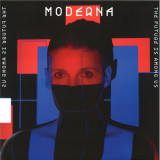
Moderna Ignites the Dance Floor with Debut Album "The Future Is Among Us"
Conceived over seven years in Berlin and Mexico City, "The Future Is Among Us" is a sonic tapestry woven from diverse influences. Each track, produced in a different era, retains its unique character while seamlessly blending into a cohesive album experience.
The album ignites with "DIE4U," a powerful homage to Prince's iconic "I Would Die 4 U." Moderna reimagines the timeless sentiment – entirely self-produced and written in Berlin. Layered vocals, a driving bass line, and a pulsating electro beats that create a controlled yet electrifying atmosphere.
The title track, "The Future Is Among Us," embodies the collaborative spirit at the heart of the album.
Originally conceived before the album was complete, bringing bass lines and a percussive energy that feels like a declaration that the future is not something to wait for, but something we are actively creating together on the dance floor.
The album promises a vibrant blend of electronic and dark wave music, showcasing Moderna's ability to weave together infectious dance floor anthems with deeper, more introspective moments.
This depth is evident in tracks like "Lost at Heart," a collaboration with post-punk artist Skelesys that transcends genre with its raw emotional vulnerability. The album's ability to seamlessly shift
between these contrasting styles is a testament to Moderna's artistry and her ability to curate a cohesive listening experience that invites a provocative energy.
Moderna’s impressive career extends beyond this album. Beyond her solo work, she has showcased her remixing talent on tracks for The Matrix 4 soundtrack and Curses' Next Wave Acid Punx compilation, collaborated on four EPs with Mexican artist Theus Mago who also contributes to the album on the dream wave serenade “Blades”.
The album will be released on her ‘Brave New Rave’ imprint which she established in 2019 from her highly recognized radio show on KCRW Berlin.
Search:controlled
The AT-LP140XP fully manual professional DJ turntable features a high-torque direct-drive motor and anti-resonant, mass-damped, die-cast aluminium platter to ensure stable, on-axis rotation at 33-1/3, 45, and 78 RPM. It is equipped with an S-shaped tonearm with height adjustment, adjustable tracking force (counterweight) and adjustable dynamic anti-skate control.
Audio-Technica has been a leader in phono cartridge design for more than 50 years, and that expertise shows in the durable, high-output AT-XP3 DJ cartridge with 0.6 mil conical bonded stylus included with the turntable. It comes pre-mounted to an AT-HS6 universal ½"-mount headshell.
Designed to connect to components with a dedicated phono input, the turntable comes with a detachable dual RCA output cable which supplies a strong 5.5 mV phono output.
Additional professional features include a start/stop button; forward and reverse play; selectable high-accuracy quartz-controlled pitch lock and pitch change slider control with +/-8%, +/-16%, and +/-24% adjustment ranges; a stroboscopic platter with speed indicator; a retractable plug-type stylus target light; and a removable hinged dust cover.
Experience high-fidelity audio and professional DJ performance
Direct-drive, high-torque servo motor with speed stabilization
Fully manual operation
Adjustable dynamic anti-skate control
Selectable 33/45/78 RPM speeds
Professional anti-resonance, mass-damped, die-cast aluminium platter with felt mat
AT-HS6 universal ½"-mount headshell and AT-XP3 DJ cartridge with 0.6 mil conical bonded stylus
Balanced S-shaped tonearm with hydraulically damped lift control, height adjustment, and lockable rest
Dedicated phono-level output (5.5 mV)
Stroboscopic platter with speed indicator
Forward/reverse operation and variable pitch control with quartz speed lock
Retractable plug-type target light for easier cueing in low light
Damped base construction for reduced low-frequency feedback coloration
Includes: detachable RCA output cable (dual RCA male to dual RCA male), power cable, 45 RPM adapter, counterweight, felt mat, and removable hinged dust cover
Turntable
Bauart 3-speed, fully manual operation
Motor High-torque DC motor
Antriebsart Direct drive
Geschwindigkeiten 33-1/3 RPM, 45 RPM, 78 RPM
Plattenteller Die-cast aluminium
Red Vinyl
Time has come for Futurepast to release a long format album: Alarm Phase Red - catalogue number FPLP01 - will be the first full-length work from Futurepast founder Davy Vandegaer, appearing here under a new name: Brainwashed Today.
Rooted in a conceptual approach of electronic music, this double LP ranges from industrial ambient to experimental techno. Like an antidote to a twisted reality of controlled screens and mental isolation, Alarm Phase Red uses the raw language of electricity
to reach the core of the machine and sabotage it, reverse its effects by mirroring them. Fighting fire with fire, deflecting the pressure and strain of a world driven by fear and anger, the music of Brainwashed Today acts like a cathartic escape from technological enslavement.
With the purchase of the vinyl comes a batch of three digital bonus tracks pursuing further the sound research of the album.
- A1: Computer Controlled Future 4 33
- A2: Church Of Algorithm 2 34
- A3: Post Human 4 02
- B1: Chaos Computer Club 4 31
- B2: Neuronet 4 28
- B3: Deep Space 5 15
- C1: You Can Only Go Forward 4 28
- C2: Cheerleaders Are Eating Flesh 5 27
- C3: Other Places 4 26
- D1: Deep Space (Cignol Remix) 4 56
- D2: Post Human (Lloyd Stellar Remix) 4 48
- D3: Church Of Algorithm (Heinrich Dressel Remix) 4 54
2024 Repress
What if Kraftwerk's "Computer World" had a more dystopian message? Then you would get this album: "Control Paradox" by T/Error. This double 12 inch vinyl is filled with Kraftworkian moments, but is more updated to our current times. Today computers, smart phones, AI and algorithms have taken over our daily lives. This release features 9 original tunes and 3 remixes by none other than: Cygnol, Lloyd Stellar and Heinrich Dressel. The track "Cheerleaders Are Eating Flesh" is a homage to the legendary maestro I-F and his cult hit: "Space Invaders Are Smoking Grass".
‘Gentle Persuaders’ is the Love Love debut from London based neo-noise-jazz outfit Sly & The Family Drone. In the form of a four track long player, Sly vomit forth a smooth serving of curious and clattering noise not devoid of fun.
With the ingredients of shattering baritone saxophone, splurges of analogue noise, rolling drum derangements and snarling feedback it is immediately clear that these formidable noise-mongers have honed their methods of ear-attack adeptly. Textural spaces are peppered with bouts of densely packed controlled-chaos creating a tension that builds almost imperceptibly until the crushing pay-off that comes with the final track.
The politest of bludgeonings, ‘Gentle Persuaders’ has a real sense of cohesion and style, at times subtle and at others shudderingly direct.
With their unusual and interactive live shows, the group cut their teeth stunning the audiences of punk and noise scenes across the UK and Europe. Now, Sly & The Family Drone present their most complete recording to date; a rush of sheer ataxia ushering in a new age of noise.
Oliver Rosemann is a DJ and producer from Leipzig, who has been active since the 90’s. During this time, he has made his experience with timeless techno exactly in the time of its creation, which can be seen later in his productions and DJ Sets.
In the Leipzig scene he played numerous live sets in the early 2000s, including at the 1040, one of the legendary clubs of the time. Increasingly, he began to show himself in public not only as a pure live act but also as a track producer. With the collaboration with MasCon called "dualit" he had first big releases on labels like Earwiggle, CLR or Fith Wall Records and also international gigs e.g. in Antwerp.
To date, there are close to 180 tracks and remixes, including 3 LPs, released on labels such as MindTrip, MORD Records, Warm Up Recordings, Pole Group, Stockholm LTD and many more. Pfirter and Oliver started producing together in 2019 and presented their first joint 4 tracker “Alpha EP” in 2020 on MindTrip Music.
Whether as a live act or as a DJ, he knows how to create a dark, driving, ecstatic atmosphere on dance floors. He has already proven this in clubs like Tresor Berlin, Distillery, Institut für Zukunft, About Blanc and also in other countries in Europe. Numerous podcasts recorded by him or live cuts from parties, which were released over the years by renowned crews such as "Reclaim Your City" or "Staub", show this.
And now follows Oliver’s next release on NEXT DOOR with the ND006. The a side is Olivers side with A1-Surface- a track with deep impact and to dance. A2-your highscore- is Olivers remix, grandiosely interpreted to immerse yourself in the universe of patterns. The B side belongs to TC/CM or written out- the computer controlled minds. B1-your highscore- comes in the original danceable and playful at the same time from the turntable. B2-Surface- remix by TC/CM hammers through the PA straight onto the floor.
ғᴏʀ ᴛʜᴏsᴇ ᴡʜᴏ ʙᴜʀɴ ᴛʜᴇ ᴄᴀɴᴅʟᴇ ᴀᴛ ʙᴏᴛʜ ᴇɴᴅs. Four prime cuts of summer party techno. Already being played by some of your favourite DJ’s like: MARRØN, Cleric, Daria Kolosova, Funk Assault (Chlär & Alarico), Phil Berg, Yanamaste, Lobster, Faster Horses, Nastia, Bailey Ibbs, Alex Nantaya, Albert Zhirnov, Beste Hira, Seretide, Erik Burka, VSC, Gonzo MDF, Boris, Dax J, Gareth Wild, SLV, Stephanie Sykes, Juri Heidemann, ANNĒ, Chontane, Desroi, Slam
An-i is the alias of Berlin-baseyd Korean-American Doug Lee, an artist with over two decades in the game already under several different monikers. This is the third EP to come under this name since debuting it in 2015 and finds him in an even more bold and adventurous mode than ever. Opener 'Rabble' is controlled techno chaos, a flurry of whirring machines and unrelenting drums that will frazzle your brain. 'Rubble' is just as intense, a big wall of rusted synth work and industrial noise mangled into something rhythmic and futuristic. 'Chapel Perilous' on the flip then offers up a spaced-out journey deep into the inner psyche. A welcome return from a truly singular artist that comes on fluorescent yellow wax.
Martinesque started his nighttime adventures with tasteful house records towards the tail end of the nineties. Inspired by the deep explorations of Chicago and New York stalwarts, he’s found pleasure in playing out low-slung grooves and stripped-back entries from all corners of electronic music. Since, the Basel native has honed his craft in clubs around the country and beyond. Methodically stitching together records from his vaults, Martinesque escalates from meditative rhythm workouts to subdued dancefloor drama in a controlled fashion.
He’s developed his artistic vision through residencies in some of Switzerland’s most cherished spaces, but nowadays found his spot as Elysia’s head of bookings, where he’s since showcased a full-spectrum analysis of contemporary dance music.
His most recent endeavour is Adam’s Bite, a cross-disciplinary cooperation zoning in on oblique music and visual arts, further cementing his position as a driving figure in a thriving scene.
After the recent Experiments re-issue with 90's off-style unclassifiable tracks composed by the legendary Dub producer - The Disciples - Androo (NS Kroo) sets out to re-create and freely adapt this material. The fact that Sound Metaphors chose Androo to re-construct these works in to new material is not random. Androo has been producing Dub since he was a teenager but he quickly turned to all kinds of musical experiences, mixing styles and influences. Once past the intimidation of working with material from one of his favorite and revered producers, Androo tried to pay homage to the free spirit that this Disciples album contains. Between reference and irreverence, the album is woven with a playful, DIY, and also serious weave. As you listen, a sometimes very harmonious and controlled landscape takes shape, then suddenly steep slopes and raw ridges appear. Almost like an art of sound drawing. A line in permanent oscillation between supposedly antagonistic registers. Danceable pieces cut for dancefloor brush against strange, problematic, and voluntarily irrecoverable elements. Consensual pop chords rub shoulders with sizzling blurred contours and sounds that are sometimes too loud. 4/4 rhythms get jackhammered out of the tempo with opulent delay effects. The “Dubmix” is here, constantly at work. It is, above all, an art of the hands, fingers handling the console which from then on becomes an instrument in its own right - for Androo Dub is experimental music.
It’s difficult to describe Partiboi69’s sound; words feel subordinate to the energy and personality he presents. This personality bleeds into his sound, as seen with his latest EP ‘Naughty By Nature’, in which the Aussie enigma brings born boundary-breaker MCR-T into his ‘naughty’ nirvana.
Bridging the gap between Techno, Hip-Hop, Trance, Booty House, and a further multitude of other genres, MCR-T is, like his partner in crime for this EP, Partiboi69, equally difficult to categorise: a compliment that few modern artists can claim. His pioneering mentality makes him a perfect fit for Mutual Pleasure; a label that bulldozes genre boundaries for fun.
From the sweet, funk-infused bassline of ‘Go To my Show’, to the devilish ‘Blow My High’, to the wildly outlandish anthem ‘Sex In The Club’, and ultimately the brazen ‘Get Freaky’, every track within ‘Naughty By Nature’ has a mind of its own, and its own unique character.
To partner the infectious production of each track, both Partiboi69 and MCR-T flex their muscles with vocal work, as the pair masterfully manipulate the microphone to create a dynamic element to their sound; one that is totally controlled by the devious double act.
Despite their differences, each track shares a common ancestor in Partiboi69 and MCR-T: mischief, rebellion and exuberance are deeply embedded into their DNA, and consequently, these qualities characterise the overall personality of this EP.
- A1: Il Principe Delle Modificazioni
- A2: Il Respiro Si Blocca
- A3: Il Castello (Dedicato A F Kafka)
- A4: La Notte È Piena Di Echi
- A5: Madame Edwarda Parte 1
- A6: Madame Edwarda Parte 2
- A7: L’uomo È Morto
- B1: Spiragli In Spazi
- B2: L’isola Nuda
- B3: Un Passo Precipitato
- B4: Effigi Inquietanti
- B5: Al Dio Ignoto
- B6: Potrebbe Dire Il Tipografo Hans
- B7: Contenta Dei Deserti
From a research work started in full lockdown three years ago, finally sees the light (or darkness) Echi Senza Fine, a remastered collection of sound material by Tasaday. Inspired by the controversial media story in 1971 of the discovery of a tribe in the Philippines that apparently had technology that had stood still in the Stone Age, the project officially borrows the name Tasaday in 1984 from the evolution of Nulla Perreale, in turn union of Die Form (musical part) & Orgasm Denied (performative part).
To put it in the words of Marcello Ambrosini, the Tasadays find in Die Form the controlled destruction of the form after its careful design and construction, while in Nulla Iperreale the spontaneity free from any possible superstructure. They declare themselves new primitives, not in the perspective of a nostalgic return to a pre-industrial or prehistoric external world, but in the exception of an inner experience in stark contrast to the leviathan of the single utilitarian thought that has dominated the West for centuries.
Their production-action does not allow itself to be tempted by the repetitiveness used by many industrial groups of those years, thus resulting seminal in the evolution of the scene. Their impulse to go further and not remain caged in the format of the new wave is witnessed by their particular sound vocabulary that sees, along with the use of conventional instruments, the use of DIY tools such as Chopper Vox and highly sui generis tools, like the Camolofono, cariole loaded with sheets, stones, tubes, chains and “garbage” of various shapes and sizes.
A discography dotted with primordial electronic experiments that reaches the new millennium through several vinyl records and an endless number of cassettes. From this undefined and mysterious number of tapes that is born Echi Senza Fine: 14 tracks (+ 2 digital bonuses) remastered, collected by Asymmetrical, who also edited the release insert, a collage of visual and textual material from their fanzines. A series of 300 transparent vinyl + Insert.
Bernard Szajner is a French composer, musical theorist, visual artist. He is credited with the invention of the laser harp, which he patented.
Between 1979 and 1983, Szajner released five albums of innovative and Avant-garde electronic music. He became renowned as a light and visual effects technician with artists such as Magma, Gong, Stomu Yamashta and The Who.
During the 1970s, he became a pioneer in the field of using laser technology as an artistic tool. As a measure of his success, he became renowned by his work with companies such as Cartier and Renault. In 1980, inspired by the novel, Nova, by Samuel R. Delany, he first created the laser harp. The laser harp became so successful that Jean-Michel Jarre ordered a version from Bernard Szajner for his tour of China. Despite all this, Szajner would only occasionally use this instrument in his own performances. He has stated that he would rather the public not know him solely for his work on the laser harp, and that it not be allowed to take precedence over his work in musical composition that it enables. This is also why he continues to develop other instruments which use other innovative methods of interaction, such as tactile or holographic.
Towards the end of the 1980s and disgusted with the music industry, he chose to abandon music entirely, and shifted his focus towards digital and visual arts, and theatre.
From Bernard Szajner : “These tracks are my preferred ones .... Ever ! ... For a long time I've been waiting for a record label to release what corresponds to what I like playing these days... Until Sleepers records decided to release this compilation which contains most of the tracks I enjoy playing live on stage ! At last my wish is fulfilled !”
Some records just stop you in your tracks. They resonate with you and feel instantly familiar like an old friend, even on the first listen. SOYUZ's third album ‘Force of the Wind’ is one of those records. It holds all the trademarks, beauty, and eccentricities of classic Brazilian recordings, from the 60s and 70s, that we have come to love. Think artists such as Milton Nascimento, Lô Borges, Burnier e Cartier, Arthur Verocai et al. But this record wasn’t made in Brazil and is in fact a brand-new release.
SOYUZ (which translates as 'union') is a creative collective from Minsk, Belarus, led by composer, arranger, and singer, Alex Chumak, multi-instrumentalist, Mikita Arlou, and drummer, Anton Nemahai. SOYUZ's previous albums explored and reimagined the legacy of jazz-oriented, non-English-language pop music of the 20th century. For their third album, there is a stronger focus, and it is influenced by 70s Música popular Brasileira and building bridges from it to present-day Belarus. Alex notes that from the moment he first encountered Brazilian music, he found in it a kind of concentrated emotion that felt as if it were familiar to him from his childhood. This non-verbal emotion and connection between the listener and musician echoes in the music, regardless of understanding of the language the album is recorded in.
‘Force of the Wind’ includes songs sung in Russian and Portuguese as well as instrumental compositions. Its musical palette is both acoustic and electroacoustic: rich warm Rhodes piano, soaring string arrangements, and a controlled drum swagger sounding both relaxed yet super tight. Alongside Alex's sublime vocals, that grace the majority of the tracks, the album features guest performances by multi-talented musician and vocalist Kate NV and rising Brazilian star, Sessa. Alex also recently arranged a number of tracks on Sessa's highly praised 2022 album 'Estrela Acesa'.
On the album, the trio is joined by a cast of friends; NY-based musician of Turkish origin percussionist, Cem Mısırlıoğlu, classically trained composer, Simon Hanes, who aided with string arrangements and conducting the string players, Netherlands-based Brazilian multi-instrumentalist, Gabriel Milliet, on flutes. With the collaboration of these friends SOYUZ have created nine songs/suites that are subtle and plenitude and like the best albums, leave you aching for more.
‘Force of the Wind’ is an enigma, Brazilian yet not Brazilian, vintage yet still contemporary, out of sync with modern culture yet completely relevant and necessary.
Black Vinyl
Time has come for Futurepast to release a long format album: Alarm Phase Red - catalogue number FPLP01 - will be the first full-length work from Futurepast founder Davy Vandegaer, appearing here under a new name: Brainwashed Today.
Rooted in a conceptual approach of electronic music, this double LP ranges from industrial ambient to experimental techno. Like an antidote to a twisted reality of controlled screens and mental isolation, Alarm Phase Red uses the raw language of electricity
to reach the core of the machine and sabotage it, reverse its effects by mirroring them. Fighting fire with fire, deflecting the pressure and strain of a world driven by fear and anger, the music of Brainwashed Today acts like a cathartic escape from technological enslavement.
With the purchase of the vinyl comes a batch of three digital bonus tracks pursuing further the sound research of the album.
Repress
Rising Dutch talent Deniro (aka Reynier Hooft van Huijsduijnen) returns to with a
double EP of original works. The Tape Records member previously appeared on the label as part of the concept albums.
'Mendoza' is an 8-track quest into the spheres of polarity and tension. Anxious distortions jitter in controlled spaces, angular melodies disfigure warm tones and frenetic cross rhythms flutter through minimalist forms. Contrasting messages are weaved together with precision to facilitate a dialogue where dancefloor function and cerebral stimulation interact.
Deniro navigates his way round vintage gear with a meticulous accuracy, held together by an intuitive ear for timbre, an ingrained passion for Detroit soul, and a firm understanding of sonic balance.
"Deniro is able to transmit emotion in his music like no other. His soft spoken live cuts are sparse and trippy and you can always feel that it's Reynier behind them' - Nina Kraviz
Longtime friend of the label Eraserhead returns after over a decade away from producing music due to his surreal MS Paint work as 'Jim'll Paint It' becoming an unexpected cultural phenomenon. With his debut full-length, 'Violence', Eraserhead presents a truly eclectic electronic LP featuring collaborations with established producers such as Om Unit, Enduser, and Brain Rays, as well as the vocal talents of Nadia Rose, Beans (of Antipop Consortium), and Cadence Weapon. An album held together by theme and tone rather than style or tempo, 'Violence' is the culmination of a bitter wave of inspiration, initially conceived in the wake of a personal tragedy that quickly grew into a broader polemic about the state of the world.
Originally linking up with Love Love in its breakcore netlabel infancy with his refined, breaks-heavy breakcore/gabba, Eraserhead's flair for tight, intricate productions was evident in his finely tuned tracks of controlled chaos. This time around, his work is a darker, more expansive evolution of his sound, with the scale upsized and the stylistic scope massively broadened, remaining unfaithful to any single genre, but with firm nods to Breakcore, Grime, Drum & Bass, Techno, Rave, Dubstep, and Footwork, all chewed up with a hard industrial edge and cinematically framed by a backdrop of apocalyptic synths.
Opening with the cold tech-noir of 'Shining Brainless Beacon' to set the tone, the album quickly locks in with the blistering spoken-word headrush of 'Hurricane With Teeth' alongside rapper Beans, before Om Unit lends his expertise on the sharp groove and clinical bass blasts of 'Operation Hardtack'. The album shifts and morphs constantly throughout the runtime, moving from the raw and urgent acid techno of 'Crowd Control' to the crunching military march of the Gore Tech collaboration 'No More Worlds' and the tribal sci-fi footwork of the Brain Rays collaboration 'Night Visions'. 'Monolith' provides a final burst of catharsis, channelling Underworld by way of Nine Inch Nails, complete with writhing screams from Amée Chanter of sludge-punk-noise-rock duo Human Leather, before the heart of the album is laid bare with the painfully bleak closing dirge of 'Animal'. In its final moments, 'Violence' leaves the listener suspended between devastation and awe - an unflinching portrait of an uncaring world.
Âsan’s second EP Go Nuclear is an eruption. This four-track follow-up stands as the aftermath — the exhale after prolonged internal pressure.
Side A unfolds inward. Two tracks built for the mind — hypnotic, immersive, almost dissociative in their pull. The opening piece, Picktooth, is a slow-burning ascent. It builds in increments — pressure accumulating in cycles.The impact feels intangible rather than physical. Gradual pressure and tension that keeps rising, rhythm locking you into a state that feels almost uncomfortable, but controlled.
2025 Reissue.
Münchenbuchsee, a suburb of Bern, Switzerland. Stephan Eicher is the youngest of three children. His father, a radio and TV repairman, is also a jazz violinist and a sound tinkerer in his spare time. In the family home's converted fallout shelter turned studio, Mr. Eicher experiments with homemade sequencers, tortures handcrafted drum machines, and abuses reel-to-reel tape recorders—all under the fascinated gaze of young Stephan.
The boy quickly develops a musical curiosity, exploring sound through various experiments and wanderings. Alongside his younger brother Martin, Stephan crafts audio plays on a homemade multi-track recorder (essentially several cassette decks hooked together!), which they write, record, add sound effects to, and perform for family and friends. Just a couple of nice kids, really...
Then comes 1972, and Lou Reed's Transformer album changes everything for the Eicher kids. For 13-year-old Stephan, it's a revelation—especially "Vicious", the opening track, which he plays on repeat for months. He convinces his father to buy him an electric guitar. Not stopping there, his father also builds him a tube amp using an old radio.
Then comes adolescence. A rough one. Stephan leaves home at 16 and moves to Zurich. With obvious artistic talent, he persuades his art teacher to help him get into F+F, a radical, alternative art school—despite his young age. Accepted, he starts learning video techniques, determined to become a filmmaker.
At F+F, Stephan organizes Dada-style happenings and concerts with a group of friends known as the Noise Boys. Among them: one of his teachers on bass, Veit Stauffer on drums (who would later found ReR/Recommended Records), his girlfriend Sacha on vocals, and Stephan on guitar. In one of their early performances, they release a remote-controlled mouse covered in dull razor blades into the audience to create panic and chaos. Keeping with this aggressive, confrontational spirit, they once played a concert while wearing headphones blasting Tristan and Isolde, trying to perform their own songs simultaneously—to maximize the cacophony. The goal was always the same: clear the room.
Their “songs,” if you can call them that, followed suit. Take "Hungeriges Afrika", for instance—performed entirely with power drills and some drum feedback.
To make ends meet, Stephan returns to Bern on weekends to work as a waiter at the Spex Club, the city’s main punk venue. On September 16, 1980, during a show by proto-electro group Starter, the police raid the club and arrest everyone. Stephan, who manages to avoid arrest, seizes the opportunity to “borrow” Starter’s gear left behind. He suddenly finds himself in possession of a Roland Promars synth, a Korg MS20, and a gorgeous CR78 drum machine, which he runs through a Big Muff distortion pedal to get that perfect gritty sound.
He then sets out to reinterpret some Noise Boys tracks, reworking them during impromptu sessions recorded on a dictaphone (yes, a dictaphone—now the lo-fi sound makes more sense, doesn’t it?). He ironically titles the resulting cassette "Stephan Eicher spielt Noise Boys" ("Stephan Eicher plays Noise Boys"). This gem features seven tracks, which are the ones reissued here.
Back in Zurich, he visits his friends Andrew Moore and Robert Vogel, who have a DIY cassette duplication setup. They make 25 copies of Stephan Eicher spielt Noise Boys for Stephan and his friends. Robert encourages him to visit Urs Steiger of Off Course Records and play him the tape.
Without much hope, Stephan shows up at Urs’s office. But Urs is instantly hooked and suggests releasing a 7” single. Due to space constraints, they reluctantly drop two of the seven tracks ("Hungeriges Afrika" and "One Second"). As for the musical score featured on the cover—it was randomly chosen and remains a mystery to this day. Calling all music theory nerds!
The 7-inch is pressed in 750 copies and released in the first week of December 1980—a date Stephan remembers well, as it’s the same week John Lennon was killed. Smartly, Urs sends a promo copy to François Murner, Switzerland’s answer to John Peel, who hosts a show on alternative station Sounds. Murner falls in love with the record and starts giving it airtime. To Stephan’s surprise, sales follow—and people actually seem interested in his music.
Even this modest underground success scares Stephan a bit. He stops making music for a year and moves to Bologna, where he works as a programmer at Radio Città, a feminist radio station.
Meanwhile, Stephan’s younger brother Martin, who’s also involved in the punk scene, joins the band Glueams as a singer and guitarist. Glueams, named after the fanzine run by two of its members (drummer Marco Repetto and bassist GT), eventually rebrands as Grauzone. Stephan is invited to their shows to project hacked Super 8 visuals live on stage.
Urs Steiger, now working on a compilation titled Swiss Wave – The Album, asks Grauzone to contribute alongside bands like Liliput, Jack and the Rippers, The Sick, and Ladyshave (Fall 1980).
For the album, Martin tasks Stephan with producing their recording sessions. Under Stephan's artistic direction, two tracks emerge: "Raum" and "Eisbär". During "Eisbär", Martin plays a minimalist bass line borrowed from post-punk band The Feelies (just an open string). Drummer Marco Repetto struggles to keep time. Later that evening, unhappy with the takes, Stephan builds a four-bar drum loop from a ¼-inch tape and uses it instead of the flawed original. He then adds bleepy synths and wind sounds to complete the track’s icy vibe before handing it over to Urs.
The Swiss Wave – The Album compilation is released quietly at first, but things snowball thanks to "Eisbär", which eventually becomes a smash hit—selling over 600,000 singles.
Meanwhile, Stephan plays in a rockabilly band called SMUV (named after Switzerland’s social security agency) and begins producing artists, including the debut album of Starter (1981), which includes a more pop-oriented version of "Minijupe".
By early 1982, Stephan starts spending time with the post-punk girl band Liliput (formerly Kleenex). They’re older than him, and he happily drives them around in his Renault Major, acting as their roadie.
By 1983, Grauzone—signed to the major label EMI, which turned out to be a misstep—is falling apart. Stephan begins to pivot toward a more mainstream pop sound with his debut solo album Les Chansons Bleues.
But that... is already another story.
Longtime friend of the label Eraserhead returns after over a decade away from producing music due to his surreal MS Paint work as 'Jim'll Paint It' becoming an unexpected cultural phenomenon. With his debut full-length, 'Violence', Eraserhead presents a truly eclectic electronic LP featuring collaborations with established producers such as Om Unit, Enduser, and Brain Rays, as well as the vocal talents of Nadia Rose, Beans (of Antipop Consortium), and Cadence Weapon. An album held together by theme and tone rather than style or tempo, 'Violence' is the culmination of a bitter wave of inspiration, initially conceived in the wake of a personal tragedy that quickly grew into a broader polemic about the state of the world.
Originally linking up with Love Love in its breakcore netlabel infancy with his refined, breaks-heavy breakcore/gabba, Eraserhead's flair for tight, intricate productions was evident in his finely tuned tracks of controlled chaos. This time around, his work is a darker, more expansive evolution of his sound, with the scale upsized and the stylistic scope massively broadened, remaining unfaithful to any single genre, but with firm nods to Breakcore, Grime, Drum & Bass, Techno, Rave, Dubstep, and Footwork, all chewed up with a hard industrial edge and cinematically framed by a backdrop of apocalyptic synths.
Opening with the cold tech-noir of 'Shining Brainless Beacon' to set the tone, the album quickly locks in with the blistering spoken-word headrush of 'Hurricane With Teeth' alongside rapper Beans, before Om Unit lends his expertise on the sharp groove and clinical bass blasts of 'Operation Hardtack'. The album shifts and morphs constantly throughout the runtime, moving from the raw and urgent acid techno of 'Crowd Control' to the crunching military march of the Gore Tech collaboration 'No More Worlds' and the tribal sci-fi footwork of the Brain Rays collaboration 'Night Visions'. 'Monolith' provides a final burst of catharsis, channelling Underworld by way of Nine Inch Nails, complete with writhing screams from Amée Chanter of sludge-punk-noise-rock duo Human Leather, before the heart of the album is laid bare with the painfully bleak closing dirge of 'Animal'. In its final moments, 'Violence' leaves the listener suspended between devastation and awe - an unflinching portrait of an uncaring world.